TPP’s Greatest Hits, Track III: Napoleonic Christmas

After MAGAWeek2023 and my extended time out of town, I’ve decided to take this week to rerun some classic hits from the extensive TPP back catalog.  Most of the posts are those with very high view counts, though I am presenting them in no particular order.  TBT will proceed as usual, and regular posts will resume Saturday, 15 July 2023.

With that, here is 23 December 2019’s “Napoleonic Christmas“:

Read More »

Monday Morning Movie Review: Bloody Oranges (2021)

I’m not typically one for “trigger warnings,” but this week’s film is hard to watch.  I’ve seen some pretty foul stuff in all the crappy B-grade horror flicks I consume, and I have, perhaps sadly, become immune to most shocking material.  Just writing that sentence made me feel convicted… dang.

But my crushing Pentecostal guilt can wait until after this film review.  This flick, the 2021 French black comedy Bloody Oranges (or Oranges sanguines in French) possesses some truly difficult scenes to endure.  I found myself watching through my fingers at a couple of points in the film.

It’s an incredible movie, a movie I will heavily discourage most readers from watching.  My parents, my aunts, Audredon’t watch itRead some reviews if your curiosity is piqued, but don’t watch itPonty, you could probably handle it, even though I know how much you hate the frogs.

Read More »

Monday Morning Movie Review: Calvaire (2004)

When I was young I thought that life was so wonderful that foreign films were snooty, arthouse affairs, the kinds of flicks pretentious people only pretended to like in order to look sophisticated.  That’s probably true of some foreign films (and most modern art in general), but I’ve found that the opposite is frequently the case.  Some of the best movies I’ve watched lately were foreign films.

Koreans and Spaniards (of various derivations) make some of the best films.  Much to my surprise and delight, the French make some excellent films, too.

To be clear, some of the crappier stuff I’ve seen have been pretentious French flicks.  My beloved Shudder has a whole collection of French films that are, let’s say, experimental garbage.

But the frogs do get some things right now and then.  One of those is 2004’s Calvaire (alternatively Calvary or The Ordeal).

Read More »

The Boogie Woogie Flu

Don’t let the title of today’s post fool you:  I’m not going to write about the coronavirus today.  I’m actually enjoying the relative freedom and flexibility of distance education, sipping car dealership coffee while I wait for my 2017 Nissan Versa Note to get a transmission flush and a belt and some wheel bearings replaced, all with appropriate social distance between me and the other people getting their cars fixed.

But in these plague-riddled times, I couldn’t resist this charming little Quora post about another, funkier plague:  the Strasbourg “Dancing Plague” of 1518.  Not that there’s anything charming about dancing yourself to hell, but it sounds a lot more fun than cloistering alone in your house for two weeks.

Read More »

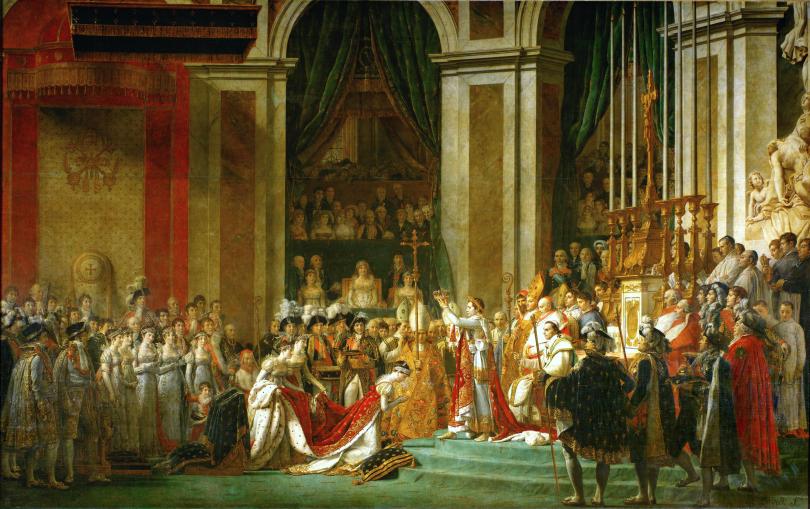
Napoleonic Christmas

It’s Christmas Week!  And what a glorious week it is.  It’s been raining persistently in South Carolina since Sunday morning, but I’m enjoying the coziness of the hygge—warm coffee and lazy reading.

PragerU had a little video up this morning from historian Andrew Roberts about Napoleon.  It’s an interesting take on the not-so-short French emperor—an apologia, really (for those that prefer reading—as I often do—to watching videos, here is a PDF transcript).

Roberts argues that Napoleon was not the necessary precursor to Hitler, et. al.; rather, Napoloen was “sui generis“—a man unto himself.  While I believe the ideas of the French Revolution did unleash the totalitarian forces of Hitlerism, Stalinism, Maoism, and all the rest—a murderous, bloody Pandora’s Box—I’ve never considered Napoleon among their ranks.

Read More »

TBT: The Bull on the Roof

It’s been a cheery, musical mood here at The Portly Politico.  I’ve been tearing through popular Christmas carols, offering up some histories of these beloved tunes, as well as a little musical analysis.  Thanks to Milo sharing my piece “Milo on Romantic Music,” I enjoyed a large surge in traffic that has now settled into a nice daily trickle (nothing huge, but it’s helped).

University of Chicago medievalist Rachel Fulton Brown also linked to the post in a piece on her blog, Fencing Bear at Prayer.  The success of that piece, plus the beauty of Christmas music and the general cheeriness of the season, has inspired me to write more about music.

This week, then, I’ve cast back to this summer, when I wrote a little piece about a whimsical piece of modern classical music, “The Bull on the Roof.”  As I recall, I wrote the piece on my phone—never ideal—while playing with my little niece.  I’d heard the tune on public radio on the drive to my parents’ house, and was so taken with its charm—and lacking any other suitable topic, or the proper conditions to write about them—I jotted out this short piece.

“The Bull on the Roof” is a marvelous example of modern classical music.  And for all I rail against cosmopolitanism, it’s a fine example of the ideal of cosmopolitanism:  a French composer celebrating the vibrant, lively traditions of Brazilian folk music.  That’s the “salt in the stew,” as John Derbyshire calls it—the pinch of cultural diversity that makes the broth more delicious.

Yesterday was spent teaching History of Conservative Thought, painting a classroom floor, and rushing around the Pee Dee region teaching four music lessons, before finally heading out of town for a few days. Needless to say, there wasn’t any time to get a post ready for this morning.

The news has also been light. The first round of Democratic presidential primary debates is tonight, but who cares other than the candidates?

There was a bit of a diplomatic imbroglio with Iran last week, but did anyone really think war was going to break out? Trump handled it Trumpishly; that is effectively, letting the mullahs sweat it out a bit before giving them an out (and signalling to Iranians that he cares more about their lives than the Ayatollah).

That’s why I’ve been sticking to the history and culture posts lately. There just hasn’t been much to say on politics, because there’s so much good happening. Illegal immigration is still a major problem, but otherwise the only “bad” news is that the economy is still growing, just not as quickly as a year ago.

So, brace yourself for another self-indulgent post (this publication is a blog, after all). While driving last night, I hit a classic rock and talk radio dead zone, so I resorted to public radio. I was pleasantly surprised.

The program featured a concert recording of the Greenville (SC) Symphony performing French composer Darius Milhaud’s delightful “Le Bœf sur le toit,” or “The Bull on the Roof.”

Fans of Civilization VI who have played as Brazil will hear some similar themes and styles, as the composition quotes dozens of Brazilian folk songs. The tune is full of Latin-inspired motifs, and it is a charming, fun piece.

Milhaud wrote the piece in 1920 for a silent Charlie Chaplin film that was never made, though the ballet has apparently been staged. I particularly enjoy these kinds of jaunty, popular modern classical pieces (I adore Gustav Holsts’s The Planets because they are pleasing and interesting, but never pretentious). If I’m going to listen to something for nearly twenty minutes, don’t make it a Philip Glassian nightmare experiment in purposeful atonality.

If you have twenty minutes, I highly recommend listening to this piece. It will be a more enjoyable use of your time than watching the Democratic debates.

SubscribeStar Saturday: O Holy Night

Today’s post is a SubscribeStar Saturday exclusive.  To read the full post, subscribe to my SubscribeStar page for $1 a month or more.  For a full rundown of everything your subscription gets, click here.

The unofficial theme of the blog this week has been Christmas music.  What better way to cap off the week than with a post about the best Christmas song ever written, Adolphe Adam’s “O Holy Night“?

Like its cousin “Silent Night,” the story of “O Holy Night” involves a village’s church organ.  In 1843, the church organ of the French village of Roquemaure had recently been renovated, so the parish priest asked a local wine merchant and poet, Placide Cappeau, to write a poem to commemorate the occasion.  That poem, “Cantique de Noël,” would be set to music a short time later by composer and music critic Adolphe Adam—and Christmas history would be made.

To read the rest of this post, subscribe to my SubscribeStar page for $1 a month or more.

Lazy Sunday XXVIII: World History

Most of my pieces here at The Portly Politico focus on American politics and culture, with some occasional dabbling in British and European affairs.  But contrary to Ron Swanson’s historiographical claim, history did not begin in 1776 (though everything that came before may have been a mistake).

As such, I’ve written a few pieces about events, current and historical, that take place in more exotic locales.  While I am a parochial homebody, I appreciate travel and the contributions of other cultures (I still wish I’d seen London and Paris before they became part of the Caliphate).  I wish I had the time to do more of it (on that note, stay tuned for details of my trip to the Yemassee Shrimp Festival).

So, here’s some worldly pieces for your Lazy Sunday:

  • North Korea Reflections” – I wrote this little piece on the occasion of President Trump’s historic summit with North Korean dictator Kim Jong-un in Singapore.  My interpretation of the summit was cautiously optimistic.  It’s still unclear what the future holds for US-Nork relations, but the gambit seemed to work—North Korea is a still a bloodthirsty, repressive, totalitarian regime, but they aren’t lobbing missiles around constantly anymore.
  • The Impermanence of Knowledge and Culture:  The Great Library and Notre Dame” – this post was a synthesis of two events—the destruction of the Great Library at Alexandria, and the burning of a substantial portion of the Notre Dame Cathedral.  The fire at the latter riled up conservatives and traditionalists because the structure had endured for so long as a symbol of Christianity and of France’s faithfulness.  France is not a very faithful country now, but Notre Dame remains a powerful symbol of man’s capacity for focusing on the greatness of God.  The major point of this piece was to drive home how even great edifices eventually crumble, and that knowledge and culture must be preserved actively if they are to endure.
  • Sri Lankan Church Bombings” – coming on the heels of the catastrophic Notre Dame fire, the island nation of Sri Lanka was shaken on Easter Sunday of this year with Islamic terrorist attacks on churches.  Democrats referred to the slain Christians as “Easter worshippers” in what appeared to be a concerted effort to appear politically-correct.  Yeesh.
  • America’s Roman Roots” – I wrote this piece earlier in the week, based on an excellent op-ed a colleague sent my way.  Commentators often fixate on the similarities between the United States today and the Roman Empire, but often miss the parallels to the Roman Republic.  Those parallels exist because the Framers of the Constitution pulled heavily from Roman tradition, even naming key institutions like the Senate after their Roman counterparts.  The Roman Republic holds valuable lessons for Americans for how to craft a robust society that enables citizens to live worthwhile lives.

That wraps up this little tour around the globe.  Rome, France, Sri Lanka and North Korea—not a bad start, though I’d better get Africa and Latin America into the mix soon, lest I catch flack from the SJWs for lack of inclusion.

Happy Sunday!

—TPP

Other Lazy Sunday Installments:

The Bull on the Roof

Yesterday was spent teaching History of Conservative Thought, painting a classroom floor, and rushing around the Pee Dee region teaching four music lessons, before finally heading out of town for a few days. Needless to say, there wasn’t any time to get a post ready for this morning.

The news has also been light. The first round of Democratic presidential primary debates is tonight, but who cares other than the candidates?

There was a bit of a diplomatic imbroglio with Iran last week, but did anyone really think war was going to break out? Trump handled it Trumpishly; that is effectively, letting the mullahs sweat it out a bit before giving them an out (and signalling to Iranians that he cares more about their lives than the Ayatollah).

That’s why I’ve been sticking to the history and culture posts lately. There just hasn’t been much to say on politics, because there’s so much good happening. Illegal immigration is still a major problem, but otherwise the only “bad” news is that the economy is still growing, just not as quickly as a year ago.

So, brace yourself for another self-indulgent post (this publication is a blog, after all). While driving last night, I hit a classic rock and talk radio dead zone, so I resorted to public radio. I was pleasantly surprised.

Read More »

The Impermanence of Knowledge and Culture: The Great Library and Notre Dame

On Sunday, blogger and antiquarian Quintus Curtius posted a piece about the famed Great Library at Alexandria.  The Library is considered one of the Seven Wonders of the Ancient War, and its destruction is an event that stands as one of the great cautionary tales of history.

Except, as Curtius points out, it wasn’t a single event.  Historians point to the accidental burning in 48 B.C., when Julius Caesar’s men’s burned Pompey’s fleet, and the flames spread, consuming a substantial portion of the Library’s connections.  Curtius mentions other events that may have damaged the Library, including Emperor Theodosius II’s decree to destroy pagan temples and buildings.

But, significantly, Curtius argues that it was centuries of neglect that destroyed the Great Library, rather than one single, spectacular event.  The burning of the Library in 48 B.C. makes for a dramatic story, but lack of maintenance, poor funding, and corrupt officials, Curtius contends, ultimately destroyed the Library.

To quote Curtius (emphasis is his):

The point is that libraries, like all institutions of culture, must be maintained and refurbished by every generation.  As I see it, the evidence points to a stark truth that tells us much about human nature.  The primary destroyer of the library, and perhaps of most cultural artifacts, was apathy.  How does this happen, in practice?  It is very simple.  It happens the same way official neglect happens today.  A new king or government minister would have said to himself, “I don’t think we need to allocate funds to the Alexandrian Library right now.  I have other priorities.  I would rather spend the money on ships, the army, or my new summer retreat.”  And this is how it starts.

Apathy—a general lack of care and concern for our cultural artifacts—destroys them far more effectively than book burnings.  Death by a thousand insouciant cuts, rather than the dramatic thrust of the sword, causes all things to wither away.

Having read Curtius’s piece (and a podcast related to it, which I cannot now locate), I very much had this topic on my mind when I heard about the tragic fire at the Notre Dame Cathedral on Monday.  I did not realize that the great cathedral is 850-years old.

Let that sink in:  it’s stood for nearly a millennium, surviving the Wars of Religion in France; the Thirty Years’ War; and the First and Second World Wars.  It also survived the French Revolution, which saw many churches destroyed or converted into blasphemous “Temples of Reason” throughout Paris and France.

Notre Dame is a powerful symbol of Western Civilization:  a bold testament of the faith and piety of a once-proud, Christian people.  A civilization that believes in itself and its God builds and maintains an edifice like Notre Dame.

We don’t yet know the source of the Notre Dame fire (at least, I don’t), and I’ve heard and read several explanations, from the careless (a dropped cigarette) to the, if true, quite wicked (Islamic terrorism; to reiterate, I am not claiming this was the cause of the fire, just that I’ve heard it insinuated).

What we do know is that France’s president, Emmanuel Macron, has promised to rebuild the destroyed roof and upper level of the cathedral “in a way consistent with our modern diverse nation.”  I let out a moan of despair upon reading that phrase.

Notre Dame is a not a symbol of a “modern diverse nation,” nor should it be.  The only universalism it embodies is Christ’s universal Love for all of humanity.  Beyond that, it is a symbol of the French people, and of Christendom.  I am not convinced that the “diverse” Maghreb and Bedouin tribesman of the banlieues are deserving of that patrimony.

The West is constantly bending over backwards to accommodate foreign cultures in a show of cosmopolitan hospitality, but the favor is never returned.  Unassimilated migrants and “refugees” don’t deserve architectural “representation” in a building that never would have been built were it not for Charles “The Hammer” Martel.

Knowledge and culture are both one generation away from darkness.  Westerners should understand the deep roots of our civilization, and protect it at all costs.  That means teaching it to our children, and instilling them a love of and reverence for our institutions, culture, and faith.