Guest Post: Brian Meredith: There’s No Such Thing as Bad Art

We have a new contributor here at The Portly Politico, a chap from jolly old England, Brian Meredith.  He’s a graphic designer by trade and is Internet friends with our own senior correspondent, Audre Myers.

In this piece, “There’s No Such Thing as Bad Art,” Brian makes an essentially semantic argument:  if we glorify pieces we like or appreciate as “art,” we conversely consider “bad” pieces as “not art.”  Ergo, we cannot have “bad art” if art is definitionally whatever we define as “good.”

As Brian noted in an e-mail to me:  “I would like to make it clear that my intention was to write something about the use of language rather [than] about art itself and in particular the commonly-accepted assumption that the very idea of art confers status.”

It’s an interesting argument, and one that I think has its merits.  I disagree with the underlying premise, in that we can create things broadly termed “art” that are, indeed, quite poor in quality, either because of aesthetic choices or merely a lack of craftsmanship on the part of the artist.  There can be “art” of varying qualities.

But I think Brian is correct when we look at “art” as a term of social categorization—as a form of judgment.  In that regard, anything that we think is worthy of praise—even if from an objective or technical standpoint it is not very good—could be elevated to the status of “art,” as his argument is that society uses the term “art” almost exclusively as a term of praise.  As such, if enough rubes agree that, say, an ashtray is a work of art, it is merely laudatory “art,” and not “bad art,” which—again—cannot exist in this usage of the word.

That explains why there are plenty of poor craftspeople whose work is lauded as “art” because they are well-connected (as I have written about before on this blog).

Ultimately, this subjective, linguistic/definitional argument results in the kind of postmodern garbage we see coming out of art studios today.  I do not think Brian would agree with the sentiment he points out—he seems to be a diagnostician, not a physician, of this problem—but its existence is certainly real.  As such, because lay persons exclusively use the term “art” in a laudatory context, the result is that we do end up with a great deal of bad art, even if definitionally that’s impossible.

It’s an intriguing semantic argument, but like most semantic arguments, it seems like it too easily devolves into postmodern nonsense.  Again, I don’t think Brian is advocating for that, but is merely diagnosing the problem.

With that, here is Brian Meredith’s “There’s No Such Thing as Bad Art”:

Read More »

Celebrating the Life of a Friend

My friend Jeremy Miles passed away last year after a brief struggle with cancer.  He was a gifted poet, with several self-published volumes before his passing.  I highly recommend his poetic output.

Besides being a great poet and a great friend, Jeremy was a builder of community.  It’s not what you’d expect from a Gen Xer clad entirely in black from head-to-toe, often with a trench coat, always with his signature black hat.  Our mental image of such a figure is a misanthropic outsider, or a socially awkward anime fanboy.

He was neither—well, maybe he was a little misanthropic, but aren’t we all after a certain age?  Regardless, he became an essential part of, and helped to build, a thriving open mic scene in the glorious Before Times, in the Long, Long Ago, before The Age of The Virus.

His longtime girlfriend/common-law-wife hosted a celebration of life/memorial service/birthday party in late January 2024 to celebrate Jeremy’s life and what would have been his birthday.  She wanted it to be an open mic, and I’m sure Jeremy would have approved.

Read More »

SubscribeStar Saturday: SC Bigfoot Festival 2023

Today’s post is a SubscribeStar Saturday exclusive.  To read the full post, subscribe to my SubscribeStar page for $1 a month or more.  For a full rundown of everything your subscription gets, click here.

Last Saturday I attended the South Carolina Bigfoot Festival in Westminster, South Carolina.  The festival is in its fourth year, and it was a bustling, fun event—a good model for how small town festivals should be.

There were some hiccups over the summer, with vendor packets (my own included) getting lost in the mail and the festival’s website disappearing for a couple of weeks.  The event organizers weren’t responding to e-mails, and I thought for awhile that maybe the whole thing had been shuttered.

Fortunately, that was not the case, and the festival organizers got everything working again.  I paid my vendor fee using some Discover Card cashback, and went up to Westminster after school on Friday, 13 October 2023 (spooky!).

My neighbors went up ahead of me, on Thursday, 12 October 2023, and picked up my vendor packet for me during the day Friday.  We stayed in adjacent campsites at Chau-Ram County Park, a beautiful park near waterfalls—and just $25 a night!

I made a critical error, however:  I should have taken off last Friday.  Because I was unable to attend the festival Friday, the vendor organizer put me down a little side street.  I was super close to the main strip, but just far enough away that most folks didn’t even realize my tent was there.

Needless to say, it was not a strong sale’s day.  Indeed, I only sold one painting, to a sweet little girl who loves the Loch Ness monster.  She purchased a painting I’d done of a strange aquatic animal, which she liked because it resembled Nessie.

I shared my vendor spot with the wife my neighbor’s family, and she was selling really cool crochet hats.  I figured she’d do a killing, as the hats were really well done, but she did not make a single sale.

In that regard, the festival was a disappointment.  As for the festival itself, though, it was an absolute blast.

To read the rest of this post, subscribe to my SubscribeStar page for $1 a month or more.

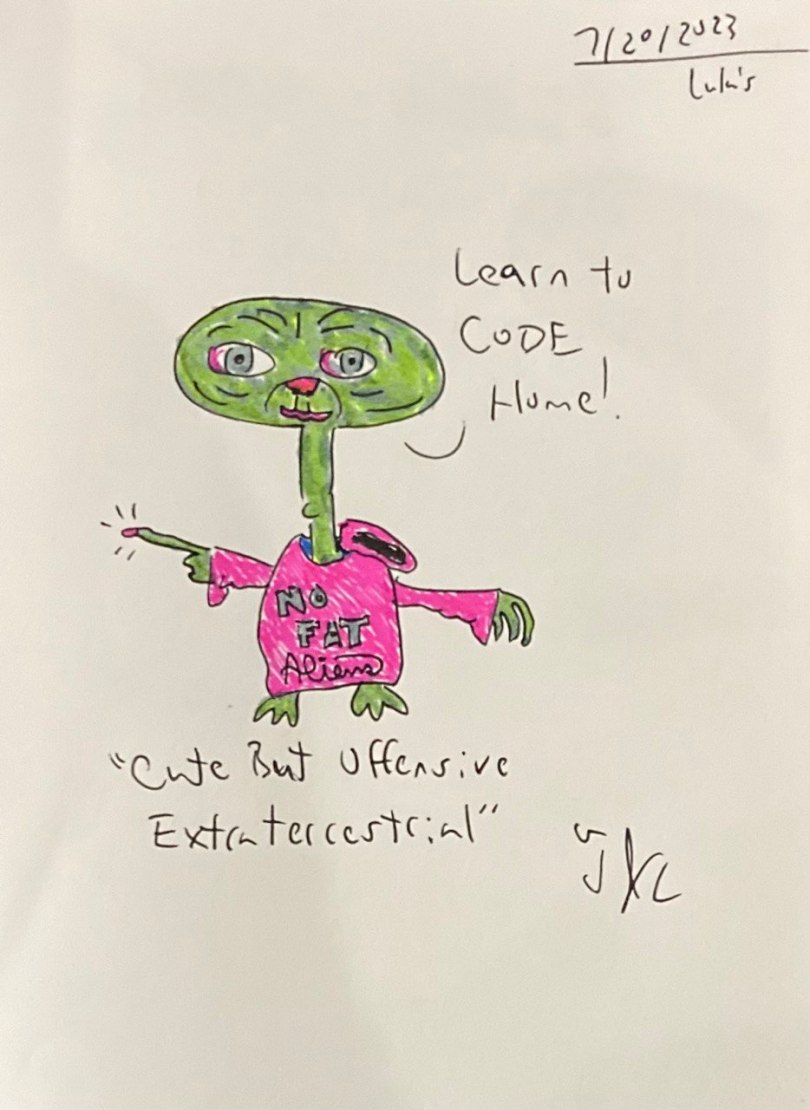
Offensive Poems: With Pictures Preview: “Cute But Offensive Extraterrestrial” & “Space Frog”

The following is a re-posting of this past Sunday’s edition of Sunday Doodles (Sunday Doodles CXCV), which is normally a perk for $5 and up subscribers to my SubscribeStar Page.  The post serves as a preview, of sorts, to the kind of content that will make up (I hope!) my third book, tentatively entitled Offensive Poems: With Pictures.  I thought I’d bring it to the masses—you, my beloved free subscribers and daily readers—to get feedback—and to let you in on this new project.  —TPP

Typically, Sunday Doodles is reserved for the classy $5 and up subscribers, while $3 a month gets the first Sunday of the month to gawk at doodles.  However, I’m opening this post up to all subscribers.

That’s because this weekend’s edition of Sunday Doodles features a preview of my current book project, Offensive Poems: With Pictures.  This project started almost by accident—I was doodling at an open mic night on Tuesday, 18 July 2023, and started sketching people around me.  Two nights later—Thursday, 20 July 2023—at another open mic, I drew “Cute But Offensive Extraterrestrial”; he prompted me to write the haiku “Learn to Code.”

That got me thinking:  what if I wrote a red-pilled haiku for every doodle?  I was already toying with the idea of writing poems to accompany each doodle, but I wasn’t thinking of making them a satirical commentary on the strange times in which we find ourselves.  Now, I can’t stop coming up with pithy verses about the various sacred cows and empty bromides of our time.  It’s remarkable how many Leftist slogans are seven-syllables, which works great for that second line of each haiku.

Why haiku?  I like the challenge of stating a complex sets of ideas in seventeen syllables.  The structure of a haiku—five syllables in the first and third lines, seven syllables in the second/middle line—means I have to be extremely efficient with words.

And, to be totally honest, I just find haiku easier to work with than other poetic forms.  It offers enough flexibility in terms of rhythm, meter, etc., for a hedge-poet like myself to play around with.  Once I have to worry about iambic pentameter, for example, and stressed and unstressed syllables, it’s a bit too much for yours portly.

That said, I wanted some form, as I find most free verse to be too loose.  There is something to be said for structure, as it forces me to think intentionally about every word.  Also, I find that much free verse quickly becomes indistinguishable from prose.  Much of it seems like prose writing with random or mildly clever line breaks.

So!  Enough rambling.  Let’s get to the doodles!

Read More »

TBT^2: Modern Art and Influence

Doing these retrospective TBT posts reminds me of the cyclical nature of life.  Just like least year, we’re in the slow, lazy days of high summer, when the heat is so intense, a permanent haze hangs over the land.  There is something surreal about it being blindingly bright and languidly hazy at the same time.

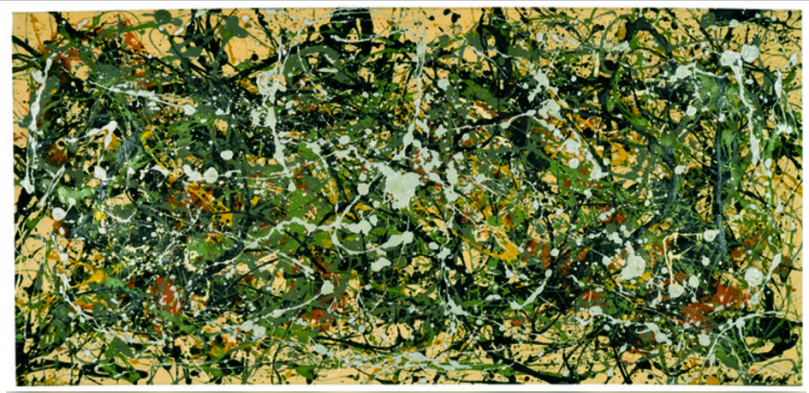
I don’t have much more to write about modern art, although I got an eyeful of it at the Art Institute of Chicago.  Some modern art is quite striking and challenging, to be sure, but when I saw a canvas that was literally painted black, I groaned internally.  A former colleague of mine, an art teacher, always said of modern art, “well, somebody had the idea to do something, and did it, so it’s art” (I’m paraphrasing rather loosely there).

It’s one of those things that’s so stupid, it sounds profound.  Her argument was essentially that if you did something—even something asinine—first, you were creating art; you just weren’t born early enough to be the guy to paint a canvas solid black and offer up some lame justification for why it’s a study in how we perceive color.

I’m fairly certain that if I painted a canvas a solid color and donated it to the Art Institute of Chicago, they would not put it on display.  I understand that modern art seeks to “shock” viewers, but the only thing shocking about a black canvas is that it’s presented to the public in one of the finest of fine arts institutions in the country.

But I digress.  It’s all just wealthy idiots smelling their own farts.

With that, here is “TBT: Modern Art and Influence“:

Read More »