Rudyard Kipling’s “The Mother Hive”

To start yesterday’s History of Conservative Thought class, I had students skim through Rudyard Kipling’s 1908 short story “The Mother Hive.”  I stumbled upon the reading in our class text, Russell Kirk’s The Portable Conservative Reader.

It is a grim little fable that warns about the perils of progressivism infiltrating a proud but weakened nation.  In the story, a deadly wax-moth sneaks into a large but bedraggled beehive during a moment of confusion.  She quickly steals away to the cell of the youngest bees, who have yet to take their first flight.  There, she fills their impressionable heads with gentle words and promises of a glorious future, all while covertly laying her eggs.

One young bee, Melissa, who has just returned from her first flight, is suspicious of the beautiful stranger’s soothing words, but the wax-moth plays the victim and insists that she’s only spreading her “principles,” not the eggs of her hungry future children.

Read More »

Lazy Sunday XVII: #MAGAWeek2019

This past week was #MAGAWeek2019 here at The Portly Politico.  Each day’s post was a SubscribeStar exclusive.  For a subscription of $1/month, you gain exclusive to each day’s posts, as well as exclusive content every Saturday throughout the rest of the year.  Visit my SubscribeStar page for more details.

In case you missed anything from #MAGAWeek2019, this week’s edition of Lazy Sunday is dedicated to catching you up on what you missed.  But remember, you only get a teaser of each post; to read the full posts, you have to subscribe to my SubscribeStar page for $1/month or more.  That includes exclusive content every Saturday, too, like yesterday’s review of my trip to New Jersey and Coney Island, NYC, “Mid-Atlantic Musings.”

But enough sales pitches.  Here were the highlights from #MAGAWeek2019:

  • Fast Food” – After a long day on the road last Sunday, I decided to do something fun and lighthearted to kick off #MAGAWeek2019.  President Trump famously loves fast food, even feeding it to the Clemsux National Championship football team in vast quantities.  I, too, appreciate good fast food, and marvel at its ability to provide a filling, calorie-rich meal at an affordable price.  You can read more of my high cholesterol musings on the topic at my SubscribeStar page.
  • Alexander Hamilton” – Hamilton engenders a great deal of debate between decentralist Jeffersonians (such as myself) and centralists, but his influence on and importance to America’s early political and financial formation cannot be denied—indeed, it should be celebrated.  Jefferson and Madison were probably correct, constitutionally, on the issue of the national bank—Congress had no explicit constitutional authority to create such an institution—but Hamilton’s financial reforms placed the nation on solid financial footing, ensuring the United States had the financial infrastructure in place for explosive growth and expansion.
  • John Adams” – John Adams is an unappreciated Founder and Framer, though David McCullough’s magisterial biography of the second President of the United States has done much to lift Adams’s profile.  Adams served the United States ably as our Commander in Chief during his single term, staving off a full-blown war with France while protecting American mercantile shipping on the high seas.
  • President Trump’s Independence Day Speech” – On a particularly star-spangled Fourth of July, President Trump delivered a powerhouse of an Independence Day speech.  Not only were the multiple flyovers of military aircraft impressive (ending, of course, with the Blue Angels soaring majestically over the National Mall), the speech itself was a masterclass in what I dub “old, patriotic American history.”  It’s well worth watching—and reading my full analysis on my SubscribeStar page.

Other Lazy Sunday Installments:

#MAGAWeek2019: Alexander Hamilton

It’s here at The Portly Politico.  Each day’s post will be a SubscribeStar exclusive.  For a subscription of $1/month, you gain exclusive to each day’s posts, as well as exclusive content every Saturday throughout the rest of the year.  Visit my SubscribeStar page for more details.

Last year for #MAGAWeek2018 I highlighted several of our great Founding Fathers, including obvious picks like George Washington, Thomas Jefferson, and James Madison.  I also threw in the less-obvious son of a Framer, John Quincy Adams.  One key Framer I left out:  the ubiquitous Alexander Hamilton.

Read More »

Southern Conservatism: John Randolph of Roanoke

MAGA Week 2019 is one week away!  Get ready to celebrate America all week long!  This year, all MAGA Week posts will be exlusive to my SubscribeStar page, so subscribe today!  $1 a month gets you full access to all posts, including new content every Saturday.

As my History of Conservative Thought course rolls on, I’m learning more about the forgotten byways and overgrown, stately ruins of the various branches of conservatism.  Students this week are reading a couple of documents from John Adams and Alexander Hamilton, the two founders of the Federalist Party, and key to the passage of the Constitution.  Hamilton, the author of the bulk of the pro-ratification Federalist Papers, also created the financial system upon which the United States functions today.

Hamilton and Adams have both enjoyed renewed interest in recent years, Hamilton due to the smash Broadway musical about his life, and Adams from a critically-acclaimed HBO series (one that, sadly, takes some unnecessary artistic license with the past).  In the case of Hamilton, American history students are often enthusiastic to get to him in my AP US History course, and Hamilton mega-fans often know more about the first Secretary of Treasury than I do.

But we’re reading a speech from another important figure from American history, albeit one largely forgotten:  John Randolph of Roanoke.

Read More »

McClay & Sheaffer on American History

It’s been a history-packed week for yours portly.  Tuesday morning my History of Conservative Thought students and I continued our examination of Edmund Burke, the great Member of Parliament and godfather of Anglosphere conservatism.  Burke foresaw the radical nature of the French Revolution well before the guillotining began.

On Thursday, I had the opportunity to substitute a colleague’s summer course, Terror and Terrorism, a popular course he’s run for several summers now.  Students in that course read excerpts from John Jacques Rousseau’s Social Contract (PDF, the same one the students read, in part), a political philosophy perhaps the polar opposite of Burkean traditionalism.

Rousseau’s theory of the “general will” is, I would argue, responsible for the radicalism of the French Revolution—which wrought the Bolshevik (Russian) Revolution, the Maoist revolutions of the Great Leap Forward and the Cultural Revolution, and on and on.  There’s a reason one of my Conservative Thought students claims that “the French Revolution was the first Communist revolution,” by which he means it contained within it the collectivist ideals of Rousseau’s general will.

But I digress.  In the spirit of all that historical musing, I thought I’d recommend two pieces I’ve read recently about the historian’s craft, and the dangers of applying a progressive lens to our understand of the past.

The most recent piece is a post from Practically Historical, entitled “Expunging Our Past.”  Gordon Sheaffer‘s pithy historical posts are enlightening and engaging, and fits with an argument he makes in this post:

“History should be popular.  Our past must be understood by the citizenry- historical studies targeted only at academics cannot be how we measure the discipline.  There is a way to make history insightful and enjoyable.”

Amen!  One of my great frustrations while in graduate school was the ponderous relativism inherent in the jargon-laden, hyper-focused monographs we were forced to read.  I certainly acknowledge the usefulness and necessity of thoroughly researching a small corner of our historical experience, but what happened to the grand, sweeping histories of the eloquent generalist?

When I was a younger man, I relished reading accessible (but, nevertheless challenging) works of history, especially broad overviews of a time period or nation.  It’s fascinating to learn about the minutiae, to be sure, but a good historian should be able to give the broad strokes and the colorful details.

But the real point of Sheaffer’s piece is that the progressive revisionists are attempting to reduce American history to a Marxist (and Manichean) story of class struggle.  That trend dates back to Progressive Era historian Charles Beard, who famously argued that the Constitution was merely an economic arrangement that benefited the wealthy Framers, protecting their wealth and privilege at the expense of the common man.

Archfiend (and political scientist, not historian) Howard Zinn continued that theme in the popular-but-inaccurate A People’s History of the United States, which has sadly been adopted in many school districts across the country as an American history textbook.  Zinn presented American history as a procession of plutocrats exploiting the working people and racial minorities for personal aggrandizement, rather than the rich tapestry of hard-working yeoman and laborers who really built the country under the protective auspices of the Constitution.

Just as Burke was the antidote to Rousseau, so historian Wilfred McClay serves as a corrective to the partisan excesses of Zinn.  He’s written a new textbook, Land of Hope, which strives to be a “well-written and appealing history of the United States that, while being informed by the best scholarship, does not lose sight of the big picture about our nation’s admirable and exceptional history.”

McClay argues that without a proper foundation in our own nation’s history, we are unable to govern ourselves.  Quite true:  I would argue that a large part of our current national discontent and brutal culture war is that we have two very different visions of America.  The one is an America that is strong, liberty-loving, fair-minded, and great; the other is of an America that is exploitative, prejudiced, greedy, and callous.

That’s why I’ve long argued that simply requiring students to take an American history course to graduate from high school and/or college isn’t enough to move the needle.  It does no good if the course is a collection of progressivist pabulum or a crash-course in victim studies.  There’s no guarantee your high school history teacher—likely certified from a progressive education program—will actually teach American history fairly or accurately, much less your community college adjunct.

There are a ton of choice tidbits in this interview McClay gave to Encounter Books, the publisher of Land of Hope, but here’s a good excerpt on Zinn:

Encounter: Howard Zinn said that his goal in writing A People’s History of the United States was to create a “quiet revolution” in our understanding of American history. Did he succeed in that endeavor?

McClay: Yes and no. He succeeded in unsettling many aspects of the consensus in which American historical writing was embedded. He did this to an astonishing degree, particularly since he was not himself a historian. But he did not succeed in providing a substitute account of American history that goes beyond simplistic melodrama. Most honest historians will acknowledge that, even if they are sympathetic to Zinn’s leftist politics.

Encounter: Why was Zinn’s account so popular?

McClay: It is engagingly written, and gives a simple-minded, moralistic, account of the past as the struggle between the white hats and the black hats, the Children of Light and the Children of Darkness. For some people, including many Americans who have felt disillusioned by our national flaws, this has been irresistible.

He also rails against the AP US History exam, which used to the “gold standard,” as he puts it, but which has suffered due to constant “tinkering with the exam, and interjection of themselves into what teachers actually teach in AP courses.”  I teach APUSH, and what McClay writes is absolutely true.  It’s bad enough teaching to a test every year—you don’t have the opportunity to luxuriate in the warm waters of historical detail—and it’s worse when the College Board tries to alter the exam every five minutes.

To close, one more powerful quotation from McClay:

Students should learn that history is not merely an inert account of self-explanatory details, but is a task of reflection that calls to our deepest sense of our humanity. And learning our history, the history of our own country, is part and parcel of learning who we are, and learning about the society of which we are already a part.

Again, I say, amen!

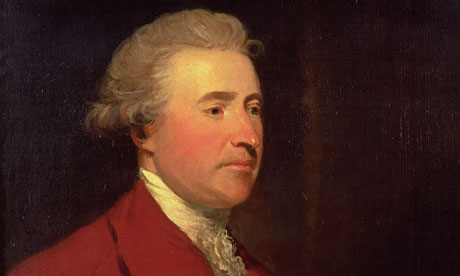
History of Conservative Thought Update: Edmund Burke

A bit of a delayed post today, due to a busier-than-usual Monday, and the attendant exhaustion that came with it. The third meeting of my new History of Conservative Thought class just wrapped up, and while I should be painting right now, I wanted to give a quite update.

Last week, we began diving into the grandfather of modern conservatism, Edmund Burke. Burke prophetically saw the outcome of the French Revolution before it turned sour, writing his legendary Reflections on the Revolution in France in 1789 as the upheaval began. Burke argued that the French Revolution ended the greatness of European civilization, a Europe that governed, in various ways, its respective realms with a light hand, and a sense of “moral imagination.”

To quote Burke reflecting on the Queen of France:

“I thought ten thousand swords must have leaped from their scabbards to avenge even a look that threatened her with insult. But the age of chivalry is gone. That of sophisters, economists, and calculators, has succeeded; and the glory of Europe is extinguished forever. Never, never more, shall we behold that generous loyalty to rank and sex, that proud submission, that dignified obedience, that subordination of the heart, which kept alive, even in servitude itself, the spirit of an exalted freedom. The unbought grace of life, the cheap defence of nations, the nurse of manly sentiment and heroick enterprise is gone! It is gone, that sensibility of principle, that chastity of honour, which felt a stain like a wound, which inspired courage whilst it mitigated ferocity, which ennobled whatever it touched, and under which vice itself lost half its evil, by losing all its grossness.”

What a powerful excerpt! The “sophisters, economists, and calculators,” indeed, reign in the West. What Burke was driving at here was that the rationalistic, abstract bureaucrats who would abandon tradition in their quest for a perfect society would sacrifice everything that made their country great, and life worth living.

Burke was also arguing that there is more to obedience to a government or king than the mere threat of power. People are invested in their country and society—and willing to submit to authority—because of organic culture from which it grows. Uprooting the great tree of tradition in favor of abstract foundations merely destroys the tree, and plants its seedlings in shallow ruts of stone. What grows will be anemic and pitiful by comparison.

Volumes could and have been written about Burke, but I’ll leave it here for now. Next week we’re getting into the development of Northern and Southern conservatism, which should make for some pre-Independence Day fun.

Hustlin’: Minecraft Camp 2019

The June slump has hit, as people are less interested in news and politics and going outside.  It’s been a gorgeous few days here in South Carolina.  I left the house Wednesday morning and it was cold.

For non-Southerners, allow me to explain:  here in the Deep South, our only true season is summer, which runs from late March through Thanksgiving.  I’ve seen people mow their lawns a week before Christmas.  If we’re lucky we get a mild summer.  After an oppressively muggy May, a morning in the low 60s is a blessed reprieve here in the Palmetto State.

But talking about the weather is probably why my numbers are down, so I’ll move on to another non-politics-related topic:  my penchant for hustlin’.  Readers know that I have a few gigs running at any time, including private music lessons, adjunct teaching, my History of Conservative Thought summer course, and playing shows.  I also paint classrooms and do sweaty manly maintenance work at my little school when I’m not molding minds.  And while it doesn’t pay anything yet, I’m hoping to get a few bucks for my writing.

But perhaps my favorite side gig is an annual tradition:  my school’s annual Minecraft Camp.  A former school administrator started the camp, and I’ve carried it on for some years now.

For the uninitiated, Minecraft is basically LEGOs in video game form.  The genius creation of programmer Markus Persson, the game places players in a massive sandbox world, with the objective being… anything!  There are no timers (other than a day and night cycle), no goals, and no ending.  Players generate a theoretically endless world from scratch, and proceed to build—craft—their way to civilization (or endless PVP battles).

Players can activate Creative Mode, which allows for endless flights of fancy, with access to every block and resource in the game, or they can play in Survival, which is exactly what it sounds like:  players hide from (or fight) monsters at night, hunt for or grow food, and have to keep their health up.

Minecraft has enjoyed ubiquity since its release in 2011—it’s the best-selling video game of all time—and when we started Minecraft Camp back in the day (I think it was summer 2013 or 2014, but I’m not sure), it was HUGE.  The game has inspired probably tens of thousands of mods, from simple additions like extra monsters or types of blocks, to total conversions that completely rebuild the game’s mechanics.

With the rise of Fortnite a year ago, the game seemed to wane in popularity, but it’s apparently enjoying a resurgence:  our camp was up to twelve Crafters from a low of about four or five last year.  It gets absolutely chaotic at times—like during our final camp PVP battle, and a hectic boss fight against a gigantic, camper-created Creeper named “Creeperzilla,” that saw kids shouting nearly at the top of their lungs with unabashed glee—but it’s also beautiful to see the creativity of young children.  I am constantly amazed to see what they create.

And, let’s face it, there are worse ways to make an extra buck than playing video games with a group of creative eight-to-thirteen-year olds.  It definitely beats raking up old pine straw and spraying Roundup on cracks in the parking lot.

You can check out our camp’s blog here:  https://tbcsminecraft.wordpress.com/

The Price of Freedom: A Good Attorney

A common observation on the Right is that the process is the punishment.  Leftists understand this premise well:  the power of an accusation and an attending lawsuit is that, even if the allegation is ultimately untrue, their opponent has endured costly legal battles.  That battle can cost them even more, including their livelihoods and their families.

Few people are able or willing to pay the costs, both financial and psychological (and, increasingly, physical) of Leftist attacks.  Those that do can look forward to years of grueling court appearances and legal fees, as the Masterpiece Cakeshop case demonstrated.

Conservatives know that story well:  the Christian owner of the Colorado bakery refused to bake a cake for a same-sex wedding, and the Colorado Civil Rights Commission trampled all over his religious convictions.  Rather than knuckle under to the social justice tyrants, the owner won a case in the Supreme Court after years of litigation… only to return home and have a man request a cake for a “gender transition” party.  The CCRC pounced on Masterpiece Cakeshop again.

The Left, in this regard, is relentless, as we saw last week with the Carlos Maza incident.  There is no pretext of fair play beyond the flimsiest, airiest of rhetoric—and, increasingly, the Left doesn’t bother with that.

Case in point:  a small, family-run bakery, Gibson’s Bakery, in Oberlin, Ohio, won a three-year suit for $11 million in damages against ultra-progressive Oberlin College.  The bakery was robbed the day after the 2016 election by three young black men, students at Oberlin.  The owner reported it to the police, and the three men were arrested.

But, because the burglars were black and the owners white—and, as the Breitbart piece reporting on the case implies, the progressives of Oberlin wanted to vent their tear-soaked anger at Donald Trump’s presidential victory on some unsuspecting white folks—the arrests soon became about race.

Not only did students protest—their professors and administration gave them time out of class to do so (and snacks)!  A college vice president, Meredith Raimondo, distributed flyers denouncing the bakery as racist, and which recommended other bakeries in the area.  The college also severed its business relationship with the bakery.

Like a medieval pope demanding criminal bishops be tried in ecclesiastical courts instead of civil ones, Oberlin further demanded that “first-time” offenders who are students at the college be turned over to the school for punishment.  Ignoring the glaring problem of how a shopkeeper is supposed to intuit if thugs in his store are first-time or repeat-offenders, that move to skirt the law through extralegal college tribunals smacks of the campus “rape” scare and its kangaroo courts—young men found guilty on flimsy charges of “retroactive rape” and the like.  Of course, in this situation, we all know that the college “courts” would sweep the criminal indiscretions of its students under the rug.

The result:  Gibson’s Bakery laid off most of its employees and nearly went out of business.

Justice was served in this instance with the much-deserved settlement (which has the potential to triple in value, pending a further hearing), but to quote commenter “mercury” on the Breitbart piece:

Unfortunately, there are probably 1,000,000 other cases that didn’t end so well for urban grocery stores, gas stations, convenience markets, clothes stores, and so on. This is where the perps got away with the theft, harassed or stole from customers, or shot the owners for resisting the theft.

Consider, too, the thousands of establishments that sucked it up and took one on the chin to stay in business.  Freedom, sadly, isn’t free.  Gibson’s Bakery defeated the Goliath of Oberlin College, but many Davids wither before progressive dominance.

Sailer and Spotted Toad on Education

Demographer Steve Sailer has a review on Taki’s Magazine of a new book from blogger Spotted Toad.  The book, 13 Ways of Going on a Field Trip: Stories about Teaching and Learning, is a narrative memoir detailing Toad’s decade teaching in public schools in the Bronx.

Sailer, a dedicated statistician in his own right, lauds Spotted Toad’s statistics-laden blog, but points out that his memoir eschews statistics in favor of narrative.  This focus on narrative, as Sailer points out, does not detract from the book’s insights about education, but makes them more viscerally real for the lay reader.

Based on Sailer’s summary of the book (which I plan to purchase and read soon), Spotted Toad’s teaching experience led him to insights similar to my own; that is, that administrators and school boards spend too much time chasing education fads and pushing a romantic narrative about teaching, rather than just getting out of the way and letting teachers… well, teach.

Toad was hired as part of the once-fashionable Teach for America program, which placed young, enthusiastic idealists into poor school districts, usually in tough inner city schools.  The theory was that bad or lazy teachers weren’t engaged enough, so schools needed an injection of Dead Poets’ Society-inspired young’uns who would bend heaven-and-earth to reach urban youths.

Sailer speculates about why Teach for America was so popular in the latter part of the last decade, and suggests that it’s because upper-middle class New York Times readers forwarded glowing articles about TFA to their out-of-work, overly-educated kids.

That somewhat comports with my own experience, as I briefly considered joining TFA upon finishing graduate school at the height of the Great Recession.  I think it’s even more accurate to say it was popular because it promised work during a time when few people could find it, and didn’t require lengthy additional years of education and training.

Sailer pooh-poohs the idea that TFA could create qualified teachers, and he’s not entirely wrong—the program was certainly overly optimistic about its own efficacy—but I think the apprenticeship model of “learning on the job” is one of the better ways to learn the craft.  Most education classes are a joke, and other than a few useful pedagogical insights, my impression is that many of them are indoctrination camps for the latest progressive educational fads.  I’d much rather have a “pure” young teacher learning the ropes with the assistance of battle-hardened veterans in the trenches than to have that teacher languish away in a series of Two-Minute Hates for another couple of years.

Indeed, that’s been my big complaint with the State of South Carolina’s alternative certification program.  We have a teacher shortage, but you want me to shell out cash and three years of my time to teach in a crummy public school?  No thanks.  How about adopt my proposal to grant automatic certification to any private school teacher with three years of teaching experience and a Master’s degree in a relevant field, or with five years and a Bachelor’s?  That would solve the problem more quickly, and would bring a number of qualified teachers into public schools quickly.

My premise is that credentials don’t make a good teacher; classroom experience does.  I’m generally anti-guildist, as I fancy myself a bit of a Renaissance Man.  Of course, that comes from my personal experiences professionally:  out of necessity, I’ve taught a slew of social studies courses, as well as music at different levels, for nearly a decade.  I would have benefited from some education classes to learn solid pedagogical methods in some areas (particularly music education), but I’ve picked up many of these methods through trial-and-error, and sheer force of will.  When you have to get twenty inexperienced middle school musicians to play a Christmas concert, you figure out how to make it work (and sound good).

Regardless, Spotted Toad’s experiences hit upon some common problems in education, particularly education policy.  Toad writes of the coming-and-going educational fads and programs, some supported by big-wigs like Bill Gates, that are championed, implemented hastily (and at great profit to the companies that market and develop these programs), and then abandoned in five years when some new, shiny trend emerges.

Take a moment to read Sailer’s review this morning, as it offers some interesting insights into the push-and-pull of education policy, and an interesting, if sad, retrospective on the bungled federal efforts in the Bush and Obama Administrations to address education in the United States.

That said, for all the doom-and-gloom surrounding discussion of education in America, Sailer ends on a positive note:

For example, as I’ve pointed out over the years, on the international PISA school tests, Asian-Americans do almost as well as Northeast Asian countries, white Americans outscore most white countries other than Finland and few other northern realms, Latino-Americans outperform all Latin American countries, and African-Americans beat the handful of black Caribbean countries that even try the test.

We Americans do spend a lot to achieve these educational results, but our outcomes by global standards are much less terrible than most Americans assume. (In particular, Indian states that have tried the PISA bomb it, scoring at sub-Saharan levels.)

At least we’re beating our peers in other countries—usually.

Conservative Divestment

Conservative readers are likely familiar with the odious BDS Movement—the movement to “Boycott, Divest, and Sanction” Israel because of its alleged “crimes” against legions of peace-loving Palestinian Arabs (oy vey).  Participants in this movement are encouraged to pull their money out of Israeli companies (or companies that do business with Israel), and to refuse to buy Israeli products, thereby pressuring Israel to be even more tolerant (it’s quite ludicrous—I’d wager an Arab Muslim in the Middle East would enjoy greater liberty to exercise his religion in Israel than anywhere else in the region).

Charlie Kirk of Turning Point USA has a video for Prager University called “DivestU” in which he argues for another kind of divestment:  denying American colleges and universities donations.

It’s a fairly commonsensical idea:  conservatives are well aware of the corrupting influence of Cultural Marxism on university faculty, and the persistent indoctrination of vulnerable young people at a particularly impressionable moment in their lives.  We’ve all known the friend or relative who came back after a semester of college convinced “xyr” knows everything about the world, possessing a sneering, elitist attitude against everything good and decent (“hugs are an oppressive form of non-consensual affection!  Smash the Patriarchy!”).  Why keep feeding the beast?

It makes sense that we pay tuition—for better or worse (and mostly for the worst), we need that catskin to land a job—but Kirk points out that Americans are voluntarily donating money to colleges, institutions already bloated with federal loan dollars.

Kirk cites that American colleges and universities received $44 billion in donations in 2017.  Scott Rasmussen’s Number of the Day for 15 February 2019 notes that in 2018, colleges and universities received $46.73 billion, a whopping $1.4 billion of which went to Harvard University.  Harvard already has an endowment of over $37 billion (the benefit of being an institution for nearly 400 years:  compounding interest has lots of time to work its magic).

Indeed, Rasmussen writes that “while there are more than 4,000 colleges in the United States, 28% of that money went to just 20 schools. Those 20 universities serve 1.6% of the total student population.”  Those schools are not conservative bastions like Hillsdale College, but often the epicenter of Ivy League elitism and disdain for traditional values.

As Kirk points out in his video, even if you donate money to a specific school within a college—say, the medical school—money is fungible.  You might think you’re helping train future doctors, but you could easily be funding gender reassignment surgery (read: butchery and mutilation), or an Assistant Vice Dean of Diversity, Inclusion, and Homeopathic Cultural Healing.  Bah!

Education is a mess in the United States.  Pouring more money into institutions that are anathema to our values and hostile to our way of life is insane and masochistic.

As such, I’d encourage you to avoid donating to colleges and universities.  Put that money to use in better ways, like retirement savings.