The Joy of Romantic Music II: Bedřich Smetana’s “The Moldau”

Last Friday I wrote of the beauty and power—the sheer joy—of Romantic music, a topic I’ve covered once before on this blog.  In writing last week’s post, I noted briefly that Romantic music is nationalistic, which was certainly true in a number of cases.

Europe following the French Revolution and the Napoleonic Wars was a hotbed of political activity and nationalist sentiment.  The Congress of Vienna (1815) redrew the map of Central Europe, reducing the hundreds of German principalities, bishoprics, duchies, baronies, and the rest into about a dozen political units, hoping these larger Germanic kingdoms would serve as a bulwark against future French aggression.  They did, and more—under the steady Realpolitik of German Chancellor Otto von Bismarck, Prussia gradually grew to unite these new lands into the Second Reich—a unified Germany.

Meanwhile, smaller nations chafed under Austrian or French influence.  Bohemia—now part of the Czech Republic—fought against Austrian political rule and the German language that came with it.  Bohemians championed the revival of their native Czech language, and began revisiting Czech folklore and music as the resting place of the national spirit.

This process was not unique to Bohemia or the Czechs, but today’s featured piece, Czech composer Bedřich Smetana‘s The Moldau, is a prime of example of how nationalist musical ideas can capture beautifully a sense of a place, while also transcending national identity and borders.

Read More »

The Joy of Romantic Music

This semester started with two weeks of online learning (of which today is the last day before students and teachers return to campus after Martin Luther King, Jr. Day), so it’s been an unusually slow start to the already sleepy January term.  However, that hasn’t stopped my music classes from listening to great music; indeed, we’re now covering what is perhaps my favorite period in the history of Western music:  the Romantic Era.

While I adore Baroque and classical composers and their works, Romantic music builds upon the forms established in those eras, stretching and expanding upon them to reach new heights of emotional intensity and musical expressiveness.  The music of the Romantic composers delights with its musical exploration of the supernatural, the mysterious, the Gothic, and the nationalistic.

Read More »

TBT: A Little Derb’ll Do Ya: Haydn’s “Derbyshire Marches”

The blog of late has been focusing more and more on culture, specifically music.  That makes sense because I am, after all, a music teacher, and am increasingly moving away from teaching social studies.  That’s never been truer than this year, where I am teaching, among other things, a detailed Music Appreciation course covering the major works and stylistic periods of Western music.

This focus is also a result of a desire to move away from the constant flux of politics.  More and more, I’m coming to believe that the best way to improve our lot is to focus on creating culture and building our communities.  Decentralized, localized bulwarks against progressivism offer one peaceful form in which like-minded conservatives and traditionalists can continue to live freely—at least to some extent—and happily.

So in casting about for a TBT post this week, I stumbled upon this one from 16 December 2019, “A Little Derb’ll Do Ya: Haydn’s ‘Derbyshire Marches.’”  My Music Appreciation students and I have been discussing Haydn, Mozart, and Beethoven, and have listened to a number of their works this week in class.

Joseph Haydn lived a remarkable, long, and successful life.  He grew up poor, and his early musical experiences involved hearing and singing the folk tunes of his native Austria.  He spent his childhood singing in a church, but was turned out when his voice changed.  He then made ends meet teaching music lessons and taking side gigs, slowly teaching himself how to compose.

His fortunes changed at 29 when he joined the Hungarian Esterházy family as their Kappelmeister, writing and composing a mind-boggling amount of pieces (at one point, the family staged two operas a week in their personal theatre in Hungary, all of which required Haydn’s pen and conductor’s baton).  But the position—difficult as it was—made Haydn wealthy and secure.

Even in spite of his workload and an unhappy marriage, Haydn maintained a positive attitude, and adopted an optimistic, humorous outlook on life.  It shows in his compositions, which are light-hearted, whimsical, joyous—and fun.

With that, here is 2019’s “A Little Derb’ll Do Ya: Haydn’s ‘Derbyshire Marches’“:

Read More »

The Joy of Music

One of the greatest joys in life is music.  Regular readers will know that I love musicplaying it, writing it, singing it, arranging it, analyzing it, launching it into space, etc.  As an art form, I believe music is uniquely suited to communicating ideas and beauty across time, space, and cultures.  It can be intensely nationalistic, yet still universal.

We’re back to distance learning today after a positive case of The Virus, and since it’s the day before Thanksgiving Break—historically the biggest blow-off day of the school year—my administration decided to play it safe and declare today a distance learning day.  As such, I took the assignment derived from The Story of 100 Great Composers and ported it to my high school music classes.  Those classes will share about their composers today.

Read More »

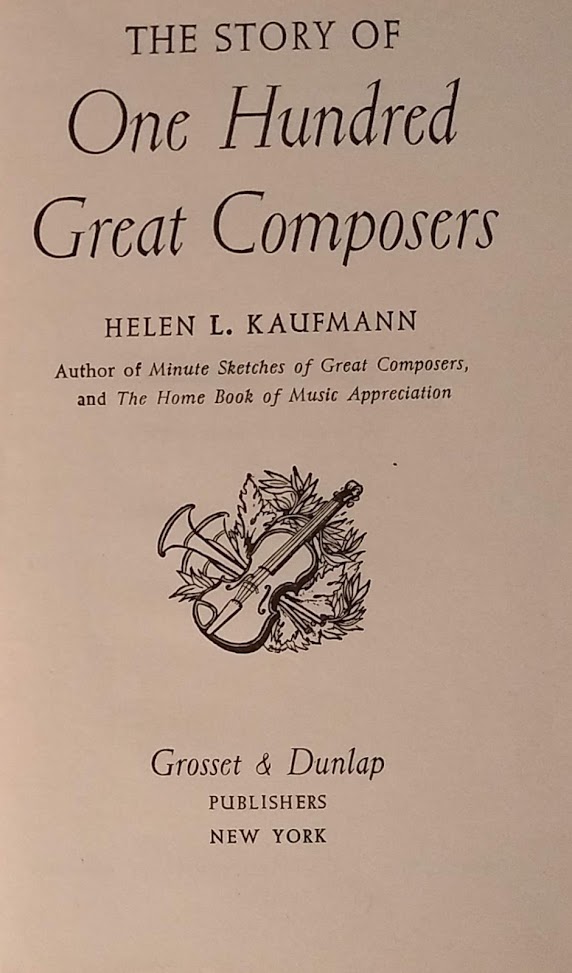
Friday Morning Reading: The Story of One Hundred Great Composers

Today my school is doing its second Live Remote Learning Rehearsal days.  These are days for us to test out remote learning in the event The Virus necessitates returning to distance learning full-timeLast time teachers tuned in from home while teachers were on-campus.  This time, both teachers and students are able to work from home, so I’ve been enjoying a more leisurely morning.

Indeed, I just wrapped up my first morning class of the day, a section of Middle School Music.  The students in that section wrote brief, rough draft biographies of renowned composers, and after giving them feedback in-class yesterday, they presented on their composers this morning.  It was a good lesson for digital learning, as it required their active participation for the bulk of the class, and they all did quite well.

I’ve assigned composer biographies in music courses for years, but what inspired the assignment this time around was the rediscovery of a charming little book I keep on a small end table in my den:  Helen L. Kaufmann’s The Story of One Hundred Great Composers.  Published in 1943, the book is a tiny, pocket-sized digest of two-to-three-page entries—arranged chronologically—of composers from the sixteenth century forward.

Read More »

Rock in Peace, Eddie Van Halen

It is with a heavy heart that we bid a fond farewell to the Mozart of our time, Eddie Van Halen.  Van Halen passed away after a lengthy struggle with lung cancer.  He is survived by his brother, drummer Alex Van Halen, and his son, Wolfgang Van Halen, who joined the band as its bassist in 2006.

Van Halen was truly one of the guitar greats of the twentieth century, the second half of which witnessed the rise of many guitar heroes to the pinnacles of superstardom, particularly in the 1970s and 1980s.

But Van Halen’s licks didn’t stop with memorable riffs.  He could play neoclassical passages with ease, weaving them into songs about partying and and lusting after one’s teacher.  Learning his signature solo, “Eruption,” became a rite of passage for budding guitarists in the 1980s and beyond.  Van Halen also dominated on the keyboards—much to the chagrin of perennial showman David Lee Roth—as is clear from the entire album 1984, one of the best albums of all time.  Who can resist jumping when hearing the opening strains of “Jump“?

Read More »

SubscribeStar Saturday: Making Music, Part II

Today’s post is a SubscribeStar Saturday exclusive.  To read the full post, subscribe to my SubscribeStar page for $1 a month or more.  For a full rundown of everything your subscription gets, click here.

This school year I began transitioning from teaching a blend of history and music classes towards focusing almost entirely on music.  While I still teach a couple of sections of American History, my teaching duties these days consist primarily music classes.

One of the real joys of teaching music—besides the fact that it’s just plain fun—is to see students inspired to create their own music.  I have been blessed over the years to witness the musical development of many students, and to hear some of their creations.

During our remote learning rehearsal day earlier this week, I pulled out some old concert footage to show my HS Music Ensemble class, a course that is entirely performance based.  That class does not port well to a fully online format, especially to a livestreamed one, as latency is so intense that it makes ensemble performance impossible.  Indeed, if that class goes to a fully online format, we’ll have to focus more on solo work and and music theory, which is what we did during distance learning earlier in the spring.

In watching that old concert footage, I was reminded of some wonderful moments in my school’s unorthodox music program’s history.  It also reminded me of the power of teaching music to inspire the creation of new works.

To hear my own musical works, visit https://tjcookmusic.bandcamp.com/ or www.tjcookmusic.com.

To read the rest of this post, subscribe to my SubscribeStar page for $1 a month or more.

Donate to The Portly Politico

Support quality commentary on politics, education, culture, and the arts with your one-time donation.

5.00 $

Music Among the Stars

Back in 1977, NASA launched Voyager I, which is some 14 million miles from Earth.  The super nerds behind the mission stowed two golden records on board.  Those golden records included various selections to represent life on Earth, from “Johnny B. Goode” to nature sounds to classical music.

Over the Labor Day weekend a colleague e-mailed me Classical Archivesweekend newsletter, which includes some musings about why humans developed the ability to create—and their interest in—music.  The newsletter features the blog posts “Can E.T. Carry a Tune?” and “Music for Extraterrestrials… Sampling the Music Selected for NASA’s Voyager I.”

The former explores the possible deep origins of humanity’s music-making abilities.  It posits several theories developed from evolutionary biology.  As  a Christian, I find these explanations ultimately wanting, though they each make interesting points (the second proposed theory, for example, suggests “that music arose because it was a social glue that helped our ancestors bond with one another and with a group”).  Music serves many purposes, even if those purposes are not strictly utilitarian (and even then music can serve that function, such as coordinating workers’ movements via work songs).

Chiefly, though, music is intended to praise God.  Like the other arts, music is God’s grant of a small sliver of His Creative potential to His Creation—Tolkien’s “sub-creation” of Middle Earth serving as a prime literary example.  The highest form of musical expression, then, lifts up songs of praise to God.

Read More »

Benjamin Britten’s “The Young Person’s Guide to the Orchestra”

This year, I’m teaching a new Pre-AP Music Appreciation course at my school.  The goal of the course is to teach students the language of music, as well as the different instruments, along with a broad survey of Western music from the Middle Ages to the present.  For the first week, we discussed dynamic contrast, tone color/timbre, and began going through the instruments typically found in the orchestra.  We’ve also listened to some excellent music, including a particularly dramatic performance of Franz Schubert’s “Der Erlkönig.”

After we covered the different orchestral instruments, we listened to Benjamin Britten‘s “The Young Person’s Guide to the Orchestra,” performed by the WDR Sinfonieorchester Köln under the direction of Jukka Pekka SarasteBritten’s piece takes a theme from seventeenth-century English composer Henry Purcell, an important Baroque composer with a distinctly English sound.  Britten has the entire orchestra play the Purcell theme, then each section takes a turn.  Then each instrument in the orchestra—including auxiliary percussion pieces like the triangle—take solo or soli sections, starting with the piccolos and flutes.

It’s a charming bit of modern classical music, and this performance is a particularly good one.  The camera crew makes sure to highlight each section of the orchestra and each group of instruments as they perform (the oboes are particularly fun, as one oboist looks like his head is about to burst from concentration).  I remember Ben Shapiro recommending the piece to a listener who wanted to introduce his young children to symphonic music, and stating that his own young daughter loved it.

After thirteen (!) variations on Purcell’s theme, Britten introduces a lively new theme, starting with a jaunty, acrobatic piccolo solo, and then slowly building back in the woodwinds, strings, brasses, and percussion in turn.  The whole thing swells to a mighty crescendo, with a powerful, full orchestra finale.  When I played it for my Pre-AP Music Appreciation students Friday morning, a few of them were awe-struck.  We finished listening in the closing minutes of class, and one student left saying, “This is my favorite class”—always satisfying to hear as a teacher.

Of course, who couldn’t love a class that involves listening to and talking about great music?  As our primary resource, I’m using Roger Kamien’s Music: An Appreciation, the eighth brief edition.  We’re also using YouTube heavily to locate quality recordings of music, such as the WDR Cologne Symphony recording featured in this post.

I’m hoping to sit my niece and nephews down soon to listen to Britten’s piece, as I think they’ll enjoy all the instruments.  It might be a tad long to hold their attention, but it can easily be enjoyed in small chunks.  My niece is particularly musically inclined, and I think will have fun seeing and hearing the different orchestral pieces in turn.

After all, if we’re trying to save Western Civilization, that means learning to appreciate some our highest cultural creations—and sharing that love with the next generation.

Phone it in Friday VI: Valentine’s Day

Happy Valentine’s Day, readers!  Don’t try going out to eat tonight—it’s going to be a mad house.  Sensible couples will probably wait and dine out on a less sexy night, like Tuesday, or pick up Taco Bell.

We’re in the midst of a glorious four-day “Winter Break.”  The great thing about teaching is all the bogus holidays.  Valentine’s Day and President’s Day just happen to bookend the weekend, so why not turn it into a slightly-extended holiday?

In the spirit of Jay Nordlinger, today’s post is going to be a series of barely-related reflections, as well as some links to the stuff you should read or watch.  Speaking of Nordlinger, how do I land a gig getting paid to write about classical music in exotic parts of the world?

But I digress.  Here are some reflections on this Day of Love:

Read More »