Wayback Wednesday: Gnostic Mysteries

The online historian Rudyard Lynch, also known by his channel name, Whatifalthist, put up an interesting video earlier this week about the influence of alchemy and alchemical modes of thinking on the development of Western civilization.  It’s worth watching and considering, especially as an example of the crosspollination of ideas between philosophical, ethical, and religious systems.

Lynch makes the point of differentiating alchemy from Gnosticism, the latter of which he clearly views as a demonic heresy (it is).  I suspect he lets alchemy off the hook a little too easily from a Christian perspective, but apparently it’s a topic that many churches have studied and even endorsed.

I’m not willing to go that far.  It smacks too much of the appeal of secret knowledge that is at the root of Gnosticism.  For nerdy men, especially, there is a pull to these kinds of mystical interpretations because, like computer programming, they offer up an alleged deeper understanding of the “code” behind existence.

Ultimately, Jesus Is the Way, the Truth, and the Life.  We must always be on guard against potential heresies.

With that, here is 20 September 2022’s “Gnostic Mysteries“:
Read More »

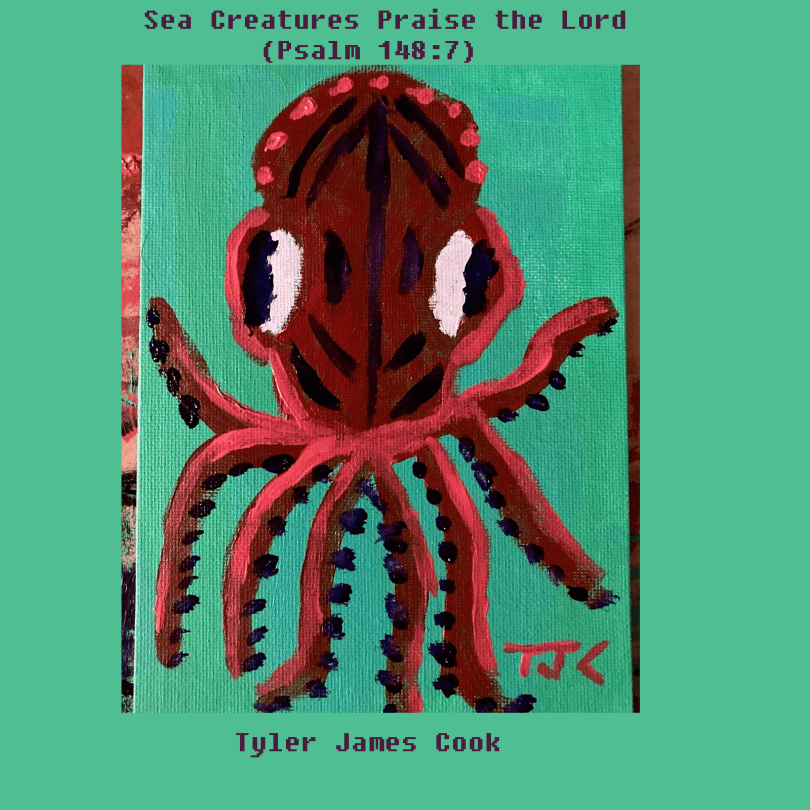
Open Mic Adventures CXXII: “Sea Creatures Praise the Lord (Psalm 148:7)”

Pickup my newest release: The Galactic Menagerie!  Use promo code obesekangaroos to take an additional 20% off all purchases on Bandcamp!  Code expires at 11:59 PM UTC on Friday, 4 April 2025.

With the release of The Galactic Menagerie, I’m really digging into the pieces from the album.  Today’s piece started life as a short string trio I wrote for some of my Middle School Music Ensemble students.

Read More »

TBT^256: Nehemiah and National Renewal

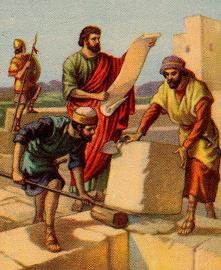
Ah, yes, another timeless TPP classic—my highly politicized commentary on Nehemiah.  It’s a powerful story of God’s people working together and placing their faith and trust in Him, overcoming formidable odds in the process.  It’s a great “But God” story—rebuilding this wall would have been impossible but for God.

From an historical standpoint, the story is also an important reminder that the life cycle of nations is often cyclical.  Perhaps no people understood that better than the Hebrews, who were often the cause of their own misery, thanks to their tendency to forget about God as soon as things got comfortable.  That sin is not unique to the Hebrews, ancient or modern; it is an affliction all peoples in all times have struggled to resist.

We’re in a moment of national renewal in the United States.  Let us remember, when the times are good again, that it was Divine Providence—God—that allowed us this reprieve, this second chance.

With that, here is 14 March 2024’s “TBT^16: Nehemiah and National Renewal“:

Read More »

TBT^16: Nehemiah and National Renewal

Ah, yes—Nehemiah.  One of my favorite books of the Bible.  What’s not to like?  A group of scrappy underdogs work together against the machinations of their enemies to build a wall.  They do it by trusting God.

When I first wrote this post way back in 2019, my most religious readers were quick to point out that, while I focused on Nehemiah building the wall, I skimped out on discussing God’s Role.  It was a fair, if slightly self-righteous, criticism.  Without God, there would have been no rebuilding of the wall.

That’s an important point:  without God, any “national renewal” would be fleeting, if it were possible at all.  Thank you to my slightly self-righteous readers for reminding me of that fact.

With that, here is 30 March 2023’s “TBT^4: Nehemiah and National Renewal“:

Read More »

Myersvision: Alexander Scourby

Growing up, I remember pastors championing the King James Version of the Bible as the only reliable translation.  It is, indeed, exceptional—and, even for a hyperintelligent Übermensch like yours portly, exceptionally difficult to read.  I now primarily use the New King James Version, which retains the KJV’s accuracy, while updating the syntax and language for modern readers.

That said, the NKJV still loses some of the poetry of the KJV.  Christianity is a reading religion, but it’s also a spoken one, and like all poetry, the Bible is meant to be read aloud.  Not many of us do it well.  When it’s done right, however, it pierces our souls.

Audre Myers graciously wrote this beautiful piece about the recorded King James Version, available on YouTube.  Actor Alexander Scourby reads the entire Bible, and from the videos I’ve listened to so far, it’s gorgeous.

Read More »

SubscribeStar Saturday: The Folly of King Edward VIII

Today’s post is a SubscribeStar Saturday exclusive.  To read the full post, subscribe to my SubscribeStar page for $1 a month or more.  For a full rundown of everything your subscription gets, click here.

One of my favorite passages of Scripture is Proverbs 31:10-31, the famous passage about the qualities of a good woman.  As verse 10 reads, “Who can find a virtuous wife? For her worth is far above rubies.”  The implication is that a true “Proverbs 31 Woman” is a rare and precious thing.

Based on earlier chapters of Proverbs, which extensively detailed the dangers of a wanton floozy, it’s pretty clear that a bad woman can be quite destructive.  Proverbs 7:6-23 is an entire cautionary tale about a foolish young man who dies when a harlot stabs him after a night of passion!

Too many men (myself included) fall for the allure of a pretty face, which is probably why there are three or four chapters in Proverbs warning us off of them (and only one chapter about a good woman).

Such is the potentially corrosive effect of a loose woman that one nearly destroyed a monarchy.  The short-reigned King Edward VIII, who ruled in 1936 for barely eleven months.

The controversy over King Edward VIII’s decision to marry a twice-divorced woman (still married at the time of Edward’s abdication in December 1936), Wallis Simpson, threatened the House of Windsor, and nearly resulted in a constitutional crisis for the British Empire.

To read the rest of this post, subscribe to my SubscribeStar page for $1 a month or more.

Supporting Friends Friday: New Works from Robert Mason Sandifer

Two years ago I wrote “Supporting Friends Friday: The Cinematic Compositions of Mason Sandifer” about the composing work of one of my student, Robert Mason Sandifer.  Mason (as I call him) started distributing his music to all the major platforms (Spotify, Apple Music, Amazon Music, YouTube, etc.) earlier this month, and he is directly responsible for inspiring me to put my old instrumental music on the same platforms.

Mason is currently undertaking an ambitious project to compose instrumental music that tells the story of the Bible, from Genesis through Revelations (or, as my friend Steve O would say, “from Genesis through Maps”).  It’s an amazing concept, and he has executed it beautifully so far.

Read More »

Chapel Lesson – Taming Your Tongue

Last week I was invited to give a brief lesson or sermon my school’s weekly chapel.  Our usual chaplain was due to be out that day, so the associate head of school asked me to deliver a message.

Earlier in the academic year I gave a short talk on listening intently and graciously, so I thought that a good complement would be to talk about the power and danger of our words—our fiery tongues!

I blog daily, and I know I’ve let my waggling tongue (in the form of a digital pen) get me into hot water.  It’s never a good feeling, and I’ve certainly written—and said!—things I regret.

For hot-blooded teens, it’s even more of a problem.  Rather than condescend to them with another jeremiad about “bullying”—such an insipid word—I decided to go directly to The Source

With that, here is my brief chapel lesson from Thursday, 2 February 2023, “Taming Your Tongue”:

Read More »

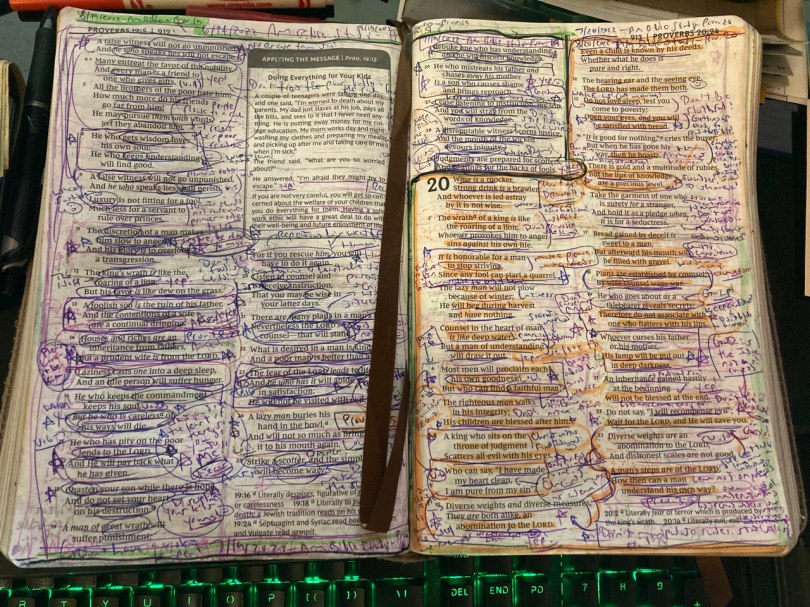
Bible Study Update II

An eager commenter on my original “Bible Study” post prompted me to give a second brief update on my daily Bible reading (I wrote the first update back in July 2022).  Apparently, my humble daily regimen inspired the reader to establish a schedule of her own.  To that, all I can say is, “To God Be the Glory!”

That said, it’s satisfying to know that the words I scribble down on this self-indulgent blog do, indeed, reach people.  There are probably fewer things more pleasurable to a writer than to find that his words have made some impact on his readers, and the pleasure is enhanced when it’s a stranger.  We all understand that we influence those close to us, for good or for ill, because we can see the effects more clearly.  But the idea that a stranger might be reading our words is a small sign that we’re expanding beyond our immediate familial and social circles to wider audiences.  It feels good.

But I digress.  This post is about studying the Bible, not tooting my own saxophone; pride, after all, is a sin.

Read More »

Gnostic Mysteries

There is something appealing about possessing some bit of secret knowledge or trivia that is unknown to everyone, save a select few “initiates” fortunate enough to partake in the mysteries.  The seductive allure of secret knowledge—or of just being “in-the-know” about some microniche subculture—seems to be a part of human nature.

We’d like to think in our modern age that we’re not superstitious sorts, but we are haunted everywhere.  Scientists have elevated themselves to the level of priests in a cult of scientism, worshipping the emptiness of nihilistic materialism just as the pagans worshipped lifeless idols.  Both are made of stuff—hard, material, unfeeling, insensate stuff—and both are equally empty.

But we here on the Right can fall prey to Gnostic fantasies as well.  The Libertarian dreams of a utopia in which everyone engages in frictionless free exchanges and all uncomfortable disputes are settled with cash and self-interest.  He’s as materialist and deluded as the mask-wearing mandatory vaxxer preaching loudly from the Church of Scientism.  The hyper-nationalist dreams of some impossible ethnostate that never really existed in the first place.  And so on.

Still, it’s seductive, the idea that we can possess the knowledge of good and evil, of true Reality.  After all, that’s the original sin, isn’t, it?  Eve, then Adam, could not resist the allure of being—so they were told, dishonestly—like God.  But even—perhaps, especially–Christians can fall into this trap.

Read More »