
TBT: Created by Philosophy

On 10 June 2016, I posted this short piece on the idea—taken from the famous Margaret Thatcher quotation—that “America was created by philosophy.”  This post was part of an ongoing examination of American nationalism, which I believe is distinct from other forms of nationalism.  Over the past two years, I have grown more convinced that culture plays a key role in defining a national identity, but I still believe in the ideational notion of America, that one can adopt the ideas of America to become part of the national fabric.

In a future post, I will likely explore further the fracturing of that national fabric, as it seems there are increasingly two—and, perhaps, three—cultures competing with one another, making even everyday communication strained.  Conservatism and Progressivism represent two opposing worldviews that share almost entirely different philosophical and cosmological foundations.  Unchecked immigration, especially from the Third World, represents another potential cultural bloc.  Without time to assimilate—to be “baked into” America’s national culture and to absorb American ideals—that third group presents its own threat to national unity, and to the very concept of liberty itself.

***

Near the end of my last post, I included a quotation from the late British Prime Minister Margaret Thatcher.  To recap, it was her famous dictum that “Europe was created by history.  America was created by philosophy.”  What exactly does that mean, and why is it important?

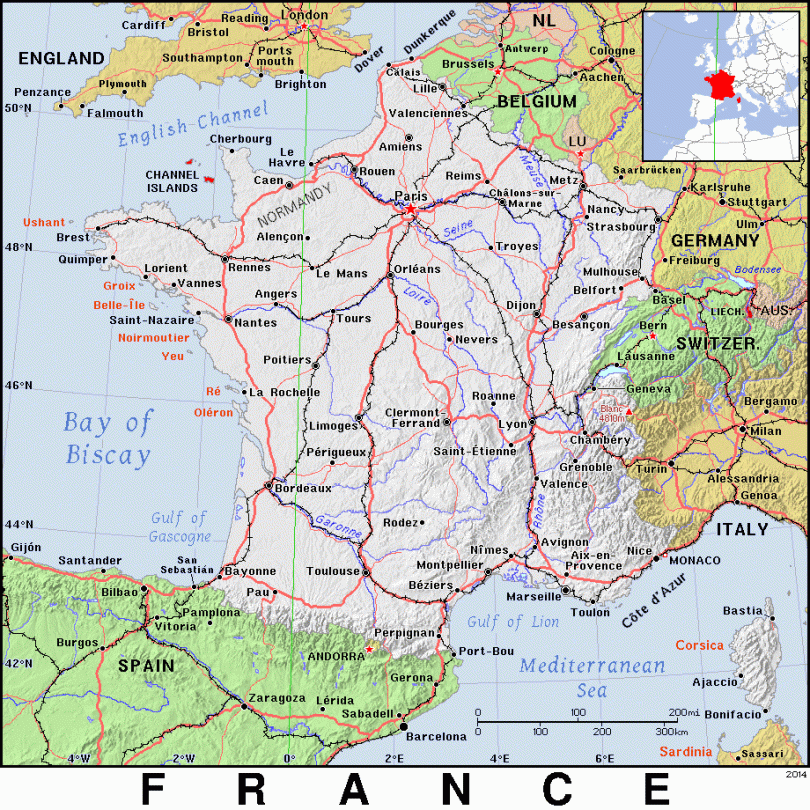
As I also pointed out in my last post, European nationality (and, by extension, the European nation-state) is built on notions of blood and soil.  In other words, being French means you are descended from a group of people broadly defined as “French” and you reside within the French “hexagon” (or at least claim that as your home).  Obviously, not every European nation-state still pursues this model–in some cases to their detriment–but some, like Italy, strenuously do.

 Now that is one sophisticated hexagon.

(Post-colonialism, being “French” includes many people outside of this geographic region, and now the French would more broadly define their nationality through shared language and culture–a model that moves closer to what I perceive to be the American model of nationalism).

In the United States–or, more specifically, in colonial British North America–Americans had a unique opportunity to define their national identity far more broadly.  Indeed, one could argue Americans did so out of necessity:  colonial British North America was a tapestry of cultures, languages, and ethnic groups.  Most hailed from the British Isles and Northern Europe, but the 18th century saw large influxes of Germanic and Scotch-Irish immigrants, not to mention the unfortunate forced immigration of the trans-Atlantic African slave trade.  Most were Protestant of various stripes–the German settlers in particular brought a rich and baffling array of spiritualism and religiosity to a young America–but Catholics and even a small number of Jews also made the trek to the colonies.

The massive Irish and German immigration brought by the Irish Potato Famine and the failed democratic revolutions of 1848, respectively, brought even more diversity to the land at that point known as the United States, and so-called “New Immigration” after the Civil War saw immigrants from Italy, Lithuania, Poland, Russia, Greece, and beyond.

By the time those “New Immigrants” began arriving in the 1870s until the tide was stemmed in the 1920s, the United States had already developed a model for nationality born of its colonial experience.  Indeed, the young United States proclaimed its nationality at the very moment it proclaimed its independence from Great Britain.

In writing the Declaration of Independence, Thomas Jefferson laid down the framework for what it means to be an American.  Jefferson, like all of the Founding Fathers, believed in the universal rights of men, rights derived not from any worldly, temporal authority, but from God Himself.  Every civics student is familiar with the ringing declaration that “We hold these truths to be self-evident, that all men are created equal, that they are endowed by their Creator with certain unalienable Rights, that among these are Life, Liberty and the pursuit of Happiness.”  Herein we see the roots of American values, birthed through the centuries by the tenacity of independent-minded Englishmen and bolstered by the more admirable claims of the Enlightenment.

However, many modern readers miss the first paragraph of the Declaration, which opens with the phrase “When in the Course of human events….”  This seemingly innocuous phrase holds within it deep wells of significance.  Jefferson here is saying that these ideals and rights are not specific to one place or one time.  The “human” here refers, rather, to all of humanity.  The phrase “in the Course of human events” refers to the timeless quality of these values–the self-evident truths of the Declaration apply yesterday, tomorrow, and forever–ad infinitum.
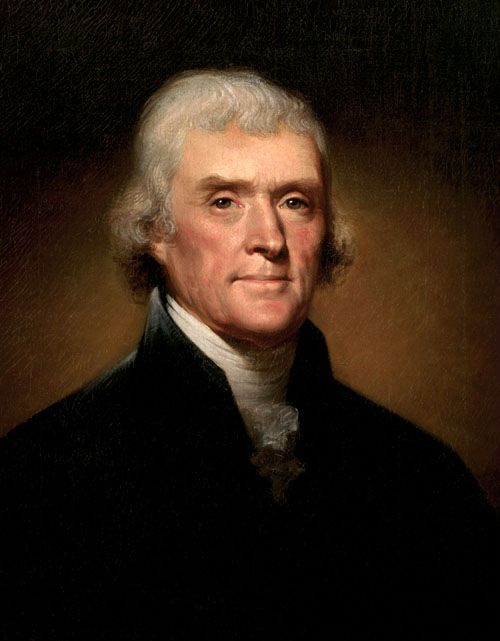
Thomas Jefferson, Babe Magnet

This simple phrase, then, goes a long way in explaining why the young United States was able to hold together in spite of its broad diversity of ethnic groups and religions, while the similarly diverse Austro-Hungarian Empire, which attempted to balance the interests of different ethnic groups by favoring some and oppressing others, ultimately collapsed.  The universal truths of the Declaration, espousing universal rights bestowed by the very Creator of the universe, give all men the opportunity to live their lives as they wish, confident in their liberty and free to pursue happiness and fulfillment as they please.

No doubt this philosophy of God-given liberty has bolstered the United States economically, allowing it become the richest, most prosperous nation on Earth–surely a carrot for future and continued immigration.  Ultimately, however, the most successful and fulfilled Americans, both native-born and immigrant, are those that come to embrace the core philosophy of the American experience.

A sad note in parting:  the increasing ignorance of these God-given rights, and the increasing balkanization of the American nationhood into favored classes and victim groups as a result of said ignorance, is undermining the universal vision of the Founders.  America today looks more and more like the Austro-Hungarian Empire of the early 20th-century:  decadent and splendid on the surface, but torn by internal turmoil and ethnic strife within.

To avoid a similar state, the United States must make a concerted effort to revive the Founders’ understanding of the American philosophy enshrined in the Declaration of Independence.

TBT: American Values, American Nationalism

Each Thursday, I’ll be digging through the Portly Politico Archives to bring you classic content from the old Blogger site.  This week’s essay re-launched the blog back in 2016.  Two years later, I still believe that our nation is built on ideas, rather than links of common blood, though I have to come to believe, too, that our borders are crucial, and that the Anglo-Saxon traditions of rule of law are essential to the maintenance of our republic.  While those traditions derived from a particular people—the English—they are inherently universalist in nature, and with the right cultural, religious, and moral framework, can be adopted by any people that will accept them.

That universality does require certain pre-conditions.  As I point out to my students, it took 561 years from the Magna Carta in 1215 to the Declaration of Independence in 1776, and the development of ideals of liberty and rule of law from a feudal arrangement to a universal declaration of individual rights occurred within the framework of English culture.

That’s why, for example, unchecked levels of immigration, both legal and illegal, undermine the delicate social and historical fabric of our nation.  It takes time for people to assimilate to these ideals, and some ethnic and cultural groups do so more quickly than others (for example, Jamaicans and East Indians in Britain were model assimiliationists, while Pakistani Muslims still struggle to assimilate—or even choose actively not to do so—into British culture and society).  But, ultimately, I do believe the ideational notion of American nationalism holds true in general—but we probably shouldn’t keep trying to plant modern democratic-republics in the Middle East (more on that another time).

Without further ado, here is 2016’s “American Values, American Nationalism“:

I’ve been teaching American history and government for six years (and continuously since 2011).  Part of my regular teaching duties includes US Government, a standard survey course that covers the Constitution, federalism, the three branches of the federal government, and other topics of interest.  It’s a simple, semester-long course that, while not terribly novel, is absolutely essential.

Before we even read the Preamble to the Constitution, though, I introduce the students to the idea of America.  This lesson plan is not a unique creation; it comes from the textbook Government By the People by David Magleby and Paul Light, which I used to use for the course (I don’t know Magleby and Light’s political leanings, but the book is a fairly straightforward and useful primer on the mechanics of US government).  I follow the authors’ course by starting with what they call the “Five Core Values” of America, which are as follows:

1.) Individualism

2.) Popular Sovereignty

3.) Equality of Opportunity

4.) Freedom of Religion

5.) Economic Liberty

Why do I start each semester in this fashion?  I’ve found that many Americans—and not just teenagers and young adults—aren’t exactly sure what makes American special.  Sure, many can point to our military dominance and our economic clout, but during a time when both appear to be losing ground to other nations, we can’t solely make our case on those grounds.

Others might point to our superior educational system, our extensive infrastructure, or our superior health.  The United States certainly is blessed with these qualities, but study after study shows that we’re falling behind the rest of the world academically, and everyday experience (especially here in South Carolina) demonstrates that our roads are crumbling.  And don’t get me started on the mess that is the Affordable Care Act.

So if we can’t rest our claims for American greatness on these grounds—or, if we can only hope to do so temporarily—what really does make the United States special?  Is American exceptionalism only truly relatively, as President Obama implied in April 2009 when he proclaimed, “I believe in American exceptionalism, just as I suspect that the Brits believe in British exceptionalism and the Greeks believe in Greek exceptionalism”?

The answer—as you’ve probably guessed—are the very values listed above, the values enshrined in our founding documents, in our political culture, and in our hearts.  The powerful but fragile legacy of liberty handed down from English common law, these values still energize the United States.

What makes the United States unique, too, is that these values form the basis of our sense of nationhood.  No other nation—at least, not prior to the declaration of the United States in 1776—can claim a similar basis.

The term “nation” itself refers to a specific tribal or ethnic affiliation based on common blood, and usually linked to a specific (if often ill-defined) bit of soil.  The nation-states of modern Europe followed this course; for example, French kings over centuries gradually created a “French” national identity, one that slowly subsumed other ethnic and regional identities (Normans, Burgundians, etc.), into a single, (largely Parisian) French culture and nation.

The United States, on the other hand, is not a nation built on ties of blood and soil (although we do owe a huge debt of gratitude to the heritage of Anglo-Saxon political culture for our institutions), but, rather, founded on ideas, ideas that anyone can adopt.

We believe, further, that these ideals are universal, and are not, ultimately, specific to our place and time.  Sure, some countries might lack the institutional stability and political culture to sustain a constitutional republic like ours, but, ultimately, we believe that any people, anywhere in the world, can come to adopt our American values.

The concept of American nationhood, therefore, is flexible and adaptive to many contexts, but is ultimately grounded in firm absolutes.  Often these values butt up against one another, or there is disagreement about their importance.  When, for example, does the will of the individual become so out-sized that it threatens, say, popular sovereignty, or freedom of religion?

The Constitution was designed to adjudicate these disputes fairly and transparently—with a Supreme Court acting in good faith and in accord with the Constitution—to protect individual rights from the tyranny of the majority, and to protect the majority from the tyranny of minority special interest groups.

In this regard, perhaps, American nationalism has faltered.  The consistent undermining of our carefully balanced constitutional order—the centralization of federal power, the aggrandizement of the executive and judiciary, the delegation of legislative powers to the federal bureaucracy, the equivocation of Congress—has served to damage our national identity and our national values, turning the five core values above into distorted perversions of their proper forms.

To wit:

1.) Individualism—the protection of the individual’s rights—has become a grotesque, licentious individualism without any consequences, one that expects the state to pick up the tab for bad decisions, which can no longer be deemed “bad.”  Alternatively, actual constitutional rights are trampled upon in the name of exorcising “hate speech.”

2.) Popular sovereignty—authority flowing upward from the people—has been flipped on its head, becoming, instead, a top-down sovereignty of the enlightened technocrats and un-elected government bureaucrats.

3.) Equality of opportunity—an equality that recognizes that everyone is different but enjoys the same legal and constitutional safeguards to fail and to succeed—morphs into equality of outcome, a radical form of egalitarianism that brought us the worst excesses of the French and the Russian Revolutions, and ultimately breeds authoritarianism and demagoguery.

4.) Freedom of religion—the most important of our constitutional rights, as it rests both at the foundation of our republic and of our very souls, the freedom of conscious itself–now becomes a vague “freedom of worship,” which is really no freedom at all.  Religious observation is to be a strictly private affair, one (impossibly) divorced from our public lives.

5.) Economic liberty—the freedom to spend and earn our money as we please, with a token amount paid in taxes to support the infrastructure we all use and to maintain the military and police that protect our freedoms abroad and domestically–becomes excessive economic regulation, with many potential economic opportunities simply regulated out of existence.  Rather than laws forming in response to new technologies or ideas, regulations are crafted to protect existing firms and well-connected special interests.

With such a distorted view of our national values and our rights—stemming, in many cases, from ignorance of them—many Americans find it difficult to articulate what exactly it means to be an American.  In this light, problems like illegal (and, in some cases, excessive legal) immigration take on a whole new tenor:  how can we expect foreign migrants to adopt our values—to become part of the American nationif we ourselves cannot articulate what American nationhood and values are?

The solution starts with proper education and a realignment of our thought toward the proper definitions and forms of our values.  As Margaret Thatcher said, “Europe was created by history. America was created by philosophy.”  Understanding our national philosophy—our “Five Core American Values”—will allow us to rediscover our exceptional nationhood.