Corporate Grind II: The Return of Corporate History International

It’s been a golden week for reblogging, as some of my blogosphere buddies continue to generate some amazing content.  It looks like I may have to do another Dissident Write feature soon (here are I and II).  Armistice Day always brings out the best material, too.

As we head into the weekend—mercifully free of professional obligations—I’m pleased to note the revival of my buddy fridrix’s blog, Corporate History International.

Read More »

Memorable Monday: Veterans’ Day 2018, Commemoration of the Great War, and Poppies

Today is Veterans’ Day in the United States.  Veterans’ Day began as Armistice Day, which ended the First World War in 1918.

The past century was not great for Western civilization.  Most of the horror of the long twentieth century stemmed from the Great War and its mostly senseless destruction.  The sense of nihilism that engulfed the West—a civilization that was bestrode the world with confidence and panache—metastasized into the identity crisis of its nations today.

The piece below is adapted from a talk I gave to the Florence County, South Carolina GOP last year at its November 2018 monthly meeting.  I still think it’s one of the best Historical Moment talks I ever gave, but that’s mostly due to John McCrae’s powerful poem “In Flanders Fields“; the poem is reproduced in full below.

Thank you to all of our veterans for their service.

—TPP

Yesterday Americans, Europeans, and the world commemorated the 100th anniversary of the end of the Great War, what we call the First World War.  The Armistice that silenced the guns of one of the most brutal conflicts in human history was signed in the wee hours of 11 November 1918, but did not take effect until 11 AM—the eleventh hour of the eleventh day of the eleventh month.  That bit of numerical symmetry, while memorable, cost an additional 2738 lives, with 10,944 casualties—a pointless denouement to a destructive war.

Peace would ultimately come to Europe—after three prolongations of the Armistice—in 1920 with the ratification of the Treaty of Versailles (the United States, refusing to join the League of Nations, negotiated a separate treaty with Germany, the Treaty of Berlin, in 1921).  That treaty, which the Germans called the Diktat because of its severity, and because it pinned the war solely on the German Empire, was a reflection of the Armistice signed three years earlier.

In preparing tonight’s remarks, I came across an article that describes the first meeting between Marshall Foch, the commander-in-chief of the Allied forces, and Matthias Erzberger, a middle-aged German politician who had come to sue for peace.  The Frenchman looked stonily at the German peace delegation, and said, “Tell these gentlemen I have no proposals to make.”  Rather, Marshal Foch had a number of demands to issue, thirty-four in total, including Germany’s agreement to pay heavy reparations.

In hindsight, we know the folly of trying to squeeze blood and treasure from the turnip that was a starving, reduced Germany—and the radicalism it, in part, inspired.  But we have to understand, as best we can, the bitterness and weariness the Great War wrought.  Millions of men in Europe had lost their lives, or were maimed for life, fighting in the war.  The republican governments of France and Britain were not willing to accept peace without something to show for it; their people (and voters) would not have accepted it.  Indeed, Marshall Foch told his staff he intended “to pursue the Feldgrauen [field grays, or German soldiers] with a sword at their backs” until the moment the Armistice went into effect.  One cannot help but wonder that the fighting in this final hours was motivated, in part, by a mutual bloodlust, and an opportunity to settle scores one last time before the clock struck eleven.

From the grime and death of the Great War, however, grew new hope—a hope for peace, yes, but also a hope that humanity could avoid such a devastating conflict again.  That hope—and the enduring hope for a world built on peace and understanding—is poignantly symbolized in the flowering of the churned up “No Man’s Land,” the pock-marked area between Allied and German trenches.  Immortalized in Canadian Lieutenant-Colonel John McCrae’s “In Flanders Fields,” poppies were first flowers to bloom in that graveyard of Western civilization.  To this day, the crimson of the poppies serves as a reminder of the men who made the ultimate sacrifice for their countries, and that even in death, life endures.

I will close this somewhat grim Historical Moment with a brief reading of that poem; it can commemorate the men there far better than I:

In Flanders fields the poppies blow
Between the crosses, row on row,
That mark our place; and in the sky
The larks, still bravely singing, fly
Scarce heard amid the guns below.

We are the Dead. Short days ago
We lived, felt dawn, saw sunset glow,
Loved and were loved, and now we lie
In Flanders fields.

Take up our quarrel with the foe:
To you from failing hands we throw
The torch; be yours to hold it high.
If ye break faith with us who die
We shall not sleep, though poppies grow
In Flanders fields.

Phone it in Friday IV: Conferencing

It’s been a very busy week, and with a slew of lessons and some open mic nighting yesterday—plus an early start this morning—I was unable to get a post written last night to go live this morning.  Further, I attended a teachers’ conference in a city about 90 minutes from my school, so I was unable to sneak in any surreptitious blogging amid sessions.

For tomorrow’s SubscribeStar Saturday post, I’m going to write more about one of the conference sessions I attended, which was about the importance of faculty culture to the functioning of an independent school.  I think it holds within it some important lessons about culture more broadly, and is worth discussing in more detail.

For this evening, though, my time is quite limited, so I thought I would share some general reflections on today’s conference.  I’m scooting off to a very cold pressbox for the evening, from which I’ll be announcing a playoff football game, and getting some hastily-rehearsed singers out onto the field for a brief Veterans’ Day presentation.  When the head of your Board of Directors wants something, he gets it.

Read More »

Happy Halloween!

It’s Halloween!  All the build-up, all the ghost stories, it’s finally here!

Last night I took the opportunity to carve my one of the two pumpkins I picked up earlier in the month ($4 a pop!).  He’s the cheeky little guy pictured above, and in the photo collage below (I’m getting fancy with the production values in this post).

His brother was stolen off my front porch Wednesday night.  I’d just gotten in bed and switched off the lights when I heard some tires squealing.  Thinking it was one of my neighbor’s buddies hydroplaning on the wet street, I didn’t think much of it, until my neighbor began shouting for me minutes later!

Read More »

On Ghost Stories

Yesterday’s post about Father Robert Morey’s courageous stand for the unborn really took off.  Thank you to readers for sharing the post, and thanks to those of you who left comments.  Please continue to keep Father Bob in your prayers.  —TPP

It’s Halloween!  Well, at least it’s All Hallow’s Eve Eve, but that’s close enough for some ghoulishly delicious ghost stories.

I love a good ghost story.  The Victorians did the genre best, but many writers since have honed it further, adding their own unique twists and scares.  Even Russell Kirk, the great conservative philosopher, was a fan of ghost stories.  Indeed, his bestselling book was a ghost story.

For the Victorians, ghost stories were told at Christmastime.  This timing, while peculiar to modern readers, makes sense intuitively—Christmas is a time for remembering the past, in part (perhaps especially) our honored dead (just ask Washington Irvingif he comes by to haunt you).  The “ghosts” of departed loved ones linger closely during those long, frosty nights.  The inherent nostalgia of Christmas and the winter season—and bundling up next to a crackling fire—sets the perfect mood for ghostly tales.

Nevertheless, what other time of year can beat Halloween for a good tale of witches and werewolves; of monsters and mummies; of ghouls, goblins, and ghosts?

Read More »

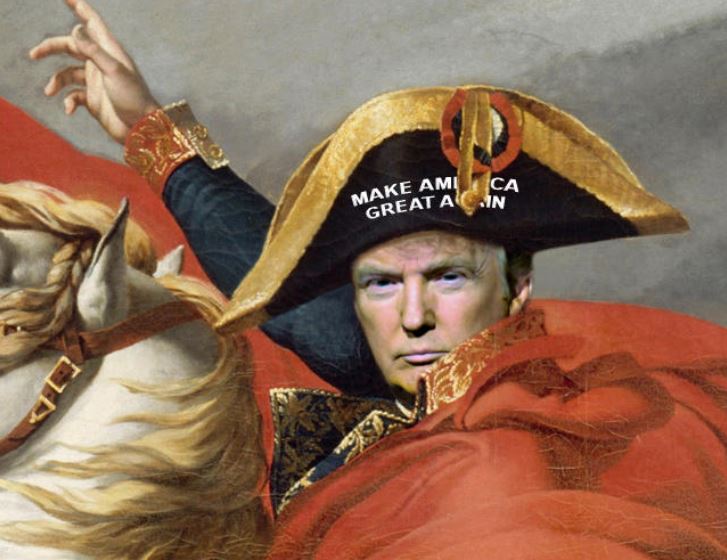
TBT – #MAGAWeek2018 – John Quincy Adams

Because I was out sick from work yesterday (and will be again today), I needed a way to cover Secretary of State and President John Quincy Adams with one AP United States History class that was slightly behind the others (in part to our strange, rotating schedule).  It occurred to me that I had written nearly 2000 words on the great Secretary of State back in 2018, during the first ever #MAGAWeek.  Why not have the students read that?

So, given my decrepit—but improving!—situation, I thought I’d dedicate today’s TBT to the man who was, perhaps, the greatest Secretary of State in American history—the oft-forgotten, much-maligned John Quincy Adams:

John Quincy Adams

If yesterday’s MAGA Week profile of George Washington was straight from “American History Greatest Hits, Volume I,” today’s selection is like a bootlegged deep-cut from an obscure local musician’s live show.  John Quincy Adams—an American diplomat, Secretary of State, President, and Congressman—deserves better.

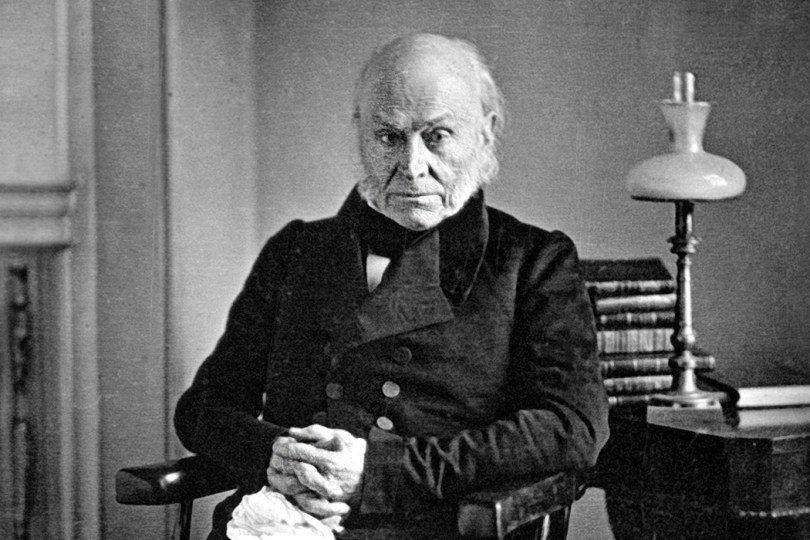
US History students of mine for years have recoiled at the dour daguerreotype portrait of our somewhat severe sixth President.  But behind that stern, austere visage churned the  mind of a brilliant, ambitious man—and probably the greatest Secretary of State in American history.  I will be focusing on Adams’s tenure in that position in today’s profile.

An “Era of Good Feeling”

Adams was one of several “all-star” statesmen of the second generation of great Americans.  After the careers of George Washington, Alexander Hamilton, Thomas Jefferson, and John Quincy’s father, John Adams, a new, youthful cadre of ambitious and talented national leaders took their place at the helm of a nation that was growing and expanding rapidly.  From the ill-fated War of 1812 through the Mexican War, leaders like John C. Calhoun, Daniel Webster, Henry Clay, and Andrew Jackson—the populist odd-man out—forged a national identity and sought to navigate the nation through its early growing pains.

John Quincy Adams was among this group.  After the War of 1812, his father’s old Federalist Party largely died out, both due to the treasonous actions of the so-called “Blue Light” Federalists (who openly sided with the British) and to demographic changes brought about by westward expansion and the Louisiana Purchase in 1803.  More Americans were small, yeoman farmers, and the Federalists’ pro-British, pro-industry, pro-commerce platform held little appeal for feisty frontiersman who were suspicious of a strong federal government and the hated Second Bank of the United States, charted in 1816.

As such, the United States entered an “Era of Good Feeling” under President James Monroe, in which one party, the Democratic-Republican Party, remained.  Monroe’s cabinet was a “who’s who” of young, dynamic men, and Adams was his Secretary of State.

Secretary of State

It was in this context that Adams made his most significant contributions to American foreign policy and nationalism.  While serving as Secretary of State, he laid out a vision for America’s future that held throughout the nineteenth century.

In essence, Adams argued that the United States should pursue a realist foreign policy that avoided wars and foreign entanglements; that the nation should not seek a European-style “balance of power” with its Latin American neighbors, but should be exercise hegemonic dominance in the Western Hemisphere; and that the United States should gain such territory as it could diplomatically.

In 1821, Adams famously issued his warning against involvement in foreign wars of liberation.  The context for this warning was the Greek War of Independence from the Ottoman Empire, an endeavor that was hugely popular in Europe, particularly in Britain.  Many Americans urged Congress to intervene in the interest of liberty, and for Americans to at least send arms to help in another fledgling nation’s war for independence.

Adams perceptively saw the dangers inherent in the United States involving itself in other nations’ wars, even on the most idealistic of grounds.  To quote Adams at length:

“Wherever the standard of freedom and Independence has been or shall be unfurled, there will her heart, her benedictions and her prayers be. But she goes not abroad, in search of monsters to destroy. She is the well-wisher to the freedom and independence of all. She is the champion and vindicator only of her own. She will commend the general cause by the countenance of her voice, and the benignant sympathy of her example. She well knows that by once enlisting under other banners than her own, were they even the banners of foreign independence, she would involve herself beyond the power of extrication, in all the wars of interest and intrigue, of individual avarice, envy, and ambition, which assume the colors and usurp the standard of freedom. The fundamental maxims of her policy would insensibly change from liberty to force…. She might become the dictatress of the world. She would be no longer the ruler of her own spirit.” (Emphasis added; Source:  https://www.mtholyoke.edu/acad/intrel/jqadams.htm)

If America were to involve itself in open-ended wars of liberation—even once!—it would set a dangerous precedent that the United States would become constantly embroiled in the squabbles of other nations.  No matter how well-meaning, such intervention would commit the nation to a disastrously unlimited policy of nation-building and war.

The Transcontinental Treaty (1819)

Prior to rumblings for intervention in Greece, Adams brokered the purchase of Spanish Florida in a rather amusing fashion.  The hero of the Battle of New Orleans, General Andrew Jackson, pursued a group of Seminole Indians into Florida, violating orders to respect the international border.  In the process, Jackson attacked a fort manned by Seminoles and escaped slaves, killed two British spies, and burned a Spanish settlement.

Instantly, an international crisis seemed imminent.  To a man, President Monroe’s cabinet demanded disciplinary action be taken against General Jackson.  It was Adams—who, ironically, would become Jackson’s bitterest political opponent in 1824 and 1828—argued against any such action, and planned to use Jackson’s boldness to America’s advantage.

With apologies to Britain and Spain, Adams pointed out that, despite the government’s best efforts, Jackson was almost impossible to control, and was apt to invade the peninsula again.  Further, Spanish rule in Florida was increasingly tenuous, due to the various Latin American wars of independence flaring up at the time.  With revolts likely—and facing the prospect of another Jackson invasion—Spain relented, selling the entire territory for a song.

The Oregon Country and the Convention of 1818

Adams was also key in securing the Oregon Country for the United States, although the process was not completed in full until James K. Polk’s presidency, some thirty years later.  The Oregon Country—consisting of the modern States of Washington and Oregon—was prime land for settlement, but the United States and Great Britain both held valid claims to the territory.

Adams realized that the United States could afford to be patient—given America’s massive population growth at the time, and its citizens’ lust for new lands, Adams reasoned that, given enough time, American settlers would quickly outnumber British settlers in the territory.

Sure enough, Adams secured another territory for the United States, albeit in far less dramatic fashion that the acquisition of Florida one year later.

The Monroe Doctrine (1823)

Perhaps Adams’s greatest contribution to the United States was his work on the Monroe Doctrine in 1823.  Once again, Adams’s diplomatic brilliance came into play.

Adams sought to keep the United States out of foreign wars, but he also wanted to keep European powers out of the Western Hemisphere.  As Spain continued to lose its grip on its American colonies, the autocratic nations of Russia, Prussia, and Austria (the Austrian Hapsburg controlled Spain at this time) sought to reestablish monarchical rule in the Western Hemisphere.

President Monroe and Secretary Adams were having none of it—nor was was Great Britain, which enjoyed a brisk trade with the newly-independent republics of Latin America.  To that end, Britain proposed issuing a joint statement to the world, with the effect of committing both nations to keeping the new nations of Latin American independent.

Monroe was excited at the idea, but in his ever-prescient manner, Adams argued for caution.  Were the United States to issue the declaration jointly with Britain, they would appear “as a cockboat in the wake of a British man-o-war.”  It would be better, Adams argued, to issue a statement unilaterally.

The United States had no way, in 1823, to enforce the terms of the resulting Monroe Doctrine, which pushed for three points:  Europe was to cease intervention in the affairs of the Western Hemisphere (non-intervention); Europe was to cease acquiring new colonies in the Western Hemisphere (non-colonization); and the United States would stay out of open-ended entanglements and alliances with Europe (isolation).

However, Adams knew that Britain would enforce the Monroe Doctrine with its mighty navy, even if the United States issued it unilaterally, because it would be in Britain’s national interest to do so.  Sure enough, Adams’s shrewd realism won the day, and, other than France’s brief occupation of Mexico during the American Civil War, European powers never again established colonies in the New World.

After Monroe’s Cabinet

For purposes of space and length, I will forego a lengthy discussion of Adams’s presidency and his tenure in Congress.  He was an ardent nationalist in the sense that he sought an ambitious project of internal improvements—roads, canals, harbors, and lighthouses—to tie the young nation together.  In his Inaugural Address, he called for investment in a national university and a series of observatories, which he called “lighthouses of the sky,” an uncharacteristically dreamy appellation that brought him ire from an already-hostile Congress.

His presidency, too, was marred by the unusual circumstances of his election; Adams is the only president to never win the popular or electoral vote, or to ascend to the position from the vice presidency.  That’s a story worth telling in brief, particularly for political nerds.

The presidential election field of 1824 was a crowded one, and the “Era of Good Feeling” and its one-party dominance were showing signs of sectional tension (indeed, the second system of two parties, the National Republicans—or “Whigs”—and Jackson’s Democratic Party, would evolve by 1828).  There were four candidates for president that year:  Andrew Jackson, John Quincy Adams, Speaker of the House Henry Clay, and Secretary of Treasury William Crawford of Georgia.

Jackson won a plurality of the electoral votes—99—but no candidate had a clear majority.  In this event, the top three candidates are thrown to the House of Representatives, where each State’s delegation votes as one.  Crawford, who finished third, was deathly ill, and was not a suitable candidate, and Henry Clay, in fourth, was not eligible constitutionally.

That left the rabble-rousing Jackson and the austere Adams.  Clay, as Speaker of the House, held immense influence in Congress, and could not stand Jackson, so he threw his support behind Adams, who won the election in Congress.

Apparently losing all the wisdom and prudence of his days at the State Department, Adams foolishly named Clay as his new Secretary of State—an office that, in those days, was perceived as a stepping stone to the presidency.  Jackson supporters immediately cried foul, arguing that it was a “corrupt bargain” in which Clay sold the presidency in exchange for the Cabinet position.

While it appears that Adams sincerely believed Clay was simply the best man for the job, the decision cast a pall over his presidency, and Jackson supporters would gleefully send their man to the Executive Mansion in 1828.

At that point, Adams expected to settle into a quiet retirement, but was elected to represent his congressional district in 1830.  During his time in Congress, he fought against slavery and the infamous “gag rule,” which prevented Congressman from receiving letters from constituents that contained anti-slavery materials.  He was also a vocal opponent of the Mexican War—as was a young Abraham Lincoln during his single term in Congress—and died, somewhat disgracefully, while rising to oppose a measure to honor the veterans of that war.

Regardless, Adams’s career shaped the future of the country, gaining it international prestige and setting it on track to emerge as a mighty nation, stretching from sea to shining sea.  Through his service and genius, Adams made America great—and, physically, in a very literal sense.

Quick References

Support Milo

I hold a soft spot in my heart for conservative gadfly and Internet provocateur Milo Yiannopoulos.  I recall fondly his heyday in 2015-2016, when he championed free speech in the Babylon of Progressivism, Berkeley, California.  I still wish President Trump would appoint him White House Press Secretary—it would be must-see TV every day.

Behind the flamboyant, cartoonish homosexuality and the over-the-top trollery, though, is a talented journalist and writer; indeed, Milo’s work is some of the best long-form journalism I’ve ever read.  His writing, like his public speaking, is engaging and well-researched:  he really checks his facts and his sources, while still delivering that withering Coulterian death strike upon his unfortunate target.

Unfortunately, even fewer Americans will have the opportunity to read his work, as he’s apparently sold his website, Dangerous.com.

Read More »

Happy Columbus Day!

Today is Columbus Day in the United States, the day that commemorates Columbus’s voyage to the Americas in 1492.  It’s one of the most significant events in human history—as I tell my American History students, “we wouldn’t be here if Columbus hadn’t made his voyages”—yet the social justice, Cultural Marxist revisionist scolds want to do away with the holiday entirely, replacing it instead with “Indigenous People’s Day.”

The thrust of the proposed (or, as is the way with SJWs, demanded) name change is that Columbus was a genocidal, white male meanie who defrauded and murdered peace-loving Native Americans (who had the gall to mislabel Indians!), so instead we should celebrate the contributions of Stone Age cannibals.

Read More »

Lazy Sunday XXXI: Trump, Part II

This week’s Lazy Sunday picks up from last week’s edition, “Lazy Sunday XXX: Trump, Part I.”  Our perpetually embattled POTUS/GEOTUS continues to fight back against the screeching Leftists:

  • Trump Up in Polls” – This piece from July looks at Trump’s rising approval ratings.  It also analyzes those numbers, and looks at MSNBC gasbag Joe Scarborough’s prediction that “bigotry and racism” would cost Trump reelection in 2020.  At the time, I wrote that “bigotry and racism” would not be much of a factor:  the epithet of “racism” has been hurled so much lately, it’s become like “The Boy Who Cried Wolf”—it’s meaningless.
  • Happy Monday: President Trump’s Approval Rating at 52” – Remember the government shutdown?  That seems like an eternity ago (I wish it were still going on).  Even in the midst of that, Trump’s approval ratings crested to their highest since Inauguration 2017.  President Trump has returned to the 52% (and 53%, I believe) mark since the impeachment witch hunt has begun.
  • Babes for Trump” – This little post always seems to do well, and was seeing a steady trickle of traffic recently (consistently enough that I made it a TBT feature).  Whenever I post it to The Portly Politico‘s Facebook page, one of my Trumpian former students always likes it.  Easy, big fella!  Regardless, the post is about President Trump’s support among Republican women.  My only real fear for 2020 is that, should Fauxcahontas get the nomination, box wine aunties and suburban moms will vote for her because she’s a woman, and because Trump is a “meanie.”  Get over yourselves!
  • Breaking:  Trump Nominated for Nobel Peace Prize” – Remember when we were supposed to be embroiled in nuclear war with North Korea?  Notice how that hasn’t happened?  A Scandinavian politician called for President Trump’s nomination to the Nobel Peace Prize.  That might have been a tad rich, but it would have been far more deserved than President Barack Obama’s receipt of the award—simply because he was a black guy who got elected President!  He won the award before he even had a chance to wreck our foreign policy.

Well, that’s it for this Sunday.  Enjoy your Columbus Day tomorrow!

–TPP

Other Lazy Sunday Installments:

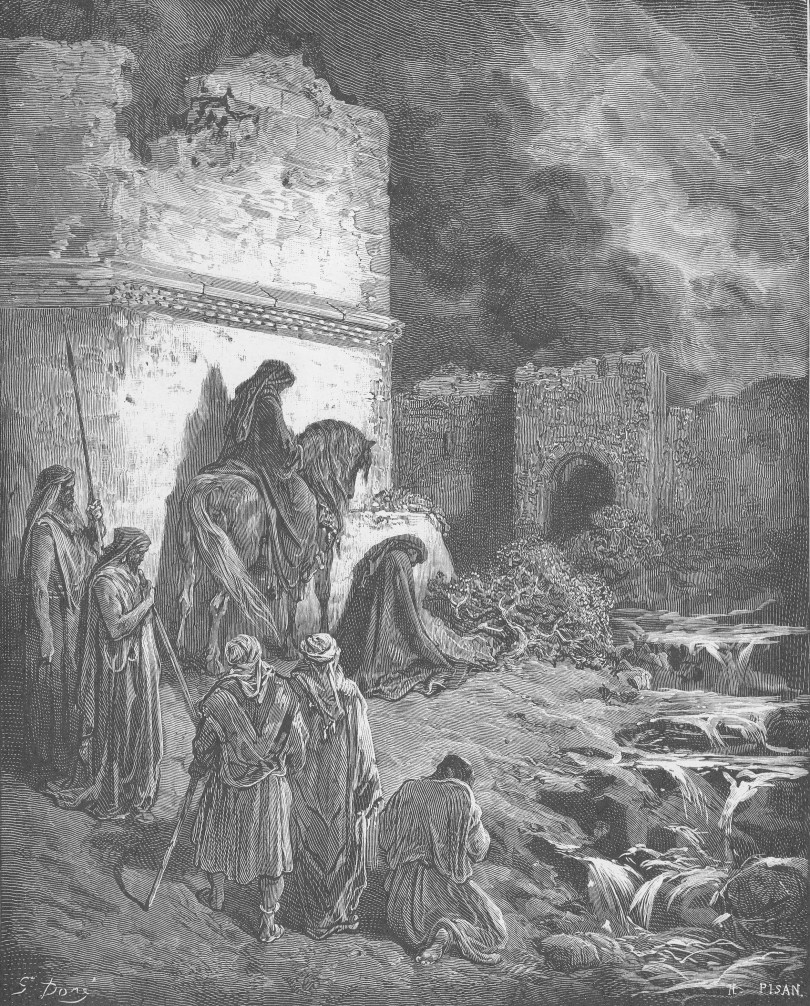
TBT: Nehemiah and National Renewal

In keeping with the unofficially churchy theme of two of this week’s posts (here and here), it seemed like a good opportunity to look back at a post from February about Nehemiah.  In “Nehemiah and National Renewal,” I explored the impact of Nehemiah’s faithful reconstruction of Jerusalem’s collapsed wall in terms of the national renewal it brought (and the spiritual renewal that came with it in a follow-up post):

This past Wednesday, I was asked to fill in for the pastor at the small church I attend.  Being such a small church—our average Sunday morning attendance is about forty—the pastor works another job, and he had a rare business trip.  I suppose he figured he could do worse than asking a high school history teacher to fill in for him.

Fortunately, the lesson was fairly straightforward:  he sent me a handout on Nehemiah 1:1-11, and the focus of the lesson was on the idea of spiritual renewal.

For the biblically illiterate—a shocking number of Americans today, I’m finding (I once had a class full of philosophy students who had never heard the story of the Tower of Babel, which is pretty much Sunday School 101)—the story of Nehemiah is simple:  after an extended period of exile in Babylon, the Israelites were sent back, under the auspices of the Persian Emperor Cyrus the Great, to Jerusalem.  Cyrus sponsored the rebuilding of the Temple in Jerusalem, but the city itself, as well as its walls, remained in a state of disrepair.

There were two waves of Israelite resettlement over the span of a century, but many Israelites remained in Babylon or other parts of the Persian Empire, such as the imperial capital.  Nehemiah was one of those, and would be part of a third wave of resettlement.  He served as cup-bearer to Artaxerxes, the Persian emperor at the time.  The position of cup-bearer was an important and trusted one:  he handled the emperor’s food and drink, ensuring it was not poisoned.

Beyond serving as the royal taste tester, the office carried with it important administrative duties, and gave incredible access to the emperor.  In short, it was a position of great influence, power, and prestige, which positioned Nehemiah nicely for what was to come.

Nehemiah spoke to a fellow Israelite who was visiting the imperial capital, and was distraught to hear of the poor condition of the city and its walls.  He fell to his knees, weeping and crying out to the Lord.  Nehemiah 1 details his prayer to God, calling out in adoration; confessing his and his people’s sins; thanking God for His mercy and gifts; and supplicating God for His Will to be accomplished through Nehemiah.

Specifically, Nehemiah asked God to be used to rebuild the wall around Jerusalem.  As cup-bearer, Nehemiah was able to present his petition to the emperor, who agreed to send Nehemiah to oversee the construction project.  In addition, Artaxerxes provided lumber from the royal forest, as well as funds to bankroll the endeavor.  He also sent letters with Nehemiah detailing his endorsement of the project.

Nehemiah’s work was not finished there, and it was anything but easy.  Initially, surrounding tribes criticized and mocked Nehemiah, questioning his loyalty to Artaxerxes, and saying that rebuilding the walls was a silly waste of time and effort.

However, once the wall reached half its height, his critics began plotting violence.  The plot to attack the workers reached Nehemiah, so he divided the work crews into those building the wall, and those defending their fellow workers from attack.

Having failed to stage an attack on the workers, Nehemiah’s enemies realized that the man himself was the target—cut off the head, kill the snake.  Again, God revealed this plot against Nehemiah, and he was able to avoid assassination.

Finally, the wall was rebuilt in an astonishing fifty-two days, an incredible feat of organization, ingenuity, and faithfulness.  The naysayers were humiliated, and Nehemiah instituted a period of national and spiritual renewal among the Israelites.  His reforms purified the nation spiritually and even ethnically, as old debts were forgiven and marriages to pagan women were dissolved.

It’s a powerful story—indeed, a powerful bit of history—about trusting in God in the face of extremely difficult odds.  But Nehemiah is also a story about national renewal, and the spiritual revival that came with it.

The wall around Jerusalem served a practical purpose—defending the city and its inhabitants from attack (even though the city was under the protection of the Persian Empire, the ancient Near East was, then as now, notoriously tribal, and the collapse of an empire would lead to dozens of ethnic conflicts)—but it was also a symbol of the Israelite nation.

Indeed, the author of the handout I used Wednesday evening writes that the “enemies of Israel could say, ‘What kind of God do you serve?  Look at the mess of your Holy City?’ It was a terrible witness and was cause for reproach from non-believers.”  The poor condition of the Jerusalem and its fortifications reflected the spiritual decay and corruption of the Israelites—they had intermarried with pagan women, adopting their false gods; they were living in rubble; and their reduced condition suggested that their God—the One True God—was not Who He made Himself out to Be.

It’s a bit on the nose, but I can’t help but recognize the parallels between the United States today and Jerusalem then—and between President Trump and Nehemiah (although I think Trump is closer to Cyrus the Great in terms of his spirituality and outlook).

I’m not suggesting Nehemiah was clubbing with Eastern European supermodels.  But like Trump, he faced overwhelming resistance from other nations to his wall project.  The rest of the ancient Near East feared a strong, renewed Israel.  Nehemiah’s return to Jerusalem, and the reconstruction of the wall, led to a period of national revival, as the people regained their identity, expelled the corrosive foreign influence in their midst, and renewed their commitment to God.

America is, spiritually and culturally, in similarly dire straits today.  President Trump has presented himself as a modern-day Nehemiah, come to control our borders, enforce our immigration laws, and restore America’s greatness on the world stage.  While he has made great strides in these areas, he meets resistance, duplicity, and mockery at every turn.

The story of Nehemiah tells us, however, that the struggle is worth the slings and arrows our enemies, both foreign and domestic, will lob at us.  To President Trump, I would urge the following:  stay the course, ignore the haters, take it to God, and BUILD THE WALL!