Happy Halloween!

It’s Halloween!  All the build-up, all the ghost stories, it’s finally here!

Last night I took the opportunity to carve my one of the two pumpkins I picked up earlier in the month ($4 a pop!).  He’s the cheeky little guy pictured above, and in the photo collage below (I’m getting fancy with the production values in this post).

His brother was stolen off my front porch Wednesday night.  I’d just gotten in bed and switched off the lights when I heard some tires squealing.  Thinking it was one of my neighbor’s buddies hydroplaning on the wet street, I didn’t think much of it, until my neighbor began shouting for me minutes later!

Read More »

Happy Columbus Day!

Today is Columbus Day in the United States, the day that commemorates Columbus’s voyage to the Americas in 1492.  It’s one of the most significant events in human history—as I tell my American History students, “we wouldn’t be here if Columbus hadn’t made his voyages”—yet the social justice, Cultural Marxist revisionist scolds want to do away with the holiday entirely, replacing it instead with “Indigenous People’s Day.”

The thrust of the proposed (or, as is the way with SJWs, demanded) name change is that Columbus was a genocidal, white male meanie who defrauded and murdered peace-loving Native Americans (who had the gall to mislabel Indians!), so instead we should celebrate the contributions of Stone Age cannibals.

Read More »

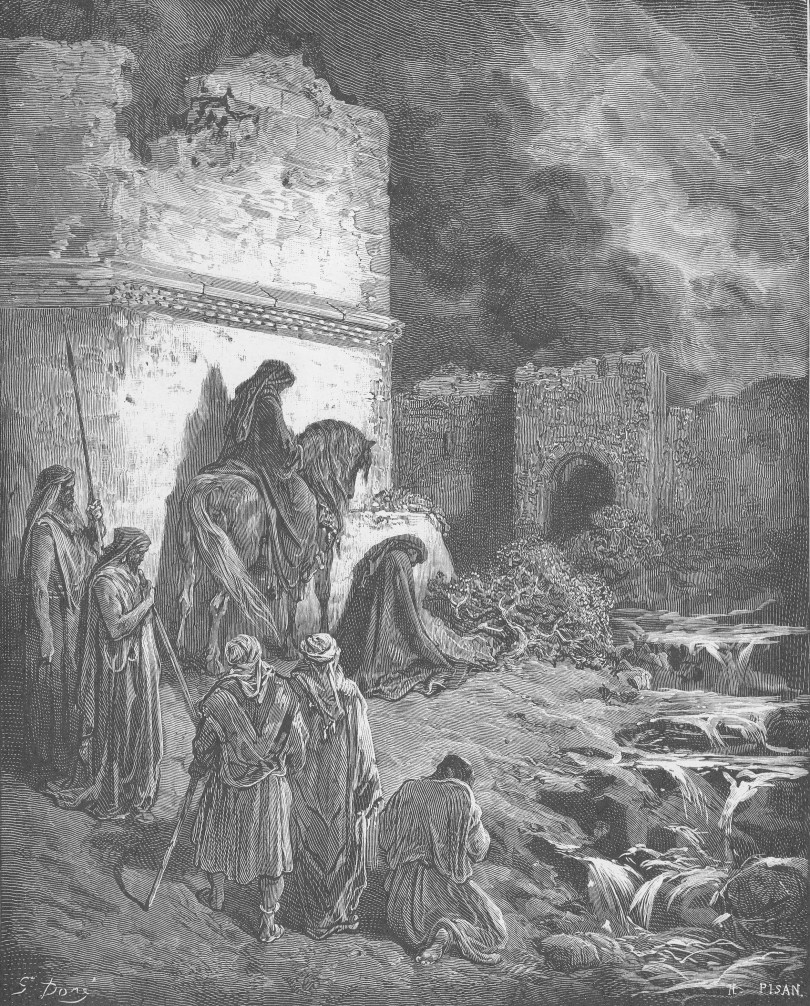
TBT: Nehemiah and National Renewal

In keeping with the unofficially churchy theme of two of this week’s posts (here and here), it seemed like a good opportunity to look back at a post from February about Nehemiah.  In “Nehemiah and National Renewal,” I explored the impact of Nehemiah’s faithful reconstruction of Jerusalem’s collapsed wall in terms of the national renewal it brought (and the spiritual renewal that came with it in a follow-up post):

This past Wednesday, I was asked to fill in for the pastor at the small church I attend.  Being such a small church—our average Sunday morning attendance is about forty—the pastor works another job, and he had a rare business trip.  I suppose he figured he could do worse than asking a high school history teacher to fill in for him.

Fortunately, the lesson was fairly straightforward:  he sent me a handout on Nehemiah 1:1-11, and the focus of the lesson was on the idea of spiritual renewal.

For the biblically illiterate—a shocking number of Americans today, I’m finding (I once had a class full of philosophy students who had never heard the story of the Tower of Babel, which is pretty much Sunday School 101)—the story of Nehemiah is simple:  after an extended period of exile in Babylon, the Israelites were sent back, under the auspices of the Persian Emperor Cyrus the Great, to Jerusalem.  Cyrus sponsored the rebuilding of the Temple in Jerusalem, but the city itself, as well as its walls, remained in a state of disrepair.

There were two waves of Israelite resettlement over the span of a century, but many Israelites remained in Babylon or other parts of the Persian Empire, such as the imperial capital.  Nehemiah was one of those, and would be part of a third wave of resettlement.  He served as cup-bearer to Artaxerxes, the Persian emperor at the time.  The position of cup-bearer was an important and trusted one:  he handled the emperor’s food and drink, ensuring it was not poisoned.

Beyond serving as the royal taste tester, the office carried with it important administrative duties, and gave incredible access to the emperor.  In short, it was a position of great influence, power, and prestige, which positioned Nehemiah nicely for what was to come.

Nehemiah spoke to a fellow Israelite who was visiting the imperial capital, and was distraught to hear of the poor condition of the city and its walls.  He fell to his knees, weeping and crying out to the Lord.  Nehemiah 1 details his prayer to God, calling out in adoration; confessing his and his people’s sins; thanking God for His mercy and gifts; and supplicating God for His Will to be accomplished through Nehemiah.

Specifically, Nehemiah asked God to be used to rebuild the wall around Jerusalem.  As cup-bearer, Nehemiah was able to present his petition to the emperor, who agreed to send Nehemiah to oversee the construction project.  In addition, Artaxerxes provided lumber from the royal forest, as well as funds to bankroll the endeavor.  He also sent letters with Nehemiah detailing his endorsement of the project.

Nehemiah’s work was not finished there, and it was anything but easy.  Initially, surrounding tribes criticized and mocked Nehemiah, questioning his loyalty to Artaxerxes, and saying that rebuilding the walls was a silly waste of time and effort.

However, once the wall reached half its height, his critics began plotting violence.  The plot to attack the workers reached Nehemiah, so he divided the work crews into those building the wall, and those defending their fellow workers from attack.

Having failed to stage an attack on the workers, Nehemiah’s enemies realized that the man himself was the target—cut off the head, kill the snake.  Again, God revealed this plot against Nehemiah, and he was able to avoid assassination.

Finally, the wall was rebuilt in an astonishing fifty-two days, an incredible feat of organization, ingenuity, and faithfulness.  The naysayers were humiliated, and Nehemiah instituted a period of national and spiritual renewal among the Israelites.  His reforms purified the nation spiritually and even ethnically, as old debts were forgiven and marriages to pagan women were dissolved.

It’s a powerful story—indeed, a powerful bit of history—about trusting in God in the face of extremely difficult odds.  But Nehemiah is also a story about national renewal, and the spiritual revival that came with it.

The wall around Jerusalem served a practical purpose—defending the city and its inhabitants from attack (even though the city was under the protection of the Persian Empire, the ancient Near East was, then as now, notoriously tribal, and the collapse of an empire would lead to dozens of ethnic conflicts)—but it was also a symbol of the Israelite nation.

Indeed, the author of the handout I used Wednesday evening writes that the “enemies of Israel could say, ‘What kind of God do you serve?  Look at the mess of your Holy City?’ It was a terrible witness and was cause for reproach from non-believers.”  The poor condition of the Jerusalem and its fortifications reflected the spiritual decay and corruption of the Israelites—they had intermarried with pagan women, adopting their false gods; they were living in rubble; and their reduced condition suggested that their God—the One True God—was not Who He made Himself out to Be.

It’s a bit on the nose, but I can’t help but recognize the parallels between the United States today and Jerusalem then—and between President Trump and Nehemiah (although I think Trump is closer to Cyrus the Great in terms of his spirituality and outlook).

I’m not suggesting Nehemiah was clubbing with Eastern European supermodels.  But like Trump, he faced overwhelming resistance from other nations to his wall project.  The rest of the ancient Near East feared a strong, renewed Israel.  Nehemiah’s return to Jerusalem, and the reconstruction of the wall, led to a period of national revival, as the people regained their identity, expelled the corrosive foreign influence in their midst, and renewed their commitment to God.

America is, spiritually and culturally, in similarly dire straits today.  President Trump has presented himself as a modern-day Nehemiah, come to control our borders, enforce our immigration laws, and restore America’s greatness on the world stage.  While he has made great strides in these areas, he meets resistance, duplicity, and mockery at every turn.

The story of Nehemiah tells us, however, that the struggle is worth the slings and arrows our enemies, both foreign and domestic, will lob at us.  To President Trump, I would urge the following:  stay the course, ignore the haters, take it to God, and BUILD THE WALL!

World Space Week Starts Today

It’s been a long but productive week for yours portly.  Readers will notice that, other than my recent features (yesterday and last Thursday’s posts), I’ve been mostly silent on the impeachment circus.  My general policy in this age of media perfidy is to withhold comment until the real facts have been reported.

The way everything is shaping up, my gut instincts—that there is nothing to claims that President Trump has committed impeachable offenses, defined constitutionally as “high crimes and misdemeanors”—seem validated.  Of course, that won’t stop the Democrats from expending months of energy, treasure, and rhetoric on banging the drum of impeachment.

In general, I’ve been trying to expand the focus of the blog, moving away from strictly writing about politics and politics-adjacent issues to more general interest topics.  My little piece on Saturn from a few weeks ago was enjoyable to write, and seemed to garner some positive feedback.

As such, I was excited to see that today marks the beginning of World Space Week.

Read More »

Lazy Sunday XXIX: The New Criterion

Conservatives, especially conservative writers and publishers, tend to get so fixated on policy wonkery and political debates, we sometimes lose sight of culture.  One reason I appreciate blogger buddy photog’s blog, Orion’s Cold Fire, so much is that he makes room for reviews of sci-fi novels, Twilight Zone episodes, and the like.

One publication that makes culture the centerpiece of its mission is The New Criterion, which takes the idea of reviewing the best in art, literature, music, and drama very seriously.  I recently re-subscribed TNC after having a lapsed subscription for a couple of years, and I’m eager to get my first issue in forty-eight weeks.

With that in mind, this week’s Lazy Sunday is dedicated to pieces the writers at The New Criterion inspired:

  • Civilization is Worth It” – This piece discusses an excellent audio version of a piece about Rousseau’s ideas regarding civilization (that is to say, Rousseau argued civilization was the cause of all of our problems, and we were better of dancing around naked in caves).  It’s definitely worth a listen.
  • E.T.A. Hoffman & Romanticism” – This very short post covered a charming little essay about E.T.A. Hoffman, arguably the founder of the Romantic movement in literature, as well as a brief discussion of the consequences, both positive and negative, of the Romantic temperament, and the idea of the brooding, troubled artist.
  • The League of Nations” – Trans- and supranational organizations were all the rage in the twentieth century, and the League of Nations was the first—and the biggest flop—in this do-gooding, globalist trend.  The League of Nations was famously ineffective, which just meant we’d be saddled with an even worse organization, the United Nations, after the League failed to prevent the Second World War.  Now the European Union is creating a tyrannical empire of Belgian bureaucrats in the name of preventing a tyrannical empire of German bureaucrats from trying to conquer Europe again.  Yeesh.
  • The Good Populism” – The counter to the aforementioned tyrannical transnational organizations is good, healthy populism, the kind of middle-class, conservative revolutions that brought us the Declaration of Independence, the Constitution, and Donald Trump (among others).  Super historian and classicist Victor Davis Hanson makes the case for the “good populism,” as opposed to Bernie Bro socialistic populism, in this piece, one of the most popular TNC published in 2018.
  • New Criterion on Principles in Politics” – What’s more important—principles or victory?  That’s not exactly the gist of this piece, but it does examine the tricky debate taking place among the Right currently about how to handle deranged Leftists.  What are the limits of principles?  The David French model of always surrendering—but being polite while doing so—is clearly not an effective way to uphold conservative principles.

That’s it for this Sunday.  Enjoy some erudite cultural criticism!

–TPP

Other Lazy Sunday Installments:

Lazy Sunday XXVIII: World History

Most of my pieces here at The Portly Politico focus on American politics and culture, with some occasional dabbling in British and European affairs.  But contrary to Ron Swanson’s historiographical claim, history did not begin in 1776 (though everything that came before may have been a mistake).

As such, I’ve written a few pieces about events, current and historical, that take place in more exotic locales.  While I am a parochial homebody, I appreciate travel and the contributions of other cultures (I still wish I’d seen London and Paris before they became part of the Caliphate).  I wish I had the time to do more of it (on that note, stay tuned for details of my trip to the Yemassee Shrimp Festival).

So, here’s some worldly pieces for your Lazy Sunday:

  • North Korea Reflections” – I wrote this little piece on the occasion of President Trump’s historic summit with North Korean dictator Kim Jong-un in Singapore.  My interpretation of the summit was cautiously optimistic.  It’s still unclear what the future holds for US-Nork relations, but the gambit seemed to work—North Korea is a still a bloodthirsty, repressive, totalitarian regime, but they aren’t lobbing missiles around constantly anymore.
  • The Impermanence of Knowledge and Culture:  The Great Library and Notre Dame” – this post was a synthesis of two events—the destruction of the Great Library at Alexandria, and the burning of a substantial portion of the Notre Dame Cathedral.  The fire at the latter riled up conservatives and traditionalists because the structure had endured for so long as a symbol of Christianity and of France’s faithfulness.  France is not a very faithful country now, but Notre Dame remains a powerful symbol of man’s capacity for focusing on the greatness of God.  The major point of this piece was to drive home how even great edifices eventually crumble, and that knowledge and culture must be preserved actively if they are to endure.
  • Sri Lankan Church Bombings” – coming on the heels of the catastrophic Notre Dame fire, the island nation of Sri Lanka was shaken on Easter Sunday of this year with Islamic terrorist attacks on churches.  Democrats referred to the slain Christians as “Easter worshippers” in what appeared to be a concerted effort to appear politically-correct.  Yeesh.
  • America’s Roman Roots” – I wrote this piece earlier in the week, based on an excellent op-ed a colleague sent my way.  Commentators often fixate on the similarities between the United States today and the Roman Empire, but often miss the parallels to the Roman Republic.  Those parallels exist because the Framers of the Constitution pulled heavily from Roman tradition, even naming key institutions like the Senate after their Roman counterparts.  The Roman Republic holds valuable lessons for Americans for how to craft a robust society that enables citizens to live worthwhile lives.

That wraps up this little tour around the globe.  Rome, France, Sri Lanka and North Korea—not a bad start, though I’d better get Africa and Latin America into the mix soon, lest I catch flack from the SJWs for lack of inclusion.

Happy Sunday!

—TPP

Other Lazy Sunday Installments:

America’s Roman Roots

The Portly Politico is striving towards self-sufficiency.  If you would like to support my work, consider subscribing to my SubscribeStar page.  Your subscription of $1/month or more gains you access to exclusive content every Saturday, including annual #MAGAWeek posts.  If you’ve received any value from my scribblings, I would very much appreciate your support.

Armchair historians and dime-a-dozen political pundits (like yours portly) love to compare the United States to the Roman Empire, usually during its decadent latter-day decline.  The comparison is an easy one to make; just like Rome in the fourth and fifth centuries, the United States possesses an underclass of wage slaves; an obsession with mystery religions and spiritualistic fads; an immigration crisis; a decadent, self-indulgent quasi-morality; declining birth rates; and a sense the precious liberty of the old Republic has been lost.

Yet for all those declinist comparisons—apt though they may be—Americans should extend their historical gaze back further, to the Roman Republic.  That is what Dr. Steele Brand, Assistant Professor of History at The King’s College, urges Americans to do in an op-ed entitled “Why knowing Roman history is key to preserving America’s future” (thanks to a dear former of colleague of mine—and a regular reader of this blog—for sharing this piece).

Read More »

Remembering 1519

The start of the school year always means the start of the grand narrative of American history.  It dawned on me some years ago that, over the course of roughly 180 days, I undertake an annual, oral retelling of the story of the United States.  One day, I plan to record my lectures, taking the best bits, and compiling them into a lengthy podcast series.  After that, I’ll never have to teach again!

Regardless, the story always starts the same:  a brief overview of the pre-Columbian Americans (what we used to call “Indians,” and more clumsily “Native Americans”), followed up with Spanish exploration from Christopher Columbus through Hernan Cortez and on.

A major part of those early lessons is the encounter of the bloodthirsty Aztecs and the gold-mad Spaniards.  Students love the story of the advanced Aztecs, sacrificing humans to ensure the sunrise, and the arrival of the fiery-haired Cortez and his ragtag band of conquistadors and buccaneers.

Read More »

Ocarina of Time Soundtrack Review

While I was up in New Jersey—I’m mentioning that about as frequently as Ben Shapiro mentioning that his wife is a doctor—my older brother sent me a review of the original soundtrack for The Legend of Zelda: Ocarina of Time.  I highly recommend you check out both the review and the soundtrack.

Ocarina of Time was the major Legend of Zelda release for the Nintendo 64 (N64), and it was an instant classic.  It’s also a testament to the strength of its soundtrack that I never really appreciated how different composer Koji Kondo‘s pieces were for the game.

Read More »

Walls Work, Part II: Sailer on Walls

Demographer Steve Sailer’s been nailing it lately in his book reviews.  On Wednesday, I wrote about his review of Spotted Toad’s new book on education.  Last week, Sailer reviewed another workWalls: A History of Civilization in Blood and Brick, by David Frye.  The key insight of the book:  walls make civilization possible (a corollary:  barbarians and invaders build bridges).

The book sounds fascinating, and like Spotted Toad’s work, it’s one I intend to purchase and read soon.  Sailer hits some of the highlights:  walls were, for thousands of years, the thin line between civilized societies and barbarians.  Where walls ended, barbarians ruled.

Walls provided effective protection against attacks until the Age of Gunpowder and heavy artillery ended their efficacy.  Constantinople withstood conquest for a thousand years before the Turks breached its great walls with the mighty bombard.

The current mania for “building bridges” is at odds with most of human experience.  Sailer points out all of the instances in which invaders have used bridges to attack their foes:  Persians crossing the Hellespont lashed pontoons togethera feat repeated when the Turks conquered Constantinople in 1453.

Indeed, walls don’t just keep bad guys out; they also protect the freedoms of those within.  To quote Sailer (with an embedded quotation from Frye in italics) at length:

Frye pithily sums up:

[Where] there are no border walls, there will be city walls, and where there are no city walls, there will be neighborhood walls….

Thus, Walls concludes with a quick history of the gated communities favored by Hollywood celebrities, such as the Malibu Colony, Hidden Hills, and Beverly Park.

Of course, where there are no neighborhood walls, there will tend to be walls around yards, often with broken bottles on top.

Granted, in the United States, the Jeffersonian tradition was to defend the country with a strong navy, which allowed, among many other benefits, houses to have open front lawns. But traditional American neighborliness seems racist now, so we’ve undertaken to import millions of people from more clannish and hostile cultures.

Put another way:  a strong national defense—bolstered with well-maintained, well-defended barriers—promotes freedom at home.  You don’t need a wall around your house when law enforcement protects against criminals, the military protects against foreign invaders, and sound immigration policy keeps out criminal riff-raff.

Hungary’s border wall is nearly 100% effective at keeping “refugees” out.  There is nothing un-American or unpatriotic about a wall, and open borders are a moral hazard for citizens and immigrants alike.

History—the sum total of human experience, not the “moral arc” dream-state of progressives—supports President Trump’s border wall.  The burden of proof is on the anti-border crowd.  History suggests that societies without border barriers cannot long remain free, and will soon become militaristic conquerors devoted fully to warfare.  Walls allow the people inside to be safe and free, and to specialize beyond a constant fight for survival.

Let’s hope many more Americans read Frye’s book—or, at the very least, Sailer’s excellent review of it—and come to support the border wall and a strong immigration policy.