Talk Radio: America’s Voice

I am a huge fan of talk radio.  Indeed, my dream job (other than teaching) is to be a talk radio show host at a local AM or FM news-talk station, maybe doing a morning show (I could at least take Glenn Beck’s sanctimonious nine-to-noon spot).  Strangers often tell me “you sound like you’re on the radio,” and talk-radio is basically everything I like about teaching without the grading.  I’ve guest-hosted online programs before, and have toyed with the idea of doing a weekly TPP podcast, but the real dream is to be on a terrestrial radio station.

As such, I was thrilled to stumble upon an interesting piece on Politico this week about AM radio stations across the country.  The piece, “The Lo-Fi Voices That Speak for America,” gives a brief overview of five broadcasters from across the country (including a Navajo-language broadcaster).  It’s worth taking ten minutes of your Tuesday morning to read through it.

The major takeaway from the piece is this:  listeners value relevant, local, even niche content.  One reason blogs and podcasts are so appealing is because they have the time and space to deal with niche (even fringe) topics in-depth at at-length.

A shortcoming of terrestrial radio, especially commercial radio, is the constraints of advertising.  I did the math once:  Sean Hannity’s program, which I listen to, in part, almost daily, consists of about thirty-two minutes of actual content per hour—and that includes the twice-hourly, one-minute cut-ins between commercial breaks.  An opening segment runs from 3:05-3:20 PM, with a one-minute cut-in at around 3:25.  He doesn’t begin his second segment until 3:35.  That means there’s nearly fifteen minutes of commercials (as well as local news updates, etc.) between segments.

Local programming, however, seems to have more space for topics, and a smidge more flexibility.  Local hosts also have a better “feel” for their communities, and the topics that people want to hear about.  Austin Rhodes has been a fixture in Augusta, Georgia, for thirty-plus years for that very reason.  Ken Ard’s programGood Morning Pee Dee, is hugely popular in Florence, South Carolina (plus, it’s fun to hear a populist good-old-boy run down the news of the day).

There are some crummy local hosts (there’s a local former mayor with a show on Augusta’s news-talk station who sounds like paint-drying), but at least there’s some color.  The downside to nationally-syndicated shows is that they tend to blur together.  The best national programs (besides the king, Rush Limbaugh, whom many imitate) are the wackiest.  That’s why Michael Savage is so fun—he goes from railing against elites to spending half-an-hour talking about what he had for dinner.

I just wish they’d give Gavin McInnes a terrestrial show, but I don’t think he could police his bad language enough.  Thank goodness for podcasts.

Painting

Tonight’s post is one of those self-indulgent entries that has little bearing on what’s happening in the world today, but it’s germane to why this post is so late to arrive.

I spent the day painting in my brother’s finished basement.  He and his wife have this great living area/playroom for their kids down there, but there was a great deal of trim work that needed painting, as well as baseboards.

I spend many of my summers working maintenance at school, which usually involves painting classrooms.  There’s something about slapping a fresh coat of paint on a room that makes it look like there have been major upgrades or improvements, when really you’ve just changed the color.

Of course, everyone loves that fresh paint smell, and new paint does look good.  A change in color can dramatically change the atmosphere of a room—it’s “feel,” if you will.

This post, however, is more about the process of painting.  While I am thankful I do not have to paint for a living, it is an activity that I enjoy on occasion, usually because I’m getting paid to do it (as was the case today—thanks, bro).  Beyond the financial benefits, the act of painting is akin to driving long distances on the Interstate:  it’s a bit tedious, but it clears the mind wonderfully.  I’ve done some of my deepest thinking done while painting walls.

There’s also a tangible pay-off to painting:  the finished product is very satisfying.  What’s more, the process itself is rewarding, as you watch your progress unfold in real time.  There is little in the way of “busy work” in painting a room.

So many jobs today, especially of the clerical sort, seem to be about spinning wheels in an attempt to appear productive.  I’m convinced that huge sectors of our economy consist of such paper-pushing.  Just look at the excessive credentialing that underpins so many fields, like education, without tangibly improving the quality of the professions.

In painting—as in my blue-collar trades—there is little room for such wheel-spinning.  The job either gets done, or it doesn’t.  Unreliable contractors baffle me for this reason (and they are common in the rural South, as I suspect demand drastically outstrips supply), although the problem there is usually getting the project started.

Regardless, the job must be done.  If it’s not done, it’s noticeable, especially when painting.  A missed spot on the wall is like starting at the pirates’ black spot in your hand.

Of course, painting takes its toll.  My entire body is sore from bending and stretching all day (I was switching between trim on the ceiling and baseboards on the floor, as well as some window trim and door frames).  Anecdotally, I’m told that many professional painters are drunks.  I don’t know if that’s true, but I’ve heard it from enough different people that there must be some kernel of truth to it.  What’s the connection?  (Apparently, paint fumes, but that’s not a huge problem, I’ve found, with latex paint in well-ventilated areas.)

That said, I will sleep soundly tonight, and enjoy a sense of serene accomplishment.  Painting today was a wonderful way to refocus my mind and to help me calm down after a busy, extended Easter Weekend.

Happy Wednesday!

–TPP

101 Postmatians – 101st Consecutive Daily Post!

Perhaps it’s a bit odd to celebrate grinding diligence, but I’m proud of myself.  Yesterday’s post on model bills (a bit of a snoozer of a topic, I’ll admit) marked the 100th consecutive daily post on this blog.

I realized in late December 2018/early January 2019 that WordPress tracks streaks once you hit three consecutive days of posting, so I decided to see how long I could keep the momentum going.  Initially, I was just going to try to get through January.  It’s a slow month in the academic year, a rare moment when I have a sliver of extra time to devote to extracurricular hobbies, like music.

Of course, the more I wrote, the easier it became to churn out posts on any number of topics.  Pretty soon, I’d gotten to fifty posts.  Despite Internet outages (within weeks of each other, both times because a Frontier technician incorrectly disconnected my line), I was able to get some posts up (even if they weren’t of the best quality).

So, to celebrate, I thought I’d take today “off” with a classic retrospective (which I already do once or twice a week with “TBT Thursdays” and “Lazy Sundays“)—a written “clip show,” if you will, of The Streak ’19’s Top Five Posts (so far).

The following are the five posts with the most views as of the time of this writing, presented in descending order (most views to fewest):

1.) “Hump Day Hoax” – it seems these local stories do well (my piece on the fight at the Lamar Egg Scramble has turned up in quite a few searches; I’m still trying to find more details about it).  This piece was about the Mayor of Lamar’s claim that her car was vandalized in a racially-motivated attack, and she expressed relief that the vandal didn’t try to kill her and her husband.  When the Darlington County Sheriff’s deputy came out to investigate, he discovered the mysterious yellow substance was pollen!  That didn’t prevent it from making national news, getting a mention in Newsweek.

At first, I thought our mayor was just trying to get some cheap PR and sympathy for herself, but after discussing it with some other folks, the consensus seems to be that she suffered from stupidity, filtered through a conspiratorial, black victim mentality.  Rather than see the sticky substance for what it was—the ubiquitous pollen that covers our fair Dixie—the mayor’s first thought was a racist attack.

That’s a sad way to live.  As I wrote in this piece, the mayor is a sweet lady, and I think she really wants to do her best to help our little town.  That said, this kind of ignorant hysteria doesn’t help anyone or anything, much less race relations.

2.) “Secession Saturday” – boy, this post generated some views.  The focus of this post was a piece from American Greatness, “The Left Won’t Allow a Peaceful Separation,” by Christopher Roach.  It explores whether or not some kind of peaceful parting of ways between America’s two cultures—traditionalists and progressives—is desirable, and revisits questions the American Civil War resolved—at least for a time—with force of arms (“do States have the right to secede?,” for example).

A panicked former student texted me in anguish, worrying about a Civil War II, after seeing this post on Facebook.  I tried to allay her fears.  But the real point of my commentary was on the idea that the Left is fundamentally totalitarian, and will broach no disagreements.  That’s a key insight Roach and others make, and it’s why I reference back to his piece so frequently.

Of course, it also helped that I linked to this guy in the comments of a more successful blog.

3.-4.) “Nehemiah and National Renewal” & “Nehemiah Follow-Up” – these two posts came amid a week in which I found myself immersed in the Book of Nehemiah (one of my favorites in the Old Testament, as he builds a wall to renew his nation).  The initial post sparked some great feedback from Ms. Bette Cox, a fellow blogger (who, incidentally, preceded me in my soon-to-be-vacated position as the Florence County [SC] GOP Secretary).  She astutely pointed out that my first post missed a key point:  in Nehemiah 1, the prophet falls to his knees and asks for God’s Will.

5.) “Tucker Carlson’s Diagnosis” – one of the posts from the early days of The Streak ’19, it was also a rare video post from me.  I’ll occasionally embed YouTube videos in my posts, but I tend to avoid writing posts that say, “hey, watch this lengthy video.”

Nothing bugs me more than when I’m out somewhere, having a conversation, and someone thrusts a phone in my face with a YouTube video.  I’ve actually told my friends that if they do this, I will refuse to watch it.  It’s not that I don’t want to share the joke with you; it’s that you’re making me watch a video on a cellphone!  C’mon.  I can barely hear the dialogue (or song, or whatever) on your tinny, bass-less phone speaker.  Furthermore, can’t we have a conversation without resorting to SNL clips?

But I digress.  I made an exception for Tucker Carlson’s powerful monologue about our frigid, uncaring elites.  I’ve definitely jumped on the Carlson populist-nationalist train, and I think he makes a compelling case for preserving—or, at least not actively destroying—small towns and the families they nurture.

So, there you have it—a lengthier-than-planned reheating of my posts during The Streak ’19.

Thanks for all of your love and support.  Here’s to another 100 posts!

–TPP

April Fool’s Day: A Retrospective

Today is April 1, 2019, popularly known as April Fool’s Day.  It’s a day for good-natured pranking and mirthful fun, a bit like a poor man’s Halloween.

This April Fool’s Day holds a particular resonance for me, however.  It was ten years ago today that, in the midst of the Great Recession, I lost my job.

Technically, my teaching contract was not renewed.  I still had an obligation to finish out the year, which I did as best I could, but I would not be coming back.

I remember it vividly:  my school’s former headmaster told me he wanted to speak with me.  I went into his office, and he told me a few things:  the school was consolidating my classes into fewer sections; the school desperately needed money (the enrollment was around ninety-five kids, and things were so tight they needed the $28,000 going towards my salary); and the economy was not conducive to private school fundraising and tuition.

He told me that, as I’d studied history (he, too, was a history teacher), I knew how these kinds of economic downturns went.  I thought he was mentioning this as a bit of cold comfort, a sort of, “don’t worry, it won’t last long, as you’ll be okay.”  Instead, he continued, saying, “this thing could last an entire decade!”  Yikes!  Way to kick a man when he’s down.

I knew (or, at least, I hoped—the day isn’t over yet!) that I’d never have the opportunity, grim as it was, again, so I said, “Wait a minute—this isn’t just some elaborate April Fool’s joke, is it?”  He said, stone-faced, “I wish it were.”

So, there I was, facing imminent unemployment in the worst job market since the Great Depression, with only one year of teaching under my belt and a Master’s degree in United States Trivia.

We forget, living in the wonderful Trump economy, how hard it was back then.  Jobs were not to be found.  Remember going to gas stations, and people would start polishing your hubcaps against your will so they could sell you the cleaner?  That’s how bad it was—people were hawking hubcap polisher at rural gas stations to try to make ends meet.  “Entry level” jobs required two years of experience, at minimum, which no one fresh out of college plausibly had (unless they’d wisely done some kind of internship or work study).

Fortunately, with some help and coaching from my dad, I landed a job at the City of Sumter, after only three months of formal joblessness.  I was quite fortunate.  I managed the Sumter Opera House, where I learned to run live lights and sound.  I also met some interesting people, including the comedian Gallagher (that used to be an impressive anecdote, but now few people under thirty know who Gallagher is; it’s a shame).  He was an odd bird, which isn’t that surprising, given he made a career out of smashing fruits with a sledgehammer.

That job turned into a grind—remember, if you had a job, you had to do pretty much anything your employer demanded, lest you face termination—but I learned a great deal, and it landed me back at my old teaching gig, under a new headmaster, in 2011.

That experience—being jobless in the Great Recession—left an enduring mark on me.  My first year teaching, I definitely phoned it in.  I worked hard on lectures, of course, but beyond a little club for musicians, I didn’t do much extra.

My first year back in the classroom, in 2011, was completely different.  I was teaching World History, Government, Economics, History of American Popular Music (a course I created), and AP US History.  I had to do prep for all of them.

I was astonished how much American history I’d forgotten since high school and college (a pro-tip:  studying American history in graduate school is more about reading overly-detailed monographs about obscure bits of the story of America; when I took my exams to finish my Master’s, I essentially used information I learned in my eleventh-grade AP US History class).  I would spend hours on Sunday afternoons at the Thomas Cooper Library at the University of South Carolina writing up lesson plans.

Then, I became the de facto sound guy for school events after a talented tech kid graduated (I named an award after him, which I give to students who assist with our concerts and plays on the tech end).  It’s the ultimate in job security—no one else knows how to do it—but it’s also a major obligation—no one else knows how to do it.

Since then, I’ve grown a decent side hustle teaching private music lessons.  I also teach courses at a local technical college, mostly online, but some face-to-face.  In 2014, I taught Monday-Wednesday evenings, first from 6-7:15, then from 9-10:15 PM.  I’d come home, exhausted, and fall asleep in my recliner.  Thursdays felt like Saturdays because, even though I still had two days at the high school, it was the longest possible point before a grueling sixteen hour Monday rolled around.

I save constantly for retirement—I make the legal annual maximum contributions to my IRA, 403(b), and HSA—and spend very little money.  I still drive the same Dodge Caravan that I’ve had since 2006.  I will occasionally splurge and buy digital piano, but my saxophones are falling apart (literally—my pawn shop alto sax has a key falling off).  I occasionally worry that, on that glorious day when I do retire, I won’t know what to do with myself if I’m not working.

All that said, I have done everything possible to position myself against another recession, bad labor market, etc.  April 1, 2009, seems now like a distant memory, but it could all come back.  I’m reminded of The Simpsons episode where some repo men are repossessing property from a failed Dot Com start-up.  One of them says, “It’s a golden age for the repo business—one which will never end!” as he lights a cigar with a $100 bill.

It’s easy to fall into that mindset.  I’m optimistic for the future, but I’ll never take prosperity or security for granted again.  Constant hustling—booking new gigs, picking up more students, getting more classes, working maintenance on the weekends, leading summer camps, collecting songwriter and publishing royalties—is what it takes.

No foolin’.

TPP Weekend Update

Readers will know that this week has been pretty insane for TPP, so the quality and length of blog posts have suffered accordingly.  My Internet connection woes, coupled with an unusually hectic work schedule, limited my ability to get posts out by 6:30 AM EST—and I had to write several entries on my phone on public WiFi.

Indeed, I’m writing today’s post amid the hectic South Carolina Junior Classical League Spring Forum, which my little school is hosting this weekend.  I just wrapped up moderating Certamen (proposed team name:  “Certamen Noodles”), which is basically quiz bowl or academic team for Latin nerds (take your average nerd and dollop even more nerdiness on top; one kid in one of the Certamen matches literally “meeped” at random, to give you a mental picture).

There’s been a lot going on this week that I’ve been unable to comment upon, like the college athletic scholarships corruption scandal and the mosque shootings in New Zealand.

The best statement I’ve seen on the latter is from an Australian Senator from Queensland, Fraser Anning, who condemned the violence, but also pointed out that Islam endorses such violence against non-Muslims on a regular basis.  Best line:  “The entire religion of Islam is simply the violent ideology of a sixth century despot masquerading as a religious leader….”  Dang.  Well said, sir.

Fortunately, the Internet is working again at home, after the valiant efforts of a gracious Frontier technician, Harold.  I’m still quite frustrated with Frontier; they told me they had no technicians in the field, but Harold told me he’d been sitting in the local office all day waiting to get dispatched.  This after I’d spent an hour on the phone with a Frontier supervisor demanding answers as to why the company couldn’t keep a four-hour appointment window scheduled a week out.

It turns out that someone in the local office unplugged a jump cable, which caused me to lose Internet.  I literally could have walked 1000 feet around the corner and talked to someone.  Now I’m armed with the general location of the local office (which is just where Frontier technicians maintain the local access point for the town, apparently, and not a true “office”) and Harold’s number, so I can (hopefully) fast-track repairs in the future.

My takeaway:  Frontier still sucks, but their technicians are great.  The whole company is just riddled with incompetence at the customer service level, and they make a lot of unforced errors (like accidentally unplugging my Internet for a week), and they operate in the Stone Ages of cable/Internet provides (a two-year contract, really?).

Enough whining.  Tomorrow we’ll be back with another installment of “Lazy Sunday” (I, II, and III), and then (hopefully) back to more substantive material.

God bless, and Happy Saturday!

–TPP

Reblog: New White Shoe Review for You

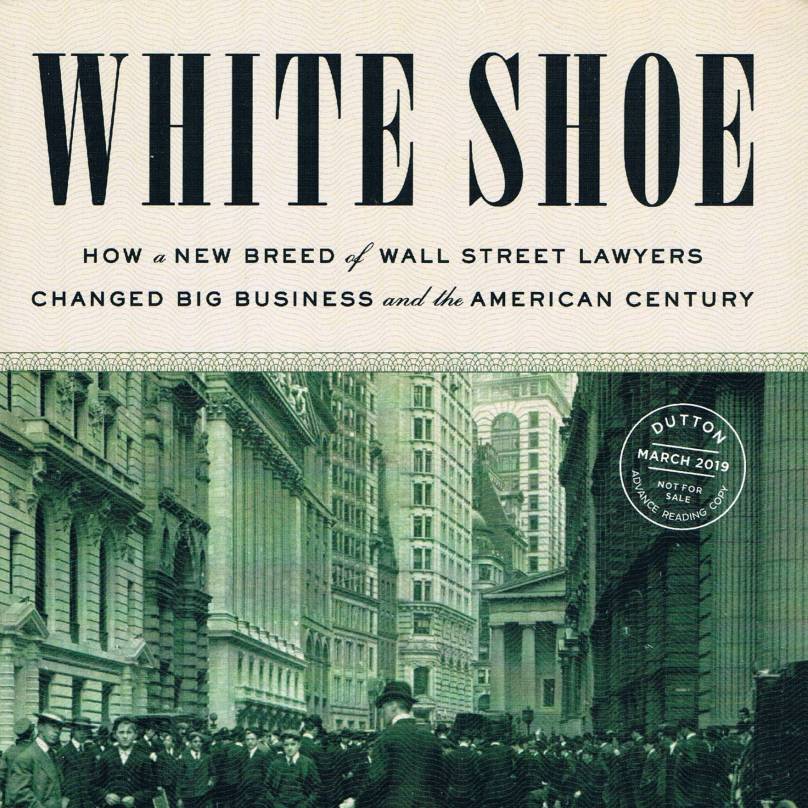
My good friend and fellow blogger Frederick Ingram of Corporate History International has written an intriguing review of what appears to be a quite intriguing book: historian John Oller’s White Shoe: How a New Bread of Wall Street Lawyers Changed Big Business and the American Century. Based on Ingram’s review alone, the book is a fascinating dive into the heady politics of early twentieth-century America, the transition from the relative laissez-faire capitalism of the so-called “Gilded Age” into the economic, political, and social reforms of the Progressive Era.

The Progressive Movement fundamentally transformed the United States, in many ways (constitutionally) for the worse. But it was an attempt to rectify some of the excesses of the Gilded Age, and to ensure that workers were not merely cogs in faceless corporate machines. In reading Ingram’s review, I heard echoes of Tucker Carlson’s recent on-air musings, particularly the idea that efficiency is not a god to be worshipped blindly, and that capitalism is great, but it should work for us, not the other way around.

The more things change, the more they stay the same: Carlson’s diagnosis of America’s current ills echoes attorney (and future Supreme Court justice) Louis Brandeis’s “curse of bigness,” the argument against efficiency-for-its-own-sake. I was struck, while reading Ingram’s review, how much our own age mirrors the period that, in many ways, begat our current crises: the Progressive Era of 100 years ago.

According to Ingram, a consensus of sorts was reached among these big Wall Street Lawyers (WSLs), which ultimately prevented radicalism and presented “capitalism with a human face”:

“The end of ‘The Last Great Epoch’ coincided with the end of World War I, flanked by the funerals of the earlier generation of great industrialists and white shoe pioneers. ‘Each year has the significance of a hundred,’ said William Nelson Cromwell in 1918, and this applied not just to armistice negotiations but vast swaths of human society. Business, law, and government in the US would be professionalized and regulated, but still relatively free by world standards. The reforms advocated by enlightened and informed WSLs formed a barrier against imported radicalism. Even rightwing attorneys backed movements such as social security, child labor prohibitions, and even minimum wage.”


Ingram, as I mentioned, is a good friend, and we’ve had some lively discussions over the years about the “big questions” of life. His thoughtfulness and reflexivity are in full display in his review here, as he links insights from this work to concurrent readings of Jordan Peterson and Christopher Andrews. He also brings in his own experiences working in “BigLaw,” as he calls it, the grueling world of billable hours and 80+-hour workweeks.

To (indulgently) block-quote Ingram once more:

“Having worked as a BigLaw accounting clerk myself, I have an issue with the Cravath System and the slavish devotion to billable hours. Is your spouse really going to leave you if you don’t make $250,000 this year? Will your children no longer look up to you? Is that worth being a cortisol-addled prick 80 hours a week, every weekday of your miserable life? Wouldn’t it be wiser to make, I don’t know, $100k or even $50k and have your peace of mind back?”


As much as I admire the energy and drive of the restless striver—and as much as I over-work myself—Ingram makes a compelling point. Money doesn’t buy happiness (although it certainly buys a great deal of freedom), and the pursuit of it can lead other, more enduring obligations—family, friends, faith—to wither.

An excellent review, from a good friend. Check it out at https://corporatehistory.international/2019/01/27/new-white-shoe-review-for-you, then pick up a copy of Oller’s book.

fridrix's avatarCorporate History International

White Shoe: How a New Breed of Wall Street Lawyers Changed Big Business and the American Century by John Oller (Dutton: 2019). Review by Frederick C. Ingram, CorporateHistory.International, January 27, 2019.

White Shoe promises to deliver an engaging and revealing tale regarding the handful of New York City attorneys who effectively created big business as we’ve known it, the “new high priests for a new century.” As an accomplished historian (The Swamp Fox: How Francis Marion Saved the American Revolution, Da Capo: 2016) and former Wall Street attorney himself (Willkie Farr & Gallagher), John Oller is well placed to fulfill this tall order.

20190127 white shoe cover squareIn a previous economy, I researched hundreds of corporations for the International Directory of Company Histories, so the prospect of peeking a little beyond the opaque public relations and investor relations curtain intrigued me. I’m also reminded of strolling along Fifth Avenue, whose equally opaque walls…

View original post 1,441 more words

Meetings are (Usually) a Waste of Time

Here’s something a bit lighter for your Friday morning:  Scott Rasmussen’s Number of the Day series on Ballotpedia from 23 January 2019 claims that, in a 40-hour workweek, Americans spend an average of 11.8 hours of that time in meetings.  That’s over two hours a day, and over 25% of the entire week!

Despite all that time in meetings, Rasmussen writes that “just 54% of workers leave most meetings with a clear idea of what to do next.”  That’s not a ringing endorsement for meetings.

Every fiber of my being is anathema to lengthy, tedious meetings, of any kind.  My time is precious (and valuable—it comes at ~$50/hour for private lessons), and I rarely need someone telling me out loud what could have been sent in an e-mail.  With rare exceptions, I almost always believe that time spent in a meeting could be spent more efficiently working on my own.

Apparently I’m not alone.  From Rasmussen:

The biggest problem workers have with meetings is that many of them are unnecessary. Seventy-six percent (76%) of workers have experienced that frustration. Also high on the list are meetings that don’t stay on topic (59%) and repetition of things that have already been said (58%).

The precise cost of ineffective meetings is impossible to quantify, but estimates range from $70 billion to $283 billion each year.

So not only are meetings ineffective, unnecessary, repetitious, and frequently off-topic, they’re potentially expensive in terms of productivity.

Of course, these numbers coming from a poll, it could be that workers merely perceive meetings to be ineffective and unclear—and they feel it’s okay to admit as such to a pollster—but this data rings true.

There are those who thrive in meetings, either in the roles of leaders or attendees.  Some enjoy preening in front of a group—the busybody types who seek out power, the narcissists who want some fluorescently-accented limelight—and some who like to use meetings as a forum to demonstrate their own cleverness.  For a small few, they need the opportunity to ask questions, either out of a genuine need for additional information, or because they want to virtue-signal to their colleagues.

In recent years, I’ve come to suspect that a large chunk of our workforce consists of people who essentially have meetings and push paper for a living.  With an average of 11.8 hours of meetings per week, this suspicion seems to be gaining concrete support:  that’s an awful lot of time in which to justify your position’s existence.  I imagine public sector bureaucrats at the federal level inflate that number, and not insubstantially (remember that the next time a conservative seeks to cut funding to some government program, and progressives wail—they’re crying about the lost make-work job, not the people who allegedly benefit from the program).  Regardless, just as the bureaucracy expands for the sake of its own self-preservation, it seems that meetings expand to justify their hosts’ jobs.

When dealing with specific technical questions or getting a quote on some expensive piece of equipment or installation, yes, meetings are important and necessary.  Long-term strategy planning requires regular meetings, and a weekly administrative meeting to set goals for the week and to review what’s coming up on the calendar is a prudent idea.  But rambling, two-hour meetings stretch to the point of ineffectiveness—no one can focus, people need to use the bathroom, and the original thread is probably long-since lost down a rabbit hole of objections and side topics.

So, here are my practical guidelines for effective meetings:

  • No more than one hour for infrequent or monthly meetings, but ideally, thirty minutes in length, tops.
  • Have a clear-cut agenda with maybe two or three items; don’t have ten agenda items that you know you won’t be able to cover adequately
  • Be willing to table important items that are not time-sensitive, with a plan to revisit them later.
  • Explain as much as possible via e-mail in advance.  In my experience, if you send a good e-mail in advance, you can wrap up a meeting in fifteen minutes—you’re mainly meeting at that point to confirm that everyone knows what’s going on, and to address any lingering questions and to clarify certain points.

I generally follow these guidelines when I’m required to hold a department meeting, and they make for smooth, quick, efficient meetings.

As a rather solitary worker, I tend to forget that some people want or need more direction—my whole career I’ve just figured stuff out as it’s come up—so I understand the necessary evil of meetings.  That said, I also value other people’s time.

So, the next time you schedule a meeting, make it quick.  People have real work to do.