TBT^256: Back to the Grind 202[5]

Well, the long, glorious, hot summer is over—at least for yours portly.  Yes, the summer heat beats on, but I’m back at work today.

It’s that time of year again:  the academic year.  The poor public school teachers (and kids!) have already been back to school.  No student should darken the door of a schoolhouse in July—that’s just brutal.  July should be completely devoid of any structured learning in a classroom.  Kids should be reading for fun, splashing in the pool, running around getting heat stroke, not locked in a stuffy classroom.

And what of the poor teachers?  I’m spoiled—I’ve taught almost all of my professional life, with the exception of two years from 2009-2011.  June and July are sacred.  I don’t to put pants on in July, much less a long-sleeved shirt and a tie.

Not that August is much better.  In my considered opinion—not based on what is best for the student, but what is best for me—school should start the Tuesday after Labor Day and the Friday before Memorial Day Weekend.  The school year is entirely too long (for students, too).

But I digress.  No one ever wants to hear a teacher complain—“I have to work every day!”  Well, I became a teacher for a reason:  summertime (and because it’s my calling and I sincerely love it—just not in August)!

With that here is 8 August 2024’s “TBT^16: Back to the Grind 202[4]“:

Read More »

TBT^16: Back to the Grind 202[4]

My two-plus months of living like a French duke and/or welfare queen have come to an end.  Yours portly returns to the salt mines of secondary education today.  Classes won’t start back until Monday, 19 August 2024, but teachers reports back today for the usual bout of annual trainings, AFLAC representatives, handbook excursions, etc.

[UPDATE:  due to Hurricane/Tropical Storm Debby, we won’t report back until Monday, 12 August 2024—whoa!  But I’m still going to grouse about going back to work.  —TPP]

I’ve never quite understood why we report back on a Thursday, when we could easily cover all of this foolishness in a day or two of meetings the following week.  It seems like a way to deprive us of one, final, long weekend before the drudgery returns.

To be frank, I am not much looking forward to this school year—a sadly common refrain from yours portly the past few years.  Our enrollment is way down, which will bring with it all sorts of austerity measures and demands for teachers to sacrifice more time and energy for the good of the school.

Last year was absolutely brutal, and while I’m always cautiously optimistic, I am having a hard time talking myself into a good attitude this year.  Perhaps simply getting back into a rhythm will be its own reward.

With that, here is 3 August 2023’s “TBT^4: Back to the Grind 202[3]“:

Read More »

TBT: Disincentives to Work

I don’t mean to be all doom and gloom this week, but it sure feels like things are falling apart all around us:  food shortages, rising unemployment, riots.  I think we’re in for a really nasty summer, but I hope I’m wrong.

We’ve been muddling through longer than we realize.  While gas prices have only shot up in the past five months, people have been dropping out of the workforce for a good while now.  Back in the Obama years, conservatives used to mock (rightly) the government’s unemployment figures for leaving out the labor force participation rate, which was pretty paltry back then (something like only 60-70% of working aged people were actually actively looking for work; the unemployment rate was based off that portion, rather than all working aged adults).

Now we’re in the midst of what the mainstream media is calling “The Great Resignation,” with millions of Americans quitting their jobs.  That’s due in part, I believe, to the generous government largesse during The Age of The Virus.  We’ve all gotten a taste of easy money—inflation be damned!—and now we want the gravy train to keep on rollin’.

But I think it goes deeper than that.  My generation in particular—prone to wokery, alas—legitimately has gotten the short end of the economic stick, entering the workforce during a recession, saddled with billions in student loans and overcredentialed.  Granted, some of those problems were our fault—we fell for the siren song of expensive degrees—but we were largely following the advice that had worked for our parents’ generation.

Understandably, many of my peers did not want to go back to waiting tables and pouring coffee for strangers—or going back to other thankless jobs.  Not all of those folks are deadbeats or mooches—some of them are just worn out.

Regardless, the government’s sticky hands are in all of this mess (for example, college tuition is so astronomically high because the government will keep extending loans to anybody to get them to go to college, even if that person isn’t going to earn much with his degree).  Work is annoying, stressful, and demanding—but doing it makes us better people.

With that, here is 26 May 2021’s “Disincentives to Work“:

Read More »

Midweek Mad Scientist Movie Madness II: Metropolis (1927)

Since the first installment of Midweek Mad Scientist Movie Madness two weeks ago, I’ve watched several more films from Mad Scientist Theatre, a collection of mostly bad, mostly public domain films.  As with any such collection, the appeal is in the handful of renowned classics, and some of the hidden gems.

The first three flicks on the very first disc are all silent movie classics.  I’ve already reviewed Dr. Jekyll and Mr. Hyde and The Cabinet of Dr. Caligari, which both debuted in 1920.  I appreciated and enjoyed both films for different reasons, and both were very well done, although quite different, films.

The third film is 1927’s Metropolis, perhaps the greatest silent film of all time.  I took a modern German history course in college, and we were supposed to attend a screening of Metropolis for class.  For some reason, I did not attend, which was very out of character for me (I only missed class twice in college:  a session of Human Geography because my saxophone sextet had its recital that morning, and a rehearsal of the University Band so I could play The Elder Scrolls: Oblivion the night it was released).  I guess we were never tested on it, but when I found out there was a robot woman, I was kicking myself for missing the flick.

Now, some twenty years later, I’ve finally watched this classic of Weimar Germany’s wild cinematic scene.  I wish I’d gone to see it in college!

As with Jekyll and Caligari, you can watch Metropolis for free on YouTube (although, apparently, the film won’t be back in the public domain in the United States until the end of this year):

As you can see, it is a long film—depending on which cut you see.  Apparently, there are dozens of different cuts and restorations, and no one knows for certain which is the “definitive” version.  One of my readers asked me which cut I saw, and I have no earthly idea (sorry, cinephiles).  It’s whatever version Mill Creek Entertainment decided to put on this collection.  I do know the film felt long in parts—although I was glued to the screen for most of it—but it didn’t feel like it was two-and-a-half hours long.

What I can say is that Metropolis is worth seeing, not only because it is an important film in the history of cinema (and the height of German Expressionism), but because it is a good movie with an important message:  the head and the hands must work together through the heart.

To read more of this post, subscribe to my SubscribeStar page for $3 a month or more.

Retro Tuesday: Christmas Break Begins!

Yesterday marked the true “beginning of my glorious, two-week Christmas break.”  It’s been a busy break so far, with a very productive Town Council work session last night, and a meeting with our new Mayor-Elect this morning.  I’m also meeting with a parent later in the day to sign some paperwork for a program for her daughter.

That’s a breakneck pace compared to past Christmas breaks, but it’s nothing too daunting.  I’m looking forward to some time with my parents, brothers, sister-in-laws, niece, and nephews soon, not to mention other family members.

It’s a lazy time of year for the blog, too:  not much is happening in the news, and everyone is settling in for a long winter’s nap.  I will have a guest contribution from 39 Pontiac Dreamer tomorrow—a review of a video game series—and some other goodies after Christmas.  Otherwise, look for a lot of re-runs from yours portly this week.

That said, the topic of this post from last Christmas Break—the need for some time off at Christmas for everyone, not just those of us in the cushy education racket—is still relevant.  Granted, some workers have decided to take the entire year off, it seems, enjoying generous federal unemployment and other kickbacks from The Age of The Virus, rather than return to their honest, albeit grueling, jobs.  Maybe let’s shoot for something a bit more balanced, yeah?

Still, work, while ennobling and healthy, can easily become overtaxing and detrimental.  There are diminishing returns, too:  after too many hours and too much effort, both mental and physical, we all start to get sloppy.  Some folks are built with the drive and energy to go nonstop, but I suspect most of us appreciate having a little downtime here and there.

With that, here is 21 December 2021’s “Christmas Break Begins!“:

Read More »

Disincentives to Work

A few weeks ago, I wrote a piece, “Fast Food Premium,” which argued that, as restaurants began offering higher wages and even signing bonuses to employees, those increased wages would get passed along to consumers, and would result in wider inflation (a big “thank you” to jonolan at Reflections from a Murky Pond for expanding upon the premise of my post with his own, excellent piece, “UBI —> UBM“).  My observations might be deemed “prophetic” if they weren’t so blindingly obvious:  higher input costs mean higher prices.  That’s basic economics.

Of course, the ongoing labor shortage is not due to a booming economy, per se, but due to excessively generous federal unemployment benefits, which have effectively increased the minimum wage for restaurant employees:  many such employees are paid more to stay at home, collecting unemployment, than they are to flip burgers, wait tables, etc.  Mogadishu Matt highlights this phenomenon in a reblog of a John Stossel piece:  the issue is not a labor shortage, but a problem of incentives.

Read More »

Christmas Break Begins!

Well, here it is—the week of Christmas, and the beginning of my glorious, two-week Christmas break.  If this blog post feels a bit like I’m rubbing in readers’ faces the bloated excess of education’s vacation time, my apologies.  I will note, though, that if you spent hours everyday as a surrogate parent to other people’s children, you, too, would want two weeks off at Christmas.

Indeed, I would argue that more professions deserve more time off at Christmastime.  Naturally, I realize that many folks save up their hard-earned vacation days to do just that:  enjoy a week or so with their families by the yule log, sipping eggnog and hot cocoa in their festive Cosby sweaters.  What I’m advocating for, though, is a widespread cultural movement—maybe even to the point of declaring some federal holidays—in the days leading up to and/or immediately after Christmas.  It always blows my mind when people work a full day—even a measly half-day—on Christmas Eve.

Read More »

Flashback Friday: Brack Friday Bunduru: Workers Need a Break

I’m embracing the lazy logic of Thanksgiving Break with more throwback posts than usual this week.  After Christmas Break, this little Thanksgiving reprieve is my favorite short break of the year.  It combines family, fun, and food, with enough time to enjoy all three.

Last year when I wrote “Brack Friday Bunduru: Workers Need a Break,” I was growing increasingly burned out and fatigued from my job and my various obligations.  Between work, music lessons, and various ensembles, I wasn’t getting home most nights until 9 or even 10 PM.  That clearly showed up in my argument here for giving workers the day of Thanksgiving—and at least Christmas Eve and Christmas Day—off from their toils.

That said, I still believe it.  What’s humorous to me, in re-reading this post after a year of lockdowns and shutdowns, is that my call for “[s]hutting down everything but essential services… would be an admirable goal for at least Christmas Eve and Christmas Day, as well as Thanksgiving” came to pass—with deleterious effect—for not three measly days but for months on end.  That’s certainly not what I had in mind, but I think workers have had all the breaks they can stand this past year.

Still, in normal times, having a couple of days for Christmas and a day or two for Thanksgiving isn’t going to tank the global economy.  Workers could use the break, and the reminder that all that hard work is in service to something greater:  family, faith, and God.

I love hard work—indeed, I think it’s one of the keys to happiness and purpose, particularly for men—but there’s hard work, and there’s exhausting yourself for a pittance.  Let’s reward the former with some downtime.

With that, here is “Brack Friday Bunduru: Workers Need a Break“:

Read More »

Progress Report: Teaching in The Age of The Virus

Progress reports go out to students today at my little school, so I thought it would be a good time to provide an update of my own now that we’re nearly a month into the school year.  I posted about teaching in The Age of The Virus after the first day and the first week, and now I have a much better perspective on how the year is unfolding.

As a refresher, my school is doing mostly face-to-face instruction, but with some students doing distance learning.  Students have the option to go to distance learning pretty much at will (for example, I had one student who stayed home today with a cold, but who tuned into my music appreciation course), and can return to school at any time.  Students engaged in distance learning are required to attend during the scheduled class period.

The caveat to that general rule pertains to international students.  We have a number of students overseas who, because of new restrictions due to The Virus, are stuck in their home countries.  Many of those students’ classes are late at night, or even in the very early morning, after accounting for the time difference.  It’s a long way from South Carolina to Vietnam.

What that means is that we have to teach our regular classes; livestream them; and record those livestreams, making the recordings available after the class.  It sounds easy enough—so long as everything works perfectly.

That’s turning out to be the fly in the pancake batter.  As one of our dedicated science teachers said—the lady who troubleshoots our woeful technological glitches—“I can livestream, or I can record.  The trouble is trying to do both.”  Amen to that.

Read More »

TBT: High-Tech Agrarianism

Lately I’ve been heavily focused on yard work, as my lawn and flower beds were resembling an abandoned lot more than a well-maintained lawn.  As such, I’ve had small-scale farming on the brain more lately, even though the only edibles I planted were one forlorn banana pepper plant and some oregano (although the celosia leaves are edible before the plants flower).

Naturally, my mind returned to this March 2020 essay, “High-Tech Agrarianism.”  It’s perhaps a testament to how much we have adjusted to The Age of The Virus that I did not go out and till my half-acre, instead letting it loose to its recent weedy state.

Reading over this essay, which I wrote in the week after South Carolina schools shut down, it’s interesting how much I’ve mellowed on The Virus.  I was skeptical of it beforehand, but when schools were shuttered for the last two months of the academic year, the sense that something big was wrong only grew.  The most remarkable aspect of The Virus is that, even with shutdowns, the economy kept going, and there’s not the same sense of depressing listlessness that reigned during the Great Recession.

Of course, the economic fallout may very well be delayed, and I’m in a much better position financially and professionally this time around than I was in 2009.  The government distributing $1200 checks and propping up businesses probably smoothed out the economic disruption a bit, too.

It’s also interesting that other than wearing masks and sanitizing ourselves and our things constantly, life seems to be marching on more normally.  The True Believers in The Virus scold large gatherings, but people want to be together.  We can limit crowds only so much—people are going to congregate.

The Age of The Virus aside, the idea of tilling suburban and small town acreage is a prudent, if difficult, job.  I still maintain it’s a better use of land than a lawn.  Instead of mowing and edging, put that effort towards watering, weeding, and fertilizing.  Crops look good—and taste good, too.

That last paragraph probably highlights my ignorance about agriculture—something I’m working on as I flirt more and more with the idea of converting my yard into arable square feet.  We’ll see where I am in another six months.

Here’s “High-Tech Agrarianism“:

The coronavirus situation—which I am convinced is both quite serious, but also inspiring some huge overreactions—has created a world that feels almost entirely different than it did even a few days ago.  This time last week, I was convinced that the whole thing was way overblown, and that life would largely continue apace, minus some school closures here and there.

By Friday evening I was growing more concerned, as everything began to get closed or cancelled.  I proctored the SAT Saturday morning and even went out of town that evening.  At that point, I thought the risk of my school closing was greater than it had been even two or three days before, but I still figured it was a relatively remote possibility.

Then Governor McMaster announced the closure of all South Carolina public schools (I teach at a private school, but we always follow gubernatorial closures)—and a bunch of other stuff shut down.  I picked up dinner at a Hardee’s in Florence, South Carolina Monday evening after a guitar lesson, and it was surreal—everything was gone from the front, and the cashier had to give me a lid and straw according to their new cleanliness guidelines.

(Let’s take a moment to thank all those service industry folks and long-distance truckers who are continuing to work and risking exposure; they are unsung heroes.  Also, spare a thought to people in those industries that are out-of-work at the moment.  They need our love and charity now more than ever.)

That’s all to say that, in a remarkably short period of time, the United States has undergone a major paradigm shift.  The world of Saturday, 14 March 2020 at 2 PM—when I emerged from the cocoon of extended time SAT testing—was a different than the world of Wednesday, 18 March 2020 at 9 PM (when I’m writing this very belated blog post).

One trend—that I think will be positive if it endures—is the implicit rejection of globalism.  People are suddenly awakening, dramatically, to the manifold downsides of open borders and excessive global economic integration.  Suddenly, localism is back in vogue.

One of my musician friends, a bit of a Sandersnista hippie-dippie type (but attractive enough to get away with it) has been posting Left-leaning memes consistently throughout this crisis.  But one meme caught my eye:
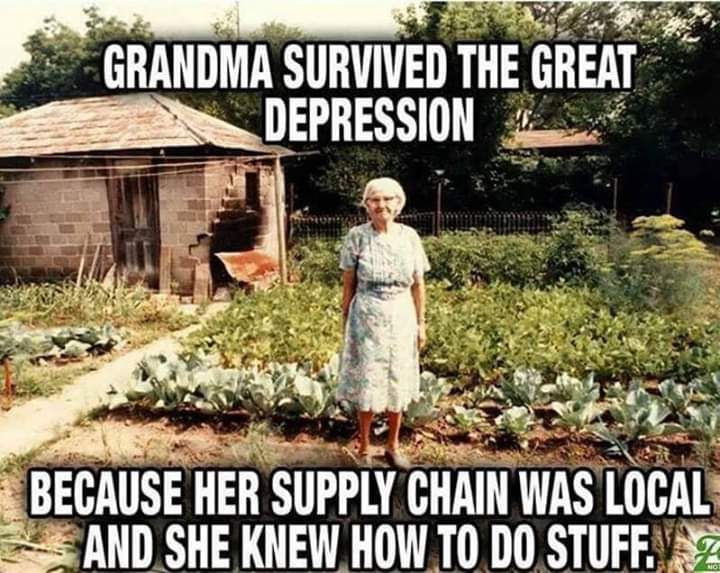
Grandma - Local Supply Chain

Here’s good ol’ Granny tending her garden.  The meme is right:  I know from family lore that my Mamaw and Papaw fed themselves, their children, and a lot of other folks in the mountains of southwestern Virginia during the Depression with chickens and crops they raised themselves.

That got me thinking:  could America see the return of widespread of homesteading, or some modern-day version of Jeffersonian agrarianism?

I was pondering this question on my way to church tonight (yes, yes, social distancing, etc., but it’s a small church, and we had a very small turnout, so I’m sure it was fine to attend), driving through the fields on the outskirts of Lamar.  I began pondering the notion of a society with our level of information technology, but that saw most Americans farming or gardening for at least a small bit of their sustenance.

Such a system would be “high-tech agrarianism”—it would combine modern technology, especially information technology like the Internet, with millions of freehold agriculturalists.  Yes, we’d still have the huge mega-farms, we’d have people working in offices, etc.  But people would be making good use of their land, too, growing crops instead of grass.

Of course, I then began to ponder if such a society could have ever developed organically.  My instinct is no—it required the massive integration of local, regional, and national economies to raise production efficiency to the point that we can have widespread, niche-y specialization in tens of thousands of fields.  Greater efficiency fed into greater technological advancement, which in turn led to greater efficiency—and on and on and on, in a revving upward cycle.

But now we’re staring down this virus, which is leading governments all over the world to close stores, cancel events, lay off workers, turn away elderly patients, and on and on.  Those long, efficient supply chains are massively disrupted.  People are hoarding toilet paper and bread in the hopes of riding out likely (and, in some places, actual) quarantines.

I’m assuming life will return to normal… eventually.  But when?  So far, many of my assumptions about the pandemic have been incorrect (it turns out this time, the media wasn’t just crying wolf—well, not entirely, anyway; it still seems that some of this panicked response is driven by ridiculous media spin and speculation).  If we continue down this road of greater and greater decentralized isolation, people are either going to riot, or figure out how to provide for themselves.

In such a world, maybe high technology and small-scale farming could work keyboard-in-glove.  I’ve long advocated for some return to a simpler, more agrarian, more localized life.

Of course, I’m romanticizing America’s Jeffersonian past.  Farming is hard—and risky (of course, that hardness made our nation great).  I certainly don’t know anything about it—another truth to the meme above.  Also, if we’d continued as a mostly farming nation, we wouldn’t have the means to fight this virus, or to figure out how to fight it.

That said, converting your half-acre lawn into a garden full of corn, squash, peppers, lettuce, cabbage, beans, berry bushes, etc., seems like a far more productive use of your little plot of land, and one that could save your life and the lives of others in a pinch.  That seems sensible.

We could also do with some can-do gumption, like Granny had.

Home Depot is operating on shortened hours, but they’re remaining open.  Maybe now is the time to buy a roto-tiller.

Donate to The Portly Politico

Support quality commentary on politics, education, culture, and the arts with your one-time donation.

$5.00