

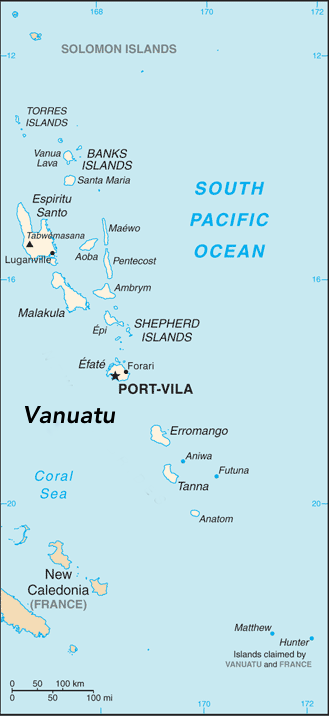
The FAIRtax folks, who advocate for replacing income and corporate taxes with a unified national sales tax, posted an interesting piece about the remote Pacific nation of Vanuatu (“FAIRtax in Vanuatu?“). It discusses how the archipelago boasts incredibly low taxes: a 15% value-added tax (“VAT”), and a business license fee of 5% (presumably, 5% of a business’s total annual revenue).
I’m personally agnostic on the adoption of a national sales tax in the United States. I do believe it would be much better than the income tax, which I absolutely loathe, and which requires a complex and oppressive bureaucracy to administer. I also resent sending the IRS all of my personal information every single year, including how many miles I drove and what sheet music I purchased (although those are great for those sweet, sweet tax write-offs). If it were practical, I’d much rather see a national sales tax, or even a return to old-school tariff regimes.
The problem is that, should we ever adopt a national sales tax, it will likely accompany the national income tax. A national sales tax also places a great deal of strain on States and localities. Good luck having a 10% national sales tax and a 6% State sales tax (as we do in South Carolina) and a plethora of local-option sales taxes (about 2% here in Darlington County; higher in neighboring Florence County). Tack on hospitality taxes, and it adds up fast.
For example, in neighboring Florence County, eating out automatically comes with a 10% sales tax: the 6% State sales tax, plus local sales and hospitality taxes, totally 10%. If we had a conservative 10% national sales tax on top, your $5 footlong (already gone—part of America’s mythological past) becomes $6 immediately. 20% sales tax means $1 of taxes for every $5 spent. A $500 item would cost $600.
I still think that’s preferable to the income tax, and instead of creating a disincentive to work, it would create a disincentive to spend.
But I digress. For a small nation like Vanuatu—population of around 300,000—a national sales tax makes sense. It’s a small enough area geographically and demographically that it the national sales tax is, essentially, akin to a State sales tax. As the article from FAIRtax.org notes, the island has something of a clean slate: no welfare, no government pensions, etc. Most people are subsistence farmers, and tourism is the major industry.
 The Portly Politico