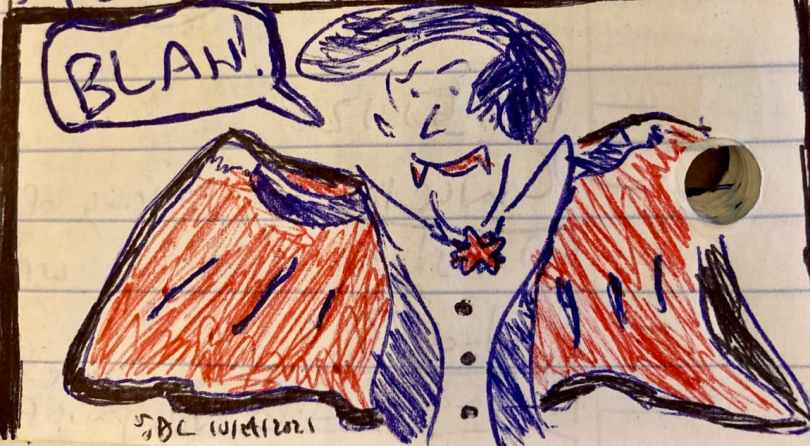
Monday Morning Movie Review: The Vourdalak (2023)

Yours portly has been on a bit of a foreign film kick, especially weird horror films.  Particularly, it seems that French-language films have been turning up quite a bit in my Shudder feed.

International horror—at least, the stuff that gets to us—tends to be pretty good, but I’ve never been too terribly impressed with the French material on Shudder.  But this week’s film, The Vourdalak (2023), is a delightful exception.

Read More »

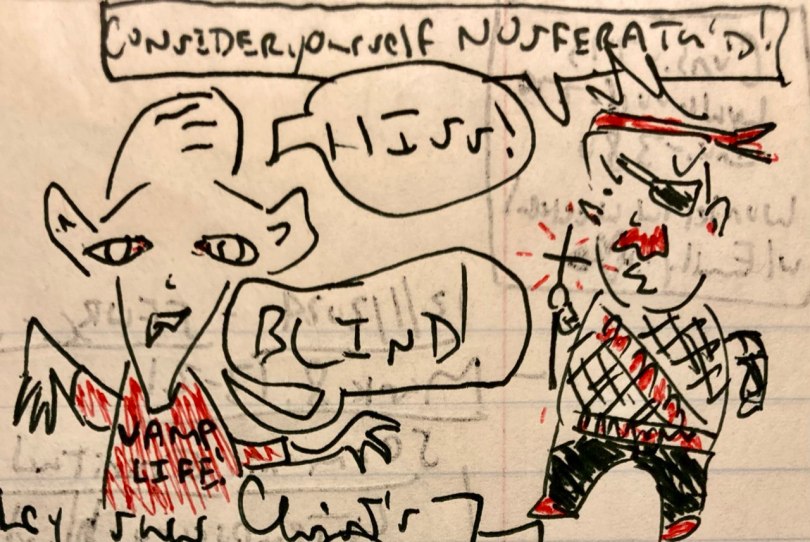
Monday Morning Movie Review: Nosferatu (2024)

My older brother and I saw Nosferatu (2024) a couple of days after its release, which was on Christmas Day 2024.  We attended a 12:30 PM EST showing on Friday, 27 December 2024, and even that early matinee had a very good crowd.

My brother and I had been anticipating the release of this film with an eagerness we rarely experience for movies anymore.  I love movies, but there aren’t many films that get me excited to go see them.

Nosferatu promised “a symphony of horror,” according to its tagline (and the subtitle of the 1924 original), and it delivered—in spades.

Read More »

Monday Morning Movie Review: Salem’s Lot (1979)

Do you feel it, dear reader?  The crisp little nip in the air?  That delicious coolness first thing in the morning?

Yes, autumn is close—and the spooky season is near!  That refreshing sense of autumnality (my favorite made-up word) conjures up all manner of pumpkin-spiced fantasies for the season ahead.

It also means Halloween is coming!

Naturally, yours portly loves Halloween—I probably won’t shut up about it from now until probably well into November—and Halloween means scary movies, which are even better when it’s dark and chilly.

What’s even better are scary movies that I saw when I was entirely too young, and which have seared themselves into my mind over the intervening decades.

The 1979 miniseries Salem’s Lot, an adaptation of the Stephen King novel “‘Salem’s Lot,” is one such film.  It’s streaming now on Shudder, and I’ve been soaking in its vampiric scares off and on for the past week.

Read More »

Monday Morning Movie Review: The Last Voyage of the Demeter (2023)

It’s been a big moviegoing summer for yours portly, and I’ve availed myself of the offerings at my local cinema quite frequently.  While I was still on summer vacation I managed to slip into a 4 PM showing of The Last Voyage of the Demeter (2023), a film about the doomed ship that carried Count Dracula to England in the original Bram Stoker novel.

I was hoping for a delightfully blood-soaked (and blood-thirsty) romp on the high seas, blending the manliness of stoic sailors in the waning days of the Age of Sail with the Gothic horror of old-school Dracula.  Instead, I got a disappointingly plodding film and a stomach ache from eating too much popcorn, albeit with a pretty terrifying depiction of the dreaded Count.

Read More »

Monday Morning Movie Review: Boys from County Hell (2020)

Today is my birthday.  I’m thirty-seven today, and am on the downward slide towards forty.

But even on my birthday, I must deliver the goods.  Since it’s Monday, that means a movie review, and this flick is really quite fun.

The film is Boys from County Hell (2020), a comedic vampire movie that takes place in rural Ireland.  My family and I had the opportunity to visit Ireland in 2006, and the film’s setting really reminded me of that trip.

The premise is straightforward:  in the small, dying town of Six Mile Hill, there is a stone cairn in the middle of a farmer’s field.  The cairn is said to be the grave of Abhartach, an ancient Irish vampire who is said to have been the inspiration for Bram Stoker’s Dracula.

The cairn—indeed, the entire town—is threatened by a proposed new bypass.  The bypass will route so much traffic away from the town, it will kill the struggling local economy.  Naturally, the construction will also move directly through the cairn.

You can probably see where this is going.

Read More »

Monday Morning Movie Review: Dracula (1931)

My local library has been screening the classic Universal Monster Movies every Saturday night this month, which is just about the greatest thing any library has ever done (besides, you know, storing all of that knowledge).  They kicked off the month with 1941’s The Wolf Man, but I think they saved the best for last—1931’s Dracula (this weekend they’re showing a non-Universal Monster flick).

Read More »

Monday Morning Movie Review: Lifeforce (1985)

I’m a big sucker—pun most certainly intended—for vampire movies.  I’ve always enjoyed the vampire mythos, and find them to be terrifyingly fascinating villains (or anti-heroes).  The concept of immortality in a fallen, ever-changing world is itself a haunting prospect, one filled both with opportunity and, ultimately, hopelessness.

I also love science-fiction movies, notably those that take place in space.  The sense of boundless adventure and the thrill of exploration combine with high-tech gobbledygook to make for some fun stories.  Sci-fi, like horror, also has the ability to be among the best social commentary put to paper.

With 1985’s Lifeforce, those two genres are combined in a pleasing, memorable way.  Indeed, the film is based on a novel called The Space Vampires, which gives the game away on the front cover.  The vampires of the film and the novel are energy vampires, sucking the lifeforce from their victims, luring them in by shapeshifting into the guise of what the human victim most desires in a mate.  In doing so, they turn their victims in ravenous husks who must feed on the energy of others to survive.  If they don’t, they explode into a puff of dust and ash.

Read More »

Monday Morning Movie Review: Jakob’s Wife (2021)

I am a great lover of vampire movies and stories, and am always interested to see how filmmakers and storytellers approach the well-worn vampire mythology.  Every vampire story must take time to establish the “rules” of that particular vampiric universe, so the (sub?)genre lends itself to world-building.  Some vampires can survive in sunlight, though uncomfortably; others can endure limited exposure; still others burst instantly into flames.  Some vampires fear the sign of the Cross; others laugh at it mockingly; still others fear the faith in what the symbol represents, but the symbol is rendered powerless without that faith.

Vampire stories also offer the opportunity to explore interesting themes.  Immortality is a common one:  what happens when you have forever to live on Earth?  Anne Rice’s novel Interview with the Vampire (1976) explores that idea in great detail, specifically the ennui and nihilism that come with earthly eternal “life.”  The initial thrill of vampiric power and endless nights of bloody reverie gradually turn to centuries of self-indulgent, murderous moping, as the vampire passively watches the world he loved transform around him into something unrecognizable.

This month, Shudder released a new exclusive, Jakob’s Wife (2021), a feminist-inflected vampire story starring 80s scream queen Barbara Crampton.  While the feminist themes were a bit heavy-handed at points, the film handled the subject matter with a surprising degree of nuance.  Suffice it to say that, like tell-tale two-pronged mark of the vampire’s bite, this film has stuck with me.

Read More »

Monday Morning Movie Review: Near Dark (1987)

August is an odd time be writing about vampires.  With the intense heat and humidity of the brutal South Carolina summer beating down upon us, it doesn’t feel like vampire weather.  But the crisp autumnal nights of October are closer than we realize, even if they seem impossible right now.

That said, the Southern vampire is a particular niche of Southern gothic horror.  All the mystery and romance of “moonlight and magnolias” is enhanced with these mysterious, romantic creatures stalking about crumbling old plantation houses in the night.  I’ve been reading Anne Rice’s novel Interview with the Vampire (the film version of which I reviewed last fall), and the titular vampire and narrator, Louis, is from Louisiana.  The exotic setting of New Orleans plays a prominent role in the first half of the book, and provides the perfect backdrop for Louis, Lestat, and Claudia’s lethal nocturnal escapades.

This week’s film, 1987’s Near Dark, isn’t exactly about Southern vampires, but Midwestern vampires.  That doesn’t exactly fit into the mold of the seductive, mysterious vampire, but that’s one of the film’s strengths:  these vampires are crazy Nebraskan (or Oklahoman?) low-lives, terrorizing the prairie in a aluminum-foil-covered panel van.

Read More »

Monday Morning Movie Review: Interview with the Vampire (1994)

It’s Halloween Week, and—appropriately and chillingly enough—today’s post marks my 666th consecutive post.  Yikes!  What better way to observe this unfortunately demonic milestone than with a review of 1994’s Interview with the Vampire?

The film itself is a frame story, with Cajun vampire Louis de Pointe du Lac (Brad Pitt) sharing his “life” story with a reporter (Christian Slater).  Louis had intended on feeding on the reporter, but decides instead to grant him the interview of a lifetime—the titular interview with a vampire.

Louis’s story begins in colonial Louisiana, when it was a Spanish colony (the territory traded hands between French and Spanish rule).  Louis’s wife and child died, sending Louis into a self-destructive spiral of risky behavior—drunken brawls, prostitutes, the works.  All he wants is death.

Into this mix comes Lestat (Tom Cruise), a flamboyant, nihilistic, haughty, obsessive vampire.  Lestat “turns” Louis, inducting him into the world of the living dead.  Louis immediately recoils at the implications of this new “life,” particularly the feeding upon humans for sustenance.

He instead attempts to live on the blood of rats and other animals, but his slaves grow suspicious when their master stops eating, and cattle and other creatures end up dead.  Lestat does not share Louis’s sense of restraint and humanity—indeed, Lestat is fascinated by Louis’s dogged persistence in maintaining what humanity he has left—and instead views humans as mere cattle.  Louis finally breaks, feeding upon his loyal house slave, Yvette, and then encourages his slaves to destroy his mansion as he flees into the night.

Lestat, naturally, is enraged at the loss of their home and their wealth, but the two find new accommodations in New Orleans.  A plague is sweeping through the city, and a distraught Louis stumbles upon a young girl trying to awaken her mother, who has died from the plague.  In a fit of hunger and shame, Louis feeds upon the child, and leaves her for dead.

Upon returning to their shared flat, Louis is horrified to find Lestat with the young girl.  Lestat feeds the young girl some of his blood, thus turning her into a five-year old vampire.

Claudia (Kirsten Dunst) becomes a voracious, childlike pupil of Lestat, and something like a daughter to both Lestat and Louis.  They dress her in finery, give her piano lessons (she feeds upon her teacher at one point, horrifyingly and humorously), and generally dote over her.  But as time marches on, Claudia’s mind develops, though her body is perpetually trapped at five-years old.

That perpetual childish body drives Claudia increasingly mad, as she yearns to be grow and develop into a woman.  She grows to despise Lestat, who dresses her “like a doll,” and draws closer to Louis.  Eventually, Claudia and Louis escape Lestat’s obsessive, controlling nature, and flee to Europe, where they encounter other vampires in Paris—with fatal consequences.

I won’t reveal any more of the plot there, but the film does an incredible job of creating investment in and sympathy for these characters.  Louis never fully embraces the vampiric life, and yearns for his lost humanity—and mortality.  Lestat is flamboyant—he reminded me a great deal of Milo—and wicked, even by vampire standards.

But the most interesting and tragic figure is Claudia, capably played by a very young Kirsten Dunst.  Claudia is “saved” from death, but is thereby denied any chance at a real life.  Her very existence is a travesty, and is considered by the European vampires to be taboo and dangerous.  Claudia’s own mental deterioration and rage clearly illustrate why.

Vampires are interesting and terrifying figures in folklore, and they are inherently demonic:  they represent a horrible inversion of Christ.  Christ died for our sins and shed His Blood for our salvation.  When we accept Christ, we are covered in His Blood, and our sins are washed away.  There is redemption and new life—eternal life—in Christ’s Sacrifice.

But vampires offer a perverted undead—an “un-life”—through their blood.  It is a form of immortality, but one that is entirely tied to this world, and completely separated from God.  Thus, the vampire is an eternal nihilist.  The implicit bargain of the vampire is a Devil’s Bargain:  enjoy as much of the world as you want, but you can never truly leave it.  The vampire is also damned—a common theme in vampire movies and books—and can only hope for Hell, or walking the Earth for all eternity, like Cain (who is often considered the father of vampires).

As for the film itself, I highly recommend it.  Anne Rice’s books about vampires quite good, too, and the film does justice to the source material.  It’s also fun seeing a pale Tom Cruise running around in flouncy eighteenth-century garb.

Tip The Portly Politico

Support quality commentary on politics, education, culture, and the arts with your one-time donation.

1.00 $