Vindication – Ben Shapiro Agrees with TPP

Yesterday, I wrote about George Will’s full-scale, Never Trump meltdown.  Later that day, the brilliant Ben Shapiro agreed with me on his daily show (not by name, mind you—that would be awesome).

Check out the video here:

I don’t like purity tests, but George Will isn’t even taking the right exam.  It’s said to see such an eloquent writer and inspired mind succumb to Trump Derangement Syndrome.

Ben Shapiro did not uncritically accept Trump during the 2016 election, and did not vote for him (or Clinton), but he’s been intellectually honest about his assessment of the Trump administration (and has pledged to vote for Trump in 2020 should the administration’s current course continue).

Sadly, such even-handedness among the so-called Conservatism, Inc., has been in short supply.  Kudos to Shapiro for calling it like it is.

George Will’s Self-Destruct Sequence

Last week, America lost one of its great columnists, Charles Krauthammer.  Krauthammer was a former speechwriter for Democratic VP candidate Walter Mondale, then realized he was no longer a Democrat when Ronald Reagan became president.  Krauthammer was a political conservative, but he wasn’t a slave to ideology.  He remained intellectually-curious and -honest, even that meant he was wrong on a rare occasion (he argued for a $1/gallon gas tax nearly a decade ago).

Long-time Washington Post columnist George Will—a colleague of Krauthammer’s at the paper—similarly has a reputation for intellectual honesty.  Like Krauthammer, Will exists in a cosseted, Beltway-Washington, D.C., and hasn’t quite come to terms with the presidency of Donald Trump.

As such, it was with dismay—but not surprise—that I read Will’s derisive op-ed in the Post, “Vote against the GOP this November.”  Never has self-destructive defeatism sounded so literate.

Will’s specious argument boils down to these details:  President Trump is a borderline dictator; Republicans in Congress are afraid to criticize him for fear they will lose their seats; Americans should vote out enough Republicans that the Democrats take control, but there will still “be enough Republicans to gum up the Senate’s machinery.”

Will points out that Congress has sacrificed its own important Article II powers in order to take the easier path of non-accountability, instead preferring to leave the hard decisions to the President and his power of executive orders.  While this point is valid, it’s not unique to the Trump administration, which, by all accounts, has used executive orders narrowly, and within the framework of existing legislation.  To read Will, this problem is due to Trump’s temperament and personality.

While the President may not enjoy criticism, he’s a big boy—not the coddled man-child that was President Barack Obama—and, besides, it’s Congress’s responsibility to pass and propose legislation.  If the President doesn’t like something, he can veto it.

Where Will’s advice truly goes off the rails is his claim that Democrats should be permitted to take control of the Senate, even if it brings in a “basket of deplorables,” because then a do-nothing Congress… would still do nothing!  He argues that enough Republicans would still be around that they would keep “the institution as peripheral as it has been under their control,” and would “asphyxiat[e] mischief from a Democratic House.”

What a load of malarkey.  As a conservative, which would you rather see:  a feckless Congress controlled by Republicans, or Democrats?  Even if you knew the Congress would be ineffective half of the time, the answer is obvious:  you’d opt for the former.  At least with ineffectual Republicans in control, you’d avoid groundless impeachment votes.

Indeed, look at the record of the current Congress:  the Senate confirmed conservative Supreme Court Justice Neil Gorsuch; the Republican-controlled Congress passed the massive tax cut bill (which Will imperiously dismisses—when one enjoys Georgetown cocktail parties and fancy D.C. brunches for a living, money isn’t an issue); the Congress enacted the Right to Try Act, which will make it easier and cheaper for patients to try still-experimental drugs for deadly illnesses.

Logically, Will’s advice makes zero sense.  If the idea is to send a message to Republicans to be more independent from the President’s agenda—why would they want to be?—the price is too high.  Why make a point on principle if it costs you the future victories of still-higher principles?

I believe Will is sincere in his desire to see constitutional checks and balances restored, but President Trump represents part of the cure to that problem, not the disease.  Congress has the responsibility to step up.

That said, I also believe Will is blinded by a sincere hatred of—or, at the very least, a passionate distaste for—President Trump.  The man left the Republican Party, and urged Republicans to ensure Trump’s defeat, back in 2016—such are the depths of his disregard.  Now that Trump is president—and restoring the nation’s economy and national sovereignty—Will’s irrelevance as a national commentator is even further highlighted, and it seems his anti-Trump impulses grow even further.

Will thinks the ideal President should be balancing a tea cup on one knee while listening attentively to a farmer in Iowa (sadly, I can’t find this quotation online at the moment, but I remember reading it back in 2016).  For better or worse, the era of the Mitt Romney Republican presidential candidate has passed.  We are in the midst of a full-blown, no-holds-barred culture war in which conservatives have played the decorum card for too long.  Trump is a brawler, and while he may be imprecise or distractible, he has the guts to tango with the enemy—and win.

Will’s self-destruction as a conservative pundit is sad to witness, but perhaps it’s overdue.

Why the Hate for Space Force?

Ever since President Trump ordered the creation of Space Force earlier this week, I’ve read a lot of snarky Facebook posts and the like mocking the idea.

Some of these posts consist of the usual arm-chair analysis:  “Trump did it to distract from the child separation crisis!” and the like (if you look at the timing of the child separation crisis issue, though, it seems like something Democrats ginned up to distract from the IG report released last week).

Much of what I’m reading, though, consists essentially of, “Wow, what a stupid idea.  Like we need to have a military in space,” or the more bleeding-heart, “Why do we want to dominate space.  LOVE TRUMPS HATE!”  That latter one is usually followed up with a link to the Wikipedia entry for the Outer Space Treaty of 1967, as if some Gene Rodenberry-style, early Star Trek-esque treaty is going to keep the ChiComs from building a death laser on the moon (don’t laugh—the Chinese are just wily enough to do it).  I’m tired of people using the name of a meaningless treaty in lieu of an actual argument.

When did we stop dreaming?  What happened to that Gene Rodenberry-style, early Star Trek-esque drive for space exploration?  I realize much of this animosity toward the idea is knee-jerk partisanship:  bearded hipsters who probably still sleep in Star Wars pajamas hate Trump so much that they can’t get behind this amazing idea.  If Obama had ordered it, they’d be throwing craft beer tasting parties sponsored by Blue Moon.

But I also suspect that Americans aren’t dreaming big anymore.  I read a little bit by National Review‘s Charles C. W. Cooke some years ago in which he talked about how great his WiFi-enabled gadgets were, and he essentially argued that we needed to appreciate the future we have instead of the sci-fi rock opera vision of the future we want (R2-D2 playing the bass guitar, taking summer vacation on the moon, using lightsabers, etc.).

While I am incredibly thankful that I can find clips like the one above in mere seconds (even if it is in another language)—and to have vast storehouses of human knowledge mere keystrokes away—does that really mean that’s all there is?  Is it ungrateful to say, “Hey, this is incredible—how about even more cool innovations?”

Space is the final—and endless—frontier.  As such, it will be the next battleground of human conflict.  Instead of laughing at the idea of Space Force, let’s figure out how to make it an efficient, effective fighting force to ensure that liberty endures beyond the 21st century—and our pale, blue dot.

Open Borders is the Real Moral Crisis

I typically avoid wading into fashionable-for-the-moment moral crusades, but the hysteria over children being separated from their parents at the border is ludicrous, and demonstrates the typical “facts over feelings” emotionalism that mars our immigration debate.  That feel-goodism is why we’re even in this mess—if it can be characterized as such—in the first place.

Because I’ll be deemed a monster—“Won’t somebody please think of the children!“—for not unequivocally denouncing this Clinton-era policy, I’ll issue the usual, tedious disclaimers:  yes, it’s all very tragic; yes, it could be handled better; yes, I would have been terrified to be separated from my parents at such a young age; etc.

Now that the genuflecting to popular pieties is out of the way, let me get to my point:  this entire situation would be a non-issue if we had simply enforced our immigration laws consistently for the past thirty years.  President Trump isn’t the villain here (if anything, Congress is—they can take immediate action to change the policy or come up with some alternative—but I don’t even think they’re wrong this time); rather, the villains are all those who—in the vague name of “humanity” and “human rights”—ignored illegal immigration (or, worse, actively condoned it).

Sadly, it is an issue.  But what else are we to do?  Years of non-enforcement have sent the implicit but clear message to potential illegal immigrants that we don’t take our own borders (and, by extension, our national sovereignty and rule of law) seriously, and that if you’re sympathetic enough, you’ll get to skip the line.  Folks come up from Mexico and Central America fully expecting that, after some brief official unpleasantness, they can dissolve into the vastness of the United States and begin sending remittances back to their relatives—who may then pull up stakes and come.

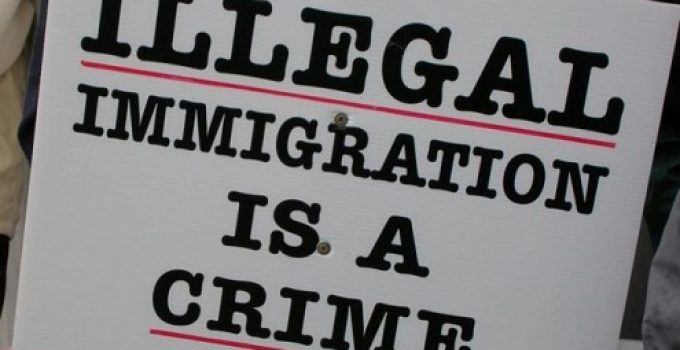
Further, sneaking into the country illegally is a crime, and the United States has every right to enforce its laws, including those pertaining to immigration.  Mexico, similarly, has that right—and uses it unabashedly to police its own border (or to let Central American migrants waltz through on their way to the Estados Unidos).  Naturally, the punishment for breaking laws is often detainment, and the kiddies don’t join dad in his cell.

To give a common example:  what happens to the children of, say, an American heroin dealer when he’s arrested and sentenced to ten years in a drug bust?  His children—if they have no relatives willing or able to take them in—go into the foster care system.  It’s tragic, it’s terrible, but it’s part of the price of committing a felony.  No one wants it to happen, but it’s a consequence of one’s actions.  This reason is why crime is so detrimental to society at large, even beyond the immediate victims.

Unfortunately, a combination of winking at immigration enforcement (“eh, come on—you won’t get deported”), feel-good bullcrap (as my Mom would call it), and Emma Lazarus Syndrome (trademarked to The Portly Politico, 2018) have contributed to the current nightmare situation.  Now that an administration is in office that actually enforces the duly legislated law of the land—and at a point at which the problem has ballooned to epic proportions due to past lax enforcement—the problem is far thornier and more consumed with emotional and moral peril.

As any self-governing, self-sufficient adult understands, sometimes doing what is necessary is hard.  I do feel for these children who are stripped from their parents arms (although, it should be noted, usually for only a matter of hours), but who cares about my feelings?  We can have compassion for those who try to arrive here illegally, as well as their children, without attempting to take on all of their problems, and without sacrificing our national sovereignty and our laws in the process.

The United States is the most generous nation in the world—and the most prosperous—but we cannot take everyone in; to do so would not make everyone else better off, but would rather destroy what makes America the land of compassion, liberty, prosperity, and charity that it is.

***

For further reference, I recommend the following videos, the first from the brilliant Ben Shapiro, the second from Dilbert creator Scott Adams:

https://www.youtube.com/watch?v=OWWVaLlpq7s&t=2134s

I’d also recommend this piece from National Review columnist Richard Lowry, which is quite good:  https://www.nationalreview.com/2018/05/illegal-immigration-enforcement-separating-kids-at-border/

And, finally, this piece from Conservative Review‘s Daniel Horowitz, which explains the true moral toll of illegal immigration—and misplaced compassion—very thoroughly:  https://www.conservativereview.com/news/the-immorality-of-the-open-borders-left/

Three Years of Excellence

Father’s Day—16 June 2018—marked three years since President Donald Trump’s now-legendary descent down the golden escalator at Trump Tower, following by his controversial but true-to-form announcement that he would be seeking the Republican Party’s nomination for President.

I was, initially, a Trump skeptic, and I voted for Texas Senator Ted Cruz in the South Carolina primaries the following February.  When Trump first announced, I wrote him off—as so many others—as a joke.  I appreciated his boldness on immigration, but I still thought the PC Police and the campus Social Justice Warriors were firmly in control of the culture, and that no one could speak hard truths.

I also remembered his brief flirtation with running in 2012, and thought this was just another episode in what I learned was a long history of Trump considering a presidential bid.  At the South Carolina Republican Party’s state convention earlier in 2015, I asked two young men working on Trump’s pre-campaign (this was before The Announcement) if he was really serious this time.  The two of them—they looked like the well-coifed dreamboat vampires from the Twilight franchise—both assured me that Trump was for real, and I left with some Trump stickers more skeptical than ever (note, too, that this was before the distinctive but simple red, white, and blue “Trump” lawn signs, and definitely before the ubiquitous “Make America Great Again” hats).

I even briefly—briefly!—considered not voting for Trump, thinking that he was not a “real” conservative.  I still don’t think he’s a conservative in the way, say, that a National Review columnist is (although, the way they’ve gotten so noodle-wristed lately, that’s a good thing; I’ve just about lost all respect for David French’s hand-wringing, and Kevin Williamson went off the deep-end), but rather—as Newt Gingrich would put it—an “anti-Leftist.”  That’s more than enough for me.

But my conversion to Trump came only belatedly.  I can still find a notebook of notes from church sermons in which I wrote, “Ted Cruz won the Wyoming primary.  Thank God!” in the margins.

Then something happened—something I predicted would happen on the old TPP site—and I couldn’t get enough of the guy.  It wasn’t a “road to Damascus” epiphany.  I started listening to his speeches.  I read up on his brilliant immigration plan (why haven’t we taxed remittances yet?).  I stopped taking him literally, and began taking him seriously.

And I noticed it happening in others all around me.  Friends who had once disdained the Republican Party were coming around on Trump.  Sure, it helped that Secretary Hillary Clinton was a sleazebag suffused with the filth of grasping careerism and political chicanery.  But more than being a vote against Hillary, my vote—and the vote of millions of other Americans—became a vote for Trump—and for reform.

Trump made politics interesting again, too, not just because he said outrageous stuff on live television (I attended his rally in Florence, South Carolina before the SC primaries, and I could feel his charisma from 200 feet away; it was like attending a rock concert).  Rather, Trump busted wide open the political orthodoxy that dominated both political parties at the expense of the American people.

Take trade, for example.  Since World War II, both Democrats and Republicans have unquestioningly supported free trade.  Along comes Trump, and suddenly we’re having serious debates again about whether or not some tariffs might be beneficial—that maybe it’s worth paying a little more for a stove or plastic knick-knacks if it means employing more Americans.

That’s not even to mention Trump’s legacy on immigration—probably the most pressing issue of our time, and one about which I will write at greater length another time.

Regardless, after over 500 days in office, the record speaks for itself:  lower taxes, fewer regulations, greater economic growth, greater security abroad.  At this point, the only reasons I can see why anyone would hate Trump are either a.) he’s disrupting their sweet government job and/or bennies; b.) they don’t like his rhetorical style, and can’t get past it (the Jonah Goldbergite “Never Trumpers”—a dying breed—fall into this group); or c.) they’re radical Cultural Marxists who recognize a natural foe.  Folks in “Option B” are probably the most common, but they’re too focused on rhetoric and “decorum”—who cares if he’s mean to Justin Trudeau if he gets results?  The folks in “Option C” are willfully ignorant, evil, or blinded by indoctrination.

As the IG report from last Thursday revealed—even if it wouldn’t come out and say it—the Deep State is very, very real.  That there were elements within the FBI willing to use extralegal means to disrupt the Trump campaign—and, one has to believe, to destroy the Trump presidency—suggests that our delicate system of checks and balances has been undermined by an out-of-control, unelected federal bureaucracy.  Such a dangerous threat to our republic is why we elected Trump.

President Trump, keep draining the swamp.  We’re with you 100%.