To the Moon!

Before beginning today’s post, a quick note about last Friday night’s concert:  the whole thing came off smashingly.  My buddy John and I gave a 90-minute performance at a coffee shop in Hartsville, South Carolina, Crema Coffee Bar, where we’ve played a number of such shows in the past.

This show was, easily, the most fun I’ve had playing this particular venue, our home-away-from-home in Hartsville.  John and I took turns playing original tunes, and we both unveiled new selections, John debuting an Irish tragedy entitled “The Sailor,” and I introducing my latest irreverent comedy tune, “Private Lessons (Goth Chick).”

We also enjoyed an excellent turnout, which is not to be taken for granted.  Live music doesn’t always have the appeal it once did, and sometimes promoting a show can come across as a bit needy—“please come listen to us!”—especially as everyone you know is in a band these days.  Fortunately, our friends and fans were hugely supportive, and it seemed like a capacity crowd at the height of the show.  A YUGE “thank-you” to everyone who came out.

My next tour stop is the Juggling Gypsy in Wilmington, North Carolina, on Friday, August 3, starting around 9 PM.  You can learn more at www.tjcookmusic.com or on my Facebook page.

***

I’ve written  a bit about space exploration and the formation of Space Force on this blog, and I’ve long been an advocate semi-publicly of expansion into space.  Neil deGrasse Tyson wrote an essay in Foreign Affairs when I still subscribed to the globalist rag that had me jumping for joy.  The essay, “The Case for Space,” is one of the best apologias written for the benefits we would reap from funding additional space exploration.  Tyson is a poor political pundit, and his fanboyish acolytes are so annoying, they reflect poorly on him, but he knows what he’s talking about when it comes to space.

I’m a fiscal, as well as a social, conservative, but I’m all about spending gobs of government cash on space exploration—and colonization.  I realize I’m committing the same error everyone does—“don’t spend my tax dollars… except on all this stuff I personally like or agree with”—but I see a role for the government in space exploration that makes sense constitutionally and functionally, in a way that, say, free bus fare for war widows isn’t.

Like Newt Gingrich—the other great modern essayist on space exploration—I see expansion into space as akin to westward expansion in the nineteenth century.  There were a lot of hardy pioneers that took the risks and were “rugged individualists”—but the government granted generous loans and tracts of land to railroad companies to open up those lands.  The government—largely Republican-controlled after the American Civil War—played a role in catalyzing western expansion.

Similarly, we see a mix of entrepreneurship and government support today, although the government seems bogged down in its usual bureaucratic inefficiencies, while the hot-shot mega-billionaire flyboys are taking the major risks.  Nevertheless, Gingrich wrote over the weekend about this very topic, marking the 49th anniversary of the moon landing.

As usual, the Trump administration, as Gingrich writes, is thinking “big league” when it comes to space, and Vice President Michael Pence is heading up a revived National Space Council.  The NSC is charged with exploring placing bases on the moon to reduce the costs of launches, which would be much more fuel-efficient in the moon’s reduced gravitational field (which is one-sixth that of Earth’s).

In a larger, cultural sense—since I’m not versed enough in the technical side of this subject, I’m deflecting to where I can bloviate on slightly more solid ground—I don’t understand the disinterest in, even hostility toward, space exploration.  In general, I’m dismayed by the lack of pioneering derring-do and spirit in American culture today.  Aren’t we descended from rugged frontiersmen and women who crossed oceans, forded rivers, climbed mountains, and endured dysentery to get here?

A few years ago, I stumbled upon one of those writers I love—a slightly fringe character who writes about weird, just-outside-of-the-mainstream topics.  The author in question is James D. Heiser, a bishop in the Evangelical Lutheran Diocese of North America and a founding member of the Mars Society, a group that aims to put Americans on Mars.

I first stumbled upon Heiser after reading a review of his book “The American Empire Should Be Destroyed”:  Alexander Dugin and the Perils of the Immanentized Eschatology, which is about the titular figure, an eccentric, Rasputin-like character who advises Vladimir Putin in some capacity.  That book led me to another Heiser work, Civilization and the New Frontier:  Reflections on Virtue and the Settlement of a New World, a collection of essays—mostly his introductory remarks at various Mars Society annual conventions—about the settlement of Mars.

The basic argument is that the quest to settle new worlds will stretch Americans not just scientifically, but spiritually:  in striving for the stars, we’ll cultivate the classical virtues that make civilization possible, and, in the process, reinvigorate our earthly civilization.

I believe there’s something to this thesis.  Struggle—be it the struggle to survive on the hostile Martian plains, or to make ends meet here on Earth—breeds growth.  Adversity is the heat that tempers the iron of the soul.

Space has much to offer:  abundant natural resources, the thrill of discovery, hot alien babes (just kidding about that last one).  But it also has the potential to inspire future generations of Americans to reach for the stars—both physically, and spiritually.

The Human Toll of Globalization

Last week’s posts shared a similar theme:  the costs of unbridled free trade; the benefits of cutting corporate and income taxes to unleash economic growth; and the human side to economics that academics tend to miss.

The first and third topics referenced above came into sharp relief as I read an excellent piece by Chadwick Moore, “Left for Dead in Danville: How Globalism is Killing Working Class America.”  It’s a long-form piece of journalism for Breitbart, but it is well worth the read.  I encourage all of my readers to set aside twenty minutes to read it and its terrifying account of globalization gone wrong.

My post today simply seeks to offer up a summary of Moore’s findings, presenting them in an easily-digestible form for those who don’t have the time or inclination to read his full-length piece.

The conceit of the piece is simple:  Moore visited Danville, Virginia, a former textile mill town located on the Dan River, and very close to North Carolina.  The town was once—and “once” doesn’t mean “a hundred years ago,” but about twenty years ago—a thriving town that supported a solid middle-class through its robust textile industry.  Civic pride was abundant, and the Dan River Mill supported a number of youth and community activities and functions that are familiar to anyone who has grown up in a small town.

Then came NAFTA in 1994, followed by China’s entrance into the World Trade Organization in 2000.  After years of struggling to compete with foreign competition, Dan River Mills shut down in 2006 (it had been open since 1882).

As the town’s economy declined and unemployment skyrocketed, social problems grew.  Drug use increased dramatically, as did crime, and formerly-safe, middle-class neighborhoods devolved into dangerous slums.  More than a quarter of the town’s population is on food stamps.

Race relations also grew worse.  The town had enjoyed peaceful, working relationships between black and white citizens, who worked together happily in the mills and other businesses.  Now, the KKK plans rallies, preying off the desperation of the unemployed (the town is roughly half white, half black).

Moore gives a good bit of space to quoting Michael Stumo, the CEO of the Coalition for a Prosperous America.  Stumo elegantly explains the problem in Danville—as with many other small towns in Middle America—tracing it to China and the World Trade Organization.  Some choice bits to chew on:

“‘When China joined the WTO in 2000 with 1.3 billion people underemployed, it began pulling them out of the rice paddies, the farms, and rural areas, and putting them to work. The Chinese under-consume. They produce more than they consume, [in] a country that’s four and a half times as big as ours and relying on the American consumer to fund their path to wealth and doing so with a state-directed economy, which is different than communist, it’s a strategic mix of state capitalism with a little bit of private sector in it. We always thought communism would fail, but China found central planning 2.0 and is pretty good at it,’ he says….

‘We have free trade within the 50 states,’ Stumo says. ‘By impoverishing our middle class with this offshoring driven by free trade policy, you’re killing the U.S. consumer market, which drives growth, because they have no money. Five or ten percent cheaper prices is overwhelmed in this stage by lack of production and stagnant wages,’ he says. ‘The U.S. middle class cannot afford to fund the rise of other countries anymore.

‘Industry doesn’t stand still; industry is always incubating—you give up the jobs, the wealth creation, the supply chain clusters in communities, and that affects the service sector around them,’ Stumo says. ‘You pull those plants out, and a lot of people are out of work, and then the whole general wage level drops because burger-flipping isn’t an upward pressure on wages, but production is.'”

A degree of globalization, in an age of mass transit and mass communications, inevitable.  And open trade with lower tariffs generally is beneficial.  But naïvely-open trade with dishonest trading partners with slave-level wages primarily benefits the dishonest party.  Yes, there are some winners in the United States—I certainly enjoy a higher quality of life because of cheap electronics from abroad, for example—but as I wrote last week, isn’t it worth paying a little more for your television or washing machine, if it means an American keeps his job.

My thinking on this is simple:  the actual, physical and mental of work, in and of itself, important.  Yes, we could pay everyone a guaranteed basic income, or help people through more assistance programs (ignore the astronomical costs of those programs for the moment), but even if they worked beautifully in the material sense, they will, in the long-run, lead to a deterioration of real skills and, more important, a spiritual vitality.

I strongly believe that the three keys to happiness are faith, family, and work, in that order.  Work is ennobling, even if it is unpleasant at times.  As such, if the government is going to do something, would it not be wiser to offer assistance that requires work?

Tariffs accomplish this goal to some extent, and are entirely constitutional (indeed, one of the authors of the Federalist Papers, Alexander Hamilton, argued for them as Secretary of Treasury).  They also produce revenue for the federal government, and could be used to offset further reductions in corporate and income tax rates.

Ultimately, the social and civic costs of unbridled, unfocused free trade seem too steep.  Read Moore’s observations about the flood of drugs and despair into this once-civic-minded, prosperous town, and understand that the 10% discount you enjoy on your consumer goods is seldom worth the human toll.

To clarify once again, I’m not arguing we return to the massively high tariffs of the late-nineteenth and early twentieth centuries.  That would be economically disastrous in other ways, and would further enhance our federal government’s penchant for corporatist back-scratching and favoritism.  But some judicious, targeted tariffs, especially against nations like China, are wise.  Why should we be subsidizing China’s growth at the expense of our own?

One final thought:  as I wrote Friday, a married man used to be able to raise his kids on a gas station pump-boy’s salary.  Sure, life was lean, and there weren’t a ton of crazy gadgets to play with or luxuries to enjoy, but the kids grew up well enough and the wife could stay home to raise them.  Are we really that much better off now, when both husband and wife slave for 40+ hours a week (and usually longer), outsource their parenting responsibilities to daycare and public schools, and can’t get out from under student loan, home, car, and consumer debt?

There are a host of factors driving the modern scenario of today versus the “blue-collar father” of yesteryear, but surely one economic solution is to stop burrowing out our families and towns in favor of frosty, urban cosmopolitanism and aloof globalism.  I care about the people of China, and I’m glad to see they’re no longer trapped in rice paddies and collectivized farms, but—like our great President Trump—I care about my country and fellow countrymen first.  So should the United States government—it’s job is, literally, to put Americans first.

Phone It in Friday – Musings & Reflections on NATO, Brexit, Etc.

Happy Friday, TPP loyalists!  Normally I’d offer up a well- (or hastily-)crafted essay for your enjoyment, but it’s been an unusually busy week here, so I thought I’d do something a bit different and offer some brief reflections on the week.  It’s been a late night a-rockin’, and I’ve got classroom walls to paint in the morning.

I was planning on writing a bit about socialist babe Alexandria Ocasio-Cortez, but I’ll have to hold off on that until next week (the gist of my analysis:  she’s a hot Millennial Latina in a congressional district with the demographics of downtown San Salvador; her primary victory isn’t that shocking in context).

A typical post takes about an hour to churn out, although it can be quicker.  Finding links to cite my sources typically takes about 10-15 minutes, depending on the complexity of the topic or what I need to cite (since, let’s be honest, a lot of this information is coming from years of reading and teaching history, and I have to fact-check myself or try to hunt down obscure snippets of old National Review articles I read eight years ago).

So, here are some of my quick takes on the news of the week, mostly on international events.  Just a warning—these are going to be delivered in a quick, jocular, talk-radio style.

NATO Summit

I know folks on the Left and Right are going to argue that President Trump’s remarks to German Chancellor Angela Merkel’s toady at that breakfast earlier this week were overly hostile, but, c’mon, the president is right—the United States has been shouldering Europe’s security for almost seventy years.  The least Germany can do is meet its 2% defense spending obligation.

European nations seem to be taking the not-so-subtle hint and doing just that.  I would argue we should probably stay with NATO, but Trump brought up a good point when he was still a candidate—what purpose does the alliance serve now?  Yes, it’s a bulwark against Vladimir Putin’s plodding expansionism, and it represents the ideal of multilateral, collective security, but it’s also a relic of the Cold War.  I’m not one to throw the baby out with the bathwater, but the baby needs to grow up, get a job, and move out of Dad’s basement.  Europe has been suckling at our nuclear-armed teat (talk about mixing metaphors) for decades, and needs to take national defense seriously.

A proud moment, though:  one of my former students, who has now become an elite Washington insider (one of the good swamp creatures), has a much more thoughtful analysis of the NATO summit; read it:  https://americasfuture.org/what-to-watch-for-at-the-2018-nato-summit/

Turkey

Speaking of NATO, why is Turkey still in NATO?  It definitely should not enter the European Union, for it’s own sake, but for the EU’s as well.  It’s a nation that has slipped back into an aggressive form of Islamism under President Erdogan, and it mainly seems to be holding the European Union hostage over the migrant crisis issue.  Let ’em fight their shadow religious war with Iran and be done with it.

Brexit

What is Prime Minister Teresa May and the noodle-wristed PMs in the Conservative Party thinking?  Brexit should have taken a week, tops, to work out—after the vote in 2016, the Brits could literally have just left the European Union.  Oh, the EU still wants Brits to follow European Court rulings?  Tough—we’re independent now.  That should be the attitude and approach.  Then Britain could work out trade deals and other details on its terms.

Of course, that’s what you get when a former Remainer—who badly bungled snap elections that cost her party seats—is in charge of overseeing an exit from a quasi-tyrannical supranational entity.

Boris Johnson was right to jump ship.

Trump in England

Meanwhile, Trump is meeting with the beleaguered Prime Minister this week.  Some Lefties made a big baby balloon of the President, and a nation that regularly violates the free speech of its citizens is letting that fly in the name of—wait for it—free speech.  Where’s the consistency?

First Lady Melania Trump is charming as ever, and looks like a Disney princess.  I’ll be honest, one (small) reason I was hoping Trump would win in 2016 is because I loved the idea of having an Eastern European supermodel as our First Lady.

***

That’s all for this morning’s post, TPP fans.  We’ll get back to our regularly-scheduled standards of excellence Monday.  Enjoy a safe, fun weekend, and be careful on this Friday the 13th.  Don’t squander your liberty—use it well!


Q&A Wednesday – Tax Cuts, Trade Wars, Etc.

Two of my most loyal readers, Megan and Frederick (I highly recommend the latter’s corporate history blog, CorporateHistory.International), both chimed in via Facebook about Monday’s post on tax cuts.  Frederick pointed out a potential downside to corporate tax cuts—what’s to stop large multinationals from investing that money in physical plants and employees overseas, notably in China?  Megan asked me to elaborate further on tariffs in relation to that very question.

Being a conservative, I like to conserve things—traditions, morals, civil society, working institutions, etc.—but most especially effort.  I’m a strong believer in the dictum, “Work smarter, not harder” (although you need a healthy dose of the latter, too).  As such, I’m adapting my Facebook response to them here.

I think the question of tariffs and trade wars is hugely interesting, and needn’t be bogged down in tedious charts and numbers.  What I do believe is that President Trump has ripped the façade from the bipartisan push for globalism, and particularly demonstrated the real, human cost of unbridled free trade.

I used to be 99% a free trader, with 1% reserved for mild tariffs on national security-related goods, like steel.

Now I’m probably more 85% free trade, 15% tariffs. A tariff is a tax, yes, and it’s borne not just by foreign nations exporting goods to the US, but also by American consumers, who have to pay more for goods that are protected (and, thus, more expensive and potentially of a lesser quality than they would be in a competitive, free market).  That disclaimer aside, it seems like paying a few more bucks for your washing machine is a good way to keep Americans employed and earning a decent wage.

If you take that reasoning too far you fall into the dilemma of minimum wage increases, which increase unemployment (especially for unskilled, young, and minority workers) and raise costs, so that any increased wages enjoyed by the beneficiaries are eaten away by the increased costs of consumer goods—all served up with a side of higher unemployment.

That said, judicious tariffs—I’m not arguing for the high, blanket tariffs of the late nineteenth century, which wouldn’t work well in our modern, interconnected economy—especially related to key industries like steel, could keep a lot of Americans working, and would allow blue-collar workers to earn a wage that wouldn’t require years of expensive schooling.

Also, I think targeted tariffs against unequal trading partners—I’m thinking primarily of China—would level the playing field, and prevent some of the outsourcing and capital flight that might occur with a corporate tax cut (or, more likely, increase). It’s unreasonable to expect American workers—with all their labor protections, etc.—to compete with near-slave wage Chinese workers. China’s currency manipulation to make its exports artificially cheaper, as well its rampant intellectual property theft, needs to be combated, and if it means getting our cheap plastic Happy Meal toys from Vietnam (or the USA!) instead of China, so be it.

The current “trade war” with China sees Americans in a much better position than the Chinese. China needs those exports, but the USA can stand to experience some minor drag to its GDP growth given the massive growth we’re seeing with the tax cuts (not just the corporate tax cut, but also the 20% deduction for small business pass-through earnings, which is YUGE for small business growth—a key driver of employment in our country). I see it as a trade-off—pay a little more for some consumer goods, but create imbalance in the Chinese economy and force them to play ball on par with the Western world and Japan.

My only real concern with this approach is there is no limiting principle (although that’s true for any type of tax, and we have to have some of them), which makes me wary as a limited-government Jeffersonian, but the Hamiltonian commercialist in me sees this moment in history as one in which we can uniquely leverage our economic clout to improve our own economy and our position internationally, and we can afford to go through a trade war longer than China (or Mexico, or Europe).

Everyone loses if a trade war lasts too long, but I think the Chinese will blink first. American workers will be the ones to benefit.

One additional thought, which will require more elegant development in a future post:  even with the inefficiencies and deadweight loss that would occur from overly-high tariffs, wouldn’t protecting domestic jobs be a more effective and fulfilling way to provide a living for blue-collar workers than the current welfare system?  Instead of a massive, government-run bureaucracy administering a complex and redundant system of bennies, society could bear the cost through paying a bit more for consumer goods.  Such a system would create more semi-skilled positions in some industries, and I’d rather we subsidize people through work than to subsidize them not to work.  Again, that’s a very rough sketch, but some food for thought.

Regardless, tariffs are not an unalloyed evil, nor is free trade an unalloyed good.  There’s room for both.  Economics suggests that the balance should favor the latter more heavily than the former, but we can temper the massive social disruption that unbridled globalization unleashes.

The Evolution of Judicial Supremacy – Judicial Review

Last night, President Trump nominated Judge Brett Kavanuagh to serve on the Supreme Court to fill the vacancy left by the retirement of Justice Anthony Kennedy.  As such, I thought it would be germane to explore briefly the role of the Supreme Court.

Popular understanding of the Court today is that it is the ultimate arbiter and interpreter of the Constitution, but that’s not properly the case.  The Court has certainly assumed that position, and it’s why the Supreme Court wields such outsized influence on our political life, to the point that social justice snowflakes are now worried about Justice Ruth Bader Ginsburg’s diet and exercise regimen.

Properly understood, each branch—the President, the Congress, and the Court—play their roles in interpreting the constitutionality of laws.  Indeed, President Andrew Jackson—a controversial populist figure in his own right—argued in his vigorous veto of the Bank Bill, which would renew the charter of the Second Bank of the United States, that the President had a duty to veto laws that he believed to be unconstitutional.

Unfortunately, we’ve forgotten this tripartite role in defending the Constitution from scurrilous and unconstitutional acts due to a number of historical developments, which I will quickly outline here, with my primary focus being a case from the early nineteenth century.

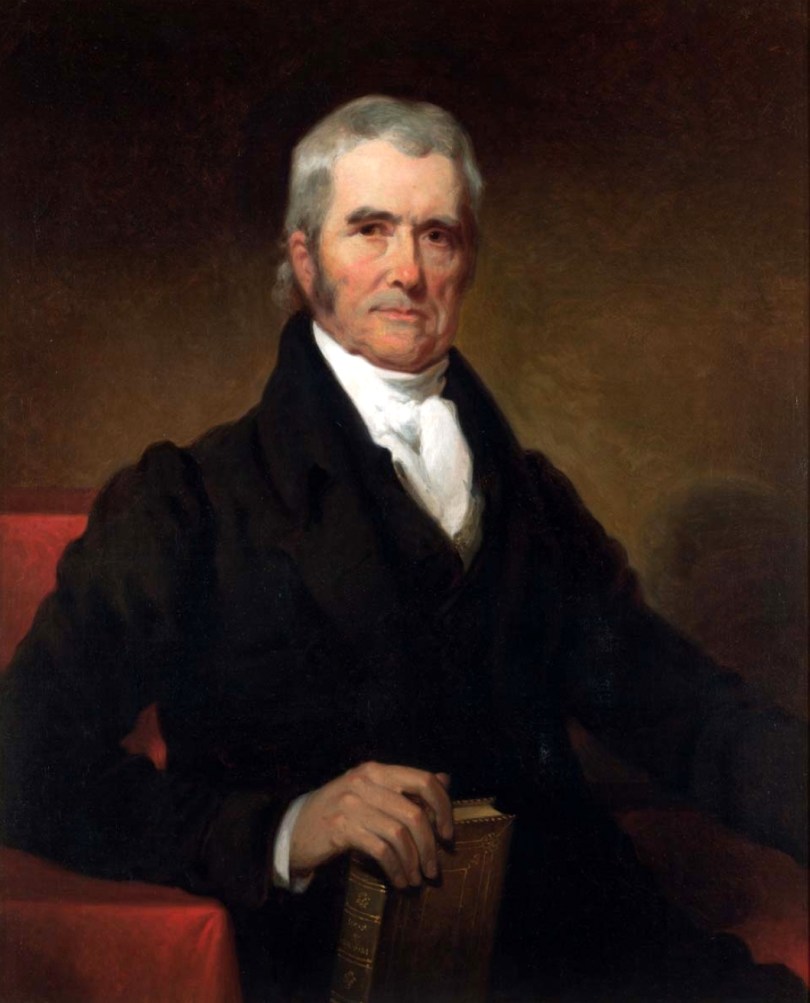
The notion that the Supreme Court is to be the interpreter of the Constitution dates back to 1803, in the famous Marbury v. Madison case.  That case was a classic showdown between Thomas Jefferson and James Madison on one hand—representing the new Democratic-Republican Party in control of the executive branch—and Chief Justice John Marshall, a Federalist appointee, on the other.

The case centered on an undelivered “midnight appointment” of William Marbury to serve as Justice of the Peace for Washington, D.C.  The prior president, John Adams, had issued a handful of last-minute appointments before leaving office, and left them on the desk of the incoming Secretary of State, James Madison, to deliver.  Naturally, Jefferson and Madison refused to do so, not wanting to pack the judicial branch with any more Federalists, and Marbury sued for his appointment.

If Marshall ruled that Madison must deliver the appointment, there was a very real risk that the Jefferson administration would refuse.  Remember, the Supreme Court has no power to execute its rulings, as the President is the chief executive and holds that authority.  On the other hand, ruling in Madison’s favor would make the Court toothless in the face of the Jefferson administration, which was already attempting to “unpack” the federal courts through acts of Congress and the impeachment (and near removal) of Justice Samuel Chase.

In a brilliant ruling with far-reaching consequences, Marshall ruled that the portion of the Judiciary Act of 1789 that legislated that such disputes be heard by the Supreme Court were unconstitutional, so the Supreme Court could not render a judgment.  At the same time, Marshall argued strongly for “judicial review,” the pointing out that the Court had a unique responsibility to strike down laws or parts of laws that were unconstitutional.

That’s all relatively non-controversial as far as it goes, but since then, the power of the federal judiciary has grown to outsize influence.  Activist judges in the twentieth century, starting with President Franklin Roosevelt’s appointees and continuing through the disastrous Warren and Burger Courts, have stretched judicial review to absurd limits, creating “penumbras of emanations” of rights, legislating from the bench, and even creating rights that are nowhere to be found in the Constitution.

Alexander Hamilton argued in Federalist No. 78 that the Court would be the weakest and most passive of the branches, but it has now become so powerful that a “swing” justice like former Justice Kennedy can become a virtual tyrant.  As such, the confirmation of any new justice has devolved into a titanic struggle of lurid accusations and litmus tests.

The shabby treatment of the late Judge Robert Bork in his own failed 1987 nomination is a mere foretaste of what awaits Judge Kavanaugh.  Hopefully Kavanaugh is well-steeped in constitutional law and history—and will steadfastly resist the siren song of personal power at the expense of the national interest.

Breaking: Trump Nominates Judge Brett Kavanaugh to Supreme Court

President Trump has nominated Judge Brett Kavanaugh to replace retired Supreme Court Justice Anthony Kennedy.  This appointment will mark Trump’s second nomination, and will cement the Court’s conservative majority by a narrow 5-4 margin.

Kavanaugh is a devout Catholic and father of three living in Washington, D.C.  He is also a champion for religious liberty, and even the feisty Ann Coulter supports him.  For some readers, that may be cause for concern, but I trust Coulter’s instincts on this one—after all, she predicted Trump would be POTUS, right?

Expect Kavanaugh to face a thorough Borking from Senate Democrats, who will unload on him mercilessly.

Tax Cuts Work

Back in December, I wrote a post on the old blog begging Republicans to pass tax cuts.  When they did, I danced around my house like a silver-backed gorilla on Christmas.

I cannot understand objections to the Tax Cuts and Jobs Act, other than fiscal conservatives’ fear of increasing deficit spending.  By that I mean I can intellectually understand objections in an abstract, academic sense, but I’m unable to accept those arguments as valid in this case, and many of them are specious.

The historical record is clear:  tax cuts works.  Be it cuts on income, corporate, estate, or sales taxes, cutting taxes, in general, stimulates economic growth and usually increases government revenues.

Take the example of Calvin Coolidge, whom we might call the godfather of modern tax cuts.  As president, Coolidge used his predecessor’s Budget and Accounting Act of 1921 to carefully monitor and eliminate excess government spending.  He also signed into law the Revenue Act of 1926, reducing the top rate to 25% on incomes greater than $100,000.

By the time he left office, the government had increased revenues (due to the stimulative effect of the tax cuts on the economy—rates fell, but more people were paying greater wages into the system), federal spending had fallen, and the size and scope of the federal government had shrunk, a feat no other president has managed to accomplish.

The perennial wag will protest, “But what about the Depression?”  Certainly, there were a number of complicated reasons that fed into the coming Depression, but the stock market crash—really, a massive correction—did not cause the Depression.  Had the government left well enough alone, the economy should have adjusted fairly quickly, although modern SEC rules and regulations were not in place.  That’s a discussion for another post, but I suspect that Herbert Hoover’s signing of the Smoot-Hawley Tariff (1930)—a tax increase on imports—did much to exacerbate the economic situation, and a decade of FDR’s social welfare experiments injected further uncertainty into markets.

But I digress.  Subsequent presidents have championed tax cuts in the Coolidge vein, albeit without the corresponding emphasis on spending cuts.  John F. Kennedy pushed for tax cuts, which threw gasoline onto the fire of the post-war American economy.  Ronald “Ronaldus Magnus” Reagan’s tax cuts created so much prosperity, the ’80s are remembered for hair metal and cocaine; had he not had to spend the Soviets out of existence (and faced a Democratic Congress), he could have cut spending, too.

President Trump’s tax cuts have breathed new life into a sluggish, post-Great Recession recovery.  Jobs growth is increasing month after month, and wages are rising, slowly but surely.  Black unemployment is down from 7.7% in January to 5.9% as of May—the first time it’s ever been below 7% since the government began keeping statistics in 1972.

Leftists object that the cut to the corporate tax rate benefits big fat cats instead of everyday Americans, but the statistics suggest otherwise (see the article linked in the previous paragraph for more good news).  Further, Leftists moan and groan when companies put increased revenues into dividend payments to stockholders, as if this move is detrimental.  On the contrary, as more Americans invest in mutual funds in their 401(k)s or IRAs, they stand only to gain from these investments.  Progressives only see these investments as “big company benefits,” without following through on what that money does.

Of course, that’s because the Left’s focus is emotional (not economic), and worries about all the sweet government gigs that majors in Interpretative Queer Baltic Dance Studies will lose without the federal government’s largesse.  Getting voters off the welfare rolls further inhibits the Democratic Party’s mantra of “Soak the Rich,” as upwardly-mobile workers naturally want to keep a good thing going.

Conservative concerns of deficit spending are more grounded in economic reality, and while the federal deficit seems like an abstraction to most Americans, it does present a looming crisis.  Perpetual indebtedness in a personal sense seems inherently immoral if undertaken as a financial strategy unto itself (taking out a loan for a car, a house, a business, or education is one thing; living off of borrowed money, and borrowing more, with no intention of paying it back is quite another; I’m referencing the latter situation); the government should be held to the same standard.

That said, the problem of the federal deficit is a longstanding issue that has more to do with excessive and wasteful spending.  The stimulative effect of the tax cuts, by putting more people to work, will increase revenues.  The most pressing concern now is for Congress to make the income tax cuts permanent—another no-brainer, win-win move for all concerned.

Taxes are a necessary evil—we need the military, roads, and the like—and there comes a point of diminishing returns with cuts just as there are with increases, but allowing Americans to keep more of their money is, in almost every situation, the better choice, both economically and morally.

Progressivism and Political Violence

The modern Left idealizes political violence.  That’s a bold statement, but it’s true, and the truth of that claim dates back to the French Revolution.  That revolution—so different from our own—was the root of almost all totalitarian movements in the 20th century, and of the American Left’s current mood for mob activity in the name of “progress.”

The big story in the world of the American Right this week has been Democratic Congresswoman “Auntie” Maxine Waters’s calls for active disruption of Trump administration officials in their private lives, to the point of harassing them at restaurants, department stores, and gas stations—even picketing at their homes, as happened to Secretary of Homeland Security Kirstjen Nielsen‘s home twice.

Waters’s execrable remarks—and her blasphemous contention that “God is on our side” (if she’s referring to Baal, the ancient Canaanite fertility god who worshipers tried to appease with child sacrifices, I’m sure he is pleased with Democrats’ support of abortion, but THE One True God must be weeping constantly over those lost lives)—were inspired by the ouster of White House Press Secretary Sarah Huckabee Sanders from the Red Hen, a restaurant in Lexington, Virginia.  In a Fox News interview after the fact, Sanders’s father, former Arkansas Governor and bassist Mike Huckabee, alleged that the progressive owner of the restaurant followed the Sanders party down the street, heckling them.

None of these events, in my mind, are surprising, but, rather, a reminder of the progressive Left’s taste for violence—or, at the very least, of achieving its long-term political goals by “any means necessary” (a slogan of the so-called “Resistance”).

Recall the soon-forgotten shooting of congressional Republicans last year as they practiced for Congress’s annual interparty baseball game.  That attack, the fevered result of a Bernie Bro’s break with reality, nearly killed Louisiana Congressman Steve Scalise.  It’s easy to forget the anti-Trump hysteria of 2017 (because the anti-Trump hysteria of 2018—after the President’s proven himself in office—seems even more unhinged), but the Left was out for blood after the Inauguration, with pink-hatted activists shouting at the sky in protest.

The Left has taken America’s cold civil war hot because it doesn’t control any of the levers of power in government.  With the retirement of swing Justice Anthony Kennedy, progressives may see their last ace-in-the-hole, the courts, lost for a generation (to be clear, the Left is still dominant in academia, pop culture, the arts, major non-profits, the corporate world, and pretty much everything that isn’t the federal and State governments).  The last tactic, then, is to amp up their social intimidation to borderline—and, if necessary, actual—violence.

Consider that the Left can only push forward its agenda for any length of time through means of coercive power (although maudlin emotional manipulation comes in handy, too, and works well with easily-manipulated “feel-good” types).  Traditionally, that’s been through the power of the state—the massive reach of the federal government.

It was the modern political Left, growing out of the Progressive movement of the late nineteenth and early twentieth centuries, that brought first the New Deal, and then the Fair Deal and the Great Society, that vastly expanded the size, scope, and reach of federal power.

While Americans were largely content with some government assistance during the throes of the Depression—and naively believed that the federal government could actively solve the nation’s problems after the Second World War, given the government’s success in fighting that global conflict—they could not stomach actual Marxism.  So it was that Democrats began gradually to lose their mid-twentieth-century vice grip on the ballot box.

With the rise of the “New Right” in the 1960s and 1970s, followed by the election of His Eminence Ronaldus Magnus in 1980, Leftists increasingly turned to the courts to fulfill by judicial fiat what could not be achieved at the ballot box.

Take, for example, the overturning of California’s ballot initiative, Proposition 8, to amend the State’s constitution to outlaw same-sex marriage.  In California—the beating heart of the modern progressive movement—a small cadre of unelected officials overturned the will of the people.

Similarly, Justice Kennedy more or less decided that federalism doesn’t matter, and we should believe that the Founding Fathers meant to support casual same-sex boning, but just forgot to put it in the Constitution (I have friends who support same-sex marriage who disagree with the Obergefell v. Hodges ruling, arguing that it oversteps the Supreme Court’s constitutional authority).

The courts were the back-up plan.  I’ve actually read (anecdotal evidence alert) some progressives posting on Facebook to the effect that, “Well, we overplayed the judicial activism thing for too long, and we relied on it at the expense of electoral victory.”  Those comments are rare—more of them are childish weeping and/or promises to move to Canada or “stop joking around.”

Now that President Trump is in the White House, Republicans control Congress, and the Supreme Court is ready to tip narrowly toward constitutional originalism, Leftists are apoplectic, and are showing their true colors.  They have two choices:  make a compelling case to the American people to elect more Democrats in November, or double-down on hysteria and send us hurtling closer towards the Second American Civil War.

While there’s been much talk of a “blue wave” this November, the Left’s outbursts and fascistic tactics seem to be hurting Democrats nationally.  That doesn’t mean they won’t take the House or the Senate—after all, some of these districts are so blue they keep voting in borderline illiterates like Congresswoman Sheila Jackson Lee of Texas—but their chances are narrowing.

Even if they do take control of one or both chambers, President Trump will still control the executive branch, and, as yet, has done nothing impeachable (being crude or saying awesome stuff on Twitter don’t qualify as “high crimes and misdemeanors”).  Sure, they might try, but it would be like the Radical Republicans impeaching President Andrew Johnson for ignoring an unconstitutional act of Congress—purely politically-motivated.

If there is impeachment in the House, it will fail—Trump will not be removed from office by the Senate—the Democrats will find themselves stuck for another two years with a president they irrationally despise.  The way things are going, he’s likely to win reelection in 2020 (please, sweet Lord).

But all of this is conjecture.  There’s a good chance Republicans hold onto the House and pick up vulnerable Democratic seats in the Senate (such as Heidi Heitkamp’s seat in North Dakota).  What then?  With a new conservative Supreme Court justice, the Left is marginalized at the federal level, other than their Deep State cronies.

My guess is that we’ll see more insanity and violence before we see less.  The Left will double-down on this progressive agenda for a decade, until a moderate, Bill Clinton-style moderate appears, or the economy turns sour (not likely!), or they can cobble together another Obama-style rainbow coalition.

The question is, will their propensity for political violence boil over into full-scale warfare and defiance of constitutional authority?  We’ve already seen California nullify federal law by refusing to enforce immigration law.  Distrust between people of different political backgrounds is at feverish highs.

Beyond some fringe kooks, no one on the American Right wants to see violence.  But the progressive Left’s deep-rooted love of “punching Nazis” and strangling dissent won’t broach much room for disagreement.

We’re living in scary times.


Indian Man Worships Trump as a God

Bussa Krishna, a 31-year old Indian man living in Hyderabad, has spent the last three years worshipping President Donald Trump.  His devotion to the God-Emperor is so intense that his parents have moved out of the house—almost the reverse of the parents who sued their 30-year old son to move out.

It seems that the social alienation Trump supporters face is an international phenomenon.

While I’m glad to see the President has admirers overseas, I pray that this gentleman will downgrade his admiration from “god worship” to “avid supporter.”

I also see an opportunity for President Trump here to evangelize.  All it would take is a quick tweet, something along these lines:

“Thanks for the love, Bussa!  But while we’re still winning and Making America Great Again, there is One far greater than me. Jesus Christ is our Lord and Personal Savior, and He deserves your praise.”

Y’all forward this along to Sarah Huckabee Sanders and see if we can’t make this happen.


Breaking: SCOTUS Upholds Trump’s Travel Ban

In a rare victory for constitutionalism and common sense, the Supreme Court in a 5-4 ruling upheld President Trump’s so-called “travel ban” on those coming from five majority-Muslim countries and two non-Muslim nations, Venezuela and North Korea.

Congress has given the President broad powers over immigration, and the Supreme Court upheld those powers, without endorsing the soundness of the policy.

The legal challenge to the ban was on the grounds that it was motivated by an anti-Muslim bias.  Whether such a bias was a motivating factor or not is inconsequential; the US President has the authority to ban travel by foreign nationals to the United States on any grounds, for any reason.  Any distaste for a president’s immigration policy should be demonstrated at the ballot box, not in the Supreme Court.

Ultimately, too, trying to read the mind of the president—especially if it’s President Trump—is a thorny proposition.  While candidate Trump made several (accurate) remarks about the dangerous nature of radical Islam as part of a justification for a proposed ban on travel by all Muslims—an idea that is probably unworkable in practice—that’s not enough evidence to support an anti-Muslim animus.

Further, what counts as an “anti-Muslim animus”?  If I criticize Pakistani-run child “grooming” gangs in Great Britain, is that an indicator?  If I speak out against genital mutilation in Muslim Somalia, does that qualify?  There’s a difference between speaking hard truths (for example, a substantial number of Muslims think terrorism is justified, even if they themselves wouldn’t commit an act of terror) about a group and hating it.

The legal challenges to the travel ban boiled down to feel-good emotionalism—“you can’t say anything bad about a minority group or your policy is invalid!”—not an actual constitutional argument against it.  The policy may or may not be sound—I think it makes perfect sense, but others are free to disagree—but that’s for the voters to decide, not a small group of legal agitators hoping for a win in the Supreme Court.