TBT: Six Long Years

I’m still indulging in the unrealistic decadence of Spring Break’s unlimited freedom.  After a long Wednesday painting, I decided to go with an unorthodox pick for this week’s TBT.  Indeed, I’ve mined out the best of the old TPP blog; pretty soon I’ll be reposting pieces from this iteration of it, what I call “TPP 3.0.”  The benefit of daily posts is that I have a good bit of windbaggery to pull from.

Today’s TBT hearkens back to the dawn of the TPP 2.0 era, when I relaunched the blog after a six- (in reality, a seven-) year hiatus.  I was down on Fripp Island, a place that always seems to get the literary juices flowing.  There’s something about sitting at a dark, wooden desk in a study at the beach that channels some Pat Conroy-esque inspirado.

Anyway, it was there that I decided to do thrice-weekly posts for the duration of the summer.  The posts then were much longer than the average posts now.  These days, I average around 600 words on a post.  In those days, I was churning out 1200-1500 words three times a week.  There’s a reason I started the TBT weekly feature:  I wrote some quality content back in those days.

The post you’re about to read, “Six Long Years,” was a quick set of reflections on the very eventful years that passed from 2010-2016.  The world changed rapidly during the Obama Administration; we often forget how quickly and how much.  I can still remember, vividly, when many States—including deep blue ones!—voted against legalizing same-sex marriage.  Now, even suggesting what was the norm less than ten years ago would be grounds for deplatforming, doxxing, and SJW Twitter (and real) mobs otherwise destroying your life.

Now, even 2016 seems like an eternity ago.  Trump’s election that November was a “through-the-looking-glass” moment.  Who knows what the next six years might hold?

There’s no way to know.  Regardless, here is 2016’s “Six Long Years“:

A lot can happen in six years.

When I last posted on this blog, I announce that Nikki Haley had been elected Governor of South Carolina.

That was November of 2010.  Think about what was going on at that time:

– Democrats still controlled the Senate, but had just lost the House to the rising T.E.A. Party insurgency.

– The Affordable Care Act had been passed, but would not go into effect until 2013 (2014, as it turned out, due to the executive fiat of the Department of Health and Human Services).

– The Great Recession was, from a technically economic standpoint, over, but the much-vaunted Obama recovery was still frustratingly anemic at best, and virtually invisible to many Americans.

– President Barack Obama hadn’t completely divided the country along race, class, and gender lines, and his disastrous foreign policy hadn’t completely crippled American power and prestige abroad.

What a difference six years make.  Here are some highlights:

– Nikki Haley not only began her first gubernatorial term in 2011; she handily won reelection in 2014 in a landslide victory against her 2010 opponent, Vincent Sheheen.  The relatively unknown upstart from Bamberg made good on her promise to grow the State economically.  She guided the state through the horrible Charleston Nine massacre in 2015; adroitly handled the resultant push to remove the Confederate Flag from the Statehouse grounds; and entered VP buzz for the carnival-like 2015-2016 presidential election season.

– The Democrats lost control of the Senate after an unexpected Republican surge in the 2014 midterm elections, which cemented the gains of 2010 and showed Americans’ growing dissatisfaction with the Affordable Care Act in particular and the Obama administration’s equivocating in general.  This victory came despite an unpopular government shut-down (led by the brilliant Senator Ted Cruz of Texas) in 2013 and former Massachusetts Governor Mitt Romney’s drubbing in the 2012 presidential election.

– Racial wounds that had mostly scabbed over were ripped open once again–this time with the president dumping plenty of salt on them.  Alleged police misconduct in Ferguson, Missouri and beyond brought out protestors in droves… despite the fact that many of these unfortunate events were not racially motivated (although some, such as the death of Eric Garner in New York City, highlighted the perils of excessive force and regulations).  Baltimore caught fire, Ferguson was ablaze, and the big losers were small black business owners who saw their stores looted amid cries for racial and social justice.

– The American college campus, always a training school for Leftist ideologues, became a breeding ground for illiberal Progressives, those who loudly (and sometimes violently) suppressed freedom of speech if such speech was deemed unacceptable or “hateful” (the latter often taking a rather protean definition).  Dovetailing with the rise in identity politics (see the previous bullet point), campus multiculturalism took on a dangerously Balkanized flavor, one that denounced the First Amendment and, in the process, heterosexual white men in favor of a vague commitment to skin-deep “diversity” (unless you’re transgender, in which case you can be whatever you feel like at any given moment).

– Out of all this craziness came the largest, most talented field of Republican presidential hopefuls in the nation’s history.  With seventeen (!) candidates, Republicans were treated to a wealth of talent—but also a great deal of muckraking, mudslinging, and intense political maneuvering.  From this crowded field emerged an unlikely victor:  business mogul Donald J. Trump.  In one of the biggest twists in American political history, a non-ideological, brash, gutsy-but-not-very-detail-oriented, and always-controversial reality television star won the nomination of an increasingly conservative Republican Party.  Put another way, a thrice-married, formerly-pro-Clinton, formerly-pro-choice New Yorker beat out a born-again, pro-life Texan.

Needless to say, it’s been pretty crazy.

With everything that’s happened, I realized that it’s time to get back into this world of political commentary.  The unique character of the 2016 presidential election alone has me salivating (be on the lookout for my brief overview of the 2015-2016 presidential nomination process).  There are so many questions:  what will become of the Republican Party?  Can Trump win the election (for what it’s worth, I think he can)?  Will Hillary manage to hold off socialist Bernie Sanders?  How will Trump and Clinton go after each other?  Should conservatives support Trump, or back a third-party candidate (for reasons I’ll explain in a future post, I’ll say “yes, with some caveats” to the first part and “no” to the second)?  What would a viable third-party candidacy look like—if such a thing is possible?

There’s a lot to talk about.

So, strap in and brace yourself—it’s going to be one heck of a ride.

All the best,

The Portly Politico

The State of the Right

A major topic of discussion among conservative and/or non-Left thinkers, bloggers, and political theorists is what exactly makes one a “conservative” (or, perhaps more accurately, what combination of values and axiomatic beliefs constitute “conservatism”).  For the philosophically-minded, it’s an intriguing and edifying activity that forces one to examine one’s convictions, and the sources thereof.

I’ve written extensively about the Left and what motivates it.  To summarize broadly:  the modern progressive Left is motivated, at bottom, by a lust for power (the more cynical of Leftists) and a zealous nihilism.  These motivations take on a Puritan cultural totalitarianism that cannot tolerate even the mildest of dissent.  Witness the many examples of how Leftists across time and nations have devoured their own.

That said, I haven’t written too much lately about what it means to be a conservative.  One reason, I’m sure, is that it’s always more difficult to engage in the oft-painful exercise of self-reflection.  Another is that the lines of conservative thought have been shifting dramatically ever since Trump’s ascendancy in 2015-2016, and the cementing of his control over the Republican Party—the ostensible vehicle for conservative ideology—since then.

As such, in the kind of serendipitous moment that is quite common in blogging, today’s post shares two pieces on the lay of the conservative landscape, and the various factions within the broader conservative movement (and, politically, the Republican Party).

One is, by the standards of the Internet, an old essay by Gavin McInnes, “An Idiot’s Guide to the Right.”  Written in 2014, one month before Republicans would win control of the US Senate, McInnes’s breakdown of the Right is still fairly prescient, although it’s always interesting reading discussions of the conservative movement pre-Trump (McInnes, like many conservatives, hoped and believed that Ted Cruz was the last, best hope of the movement; that was certainly my view well into 2016).

The other is a post from Tax Day, “What’s Right,” by an upcoming blogger, my e-friend photog of Orion’s Cold Fire.  He gives a detailed breakdown of the shifting coalition of the Right at present, and his own “red-pilling” is very similar to my own (indeed, photog and I both fall somewhat on the fringes of the “civic nationlist” camp, with toes cautiously dipped into the parts of the “Dissident Right,” a term itself coined by VDARE.com‘s John Derbyshire).

Traditionally (since the end of the Second World War, that is), the old Republican coalition was a three-legged stool, bringing together economic/fiscal conservatives, social conservatives, and national security conservatives.  In the wake of the Cold War, the first two legs ceded more ground to the national security conservatives, some whom consisted of the much maligned “neoconservatives,” themselves reformed progressives who had been “mugged by reality.”

The neocons would enjoy their ascendancy during the George W. Bush administration, and they tend to be the major proponents of the dying Never Trump movement.  Their vehement hatred of Trump (see also: Bill Kristol, Senator Mitt Romney, and George Will) has largely discredited them, and they’ve shown that their true loyalty is to frosty globalism, not the United States.  They also pine for a mythical form of “decorum” in politics that never truly existed outside of the immediate postwar decades.

photog characterizes this group as essentially less strident Leftists, a group that “doesn’t shrink or grow.”  They were the “we need decorum” crowd that went big for the Never Trumpers, but who have largely made an unsteady cease-fire with the president—for now.  Bill Kristol and Max Boot, the extreme of this group, have essentially become full-fledged Leftists (making Kristol’s latest project, The Bulwark—to protect “conservatism,” ostensibly—all the more laughable).

These are the people that don’t want to vote for Trump, but might anyway, because he’s “morally reprehensible,” which is just their way of saying they think he’s icky and boorish.  These are the upper-middle class white women of the Republican Party, the ones I constantly implore to get over their neo-Victorian sensibilities and stop destroying the Republic from their fainting couches.

The biggest group, per photog, are the Conservative Civic Nationalists.  These are the people that love God and country, and like Trump because he represents the best hope to defend those very things.  McInnes, less perceptively, just calls this groups “Republicans,” although his “Libertarians” might fall into this group, too.  To quote photog at length:

The next big class of people are the Conservative Civic Nationalists.  This is the bulk of the Non-Left.  These are the normal people who have always believed in God and Country and that America was the land of freedom, opportunity and fairness.  They believed that all Americans were lucky to be living in the greatest country on God’s green earth.  They believed that the rule of law under the Constitution and especially the Bill of Rights is what made this the closest thing to heaven on earth and anyone living here should be supremely grateful to the Founding Fathers for inventing it and his own ancestors for coming here.  This is the group that has had the biggest change occur in the last couple of years.  But to define the change let’s break this group into two sub-divisions.  Let’s call them Sleepwalkers and the Red-Pilled.  Back in the early 2000s all the Civic Nationalists (including myself) were Sleepwalkers.

The “Red-Pilled” and “Sleepwalkers” dichotomy is one of the most interesting interpretations I’ve read about the Right lately, and it’s certainly true.  Trump awoke a large group of these Civic Nationalists, people that were disgruntled with the government overreach of the Obama era, but weren’t certain about the way forward.

Like myself, photog is cautiously optimistic that these folks will continue to wake up, bringing along non-political Centrists—the squishy, non-ideological middle—to bolster Trump’s reelection in 2020.  The Left’s relentless push for socialism and transgender bathrooms have done much to red-pill these folks, who find themselves struggling to articulate values that they just implicitly know are good, but which the Left insists on destroying.

There’s still much to be said about the current state of the Right, and I will be delving into it in more depth as the weeks progress.  For now, read these two essays—particularly photog’s—and begin digesting their ideas.  American politics are undergoing a major realignment, and we need people of good faith and values to stand for our nation.  Understanding the state of play is an important part of arming ourselves for the struggle.

Lazy Sunday VII: The Deep State

It’s been a good weekend, and today’s post marks another milestone in this blog’s brief history:  fifteen weeks of consecutive daily posts.  After a change of pace last Sunday, I’m back to Lazy Sunday. This week’s edition looks back at posts about the administrative Deep State that exists in the federal government.  Indeed, it’s an unholy alliance of D.C. insiders, corporate elites, academic Leftists, and social justice warriors, all arrayed against President Trump and his agenda.

The Deep State is, as I’ve written, very real.  We can no longer trust judges to dispassionately rule on or uphold the Constitution; bureaucrats to execute faithfully the president’s orders; or government officials to act in the best interest of the American people.  Further, we cannot trust our elites to even abide by the outcome of a fair, free election.  The long, expensive Mueller probe represented a vague, politically-motivated witch hunt, all designed to de-legitimize President Trump.  That our unelected intelligence agencies played an active role in such treasonous activity further highlights the dire situation in which the Republic finds itself.

Indeed, we’ve entered into a period of praetorian rule in the United States.  No longer is the Constitution respected.  If the people make the “wrong” choice for president, then the full apparatus of the Swamp will swing into action to “correct” the wrongthink of the plebes.  Most Americans do not appreciate how far we’ve passed through the looking glass.  I would urge President Trump to restructure radically our intelligence agencies, making them accountable to elected officials and, therefore, the American people.

These posts detail the perfidy and duplicity of the Deep State.  They only scratch the surface.

1.) “Fictitious Frogs and Bureaucratic Despotism” – this piece examines, in brief, the excesses and abuses of federal agencies that have been delegated lawmaking powers.  Weak-willed Congress’s have readily given up their precious legislative powers, and out-of-control justices have approved this unconstitutional, cowardly activity.  The results have been both absurd and catastrophic, particularly with everyone’s favorite government-agency-to-hate, the Environmental Protection Agency.

2.) “The Deep State is Real – Silent Coup Attempt and Andrew McCabe” – disgraced Deputy Attorney General was going around bragging about his attempt to lead a 25th Amendment removal of President Trump from office, premised on the ridiculous notion—unfortunately axiomatic among Leftists—that the president is insane.  Despite no evidence to suggest as much, McCabe, like other Deep States progressives, merely wanted to remove the president from office.  Of course, to progressives, anyone who disagrees with them is either mentally ill or evil.

3.) “The Deep State is Real, Part II: US Ambassadors and DOJ Conspired Against Trump” – this post kicked off a few days of Deep State reflections.  It’s a “must-read,” as I explain how the notorious Steele dossier, a fake document used to obtain a FISA warrant to wiretap the Trump campaign phones, was commissioned by the Clinton campaign.  With all the claims of “Russian collusion” levied at President Trump, it’s an absurd example of projection:  Clinton was the one “colluding” with a foreign agent (Christopher Steele, the author of the dossier, is a former British spy) to influence the outcome of an American election—and using the backchannels of state power to eavesdrop on an innocent man’s presidential campaign.  That’s far more sinister than anything the Nixon campaign did in 1972 (at least the Committee to Re-Elect the President kept the Watergate burglary domestic).  Secretary of State Hillary Clinton should be in federal prison.

4.) “Mueller Probe Complete, Trump Vindicated” – remarkably, even Robert Mueller couldn’t straight-up lie about President Trump.  I’ll end this Lazy Sunday on a positive note:  President Trump was cleared of any “collusion” with Russia (keep in mind, “collusion” isn’t even a legal term, and is vague to the point of meaninglessness, which is the point:  anyone can read into the phrase “Russian collusion” whatever dark fantasies they want).  Now that the probe is done, President Trump should act with all haste to DRAIN THE SWAMP!

Happy Sunday.  Rest up—we’ve got to take back America!

Other Lazy Sunday Posts:

TBT: Politics, Locally-Sourced

Monday’s post, “Symbolism and Trumpism,” looked at the importance of unifying symbols, and how our interpretations of those symbols derive from our local experiences.  While Trumpism is a nationalist movement, it is one infused with localism—the more parochial form of federalism.  Local identity—and rootedness to a place—is crucial in building investment in one’s nation.

Indeed, I would argue that localism is key to building a strong nation.  People need personal and emotional investment in their communities.  That means the ability to make a living and support one’s family where one finds oneself.

Unfortunately, we tend to emphasize the importance of national politics, while knowing very little about local and State politics—the level that can really affect our lives day-to-day.  Yes, the federal government and its power are cause for concern, and we should keep a close eye on it.  But the reason it’s grown to such gargantuan proportions is because we’ve delegated greater powers and responsibilities to it, rather than doing the hard work of governing ourselves and learning about our local politics.

Yesterday was election day in Florence, South Carolina, and in other localities throughout the state.  Specifically, there were a number of primaries, both Democratic and Republican, for various local and statewide seats, including an exciting State Senate race for my district, SC-31.  That race saw a long-serving incumbent, Senator Hugh Leatherman, face challenges from local insurance agent Richard Skipper and current Florence County Treasurer Dean Fowler, Jr.  This race was of particular interest because of the huge sums of money spent on it, as well as Governor Nikki Haley’s injection into the race (she endorsed Richard Skipper).  Ultimately, Senator Leatherman retained his seat for another term (he’s currently been serving in the SC State House and/or Senate for thirty-six years) handily, with a respectable showing from Mr. Skipper.

(For detailed results of yesterday’s elections throughout the Pee Dee region, click here.)

Mmm… sweet, delicious numbers.
(Source:  http://wpde.com/news/election-results; screen-shot taken at 10:09 PM, 14 June 2016)

For all that time, money, and effort, 10,953 voters cast ballots (according to returns from WPDE.com).  In essence, those voters picked the State Senator (as there is no Democratic challenger, Leatherman will run unopposed to retain his seat in November).  I don’t know the exact number of eligible voters in SC-31–it’s a strange district that includes parts of Florence and Darlington Counties–but I would wager there are far more than 10,953.

Turnout for primaries, especially off-season and local ones, is typically very low.  Voters in these primaries tend to be more involved politically and more informed about local politics… or they happen to be friends with a candidate.

It’s often said that politics, like much else in life, is all about relationships.  This quality is what gives local elections their flavor, and what keeps candidates accountable to their constituents.  In other words, it’s usually good that we know the people we elect to serve us, or at least to have the opportunity to get to know that person.

Indeed, our entire system is designed to work from the bottom-up, not from the top-down.  As I will discuss on Friday in a longer post about the concept of popular sovereignty (written in response to comments about last week’s post “American Values, American Nationalism”), this does not mean that we don’t occasionally entrust professionals to complete the people’s work–after all, I wouldn’t want a dam constructed by an attorney with no background in hydroelectric engineering.  But it does mean that ultimate political authority derives from the consent of the governed–from “We, the people.”

In the late 18th and early 19th centuries, Americans often knew very little about the goings-on in the nation’s capital.  Washington, D.C. was largely seen as a distant, almost alien place that served an important role in foreign policy and in times of national crisis, such as war, but few people followed national politics too terribly closely.  Indeed, even presidential candidates were nominated by state legislatures or party caucuses, and were elected at conventions by national delegates (as opposed to the current system of “pledged delegates” that exists in conjunction with democratic primaries).

“[U]ltimate political authority derives from the consent of the governed–from ‘We, the people.'”

Instead, most Americans’ focus was on local and state politics, because those were the levels of government that most affected their lives.

Today, that relationship is almost completely inverted.  Due to a complex host of factors–the centralization of the federal government; the standardization of mass news media to reach a national scope; the ratification of the XVII Amendment and the subsequent breakdown of federalism–Americans now know far more about national politics than they do local or statewide politics.

The irony is, the national government is where everyday people have the least influence, and where it is the hardest to change policy.  Also, changes in national policy affect all Americans.  What might work well in, say, Pennsylvania could be a poor fit for South Carolina or Oregon.

At the local level, though, Americans can have a great deal of impact–they can more easily talk to their city councilman than their congressman (although I would like to note that SC-7 Congressman Tom Rice is one of the most accessible and approachable people I’ve ever met).

Let’s follow the trends in dining and shopping and go local.  Learning more about local politics is healthy for the body politic, and is one small but effective way we can begin to restore the proper balance and focus between the people, the States, and the federal government.

101 Postmatians – 101st Consecutive Daily Post!

Perhaps it’s a bit odd to celebrate grinding diligence, but I’m proud of myself.  Yesterday’s post on model bills (a bit of a snoozer of a topic, I’ll admit) marked the 100th consecutive daily post on this blog.

I realized in late December 2018/early January 2019 that WordPress tracks streaks once you hit three consecutive days of posting, so I decided to see how long I could keep the momentum going.  Initially, I was just going to try to get through January.  It’s a slow month in the academic year, a rare moment when I have a sliver of extra time to devote to extracurricular hobbies, like music.

Of course, the more I wrote, the easier it became to churn out posts on any number of topics.  Pretty soon, I’d gotten to fifty posts.  Despite Internet outages (within weeks of each other, both times because a Frontier technician incorrectly disconnected my line), I was able to get some posts up (even if they weren’t of the best quality).

So, to celebrate, I thought I’d take today “off” with a classic retrospective (which I already do once or twice a week with “TBT Thursdays” and “Lazy Sundays“)—a written “clip show,” if you will, of The Streak ’19’s Top Five Posts (so far).

The following are the five posts with the most views as of the time of this writing, presented in descending order (most views to fewest):

1.) “Hump Day Hoax” – it seems these local stories do well (my piece on the fight at the Lamar Egg Scramble has turned up in quite a few searches; I’m still trying to find more details about it).  This piece was about the Mayor of Lamar’s claim that her car was vandalized in a racially-motivated attack, and she expressed relief that the vandal didn’t try to kill her and her husband.  When the Darlington County Sheriff’s deputy came out to investigate, he discovered the mysterious yellow substance was pollen!  That didn’t prevent it from making national news, getting a mention in Newsweek.

At first, I thought our mayor was just trying to get some cheap PR and sympathy for herself, but after discussing it with some other folks, the consensus seems to be that she suffered from stupidity, filtered through a conspiratorial, black victim mentality.  Rather than see the sticky substance for what it was—the ubiquitous pollen that covers our fair Dixie—the mayor’s first thought was a racist attack.

That’s a sad way to live.  As I wrote in this piece, the mayor is a sweet lady, and I think she really wants to do her best to help our little town.  That said, this kind of ignorant hysteria doesn’t help anyone or anything, much less race relations.

2.) “Secession Saturday” – boy, this post generated some views.  The focus of this post was a piece from American Greatness, “The Left Won’t Allow a Peaceful Separation,” by Christopher Roach.  It explores whether or not some kind of peaceful parting of ways between America’s two cultures—traditionalists and progressives—is desirable, and revisits questions the American Civil War resolved—at least for a time—with force of arms (“do States have the right to secede?,” for example).

A panicked former student texted me in anguish, worrying about a Civil War II, after seeing this post on Facebook.  I tried to allay her fears.  But the real point of my commentary was on the idea that the Left is fundamentally totalitarian, and will broach no disagreements.  That’s a key insight Roach and others make, and it’s why I reference back to his piece so frequently.

Of course, it also helped that I linked to this guy in the comments of a more successful blog.

3.-4.) “Nehemiah and National Renewal” & “Nehemiah Follow-Up” – these two posts came amid a week in which I found myself immersed in the Book of Nehemiah (one of my favorites in the Old Testament, as he builds a wall to renew his nation).  The initial post sparked some great feedback from Ms. Bette Cox, a fellow blogger (who, incidentally, preceded me in my soon-to-be-vacated position as the Florence County [SC] GOP Secretary).  She astutely pointed out that my first post missed a key point:  in Nehemiah 1, the prophet falls to his knees and asks for God’s Will.

5.) “Tucker Carlson’s Diagnosis” – one of the posts from the early days of The Streak ’19, it was also a rare video post from me.  I’ll occasionally embed YouTube videos in my posts, but I tend to avoid writing posts that say, “hey, watch this lengthy video.”

Nothing bugs me more than when I’m out somewhere, having a conversation, and someone thrusts a phone in my face with a YouTube video.  I’ve actually told my friends that if they do this, I will refuse to watch it.  It’s not that I don’t want to share the joke with you; it’s that you’re making me watch a video on a cellphone!  C’mon.  I can barely hear the dialogue (or song, or whatever) on your tinny, bass-less phone speaker.  Furthermore, can’t we have a conversation without resorting to SNL clips?

But I digress.  I made an exception for Tucker Carlson’s powerful monologue about our frigid, uncaring elites.  I’ve definitely jumped on the Carlson populist-nationalist train, and I think he makes a compelling case for preserving—or, at least not actively destroying—small towns and the families they nurture.

So, there you have it—a lengthier-than-planned reheating of my posts during The Streak ’19.

Thanks for all of your love and support.  Here’s to another 100 posts!

–TPP

Symbolism and Trumpism

Blogger photog at Orion’s Cold Fire often links to noteworthy pieces on American Greatness, the premiere blog for the Trumpist Right.  American Greatness does real yeoman’s work to articulate what Trumpian conservatism is.

His American Greatness Post of the Day for this foggy Monday morning is Robin Burk’s “What Trump Understands that Kevin Williamson Doesn’t.”

Kevin Williamson, you’ll recall, is the house globalist/libertarian for National Review (despite a brief, one-article stint at The Atlantic).  In 2016, he infamously wrote that “dysfunctional, downscale communities… deserve to die.”  He argued that communities like Garbutt, New York—a gypsum boomtown in the nineteenth century that ran its course when the gypsum was gone—have outlived their economic usefulness, and its inhabitants should move elsewhere for opportunity.

There is something to this perspective, but, as Tucker Carlson eloquently noted in an exchange with Ben Shapiro, the neoliberal order and its notions of economic mobility are hugely disruptive to communities.  Families are told, essentially, to leave behind their grandparents’ graves, their Little League teams, their memories, in order to work in service to the gaping maw of some efficiency-maximizing corporate conglomerate.

What Trumpism understands is that, while economies are dynamic, they require strong communities and stable families to maintain.  So it is that Robin Burk argues that Williamson’s libertarian approach lacks any sense of a narrative or symbols.  Williamson is testy because Trump is planning a big military parade (and, presumably, because Trump has been a far more effective advocate for conservatism than Williamson’s angry brand of libertarian orthodoxy).  It seems like wasteful agitprop to him.

What Burk explains in her piece, however, is that a common people need some unifying symbols.  That’s why the NFL National Anthem controversy revealed such deep splits in our culture.  It’s why Americans don’t particularly like it when protesters burn the American Flag.  Yes, it’s constitutional, but that doesn’t mean it’s good—and it’s the literal destruction of one of the most unifying national symbols.

Burk’s focus is more on the local, though, and it’s what makes her piece so interesting.  Communities are built between friends and neighbors.  Yes, the mills shutdown, and some people have to move to look for opportunity.  The mills shutting down also mean some people lose their way, and resort to opiates to numb the pain.

But not everyone can or wants to become economic mercenaries, shifting about rootlessly in search of the highest bidder—or just a job, for that matter.  Some folks want to build a life and a community where their ancestors did.

The implication from neoliberal and libertarian types is that, at best, that desire is unrealistic; at worst, it’s bad:  your loyalty should only be to efficiency!  Efficiency is morality!  While I love efficiency as much as the next cog, efficiency-for-its-own-sake is not and should not be our god.

As Carlson puts it (to paraphrase), we shouldn’t work for capitalism; capitalism should work for us.  Burk adds that we need symbols, formed from and interpreted by our individual experiences and memories, to create a society that fosters the good life.

April Fool’s Day: A Retrospective

Today is April 1, 2019, popularly known as April Fool’s Day.  It’s a day for good-natured pranking and mirthful fun, a bit like a poor man’s Halloween.

This April Fool’s Day holds a particular resonance for me, however.  It was ten years ago today that, in the midst of the Great Recession, I lost my job.

Technically, my teaching contract was not renewed.  I still had an obligation to finish out the year, which I did as best I could, but I would not be coming back.

I remember it vividly:  my school’s former headmaster told me he wanted to speak with me.  I went into his office, and he told me a few things:  the school was consolidating my classes into fewer sections; the school desperately needed money (the enrollment was around ninety-five kids, and things were so tight they needed the $28,000 going towards my salary); and the economy was not conducive to private school fundraising and tuition.

He told me that, as I’d studied history (he, too, was a history teacher), I knew how these kinds of economic downturns went.  I thought he was mentioning this as a bit of cold comfort, a sort of, “don’t worry, it won’t last long, as you’ll be okay.”  Instead, he continued, saying, “this thing could last an entire decade!”  Yikes!  Way to kick a man when he’s down.

I knew (or, at least, I hoped—the day isn’t over yet!) that I’d never have the opportunity, grim as it was, again, so I said, “Wait a minute—this isn’t just some elaborate April Fool’s joke, is it?”  He said, stone-faced, “I wish it were.”

So, there I was, facing imminent unemployment in the worst job market since the Great Depression, with only one year of teaching under my belt and a Master’s degree in United States Trivia.

We forget, living in the wonderful Trump economy, how hard it was back then.  Jobs were not to be found.  Remember going to gas stations, and people would start polishing your hubcaps against your will so they could sell you the cleaner?  That’s how bad it was—people were hawking hubcap polisher at rural gas stations to try to make ends meet.  “Entry level” jobs required two years of experience, at minimum, which no one fresh out of college plausibly had (unless they’d wisely done some kind of internship or work study).

Fortunately, with some help and coaching from my dad, I landed a job at the City of Sumter, after only three months of formal joblessness.  I was quite fortunate.  I managed the Sumter Opera House, where I learned to run live lights and sound.  I also met some interesting people, including the comedian Gallagher (that used to be an impressive anecdote, but now few people under thirty know who Gallagher is; it’s a shame).  He was an odd bird, which isn’t that surprising, given he made a career out of smashing fruits with a sledgehammer.

That job turned into a grind—remember, if you had a job, you had to do pretty much anything your employer demanded, lest you face termination—but I learned a great deal, and it landed me back at my old teaching gig, under a new headmaster, in 2011.

That experience—being jobless in the Great Recession—left an enduring mark on me.  My first year teaching, I definitely phoned it in.  I worked hard on lectures, of course, but beyond a little club for musicians, I didn’t do much extra.

My first year back in the classroom, in 2011, was completely different.  I was teaching World History, Government, Economics, History of American Popular Music (a course I created), and AP US History.  I had to do prep for all of them.

I was astonished how much American history I’d forgotten since high school and college (a pro-tip:  studying American history in graduate school is more about reading overly-detailed monographs about obscure bits of the story of America; when I took my exams to finish my Master’s, I essentially used information I learned in my eleventh-grade AP US History class).  I would spend hours on Sunday afternoons at the Thomas Cooper Library at the University of South Carolina writing up lesson plans.

Then, I became the de facto sound guy for school events after a talented tech kid graduated (I named an award after him, which I give to students who assist with our concerts and plays on the tech end).  It’s the ultimate in job security—no one else knows how to do it—but it’s also a major obligation—no one else knows how to do it.

Since then, I’ve grown a decent side hustle teaching private music lessons.  I also teach courses at a local technical college, mostly online, but some face-to-face.  In 2014, I taught Monday-Wednesday evenings, first from 6-7:15, then from 9-10:15 PM.  I’d come home, exhausted, and fall asleep in my recliner.  Thursdays felt like Saturdays because, even though I still had two days at the high school, it was the longest possible point before a grueling sixteen hour Monday rolled around.

I save constantly for retirement—I make the legal annual maximum contributions to my IRA, 403(b), and HSA—and spend very little money.  I still drive the same Dodge Caravan that I’ve had since 2006.  I will occasionally splurge and buy digital piano, but my saxophones are falling apart (literally—my pawn shop alto sax has a key falling off).  I occasionally worry that, on that glorious day when I do retire, I won’t know what to do with myself if I’m not working.

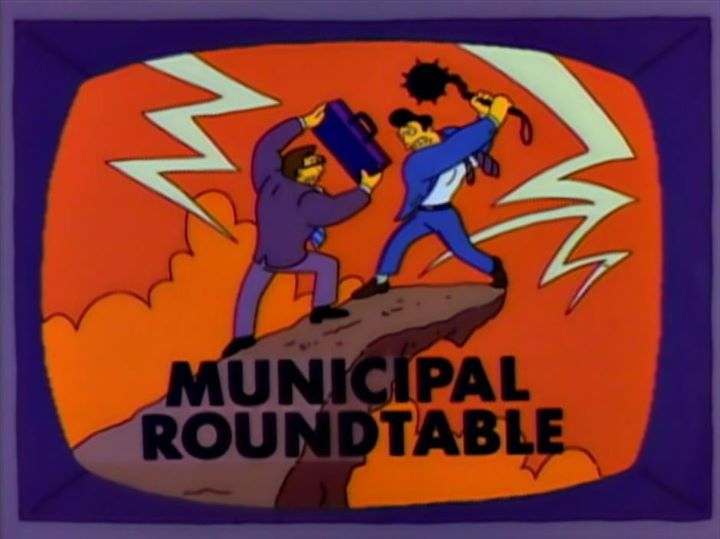
All that said, I have done everything possible to position myself against another recession, bad labor market, etc.  April 1, 2009, seems now like a distant memory, but it could all come back.  I’m reminded of The Simpsons episode where some repo men are repossessing property from a failed Dot Com start-up.  One of them says, “It’s a golden age for the repo business—one which will never end!” as he lights a cigar with a $100 bill.

It’s easy to fall into that mindset.  I’m optimistic for the future, but I’ll never take prosperity or security for granted again.  Constant hustling—booking new gigs, picking up more students, getting more classes, working maintenance on the weekends, leading summer camps, collecting songwriter and publishing royalties—is what it takes.

No foolin’.

Hungarian Border Wall is 100% Effective

Pundit Dick Morris has a short piece on his website, DickMorris.com, about the Hungarian border fence.  It’s a quick read, but here are the key excerpts:

Along its 109-mile border with Serbia, Hungary has built a 13-foot-high fence featuring concertina wire (barbed wire in circles). It took six months to build (July-December of 2015) and cost $106 million. It was built by contractors and 900 Hungarian soldiers.

The fence consists of three rows of razor wire with a sturdier 11.5-foot-tall barrier inside….

And the Hungarian fence works! Before the barrier was built, in September of 2015, 138,396 migrants entered Hungary over the Serbian border. Within the first two weeks of November, the average daily flow had dropped to only 15 people.

Hungary and its populist-nationalist leader, President Viktor Orban, have faced a great deal of backlash and scorn from the progressive, bureaucratic autocrats of the European Union for their border control and immigration measures.  But Hungary is intent on keeping itself culturally Hungarian—it cannot effectively absorb the millions of potential migrants that began pouring into Europe from Syria and North Africa a few years ago.

President Orban is often cast as some latter-day Hitler, but he’s merely doing his job:  he’s putting the people of Hungary and their interests first, behind the interests of foreign vagabonds.

While researching this post, I learned that the European People’s Party—an umbrella party of “center-right” parties (as many outlets described it) running in the European Parliament’s elections this May—is barring Orban’s Fidesz Party from participating.  Apparently, part of their concern is that Orban’s Fidesz Party has posted humorous ads depicting George Soros and Jean-Claude Juncker (the Leftist super-villain billionaire and the President of the European Commission, respectively), suggesting the two are in cahoots to control Europe.

Well… aren’t they?  Isn’t the “center-right” European People’s Party supposed to represent a challenge to the Eurocrats (if anyone knows, I’m only asking semi-rhetorically)?

Two takeaways:

1.) Leave Viktor Orban alone.  He’s helped protect his country at a time when other European nations turn blind-eyes to Muslim rape gangs.

2.) The original point of this post:  President Trump can follow the Hungarian model and build an effective wall on the cheap.  Granted, we have more than 109 miles, but copy-paste that approach along our long border with Mexico, and could get the job done quickly and efficiently.

Open borders and progressive politics are the real dangers to liberty and prosperity, not an unabashed nationalist in Central Europe—or one in the United States.  Build the Wall, Drain the Swamp, and Leave the European Union!

Avenatti Arrested

President Trump was vindicated Friday.  Yesterday, attorney Michael Avenatti—the attorney who represented porn star Stormy Daniels, making him a star among Democratic sycophants—was arrested on charges of extortion and fraud, and could face fifty years in prison.

I wrote yesterday that the end of the Mueller probe, with its lack of any charges of collusion or obstruction of justice against Trump, felt like the 2016 Election, Part II.  That sense of victory—and intense satisfaction—deepened with Avenatti’s arrest.

Here is a brief excerpt from that National Review breaking news piece linked above:

Avenatti worked “to extract more than $20 million in payments from a publicly traded company by threatening to use his ability to garner publicity to inflict substantial financial and reputational harm on the company if his demands were not met,” according to SDNY prosecutors. Those threats, which were made over the phone and in-person meetings with Nike’s attorneys, were recorded.

“A suit and tie does not mask that fact that, at its core, this was an old-fashioned shake down,” U.S. attorney Geoffrey Berman said when announcing the charges Monday.

Democrats were trumpeting Avenatti as a presidential contender in 2020.  He began to believe the hype before deciding not to run (he probably realized he, unlike the president, actually had committed some heinous misdeeds).

Progressives make a huge deal about how they’re guardians of “principle” and “decorum” in the “Age of Trump,” yet they cling to whatever crass personality says mean things about the president the loudest.  They don’t even believe their own tripe.  Political victory is all that matters—by any means necessary.

That’s why substance-less hacks like Avenatti—or low-IQ race-baiters like “Auntie” Maxine Waters—are such darlings to the Left.  They promise to “impeach 45” and to uncover misdeeds, so they can do whatever they want (like encourage their supporters to commit violence against conservatives, as Congresswoman Waters did).

Trump did nothing wrong.  Avenatti tried to use his unearned media clout to shake-down a publicly-traded company for his own personal gain.

I fully expect the Dems will quickly throw away Avenatti now that he is no longer useful to their cause.  There’s a lesson there for us all:  revolutions eat their own.  But they’ll keep fabricating charges against President Trump.

Mueller Probe Complete, Trump Vindicated

The long national nightmare is overThe long national nightmare is over—the Mueller probe/expensive government boondoggle/politically-motivated, Deep State witch hunt is finally complete, and President Trump is in the clear:  there was no collusion between the Trump campaign and the Russian government.

Now that the world finally knows what we all suspected for the past two years, the Left is in complete meltdown mode.  The mental gymnastics to which they’re resorting is humorous, but sad.  A key lesson to remember is that what the Left can’t achieve politically or socially, it will achieve through the courts (or violence).

For two years, the Left assumed that their inside man, Robert Mueller, and the rest of the Clintonian, globalist Deep State would produce (or, if need be, fabricate) the “evidence” needed to oust a duly-elected President of the United States.

Now, they’re magic wand has turned into a limp stick, incapable of conjuring up the fabled “collusion” the Left dreamed about for two long years.

President Trump emerges victorious.  It’s a huge blow to the Deep State, and almost like Part II of the 2016 election:  an outside figure, facing enormous odds and an entire media-government-business establishment arrayed against him, has won a hard-fought battle, even with the deck stacked against him.

There are still investigations in New York involving the perfidious and mendacious Michael Cohen, but those will, most likely, similarly yield nothing but bitter fruit for the Left—and more vindication for Trump.

In the meantime, it’s a great day to be on the Trumpian Right.  MAGA MAGA MAGA!

–TPP

P.S.—Here’s a great video c/o my younger brother: