The Evolution of Judicial Supremacy – Judicial Review

Last night, President Trump nominated Judge Brett Kavanuagh to serve on the Supreme Court to fill the vacancy left by the retirement of Justice Anthony Kennedy.  As such, I thought it would be germane to explore briefly the role of the Supreme Court.

Popular understanding of the Court today is that it is the ultimate arbiter and interpreter of the Constitution, but that’s not properly the case.  The Court has certainly assumed that position, and it’s why the Supreme Court wields such outsized influence on our political life, to the point that social justice snowflakes are now worried about Justice Ruth Bader Ginsburg’s diet and exercise regimen.

Properly understood, each branch—the President, the Congress, and the Court—play their roles in interpreting the constitutionality of laws.  Indeed, President Andrew Jackson—a controversial populist figure in his own right—argued in his vigorous veto of the Bank Bill, which would renew the charter of the Second Bank of the United States, that the President had a duty to veto laws that he believed to be unconstitutional.

Unfortunately, we’ve forgotten this tripartite role in defending the Constitution from scurrilous and unconstitutional acts due to a number of historical developments, which I will quickly outline here, with my primary focus being a case from the early nineteenth century.

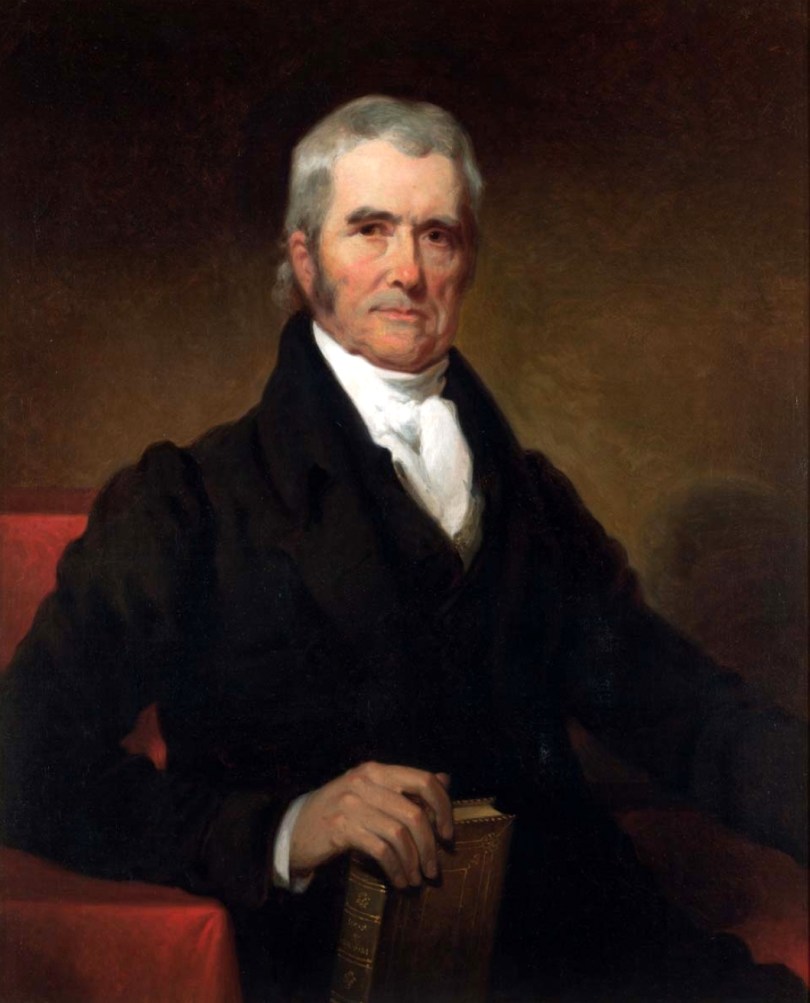
The notion that the Supreme Court is to be the interpreter of the Constitution dates back to 1803, in the famous Marbury v. Madison case.  That case was a classic showdown between Thomas Jefferson and James Madison on one hand—representing the new Democratic-Republican Party in control of the executive branch—and Chief Justice John Marshall, a Federalist appointee, on the other.

The case centered on an undelivered “midnight appointment” of William Marbury to serve as Justice of the Peace for Washington, D.C.  The prior president, John Adams, had issued a handful of last-minute appointments before leaving office, and left them on the desk of the incoming Secretary of State, James Madison, to deliver.  Naturally, Jefferson and Madison refused to do so, not wanting to pack the judicial branch with any more Federalists, and Marbury sued for his appointment.

If Marshall ruled that Madison must deliver the appointment, there was a very real risk that the Jefferson administration would refuse.  Remember, the Supreme Court has no power to execute its rulings, as the President is the chief executive and holds that authority.  On the other hand, ruling in Madison’s favor would make the Court toothless in the face of the Jefferson administration, which was already attempting to “unpack” the federal courts through acts of Congress and the impeachment (and near removal) of Justice Samuel Chase.

In a brilliant ruling with far-reaching consequences, Marshall ruled that the portion of the Judiciary Act of 1789 that legislated that such disputes be heard by the Supreme Court were unconstitutional, so the Supreme Court could not render a judgment.  At the same time, Marshall argued strongly for “judicial review,” the pointing out that the Court had a unique responsibility to strike down laws or parts of laws that were unconstitutional.

That’s all relatively non-controversial as far as it goes, but since then, the power of the federal judiciary has grown to outsize influence.  Activist judges in the twentieth century, starting with President Franklin Roosevelt’s appointees and continuing through the disastrous Warren and Burger Courts, have stretched judicial review to absurd limits, creating “penumbras of emanations” of rights, legislating from the bench, and even creating rights that are nowhere to be found in the Constitution.

Alexander Hamilton argued in Federalist No. 78 that the Court would be the weakest and most passive of the branches, but it has now become so powerful that a “swing” justice like former Justice Kennedy can become a virtual tyrant.  As such, the confirmation of any new justice has devolved into a titanic struggle of lurid accusations and litmus tests.

The shabby treatment of the late Judge Robert Bork in his own failed 1987 nomination is a mere foretaste of what awaits Judge Kavanaugh.  Hopefully Kavanaugh is well-steeped in constitutional law and history—and will steadfastly resist the siren song of personal power at the expense of the national interest.

Breaking: Trump Nominates Judge Brett Kavanaugh to Supreme Court

President Trump has nominated Judge Brett Kavanaugh to replace retired Supreme Court Justice Anthony Kennedy.  This appointment will mark Trump’s second nomination, and will cement the Court’s conservative majority by a narrow 5-4 margin.

Kavanaugh is a devout Catholic and father of three living in Washington, D.C.  He is also a champion for religious liberty, and even the feisty Ann Coulter supports him.  For some readers, that may be cause for concern, but I trust Coulter’s instincts on this one—after all, she predicted Trump would be POTUS, right?

Expect Kavanaugh to face a thorough Borking from Senate Democrats, who will unload on him mercilessly.

Tax Cuts Work

Back in December, I wrote a post on the old blog begging Republicans to pass tax cuts.  When they did, I danced around my house like a silver-backed gorilla on Christmas.

I cannot understand objections to the Tax Cuts and Jobs Act, other than fiscal conservatives’ fear of increasing deficit spending.  By that I mean I can intellectually understand objections in an abstract, academic sense, but I’m unable to accept those arguments as valid in this case, and many of them are specious.

The historical record is clear:  tax cuts works.  Be it cuts on income, corporate, estate, or sales taxes, cutting taxes, in general, stimulates economic growth and usually increases government revenues.

Take the example of Calvin Coolidge, whom we might call the godfather of modern tax cuts.  As president, Coolidge used his predecessor’s Budget and Accounting Act of 1921 to carefully monitor and eliminate excess government spending.  He also signed into law the Revenue Act of 1926, reducing the top rate to 25% on incomes greater than $100,000.

By the time he left office, the government had increased revenues (due to the stimulative effect of the tax cuts on the economy—rates fell, but more people were paying greater wages into the system), federal spending had fallen, and the size and scope of the federal government had shrunk, a feat no other president has managed to accomplish.

The perennial wag will protest, “But what about the Depression?”  Certainly, there were a number of complicated reasons that fed into the coming Depression, but the stock market crash—really, a massive correction—did not cause the Depression.  Had the government left well enough alone, the economy should have adjusted fairly quickly, although modern SEC rules and regulations were not in place.  That’s a discussion for another post, but I suspect that Herbert Hoover’s signing of the Smoot-Hawley Tariff (1930)—a tax increase on imports—did much to exacerbate the economic situation, and a decade of FDR’s social welfare experiments injected further uncertainty into markets.

But I digress.  Subsequent presidents have championed tax cuts in the Coolidge vein, albeit without the corresponding emphasis on spending cuts.  John F. Kennedy pushed for tax cuts, which threw gasoline onto the fire of the post-war American economy.  Ronald “Ronaldus Magnus” Reagan’s tax cuts created so much prosperity, the ’80s are remembered for hair metal and cocaine; had he not had to spend the Soviets out of existence (and faced a Democratic Congress), he could have cut spending, too.

President Trump’s tax cuts have breathed new life into a sluggish, post-Great Recession recovery.  Jobs growth is increasing month after month, and wages are rising, slowly but surely.  Black unemployment is down from 7.7% in January to 5.9% as of May—the first time it’s ever been below 7% since the government began keeping statistics in 1972.

Leftists object that the cut to the corporate tax rate benefits big fat cats instead of everyday Americans, but the statistics suggest otherwise (see the article linked in the previous paragraph for more good news).  Further, Leftists moan and groan when companies put increased revenues into dividend payments to stockholders, as if this move is detrimental.  On the contrary, as more Americans invest in mutual funds in their 401(k)s or IRAs, they stand only to gain from these investments.  Progressives only see these investments as “big company benefits,” without following through on what that money does.

Of course, that’s because the Left’s focus is emotional (not economic), and worries about all the sweet government gigs that majors in Interpretative Queer Baltic Dance Studies will lose without the federal government’s largesse.  Getting voters off the welfare rolls further inhibits the Democratic Party’s mantra of “Soak the Rich,” as upwardly-mobile workers naturally want to keep a good thing going.

Conservative concerns of deficit spending are more grounded in economic reality, and while the federal deficit seems like an abstraction to most Americans, it does present a looming crisis.  Perpetual indebtedness in a personal sense seems inherently immoral if undertaken as a financial strategy unto itself (taking out a loan for a car, a house, a business, or education is one thing; living off of borrowed money, and borrowing more, with no intention of paying it back is quite another; I’m referencing the latter situation); the government should be held to the same standard.

That said, the problem of the federal deficit is a longstanding issue that has more to do with excessive and wasteful spending.  The stimulative effect of the tax cuts, by putting more people to work, will increase revenues.  The most pressing concern now is for Congress to make the income tax cuts permanent—another no-brainer, win-win move for all concerned.

Taxes are a necessary evil—we need the military, roads, and the like—and there comes a point of diminishing returns with cuts just as there are with increases, but allowing Americans to keep more of their money is, in almost every situation, the better choice, both economically and morally.

Progressivism and Political Violence

The modern Left idealizes political violence.  That’s a bold statement, but it’s true, and the truth of that claim dates back to the French Revolution.  That revolution—so different from our own—was the root of almost all totalitarian movements in the 20th century, and of the American Left’s current mood for mob activity in the name of “progress.”

The big story in the world of the American Right this week has been Democratic Congresswoman “Auntie” Maxine Waters’s calls for active disruption of Trump administration officials in their private lives, to the point of harassing them at restaurants, department stores, and gas stations—even picketing at their homes, as happened to Secretary of Homeland Security Kirstjen Nielsen‘s home twice.

Waters’s execrable remarks—and her blasphemous contention that “God is on our side” (if she’s referring to Baal, the ancient Canaanite fertility god who worshipers tried to appease with child sacrifices, I’m sure he is pleased with Democrats’ support of abortion, but THE One True God must be weeping constantly over those lost lives)—were inspired by the ouster of White House Press Secretary Sarah Huckabee Sanders from the Red Hen, a restaurant in Lexington, Virginia.  In a Fox News interview after the fact, Sanders’s father, former Arkansas Governor and bassist Mike Huckabee, alleged that the progressive owner of the restaurant followed the Sanders party down the street, heckling them.

None of these events, in my mind, are surprising, but, rather, a reminder of the progressive Left’s taste for violence—or, at the very least, of achieving its long-term political goals by “any means necessary” (a slogan of the so-called “Resistance”).

Recall the soon-forgotten shooting of congressional Republicans last year as they practiced for Congress’s annual interparty baseball game.  That attack, the fevered result of a Bernie Bro’s break with reality, nearly killed Louisiana Congressman Steve Scalise.  It’s easy to forget the anti-Trump hysteria of 2017 (because the anti-Trump hysteria of 2018—after the President’s proven himself in office—seems even more unhinged), but the Left was out for blood after the Inauguration, with pink-hatted activists shouting at the sky in protest.

The Left has taken America’s cold civil war hot because it doesn’t control any of the levers of power in government.  With the retirement of swing Justice Anthony Kennedy, progressives may see their last ace-in-the-hole, the courts, lost for a generation (to be clear, the Left is still dominant in academia, pop culture, the arts, major non-profits, the corporate world, and pretty much everything that isn’t the federal and State governments).  The last tactic, then, is to amp up their social intimidation to borderline—and, if necessary, actual—violence.

Consider that the Left can only push forward its agenda for any length of time through means of coercive power (although maudlin emotional manipulation comes in handy, too, and works well with easily-manipulated “feel-good” types).  Traditionally, that’s been through the power of the state—the massive reach of the federal government.

It was the modern political Left, growing out of the Progressive movement of the late nineteenth and early twentieth centuries, that brought first the New Deal, and then the Fair Deal and the Great Society, that vastly expanded the size, scope, and reach of federal power.

While Americans were largely content with some government assistance during the throes of the Depression—and naively believed that the federal government could actively solve the nation’s problems after the Second World War, given the government’s success in fighting that global conflict—they could not stomach actual Marxism.  So it was that Democrats began gradually to lose their mid-twentieth-century vice grip on the ballot box.

With the rise of the “New Right” in the 1960s and 1970s, followed by the election of His Eminence Ronaldus Magnus in 1980, Leftists increasingly turned to the courts to fulfill by judicial fiat what could not be achieved at the ballot box.

Take, for example, the overturning of California’s ballot initiative, Proposition 8, to amend the State’s constitution to outlaw same-sex marriage.  In California—the beating heart of the modern progressive movement—a small cadre of unelected officials overturned the will of the people.

Similarly, Justice Kennedy more or less decided that federalism doesn’t matter, and we should believe that the Founding Fathers meant to support casual same-sex boning, but just forgot to put it in the Constitution (I have friends who support same-sex marriage who disagree with the Obergefell v. Hodges ruling, arguing that it oversteps the Supreme Court’s constitutional authority).

The courts were the back-up plan.  I’ve actually read (anecdotal evidence alert) some progressives posting on Facebook to the effect that, “Well, we overplayed the judicial activism thing for too long, and we relied on it at the expense of electoral victory.”  Those comments are rare—more of them are childish weeping and/or promises to move to Canada or “stop joking around.”

Now that President Trump is in the White House, Republicans control Congress, and the Supreme Court is ready to tip narrowly toward constitutional originalism, Leftists are apoplectic, and are showing their true colors.  They have two choices:  make a compelling case to the American people to elect more Democrats in November, or double-down on hysteria and send us hurtling closer towards the Second American Civil War.

While there’s been much talk of a “blue wave” this November, the Left’s outbursts and fascistic tactics seem to be hurting Democrats nationally.  That doesn’t mean they won’t take the House or the Senate—after all, some of these districts are so blue they keep voting in borderline illiterates like Congresswoman Sheila Jackson Lee of Texas—but their chances are narrowing.

Even if they do take control of one or both chambers, President Trump will still control the executive branch, and, as yet, has done nothing impeachable (being crude or saying awesome stuff on Twitter don’t qualify as “high crimes and misdemeanors”).  Sure, they might try, but it would be like the Radical Republicans impeaching President Andrew Johnson for ignoring an unconstitutional act of Congress—purely politically-motivated.

If there is impeachment in the House, it will fail—Trump will not be removed from office by the Senate—the Democrats will find themselves stuck for another two years with a president they irrationally despise.  The way things are going, he’s likely to win reelection in 2020 (please, sweet Lord).

But all of this is conjecture.  There’s a good chance Republicans hold onto the House and pick up vulnerable Democratic seats in the Senate (such as Heidi Heitkamp’s seat in North Dakota).  What then?  With a new conservative Supreme Court justice, the Left is marginalized at the federal level, other than their Deep State cronies.

My guess is that we’ll see more insanity and violence before we see less.  The Left will double-down on this progressive agenda for a decade, until a moderate, Bill Clinton-style moderate appears, or the economy turns sour (not likely!), or they can cobble together another Obama-style rainbow coalition.

The question is, will their propensity for political violence boil over into full-scale warfare and defiance of constitutional authority?  We’ve already seen California nullify federal law by refusing to enforce immigration law.  Distrust between people of different political backgrounds is at feverish highs.

Beyond some fringe kooks, no one on the American Right wants to see violence.  But the progressive Left’s deep-rooted love of “punching Nazis” and strangling dissent won’t broach much room for disagreement.

We’re living in scary times.


Indian Man Worships Trump as a God

Bussa Krishna, a 31-year old Indian man living in Hyderabad, has spent the last three years worshipping President Donald Trump.  His devotion to the God-Emperor is so intense that his parents have moved out of the house—almost the reverse of the parents who sued their 30-year old son to move out.

It seems that the social alienation Trump supporters face is an international phenomenon.

While I’m glad to see the President has admirers overseas, I pray that this gentleman will downgrade his admiration from “god worship” to “avid supporter.”

I also see an opportunity for President Trump here to evangelize.  All it would take is a quick tweet, something along these lines:

“Thanks for the love, Bussa!  But while we’re still winning and Making America Great Again, there is One far greater than me. Jesus Christ is our Lord and Personal Savior, and He deserves your praise.”

Y’all forward this along to Sarah Huckabee Sanders and see if we can’t make this happen.


Breaking: Justice Anthony Kennedy Retires

The past few weeks have been chock-a-block with major developments.  The Supreme Court, in particular, has been in the news quite a bit, including striking down compulsory dues payments for non-union members.

Now that the current session of SCOTUS is in recess, Justice Anthony Kennedy, the infamous “swing” justice, has announced his retirement, which is effective 1 July 2018.

This gives President Trump his second opportunity to appoint a justice to the highest court in the land.  The Neil Gorsuch nomination was a slam-dunk, as recent Supreme Court rulings have demonstrated.  Now Trump has the opportunity to appoint a true, consistent, constitutional conservative to the bench.

Justice Kennedy was nominated thirty years ago, after the railroading of Robert Bork.  Bork, a hard-nosed conservative and constitutional originalist—indeed, Bork made originalism cool again—was slandered by the execrable Senator Edward “Teddy” Kennedy, the so-called “Lion of the Senate,” in his melodramatic “Robert Bork’s America” speech against Bork’s appointment.

The speech—a classic misunderstanding of constitutional originalism, and a classic example of fearmongering—argued that women would be forced to have back alley abortions, that black Americans would have to sit at segregated lunch counters, and that Americans would face “midnight raids” on their homes.  Critics of originalists ignore that constitutional originalists recognize the amendment clause of the Constitution—they wouldn’t very “originalist” if they didn’t—and so falsely claim that anyone who supports a literal reading of the document supports slavery (or some such nonsense).

Regardless, President Trump’s potential nominee—who will be chosen from a list of twenty-five—will no-doubt face a proper Borking of his own.  Here’s hoping the Republican-controlled Senate can avoid cucking out on this rare opportunity, and put someone who actually understands and believes in the Constitution on the bench.

Breaking: SCOTUS Upholds Trump’s Travel Ban

In a rare victory for constitutionalism and common sense, the Supreme Court in a 5-4 ruling upheld President Trump’s so-called “travel ban” on those coming from five majority-Muslim countries and two non-Muslim nations, Venezuela and North Korea.

Congress has given the President broad powers over immigration, and the Supreme Court upheld those powers, without endorsing the soundness of the policy.

The legal challenge to the ban was on the grounds that it was motivated by an anti-Muslim bias.  Whether such a bias was a motivating factor or not is inconsequential; the US President has the authority to ban travel by foreign nationals to the United States on any grounds, for any reason.  Any distaste for a president’s immigration policy should be demonstrated at the ballot box, not in the Supreme Court.

Ultimately, too, trying to read the mind of the president—especially if it’s President Trump—is a thorny proposition.  While candidate Trump made several (accurate) remarks about the dangerous nature of radical Islam as part of a justification for a proposed ban on travel by all Muslims—an idea that is probably unworkable in practice—that’s not enough evidence to support an anti-Muslim animus.

Further, what counts as an “anti-Muslim animus”?  If I criticize Pakistani-run child “grooming” gangs in Great Britain, is that an indicator?  If I speak out against genital mutilation in Muslim Somalia, does that qualify?  There’s a difference between speaking hard truths (for example, a substantial number of Muslims think terrorism is justified, even if they themselves wouldn’t commit an act of terror) about a group and hating it.

The legal challenges to the travel ban boiled down to feel-good emotionalism—“you can’t say anything bad about a minority group or your policy is invalid!”—not an actual constitutional argument against it.  The policy may or may not be sound—I think it makes perfect sense, but others are free to disagree—but that’s for the voters to decide, not a small group of legal agitators hoping for a win in the Supreme Court.

Vindication – Ben Shapiro Agrees with TPP

Yesterday, I wrote about George Will’s full-scale, Never Trump meltdown.  Later that day, the brilliant Ben Shapiro agreed with me on his daily show (not by name, mind you—that would be awesome).

Check out the video here:

I don’t like purity tests, but George Will isn’t even taking the right exam.  It’s said to see such an eloquent writer and inspired mind succumb to Trump Derangement Syndrome.

Ben Shapiro did not uncritically accept Trump during the 2016 election, and did not vote for him (or Clinton), but he’s been intellectually honest about his assessment of the Trump administration (and has pledged to vote for Trump in 2020 should the administration’s current course continue).

Sadly, such even-handedness among the so-called Conservatism, Inc., has been in short supply.  Kudos to Shapiro for calling it like it is.

George Will’s Self-Destruct Sequence

Last week, America lost one of its great columnists, Charles Krauthammer.  Krauthammer was a former speechwriter for Democratic VP candidate Walter Mondale, then realized he was no longer a Democrat when Ronald Reagan became president.  Krauthammer was a political conservative, but he wasn’t a slave to ideology.  He remained intellectually-curious and -honest, even that meant he was wrong on a rare occasion (he argued for a $1/gallon gas tax nearly a decade ago).

Long-time Washington Post columnist George Will—a colleague of Krauthammer’s at the paper—similarly has a reputation for intellectual honesty.  Like Krauthammer, Will exists in a cosseted, Beltway-Washington, D.C., and hasn’t quite come to terms with the presidency of Donald Trump.

As such, it was with dismay—but not surprise—that I read Will’s derisive op-ed in the Post, “Vote against the GOP this November.”  Never has self-destructive defeatism sounded so literate.

Will’s specious argument boils down to these details:  President Trump is a borderline dictator; Republicans in Congress are afraid to criticize him for fear they will lose their seats; Americans should vote out enough Republicans that the Democrats take control, but there will still “be enough Republicans to gum up the Senate’s machinery.”

Will points out that Congress has sacrificed its own important Article II powers in order to take the easier path of non-accountability, instead preferring to leave the hard decisions to the President and his power of executive orders.  While this point is valid, it’s not unique to the Trump administration, which, by all accounts, has used executive orders narrowly, and within the framework of existing legislation.  To read Will, this problem is due to Trump’s temperament and personality.

While the President may not enjoy criticism, he’s a big boy—not the coddled man-child that was President Barack Obama—and, besides, it’s Congress’s responsibility to pass and propose legislation.  If the President doesn’t like something, he can veto it.

Where Will’s advice truly goes off the rails is his claim that Democrats should be permitted to take control of the Senate, even if it brings in a “basket of deplorables,” because then a do-nothing Congress… would still do nothing!  He argues that enough Republicans would still be around that they would keep “the institution as peripheral as it has been under their control,” and would “asphyxiat[e] mischief from a Democratic House.”

What a load of malarkey.  As a conservative, which would you rather see:  a feckless Congress controlled by Republicans, or Democrats?  Even if you knew the Congress would be ineffective half of the time, the answer is obvious:  you’d opt for the former.  At least with ineffectual Republicans in control, you’d avoid groundless impeachment votes.

Indeed, look at the record of the current Congress:  the Senate confirmed conservative Supreme Court Justice Neil Gorsuch; the Republican-controlled Congress passed the massive tax cut bill (which Will imperiously dismisses—when one enjoys Georgetown cocktail parties and fancy D.C. brunches for a living, money isn’t an issue); the Congress enacted the Right to Try Act, which will make it easier and cheaper for patients to try still-experimental drugs for deadly illnesses.

Logically, Will’s advice makes zero sense.  If the idea is to send a message to Republicans to be more independent from the President’s agenda—why would they want to be?—the price is too high.  Why make a point on principle if it costs you the future victories of still-higher principles?

I believe Will is sincere in his desire to see constitutional checks and balances restored, but President Trump represents part of the cure to that problem, not the disease.  Congress has the responsibility to step up.

That said, I also believe Will is blinded by a sincere hatred of—or, at the very least, a passionate distaste for—President Trump.  The man left the Republican Party, and urged Republicans to ensure Trump’s defeat, back in 2016—such are the depths of his disregard.  Now that Trump is president—and restoring the nation’s economy and national sovereignty—Will’s irrelevance as a national commentator is even further highlighted, and it seems his anti-Trump impulses grow even further.

Will thinks the ideal President should be balancing a tea cup on one knee while listening attentively to a farmer in Iowa (sadly, I can’t find this quotation online at the moment, but I remember reading it back in 2016).  For better or worse, the era of the Mitt Romney Republican presidential candidate has passed.  We are in the midst of a full-blown, no-holds-barred culture war in which conservatives have played the decorum card for too long.  Trump is a brawler, and while he may be imprecise or distractible, he has the guts to tango with the enemy—and win.

Will’s self-destruction as a conservative pundit is sad to witness, but perhaps it’s overdue.

Why the Hate for Space Force?

Ever since President Trump ordered the creation of Space Force earlier this week, I’ve read a lot of snarky Facebook posts and the like mocking the idea.

Some of these posts consist of the usual arm-chair analysis:  “Trump did it to distract from the child separation crisis!” and the like (if you look at the timing of the child separation crisis issue, though, it seems like something Democrats ginned up to distract from the IG report released last week).

Much of what I’m reading, though, consists essentially of, “Wow, what a stupid idea.  Like we need to have a military in space,” or the more bleeding-heart, “Why do we want to dominate space.  LOVE TRUMPS HATE!”  That latter one is usually followed up with a link to the Wikipedia entry for the Outer Space Treaty of 1967, as if some Gene Rodenberry-style, early Star Trek-esque treaty is going to keep the ChiComs from building a death laser on the moon (don’t laugh—the Chinese are just wily enough to do it).  I’m tired of people using the name of a meaningless treaty in lieu of an actual argument.

When did we stop dreaming?  What happened to that Gene Rodenberry-style, early Star Trek-esque drive for space exploration?  I realize much of this animosity toward the idea is knee-jerk partisanship:  bearded hipsters who probably still sleep in Star Wars pajamas hate Trump so much that they can’t get behind this amazing idea.  If Obama had ordered it, they’d be throwing craft beer tasting parties sponsored by Blue Moon.

But I also suspect that Americans aren’t dreaming big anymore.  I read a little bit by National Review‘s Charles C. W. Cooke some years ago in which he talked about how great his WiFi-enabled gadgets were, and he essentially argued that we needed to appreciate the future we have instead of the sci-fi rock opera vision of the future we want (R2-D2 playing the bass guitar, taking summer vacation on the moon, using lightsabers, etc.).

While I am incredibly thankful that I can find clips like the one above in mere seconds (even if it is in another language)—and to have vast storehouses of human knowledge mere keystrokes away—does that really mean that’s all there is?  Is it ungrateful to say, “Hey, this is incredible—how about even more cool innovations?”

Space is the final—and endless—frontier.  As such, it will be the next battleground of human conflict.  Instead of laughing at the idea of Space Force, let’s figure out how to make it an efficient, effective fighting force to ensure that liberty endures beyond the 21st century—and our pale, blue dot.