Trump’s Economic Growth Isn’t Due to Farm Exports

President Trump has enjoyed massive economic growth since his election, much less his actual inauguration.  The latest economic growth numbers for Q2 put the annualized rate of growth at a whopping 4.1%.

Naturally, the progressive Leftists are grasping about for any explanation they can to account for this growth, or to downplay it.  One of the more novel proposals is that the only reason growth is so high is because farmers are rushing out their exports to other nations ahead of planned tariffs—and the retaliatory measures they will garner.

While I’m willing to concede these premature exports may account for some of the growth rate in Q2, I doubt very seriously that there are enough additional soybean exports to China in a three-month period to bump the entire economic growth rate by more than a fraction of a percent.

Consider all the factors at play here:  the 2017 tax cut, specifically to the corporate tax rate, created a yuge incentive to companies to repatriate dollars held overseas, and made American companies internationally competitive again (prior to the cuts, our corporate tax rate of 35% was one of the highest in the developed world).  The easing of pressure on corporate rates and individual income tax rates have boosted business and consumer confidence, and wages have increased as unemployment continues to fall.

Even before the passage of the tax cut, deregulation within the executive branch began stimulating the economy.  In his famous Gettysburg campaign speech, in which then-candidate Trump put forth his reform agenda for the United States, he promised an executive order requiring the removal of two regulations for every one new regulation written.  In classic Trumpian fashion, the President delivered—and then some:  in 2017, the Trump administration cut a whopping twenty-two regulations for every one regulation passed.

The one-two punch of deregulation and tax cuts has juiced the engine of the economy with rocket fuel, but the media loves to run with the narrative that it’s all smoke-and-mirrors, and we’re only enjoying this growth because a bunch of farmers rushed out exports early.

They push that story for two reasons:

1.) They can’t give Trump credit for anything positive

2.) It draws attention to the downsides of tariffs, and the cloying sentimentality of the farmer struggling under Trump

I have a great deal of respect for farming and the rural life, but these aren’t Nebraska homesteaders or Jeffersonian yeoman farmers we’re talking about.  Not that that matters—big corporate farms shouldn’t be punished for being big; I’m merely cautioning readers to take such rhetoric with a massive dose of soy (actually, pick something else; we don’t need anymore soy boys).  The mainstream media is going to spin this story in the most maudlin fashion possible.

Tariffs historically have hurt farmers, who often pay the price of tariffs both ways:  they pay more imported goods, and they struggle to access foreign markets competitively when they export their products.  And, as I wrote recently, I don’t think tariffs are without their costs.

That said, there’s no way Q2 GDP growth can be driven solely, or even mostly, by farm exports.  Further, it seems that such robust growth makes tariffs more affordable, in the sense that the United States can spare a few decimals of growth in exchange for greater protections of worker.

Finally, tariffs-as-bargaining-chip seems to be working.  China’s economy is in free-fall, and the Chinese have to eat.  Even with tariffs on US soybeans and other farm products, China needs what we’re growing more than we need what they’re churning out.

In short, stay the course, President Trump.  Rebalance our trade agreements, make the income tax cuts permanent, and keep regulations light.

Numbers Don’t Lie – The Electoral College

Pollster Scott Rasmussen writes a brief, daily post for Ballotpedia called “Number of the Day.”  It’s an excellent, bite-sized chunk o’ statistical knowledge that gives an enlightening view of our nation from one of America’s great polltakers.

Monday’s “Number of the Day” was “49.5% of the U.S. Population Will Live in Eight States by 2040“—and continued with a discussion of the Electoral College.

For the unfamiliar, the Electoral College takes a lot of heat, usually from progressives (and especially so since President Trump won the 2016 election in the Electoral College, but lost the popular vote by margin of some millions).  There have been multiple attempts to abolish the Electoral College throughout American history, with the most successful effort coming after Richard Nixon’s electoral victory in 1968 (of course, that effort failed—fortunately).  Critics argue that the institution is “undemocratic,” as it seems to violate the principle of “one person, one vote.”

Fortunately, the Framers of the Constitution were wise enough to realize the pitfalls of popular democracy, which they believed devolved into mob rule and, ultimately, tyranny (see also:  the French Revolution), and also anticipated the dangers of a small group of urban voters being able to swing presidential elections at the expense of voters in rural States.

It is precisely this fear that Rasmussen’s demographic data highlights.  Rasmussen writes that nearly half of the nation’s population will live in one of eight States by 2040:  California, Texas, Florida, New York, Pennsylvania, Georgia, Illinois, and North Carolina.  That means that, in a popular system, those States could nearly swing a presidential election themselves.

Some readers might object that those voters are not uniform, and a popular vote would put a State like Wyoming more into play (as those ~600,000 voters—projected to be around 688,000 in 2040), but that assumes a level of individuality that, while attractive to the libertarian-minded, is not realistic.

Rural sections of the country have different goals, values, and concerns than urban centers.  A State with one or more major metropolitan areas would dominate national politics.

Rasmussen touches on this dynamic in Congress, too.  Currently, large States enjoy a huge advantage in the House of Representatives, the most “democratic” chamber at the federal level.  Small States, on the other hand, possess greater leverage in the Senate, where every State gets two Senators, regardless of population.  California—with its fifty-three Congressmen—can run roughshod over Wyoming in the House, but California’s Senators have the same clout as Wyoming’s two.

In essence, then, the different sections of the country have to reach some level of compromise to accomplish anything.  Rural States have to throw urban States a bone to get legislation passed in the House, and urban States have to support some rural State measures.

Indeed, this is largely how the farm bill and food stamps get passed:  rural Republicans vote for food stamps for the urban poor, and urban Democrats vote for corn subsidies for rural farmers.

That’s all Civics 101, but, as Dr. Samuel Johnson wrote, “People need to be reminded more often than they need to be instructed.”

A final thought:  what happens when rural-urban compromise breaks down?  The values of the rural portions of the country—chiefly the South and Midwest—are increasingly at odds with the values of the bicoastal elites and their scattered archipelago of continental metropolises.  In that case, shouldn’t we throw out the system, as we’ll just get gridlock?

To quote the Apostle Paul, “God forbid!”  That divide highlights the necessity of separation of powers.  I’d rather not have a demiqueer otherkin alternative poetess-programmer (that’s the most ridiculous caricature I could conjure up) and xyr pansexual two-spirited Wookie life-mate ramming ultra-leftist progressive policies up my butt like a hamster at their next vegan pottery party, just as I’m sure the Wookie life-mates wouldn’t want me dictating my rustic Biblical morality to them (but, just so we’re clear, you people have lost your way).

The only major threat, as I see it, is that Congress has so abdicated its responsibility to the executive branch and its unelected bureaucracy of careerist swamp creatures, that we could see the further rise of executive overreach.  That’s why progressives howl at the moon in protest to President Trump—they think he’s going to wield the sword of executive power against them the way President Obama did against us.

But with the Deep State so ensconced in our national life, I sometimes fear that we’re living in pre-Augustusean times.  In the meantime, let us hope President Trump can correct the course; that Congress will once again jealously guard its prerogatives; and that the Electoral College stands for centuries to come.

Democrats Show Their True Colors

Over the weekend, Democratic congressional nominee Alexandria Ocasio-Cortez appeared on a video with Vermont Senator Bernie Sanders.  The two self-styled democratic socialists were campaigning for Brent Welder in Kansas City.  In the video, the telegenic young Marxist boasted that “We’re gonna flip this seat red in November,” accidentally confusing the Republican Red for the Democratic Blue.

A minor gaffe, to be sure, but it’s interesting to consider the political party colors, which were reversed not too long agoRed has traditionally been the color of Communist, Marxist, socialist, and other leftist movements since the nineteenth century.  According to a piece from The Smithsonian (linked above and here), the media’s first usage of different colors to demonstrate presidential election results occurred in the 1976 race, in which Democratic candidate Jimmy Carter won when Mississippi went “red.”  Apparently, media outlets used the colors interchangeably until the 2000 election; we’ve stuck to red for Republicans and blue for Democrats since then.

In retrospect, though, the red coloring fits more with the ideology, goals, and history of the Democratic Party, and particularly its progressive wing (which, I would argue, is most of the party at this point).  Lately, Democrats have been flaunting their true colors unabashedly.

Take Ms. Ocasio-Cortez, for example.  She won a much-discussed upset in the Democratic primary for a New York congressional district against a powerful incumbent, Joe Crowley.  Her politics are stridently Leftist:  she supports Medicare for all, the abolishment of Immigration and Customs Enforcement (ICE), the forgiveness of all student loan debt, and a plethora of other unrealistic, expensive causes.

She’s also a much more appealing—and, therefore, more dangerous—face for “democratic” socialism than its other ubiquitous standard-bearer, Bernie Sanders. Senator Sanders is an aging, old-school socialist of the Trotskyite variety, much like his British counterpart, Labour Party leader Jeremy Corbyn.  He’s never held a serious job outside of politics (which he entered in his forties), and he now looks like a kooky mad scientist who could disappear in a pile of dust and bones if a strong wind hit him (or if the deal he made with that necromancer is broken).

Ocasio-Cortez, on the other hand, is 28, and has the sort of Millennial profile that is common for my confused generation:  she worked as a bartender until a year ago; she’s passionate about many subjects, but not well-versed in any of them; she’s over-educated to the point of uselessness (see the previous phrase).

She’s also super telegenic and—except for some unfortunately-timed photos—a babe, and a Latina at that.

That’s a combination that Democrats can’t resist.  Like President Barack Obama—who was cool, African-American, a community organizer, and had a messiah complex—Democrats want a candidate who parrots radical ideologies while also validating them emotionally.  The hope is that an attractive young candidate will help them in future elections; thus, the constant touting of Ocasio-Cortez as the “future of the Democratic Party.”

Never mind that NY-14 congressional district that Ocasio-Cortez will soon represent (there’s not much chance of a Republican challenger succeeding in this district, which is a +29 D district) is nearly 50% Hispanic.  “Hispanic” is a tricky term, because it covers a number of different groups, but these aren’t your third- or fourth-generation Texas Hispanics (the ones who make up about half of the ICE agents Ocasio-Cortez wants out of a job); these are likely recent immigrants who, regardless of race, traditionally vote Democratic.  Some of them no-doubt originate from countries accustomed to leftist populist politicians.

Regardless, the Left is stripping down the last pretenses of being “moderate” or in favor of “common sense,” although you’ll still hear some use that phrase.  In the wake of President Trump’s election and administration, the Democratic Party has become increasingly open about its desire to soak the rich, redistribute wealth, take on a host of burdensome social and economic responsibilities, and generally move the nation further along toward socialism.

Outside of some parts of the South and the Midwest, the idea of the old-school “conservative Democrat” is long dead; it’s only now that the Democratic Party is showing its true colors.

To the Moon!

Before beginning today’s post, a quick note about last Friday night’s concert:  the whole thing came off smashingly.  My buddy John and I gave a 90-minute performance at a coffee shop in Hartsville, South Carolina, Crema Coffee Bar, where we’ve played a number of such shows in the past.

This show was, easily, the most fun I’ve had playing this particular venue, our home-away-from-home in Hartsville.  John and I took turns playing original tunes, and we both unveiled new selections, John debuting an Irish tragedy entitled “The Sailor,” and I introducing my latest irreverent comedy tune, “Private Lessons (Goth Chick).”

We also enjoyed an excellent turnout, which is not to be taken for granted.  Live music doesn’t always have the appeal it once did, and sometimes promoting a show can come across as a bit needy—“please come listen to us!”—especially as everyone you know is in a band these days.  Fortunately, our friends and fans were hugely supportive, and it seemed like a capacity crowd at the height of the show.  A YUGE “thank-you” to everyone who came out.

My next tour stop is the Juggling Gypsy in Wilmington, North Carolina, on Friday, August 3, starting around 9 PM.  You can learn more at www.tjcookmusic.com or on my Facebook page.

***

I’ve written  a bit about space exploration and the formation of Space Force on this blog, and I’ve long been an advocate semi-publicly of expansion into space.  Neil deGrasse Tyson wrote an essay in Foreign Affairs when I still subscribed to the globalist rag that had me jumping for joy.  The essay, “The Case for Space,” is one of the best apologias written for the benefits we would reap from funding additional space exploration.  Tyson is a poor political pundit, and his fanboyish acolytes are so annoying, they reflect poorly on him, but he knows what he’s talking about when it comes to space.

I’m a fiscal, as well as a social, conservative, but I’m all about spending gobs of government cash on space exploration—and colonization.  I realize I’m committing the same error everyone does—“don’t spend my tax dollars… except on all this stuff I personally like or agree with”—but I see a role for the government in space exploration that makes sense constitutionally and functionally, in a way that, say, free bus fare for war widows isn’t.

Like Newt Gingrich—the other great modern essayist on space exploration—I see expansion into space as akin to westward expansion in the nineteenth century.  There were a lot of hardy pioneers that took the risks and were “rugged individualists”—but the government granted generous loans and tracts of land to railroad companies to open up those lands.  The government—largely Republican-controlled after the American Civil War—played a role in catalyzing western expansion.

Similarly, we see a mix of entrepreneurship and government support today, although the government seems bogged down in its usual bureaucratic inefficiencies, while the hot-shot mega-billionaire flyboys are taking the major risks.  Nevertheless, Gingrich wrote over the weekend about this very topic, marking the 49th anniversary of the moon landing.

As usual, the Trump administration, as Gingrich writes, is thinking “big league” when it comes to space, and Vice President Michael Pence is heading up a revived National Space Council.  The NSC is charged with exploring placing bases on the moon to reduce the costs of launches, which would be much more fuel-efficient in the moon’s reduced gravitational field (which is one-sixth that of Earth’s).

In a larger, cultural sense—since I’m not versed enough in the technical side of this subject, I’m deflecting to where I can bloviate on slightly more solid ground—I don’t understand the disinterest in, even hostility toward, space exploration.  In general, I’m dismayed by the lack of pioneering derring-do and spirit in American culture today.  Aren’t we descended from rugged frontiersmen and women who crossed oceans, forded rivers, climbed mountains, and endured dysentery to get here?

A few years ago, I stumbled upon one of those writers I love—a slightly fringe character who writes about weird, just-outside-of-the-mainstream topics.  The author in question is James D. Heiser, a bishop in the Evangelical Lutheran Diocese of North America and a founding member of the Mars Society, a group that aims to put Americans on Mars.

I first stumbled upon Heiser after reading a review of his book “The American Empire Should Be Destroyed”:  Alexander Dugin and the Perils of the Immanentized Eschatology, which is about the titular figure, an eccentric, Rasputin-like character who advises Vladimir Putin in some capacity.  That book led me to another Heiser work, Civilization and the New Frontier:  Reflections on Virtue and the Settlement of a New World, a collection of essays—mostly his introductory remarks at various Mars Society annual conventions—about the settlement of Mars.

The basic argument is that the quest to settle new worlds will stretch Americans not just scientifically, but spiritually:  in striving for the stars, we’ll cultivate the classical virtues that make civilization possible, and, in the process, reinvigorate our earthly civilization.

I believe there’s something to this thesis.  Struggle—be it the struggle to survive on the hostile Martian plains, or to make ends meet here on Earth—breeds growth.  Adversity is the heat that tempers the iron of the soul.

Space has much to offer:  abundant natural resources, the thrill of discovery, hot alien babes (just kidding about that last one).  But it also has the potential to inspire future generations of Americans to reach for the stars—both physically, and spiritually.

Gig Day!

Happy Friday, TPP Readers!  In lieu of my usual politically-charged antics, I thought I’d give you a brief glimpse into my non-political life.  Normally, that wouldn’t be very interesting—a hairy man watching YouTube videos in his underwear—but today is different:  it’s Gig Day!

When I’m not molding minds, I’m rocking faces.  “Rocking faces” is a relative term; my music is mostly piano-based pop-rock, and I shout out at performances, “Are you ready to soft rock?”  My music has been compared to Elton John, Meat Loaf, Ben Folds, and “Weird Al” Yankovic (how’s that for a mix).  Click those last two links to listen on Spotify, and I’ll earn ~$0.00011 per stream.

Anyway, that’s enough shameless self-promotion.  Because I’m writing this after a late night at an open mic, and because I’m excited to play my first major show since breaking my wrist last November (“major show,” again, being a relative term), I decided to take you on a tour of Gig Day rituals, and give you a break from politics.  We’ll get to how President Trump didn’t commit treason when he declined to diss the leader of a major nuclear power during a joint press conference next week.

The day of a show is always a bit electric.  I’ll spend this morning painting the floor of a boys’ locker room, but the tension and energy will be building even as I’m slopping paint.  The real magic happens after that.  I’ll come home and begin my elaborate pre-show rituals.

First, I’ll “sweat lodge it” in my little cottage for a short period.  This technique involves not running my flimsy air-conditioning units, while my body sweats out the impurities.  I’ll drink copious amounts of icy water, and probably run through some tunes.  I’m a very physical performer, and I get hot when I play, so the A/C will come on at some point during this phase.

After that, if all is good, I’ll begin packing everything into my twelve-year old minivan.  For a coffee house show like this, I’ll bring the following:

  • Keyboard (duh), mic stand, my beautiful Sennheiser microphone, and any necessary cables
  • A couple of tip jars
  • Merchandise, including my album and some sweet Tyler James Cook “Flamin'” t-shirts
  • A few Sharpies to sign autographs—because my fans deserve my signature immortalized in permanent marker

Next, I’ll take a purifying shower that will start off hot, then end ice-cold.  There’s no physiological reason for this method—I just like to cool down dramatically in the heat of the summer.  The A/C will be blasting pure frostiness by this point.

Then, I dress.  Tonight’s duds include this shirt:

Star Wars Shirt

My usual attire—even in the summer—consists of a long-sleeve button-up, jeans, dress-casual shoes, a sports coat, and tie (I used to play outdoor gigs in this get-up, minus the sports coat, but that was insane in South Carolina summers).  I’m sporting the above short-sleeve button-up because one of my weight-loss goals was to fit into it comfortably by the time I played this show.  I’ll probably still wear a tie with it.

Once everything is packed and ready to go—and after I’ve inventoried to make sure everything is packed (I once played a pool party gig without a mic stand; we had to suspend the mic from its cable over a support beam in the pop-up tent I was under)—I hit the road.  For today’s show, I’m picking up my buddy John, who will be joining me on this bill.

I like to arrive a solid hour before showtime, if not earlier.  It doesn’t take long to setup my minimal rig, but you never know what you’ll find.  I’ve played shows where the stage doubles as a dining area during normal business hours, and have had to move furniture just to set up my gear.  This timing also allows for a decent soundcheck, and gives me a chance to get my tip jars arranged as I want them.  Most importantly, it provides time to sort through music, tweak my setlist, and generally calm down before it’s showtime.

Finally—I play the gig!  Obviously, my favorite part, usually followed by some post-show camaraderie with friends and TJC mega-fans at that great, modern Southern institution, Cook Out.  John and I typically do a post-mortem of the show during our meal.

That’s a lot of navel-gazing, to be sure, but we’ll be back to our normal programming Monday.  I don’t play nearly as many gigs as I used to play, but it’s a decent way to earn a few extra bucks doing something I love.

If you’d like to learn more, visit www.tjcookmusic.com.

***

A final, parting coda:  I’m toying with the idea of doing a sort of “reverse house concert” later in the fall.  Unlike a typical house concert, where a host invites an artist to play, charges admission to friends, and puts the artist up for the night (usually with a free meal), I’d host a super-exclusive, very intimate show in my little place.

For context, I live in a 525-square foot cottage that’s packed to the gills with books, keyboards, and the like.  I’ve recorded a few “Kitchen Concerts” with John and another pal, Steve O (not the one you’re thinking about), a la NPR’s “Tiny Desk” concerts.  John and I would post up in the kitchen, and I’ll sell maybe six-to-eight tickets, with people piling in super-close.  We’d have some light h’ordeuvres, then commence a-rockin’.

The idea is that it’d be the ultimate fan experience, but we’d also livestream the concert on Facebook or Periscope for those unable to attend.  It would certainly be a unique experience.

What do you think?  Good idea?  Stupid to shove a bunch of people into a lonely man’s bungalow?  If you were interested in such an event, how much would you pay for a ticket?  $5?  $10?  $15?

Thanks for your feedback—and rock on!

TBT: Capitalism Needs Social Conservatism

On Tuesday, I wrote about the “Human Toll of Globalization“—the dire consequences, both economic and moral, that befall a community when its primary economic engine is gutted through a naïve faith in unbridled free trade and globalization.  Another title for that piece might be almost a mirror of this essay’s from 2016:  “Civil Society Needs Cash.”

I don’t want to take that argument too far, though.  In the case of Danville, Virginia—and countless other American towns that have seen their prosperity flee abroad, or to bicoastal urban cloisters—a decaying economy wrought decaying morality, civil society, and civic pride.  That would suggest that prosperity, in and itself, cannot sustain true morality and virtue.

Indeed, as I argue in the essay below, “Capitalism Needs Social Conservatism,” excessive prosperity and material comfort breed a kind of moral complacency, what Kenneth Minogue likened to widespread Epicureanism (an excellent essay, and well worth reading if you don’t mind subscribing to The New Criterion, which is also worth the price).  Richard Weaver—one of my intellectual heroes—compared the material comfort of the then-mid-twentieth-century West to a drunk who, having grown addicted to alcohol, and requiring ever-greater quantities of it, no longer has the capacity to obtain the very substance he craves.

Milton Friedman famously argued that economic liberty is a necessary precursor to political liberty.  Similarly, I would argue that morality and virtue are necessary pillars to sustaining economic liberty for any length of time.  Indeed, George Washington argued that religion and public morality were “indispensable” to a self-governing republic.

In my mind, the orthodox libertarian (in the political sense, not the “free-will” libertarianism of the free-will-versus-determinism debate in modern philosophy) commits the same error as the orthodox Marxist in relying too much on economic analysis of behavior.  The idea of the “rational man” or “man as a rational animal” is a uniquely modern concept, and while Westerners have tried hard to shoe-horn themselves into that mold, the inner, teeming depths of our souls are still pre-rationalist.  We need God, and we still live according to symbols, rituals, and virtues.

As I wrote in 2016, “Without moral common ground and shared values that stress self-control, liberty rapidly turns to libertinism.  Libertinism without a great deal of wealth leads to shattered lives, which in turn wreck families and communities.”  I’ll explore these ideas further in my upcoming eBook, Values Have Consequences.

***

For the past week, I’ve written about the decline of the nuclear family, with follow-up posts about divorce and sex education, and about the negative impact of the of the welfare state on family formation.  These post have generated some wonderful discussions and input from followers, and I’ve been surprised by their popularity.

As I wrote in “Values Have Consequences,” I’m devoting Friday posts to discussions of social conservatism.  Social conservatism is increasingly the red-headed stepchild of the traditional Republican “tripod” coalition that also includes national security and economic conservatives (with the rise of Trump, populist nationalism could count as a fourth leg).  Politically, this marginalization makes some sense, as it’s not likely that fifty or sixty years of cultural attitudes and values will be changed at the ballot box.

Nevertheless, social conservatism is an important leg of the tripod.  Indeed, I would argue that the three coalitions are not at odds, but create logical synergies that allow each leg to stand.  The stool is much more stable when the three legs work together.

Economic conservatism–by which I mean the belief that freer markets, fewer and lighter regulations, and lower taxes, or what is more properly called neoliberalism (after the classical liberalism of the 18th-century thinkers like Adam Smith)–is wonderful and hugely important.  It’s led to massive gains domestically and globally, lifting untold millions off people out of poverty.  It allows people to enjoy a greater variety of goods and labor-saving devices, and provides more leisure time (and plenty of things to do during that time).

But free markets unmoored from guiding principles, strong and stable institutions, and the rule of law can morph into mindless Mammon worship.  Without a shared sense of trust and belief in human dignity, capitalism becomes cold and abstract.

Further, full-fledged economic liberalization without the limiting principles applied by constitutionalism and a morality supported by strong families and a robust civil society can lead to socially-destructive disruptions and behaviors.

As I’ve argued many times, making mistakes or bad choices is the necessary price of liberty.  But for self-government to work effectively–and to avoid social instability–a healthy dose of social conservatism is the best medicine.

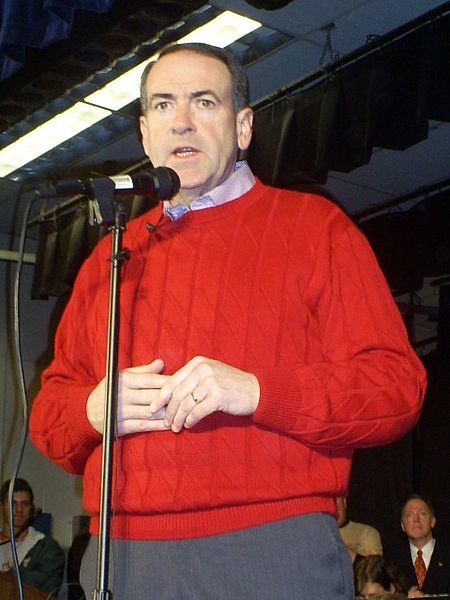
Former Arkansas Governor Mike Huckabee wears the most socially conservative outfit ever; later, he played bass on Fox News.
(Image Sourcehttps://en.wikipedia.org/wiki/File:Huckabeemike.JPG; photo by Craig Michaud)

To offer an illustration from recent history, contrast the post-Soviet experiences of Poland (and most of Eastern Europe) with that of Russia.  Despite decades under Communism–an ideology that was aggressively atheistic, stressing loyalty to the state and Communist Party over all else–Poland roared back into the West.  It adopted neoliberal (modern conservative) economic policies, and was one of the few European nations not to suffer severely during the Great Recession.

Russia similarly adopted “shock therapy” after the Soviet Union collapsed for good in 1991.  Rather than experiencing a huge economic boom, however, well-connected former Communists and others close to the old regime made off like bandits, leaving most Russians left holding the bag.

What’s the difference?  For one, the Russians lived under Communism for nearly a generation longer than the Poles, meaning there were several generations of downtrodden, state-dependent Russians by the time the USSR collapsed.  Many of these Russians were unable to adjust to a free-market system after living in a closed economy for so long.

Another key difference–and one that I think is extremely significant–is that Russians lost any scrap of civil society they might have possessed prior to the Bolshevik takeover in late 1917.  Civil society–the institutions between the basic family unit and the government, like churches, schools, clubs, civic organizations, etc.–was automatically preempted when every club, organization, or activity became part of the Soviet government.  The severely crippled (and, as I understand it, collaborationist) Russian Orthodox Church was unable or unwilling to push back against Soviet rule, providing little in the way of a spiritual alternative to the totalizing influence of Communism.

“[F]ree markets unmoored from guiding principles, strong and stable institutions, and the rule of law can morph into mindless Mammon worship.”

Poland, on the other hand, managed to maintain its deep Catholic faith.  The Catholic Church as an international organization (and with powerful, influential popes, most notably the Polish anti-Communist John Paul II) could never be wiped out completely by Soviet Communism.  Further, the Poles formed the Solidarity trades union movement, which offered an alternative to official Communist organizations.

Thus, after the dissolution of the Soviet Union, Poland emerged with a strong civil society anchored in a richly Christian worldview and ethic.  The shared sense of morality–one that stresses mutual respect, the dignity of human life, and the importance of honesty–allowed the complex deals and uptempo economic exchanges of capitalism to occur smoothly and rapidly.  From these civil and religious values came a firmer grasp of and respect for the rule of law, making predictable economic activity and long-term planning possible.

Russia, on the other hand, devolved into a fast-paced, nationwide run on the national cupboard.  Those with good connections grabbed whatever public funds and goodies they could.  Normal Russians couldn’t figure out why their government checks and free lunches stopped coming, and couldn’t understand why (or how) to pay taxes.  With the collapse of the Soviet Union, all civic organizations ceased to exist, because they were all part of the Soviet government.  Without any civil society or other enduring institutions to model good behavior and to stress and enforce moral values, Russia struggled–and continues to do so–to adapt to global capitalism and democracy.  Not surprisingly, they’ve turned to a dictatorial strongman for guidance.

***

What of the American context?  As I’ve written before, I’m skeptical of full-fledged libertarianism–what I would broadly define as the marriage of economically conservative and socially liberal views–because it fails to acknowledge the need for strong moral values to uphold its own economic assumptionsLiberty and self-government can only really work when coupled with self-imposed order and restraint.  Without moral common ground and shared values that stress self-control, liberty rapidly turns to libertinism.  Libertinism without a great deal of wealth leads to shattered lives, which in turn wreck families and communities.

Eventually, unbridled, unchecked lasciviousness–even among (formerly) responsible adults–results in social chaos, requiring a dwindling number of hardworking, honest, and thrifty individuals to pay for the ramifications of poor moral choices that have been magnified many times over.

“[L]ibertarianism… fails to acknowledge the need for strong moral values to uphold its own economic assumptions.  Liberty and self-government can only really work when coupled with self-imposed order and restraint.”

Capitalism’s blessing of unparalleled abundance is also a potential curse.  Without a strong civil society that stresses good moral values–and without proper historical perspective–it becomes easy to take that abundance for granted.

That abundance also allows, for a time, more and more individuals to pay for the price of bad decisions.  Prior to the modern era, few people were wealthy enough to risk the negative consequences of immorality.  Now, Americans and Westerners enjoy a level of material comfort and well-being that can absorb at least some of the unpleasantness of questionable choices.  Over time, however, that security breaks down.

Richard Weaver likened the situation to an alcoholic who is so addicted to his drink, he’s unable to do the work necessary to pay for his addiction.  The more he needs the alcohol, the less capable he becomes of obtaining it.  Likewise, the more individuals become addicted to luxuries, the less able they are to work hard to maintain them.

To avoid the fate of Weaver’s drunk, we must recognize the importance of social conservatism.  While we should maximize individual liberty as much as possible, and within the bounds of the Constitution, we should also stress the moral and religious underpinnings that make that liberty both possible and responsible.

The Human Toll of Globalization

Last week’s posts shared a similar theme:  the costs of unbridled free trade; the benefits of cutting corporate and income taxes to unleash economic growth; and the human side to economics that academics tend to miss.

The first and third topics referenced above came into sharp relief as I read an excellent piece by Chadwick Moore, “Left for Dead in Danville: How Globalism is Killing Working Class America.”  It’s a long-form piece of journalism for Breitbart, but it is well worth the read.  I encourage all of my readers to set aside twenty minutes to read it and its terrifying account of globalization gone wrong.

My post today simply seeks to offer up a summary of Moore’s findings, presenting them in an easily-digestible form for those who don’t have the time or inclination to read his full-length piece.

The conceit of the piece is simple:  Moore visited Danville, Virginia, a former textile mill town located on the Dan River, and very close to North Carolina.  The town was once—and “once” doesn’t mean “a hundred years ago,” but about twenty years ago—a thriving town that supported a solid middle-class through its robust textile industry.  Civic pride was abundant, and the Dan River Mill supported a number of youth and community activities and functions that are familiar to anyone who has grown up in a small town.

Then came NAFTA in 1994, followed by China’s entrance into the World Trade Organization in 2000.  After years of struggling to compete with foreign competition, Dan River Mills shut down in 2006 (it had been open since 1882).

As the town’s economy declined and unemployment skyrocketed, social problems grew.  Drug use increased dramatically, as did crime, and formerly-safe, middle-class neighborhoods devolved into dangerous slums.  More than a quarter of the town’s population is on food stamps.

Race relations also grew worse.  The town had enjoyed peaceful, working relationships between black and white citizens, who worked together happily in the mills and other businesses.  Now, the KKK plans rallies, preying off the desperation of the unemployed (the town is roughly half white, half black).

Moore gives a good bit of space to quoting Michael Stumo, the CEO of the Coalition for a Prosperous America.  Stumo elegantly explains the problem in Danville—as with many other small towns in Middle America—tracing it to China and the World Trade Organization.  Some choice bits to chew on:

“‘When China joined the WTO in 2000 with 1.3 billion people underemployed, it began pulling them out of the rice paddies, the farms, and rural areas, and putting them to work. The Chinese under-consume. They produce more than they consume, [in] a country that’s four and a half times as big as ours and relying on the American consumer to fund their path to wealth and doing so with a state-directed economy, which is different than communist, it’s a strategic mix of state capitalism with a little bit of private sector in it. We always thought communism would fail, but China found central planning 2.0 and is pretty good at it,’ he says….

‘We have free trade within the 50 states,’ Stumo says. ‘By impoverishing our middle class with this offshoring driven by free trade policy, you’re killing the U.S. consumer market, which drives growth, because they have no money. Five or ten percent cheaper prices is overwhelmed in this stage by lack of production and stagnant wages,’ he says. ‘The U.S. middle class cannot afford to fund the rise of other countries anymore.

‘Industry doesn’t stand still; industry is always incubating—you give up the jobs, the wealth creation, the supply chain clusters in communities, and that affects the service sector around them,’ Stumo says. ‘You pull those plants out, and a lot of people are out of work, and then the whole general wage level drops because burger-flipping isn’t an upward pressure on wages, but production is.'”

A degree of globalization, in an age of mass transit and mass communications, inevitable.  And open trade with lower tariffs generally is beneficial.  But naïvely-open trade with dishonest trading partners with slave-level wages primarily benefits the dishonest party.  Yes, there are some winners in the United States—I certainly enjoy a higher quality of life because of cheap electronics from abroad, for example—but as I wrote last week, isn’t it worth paying a little more for your television or washing machine, if it means an American keeps his job.

My thinking on this is simple:  the actual, physical and mental of work, in and of itself, important.  Yes, we could pay everyone a guaranteed basic income, or help people through more assistance programs (ignore the astronomical costs of those programs for the moment), but even if they worked beautifully in the material sense, they will, in the long-run, lead to a deterioration of real skills and, more important, a spiritual vitality.

I strongly believe that the three keys to happiness are faith, family, and work, in that order.  Work is ennobling, even if it is unpleasant at times.  As such, if the government is going to do something, would it not be wiser to offer assistance that requires work?

Tariffs accomplish this goal to some extent, and are entirely constitutional (indeed, one of the authors of the Federalist Papers, Alexander Hamilton, argued for them as Secretary of Treasury).  They also produce revenue for the federal government, and could be used to offset further reductions in corporate and income tax rates.

Ultimately, the social and civic costs of unbridled, unfocused free trade seem too steep.  Read Moore’s observations about the flood of drugs and despair into this once-civic-minded, prosperous town, and understand that the 10% discount you enjoy on your consumer goods is seldom worth the human toll.

To clarify once again, I’m not arguing we return to the massively high tariffs of the late-nineteenth and early twentieth centuries.  That would be economically disastrous in other ways, and would further enhance our federal government’s penchant for corporatist back-scratching and favoritism.  But some judicious, targeted tariffs, especially against nations like China, are wise.  Why should we be subsidizing China’s growth at the expense of our own?

One final thought:  as I wrote Friday, a married man used to be able to raise his kids on a gas station pump-boy’s salary.  Sure, life was lean, and there weren’t a ton of crazy gadgets to play with or luxuries to enjoy, but the kids grew up well enough and the wife could stay home to raise them.  Are we really that much better off now, when both husband and wife slave for 40+ hours a week (and usually longer), outsource their parenting responsibilities to daycare and public schools, and can’t get out from under student loan, home, car, and consumer debt?

There are a host of factors driving the modern scenario of today versus the “blue-collar father” of yesteryear, but surely one economic solution is to stop burrowing out our families and towns in favor of frosty, urban cosmopolitanism and aloof globalism.  I care about the people of China, and I’m glad to see they’re no longer trapped in rice paddies and collectivized farms, but—like our great President Trump—I care about my country and fellow countrymen first.  So should the United States government—it’s job is, literally, to put Americans first.

SCOTUS D&D

This past Monday night, President Trump nominated Judge Brett Kavanaugh to the Supreme Court, predictably sending progressives into apoplectic (and apocalyptic) fits of self-righteous virtue-signaling and white-knighting.  Naturally, Leftists realize their decades-long project of circumventing representative government through the courts might backfire—when you create an excessively powerful institution and lose control of it, you start to worry that weapon will be turned back on you.

There’s been a great deal of analysis since then of Kavanaugh and how his nomination might shift the direction of the Court.  I’m not steeped enough in the details to make a judgment call myself, though it seems that Kavanaugh is remarkably experienced, and interprets the Constitution fairly narrowly (in the sense that he’s not one to create “emanations of penumbras” of rights or legislate from the bench).

I’m a bit concerned that he’ll be too restrained, a la Chief Justice John Roberts, who disastrously upheld the Affordable Care Act twice, the second time largely on the grounds that the Court should avoid overturning what legislatures enact.  That’s a good impulse generally, but not when the plain language of the act states something contrary to what the Court rules, and the Court deciding that Congress “meant to write it another way” is a funny way of exercising judicial “restraint.”

Regardless, my sense is that Kavanaugh is a solid and safe pick.  I’d much rather have seen, say, Utah Senator Mike Lee get the nomination—there’s no ambiguity about his commitment to constitutionalism—but Kavanaugh might stand a better chance of surviving his confirmation vote (after a predictably theatrical bout of boisterous dissent from doomsday-speaking Democratic Senators).

But I digress.  In attempting to analyze the Supreme Court, Conservative Review‘s Joseph Koss has applied a nifty little model to try to make sense of where the Court has been, and where it might be headed with the addition of Kavanaugh.

Koss is quick to point out that he’s not completely satisfied with this model—he applies the classic Dungeons and Dragons alignment system (the nerd in me is rejoicing)—and that some justices don’t quite fit into one of the nine slots, but he explains his placements thoroughly and carefully.

Check out his analysis here:  https://mailchi.mp/ab9d22079504/supreme-court-alignment?e=0d04a04a52

He also invites readers to tell him how wrong he is here.

***

What do you think, TPP readers?  Is Kavanaugh a slam-dunk pick?  A Washington-insider swamp creature sell-out?  A rock-ribbed conservative?  Leave your thoughts and comments below!

Phone It in Friday – Musings & Reflections on NATO, Brexit, Etc.

Happy Friday, TPP loyalists!  Normally I’d offer up a well- (or hastily-)crafted essay for your enjoyment, but it’s been an unusually busy week here, so I thought I’d do something a bit different and offer some brief reflections on the week.  It’s been a late night a-rockin’, and I’ve got classroom walls to paint in the morning.

I was planning on writing a bit about socialist babe Alexandria Ocasio-Cortez, but I’ll have to hold off on that until next week (the gist of my analysis:  she’s a hot Millennial Latina in a congressional district with the demographics of downtown San Salvador; her primary victory isn’t that shocking in context).

A typical post takes about an hour to churn out, although it can be quicker.  Finding links to cite my sources typically takes about 10-15 minutes, depending on the complexity of the topic or what I need to cite (since, let’s be honest, a lot of this information is coming from years of reading and teaching history, and I have to fact-check myself or try to hunt down obscure snippets of old National Review articles I read eight years ago).

So, here are some of my quick takes on the news of the week, mostly on international events.  Just a warning—these are going to be delivered in a quick, jocular, talk-radio style.

NATO Summit

I know folks on the Left and Right are going to argue that President Trump’s remarks to German Chancellor Angela Merkel’s toady at that breakfast earlier this week were overly hostile, but, c’mon, the president is right—the United States has been shouldering Europe’s security for almost seventy years.  The least Germany can do is meet its 2% defense spending obligation.

European nations seem to be taking the not-so-subtle hint and doing just that.  I would argue we should probably stay with NATO, but Trump brought up a good point when he was still a candidate—what purpose does the alliance serve now?  Yes, it’s a bulwark against Vladimir Putin’s plodding expansionism, and it represents the ideal of multilateral, collective security, but it’s also a relic of the Cold War.  I’m not one to throw the baby out with the bathwater, but the baby needs to grow up, get a job, and move out of Dad’s basement.  Europe has been suckling at our nuclear-armed teat (talk about mixing metaphors) for decades, and needs to take national defense seriously.

A proud moment, though:  one of my former students, who has now become an elite Washington insider (one of the good swamp creatures), has a much more thoughtful analysis of the NATO summit; read it:  https://americasfuture.org/what-to-watch-for-at-the-2018-nato-summit/

Turkey

Speaking of NATO, why is Turkey still in NATO?  It definitely should not enter the European Union, for it’s own sake, but for the EU’s as well.  It’s a nation that has slipped back into an aggressive form of Islamism under President Erdogan, and it mainly seems to be holding the European Union hostage over the migrant crisis issue.  Let ’em fight their shadow religious war with Iran and be done with it.

Brexit

What is Prime Minister Teresa May and the noodle-wristed PMs in the Conservative Party thinking?  Brexit should have taken a week, tops, to work out—after the vote in 2016, the Brits could literally have just left the European Union.  Oh, the EU still wants Brits to follow European Court rulings?  Tough—we’re independent now.  That should be the attitude and approach.  Then Britain could work out trade deals and other details on its terms.

Of course, that’s what you get when a former Remainer—who badly bungled snap elections that cost her party seats—is in charge of overseeing an exit from a quasi-tyrannical supranational entity.

Boris Johnson was right to jump ship.

Trump in England

Meanwhile, Trump is meeting with the beleaguered Prime Minister this week.  Some Lefties made a big baby balloon of the President, and a nation that regularly violates the free speech of its citizens is letting that fly in the name of—wait for it—free speech.  Where’s the consistency?

First Lady Melania Trump is charming as ever, and looks like a Disney princess.  I’ll be honest, one (small) reason I was hoping Trump would win in 2016 is because I loved the idea of having an Eastern European supermodel as our First Lady.

***

That’s all for this morning’s post, TPP fans.  We’ll get back to our regularly-scheduled standards of excellence Monday.  Enjoy a safe, fun weekend, and be careful on this Friday the 13th.  Don’t squander your liberty—use it well!


Q&A Wednesday – Tax Cuts, Trade Wars, Etc.

Two of my most loyal readers, Megan and Frederick (I highly recommend the latter’s corporate history blog, CorporateHistory.International), both chimed in via Facebook about Monday’s post on tax cuts.  Frederick pointed out a potential downside to corporate tax cuts—what’s to stop large multinationals from investing that money in physical plants and employees overseas, notably in China?  Megan asked me to elaborate further on tariffs in relation to that very question.

Being a conservative, I like to conserve things—traditions, morals, civil society, working institutions, etc.—but most especially effort.  I’m a strong believer in the dictum, “Work smarter, not harder” (although you need a healthy dose of the latter, too).  As such, I’m adapting my Facebook response to them here.

I think the question of tariffs and trade wars is hugely interesting, and needn’t be bogged down in tedious charts and numbers.  What I do believe is that President Trump has ripped the façade from the bipartisan push for globalism, and particularly demonstrated the real, human cost of unbridled free trade.

I used to be 99% a free trader, with 1% reserved for mild tariffs on national security-related goods, like steel.

Now I’m probably more 85% free trade, 15% tariffs. A tariff is a tax, yes, and it’s borne not just by foreign nations exporting goods to the US, but also by American consumers, who have to pay more for goods that are protected (and, thus, more expensive and potentially of a lesser quality than they would be in a competitive, free market).  That disclaimer aside, it seems like paying a few more bucks for your washing machine is a good way to keep Americans employed and earning a decent wage.

If you take that reasoning too far you fall into the dilemma of minimum wage increases, which increase unemployment (especially for unskilled, young, and minority workers) and raise costs, so that any increased wages enjoyed by the beneficiaries are eaten away by the increased costs of consumer goods—all served up with a side of higher unemployment.

That said, judicious tariffs—I’m not arguing for the high, blanket tariffs of the late nineteenth century, which wouldn’t work well in our modern, interconnected economy—especially related to key industries like steel, could keep a lot of Americans working, and would allow blue-collar workers to earn a wage that wouldn’t require years of expensive schooling.

Also, I think targeted tariffs against unequal trading partners—I’m thinking primarily of China—would level the playing field, and prevent some of the outsourcing and capital flight that might occur with a corporate tax cut (or, more likely, increase). It’s unreasonable to expect American workers—with all their labor protections, etc.—to compete with near-slave wage Chinese workers. China’s currency manipulation to make its exports artificially cheaper, as well its rampant intellectual property theft, needs to be combated, and if it means getting our cheap plastic Happy Meal toys from Vietnam (or the USA!) instead of China, so be it.

The current “trade war” with China sees Americans in a much better position than the Chinese. China needs those exports, but the USA can stand to experience some minor drag to its GDP growth given the massive growth we’re seeing with the tax cuts (not just the corporate tax cut, but also the 20% deduction for small business pass-through earnings, which is YUGE for small business growth—a key driver of employment in our country). I see it as a trade-off—pay a little more for some consumer goods, but create imbalance in the Chinese economy and force them to play ball on par with the Western world and Japan.

My only real concern with this approach is there is no limiting principle (although that’s true for any type of tax, and we have to have some of them), which makes me wary as a limited-government Jeffersonian, but the Hamiltonian commercialist in me sees this moment in history as one in which we can uniquely leverage our economic clout to improve our own economy and our position internationally, and we can afford to go through a trade war longer than China (or Mexico, or Europe).

Everyone loses if a trade war lasts too long, but I think the Chinese will blink first. American workers will be the ones to benefit.

One additional thought, which will require more elegant development in a future post:  even with the inefficiencies and deadweight loss that would occur from overly-high tariffs, wouldn’t protecting domestic jobs be a more effective and fulfilling way to provide a living for blue-collar workers than the current welfare system?  Instead of a massive, government-run bureaucracy administering a complex and redundant system of bennies, society could bear the cost through paying a bit more for consumer goods.  Such a system would create more semi-skilled positions in some industries, and I’d rather we subsidize people through work than to subsidize them not to work.  Again, that’s a very rough sketch, but some food for thought.

Regardless, tariffs are not an unalloyed evil, nor is free trade an unalloyed good.  There’s room for both.  Economics suggests that the balance should favor the latter more heavily than the former, but we can temper the massive social disruption that unbridled globalization unleashes.