TBT: Gig Day!

Today kicks off my school’s big annual Fine Arts Festival.  It’s a weekend of students showcasing their talents in dance, music, drama, and the visual arts, and it’s always a fun (and hectic) time.  Tonight is our big Spring Concert, which is the biggest concert in our program.  Based on what we have programmed, it’s going to be bonkers—in the best possible way.  I love over-the-top, melodramatic rockin’, and this concert will be dripping with it.

In honor of that—and because I’m exceptionally busy—today’s features the first throwback to a post on the WordPress version of this blog.  That post is “Gig Day!

Gig Day!” details my elaborate pre-show rituals, which really aren’t all that elaborate or ritualistic.  I mainly practice at the last minute, take inventory of my gear, and shower.  But, hey, that’s what makes the world go round.

I’ve been gigging much more this year, as I’ve dubbed 2019 “The Year of the Panther.”  It’s been fun (and mildly lucrative).

If you’d like to hear more of my music, you can visit www.tjcookmusic.com, or check me out on Spotify.  I’m also on Amazon, iTunes, Google Play, CD Baby, Bandcamp, etc.

Rock on!

–TPP

TBT: What is Popular Sovereignty?

Today’s looks back at an essay entitled “What is Popular Sovereignty?”  It was a follow-up, of sorts, to “American Values, American Nationalism,” one of my most-read posts (a post that I still largely agree with, though I am moving away slightly from the idea of American as absolutely a “propositional nation”—I do think it was an outgrowth of a distinctly Anglo-American culture, though it’s proven remarkably adaptive as peoples of different nationalities and cultures have settled here).  A friend posted a Facebook comment taking issue with the idea of popular sovereignty as I presented it in that essay, and this was my attempt to address his objections.

As I point out in the essay below, I do think we should have some un-elected positions within government.  If the government is building a hydroelectric dam, I don’t want to hold an election for the lead engineer.  I’m also not advocating for pure democracy, which the Framers of the Constitution rightfully saw as an odious and dangerous form of government that would, inevitably, collapse into mob rule and, ultimately, tyranny.

What I do warn against is the law-making power invested increasingly in the hands of an unaccountable federal bureaucracy, one that is technically under the control of the executive branch, but which functionally operates independently—the “Deep State,” as it were.  If the President did have control over the bureaucracy, it would be bad enough—the executive would wield legislative powers.  But an unaccountable bureaucracy that even the executive cannot rein in is even more frightening.  At least we could hope for an “enlightened despot” executive who would minimize the damage of his bureaucracy, but if the bureaucracy runs itself, regardless of who holds the presidency, liberty is deeply threatened.

So, here is 2016’s “What is Popular Sovereignty?”:

On Wednesday, 8 June 2016, I posted a piece entitled “American Values, American Nationalism.”  In that piece, I discussed the “Five Core Values of America,” a set of values inspired by a government textbook I used to use with my US Government students.  The second value, “popular sovereignty,” is deals with the idea that power in our political system ultimately derives from the people–as Abraham Lincoln said in the Gettysburg Address, our government is “by, of, and for the people.”

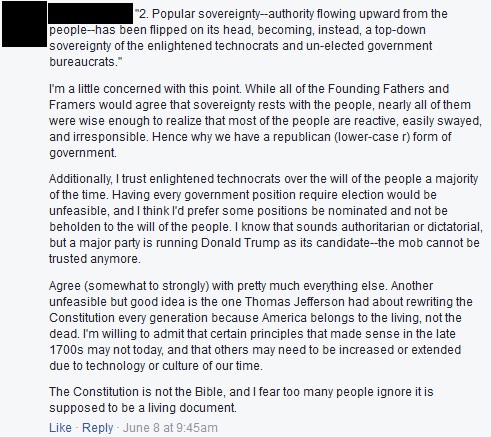
This post received quite a few comments on my Facebook page, including this one from a good friend of mine:

Now watch as I set my progressive-libertarian friend straight–respectfully.

My friend raised a very valid point:  the Framers of the Constitution were suspicious, if not outright terrified, of democracy.  Aristotle had identified democracy as one of the “bad” forms of government that came when rule by the people went bad.  The Framers had seen the consequences of a federal government that was too weak, namely the barely-contained chaos of Shays’ Rebellion in 1785.  Naturally, they wanted a government by, of, and for the people–thus the requirement that the Constitution be ratified by 3/4ths of the States in special ratifying conventions (designed to circumvent the Anti-Federalist state legislatures)–but they recognized that unbridled populism would lead to demagoguery.  It’s pedantic to say it, but Nazi Germany is the quintessential example of a desperate people granting dictatorial powers to a charismatic individual.

Pure democracy, without any checks on the majority’s power, quickly turns to one-man authoritarianism.”

The French political philosopher Montesquieu argued that the English government succeeded because it balanced monarchy, aristocracy, and democracy effectively, which further influenced the belief of the Framers that government should filter the will of the people through a complex system of checks and balances, and a rigorous, jealously-guarded separation of powers.  Thus we have such institutions as the much-maligned (but quite brilliant) Electoral College, and a Senate that is designed to act as a break on the people’s (often fickle) will.  Indeed, before it was corrupted by the XVII Amendment, the Senate was intended to represent the interests of the States themselves, rather than the will of the people, which is represented in the House of Representatives.

***

So, how did I address my friend’s concerns?  Here is my reply (with some minor edits for clarity and brevity) to my friend’s remarks, and to elaborate on the concept of “popular sovereignty”:

You are correct in noting the skepticism with which the Framers viewed unbridled democracy. There was much wisdom in their skepticism, precisely out of concern that a well-positioned demagogue could, in the right circumstances, sway the fickle populous to his whims. Pure democracy, without any checks on the majority’s power, quickly turns to one-man authoritarianism.

When I write about popular sovereignty, then, perhaps it would be more accurate to say that I mean “consent of the governed.” The people consented through our constitutional order when they elected delegates to special state ratifying conventions (circumventing the generally Anti-Federalist-controlled state legislatures). The people, then, ultimately gave consent to that government, and continue to do so through regular elections. Of course, a complex system of checks and balances tempers the will of the people (voiced primarily through the House of Representatives, which controls the power of the purse), balancing with it the will of the States, and vesting a great deal of authority to halt dubious legislation in the hands of the executive.

As for Thomas Jefferson’s love of revolutions and his proposal to rewrite the Constitution each generation, the actual Constitution provides a useful mechanism that makes such rewrites generally unnecessary, but possible: the amendment process. So far, every proposed amendment has come from the Congress, and all but two have been ratified in state legislatures (the other two were ratified, like the Constitution itself, in special state ratifying conventions). However, the Constitution provides another method–one that has yet to be used–to propose amendments: 2/3rds of the States can convene a constitutional convention to propose amendments. Texas’s current governor, Greg Abbott, is currently working on just such a convention of the States. In short, the Constitution provides us a way to change it to fit current needs without throwing out the whole document.

Of course, I would argue strenuously for an originalist reading of the Constitution and its amendments, all of which should be read in the context of those who proposed them. This still allows for changes through the amendment process, and for congressional elaboration. The Constitution is not meant to cover ever eventuality, and gives a great deal of space to Congress and (this is important and often forgotten) the States.

“It approaches something like tyranny when the President has the power to write laws (indirectly through the bureaucracy he manages) and to enforce them.” 


As for your comments about technocrats, perhaps I should clarify here, too. What I am primarily concerned about is the ability of federal agencies to write their own rules, many of which have the force of law. This practice is dangerous because most of these federal agencies operate within the executive branch and have little congressional oversight. Law-making powers are meant to rest solely within the Congress, and the job of the President is to duly enforce those acts to the best of his ability. It approaches something like tyranny when the President has the power to write laws (indirectly through the bureaucracy he manages) and to enforce them. Even scarier is the prospect that the federal bureaucracy has become so large that the President cannot exercise effective control over it, or even know what it’s doing! Many presidents–particularly our current one–have used bureaucratic rule-making to push unpopular measures without input from the people’s representatives. Congress is complicit in this, as it has delegated these powers to the executive bureaucracy, and the Supreme Court has allowed it to do so.

That being said, you are absolutely correct that there is a need for an intelligent, qualified, and motivated civil service, and, naturally, we want our dams to stay sealed tight and our roads to be paved and efficient. I would never dream of proposing we elect, say, the head of the South Carolina Department of Transportation. Here, again, the Constitution provides precedent: at the national level, the President appoints his cabinet heads, as well as federal and Supreme Court judges and justices. The Senate, however, has the responsibility of confirming these nominations, helping to prevent egregiously bad appointments.

If these proper checks and balances are maintained–if the different branches stick to their constitutional duties and limits, and if the proper relationship exists between the federal government and the several States–even a reckless executive can only do so much damage. If Congress vigorously protects its legislative prerogatives, an unqualified or authoritarian-minded president may still do some harm, but his ability to do so will be greatly diminished, and the damage can be contained.

***

This conversation went back and forth for a few more posts, which I will possibly include in future pieces.  In the interest of space–as this rumination is already quite lengthy–I will refrain from sharing them now.

However, I would ask that you permit me one parting thought:  we should be on guard against the lionization of the presidency.  The Congress–which represents the people and is, therefore the seat of popular sovereignty–may be consistently unpopular, but it is the proper branch to resist the huge expansion of the presidency.  Presidents increasingly attempt to speak for the people, but in a country that is divided between two entrenched, fundamentally incompatible political philosophies, it is nearly impossible to do so.  Indeed, attempting to do so leads to a Rousseau-style attempt to impose “the common will” on people–whether they want it or not.

Instead, let’s speak for ourselves.  We can do that through involvement in local politics, but also by communicating with our Congressmen and Senators.  Let them know that we expect Congress to reclaim its proper legislative powers from the executive bureaucracy.

Lazy Sunday IV: Christianity

Ah, yes, the sweet smell of at-home, high-speed Internet access in the morning.  It’s good to be back online.

For this week’s edition of “Lazy Sunday,” I thought I’d look back at some posts I’ve written about or related to the Christian faith.  For those of you that “choose to worship God in my own way” by staying home and watching televangelists in your underwear, these throwbacks are, perhaps, a timely addition to your Sunday morning.

Without further ado, here are some of my Christianity-related posts from the past few months:

    • The Influence of Christianity on America’s Founding” – I featured this piece in “Lazy Sunday III – Historical Moments,” so you can read a more thorough synopsis of it there.  After giving this talk, I walked outside to find it snowing.  Snow in December in South Carolina:  a miracle!
    • ‘Silent Night’ turns 200” – a short Christmas post, on the occasion of the 200th anniversary of “Silent Night.”  Next to “O, Holy Night”—objectively the best Christmas song ever written—“Silent Night” is one of my favorites.  The story behind it is almost as beautiful as the song itself.
    • How the Reformation Shaped the World” – the title for this post comes from a Prager University video of the same name.  The post explores—in a very broad way—the ripple effects of Martin Luther’s courageous act of faith.  The piece is a short introduction to a very complex idea; feel free to leave your thoughts below or on the original post.
    • Nehemiah and National Renewal“; “Nehemiah Follow-Up” – these companion posts deal with the Book of Nehemiah, and how the rebuilding of the wall around Jerusalem was a symbolic and practical recommitment to God and restoration of Israelite national identity.  The parallels to President Trump are a bit on the nose, but obvious.
    • The Desperate Search for Meaning” – this piece came about as many of my posts do:  I read something that floated through my transom, and thought I’d write about it.  Essentially, an online, New Age fraud was selling cheap spirituality, and was herself a troubled, possessive individual.  The real crux was how she pulled susceptible, gullible women into her orbit, women desperately searching for some meaning in their lives.  There are all manner of online charlatans who try to fill men and women’s “God-hole.”

So, enjoy your churchy Lazy Sunday with these timeless classics.

Other Lazy Sunday posts:

1.) Lazy Sunday – APR Pieces

2.) Lazy Sunday II: Lincoln Posts

3.) Lazy Sunday III: Historical Moments

TBT: Conservatives and Country Music

This week’s is another throwback from 2009, entitled “Conservatives and Country Music.”  It’s been a music-filled week at my job, so this topic seemed apropos.

Indeed, I’ve written about the intersection of music and politics before, such as my classic post “Music is for Everyone.”  There I expressed concerns about the politicization of music, which I originally voiced in this piece from 2009.

In looking back at these decades-old posts, I’m struck by how bad my writing was, and how much liberalism seeped into my supposedly conservative ideas.  The whole discussion about Sean Hannity’s love of country music seeming disingenuous is way too long and rambling, even if it might be a correct instinct.

It’s interesting seeing, though, how Senator Ted Cruz of Texas claimed that, after 9-11, he stopped listening to classic rock—which, as much as I love the man, sounds ridiculous, and a tad pandering—and only listened to country music.

Of course, my fretting in 2009 was, sadly, prophetic—the Mandalay Bay shooter in Vegas targeted a country music festival, and one Lefty ensconced in the upper tiers of ivory tower media progressivism opined that the victims deserved it because they were “likely Trump supporters.”   I’m not sure we’ve gotten any clear explanation as to why that guy shot all of those people—somewhat suspicious in and of itself—but that callous remark spoke volumes about the extent of our cultural divide, and how indicative musical tastes have become of political leanings.

And, for all that, I (in?)famously expressed excitement about Kid Rock’s senatorial ambitions… which turned out to be an elaborate publicity stunt.  Yeesh!

Well, what can you do.  Enjoy this lengthy discourse from a younger, fatter version of myself:

I am an avid fan of talk radio. Therefore, I am a fan of conservative talk radio. When one speaks of talk radio, it’s pretty much understood that one is speaking of conservative talk show hosts like Rush Limbaugh, Sean Hannity, Neal Boortz, etc. Despite their best efforts, liberals have never been able to establish much of a foothold on the radio, although Alan Colmes does have a show that airs pretty late at night on 560 AM in Columbia. Air America, the one serious attempt at a talk radio network with a stable of liberal hosts, has filed for bankruptcy at least once, if not more, and I have honestly never heard an original Air America broadcast.
Of course, I could go off on a whole discussion of the ridiculous Fairness Doctrine and the recent attempts to get it reinstated (for the unfamiliar, the Fairness Doctrine, which the FCC abolished in 1987, stated that those holding broadcast licenses were required to give contrasting views of controversial issues), but I won’t. It’s painfully obvious that liberals want the Fairness Doctrine back because they aren’t being heard anymore because, for whatever reason, most listeners don’t want to hear what they have to say. In fact, since the Fairness Doctrine was abolished the spirit of the doctrine–to engender open debate–has been fulfilled in a way it never was while the doctrine was in effect. Whether we want to admit it or not, the mainstream news media is basically left-leaning and pro-Obama, and talk radio is basically right-leaning and pro-limited government. The left-leaning news media reports on events with its bias built-in, and right-leaning talk radio hosts ferret out the liberal bullcrap.
I’m not interested in any of this debate, however, at least not for this discussion. Suffice it to say, I know talk radio, and there’s something that has struck me as rather odd: conservative hosts love country music. They absolutely adore it, and I don’t know why.
Well, that’s a lie. I have some theories and, naturally, I’m going to offer them up for your consumption. But first let’s take a look at some talk radio hosts. Sean Hannity is probably the most obvious example. While taking a class in Columbia this past semester, I listened to Sean on 970 AM in Florence on my weekly drive down, and at the top of every hour his show would lead in with Martina McBride’s “Independence Day,” a soaring, super-patriotic ode to the American way of life. Okay, one song, no big deal. Then, about a week ago, Sean started promoting a series of pro-American, pro-limited government concerts that he has helped to organize, featuring, among others, Billy Ray Cyrus and Charlie Daniels. Add to that the occasional visit by a country music artist, and The Sean Hannity Show is a veritable hee-haw of country music royalty.
One show doesn’t say much, though. Maybe Sean Hannity, a New Yorker, just loves country music. I’ll even admit that I’m biased in thinking that Northerners aren’t country music lovers, and that Sean has proven me wrong.
Then something happened that made me rethink this whole issue. This week the students at the school where I teach are taking their final exams, and so teachers are permitted to leave school early if they have nothing to do. I finished up my various tasks and hit the road around 11 this morning, and so I tuned in to 970 AM as always. At this time Laura Ingraham broadcasts her show, which I had never heard before because I’m usually knee-deep in lesson plans at 11 in the morning. So I’m listening to Laura when, all of a sudden, she starts talking about how much she loves country music. Can’t get enough of it.
Sean Hannity was a hardworking construction worker in a former life. I can completely buy Hannity standing over his sledgehammer, wiping the sweat from off his brow, and listening to Garth Brooks. But Laura Ingraham? Besides the fact that she’s a woman–and chicks love country music, for whatever reason–it makes no sense. The name “Ingraham” is probably the least countrified name in the world.
Now, I’ll admit that I don’t know much about Laura Ingraham and that I’m probably being a little sexist when I write things like “chicks love country music,” but there is an undeniable trend on the right toward country music. In fact, there’s a corresponding trend on the left toward rock music. How else can you explain this sudden glut of conservatives espousing their love of country music? At the same time, observe all of the activist, left-wing rockers out there: U2, The Clash, Neil Young, Elvis Costello, etc.
This is not an original revelation. South Park did an entire episode on pro-war country music lovers and anti-war rock ‘n’ roll protesters. I mention it because I find it all a bit disturbing–and, in a way, potentially dangerous. First of all, I really don’t like country music. There are always the obvious exceptions, and I should probably qualify that by saying that I don’t like new country music, but generally speaking I can’t stand it (the odd thing is, most of it is just classic rock with banjos and twangy vocals).
Secondly, why should conservatives give up rock music? Chuck Klosterman, author of Fargo Rock City: A Heavy Metal Odyssey of Rural North Dakota,argues that glam metal in the 1980s “latently adopted the Republican persona of the 1980s,” which was “an incredibly popular way of thinking, especially (and surprisingly) among young males” who made up the bulk of heavy metal’s listeners. Heavy metal in its biggest, glammiest, most capitalistic form has fallen by the wayside, but for its time it was a musical movement that, according to Klosterman, was completely in-tune with the prevailing conservative sentiments of the Reagan era. Sure, heavy metal was an exaggeration of the already-exaggerated excesses of the 1980s, but it was the popular music of the time and reflected the mood of the nation and the political establishment, something that is pretty rare as far as pop music goes. Just look at the pop music of the 1960s and 1970s, which cast itself in a light that was decidedly anti-establishment.
So, why is this dangerous? Because I get the impression that most conservative talk show hosts are being a tad disingenuous when they talk about their love of country music. They’re playing to their audience–or so they think–which they assume is made up largely of pro-war, pro-limited government, anti-Obama listeners, which is true. However, they’re making the assumption that most of those listeners love country music because those are the things they believe, and I don’t think that’s the case. I believe in all of those things and I much prefer rock–even crappy modern rock–to country music.
The danger also comes in the increasing fragmentation of American political life geographically and culturally. I think it’s safe to assume that most fans of country music are, well, those who live in the country (although every good ol’ boy I’ve ever known has been a fan of country and rap simultaneously). But when country music becomes synonymous with one political ideology and rock music with the other, it serves to intensify political fragmentation. Suddenly, McBride’s “Independence Day” becomes a post-9/11 rallying cry for anti-Obama revolutionaries instead of a genuine appreciation for the United States and its freedoms.
Instead of looking at genres of music as inherently politicized, we should be using music as a way to bridge the ever-widening gap between different ideologies. I love my talk show hosts, but if I’m right, I have to fault them on their constant peddling of country as some kind of conservative alternative to mainstream music. At the same time, liberals deserve much more of my ire, as they’ve effectively hijacked rock music and have been using music politically for much, much longer than conservative radio personalities. Woodstock, anyone?

TBT: Transformers 2: Conservatives in Disguise?

For this week’s #TBT feature, I’m digging back, for the second time, to a very old post from 2009.  It’s about—of all things—the second movie in the modern Transformers franchise.  Yeesh.

Anyway, the point of the essay—and its cringe-inducing navel-gazing—is that a government bean-counter does everything he can to wield his meager bureaucratic power like a little dictator, in the process undermining the unsteady alliance between the good Autobots and the US military.

It reminds me of Ghostbusters, when the functionary from the Environmental Protection Agency comes and shuts down the containment unit—the one holding all the captured ghosts—because it’s using too much energy and might represent an environmental threat.

Think about that for a minute, and reflect on how awesome the 1980s were—the Zeitgeist was such that the minor villain was guy who worked for the EPA.  Even left-leaning Hollywood razzed busy-body government employees during the Reagan era.

Regardless, enjoy this blast from the past, an example of a trend in Conservatism, Inc. of reading into films a conservatism message (except I was probably right on this one):

Earlier today I saw Michael Bay‘s highly-anticipated (and critically-panned) Transformers 2: Revenge of the Fallen. Prior to seeing the movie, I had no intention of writing a blog about it. Although films are occasional inspirations for my essays (see my article about the lack of strong African-American fathers, which I wrote after seeing Boyz n the Hood), I never imagined that Transformers 2 would be the subject of one of my blog entries because I don’t write straight-up reviews. Honestly, I figured it would be exactly what it is: a steady stream of explosions, robots, and mass destruction.

What I didn’t count on was that it would only be what I expected 99% of the time. That other 1% is the focus of this essay. Like the first Transformers film, Transformers 2 spent a great deal of time covering the U.S. military and its interactions with and against the various transforming automatons. Generally speaking, the soldiers are characterized as normal and basically decent–they want to do what is best for their country and they want to protect the weak and innocent, but they will follow the civilian authority of the Constitution.
In Transformers 2, however, I noticed a more overt, though still very, very subtle, endorsement of conservative politics–or, at the very least, a critique of modern liberalism. I don’t want to read too much into this (well, actually, I do), but there are several moments during the movie when the misinformed meddler, the entity trying to put the kibosh on the Autobot-military alliance, is a mealy-mouthed government bean-counter who sees the Autobots as an alien menace that constitutes a risk to national security. Now, sure, action movies are overflowing with literal-minded government stooges and opportunistic politicians who are always putting up a wall of red tape that is harder to break than the concrete bunker our hero just crashed through on his motorcycle. The key difference in Transformers 2, however, is that the government stooge in question is acting under direct orders from the president, who is explicitly identified as… Barack Obama (one news report states that “President Obama has been relocated” to a bunker somewhere in the Midwest).
Not evidence enough? At one point, this pencil-pusher makes a point straight out of the Obama foreign policy playbook: let’s try to negotiate with the bad guys. Maybe we can talk out our differences and everyone can live in peace. When the bureaucratic boob said that, I almost fell out of my seat. I don’t know if Michael Bay or the writers of Transformers 2 were intentionally making this point, but for this chubby conservative the implications were loud and clear: Obama and other liberals who demand negotiations before resorting to force against overtly hostile, dangerous opponents are fatally off base and out-of-touch. The president’s puppet makes the point that the United States should not be involved in the civil war of an alien race in the first place, but that doesn’t change the fact that it is anyway. The United States, the filmmakers seem to be suggesting, has a responsibility to aid the Autobots against the new Decepticon menace, whether it likes that obligation or not, and the proposed policies of Obama and other liberals in foreign relations are potentially devastating.
Besides a subtle endorsement of a neoconservative foreign policy–or at least a more realistic approach to foreign threats–Transformers 2 is, as I have mentioned, heavily pro-military. The film depicts soldiers as law- and order-abiding citizens who, even if they don’t like it, abide by civilian authority. This is a refreshing change from the usual Hollywood fare, which casts soldiers in the light of threats to democracy and as right-wing gun nuts who want nothing more than to seize control of the government themselves. While we should have a healthy wariness of the military as a potentially repressive arm of the federal government–a wariness that dates back to colonial America and that is most evident in the writings of Thomas JeffersonTransformers 2 makes it clear that the U.S. military is a military of dedicated civilian volunteers who value and fight for freedom. They are not professionals who ride roughshod over the freedoms of others, be they Americans or foreigners. In fact, the U.S. military works closely with several Middle Eastern governments in the film, including the Egyptian and Jordanian militaries. In one scene, when a Jordanian helicopter is grounded by a Decepticon, American soldiers aid the fallen foreigners. This is not the unilateral, oppressive, quagmired military we hear so much about in the media; this is a dynamic, humane force made up of regular, freedom-loving Americans.
This brings me to one final point, a point I’ve been mulling over for awhile. We are constantly told that wars are started by the elite and fought by the poor; that wars are little more than opportunistic struggles or, even worse, the effect of some perceived slight or random occurrence; that war is rarely right or even necessary. In different times and in different places, many of these assumptions were true. Wars in the past were started by absolute monarchs or power-hungry tyrants, while they were fought by loyal vassals or downtrodden peasants.
In the United States, however, this is not the case. We live in a society where the people, at least in theory and, cynics aside, very much in practice, have a say in the functioning of government. Whatever slogan-spouting liberals will tell you, their bumper-sticker philosophy is severely flawed and misinformed. If the United States goes to war against a hostile power or terrorist group, it is because the people have given their approval. Foreign policy is, admittedly, concentrated in the executive branch of the government, which means that the president and the Secretary of State have a great deal of influence in deciding its direction. Any president hoping to keep his office, however, is going to be careful in how he deals with foreign policy.
Therefore, the traditional criticisms levelled against war are at best incomplete and at worst obsolete, at least when applied to the United States. There is still a great deal of debate about whether or not the United States should be the world’s police officer; regardless, wars are not foisted on unwitting dupes by a greedy elite in America.
This claim is a bold one, but I stand by it. The wars in Iraq and Afghanistan would not have been fought and would not have endured so long without significant support from the American people. Now that support is beginning to wane, serious questions are being asked about America’s future role in those countries, but we are seeing a huge amount of popular outpouring for the people of Iran, who are currently struggling against their sham of a government. President Obama’s “let’s-talk-it-out” approach to foreign policy is not enough when facing a regime of authoritarian thugs.

Lazy Sunday II: Lincoln Posts

I’ve been out of town all weekend—thus yesterday’s very belated post—and it’s getting to the point in the academic year where all the craziness hits at once.  That being the case, I’m posting another one of these “compilation” reference posts to give you, my insatiable readers, the illusion of new content.  It’s like when a classic television show does a clip show episode:  you relive your favorite moments from the series (or, in this case, the arbitrary theming I foist upon you).

Today’s “Lazy Sunday” readings look back at my posts that pertain to President Abraham Lincoln, the Great Emancipator (read the first “Lazy Sunday” compilation).  I noticed that I’ve been writing more about Lincoln over the past week (perhaps my quiet homage to the recently-completed Black History Month?), so I decided to compile, in one place, all of my Abraham Lincoln posts (at least, the ones I could find on this blog).

Without further ado, here are The Portly Politico‘s Lincoln Posts (in chronological order):

  • TBT: Happy Birthday, America!” – a reblog from the old TPP site, this post largely lets Lincoln speak for himself, as it features a full transcript of the Gettysburg Address.  Always good for patriotic goosebumps.
  • Historical Moment – The Formation of the Republican Party” – this short post was adapted from a brief talk I gave to the Florence County Republican Party.  The purpose of the meeting, I recall, was to focus Republicans on who we are as a Party and what we believe, so I thought it would be useful to give a brief introduction to the formation of the GOP.  As the first Republican President (although not the first Republican presidential candidate—that honor goes to John Charles Fremont of California, who ran in 1856), Lincoln obviously exercised huge influence on the young party.
  • Lincoln on Education” – another “Historical Moment” adaptation (I’m all about recycling material), I was supposed to deliver this moment before a forum of candidates for the Florence School District 1 race in autumn 2018.  I was all set to deliver it, but the FCGOP Chairman (accidentally?) skipped over me in the agenda, so I saved it until the following month’s meeting (again, why let good copy go to waste?).
  • Lincoln’s Favorability” – here’s one of TWO posts from last week about Abraham Lincoln.  I’m going to give Lincoln a rest after tonight—he worked hard enough during the Civil War—but this piece looked at an interesting Rasmussen poll, that shows Lincoln is massively beloved by the American people.
  • Reblog: Lincoln and Civil Liberties” – this post is a reblog from Practically Historical, the blog of SheafferHistorianAZ.  Sheaffer—a fellow high school history teacher—wrote a post detailing how Lincoln’s suspension of the writ of habeus corpus was, indeed, constitutional.

Happy Sunday!

–TPP

TBT: Federalism Denied

It’s a late post today, faithful TPP readers, as the school year is gearing up and constraints on my time increase.  Better late than never, yes?

This week’s throwback post discusses the Seventeenth Amendment, which ended the election of US Senators via their respective State legislatures, and instead moved that choice directly to the people of the several States.

One of the Progressive Era Amendments—which gave us such chestnuts as the graduated income tax (Sixteenth Amendment), Prohibition (Eighteenth Amendment), and women’s suffrage (Nineteenth Amendment)—the Seventeenth Amendment was part of a broad cultural and political shift toward, paradoxically, greater choice and enfranchisement for the electorate on the one hand, and greater government control and oversight on the other.

Americans were optimistic in the power of the government at all levels—and, increasingly, at the federal level—to solve problems like poverty and privation, naively believing that, in a democracy, the people would make wise decisions about selecting its technocratic, managerial elite.

Not surprisingly, the managerial elites gained enormous power, and the people got the shaft.

This essay explores the consequences of the direct election of US Senators, as well as why State legislatures came to support the idea.  On the one hand, States lost their representation in Congress—the Senate was designed to represent State-level interests nationally—but State legislatures were also relieved of responsibility for what was becoming an onerous duty, susceptible to corruption, or even carelessness.

Here is “Federalism Denied”:

In last Wednesday’s post, “Politics, Locally-Sourced,” I urged readers to become more interested in and educated about their local and state governments.  A keystone of modern conservative political philosophy (and of the classical liberalism of the Framers) is decentralization, the idea that power should be spread broadly, both in terms of population and geography.  Due to the massive power the federal government accrued during and after the Second World War, decentralists also argue that power should devolve from the federal government back to the States.  The federal government, of course, plays an important role in maintaining the national defense, conducting foreign affairs, and regulating interstate commerce, among a number of other constitutionally delineated areas, but a great deal of power is reserved for the States in the X Amendment.

The X Amendment reads thus:  “The powers not delegated to the United States by the Constitution, nor prohibited by it to the States, are reserved to the States respectively, or to the people.”  Clearly, then, where the Constitution is silent, the States are reserved broad powers.  They cannot become dictatorial–their constitutions must not conflict with the national supremacy of the US Constitution–but they can have broad latitude in determining statewide regulations, taxes, and the like.

In theory, at least, this federalist structure is how our nation is supposed to operate, and it manages to do so, despite significant hobbling from the federal government.  Congress has forced upon the States a number of unfunded federal mandates.  Essentially, a large portion of State budgets are consumed with fulfilling orders from Washington, D.C., without any form of assistance.  Additionally, States are often coerced into adopting certain policies or passing certain laws, lest the federal government withdraw their funding (this tactic was used to increase the drinking age from 18 to 21–not necessarily a bad thing, but the means matter almost as much as the ends; such coercion circumvents the proper amendment process).

What brought about this change, and how can we reverse it?  How can we restore the proper balance between the States and the federal government?

There are no easy answers here, and the centralization of power in the federal government occurred for a complicated host of reasons:  the acceptance of a desperate people of a greater role for the government in the economy during the Great Depression; the (temporary) success of a massively planned economy during the Second World War; the massive expansion of the welfare state during the Great Society; the (necessary) fight at the national level to protect the civil rights of black Americans; and more.

However, I would argue that a major source of this problem was the passage of the XVII Amendment.

The XVII Amendment replaced the old system of selecting senators with their direct election.  Prior to its passage, senators were selected by their state legislatures, which were themselves chosen in local elections.

There are a number of compelling arguments for why this amendment was adopted.  For one, many states had already moved to a de facto system of direct election, in which voters essentially “elected” their senator, and the state legislatures were duly pledged to vote in accord with the people’s choice.  Also, there were several scandals in which senate candidates merely bribed state legislators for their votes.  Finally, many state legislators found that voters cared more about who the legislators would elect to the Senate, not what they thought about state problems.

You can review these arguments in a (rather condescending) piece from Slate by David Schleicher entitled “States’ Wrongs.”


“[T]he States no longer have a constitutional role in the federal government.”

However, while there certainly appeared to be need for reform in senatorial elections, many of these problems still persist.  Voters are still overly-fixated on national politics, even more so than voters in the late nineteenth and early twentieth centuries.  If anything, state elections are even more focused on national issues than they were before.  Special interest groups still manage to exert influence over the Senate, and can do so even more effectively by whipping up voters.

Most importantly, though, is that the States no longer have a constitutional role in the federal government.  The Senate used to serve as the representative of the States’ interests, while the House still operates as the representative of the people’s interests.  Now the people have direct influence over both branches of Congress, and an important, necessary brake on the fickle will of the majority is gone.

States’ rights has become an ugly phrase, associated as it is with slavery and segregation.  However, just because states’ rights has been invoked to defend the indefensible doesn’t mean that it isn’t a good idea.  The States function as an important bulwark against tyranny, and federalism affords many opportunities for policy innovation and experimentation–Louis Brandeis’s “laboratories of democracy.”  Also, the geographical, ethnic, religious, and cultural diversity of the United States practically demands states’ rights, as different States have different needs, goals, and desires.

Repeal of the XVII Amendment is extremely difficult and unlikely:  people like to vote (actually, people like to know they can vote, even if they often choose not to do so).  But Congress, specifically the Senate, can do much to keep the further expansion of federal power in check.  Senator Ben Sasse of Nebraska is spearheading this effort through his speeches, delivered from the Senate floor, about the proper role of the Senate and its obligation to be an august, contemplative chamber.

We, the people, can also take steps to become more involved in state politics.  Ultimately, the drive to restore federalism starts with us.

***

For more information about the XVII Amendment and different approaches to addressing it, here are some resources:

The Campaign to Restore Federalism (pro-repeal of the XVII Amendment):  http://www.restorefederalism.org/

“Repeal the 17th:  Problems to Address” by constitutional scholar Rob Natelson:  http://tenthamendmentcenter.com/2013/08/26/repeal-the-17th-problems-to-address/

“Repeal the 17th Amendment?” by Gene Healy of the Cato Institute (great piece that is sympathetic to the idea, but recognizes the political problems involved):  http://www.cato.org/publications/commentary/repeal-17th-amendment

“States’ Wrongs” (mentioned above) by David Schleicher of Slate (anti-repeal, with some interesting historical background and a lot of elitist sneering at movement conservatives):  http://www.slate.com/articles/news_and_politics/jurisprudence/2014/02/conservatives_17th_amendment_repeal_effort_why_their_plan_will_backfire.html

Lazy Sunday – APR Pieces

It’s been a busy weekend, so I’m very far behind on today’s post (about twelve hours late!).  That said, I’m worn out, so I’m phoning in this Sunday’s post.

I used to be associated with an online radio station, American Patriot Radio, in a mild way:  I would occasionally fill-in for the station’s most popular host, and I contributed some pieces for the site’s blog.

There’s no good way to navigate to these pieces on the site now, but they are, remarkably, still there.  I do not know the current status of the station, but while seeking out these pieces, I heard some streaming audio, so it may still be active, or it may be recycling old content.

Regardless, I thought it would be worthwhile to link to my writings there, as they reflect the heady days of early 2017, when the young Trump presidency seemed full of promise, and it looked as though populist uprisings would continue all over the globe.

Enjoy this grab-bag/impromptu archive of TPP submissions to APR.

8 May 2017 – “A Disheartening, but Expected, Defeat” (about the defeat of National Front candidate Marine Le Pen to France’s current president, Emmanuel Macron): https://americanpatriotradio.com/2017/05/08/a-disheartening-but-expected-defeat/

8 May 2017 – “Pat Buchanan’s America” (about the impact of Pat Buchanan’s economic and foreign policy thought on the Trump ascendancy): https://americanpatriotradio.com/2017/05/08/pat-buchanans-america/

9 May 2017 – “A New Conservatism?” (a rumination on the future of conservatism, and the possibility of a new “fusionism” to include Trumpism): https://americanpatriotradio.com/2017/05/09/a-new-conservatism/

10 May 2017 – “Comey-tose” (about the firing of former FBI Director James Comey, as well as a brief discussion of my frustration with National Review‘s hand-wringing over decorum):  https://americanpatriotradio.com/2017/05/10/comey-tose/

Enjoy this self-indulgent blast from the recent past.

–TPP

TBT: Family Matters Follow-Up Part II: The Welfare State and the Crisis of the Family

TBT for this week: https://theportlypolitico.blogspot.com/2016/08/family-matters-follow-up-part-ii.html

Last week’s featured a follow-up to one of the most read pieces on my old site, “Family Matters.”  That piece generated so many questions and comments on Facebook back in 2016 that I wrote two lengthy follow-up posts.  This post deals with the deleterious impact of the welfare state upon the family, looking first at the effect of the Great Society on the black family.  It then examines how those negative consequences spread beyond racial barriers to destroy traditional and nuclear family formation across races.

Now, over half of children born to women under 30 are born out of wedlock, regardless of race.  Economics doesn’t explain that story entirely, but misguided government policy, which placed perverse incentives on single motherhood, have driven what is ultimately a cultural and spiritual decline.

The details are in the post below, so without further ado, here is 10 August 2016’s “Family Matters Follow-Up Part II: The Welfare State and the Crisis of the Family“:

My series of posts on the decline of the traditional family unit in the United States and the West has generated a great deal of discussion (and, occasionally, some bitter recriminations).  Thus, after the overwhelming feedback and requests for clarification I received to “Family Matters,” I decided to expand upon some portions of that piece (click here to read “Follow-Up Part I” about divorce and sex education).

One of the claims of “Family Matters” concerned the “havoc” President Lyndon Johnson’s Great Society/War on Poverty wreaked on the black American families.  In the original post, I failed to link to any data or articles to substantiate this claim, but I’ve since updated the post with links to Daniel Patrick Moynihan’s famous “Moynihan Report” (actual title:  The Negro Family:  The Case for National Action) and a piece from 2015 that summarizes some of the main points of the report.

The late Daniel Patrick Moynihan–who would go on to serve as US Ambassador to India and the United Nations, then as a Democratic Senator for New York–enjoys a rare respect as a liberal among conservatives.  Though he was a leftist on many issues, he was first and foremost a scholar with a commitment to following the data wherever it took him.

The so-called “Moynihan Report”–which he wrote while working as a bureaucrat in the Department of Labor in 1965–demonstrated that many of the problems of the black community were caused only in part by discrimination, but much more so by a decline in marriage and stable family formation.  While racial discrimination was (and–I would like to think to a lesser extent–still is) a major problem in the 1960s, it alone could not explain adequately the plight of many black Americans.

Instead, what Moynihan discovered was that well-intentioned government programs inadvertently subsidized single motherhood, and were destroying the black family.  Indeed, the “national action” for which Moynihan called was that which would reinforce “the establishment of a stable Negro family structure.”  This national goal would be “difficult,” but “it almost certainly offers the only possibility of resolving in our time what is, after all, the nation’s oldest, and most instransigent, and now its most dangerous social problem.”  (Moynihan, The Negro Family)

I once heard a conservative black gentleman from Darlington, South Carolina, summarize Moynihan’s argument thus:  at a time when black men faced legitimate discrimination in the workforce, and could lose their jobs on the flimsiest of pretexts, the federal government came along offering generous support to single mothers.  By 1975–ten years after Moynihan’s prophetic report–a head of household would have to earn $88,000 (in 2015 dollars; about $22,000 in 1975) to out-earn the benefit from the federal government.  (Jack Coleman, “Juan Williams:  Daniel Patrick Moynihan ‘Had it Right’ About Breakdown of the Black Family”)  As Jason Riley, author of Please Stop Helping Us:  How Liberals Make it Harder for Blacks to Succeed wrote in a 2015 op-ed in The Wall Street Journal, “In effect, the government paid mothers to keep fathers out of the home–and paid them well.”

Not surprisingly, many women took note of this benefit.  Some of them–and, yes, I know what you’re about to read will be hard to believe, but it actually happened–calculated that they were better off divorcing their husbands or having a child out of wedlock, especially given the real, costly discrimination their husbands faced.  Government do-gooding, coupled with a legacy of racial discrimination, caused many young black children to grow up without fathers.

Initially, that might not have been a huge problem… but it metastasized.  Young boys grew up without father figures to shape them, and came to expect that leaving a woman, or having children with multiple women, was natural.  Young girls grew up thinking they had no reasonable expectation of their man sticking around.  With each generation, the problem grew worse and worse, until now roughly 72-73% of black children born in America are born to a single parent.

“[S]imply replacing one parent with a paycheck does not fulfill a child’s many needs.”

Single parenthood is sometimes the only option, but it’s a tough row to hoe.  Not only does it place financial burdens on the parent; it also removes from her or him the ability to parent a child adequately.  To quote economist Walter Williams at length:

“Whether a student is black, white, orange or polka-dot and whether he’s poor or rich, there are some minimum requirements that must be met in order for him to do well in school. Someone must make the student do his homework. Someone must see to it that he gets eight to nine hours of sleep. Someone has to fix him a wholesome breakfast and ensure that he gets to school on time and respects and obeys teachers.

“Here’s my question: Which one of those basic requirements can be accomplished through a presidential executive order, a congressional mandate or the edict of a mayor, a superintendent of schools or a teacher? If those basic requirements aren’t met, whatever else that is done in the name of education is for naught.” (emphasis added; Walter Williams, “Can Racial Discrimination Explain Much?”)

In other words, simply replacing one parent with a paycheck does not fulfill a child’s many needs.  Children born out-of-wedlock and raised by a single parent are more likely “to experience a variety of cognitive, emotional, and behavioral problems,” according to Dr. Paul Amato in “The Impact of Family Formation Change on the Cognitive, Social, and Emotional Well-Being of the Next Generation.”   That creates ripple effects for generations to come, and the cycle is difficult to break.

***

The problem was prevalent even before Moynihan wrote his report (which, not surprisingly, caused many of his fellow-liberals to accuse him of “racism” and bigotry–common tactics when faced with an unpleasant truth).  Ronald Reagan, while campaigning for Arizona Senator and Republican presidential candidate Barry Goldwater in 1964, told the story in his magisterial “A Time for Choosing” speech of a mother who divorced her husband to get a check from the government, and how she learned to do it after talking to two other women who’d also gamed the system.

We’ve now had fifty-one years of the Great Society, and while some of its programs helped alleviate malnutrition and other problems that are, thankfully, dwindling issues, its good intentions created a host of other problems.  In 1965, one could still plausibly claim that government do-gooders merely didn’t know any better.  Now, the argument seems to be, “Well, we’re trying to do the right thing, so that’s all that should matter.”  That’s prime paving stone for the road to hell.

“The decline of the family is a problem all Americans will have to address.”

Moynihan argued that black Americans in particular were experiencing the decline of family formation most heavily because of the “tangle of pathologies” stemming from centuries of slavery and a century of legal, social, and economic segregation, and that this legacy dovetailed disastrously with the perverse incentive toward divorce and single motherhood.  As he predicted, this tangle morphed into a multi-generational cycle that has ground many black Americans further into poverty.

In 2016, the negative consequences have not only magnified the problem among black Americans; it’s spread throughout American society.  There’s been a crisis among black families for fifty years; we ignored it at our peril.

The experience of black American families since the 1960s is a sad story, though there are many brave black mothers and fathers who raise their children with love and support.  They are struggling to break a dangerous cycle, one that swirls in a murky stew of cultural, social, and economic pressures against the two-parent family and traditional marriage.

Racism appears to have enhanced the deleterious effects of the welfare state in the case of black families, but now those negative consequences are increasingly color-blind.  The decline of the family is a problem all Americans will have to address.

(For additional reading, check out the works of Walter Williams, a brilliant economist and political conservative who, as it happens, is black.  Start here for an appetizer:  http://www.washingtonexaminer.com/can-racial-discrimination-explain-much/article/2556814; after that, get Race and Economics:  How Much Can Be Blamed on Discrimination?)

TBT: Family Matters Follow-Up Part I: Divorce and Marriage; Sex Education

Happy Valentine’s Day!  To celebrate the Day of Love, here’s a #TBT about the collapse of the American family and divorce.  This piece was a follow-up to one of my most popular posts on the old site, “Family Matters.”  I received a ton of feedback on that post (in those days, I posted everything to my personal Facebook page, but that was before it became completely unpleasant to be a conservative online—Trump was elected that November and it became much more dangerous to espouse conservative ideas on Facebook), including lots of questions about divorce and such.

Most of those comments fell into the anecdotal, “well, ACTUALLY” range—“what you’re saying is true, but here’s my one exception that I think undermines the general trend.”  Yes, yes—of course there are rare instances in which divorce is preferable to sticking it out, like violent abuse.  That said, we should generally support preserving marriage and discouraging divorce.

So, enjoy your Valentine’s Day with this lengthy rumination on divorce, marriage, and sex education:

Last Friday I wrote a post entitled “Family Matters” about the decline of the traditional family in the United States and the West, which I called “our true national and civilizational crisis.”  To my surprise, the post was very well-received and popular.  To date, it is the second-most read blog post on the site, and I look for it to eclipse the most-read entry, “American Values, American Nationalism.”  It certainly shattered single-day records for The Portly Politico.

It also garnered quite a bit of discussion on my Facebook page, where I always share links to these posts.  There was a great deal of excellent discussion, including questions for clarification on some points.  People also shared some of their personal experiences with matters of family and what sorts of arrangements work and in what circumstances.

As such, I thought I’d dedicate today and Wednesday’s posts to following up on some of the comments, questions, and observations I received.  I do so to facilitate further discussion and to help clear up any confusion about some of my contentions.

(Note:  As I wrote this post, I decided to split it into [at least] two parts.  Wednesday’s portion will deal with questions about same-sex couples and the impact of the Great Society upon black families.)

– Divorce:  I did not mention divorce at all in Friday’s post, but many of the comments I received dealt with this painful scenario.  Certainly, no picture of the decline of the traditional family is complete without a discussion of dissolved unions.

With roughly 50% of marriages ending in divorce, the model of the stable, two-parent family is further threatened, although increasingly families are forming outside of formal marriage.  Neither of these scenarios is ideal.  The rate of divorce naturally increased in the twentieth century in part because divorces became easier to obtain, especially with the rise and success of the women’s suffrage and rights movements.

The relative legal ease of acquiring a divorce, however, does not tell the full story.  Divorce also increased because of increasingly relaxed attitudes about marriage and family formation.  As the single working mother morphed from an object of sympathy into a perverse ideal–and as social signals and laws increasingly downplayed the importance of fathers and privileged mothers–both men and women came to see marriage as less of an institution and more of a formality.

“[Parents]… should make a good-faith effort to raise their children in a stable home, and to spare them the misery, confusion, and familial turmoil of divorce.”

As several commenters noted, sometimes divorce is, sadly, the better option, such as when a spouse is abusive.  I suspect many such unfortunate unions take place precisely because we’ve come to take marriage (and love) so lightly.  The erosion of a broad, common set of cultural and religious values could also play a role, as more and more “oxen” are unevenly “yoked,” creating deep tensions within relationships.

Of course, marriage is hugely complicated, and couples part way for many reasons (usually money).  However, it does seem that, absent abuse, infidelity, or criminality, couples with children should make a good-faith effort to raise their children in a stable home, and to spare them the misery, confusion, and familial turmoil of divorce.

Marriage, after all, is–or, at least, should be–a serious obligation entered into by two sober-minded adults with shared values and principles.  Of course, actual human relationships tend to be messy even in the most ideal of circumstances, but a proper focus on the point of marriage–two people coming together as one in the presence of God–would go a long way to help realign and heal struggling marriages.

 “Marriage, after all, is… a serious obligation entered into by two sober-minded adults with shared values and principles.”

– Sex Education:  One friend argued that we need more sex education in schools, as well as free birth control for young people to prevent unwanted pregnancies.  While I believe that abstinence is the best method of birth control to emphasize, I’m enough of a realist to know that teenagers find particular joy in doing what they’re told not to do.

The problem I see is two-fold:  first, we already provide sex education in most public high schools throughout the United States; second, the call for more sex education and access to contraceptives merely demonstrate the crisis of the family I’ve noted.

The proper realm for sex education is the home.  The popular media has perpetuated the myth that parents don’t talk to their children about the pitfalls of premarital sex because they’re uncomfortable or prudish, so the schools have to do it to prevent millions of unplanned pregnancies.

The problem, rather, is that so many children are growing up in homes without proper parental guidance, they’re missing out on important lessons about sex, marriage, and family.  Absent fathers aren’t there to teach their children that it’s wrong to get a woman pregnant and then to leave her.  Sex outside of the framework or expectation of marriage becomes devoid of any larger sense of responsibility.

 “[S]o many children are growing up in homes without proper parental guidance, they’re missing out on important lessons about sex, marriage, and family.”

Therefore, teachers have had to take on yet another responsibility that should rest primarily, if not solely, with parents.  Add to this lack of parental involvement the glorification of sex in the media and the general “if-it-feels-good-do-it” philosophy of postmodern America, and you have a recipe for moral disaster.

It’s unfortunate that schools have had to adopt this responsibility, at it suggests a massive decline in the understanding of what parents are supposed to do for their children.

To the point about free birth control in schools, I’ve never really understood this argument.  I understand that the logic goes, “it’s worth taxpayers’ money because it prevents the births of children who would become wards of the state; therefore, it’s ultimately more cost-effective.”  But many forms of birth control are incredibly cheap and readily available.  There’s no compelling argument for why the government should force taxpayers to pay for a box of condoms for high school students.

As far as the birth control pill for girls, it’s actually Republicans who want to make it available over-the-counter, which would further drive down the cost and allow young women experiencing shame or uncertainty to obtain it more easily.

 “[P]roviding birth control pills to minors through public schools introduces a host of sticky constitutional and legal concerns….”

Most importantly, providing birth control pills to minors through public schools introduces a host of sticky constitutional and legal concerns, the biggest being, “what if a family’s faith forbids the use of contraceptives”?  A devout, traditional Catholic, for example, would no-doubt object to being forced to pay for birth control for his daughter and the daughters of strangers.  He would likewise experience a crisis being required to purchase condoms for his or others sons.

Just because most people–including, apparently, most Catholics–are morally comfortable using traditional birth control and contraceptive methods doesn’t mean that we should make those who disagree pay for it.  The need to fund contraceptives becomes even less pressing when the low cost is considered.  Why cause an unnecessary, stressful crisis of faith for millions just to save a kid a quarter on a gas station rubber?

At this point, I would agree with my friend that, unfortunately, schools do have to take some role in sex education, especially given the increased likelihood children won’t receive it at home, since the traditional family unit is on the decline.  If private non-profit organizations want to provide additional information or free contraceptives, no worries–there’s no infringement upon religious liberty via official coercion.  Additionally, schools should stress the moral and financial obligations of parents to their children, especially in those communities where good role models are lacking.

Unfortunately, another government program to hand out free condoms is not a lasting solution to a problem that is one of the soul, not of the pocketbook.  Let civil society address these problems (perhaps with a revival of the good, old-fashioned shotgun wedding).

***
These are certainly thorny problems, and I fully recognize that as a single, never-married man I don’t possess the same perspective as, say, a married couple of twenty years or a divorcee.  Nevertheless, I reject the notion that a lack of personal experience disqualifies one from the discussion (even while acknowledging that personal experience often provides a great deal of clarity).  Besides, I’ve witnessed first-hand the power of strong marriages and stable families.  Indeed, I’m the beneficiary of one such union.

Finally, I appreciate lively (and civil) feedback and discussion, and I look forward to expanding further on this topic on Wednesday.