TBT^2: It’s a Thanksgiving Miracle!

Dang, it’s been another year already.  Yikes!  Last year I wrote about the updates since the tragic weekend before Thanksgiving 2017.  The year after my fall was eventful, as I detail below (my commentary on the original post from the old website is in italics).

Looking back, 2019 has been pretty solid, too.  I’ve been a bit morose in a few posts lately, but the beauty of Thanksgiving is it helps clarify the mind—we’re told to focus on what we’re thankful for, and it seems to work.

Read More »

TBT: The Influence of Christianity on America’s Founding

My high school American history classes are getting into the American Civil War—or the War of Northern Aggression, or the War for Southern Independence, or whatever you’d like to call it—this week, so we’ve been talking about beginnings a good bit.  The Civil War had deep roots that go back not just to the 1840s or 1850s, and not even to the Constitutional Convention in 1787.

Indeed, the fundamental division dates back to the English Civil War in the 1648, when the Puritan Roundheads under Oliver Cromwell ousted and beheaded Charles I, and established the English Republic (which—the English having little taste for radicalism or dictatorships, fortunately collapses in 1660 with the restoration of the Stuart monarchs).  Loyalists to the king and the monarchical order were the aristocratic Cavaliers.  Those same Puritans of East Anglia settled heavily in Massachusetts following the Pilgrims’ famous landing at Plymouth Rock, and the Cavaliers—in body and spirit—dominated the tidewater plantations of the South.

Read More »

Galaxy Quest II: Cox Blogged

Following yesterday’s post on the galaxy, blogger buddy Bette Cox—who was also my predecessor as Secretary of the Florence County (SC) GOP—shot me an e-mail with links to some of her own writings on astronomy, the galaxy, and faith.  I wanted to share a few of those pieces with you today.

Bette is a prolific writer, and maintains a dizzying array of blogs.  She contacted me with some excellent feedback on my first Nehemiah essay, which prompted a follow-up incorporating her remarks.  She writes beautifully about faith at Esther’s Petition, and about the fulfillment of end-times prophecy at Tapister.

What I did not realize, until yesterday, is that Bette writes extensively about space—one of my favorite topics—at another blog Speaking of Heaven (her main blog, Bette Cox, is also dedicated to space).  Her writings about the intersection of space exploration and faith are particularly thought-provoking.

Read More »

Galaxy Quest

Our universe is massive—the adverb “unfathomably” usually modifies that descriptor.  It’s an apt adverb—we can’t conceive—fathom—how vast it is.

That said, we manage to possess some picture of our galaxy, the Milky Way, and our neighboring galaxies, even though we will likely never visit them, much less probe them.  So how do we know what the Milky Way looks like, when we’re in it?

Once again, Quora comes to the rescue.  There’s no way to photograph the Milky Way from the outside looking in, because we haven’t put any probes out that far (the pictures of galaxies we see is usually the Andromeda Galaxy, a spiral galaxy like our own).  Voyager 1, which was launched in 1977, exited the Solar System in 2011; astronomically speaking, that’s like getting to the end of the block on your way to the edge of the country.

Read More »

Lazy Sunday XXXIV: The Desperate Search for Meaning Series

Next to Halloween and Christmas, today is the most wonderful of the year—it’s the day that the clock falls back an hour!  Sure, that means I’ll never see the sun for the next few months, as I’ll spend the dwindling daylight hours inside a classroom, but at least I got an extra hour of sleep this morning.

This week saw a good bit of reflecting on what is important in life (like ghost stories), so I thought it would be a good opportunity to reflect on “The Desperate Search for Meaning” series of posts.  It will also help to aggregate those posts into one place.

  • The Desperate Search for Meaning” – The post that started this impromptu series (and the subject of this week’s Flashback Friday featurette), this essay was about a New Age healer, Audrey Kitching, who exploited vulnerable women into working in slave-like conditions.  Kitching bamboozled these women with her gauzy, neo-spiritualist babble; her thin sense of meaning of belonging roped them in, as they desperately attempted to fill a void in their lives—and that doesn’t even include all the women who bought Kitching’s fraudulent products.  It’s a sad story, one I think is indicative of our times.
  • The Desperate Search for Meaning, Part II” – This piece was about a crazy old lady who believes that cancer can be extruded from the body through a series of energy-channeling motions—at least on the surface.  The real focus was that, while this old loon was going through her bizarre ritual, she espoused a cult of death:  having babies is bad because of overpopulation.  It’s the religion of environmentalism, one of the several cults of modern progressivism.  It is a deadly ideology that is, essentially, anti-human.
  • The Desperate Search for Meaning, Part III: Progressive Power Crystal” – This post looked at an LA Times piece on New Age spirituality, and how it was replacing traditional Christianity as the “faith” of young Americans.  That’s all tied up with progressivism’s imperial and totalitarian ambitions—all off these anti-Christian, anti-American movements are of a piece, serving similar ends.  As I write at the end of the post:

    “Even if our elites aren’t specifically Satanists, they’re certainly not Christians.  Their religion is progressivism, an jumble of ideologies that, at bottoms, rejects Christianity and its view of human nature.  Their gods are power and envy—just like Lucifer.”

  • The Desperate Search for Meaning IV: Vanity” – This piece pulled from a sermon my pastor gave on Ecclesiastes, one of my favorite books of the Bible.  Ecclesiastes is a work of philosophy, in which King Solomon examines his life and finds that all of his pursuits are, ultimately, meaningless:  he will die, and everything he experienced and built will eventually disappear.  Therefore, his only true meaning comes through God.  It’s the earliest form of Christian existentialism ever written (with apologies to Søren Kierkegaard).  It’s also a powerful reminder that this world, in which we are so involved, is fleeting.

That’s it for this Sunday.  Going back through this posts really makes my soul ache for the people that fall for New Age nonsense and neo-paganism.  Good thing I’ve found the One True Faith—the Southern branch of the Free Will Baptist denomination. 😀

Happy Sunday!

—TPP

Other Lazy Sunday Installments:

Flashback Friday: The Desperate Search for Meaning

Seeing as yesterday was Halloween, I skipped the usual TBT feature to write about one of my favorite holidays.  Never one to waste effort, though, I simply cannot pass up the opportunity to copy-paste old material.  Even I need a break once a week.

So it is that we come to our first ever “Flashback Friday.”  Double-F won’t be a regular feature, but for those times when Thursdays warrant a fresh post, I’ll have this dubious quasi-featurette to assure I don’t have to spend too much time blogging at the end of a long week (seriously, knowing that Thursday’s post is an “easy” one usually helps, as Wednesdays are usually killer for me).

Being the Halloween season, I thought it would be worth looking back at one of the first posts in a currently four-part series (I, II, III, and IV), “The Desperate Search for Meaning.”  The series explores the various futile ways in which Westerners today attempt to find meaning in life without Christ, as well as the shockingly neo-pagan ideas that are regaining ground in our spiritually lost and fallen world.

The original post looked at a New Age fraud, Audrey Kitching, and the gullible, desperate women who literally slaved to help this snake-oil saleswoman sell cheap Chinese crap (if I ever try to sell any merchandise through this site, I promise I will not pitch Portly Politico: The Mug as having curative properties—it’ll just be a crummy mug with the blog’s name on it).  It’s a heartbreaking commentary on people’s willingness to ruin their lives just for the fleeting sensation of being a part of something bigger than themselves—filling their God-hole with Internet detritus instead of Christ.

So, without further soul-searching, here is “The Desperate Search for Meaning“:

Despite this post’s lofty title, the focus is somewhat narrow.  Many Christians and other people of faith believe there is an innate desire in all humans to believe in something higher than themselves—God.  I’ve heard this desire inelegantly (but accurately) described as a “God-hole,” a hole that cannot be filled with anything other than the Divine.

The West today is awash in cynicism and nihilism, and an aggressive form of anti-religious sentiment.  Just witness the amusing, angry lengths to which strident Internet atheists will go to denounce religious (almost always specifically Christian) beliefs.  It’s pedantic to write, but it bears repeating:  atheists ironically fill their “God-hole” with the religion of hating and/or denying God’s Existence.

The net effect of this existential nihilism is manifest in abundant ways:  high suicide rates, debased morality and behavior, the destruction of the family, and spiritual emptiness and confusion.  We overthrew God—or at least, we tried to remove Him from our lives—but the void, the “God-hole,” within us remains.

Nature abhors a vacuum, so something is going to fill that hole.  It was with interest, then, that I read this piece from The Daily Dot that I stumbled upon while mindlessly scrolling through Facebook one day.  The piece is about a “healer” and lifestyle blogger named Audrey Kitching, who by all accounts is a duplicitous fraud:  she resells cheap Chinese jewelry at a huge markup, billing them as “energy crystals” and the like, and her gullible followers/victims eagerly lap it up.

What caught my attention, though, was not that a woman was trading on her looks and Instagram filters to build an online business, but rather the women who sacrificed their lives and good sense to someone who is, essentially, a bubblegum-haired freak with a penchant for codependent, psychologically abusive relationships.  Kitching convinced one of her employees to sever all ties with her family for a full year, and essentially used the poor, misguided woman as slave labor.

Men seem to succumb to the supposed “logic” of atheism, priding themselves on their assumed intellectual superiority for refusing to believe in anything beyond themselves.  Women, on the other hand, love quasi-spiritual garbage like Kitching’s baubles (it’s humorous reading how allegedly “legitimate” healers are opposed to Kitching for diminishing their corner on the medium/spiritualist market—I guess she’s not in their Scammers Guild).

Kitchings and her ilk—palm readers, dime-store oracles, astrologers, “good witches,” etc.—offer spirituality on the cheap:  all the “feel-good” stuff about loving other people and being part of the Universe, without any of the obligations—forming a family, living chastely and soberly, etc.  In the absence of strong men and strong institutions—namely the Church—and in an age of #MeToo feminism and “you go grrrrrl”-ism, women are easy prey for bubbly charlatans (if you’ve followed Hulu’s Into the Dark horror anthology, the fourth installment, “New Year, New You,” beautifully satirizes this kind of Instagram-friendly quasi-spirituality—and its horrifying consequences).

Don’t get me wrong:  I don’t discount this stuff out of hand.  Indeed, I believe we’re always struggling against principalities and demonic forces, which is precisely why we should take this seriously.  Witchcraft and its associated branches are a real spiritual threat, and we’re losing a generation of women (and soy-boyish men) to a new wave of New Age spirituality and feel-good bullcrap.  It’s most insidious in the Church (by which I mean broadly all of Christianity, although I think High Protestant churches are particularly susceptible to this kind of infiltration), where its pernicious influence is far more subtle.

But the rise of witchcraft and other forms of knock-off spiritualism represent physical and metaphysical dangers.  Metaphysically, we shouldn’t be messing around with the spiritual world outside of our relationship with Christ.  Just look at what happened to King Saul when he consulted with the witch at Endor.

Physically, men and women are debasing themselves in the name of a “if it feels good, do it” mentality in a desperate attempt to fill their empty “God-holes.”  Women are literally prostituting themselves via Instagram—a terrifying intersection of online media attention-whoring and real-life whoring.  That kind of cheapness only comes in a culture that discourages traditional values and encourages riotousness and spiritual rebellion.

I always warn my students—I’m sure they occasionally roll their eyes—not to mess around with the spiritual world.  Angels are real—but so are demons.  And Satan always comes clothed in light—and shiny Snapchat filters.

Happy Halloween!

It’s Halloween!  All the build-up, all the ghost stories, it’s finally here!

Last night I took the opportunity to carve my one of the two pumpkins I picked up earlier in the month ($4 a pop!).  He’s the cheeky little guy pictured above, and in the photo collage below (I’m getting fancy with the production values in this post).

His brother was stolen off my front porch Wednesday night.  I’d just gotten in bed and switched off the lights when I heard some tires squealing.  Thinking it was one of my neighbor’s buddies hydroplaning on the wet street, I didn’t think much of it, until my neighbor began shouting for me minutes later!

Read More »

Warrior for Life

Per yesterday’s post, my intent was to share a spooky ghost story with readers today.  However, some major news broke locally that has important national and spiritual implications.

Father Robert E. Morey, the priest at Saint Anthony’s Catholic Church in Florence, South Carolina, denied former Vice President Joe Biden Communion at the 9 AM Sunday Mass.  Father Morey wrote that “Holy Communion signifies we are one with God, each other and the Church. Our actions should reflect that. Any public figure who advocates for abortion places himself or herself outside of Church teaching.”

Read More »

Happy Columbus Day!

Today is Columbus Day in the United States, the day that commemorates Columbus’s voyage to the Americas in 1492.  It’s one of the most significant events in human history—as I tell my American History students, “we wouldn’t be here if Columbus hadn’t made his voyages”—yet the social justice, Cultural Marxist revisionist scolds want to do away with the holiday entirely, replacing it instead with “Indigenous People’s Day.”

The thrust of the proposed (or, as is the way with SJWs, demanded) name change is that Columbus was a genocidal, white male meanie who defrauded and murdered peace-loving Native Americans (who had the gall to mislabel Indians!), so instead we should celebrate the contributions of Stone Age cannibals.

Read More »

TBT: Nehemiah and National Renewal

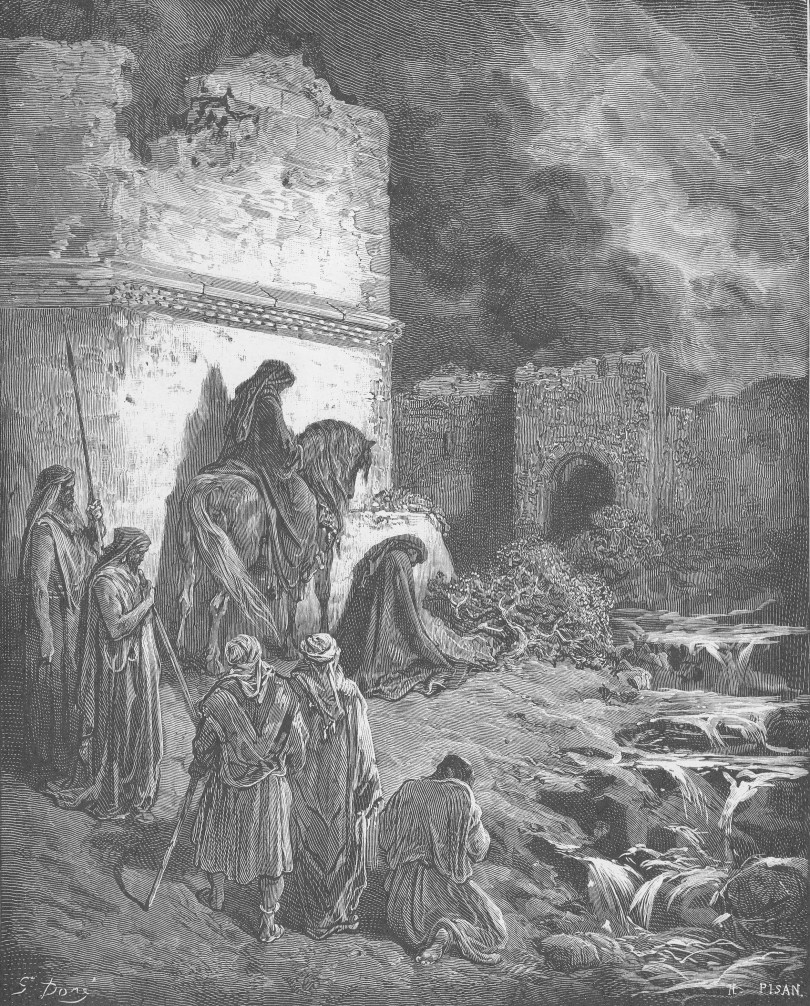
In keeping with the unofficially churchy theme of two of this week’s posts (here and here), it seemed like a good opportunity to look back at a post from February about Nehemiah.  In “Nehemiah and National Renewal,” I explored the impact of Nehemiah’s faithful reconstruction of Jerusalem’s collapsed wall in terms of the national renewal it brought (and the spiritual renewal that came with it in a follow-up post):

This past Wednesday, I was asked to fill in for the pastor at the small church I attend.  Being such a small church—our average Sunday morning attendance is about forty—the pastor works another job, and he had a rare business trip.  I suppose he figured he could do worse than asking a high school history teacher to fill in for him.

Fortunately, the lesson was fairly straightforward:  he sent me a handout on Nehemiah 1:1-11, and the focus of the lesson was on the idea of spiritual renewal.

For the biblically illiterate—a shocking number of Americans today, I’m finding (I once had a class full of philosophy students who had never heard the story of the Tower of Babel, which is pretty much Sunday School 101)—the story of Nehemiah is simple:  after an extended period of exile in Babylon, the Israelites were sent back, under the auspices of the Persian Emperor Cyrus the Great, to Jerusalem.  Cyrus sponsored the rebuilding of the Temple in Jerusalem, but the city itself, as well as its walls, remained in a state of disrepair.

There were two waves of Israelite resettlement over the span of a century, but many Israelites remained in Babylon or other parts of the Persian Empire, such as the imperial capital.  Nehemiah was one of those, and would be part of a third wave of resettlement.  He served as cup-bearer to Artaxerxes, the Persian emperor at the time.  The position of cup-bearer was an important and trusted one:  he handled the emperor’s food and drink, ensuring it was not poisoned.

Beyond serving as the royal taste tester, the office carried with it important administrative duties, and gave incredible access to the emperor.  In short, it was a position of great influence, power, and prestige, which positioned Nehemiah nicely for what was to come.

Nehemiah spoke to a fellow Israelite who was visiting the imperial capital, and was distraught to hear of the poor condition of the city and its walls.  He fell to his knees, weeping and crying out to the Lord.  Nehemiah 1 details his prayer to God, calling out in adoration; confessing his and his people’s sins; thanking God for His mercy and gifts; and supplicating God for His Will to be accomplished through Nehemiah.

Specifically, Nehemiah asked God to be used to rebuild the wall around Jerusalem.  As cup-bearer, Nehemiah was able to present his petition to the emperor, who agreed to send Nehemiah to oversee the construction project.  In addition, Artaxerxes provided lumber from the royal forest, as well as funds to bankroll the endeavor.  He also sent letters with Nehemiah detailing his endorsement of the project.

Nehemiah’s work was not finished there, and it was anything but easy.  Initially, surrounding tribes criticized and mocked Nehemiah, questioning his loyalty to Artaxerxes, and saying that rebuilding the walls was a silly waste of time and effort.

However, once the wall reached half its height, his critics began plotting violence.  The plot to attack the workers reached Nehemiah, so he divided the work crews into those building the wall, and those defending their fellow workers from attack.

Having failed to stage an attack on the workers, Nehemiah’s enemies realized that the man himself was the target—cut off the head, kill the snake.  Again, God revealed this plot against Nehemiah, and he was able to avoid assassination.

Finally, the wall was rebuilt in an astonishing fifty-two days, an incredible feat of organization, ingenuity, and faithfulness.  The naysayers were humiliated, and Nehemiah instituted a period of national and spiritual renewal among the Israelites.  His reforms purified the nation spiritually and even ethnically, as old debts were forgiven and marriages to pagan women were dissolved.

It’s a powerful story—indeed, a powerful bit of history—about trusting in God in the face of extremely difficult odds.  But Nehemiah is also a story about national renewal, and the spiritual revival that came with it.

The wall around Jerusalem served a practical purpose—defending the city and its inhabitants from attack (even though the city was under the protection of the Persian Empire, the ancient Near East was, then as now, notoriously tribal, and the collapse of an empire would lead to dozens of ethnic conflicts)—but it was also a symbol of the Israelite nation.

Indeed, the author of the handout I used Wednesday evening writes that the “enemies of Israel could say, ‘What kind of God do you serve?  Look at the mess of your Holy City?’ It was a terrible witness and was cause for reproach from non-believers.”  The poor condition of the Jerusalem and its fortifications reflected the spiritual decay and corruption of the Israelites—they had intermarried with pagan women, adopting their false gods; they were living in rubble; and their reduced condition suggested that their God—the One True God—was not Who He made Himself out to Be.

It’s a bit on the nose, but I can’t help but recognize the parallels between the United States today and Jerusalem then—and between President Trump and Nehemiah (although I think Trump is closer to Cyrus the Great in terms of his spirituality and outlook).

I’m not suggesting Nehemiah was clubbing with Eastern European supermodels.  But like Trump, he faced overwhelming resistance from other nations to his wall project.  The rest of the ancient Near East feared a strong, renewed Israel.  Nehemiah’s return to Jerusalem, and the reconstruction of the wall, led to a period of national revival, as the people regained their identity, expelled the corrosive foreign influence in their midst, and renewed their commitment to God.

America is, spiritually and culturally, in similarly dire straits today.  President Trump has presented himself as a modern-day Nehemiah, come to control our borders, enforce our immigration laws, and restore America’s greatness on the world stage.  While he has made great strides in these areas, he meets resistance, duplicity, and mockery at every turn.

The story of Nehemiah tells us, however, that the struggle is worth the slings and arrows our enemies, both foreign and domestic, will lob at us.  To President Trump, I would urge the following:  stay the course, ignore the haters, take it to God, and BUILD THE WALL!