

Today’s post is a SubscribeStar Saturday exclusive. To read the full post, subscribe to my SubscribeStar page for $1 a month or more. For a full rundown of everything your subscription gets, click here.
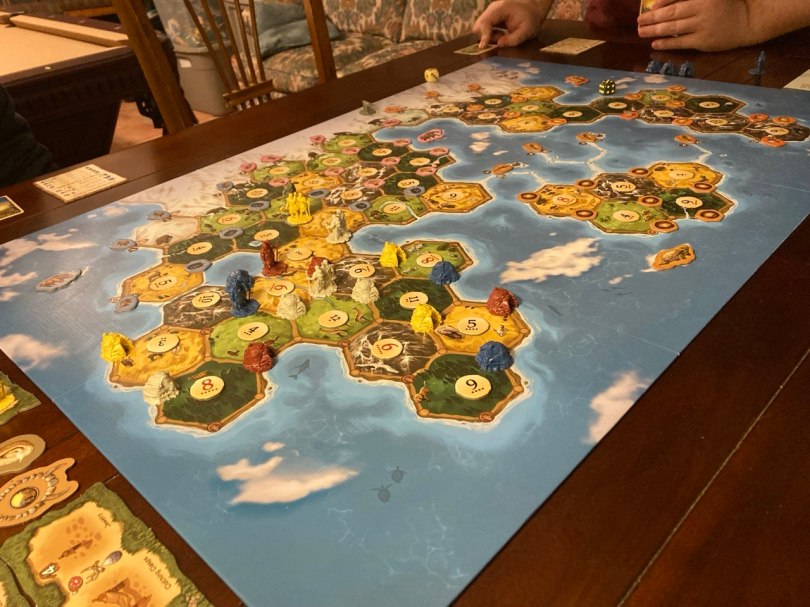
Last night yours portly had his raucous bachelor party, which consisted of eating pizza and play board games with my friends at my younger brother’s house. The board gaming highlight of the evening was playing Catan: Dawn of Humankind (that’s an Amazon Affiliate link; I receive a portion of any purchases made through that link, at no additional cost to you), which my best man purchased as an early wedding gift.
The game can best be described as a blend of the early turns of any Civilization game and Settlers of Catan (more affiliate links), the classic Klaus Teuber game. The map takes place on Earth, with all players starting with camps and explorers (imagine a blend of the scout and settler in Civ) in Africa. Players are encouraged via various game mechanics to migrate out of Africa and to explore and populate the rest of the world.

Like classic Catan, the goal is to reach ten victory points. These points achieved through various means—cultural and scientific development; exploration; and settlement outside of Africa. Like Catan, players gather four different resources, re-themed to fit the prehistoric setting, by rolling two six-sided dice. Players may trade these resources or cash triplicates into the bank in exchange for a single resource of another type.
There are some key differences, however: while Dawn of Humankind is built on the Catan system, it is geared towards exploration and research. Settlement is a key component of the game, but it’s done by sending out explorers. Some areas of the map are blocked off by certain research requirements; for example, reaching Australia requires substantial investments into construction (for boats, presumably) and clothing. Going towards the Arctic requires high clothing investments. Investing in exploration lets explorers move more quickly, and investing in hunting allows players to move the Neanderthal in Eurasia and the Smilodon (saber-toothed tiger) in the Americas and Australia (these tokens act as the equivalent to the thief in classic Catan.
To read the rest of this post, subscribe to my SubscribeStar page for $1 a month or more.
 The Portly Politico