Populism Wins

A major lesson of the 2016 election was that the neoliberal consensus of the prior thirty years was not the panacea its advocates claimed.  Trump’s candidacy was premised on the notion that the national government should work for the interests of the nation’s people, not on behalf of globalist concerns and aloof cosmopolitan elites.  Government could be reformed to strengthen the nation, rather than operating as the piggy bank for and protector of internationalists.

It’s interesting to reflect how entrenched the assumptions of neoliberalism were prior to 2015-2016.  When Trump began his historic campaign, virtually no one on the Right was talking about tariffs, other than Pat Buchanan (and a long essay on the necessity of a trade war with China that Oren Cass wrote for National Review in 2014).  The outsourcing of jobs overseas was assumed to be a short-term sacrifice that would result in more efficiency (ergo, lower prices on consumer goods) and more skilled jobs here.  We were a “nation of immigrants,” so we’d better throw the doors wide open.

With Trump’s election, a long-dormant populist wing reemerged, consisting both of conservative Republicans and disgruntled Democrats.  Tariffs became an important foreign and domestic policy tool.  A trade war with China soon began, and the United States renegotiated the NAFTA agreement with Mexico and Canada.  Manufacturing jobs began returning to the United States, and immigration laws began to be enforced (so long as those Hawaiian judges didn’t get in the way).  The economy, rather than contracting as the free trade hardliners warned, grew exponentially, and even now is recovering at a remarkable clip after The Age of The Virus temporarily sidelined it.

Read More »

Flynn Flies Free

A big H/T to blogger buddy photog at Orion’s Cold Fire for sharing Tucker Carlson‘s latest Truth Bomb.  photog helpfully shares Tuck’s summary of the Flynn fiasco:

Michael Flynn’s coerced guilty plea is one of the many puzzle pieces clumsily assembled in the vast coup conspiracy against President Trump.  Our ursuline Attorney General, Bill “The Bear” Barr, has pushed for a dismissal of the bogus case against Flynn.

The commentary from the Left boils down to, “But he plead guilty!”  Yes, he plead guilty, out of desperation, to spare his son from a similar witch hunt—a father taking the fall to save his son.

More importantly, the entire investigation was based on FISA warrants obtained under false pretenses.  If your local police department bust into your house without a warrant and went through your underwear drawer, every judge in the country would throw out the case, even if they found bags of cocaine tucked away with your Fruit of the Looms.

The entire Mueller probe was a farceJames Comey is a sanctimonious a-hole who self-righteously mismanaged the FBI because of his own apparent moral superiority.  Two agents involved in an extramarital affair—presumably our moral betters, or least smarter than the rest of us—plotted the overthrow of President Trump.

And yet they all waltz about, consequence-free, while a military man who served his country was facing five years over a guilty plea for something that AG Barr says wasn’t even a crime!  Per Barr:

[P]eople sometimes plead to things that turn out not to be crimes. … And the Department of Justice is not persuaded that this was material to any legitimate counterintelligence investigation. So it was not a crime

It’s the same situation with Roger Stone, who is literally facing four years in prison for forgetting he sent an e-mail, while other, actual convicts—like slick extorionist Michael Avenatti—are being released from prison because of The Virus.  Stone mixed up some dates while being interrogated as a part of—again—the bogus Mueller investigation.

In both cases, the FBI withheld exculpatory evidence—a clear violation of the right to a fair trial, in which the defense is supposed to have access to all the same evidence as the prosecution.

Our federal justice system is a farce.  Barr made this point in a CBS News interview:

I was concerned people were feeling there were two standards of justice in this country. … I wanted to make sure that we restore confidence in the system. There’s only one standard of justice.

But our elites are content to destroy due process and rule of law in order to get Trump, or anyone near him.  They’ll violate the spirit and letter of the law with impunity whenever it suits their purposes.

If there was any justice in this world, the Clintons would be in prison, Ilhan Omar would be deported, and James Comey would be dime-store philosophizing on third shift at the 7-11.

Instead, we’re destroying our economy over the flu and arresting salon owners for feeding their families.

Can we just have an amicable divorce from these weirdos?

Cass on Our Diminished Income

Way back in The Before Times, in the Long, Long Ago, before The Age of The Virus, Oren Cass presented a series of sixteen tweets, asking this question:  “How is that our economic statistics suggest workers have been making slow but steady progress in recent decades, while popular perception is that their family finances are coming under increasingly untenable pressure?”

Cass also wrote about the issue in greater detail in American Affairs and in a lengthy paper for the Manhattan Institute.  That question—why does it feel like it’s harder to make ends meet now, even though inflation is low and we’re wealthier?—is one of the gnawing concerns of modern-day America.

Read More »

The Boogie Woogie Flu

Don’t let the title of today’s post fool you:  I’m not going to write about the coronavirus today.  I’m actually enjoying the relative freedom and flexibility of distance education, sipping car dealership coffee while I wait for my 2017 Nissan Versa Note to get a transmission flush and a belt and some wheel bearings replaced, all with appropriate social distance between me and the other people getting their cars fixed.

But in these plague-riddled times, I couldn’t resist this charming little Quora post about another, funkier plague:  the Strasbourg “Dancing Plague” of 1518.  Not that there’s anything charming about dancing yourself to hell, but it sounds a lot more fun than cloistering alone in your house for two weeks.

Read More »

TBT: Trade War with China is Worth It

Amid this whole coronavirus situationconundrum, crisis, globalist meltdown—we should keep in mind that it’s all China’s fault.  That’s why GEOTUS keeps calling it the “Chinese Virus” and the “Wuhan Flu,” because those names are completely accurate.  Of course, the media is having conniption fits about the supposedly “racist” intentions and implications of those names (which are quite mild compared to my favorite, “Kung Flu”).  It’s why the only real response to charges of racism—which are designed to make conservatives apologize in panicked fear—is to ignore them.

Regardless, it’s worth remembering that China is to blame.  Whether it was the result of abhorrent, unhygienic culinary practices (the infamous “bat soup“) or a malicious (or incompetent) leak of an engineered biological weapon, China unleashed this plague upon the world.  Perhaps the strongest argument against uncritical globalization is just that:  we made ourselves excessively dependent upon a regime that is fundamentally opposed to our very existence, and which rejects our deepest held values and beliefs.

In retrospect, then, President Trump’s trade war with China looks all the more prescient.  We’ve become so dependent upon and integrated with China, we’re running short on the ingredients for essential medicines because of China’s disease.  Supply chains have been seriously disrupted, and will continue to be, it seems, for some weeks.  Thank goodness the tariffs began moving production of some goods back to the United States.

That’s an important lesson to remember:  paying a bit more for your washing machine is worth the price of having domestic production.  We don’t need to make everything in the United States, but saving a hundred bucks or so on a major appliance isn’t worth gutting our industrial capacity and leaving our middle and working classes out of work.

Oh, well.  A lesson learned too late is still a lesson learned.  When this whole fiasco is over, let’s consider a healthy dose of autarky going forward.

With that, here is August 2019’s “Trade War with China is Worth It“:

There’s a lot of disingenuous scuttlebutt flying around about a looming recession, the inverted yield curve, and the costs of the trade war with China.  I can’t help but think such doom and gloom reporting is part of an effort to undermine President Trump.  Investor and consumer confidence are emotional, fickle things, based as much on feeling as they are on hard economic data.

As such, I suspect that major media outlets are attempting a bank-shot:  scare investors and consumers enough, and they panic into a recession.  President Trump’s greatest strength at present is the booming economy and low unemployment rate; take that away, and loopy, socialist Democrats have a much better shot in the 2020 elections.  With Leftists like Bill Maher actually hoping for a recession to unseat President Trump, that’s not a far-fetched speculation at all.

The inverted yield curve is a bit academic, though, and I don’t think it’s going to have the scary impact its prophets of doom hope.  Oh, a curve on a graph is inverted—scary!  Most Americans aren’t going to respond to that in any substantial way.

On the other hand, the negative media attention around the trade war with China could negatively impact perceptions of the president.  Trade wars, in which countries throw up tariff barriers against one another’s imports, often ratcheting up the duty levels, is a game in which both sides lose out over the long-run—that is, assuming they don’t have other viable trading partners, and that they’re both evenly matched economically.

And, yes, the trade war has had some drag on the American economy—but it’s been so minuscule, only a few sectors have really felt the pain.  Meanwhile, China is really struggling.  Getting Trump out of office would serve China beautifully, as narrow-minded neoliberal economists would likely push a Biden (or Harris—gulp!) administration to end the tariffs.  China has the dubious luxury of an authoritarian system that can direct its economy, while President Trump must survive reelection to keep his trade policy going.

The case for maintaining the trade war is compelling (and it pre-dates Trump:  one of Mitt Romney’s advisers in the 2012 election, Oren Cass, wrote an essay for National Review calling for a trade war with China in 2014).  The best recent summary for why the trade war is beneficial actually comes from my hometown paper, The Aiken Standard (kudos to my Dad for sharing this piece).

Greg Roberts spells out the case in “Facts behind the U.S.-China trade war“; I highly recommend you give it a read.  As Roberts points out, in a normal trading relationship, the price of each trading nations’ currencies would fluctuate based on its relative trade imbalance with its trading partners; this fluctuation would occur until some rough equilibrium in currency values is reached.

China—in violation of its agreement not to do so upon entering the World Trade Organization—has continually depressed the value of its own currency in order to encourage a trade imbalance with the United States.  Because the Chinese currency is held artificially low, it is cheaper for the United States to import Chinese goods than to export American goods to China.  Why?  Because the Chinese currency is cheaper, Chinese goods are less expensive, and can be bought and imported cheaply.

Because China is a currency manipulator, it is not acting per its agreement upon joining the WTO.  Further, Roberts points out other violations, including China’s requirement that firms wishing to manufacture in China turn over their patents, blueprints, and other intellectual property to the Chinese government as the cost of doing business.

Here are two relevant paragraphs:

Has China kept its promise? The answer is a resounding no, since the Peoples Bank in China, which is controlled by the Communist Party, routinely devalues its currency to maintain, in the case of the U.S., a positive trade balance, which, for us, means we have a trade deficit with China, now totaling more than $300 billion annually.

China agreed to many other provisions when it joined the WTO which the country has not kept, to wit not requiring the transfer of foreign technology as a condition of market access; enterprises in China that are owned or controlled by the government have expanded rather than diminished; foreign banks have not been given the access that had been agreed to; the theft of intellectual property has not abated; among many others.

Clearly, China has acted in bad faith repeatedly.  Further, the United States has a number of alternatives for trade in the region, including Vietnam.

Also, the goods China receives from the United States are the stuff of life—soybeans and other agricultural products.  Does the United States need more cheap plastic crap?

Give Roberts’s analysis a read.  It’s the best, most succinct summary of the trade war I’ve read recently, and it will convince you of the necessity of holding the line against Chinese economic aggression.

High-Tech Agrarianism

The coronavirus situation—which I am convinced is both quite serious, but also inspiring some huge overreactions—has created a world that feels almost entirely different than it did even a few days ago.  This time last week, I was convinced that the whole thing was way overblown, and that life would largely continue apace, minus some school closures here and there.

By Friday evening I was growing more concerned, as everything began to get closed or cancelled.  I proctored the SAT Saturday morning and even went out of town that evening.  At that point, I thought the risk of my school closing was greater than it had been even two or three days before, but I still figured it was a relatively remote possibility.

Then Governor McMaster announced the closure of all South Carolina public schools (I teach at a private school, but we always follow gubernatorial closures)—and a bunch of other stuff shut down.  I picked up dinner at a Hardee’s in Florence, South Carolina Monday evening after a guitar lesson, and it was surreal—everything was gone from the front, and the cashier had to give me a lid and straw according to their new cleanliness guidelines.

(Let’s take a moment to thank all those service industry folks and long-distance truckers who are continuing to work and risking exposure; they are unsung heroes.  Also, spare a thought to people in those industries that are out-of-work at the moment.  They need our love and charity now more than ever.)

That’s all to say that, in a remarkably short period of time, the United States has undergone a major paradigm shift.  The world of Saturday, 14 March 2020 at 2 PM—when I emerged from the cocoon of extended time SAT testing—was a different than the world of Wednesday, 18 March 2020 at 9 PM (when I’m writing this very belated blog post).

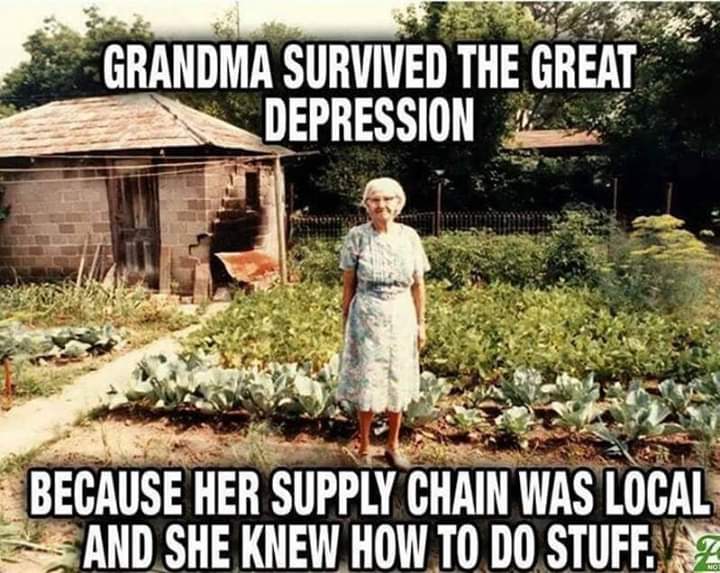
One trend—that I think will be positive if it endures—is the implicit rejection of globalism.  People are suddenly awakening, dramatically, to the manifold downsides of open borders and excessive global economic integration.  Suddenly, localism is back in vogue.

Read More »

TBT: The Human Toll of Globalization

One of the more interesting developments in conservatism since Trump’s rise in 2015-2016 has been a reevaluation of our basic economic policy.  Much of the ideas debated originated, in our modern political era, with Pat Buchanan.  For decades, the assumption among conservatism was that economic efficiency was the highest good, as it lowered costs and eliminated or reduced government overreach.

That was a reasonable set of assumptions when our nation shared a common culture, and when the United States dominated global markets hegemonically.  But the goal of reducing the size of government morphed pathologically into the mad worship of Efficiency above all else.  We sold out social capital—stable families, cohesive communities, robust civil society—for quick cash.

That’s the gist of Z-Man’s post today, “Middle-Man Conservatism.”  Tucker Carlson has similarly touched upon the woeful consequences of worshiping Efficiency-for-its-own-sake.  Sure, Americans possess a pioneering spirit—we’ll move to the oil fields in North Dakota if we have to do so—but we’re still motivated by the same things other humans are:  family, community, belonging.  Gutting our communities to save fifty bucks on a washing machine is a ludicrous trade-off.

Read More »

TBT: Best SOTU Ever

Trump delivered an amazing State of the Union address Tuesday night—the best I have ever heard in my own lifetime, as well as the most entertaining.  That incredible, lively address—a celebration of America and her greatness—was followed Wednesday by Trump’s acquittal in the Senate on both of the flagrant, fallacious impeachment charges.  President Trump and the American people are riding high.

Before Tuesday night’s address, I thought the 2019 SOTU was the “Best SOTU Ever.”  Now it’s fallen to a respectable second place slot—perfect for this week’s TBT feature:

I was wrong, as were most conservative (and some progressive) commentators:  President Trump was right to hold out for a real State of the Union Address, rather than reviving the Jeffersonian tradition of the written address.

The president’s State of the Union speech was a tour de force:  he spoke eloquently of America’s role in advancing civil and human rights; the sanctity of human life, born and unborn; the economic development of the United States in the last two years; and the crisis at the border.

It was an address that was optimistic and accurate.  Unlike most SOTU addresses, which tend to be tedious attempts to inflate small bits of good news beyond all reasonable proportions, Trump’s 2019 address described, in detail, just how great America is, and how far we’ve come in two short years.

It’s little wonder Speaker of the House Nancy Pelosi wanted to cancel the speech:  how do Democrats respond to that?  The first part of the speech was full of positive economic news, news that can’t be ignored or denied.  The president detailed explosive wage and job growth, including the lowest unemployment rates for black, Hispanic, and Asian Americans in history.

Beyond the economic good news—and the vow that the United States will never be a socialist country—it was a fun speech (well, it was a bit long, and dragged a smidge, but not much).  Even Democrats started getting up and dancing around at one point!  Congress sang “Happy Birthday” to a Holocaust survivor.  President Trump cut some jokes, and was clearly having a blast.  As any performer knows, if you’re having fun on stage, the people in the audience will have fun, too.

If you missed the speech, go to YouTube, shut the office door, and fire that baby up while you file TPS reports.  You won’t regret it.

TBT: Tucker Carlson’s Diagnosis

This week’s TBT looks back to a piece I wrote in January 2019 that summarized a segment Tucker Carlson did on his wildly popular show.  That segment really shaped my thinking on some economic and social issues (although other commentators and writers were already influencing my thinking in that direction).

Earlier this week, I wrote a piece about another Tucker segment that applied these concerns into a political platform, of sorts, one that moves beyond economic growth to real improvement for people’s lives.

This blog post was a bit shorter, so I’ll allow it to speak for itself.  It’s definitely worth watching the linked video in the piece, as it is the segment the post covers.

Here is January 2019’s “Tucker Carlson’s Diagnosis“:

recent monologue from Tucker Carlson’s Fox News program is blowing up the right-wing blogosphere, and understandably so.  Carlson has been a vocal critic of the neoliberal deification of economic efficiency at all costs.  I used to be a member of this cult, until the candidacy of Donald Trump (and lived experience) knocked the idealistic scales from my eyes.

Normally, it bugs me when people send me video clips to watch.  If they’re cutesy videos of the variety that drive clicks—think cats playing piano, or Goth versions of Christmas songs—I usually ignore them, no matter how hyped they are.  That’s not some virtue on my part; I just don’t want to take the time to watch them, especially on a cell phone (a pet peeve:  someone making me watch a video on their cell phone; I will refuse).

That said, I’m indulging in some hypocrisy:  you must watch this video as soon as you’re able.

For those of you that don’t want to take the time, here are some highlights:

  • Elites care only about maximizing economic efficiency, regardless of the human costs to individuals, families, and communities
  • That lust for efficiency drives income inequality, particularly benefiting the technology sector/Silicon Valley
  • “We are ruled by mercenaries, who feel no long-term obligation to the people they rule”—a key idea; I’ve read a similar analysis from controversial blogger Z-Man, in which he argues that leaders in a democracy are, inherently, renters rather than owners, and therefore are heavily tempted towards asset-stripping while in office, rather than building and maintaining a nation:  http://thezman.com/wordpress/?p=15929
  • Because of the hollowing out of American manufacturing and declining wages (again, due in part to the quest for efficiency), men struggle to find employment or to improve their wages
    • Because of that, rural parts of the country are dominated increasingly by healthcare and education, female-dominated fields
    • While better wages for women is fine, Carlson claims that—whether or not they should—women are less likely to marry men who earn less than them, therefore

These are just some of the most interesting insights, but Carlson sums up in fifteen minutes what would take a legion of hack bloggers like me hours or weeks to explain.

Again, I urge you to watch this video:  https://video.foxnews.com/v/5985464569001/?playlist_id=5198073478001#sp=show-clips

Free Speech in the Private Sector

Assaults on free speech may be the most pressing issue of our time.  Anyone reading this blog has surely witnessed the deplatforming of conservative figures under nebulous “community guidelines,” as well as the personal and professional ruin that tend to follow.

Indeed, I occasionally fear that my dashed-off ramblings might, in some none-too-distant Orwellian America, be misinterpreted or misapplied as “hate speech”—all it takes is the wrong person complaining.  Of course, this blog’s obscurity is perhaps my best defense—I’m too small to matter.  That said, that fear is one reason I’m pumping up alternative income streams and attempting to boost my SubscribeStar subscriber base; the authoritarian maw of the SJWs grows ever wider.

Read More »