TBT: Transformers 2: Conservatives in Disguise?

For this week’s #TBT feature, I’m digging back, for the second time, to a very old post from 2009.  It’s about—of all things—the second movie in the modern Transformers franchise.  Yeesh.

Anyway, the point of the essay—and its cringe-inducing navel-gazing—is that a government bean-counter does everything he can to wield his meager bureaucratic power like a little dictator, in the process undermining the unsteady alliance between the good Autobots and the US military.

It reminds me of Ghostbusters, when the functionary from the Environmental Protection Agency comes and shuts down the containment unit—the one holding all the captured ghosts—because it’s using too much energy and might represent an environmental threat.

Think about that for a minute, and reflect on how awesome the 1980s were—the Zeitgeist was such that the minor villain was guy who worked for the EPA.  Even left-leaning Hollywood razzed busy-body government employees during the Reagan era.

Regardless, enjoy this blast from the past, an example of a trend in Conservatism, Inc. of reading into films a conservatism message (except I was probably right on this one):

Earlier today I saw Michael Bay‘s highly-anticipated (and critically-panned) Transformers 2: Revenge of the Fallen. Prior to seeing the movie, I had no intention of writing a blog about it. Although films are occasional inspirations for my essays (see my article about the lack of strong African-American fathers, which I wrote after seeing Boyz n the Hood), I never imagined that Transformers 2 would be the subject of one of my blog entries because I don’t write straight-up reviews. Honestly, I figured it would be exactly what it is: a steady stream of explosions, robots, and mass destruction.

What I didn’t count on was that it would only be what I expected 99% of the time. That other 1% is the focus of this essay. Like the first Transformers film, Transformers 2 spent a great deal of time covering the U.S. military and its interactions with and against the various transforming automatons. Generally speaking, the soldiers are characterized as normal and basically decent–they want to do what is best for their country and they want to protect the weak and innocent, but they will follow the civilian authority of the Constitution.
In Transformers 2, however, I noticed a more overt, though still very, very subtle, endorsement of conservative politics–or, at the very least, a critique of modern liberalism. I don’t want to read too much into this (well, actually, I do), but there are several moments during the movie when the misinformed meddler, the entity trying to put the kibosh on the Autobot-military alliance, is a mealy-mouthed government bean-counter who sees the Autobots as an alien menace that constitutes a risk to national security. Now, sure, action movies are overflowing with literal-minded government stooges and opportunistic politicians who are always putting up a wall of red tape that is harder to break than the concrete bunker our hero just crashed through on his motorcycle. The key difference in Transformers 2, however, is that the government stooge in question is acting under direct orders from the president, who is explicitly identified as… Barack Obama (one news report states that “President Obama has been relocated” to a bunker somewhere in the Midwest).
Not evidence enough? At one point, this pencil-pusher makes a point straight out of the Obama foreign policy playbook: let’s try to negotiate with the bad guys. Maybe we can talk out our differences and everyone can live in peace. When the bureaucratic boob said that, I almost fell out of my seat. I don’t know if Michael Bay or the writers of Transformers 2 were intentionally making this point, but for this chubby conservative the implications were loud and clear: Obama and other liberals who demand negotiations before resorting to force against overtly hostile, dangerous opponents are fatally off base and out-of-touch. The president’s puppet makes the point that the United States should not be involved in the civil war of an alien race in the first place, but that doesn’t change the fact that it is anyway. The United States, the filmmakers seem to be suggesting, has a responsibility to aid the Autobots against the new Decepticon menace, whether it likes that obligation or not, and the proposed policies of Obama and other liberals in foreign relations are potentially devastating.
Besides a subtle endorsement of a neoconservative foreign policy–or at least a more realistic approach to foreign threats–Transformers 2 is, as I have mentioned, heavily pro-military. The film depicts soldiers as law- and order-abiding citizens who, even if they don’t like it, abide by civilian authority. This is a refreshing change from the usual Hollywood fare, which casts soldiers in the light of threats to democracy and as right-wing gun nuts who want nothing more than to seize control of the government themselves. While we should have a healthy wariness of the military as a potentially repressive arm of the federal government–a wariness that dates back to colonial America and that is most evident in the writings of Thomas JeffersonTransformers 2 makes it clear that the U.S. military is a military of dedicated civilian volunteers who value and fight for freedom. They are not professionals who ride roughshod over the freedoms of others, be they Americans or foreigners. In fact, the U.S. military works closely with several Middle Eastern governments in the film, including the Egyptian and Jordanian militaries. In one scene, when a Jordanian helicopter is grounded by a Decepticon, American soldiers aid the fallen foreigners. This is not the unilateral, oppressive, quagmired military we hear so much about in the media; this is a dynamic, humane force made up of regular, freedom-loving Americans.
This brings me to one final point, a point I’ve been mulling over for awhile. We are constantly told that wars are started by the elite and fought by the poor; that wars are little more than opportunistic struggles or, even worse, the effect of some perceived slight or random occurrence; that war is rarely right or even necessary. In different times and in different places, many of these assumptions were true. Wars in the past were started by absolute monarchs or power-hungry tyrants, while they were fought by loyal vassals or downtrodden peasants.
In the United States, however, this is not the case. We live in a society where the people, at least in theory and, cynics aside, very much in practice, have a say in the functioning of government. Whatever slogan-spouting liberals will tell you, their bumper-sticker philosophy is severely flawed and misinformed. If the United States goes to war against a hostile power or terrorist group, it is because the people have given their approval. Foreign policy is, admittedly, concentrated in the executive branch of the government, which means that the president and the Secretary of State have a great deal of influence in deciding its direction. Any president hoping to keep his office, however, is going to be careful in how he deals with foreign policy.
Therefore, the traditional criticisms levelled against war are at best incomplete and at worst obsolete, at least when applied to the United States. There is still a great deal of debate about whether or not the United States should be the world’s police officer; regardless, wars are not foisted on unwitting dupes by a greedy elite in America.
This claim is a bold one, but I stand by it. The wars in Iraq and Afghanistan would not have been fought and would not have endured so long without significant support from the American people. Now that support is beginning to wane, serious questions are being asked about America’s future role in those countries, but we are seeing a huge amount of popular outpouring for the people of Iran, who are currently struggling against their sham of a government. President Obama’s “let’s-talk-it-out” approach to foreign policy is not enough when facing a regime of authoritarian thugs.

Self-Righteous Virtue-Signalling Lives On

The Right prides itself on its ability and willingness to police its own, and that impulse is usually healthy.  It would be inconceivable, for example, for congressional Democrats to overwhelmingly support investigation and even impeachment of a Democratic president the way congressional Republicans did with President Richard Nixon during the Watergate scandal (for what it’s worth, I think Nixon was railroaded—more on that another time).

That impulse, though, can easily morph into SJW-esque virtue-signalling, which is exactly what happened in response to the Covington Catholic non-troversy over the weekend.

Remember, every time there is some accusation in the news of conservatives or Trumpists behaving badly—especially if the allegations involve some form of bigotry against protected classes of the rainbow coalition—wait 24-48 hours, and it will invariably be revealed to be either a hoax or a willful misrepresentation of the facts.

There is some truly lurid stuff circulating about the high school students who were attending a pro-life march.  The iconic image is of a young man smirking as an elderly Native American war vet bangs a drum in his face.  Somehow, that smirk is a form of aggression, while an aging hippie provocatively banging a drum inches from your face is peaceful protest.

I expect swift denunciations and lengthy, navel-gazing think-pieces from Leftists about the “male gaze” and “white privilege.”  I don’t expect them from National Review (except for famed hand-wringer David French).

Of course, I should have learned by now, just as noodle-wristed neocons should have learned to wait for all the facts to come out before rendering judgment:  a substantial portion of the Right, sadly, simply seems to be “loyal opposition” to the Left.  That is, they accept the paradigm the progressive Left has foisted upon us, and instead of trying to chuck that paradigm, merely attempt to exist in a tiny corner of (barely) permitted dissent within it.

Nicholas Frankovich, a deputy managing editor at NR, wrote a piece comparing the elderly Native American man to Jesus Christ, and the pro-life Catholic students who almost literally turned the other cheek to the wicked Roman soldiers that crucified our Lord.  Never have I seen a more egregious example of virtue-signalling:  Frankovich, from the first sentence, is saying, “I’m holier than you because I take the Gospel account of the Crucifixion so seriously that I see it everywhere; the rest of you have just forgotten it.”  That pithy paraphrasing is not far from what he actually writes (from the second paragraph):

For some of us, the gospel stories of Jesus’s passion and death are so familiar we no longer hear them. The evangelists are terse in their descriptions of the humiliations heaped on Jesus in the final hours before his crucifixion, the consummate humiliation. Read the accounts again or, if you’d rather not, watch the video. The human capacity for sadism is too great.

John Nolte of Breitbart gives a humorous but accurate analysis of Frankovich’s melodramatic piece, which you can read here:  https://www.breitbart.com/the-media/2019/01/21/fake-news-never-sleeps-national-review-falls-for-more-anti-trump-media-hoaxes/

Of course, if you listened to conservative talk radio at all yesterday, all of the hosts relayed the full story (I heard, throughout the course of the day, Rush Limbaugh, Sean Hannity, and Mark “The Great One” Levin cover the events).  Here is my quick recap:

Essentially, this group of teenagers was waiting for their bus, when an extreme black nationalist fringe group, the Black Hebrew Israelites, began pelting them with obscenities.  That apparently went on for some time, before Nathan Phillips, the Native American activist and war veteran, came between the young men and the BHIs.  The boys were unsure whose “side” Phillips was on, but when he began some kind of war chant, they began to sing school songs (the source of the media’s claim that the young men were “mocking” Phillips and his Native American heritage).  Then someone snapped the picture of the young man “smirking”—and, out of context, it does look like a sh*t-eating grin—at the Native American, and the rest is revisionist history.

The truth about these events came out very quickly, to the shame of National Review and notorious Never Trumper Bill Kristol.  A member of the Polish Parliament has invited the boys to speak there in a sign of solidarity and to help get out the truth.

Sadly, rush-to-judgment virtue-signalling continues to live on.  Why play the Left’s game?  Are you that desperate to get a spot on morning talk shows?  Conservatives shouldn’t fall for it.  Ethically, we should at the very least wait for the full facts to come out about any negative story, whether it involves a conservative or a progressive.

Frankovich, Kristol, and their ilk might gain some temporary encomiums from the Left, but—as I’ve written before—their accolades will be short-lived.  The hot knife of progressive perfidy will find its way into their bent backs as soon as their political usefulness is dried up.

National Review Carries Water for The Rock

The cuckier writers at National Review are apparently obsessed with Dwayne “The Rock” Johnson as a potential Republican presidential candidate.  It’s almost as if they acknowledge that a charismatic celebrity with massive name recognition is a political boon, they just don’t like the guy that had the guts to pull it off.

The publication ran a cover story about The Rock—by noodle-wristed particularist and moral scold David French—back in 2017, and Jim Geraghty wrote glowingly about him in 11 January 2019’s “Morning Jolt” newsletter.  The occasion for Geraghty’s blurb was an interview in which The Rock gave a “full-throated defense of freedom of speech”; however, Johnson now says the entire interview was fabricated.

I don’t have anything against The Rock.  He makes movies that people enjoy and is personable.  That said, I know precious little about his politics (everyone’s favorite source, Wikipedia, isn’t much help).  The NR guys seem to think he’s a “natural conservative” (not a direct quotation), and we all know how that works out.

This plumping for The Rock may very well be part of Conservatism, Inc.’s tendency to declare progressive ideas actually conservative, something The Z-Man discusses in his various podcasts (unfortunately, I can’t find a specific example quickly on his blog, though I’ve heard him make this point in numerous podcasts).  As conservatives, I don’t think we can really trust anyone who isn’t explicitly conservative.

Granted, Trump isn’t so much conservative as he is anti-Leftist, but his instincts are fundamentally conservative; his Supreme Court and federal judge nominees are constitutionalists; and he’s surrounded himself with solid conservatives.  Trump possesses a gut-level conservatism, the kind that is more practical than philosophical.

Maybe The Rock has that, too—Trump certainly surprised us—but I don’t get the fascination with him here in 2019.  Of course, I was dead-wrong about Trump back in 2015, so what do I know?  If he runs as a Republican in 2024, I’ll hear him out.  Despite my purist ravings, I’ll take a flawed, uncertain Republican over a Democrat 9999 out of 10,000 times.

Proud Boys

An enduring challenge for conservatives is the constant campaign of disinformation from the Left regarding our organizations, tactics, and beliefs.  Conservatives are limited to a few bastions of barely-tolerated resistance:  the Republican Party, the Cato Institute, National Review, etc., organizations that fastidiously hold to an ever-more-narrow range of acceptable discourse.

That, of course, is a huge source of President Trump’s appeal—he smashed through the barriers the Right’s enemies imposed upon it, and it won him the presidency.  You could feel Americans breathing a nearly-audible sigh of relief that, finally, someone was saying the things we were all told we weren’t supposed to say.

It was in the heady days of 2016, then, that edgy, fun-loving dissidents like Milo Yiannopoulos and Gavin McInnes rose to prominence in the conservative movement.  McInnes tells some sordid stories about his wild, punk rock past, but largely his advice would have been deemed commonsensical just sixty years ago:  get married, have kids, work hard, love God, love Western civilization and the freedom it brings.

Now, uttering some of those same tenants gets you sent to the cultural gulags.  Take, for instance, McInnes’s fraternal organization, the cheekily-named Proud Boys.  The organization has come under fire lately as an allegedly sexist, racist, xenophobic order (it allows men, women, immigrants, and all races to join), and because it is proudly “Western chauvinist,” meaning it champions Western civilization as the best civilization.  Given Western civilization’s inherently universalist claims to human rights and liberty, it’s clearly open to all peoples of all backgrounds who accept its basic premises.

Primarily, however, it’s been criticized for engaging in self-defense.  Instead of taking beatings from radical, violent Antifa terrorists, the Proud Boys fight back.  Their whole maxim is that they don’t start fights, but they will fight back in self-defense.

Not surprisingly, noodle-wristed hand-wringers of the NR persuasion foppishly bemoan this completely reasonable response to unwarranted assaults with their usual appeals to decorum (the comments on that linked piece are instructive of how out-of-touch NR has become even with its own readers).  “Just take the beating” is apparently the primary admonishment.

While we could certainly have some discussion about Christ’s famous instruction to “turn the other cheek,” it seems completely permissible to strike back at the masked hooligan waving a piece of rebar at you.

At the risk of breaking my general injunction against telling people to watch lengthy videos twice in one month, I’d refer you to this excellent explanation from McInnes himself:

https://youtu.be/DGrPjx2V_TA

To alleviate the unnecessary legal suffering of some of the group’s members, McInnes reluctantly but decisively backs out of the organization.

For further reading, here is Milo’s piece about the libelous death of the Proud Boys:  https://www.dangerous.com/50463/i-too-must-bid-adieu-to-the-proud-boys-a-spunky-pro-western-mens-club-defamed-to-death/


TBT: Ted Cruz – Conservative Hero, or Traitor to His Party?

Given Mitt Romney’s perfidious WaPo op-edit seemed germane to look back to a seemingly forgotten moment from the 2016 Republican National Convention:  Ted Cruz’s convention speech in which he did not endorse (or, as I noted, not not-endorsed) nominee Donald Trump.  While Senator Cruz has become a steadfast supporter of President Trump’s agenda, at the time it was unclear where the conservative firebrand stood on Trump’s candidacy.

Cruz’s speech in 2016, however, was different in tone, tenor, and emphasis than Senator Romney’s traitorous op-ed.  Cruz fought a grueling series of primaries and caucuses against Trump.  Trump had insulted Cruz’s wife’s looks—a point Cruz made to a group of angry Texans who questioned why the Senator had not endorsed the candidate outright.  And Cruz largely aligned, in practice, with Trump’s policies, albeit in a more conventionally Conservative, Inc. way.

Romney, on the other hand, reeks of the kind of Jeff Flake/Bob Corker Republican who will undermine Trump’s agenda given the slightest chance, in exchange for the fleeting applause of the mainstream media.

Much of the analysis below assumed a stronger, more enduring Never Trump movement within the Republican Party, as well as a less successful Trump presidency.  Trump, fortunately, has exceeded expectations.  His successes on tax cuts, foreign policy, the judiciary, and elsewhere have taken the wind out of neocon sails, and energized the populist-nationalist conservative movement.

With that, here is my lengthy analysis of Senator Cruz’s fateful, mostly forgotten, speech:

On Wednesday, 20 July 2016, Texas Senator Ted Cruz delivered a speech at the Republican National Convention in Cleveland, Ohio, in which he congratulated his primary opponent and Republican presidential nominee Donald Trump on his victory, then urged voters to “vote your conscience” in November.  Boos filled the arena.

What convention delegates were booing was not the admonition to vote their conscience–for many of them, that means voting for Donald Trump–but the lack of an explicit endorsement from Senator Cruz to endorse Trump.

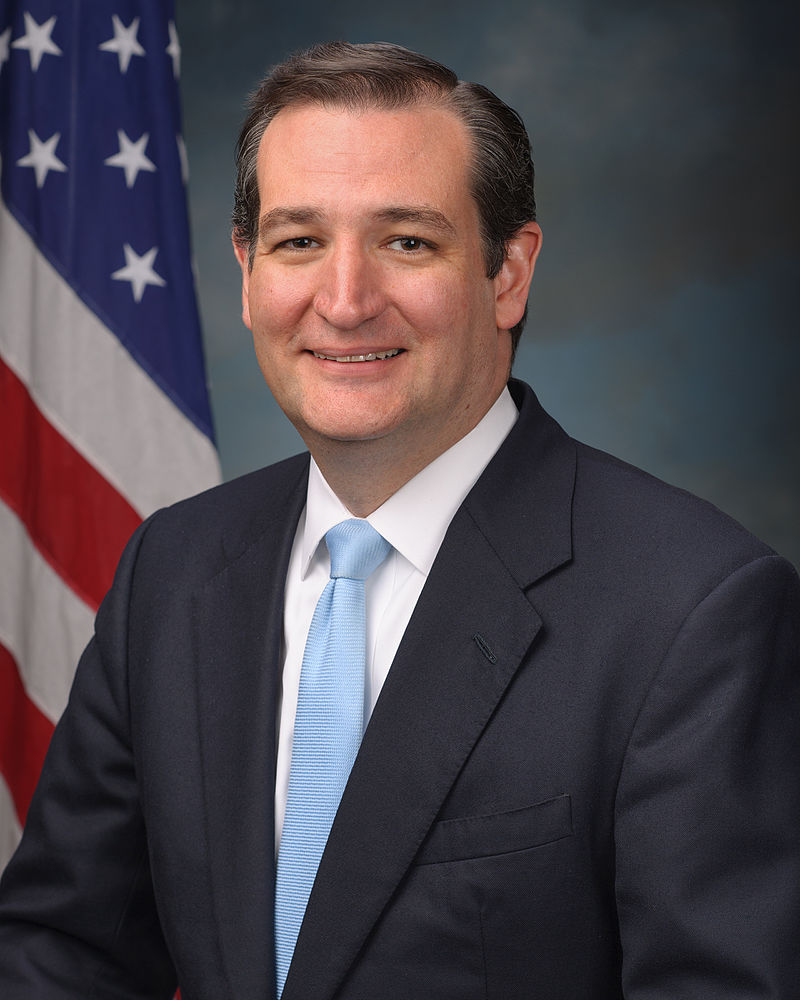
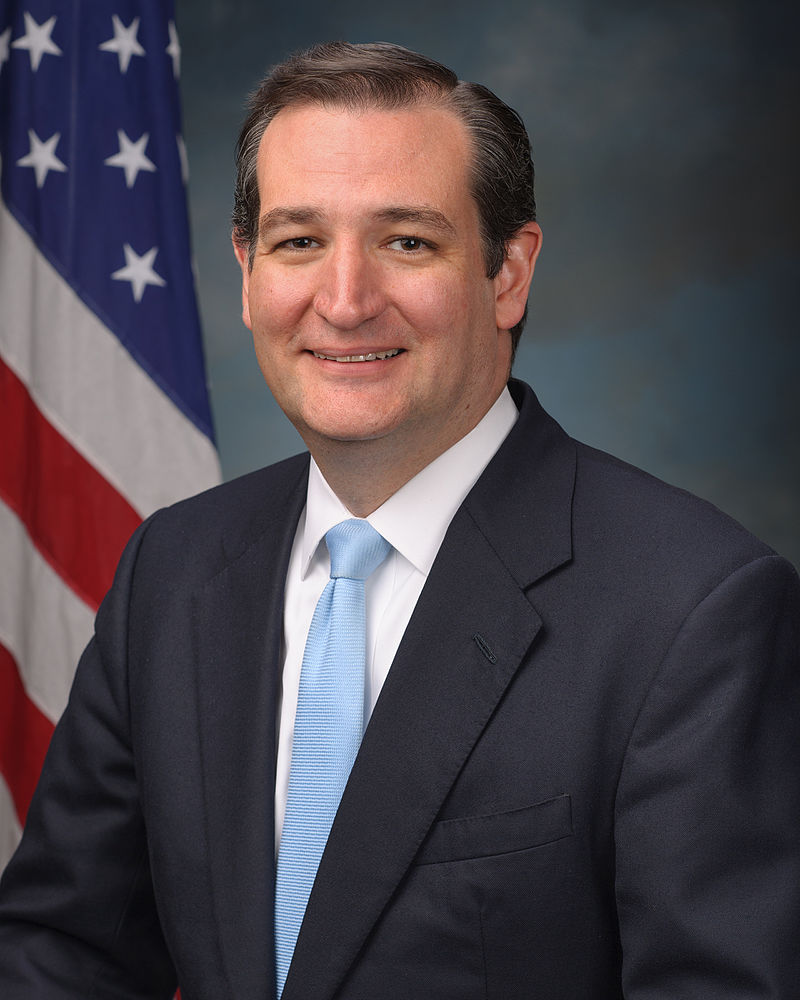
Ted Cruz – not the Zodiac Killer, but almost in as much trouble.
(Image Source:  By Frank Fey (U.S. Senate Photographic Studio) – Office of Senator Ted Cruz, Public Domain, https://commons.wikimedia.org/w/index.php?curid=25195114)

Immediately, two camps formed:  the majority pro-Trump camp, and the dwindling minority of Never Trumpers.  Within the former there are, broadly, two groups:  die-hard Trump fans, who have supported the candidate since last summer; and more tepid supporters who have given their support to Trump because they support their party’s nominee, they won’t support Hillary Clinton, they support elements of Trumpism, or some combination of the three.

The latter camp–I suspect–will continue to lose momentum now that the nomination process is complete.  Some of those voters will reluctantly vote for Trump for fear that a Clinton presidency will irrevocably shift the Supreme Court toward constitutional adaptavism and judicial activism.  Some will vote third-party, probably for Libertarian candidate Gary Johnson, or not vote at all.  A very small minority will vote for Clinton.

The kerfuffle highlights well the tensions inherent in party politics:  when does loyalty to party overcome adherence to principles, and vice-versa?

How these two groups have interpreted Cruz’s speech is predictable.  For the pro-Trump/party unity crowd, they see Cruz’s non-endorsement as a traitorous, duplicitous swipe at the nominee and his supporters, someone who went back on his word to endorse the winner of the primary process.

For the anti-Trump side, Cruz is a hero who stands on principle, even in the face of overwhelming pressure from his party to support explicitly the GOP nominee.  They argue that his pledge to support the candidate became null and void when the Trump campaign attacked Cruz’s wife, Heidi, and insinuated that his father was involved in the Kennedy assassination.

The kerfuffle highlights well the tensions inherent in party politics:  when does loyalty to party overcome adherence to principles, and vice-versa?  To what extent should a voter temper his principles for the sake of political advantage, expediency, or compromise?

These are difficult questions, and they did not start with the 2016 election cycle.  Movement conservatives were frustrated, for example, with the 2008 and 2012 GOP nominees.  They perceived Arizona Senator John McCain and Massachusetts Senator Mitt Romney, respectively, as being inconsistently conservative.  Some conservatives refused to vote for those candidates; many did.  Some voted for them enthusiastically, reasoning that their flaws were better than accepting the progressivism of President Barack Obama, or changing their thinking to align with the candidates.  Others did so more reluctantly.

***

(Full disclosure–and a disclaimer:  I voted for Senator Cruz in the 2016 South Carolina GOP primary.  The analysis to follow does not represent an endorsement or criticism of Senator Cruz’s speech or positions, but rather is an attempt–as fully as possible–at an objective analysis of the reasons for his position, and the consequences of it.  Angry advocates of both sides take note.)

So, which is it?  Is Ted Cruz a hero of the conservative movement, standing on principle at the expense of party unity?  Or is he an opportunistic traitor to the Republican Party?

It’s a tricky question, and both sides have merit.  The pro-Trump majority is broadly correct that, having committed to endorsing the ultimate nominee, Cruz should hold up that endorsement, as many other Republicans have done, if reluctantly.  Take, for example, Speaker of the House Paul Ryan, who has endorsed Trump, but also been quick to criticize the nominee when his statement’s violated Ryan’s principles.

“…while Cruz didn’t outright endorse Trump, he didn’t not endorse him, either, and in no way maimed Trump.  If anything, he mostly hurt himself.”

On the other hand, Cruz in no way denigrated Donald Trump, or even suggested that voters should not vote for him.  Given in any other context, his speech would have received uproarious applause and plaudits from conservatives.  It did not explicitly fulfill his pledge to support the nominee, but it did not seek to criticize or harm the nominee overtly.

Lost in this debate–and in media coverage of the Cruz incident–was one of the best moments of party unity and statesmanship, which came when former Speaker of the House Newt Gingrich started his speech by saying, essentially, that Senator Cruz had encouraged voters to vote their conscience for the candidate most likely to uphold the Constitution.  As Gingrich put it, the only viable candidate for president who would plausibly do so is Trump.

Some may object that Newt’s entreaty was a neat verbal trick, or point out the possibility of voting third-party (though Gary Johnson isn’t viable), but it demonstrated his ability to think on his feet and his skills at diplomacy.  He was able to restore some sense of decorum and unity to the proceedings.

In short, while Cruz didn’t outright endorse Trump, he didn’t not endorse him, either, and in no way maimed Trump.  If anything, he mostly hurt himself.

***
That gets to another question, one that I think is equally interesting:  what, if anything, did Cruz hope to gain from this speech?  Some will say it was free of any political motivation, but that seems unlikely.  Call me a cynic, but I think Cruz has his eye on the future.
I suspect–and, naturally, I could be very wrong–that Cruz is setting himself to win over the support of conservatives who either won’t vote for Trump, or will vote for him with deep misgivings.  He’s also looking for those voters who are becoming more enthusiastic about Trump, but have lingering feelings that they’ve had to talk themselves into liking the candidate a bit too much.  If anything goes majorly wrong in a Trump presidency, these voters may turn to Cruz in four or eight years.
Whether Hillary Clinton or Donald Trump wins in November, Cruz will cast himself as the principled conservative who took a stand when the overwhelming force of his party’s opinion pressured him to do otherwise.  In the event of a Clinton victory, Cruz will attempt to win the GOP nomination in 2020.  In the event of a Trump victory, Cruz is betting on Trump making enough mistakes that enthusiasm for him sours, and in their hour of need, Republicans will say, “this was the man with the wisdom to resist.”  That’s a much tougher path, as it is extremely difficult to challenge successfully an incumbent president for his party’s nomination.
In both cases, it’s assuming an awful lot, and if the reaction at the Quicken Loans Arena Wednesday night is any indication, Cruz miscalculated badly.  But politics is a fickle mistress, and the political scene could look very different in four years.
***
Will Cruz’s speech galvanize the dwindling Never Trump forces?  Or will he spur more conservatives to support the party as a rallying cry against him?  Will he be blamed for splitting the party if Clinton wins?  Or will his gambit pay off, with voters of some distant election year seeing in him a man of principle?
These are interesting questions; ultimately, they are for the voters to decide.

Romney’s Perfidy Runs in the Family

The occasion for Tucker Carlson’s trenchant insights was Utah Senator Mitt Romney’s Washington Post op-ed, in which the failed presidential candidate excoriated President Trump not on substantive policy disagreements, but because the president is a big meanie.

I’m a bit late to the party on this topic, but most of the commentary I’ve read is consistent with my own thoughts: that Romney is clinging to a vanishing, ostensibly more decorous, vestige of the (thankfully) dying neocon cell within the Republican Party. Former Speaker Newt Gingrich probably offers the best analysis of (and advice for) the freshman senator. It seems that Mitt is prepping for a Kasich-style 2020 primary challenge.

When Romney ran in 2012, I was hopeful. I’d voted for Newtie in the SC presidential primaries, and was sad to see him flame out. While I was lukewarm on Senator Rick Santorum, I was hoping he’d pull out a late victory just so we could avoid another Establishment type.

But when Romney won the nomination, I was cautiously optimistic, and his first debate performance against President Barack Obama was masterful, tenacious, and aggressive—the qualities that ultimately won the presidency in 2016. But the love of losing is strong among neocons, and decorum and tact got in the way (not to mention the lackluster response from evangelical Christians to a Mormon candidate—talk about throwing out the baby with the bathwater).

Now, Romney is characteristically backstabbing his president and his party for personal gain. Fellow blogger photog at Orion’s Cold Fire lived in Massachusetts during Romney’s tenure as governor, and describes Romney as “useless.” I highly recommend you check out his piece “Mitt Romney is the New John McCain” for some excellent, succinct analysis regarding Romney’s penchant for flip-floppery. (You can also read some of my music reviews there, too!)

All of that is introduction to the meat of this post: Romney comes by his perfidious, shape-shifting nature honestly. Indeed, it seems he inherited or learned it from his dad, former Michigan Governor and original RINO George Romney.

Over the past year, I’ve been intermittently dipping in and out of Pat Buchanan’s excellent first-hand account of Richard Nixon’s remarkable political revival in the 1960s. The Greatest Comeback: How Richard Nixon Rose from Defeat to Create the New Majority details the ins-and-outs of Nixon’s unlikely, brilliant rise to the presidency.

Recall that Nixon was considered politically D.O.A. after his twin defeats in the 1960 presidential election and the 1962 California gubernatorial election. Given those defeats—and Nixon’s own self-defeating announcement that “You [the press] don’t have Nixon to kick around anymore because, gentlemen, this is my last press conference”—every mainstream media pundit was convinced the old Red Hunter and former Vice President was done.

In reading this book, a central figure in the Republican Party was George Romney, one of Nixon’s three potential rivals for the nomination in 1968 (the other two being liberal Republican Governor Nelson Rockefeller of New York and grassroots conservative Republican Governor Ronald Reagan of California, the latter of which reached a detente of sorts with Nixon, biding his time for a future successful run of his own). Throughout the book, Buchanan details Romney the Elder’s shifting positions on the hot-button issues of the 1960s.

Of the many examples Buchanan provides, one of the most representative is in a section entitled “The Great Brainwashing” (pages 131-133 in the 2014 hardcover edition). Buchanan writes that by “the summer of ’67, Governor Romney, who in 1965 had come back from Vietnam to laud the war effort, was moving toward opposition to the war.” When Lou Gordon asked Romney about the shift in his position in a taped television interview, Romney responded that he “had the greatest brainwashing that anybody can get when you go over to Vietnam. Not only by the generals, but also by the diplomatic corps over there, and they do a very thorough job.”

Not only had Romney flip-flopped on the Vietnam War (presumably in an effort to capitalize politically on anti-war sentiment in the country), he’d stumbled into a gaffe. The claim of “brainwashing” was bizarre, but it also threw the entire US military leadership under the bus.

Further, the “brainwashing” claim seemed to be a rhetorical sop to the hard-Left elements that dominated the anti-war movement. Such an assertion fit in neatly with their view that the establishment was acting in bad faith.

Buchanan details the political toll:

“The first polls after the ‘brainwashing’ episode were devastating, deepening a decline that had already begun. Since 1966, among Republicans, Romney had been running the strongest against [President Lyndon B.] Johnson. Now, in the new Harris survey, he had fallen to fourth, behind Rockefeller, Nixon, and Reagan. Romney had fallen from 4 points behind the President to a 16-point deficit. In a Gallup poll of September 23, only 14 percent of Republicans wanted Romney as their nominee, a 10-point drop in three weeks.” (The Greatest Comeback, 133)

It would seem George Romney’s son is committing the same form of political suicide, similarly attempting to curry favor with the mainstream media and the Left in some oddball attempt to gain respectability.

The MSM will play ball—for a time. Mitt will get some accolades and cheers from the “centrist” Left and the Jonah Goldbergites of the dwindling Never Trump/Weekly Standard (ding, dong, the witch is dead!) crowd, the latter of which will crow over Romney’s superior “character” and “decorum.” But should he ever succeed electorally on the national level again, the knives will come out, and wedge themselves deeply into his back.

Such is the fate of traitors: he who lives by the back-stab, dies by the back-stab. It’s a shame Romney the Younger didn’t learn this lesson from his father’s hubristic, doomed career.