
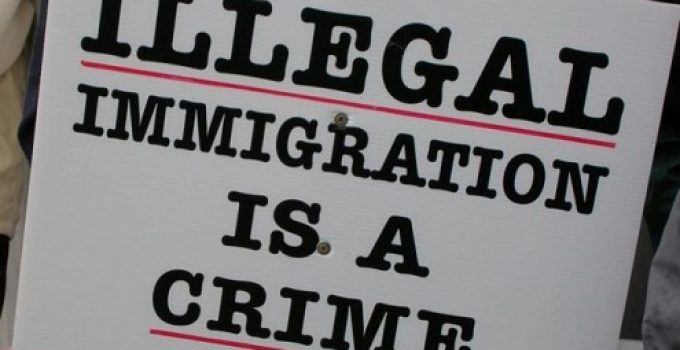
Open Borders is the Real Moral Crisis

I typically avoid wading into fashionable-for-the-moment moral crusades, but the hysteria over children being separated from their parents at the border is ludicrous, and demonstrates the typical “facts over feelings” emotionalism that mars our immigration debate.  That feel-goodism is why we’re even in this mess—if it can be characterized as such—in the first place.

Because I’ll be deemed a monster—“Won’t somebody please think of the children!“—for not unequivocally denouncing this Clinton-era policy, I’ll issue the usual, tedious disclaimers:  yes, it’s all very tragic; yes, it could be handled better; yes, I would have been terrified to be separated from my parents at such a young age; etc.

Now that the genuflecting to popular pieties is out of the way, let me get to my point:  this entire situation would be a non-issue if we had simply enforced our immigration laws consistently for the past thirty years.  President Trump isn’t the villain here (if anything, Congress is—they can take immediate action to change the policy or come up with some alternative—but I don’t even think they’re wrong this time); rather, the villains are all those who—in the vague name of “humanity” and “human rights”—ignored illegal immigration (or, worse, actively condoned it).

Sadly, it is an issue.  But what else are we to do?  Years of non-enforcement have sent the implicit but clear message to potential illegal immigrants that we don’t take our own borders (and, by extension, our national sovereignty and rule of law) seriously, and that if you’re sympathetic enough, you’ll get to skip the line.  Folks come up from Mexico and Central America fully expecting that, after some brief official unpleasantness, they can dissolve into the vastness of the United States and begin sending remittances back to their relatives—who may then pull up stakes and come.

Further, sneaking into the country illegally is a crime, and the United States has every right to enforce its laws, including those pertaining to immigration.  Mexico, similarly, has that right—and uses it unabashedly to police its own border (or to let Central American migrants waltz through on their way to the Estados Unidos).  Naturally, the punishment for breaking laws is often detainment, and the kiddies don’t join dad in his cell.

To give a common example:  what happens to the children of, say, an American heroin dealer when he’s arrested and sentenced to ten years in a drug bust?  His children—if they have no relatives willing or able to take them in—go into the foster care system.  It’s tragic, it’s terrible, but it’s part of the price of committing a felony.  No one wants it to happen, but it’s a consequence of one’s actions.  This reason is why crime is so detrimental to society at large, even beyond the immediate victims.

Unfortunately, a combination of winking at immigration enforcement (“eh, come on—you won’t get deported”), feel-good bullcrap (as my Mom would call it), and Emma Lazarus Syndrome (trademarked to The Portly Politico, 2018) have contributed to the current nightmare situation.  Now that an administration is in office that actually enforces the duly legislated law of the land—and at a point at which the problem has ballooned to epic proportions due to past lax enforcement—the problem is far thornier and more consumed with emotional and moral peril.

As any self-governing, self-sufficient adult understands, sometimes doing what is necessary is hard.  I do feel for these children who are stripped from their parents arms (although, it should be noted, usually for only a matter of hours), but who cares about my feelings?  We can have compassion for those who try to arrive here illegally, as well as their children, without attempting to take on all of their problems, and without sacrificing our national sovereignty and our laws in the process.

The United States is the most generous nation in the world—and the most prosperous—but we cannot take everyone in; to do so would not make everyone else better off, but would rather destroy what makes America the land of compassion, liberty, prosperity, and charity that it is.

***

For further reference, I recommend the following videos, the first from the brilliant Ben Shapiro, the second from Dilbert creator Scott Adams:

https://www.youtube.com/watch?v=OWWVaLlpq7s&t=2134s

I’d also recommend this piece from National Review columnist Richard Lowry, which is quite good:  https://www.nationalreview.com/2018/05/illegal-immigration-enforcement-separating-kids-at-border/

And, finally, this piece from Conservative Review‘s Daniel Horowitz, which explains the true moral toll of illegal immigration—and misplaced compassion—very thoroughly:  https://www.conservativereview.com/news/the-immorality-of-the-open-borders-left/

Three Years of Excellence

Father’s Day—16 June 2018—marked three years since President Donald Trump’s now-legendary descent down the golden escalator at Trump Tower, following by his controversial but true-to-form announcement that he would be seeking the Republican Party’s nomination for President.

I was, initially, a Trump skeptic, and I voted for Texas Senator Ted Cruz in the South Carolina primaries the following February.  When Trump first announced, I wrote him off—as so many others—as a joke.  I appreciated his boldness on immigration, but I still thought the PC Police and the campus Social Justice Warriors were firmly in control of the culture, and that no one could speak hard truths.

I also remembered his brief flirtation with running in 2012, and thought this was just another episode in what I learned was a long history of Trump considering a presidential bid.  At the South Carolina Republican Party’s state convention earlier in 2015, I asked two young men working on Trump’s pre-campaign (this was before The Announcement) if he was really serious this time.  The two of them—they looked like the well-coifed dreamboat vampires from the Twilight franchise—both assured me that Trump was for real, and I left with some Trump stickers more skeptical than ever (note, too, that this was before the distinctive but simple red, white, and blue “Trump” lawn signs, and definitely before the ubiquitous “Make America Great Again” hats).

I even briefly—briefly!—considered not voting for Trump, thinking that he was not a “real” conservative.  I still don’t think he’s a conservative in the way, say, that a National Review columnist is (although, the way they’ve gotten so noodle-wristed lately, that’s a good thing; I’ve just about lost all respect for David French’s hand-wringing, and Kevin Williamson went off the deep-end), but rather—as Newt Gingrich would put it—an “anti-Leftist.”  That’s more than enough for me.

But my conversion to Trump came only belatedly.  I can still find a notebook of notes from church sermons in which I wrote, “Ted Cruz won the Wyoming primary.  Thank God!” in the margins.

Then something happened—something I predicted would happen on the old TPP site—and I couldn’t get enough of the guy.  It wasn’t a “road to Damascus” epiphany.  I started listening to his speeches.  I read up on his brilliant immigration plan (why haven’t we taxed remittances yet?).  I stopped taking him literally, and began taking him seriously.

And I noticed it happening in others all around me.  Friends who had once disdained the Republican Party were coming around on Trump.  Sure, it helped that Secretary Hillary Clinton was a sleazebag suffused with the filth of grasping careerism and political chicanery.  But more than being a vote against Hillary, my vote—and the vote of millions of other Americans—became a vote for Trump—and for reform.

Trump made politics interesting again, too, not just because he said outrageous stuff on live television (I attended his rally in Florence, South Carolina before the SC primaries, and I could feel his charisma from 200 feet away; it was like attending a rock concert).  Rather, Trump busted wide open the political orthodoxy that dominated both political parties at the expense of the American people.

Take trade, for example.  Since World War II, both Democrats and Republicans have unquestioningly supported free trade.  Along comes Trump, and suddenly we’re having serious debates again about whether or not some tariffs might be beneficial—that maybe it’s worth paying a little more for a stove or plastic knick-knacks if it means employing more Americans.

That’s not even to mention Trump’s legacy on immigration—probably the most pressing issue of our time, and one about which I will write at greater length another time.

Regardless, after over 500 days in office, the record speaks for itself:  lower taxes, fewer regulations, greater economic growth, greater security abroad.  At this point, the only reasons I can see why anyone would hate Trump are either a.) he’s disrupting their sweet government job and/or bennies; b.) they don’t like his rhetorical style, and can’t get past it (the Jonah Goldbergite “Never Trumpers”—a dying breed—fall into this group); or c.) they’re radical Cultural Marxists who recognize a natural foe.  Folks in “Option B” are probably the most common, but they’re too focused on rhetoric and “decorum”—who cares if he’s mean to Justin Trudeau if he gets results?  The folks in “Option C” are willfully ignorant, evil, or blinded by indoctrination.

As the IG report from last Thursday revealed—even if it wouldn’t come out and say it—the Deep State is very, very real.  That there were elements within the FBI willing to use extralegal means to disrupt the Trump campaign—and, one has to believe, to destroy the Trump presidency—suggests that our delicate system of checks and balances has been undermined by an out-of-control, unelected federal bureaucracy.  Such a dangerous threat to our republic is why we elected Trump.

President Trump, keep draining the swamp.  We’re with you 100%.


TBT: American Values, American Nationalism

Each Thursday, I’ll be digging through the Portly Politico Archives to bring you classic content from the old Blogger site.  This week’s essay re-launched the blog back in 2016.  Two years later, I still believe that our nation is built on ideas, rather than links of common blood, though I have to come to believe, too, that our borders are crucial, and that the Anglo-Saxon traditions of rule of law are essential to the maintenance of our republic.  While those traditions derived from a particular people—the English—they are inherently universalist in nature, and with the right cultural, religious, and moral framework, can be adopted by any people that will accept them.

That universality does require certain pre-conditions.  As I point out to my students, it took 561 years from the Magna Carta in 1215 to the Declaration of Independence in 1776, and the development of ideals of liberty and rule of law from a feudal arrangement to a universal declaration of individual rights occurred within the framework of English culture.

That’s why, for example, unchecked levels of immigration, both legal and illegal, undermine the delicate social and historical fabric of our nation.  It takes time for people to assimilate to these ideals, and some ethnic and cultural groups do so more quickly than others (for example, Jamaicans and East Indians in Britain were model assimiliationists, while Pakistani Muslims still struggle to assimilate—or even choose actively not to do so—into British culture and society).  But, ultimately, I do believe the ideational notion of American nationalism holds true in general—but we probably shouldn’t keep trying to plant modern democratic-republics in the Middle East (more on that another time).

Without further ado, here is 2016’s “American Values, American Nationalism“:

I’ve been teaching American history and government for six years (and continuously since 2011).  Part of my regular teaching duties includes US Government, a standard survey course that covers the Constitution, federalism, the three branches of the federal government, and other topics of interest.  It’s a simple, semester-long course that, while not terribly novel, is absolutely essential.

Before we even read the Preamble to the Constitution, though, I introduce the students to the idea of America.  This lesson plan is not a unique creation; it comes from the textbook Government By the People by David Magleby and Paul Light, which I used to use for the course (I don’t know Magleby and Light’s political leanings, but the book is a fairly straightforward and useful primer on the mechanics of US government).  I follow the authors’ course by starting with what they call the “Five Core Values” of America, which are as follows:

1.) Individualism

2.) Popular Sovereignty

3.) Equality of Opportunity

4.) Freedom of Religion

5.) Economic Liberty

Why do I start each semester in this fashion?  I’ve found that many Americans—and not just teenagers and young adults—aren’t exactly sure what makes American special.  Sure, many can point to our military dominance and our economic clout, but during a time when both appear to be losing ground to other nations, we can’t solely make our case on those grounds.

Others might point to our superior educational system, our extensive infrastructure, or our superior health.  The United States certainly is blessed with these qualities, but study after study shows that we’re falling behind the rest of the world academically, and everyday experience (especially here in South Carolina) demonstrates that our roads are crumbling.  And don’t get me started on the mess that is the Affordable Care Act.

So if we can’t rest our claims for American greatness on these grounds—or, if we can only hope to do so temporarily—what really does make the United States special?  Is American exceptionalism only truly relatively, as President Obama implied in April 2009 when he proclaimed, “I believe in American exceptionalism, just as I suspect that the Brits believe in British exceptionalism and the Greeks believe in Greek exceptionalism”?

The answer—as you’ve probably guessed—are the very values listed above, the values enshrined in our founding documents, in our political culture, and in our hearts.  The powerful but fragile legacy of liberty handed down from English common law, these values still energize the United States.

What makes the United States unique, too, is that these values form the basis of our sense of nationhood.  No other nation—at least, not prior to the declaration of the United States in 1776—can claim a similar basis.

The term “nation” itself refers to a specific tribal or ethnic affiliation based on common blood, and usually linked to a specific (if often ill-defined) bit of soil.  The nation-states of modern Europe followed this course; for example, French kings over centuries gradually created a “French” national identity, one that slowly subsumed other ethnic and regional identities (Normans, Burgundians, etc.), into a single, (largely Parisian) French culture and nation.

The United States, on the other hand, is not a nation built on ties of blood and soil (although we do owe a huge debt of gratitude to the heritage of Anglo-Saxon political culture for our institutions), but, rather, founded on ideas, ideas that anyone can adopt.

We believe, further, that these ideals are universal, and are not, ultimately, specific to our place and time.  Sure, some countries might lack the institutional stability and political culture to sustain a constitutional republic like ours, but, ultimately, we believe that any people, anywhere in the world, can come to adopt our American values.

The concept of American nationhood, therefore, is flexible and adaptive to many contexts, but is ultimately grounded in firm absolutes.  Often these values butt up against one another, or there is disagreement about their importance.  When, for example, does the will of the individual become so out-sized that it threatens, say, popular sovereignty, or freedom of religion?

The Constitution was designed to adjudicate these disputes fairly and transparently—with a Supreme Court acting in good faith and in accord with the Constitution—to protect individual rights from the tyranny of the majority, and to protect the majority from the tyranny of minority special interest groups.

In this regard, perhaps, American nationalism has faltered.  The consistent undermining of our carefully balanced constitutional order—the centralization of federal power, the aggrandizement of the executive and judiciary, the delegation of legislative powers to the federal bureaucracy, the equivocation of Congress—has served to damage our national identity and our national values, turning the five core values above into distorted perversions of their proper forms.

To wit:

1.) Individualism—the protection of the individual’s rights—has become a grotesque, licentious individualism without any consequences, one that expects the state to pick up the tab for bad decisions, which can no longer be deemed “bad.”  Alternatively, actual constitutional rights are trampled upon in the name of exorcising “hate speech.”

2.) Popular sovereignty—authority flowing upward from the people—has been flipped on its head, becoming, instead, a top-down sovereignty of the enlightened technocrats and un-elected government bureaucrats.

3.) Equality of opportunity—an equality that recognizes that everyone is different but enjoys the same legal and constitutional safeguards to fail and to succeed—morphs into equality of outcome, a radical form of egalitarianism that brought us the worst excesses of the French and the Russian Revolutions, and ultimately breeds authoritarianism and demagoguery.

4.) Freedom of religion—the most important of our constitutional rights, as it rests both at the foundation of our republic and of our very souls, the freedom of conscious itself–now becomes a vague “freedom of worship,” which is really no freedom at all.  Religious observation is to be a strictly private affair, one (impossibly) divorced from our public lives.

5.) Economic liberty—the freedom to spend and earn our money as we please, with a token amount paid in taxes to support the infrastructure we all use and to maintain the military and police that protect our freedoms abroad and domestically–becomes excessive economic regulation, with many potential economic opportunities simply regulated out of existence.  Rather than laws forming in response to new technologies or ideas, regulations are crafted to protect existing firms and well-connected special interests.

With such a distorted view of our national values and our rights—stemming, in many cases, from ignorance of them—many Americans find it difficult to articulate what exactly it means to be an American.  In this light, problems like illegal (and, in some cases, excessive legal) immigration take on a whole new tenor:  how can we expect foreign migrants to adopt our values—to become part of the American nationif we ourselves cannot articulate what American nationhood and values are?

The solution starts with proper education and a realignment of our thought toward the proper definitions and forms of our values.  As Margaret Thatcher said, “Europe was created by history. America was created by philosophy.”  Understanding our national philosophy—our “Five Core American Values”—will allow us to rediscover our exceptional nationhood.