The Good Populism

I’ve been kicking around a course idea for a couple of years now:  History of Conservative Thought.  I’ll be offering the course this summer for high school students; if it “makes” (gets enough enrollment to run), I’ll have to put together a quality syllabus.  The scope of the course will essentially begin with the Enlightenment and the American and French Revolutions, and extend to the present populist-nationalist movements in Europe and the United States.

I have a few ideas for course readings already, including Richard Weaver‘s Ideas Have Consequences and excerpts from Milton and Rose Friedman’s Free to Choose.  I also need to include some shorter readings, and I’ll probably include a couple of podcast episodes.  Of course, with only eight weeks, it’ll be a fairly focused course (if you have any recommendations for readings or possible topics, leave a comment below, or e-mail me).

We’ll see if it makes.  Regardless, one reading I will definitely include is a popular essay from New Criterion; indeed, it was their most popular essay in 2018.  The piece, “The Good Populism” by ancient historian Victor Davis Hanson, is a consideration of healthy, middle-class populist movements in the United States.

Populism—like its cousin, nationalism—suffers from a public relations problem.  Hanson argues effectively that there are different kinds of populism, and it shouldn’t, by default, be considered a bad word.  Conservatives tend to get hung up on populism as an essentially Leftist phenomenon—think corrupt Louisiana Governor Huey Long in the 1930s, or Senator Bernie Sanders or Congressbabe Alexandria Ocasio-Cortez today—while progressives link it to nationalism, which they perceive as inherently fascistic.

In fact, as Hanson argues, the “good” populism is the populism of the middle-class, those who love their country, want to enjoy the fruits of their labor, and generally want their values and property to be protected.  To quote Hanson:

The antithesis to such radical populism was likely thought by ancient conservative historians to be the “good” populism of the past—and what the contemporary media might call the “bad” populism of the present: the push-back of small property owners and the middle classes against the power of oppressive government, steep taxation, and internationalism, coupled with unhappiness over imperialism and foreign wars and a preference for liberty rather than mandated equality. Think of the second century B.C. Gracchi brothers rather than Juvenal’s “bread-and-circuses” imperial Roman underclass, the American rather than the French Revolution, or the Tea Party versus Occupy Wall Street.

Since Trump’s triumphant rise in 2015-2016, we’ve seen the reinvigoration of this kind of “good populism,” which was dormant for many years, but smoldering below the surface.

Grab a cup of coffee and give yourself fifteen minutes to read Hanson’s essay.  It’s a great discussion of a much-maligned, oft-misunderstood term: https://www.newcriterion.com/issues/2018/6/the-good-populism-9842

Friday Musings: Populism is East versus West

I share my classroom with a veteran history teacher, who teaches my school’s eighth grade South Carolina History course.  The students are currently covering the events leading up to the American Revolution, particularly the unpopular Proclamation Line of 1763.  His discussion of the topic led me to a minor epiphany.

First, some historical context:  after the British defeated the French and their allies in the French and Indian War (the Seven Years’ War in Europe), millions of acres of land west of the Appalachian Mountains were open to American settlement.  The Americans were bursting with pride in delivering a hard-fought victory against Britain’s major European foe, and were eager to enjoy the spoils of war:  the newly opened lands.

Unfortunately, Parliament stalled land-hungry settlers with a well-intentioned but misguided policy:  the Proclamation Line of 1763.  According to an act of Parliament, there was to be no settlement west of the Appalachian Mountains.  The land was to be left to the Indians living there.

The policy was not without merit:  the British spent a great deal of blood and treasure fighting Indians during the French and Indian War, and while the conflict was global in nature, most of the fighting occurred in British North America and present-day Canada.  A major source of bad blood was the tendency of Americans to move onto Indian-owned lands; similarly, rapacious Indians would raid vulnerable settlers in the western parts of colonies (such raids fomented an early populist uprising of farmers in western Virginia, Bacon’s Rebellion, in 1676).  The British sought to avoid another costly war with the natives by preventing their future antagonism:  keep Americans off that land.

Americans, understandably, were livid.  For one, they saw it as Britain rewarding the very foes they’d just vanquished (keep in mind, too, the ferocity of native warriors—there’s a reason we name our military hardware and athletic teams “The Braves” and the like).  They also believed this land was their destiny and their birthright—having defeated a tenacious foe, they were ready to head west.

What got me thinking was a comment my colleague made; to paraphrase:  “If Parliament had just sat down with the colonists and discussed it with them, they could have avoided a lot of disaster.”  That comment made me realize:  so much populism is a conflict between an indifferent Eastern (now bicoastal) elite, and an energetic, cantankerous Western settler-class.

That is, by no means, a novel insight (see also:  Bacon’s Rebellion).  The insight, however, is the repeated unwillingness of elite interests to try to understand or cope with the sources of the common man’s difficulties.  Some differences are, indeed, intractable, but it seems that, in many cases, elites could hear out and account for the problems of the common folk.

Indeed, in many cases, both are right.  Consider the historic struggles between Thomas Jefferson and Alexander Hamilton.  Thank goodness George Washington heeded Hamilton’s advice for how to structure the finances of the young nation.  Hamilton’s fiscal policies set the United States on firm footing, building investor confidence and shoring up the American government’s credit.

On the other hand, Jefferson was right that Congress had no explicit authority to establish a national bank, and that we shouldn’t become too dependent on urban industrialization and finance, lest we lose our sense of republican virtue.

There are, increasingly, fundamental disconnects between America’s urban elites and rural commoners.  Witness New York State’s catastrophic, plainly satanic abortion law, which (from all the discussion around it), seems to allow for abortion while a woman is still in labor.  There’s no compromising with an idea that is, unarguably, evil.

That said, elites should take seriously the common American’s keen sense for fair play.  Illegal (and mass legal) immigration is deleterious not only because it is illegal, but because it hurts native-born Americans, driving down their wages (for the benefit of the elites) and transforming their neighborhoods and towns.  Americans will welcome a reasonable number of legal immigrants with open arms, but they expect immigrants to come legally, to assimilate, and to become loyal American citizens (including breaking ties with their old countries).

The elites are people, too, and often act in what they believe is for the greater good, or for long-term national preservation (at least, this statement seemed accurate in America’s past; our postmodern elites seem largely committed to undermining core American principles).  That said, they’ve adopted the Left’s prevailing ethos of de facto nihilism and materialist self-indulgence, along with the Left’s disdain for the common man.

In short, the elites have lost any sense of noblesse oblige, of obligation to maintaining a good, happy, healthy society.  They are as far removed from their fellow countrymen as East is from West.

TBT: Brexit: The Antidote to Supranational Tyranny

The first indication that a major sea-change in Western politics was underway was the historic Brexit vote in June 2016.  The mere fact that Britain voted to leave the European Union boosted nationalist movements in Europe, and reflected the growing discontent of Britons with the policies of their elites.  That frustration manifested itself outside of Britain, and seemed to presage—at least in hindsight—Trump’s unlikely, underdog victory in November of that year.

The following is my first piece on Brexit, dated 13 June 2016.  I wrote it in response to a student’s inquiry.  That launched a series of pieces on Brexit that I will—eventually—compile into an eBook, the title of which will draw from a phrase I coined for this article:  “supranational tyranny.”

In essence, I argued then (and still argue now) that Brexit was, at bottom, a referendum on national sovereignty.  Issues like trade and immigration, while quite important, were merely the outgrowth of that fundamental issue.  Brexit, in so many words and in so many ways, simply asked, “Can a country make its own decisions about its own destiny?”  Like so many fundamentals, that we even have to ask the question demonstrates how far postmodern deconstructionism has taken us.  Regardless, the people of Britain resoundingly answered, “YES!”  The vote to leave was not an endorsement of xenophobia or anything else:  it was a vote for national sovereignty.

The European Union was a classic bait-and-switch:  Britain joined under the pretense that it was entering an economic free trade zone.  That morphed—it seems, based on the EU’s charter and its goal of “ever closer union”, deliberately and by design—into the supranational, undemocratic behemoth it is today, with decisions largely dictated from Germany and its toadie, France.  When the people lost the ability to control their own borders and immigration policies—the bare-bone essentials of what constitute a “nation” and “national sovereignty”—they seized the opening and voted for liberty and sovereignty over continued acquiescence in exchange for goodies.

Here is June 2016’s “Brexit:  The Antidote to Supranational Tyranny“:

I’ve been planning to do a few pieces on the question of “Brexit”–whether or not the United Kingdom should leave the European Union, or to remain a part of it–but originally intended to wait until the 23 June referendum drew closer.  However, over the weekend I received this e-mail from a student:

A summer vacation well spent.
In case you can’t read the e-mail, here’s the text in full:
Dear Mr[.] Cook (Self entitled defender of Rock & Roll),
I know this isn’t the average email you get from a student, political. However, with one of the most impactful votes to effect [
sic] the US economy to take place in just 11 days, June 23, I would like to ask how you felt on the United Kingdom’s vote on whether to stay in the EU or leave it. US news has refused to cover this major event due to irresponsibility and foolishness. Just wanted to know your thoughts on this vital subject.

(Please note that I am blessed to teach some very bright students.)

Brexit is a hugely complicated issue; however, viewed through the lens of national sovereignty versus the dubious claims of supranational organizations, the ultimate solution is, in my mind, a no-brainer:  the people of Great Britain should vote “Leave” this June.

Now for some preliminary disclaimers, lest I be burned in effigy:

To any British readers, please do not presume that an upstart, boorish American is preaching at you about what to do with your national destiny.  If the situation were reversed, I’d rightfully scoff at any attempts from “Europeans” to tell my country how to function.  However, I ask that all readers approach my arguments for Brexit in a philosophical and rational way; that is, treat them in the context of one mind reasoning from a set a premises, not as an American lecturing foreign nationals about their sovereign politics.

(British readers–if you exist–please feel free to leave your comments, reflections, reactions, and bitter recriminations below; I respect and welcome your perspective, which is far more accurate and attuned to the realities of the situation than my own.)

I’d also like to acknowledge the influence of a book review I read over the weekend in the 9 May 2016 edition of National Review(Volume LXVIII, No. 8).  The review, written by John Fonte and entitled “The EU’s Soft Utopia,” is of the book The Totalitarian Temptation:  Global Governance and the Crisis of Democracy in Europe by Todd Huizinga, a long-time observer of European Union politics.  I highly recommend you seek out this review.  I intend to read the book soon.

 ***

Now that those pleasantries are out of the way, I’d like to lay out my case, clumsy though it may be.  My remarks are adapted from those I sent to the young man above.

The Brexit issue is one of huge importance to the US, the UK, and Europe, and while it has not been covered heavily in the mainstream media, I’ve read a number of articles about it in both National Review and the Weekly Standard.

The question of whether or not to vote “Remain” or “Leave” really depends on your perspective and your goals, or what you think the European Union is supposed to do.  The EU itself tries to appear unsure of its goals, but its mission clearly states that it seeks “ever closer union” of the various member nation-states.

The EU began life as essentially a large economic free trade zone that gradually expanded, and which then adopted a common currency in the late 1990s (a move, we now know, that was fraught with peril, especially as it is very difficult for disparate nations at different points of economic development and national sovereignty to share a single currency effectively; see also Greece).  My perception is that the EU wants to become, ultimately, the “United States of Europe”; indeed, this goal is straightforwardly expressed by many pro-Europe observers.  The question, then, is this goal desirable or not?

 The United States of Europe, where six-weeks paid vacation is a basic human right.

It certainly has elements that are attractive.  In theory, a politically unified Europe becomes a powerful check against Vladimir Putin’s Russia.  Many of the “far-right” populist parties in European nations (France’s National Front, Germany’s Alternativ für Deutschland, etc.) are gaining traction now due to the flood of (often violent) Islamic “refugees” into Europe, and many of those groups view Putin’s ultra-nationalistic Russia warmly (some, too, are allegedly bankrolled by Russia).  Moving toward greater union would help resolve the economic problems the euro faces, as it would allow the EU to change monetary and fiscal policy in its member states, which would no longer look like America under the Articles of Confederation, but would instead look more like America under the Constitution.

At least, that’s how we’re supposed to view it.  Unfortunately, that comparison quickly falls apart under scrutiny.  The constitutional order our Framers carefully constructed in 1787 functions verydifferently than the European Union conceived of by its architects.  The EU is largely run by an unelected, globalist-progressive bureaucracy that is both unaccountable to the peoples and sovereign member states of Europe, and which has already acted to oust democratically-elected leaders (see also:  Italy).  Sure, there’s the European Parliament, which is currently (and ironically) dominated by members from Euroskeptic parties like UKIP, but it has only limited functions and can essentially only vote to block decisions made by the European Commission, itself made up of unelected commissioners.

The EU, then, cares not for democratic input, national sovereignty (and, therefore, borders), or federalism.  A United States of Europe would be a heavily centralized unit that might allow some state sovereignty in some limited areas, but would ultimately have vast, unchecked control over its members, with little regard for what the people in those member states want (just look at Germany and Angela Merkel’s increasingly unpopular–and arguably dangerous–stance on the refugee crisis).

So, while a large, intact European Union would present a unified front against Russia, it would also be a largely undemocratic front against the United States.  Some have argued that the EU is necessary to keep NATO viable, but I don’t buy this argument.  NATO has functioned well, if somewhat inconsistently, with a couple of dozen or so sovereign states for decades.  If Britain votes “Leave,” how would this dynamic substantially change in the long-run?

A United States of Europe would be a heavily centralized unit that might allow some state sovereignty in some limited areas, but would ultimately have vast, unchecked control over its members, with little regard for what the people in those member states want….”

Ultimately, the Brexit vote is a referendum on national sovereignty.  If national sovereignty has any meaning and significance for the people of Britain–and for the world–British voters will resoundingly vote “no” to the EU.

Would such an outcome have ripple effects politically and economically?  Absolutely.  Britain might struggle temporarily because of the (admittedly) huge institutional and economic disruptions, but it would soon rock back to its feet, as it would find itself freed of the EU’s overbearing economic regulations and rules.  Britain is also well-positioned to leave, as it prudently maintained the British pound, and could very likely continue to accept euros for everyday economic exchanges.

The European Union might callously block trade with Britain, but Britain’s large financial and consumer markets would quickly erode any such vindictive measures.  President Obama has darkly warned that Britain would be at “the back of the queue” for future trade deals, which would be a slap to the face to the Churchillian, Anglo-American “special relationship.”  Our next president would, if he or she is wise, quickly embrace a “most-favored nation” treaty with Britain to keep trade open and affordable between our nations.

Putin might take advantage of the situation temporarily, but Europe and Britain would likely come together rapidly in the face of any Russian aggression.  Putin is wily and will take any advantage he can, which is all the more reason for the Obama administration to put aside its pro-EU stance and to support an independent Britain should the British people vote “Leave.”

Just because Putin might benefit doesn’t mean that Brexit is ultimately a bad idea.  A “Leave” vote would, in a paradoxical way, be healthy for the EU, as it would likely lead to the exit of nations that have no business being under the euro, such as Greece and Spain.  It would also inspire and embolden other nations to push for greater transparency, accountability, and democratization from the European Union’s leaders and institutions.

Most importantly, though, it would strike a blow against the totalizing, globalist elitism of the EU bureaucracy.  Brussels might see itself as enlightened, progressive, cosmopolitan–and, as a result, more humane–but it’s still authoritarian and anti-democratic-republican in the way it functions and pursues its vision.

Therefore, while I recognize the potential geopolitical and economic risks, I sincerely pray that the good people of the United Kingdom will strike a blow for republican self-government, national sovereignty, and liberty, and vote “Leave” this June.

The time for Brexit is now.  Like ripping off an old bandage, the initial pain will sting, but only briefly.  The old wound will heal, and a new, freer nation will enjoy the fruits of its sovereignty.

The League of Nations

For the past five years, Western civilization has been observing and memorializing the Great War, what we now call the First World War. That war was so destructive, it single-handedly cost the West its mojo. Before the war, Western civilization was supremely confident, believing in the rightness and righteousness of its own ideals. After it, self-doubt and nihilism gripped the hearts of once-great nations.

Some of that antebellum self-confidence was founded on the sandy foundation of positivist idealism, and some of it on the misguided internationalism that tied European nations together in a strangling, inflexible web of secret alliances and global brinksmanship. But for all its faults—and the mostly pointless slaughter of millions of young men on the battlefields of Europe—the West was (and is) the best.

Friday, 25 January 2019 quietly marked another milestone in the rolling commemoration of the Great War: the opening, 100 years ago, of the Versailles Peace Conference, the gathering that planted the seeds for the Second World War. New Criterion published a short essay on the anniversary that discusses the maneuvering at the Conference with lively detail; it’s even more impressive when you realize the author, Daniel M. Bring, is still in college.

The League of Nations was the precursor to the United Nations, and the godfather of various supranational entities. In that context, it is rather inauspicious, and is the root of many evils. It was a stunningly ineffective organization, too, that failed to uphold its obligations to collective security.

The United States famously did not join the League, as the Senate refused to ratify the Treaty of Versailles, which included membership in the organization. Senator Henry Cabot Lodge of Massachusetts led the charge against ratification, arguing that Article X of the League charter would compel the United States to join in foreign wars that may have little bearing on actual American interests.

Such a degree of foreign policy realism would be refreshing in today’s political climate; as it was, Lodge’s reservations were entirely consistent with American foreign policy dating back to George Washington and John Quincy Adams. The United States did not formally make peace with Germany until 1921, with the signing of the Treaty of Berlin.

Without American support—and in the wake of the global Great Depression—the League of Nations floundered and failed. To quote Bring:

In discussions of (especially, recent) history, there is much said by historians about hindsight and counterfactual scenarios. What if the United States had lent its strength to the League’s success? What if the League had levied more effective sanctions and even executed military countermeasures? But in the end, these hypotheticals cannot change the past.
“All that matters is that which occurred. Within thirty years from the League’s creation, tens of millions, both soldiers and civilians, were dead in a second great war.”

The post Second World War global order has endured reasonably well, with its broad commitment to global security underpinned with American might. That order flourished, however, in the face of the long Cold War and the mostly-united fronts of a long ideological struggle with Soviet Communism. In the absence of such a major external threat—radical Islamism notwithstanding—the raison d’etre for open-ended, supranational regimes is largely gone, and such organizations are ineffective at best or tyrannical at worst.

The United Nations is a clown college for Third World dictators and their lackeys. The European Union is an undemocratic dystopia under German rule (didn’t we fight two world wars to prevent that outcome?). NATO (perhaps inadvertently) antagonizes Russia by extending into the Baltic region, and American lives are obligated to prop up those very regions should Russia interfere. Further, NATO is only truly effective with American backing and support—a major sticking point for President Trump, who wants member nations to meet their obligations to funding it (and they even balk at that minimal request).

Nineteenth-century isolationism no longer appears to be a viable option for the United States, but constant interventionism and multilateralism come with all the costs and none of the benefits of empire, and severely stretch America’s blood and treasure. An earnest reevaluation of the effectiveness of our international institutions is long overdue; kudos to President Trump for questioning the orthodoxy and probing new possibilities.

As part of that re-examination, let us look back to the idealistic, but unhappy, failure of the League—and the costs its failure entailed for humanity.

TBT: Rustics Have Opinions, Too

I first launched The Portly Politico on Blogger back in 2009.  It was a different world back then, and I was a different conservative.  I was probably still deep in my Randian-libertarian economic conservative phase:  I sincerely believed neoliberal economics and mostly unbridled capitalism could solve almost all of the world’s problems, which meant I was fundamentally progressive in my outlook, “progressive” in the sense of taking a Whiggish view of human history—yes, some things are bad now, but they’ll inexorably get better as we expand free trade and free movement of peoples across borders.  Heck, I even thought that, as a Christian nation, America should take in illegal immigrants!

Such are the follies of youth.  Intervening years of lived experience—not to mention the increasingly overt radicalism of the Left—have convinced me that, as wonderful as free markets are, we’ve tended to sacrifice real lives and communities in exchange for cheap plastic junk.  I’ve also considerably altered my views on immigration; at this point, I think America needs 150 milligrams of Deportemal (and a healthy dose of limiting legal immigration, too).

One thing that hasn’t changed:  I still identify with the struggles and values of rural America.  In this 2009 post, I pointed out the growing contempt for rural Americans that the Democratic Party now openly embraces.  I think I was overly-generous to the author of the piece discussed herein, however; upon re-reading Kevin Baker’s essay “Barack Hoover Obama,” I’m chilled by how openly he argues for the usurpation of usual constitutional order and division of powers in order to push for “change.”  I apparently missed it completely ten years ago, much to my current chagrin.

Back then, I remember conservatives having some mild optimism that President Obama would govern as a pragmatic moderate—left-of-center, to be sure, but reasonable.  Then he forced through the Affordable Care Act on a purely partisan basis, alienating Republicans and contributing to the deep ideological divide in America today.  His administration doubled down on identity politics, reopening mostly-healed racial wounds.  Much of the cultural chaos we suffer today is the result of the twin evils of Senator Teddy Kennedy’s 1965 immigration bill and President Obama’s politics of racial grievance.

So, that’s my apology for my naivety as a young, portly man.  That said, here is 2009’s “Rustics Have Opinions, Too“:

I’ve noticed something about the American Left, specifically those members who claim to be “cultured”: they share a distrust and even hatred for rural Americans. They constantly mock the values, feelings, and politics of this oft-derided constituency, framing them as stereotypical “rednecks” or “good ol’ boys” who spend most of their time polishing their guns drunk while watching NASCAR.

Let’s face it: stereotypes exist for a reason. Think of any offensive stereotype and there’s a kernel of truth to it. But that doesn’t mean we should go around judging people based on those stereotypes. Liberals are making that point all the time, and in this case they’re actually right. As usual, though, they fall back into their old, hypocritical ways when it comes to rural Americans. It’s “hate speech” if someone insinuates that an Asian is good at math, but it’s perfectly acceptable to laugh at someone who’s only skin pigmentation is on the back of his neck.

I’m not saying that having a sense of humor is wrong. Maybe white guys really aren’t as cool as black dudes when they drive. Dave Chappelle had tons of great material and Boondocks deals with race relations in the United States today better than any other show out there. I want to make it clear that I have nothing against humor. By laughing at stereotypes, we rob them of their power, rather than adding to it.

The same holds true for “rednecks” or “white trash” or whatever label one uses. If it weren’t, Jeff Foxworthy would be out of a job. The problem arises, however, when we start to marginalize those Americans because of the stereotypes that exist. Such marginalization of African Americans, for example, would be roundly denounced by the left, and rightfully so. Unfortunately, liberals often celebrate when such marginalization is applied to the rural white American.

In an otherwise excellent article in Harper’s Magazine entitled “Barak Hoover Obama: The Best and the Brightest Blow it Again,” Kevin Baker indulges in this marginalization to a sickening extent [Note–at the time of this writing, the full text of the article is only available to Harper’s subscribers]. The bulk of the article draws historical parallels between Presidents Herbert Hoover and Barack Obama. Baker’s research is impeccable and his understanding of an oft-maligned (and extremely intelligent) former president is refreshing. He implicitly challenges the more common “Obama-is-to-Roosevelt-as-Bush-is-to-Hoover” analogy and draws some pessimistic conclusions about Obama’s approach to passing many of his long-promised, radically liberal reforms.

A large part of Baker’s argument is that President Obama is proceeding with excessive caution and is relying too heavily on Congress to enact the changes he seeks for the nation (naturally, many conservatives would argue that the opposite is true, but suffice it to say that Baker is approaching Obama’s proposed reforms from the point of view of a liberal supporter–he actually thinks that cap-and-trade is a good thing). Baker maintains that congressional Democrats from states with small populations like Montana are stepping up after years of quiet service to challenge many of Obama’s efforts.

The language Baker uses to describe these representatives and senators is thick with disrespect. He talks about their states as filled with tumbleweeds and ignorance. He implicitly challenges the notion that these congressmen–and by extension their constituents–have no place in contemporary American politics and that they should be brushed aside and ignored, all because they’re impeding Ossiah’s democratic-socialist vision. This viewpoint is shared implicitly and explicitly by most liberals and leftists. The thinking is that because these states have small populations–and don’t have a good place to get sushi or gourmet coffee–they don’t deserve to have a place in the American political system (not to mention the fact that Baker is encouraging Obama to squelch dissent and open discussion, supposed bedrocks of modern liberalism).

What’s most disturbing about this reasoning is that it is anathema to the very structural philosophy of the United States Constitution. The Constitution clearly sets out to create a structure that gives states with large populations more power in the House of Representatives, while allowing states with small populations to maintain an equal footing in the Senate. The same theory exists behind the Electoral College. If our system was not balanced in this way, New York and California would always pick the next president and would exert a dangerous amount of control over national politics (with only conservative Texas able to balance things out a bit). Regional interests do not necessarily coincide with national interests, and what’s good for New York may not be good, and may even be bad, for Iowa.

Yet liberals consistently ignore this inconvenient truth and view it as a stumbling block to their pet projects, whatever they might be. At the risk of sounding like a blowhard conservative talk show host, leftists in America today have no respect for the Constitution except when it is politically advantageous or convenient. Now, I am willing to admit that there are plenty of conservatives who probably treat the Constitution in the same way, but they are much, much harder to find. This disrespect cannot endure for long, regardless of the side.

Therefore, I applaud what these rural Democrats are doing. Maybe they are dusty old relics of the party, but that’s for the Democrats to sort out themselves, and that should not invalidate what these men have to say. Maybe most of them are blowhards and are simply seizing their moment to be in the spotlight or to play to their base, but some of them have useful objections and suggestions. I don’t want to give liberals any additional aid, but it seems to me that they could use all the help they can get in the more rural parts of the country. Taking the interests of rural Democrats more seriously would be a great start.

Kevin Baker and his ilk live in a world of trendy green advertising and mocha lattes. They have no respect for hard working rural Americans–oh, heck, we’ll call them “rednecks”–who help make this country into the wonderful tapestry of ideas and cultures it is today.

Besides, who wants to watch Jeff Gordon race in a Prius?

Reblog: The Falling Down Revolt

Blogger photog of Orion’s Cold Fire has written a trenchant, insightful essay about the political and cultural revolution occurring in the United States now.  It’s called “The Falling Down Revolt,” taking its name from the 1993 film Falling Down, starring Michael Douglas.

In that film (as photog explains in a follow-up essay, “I’m the Bad Guy? How Did That Happen?“), Douglas plays a disgruntled private defense contractor who, despite obeying all the rules and following the script that was meant to guarantee a decent life, has lost his job, his family, and, ultimately, his sanity.  After facing numerous obstacles and inconveniences of post-modern life—gang violence, traffic jams, fast-food bureaucracy, etc.—the protagonist snaps, going on an intense, cathartic killing spree.

For photog, the film serves as a metaphor for average Americans who do everything they’re supposed to do—work, support their families, pay their taxes, obey the law—but are, in turn, rewarded with scorn, derision, and indifference (or even hatred) from political and cultural elites.  Those elites don’t see these Americans as the backbone of the country, but as “backwards” rubes who cling to outmoded, bourgeois and traditional social values.

Neither photog or myself are suggesting that working- and middle-class Americans should erupt into a bev-rage this summer; rather, the frustration many Americans (including ourselves) feel is that of being hoodwinked.  Instead of the beautiful cheeseburger in the picture, we got a squishy, shriveled mess.

In a comment on photog’s essay, I drew a parallel to the 2018 remake of Death Wish starring Bruce Willis.  To self-indulgently and arrogantly quote myself:

[T]his guy [Willis’s character] that did everything right was screwed by an elite indifferent to and incapable of addressing a rising tide of criminality and violence. He finally broke and took matters into his own hands. I’m not endorsing vigilantism, but he realized he was a chump.

I think (metaphorically) the country has woken up to the chumpitude our elites foisted on us for so long. Tucker Carlson’s monologue diagnoses this malady thoroughly, as you and I have both written about.  (Hyperlink added)

The “Falling Down Revolt” is an excellent name for this movement of normal, traditional Americans who just want a fair shake—and who are tired of being blamed for everyone else’s problems while their own are steadfastly ignored or ridiculed.  Kudos to photog for coining and applying such an apt metaphor.

Patriots Would Pitch In for the Wall

An interesting piece from Breitbart about President Trump’s proposed wall: https://www.breitbart.com/politics/2018/12/19/poll-one-third-of-republicans-would-pitch-in-to-build-wall/

It seems that a third of Republicans surveyed would be willing to make a personal contribution (or pay more in taxes; it’s a bit unclear which) to build the border wall.

Meanwhile, 97% voters opposed to President Trump also oppose funding the border wall.

I’m open to the argument that the wall might not be an effective enforcement tool—to be clear, I disagree with that argument, but I understand where its proponents are coming from—but I suspect that’s not the case for the bulk of that 97%.

A border is one of the most basic elements of what makes a state a state—or a nation a nation. It’s inherent in the definition of what it means to be a sovereign state.

As such, securing the border seems like a logical, natural thing for a nation to pursue. In my mind, that includes the construction of a border wall.

Yes, I’m familiar with the usual objections: it’s expensive; modern air travel would diminish a wall’s effectiveness; technology can fill the same role. But an actual, physical wall is a powerful symbol that America takes border enforcement seriously, that as a nation we not only will build physical barriers to keep out dishonest invaders, we’ll also enforce those laws on the books.

The message to the world for the past thirty years has been “we have laws, but they’re just a suggestion; get here, and we’ll figure out how to keep you in and get you bennies.” A wall sends a different message: “if you’re going to come, you’d better do it right. Don’t think about sneaking in.”

In short, if there’s a GoFundMe or Kickstarter for the border wall, I’ll pitch in. Every patriot should—and would. Or President Trump can stick to his guns, refuse any budget deal that doesn’t fund at least part of the wall, and keep his greatest campaign promise.

Build the Wall!

UPDATE: after writing this post, but before it was published, I happened to receive an e-mail from a friend to a fundraiser to raise $1 billion toward the Border Wall. You can contribute to it here: https://ca.gofundme.com/TheTrumpWall

Lincoln on Education

The following is adapted from remarks to the Florence County (SC) Republican Party on the evening of 10 September 2018.  The monthly program featured members of and candidates for the local school board, so I spoke briefly about President Abraham Lincoln’s education, and his views thereof.

We’re gathered here tonight to hear from members of and candidates for School Board; in that spirit, I’d like to speak briefly about education, particularly the education of the first Republican President, Abraham Lincoln.

From what I’ve read, Lincoln’s entire formal education consisted of around a year of schooling.  He would have a week or two here and there throughout his childhood in Kentucky and Indiana, and then return to working on the family’s farm.

Despite little formal education, Lincoln taught himself throughout his life.  He loved to read, and would read deeply on a variety of subjects, obtaining books whenever and wherever he could.  One of his contemporaries commented that “I never saw Abe after he was twelve that he didn’t have a book in his hand or in his pocket. It didn’t seem natural to see a feller read like that.”  When he sat for the bar exam, he’d read law books on his own time to prepare.

Lincoln also believed in education as a source of patriotism, morality, and self-improvement—what we might call “upward mobility.”  He was not a man who wanted to stay on the farm, and his self-education was a means to escape poverty.

If you’ll indulge me, I’d like to quote Lincoln at length from his 1832 speech “To the People of Sangamo County”:

“Upon the subject of education, not presuming to dictate any plan or system respecting it, I can only say that I view it as the most important subject which we as a people can be engaged in. That every man may receive at least, a moderate education, and thereby be enabled to read the histories of his own and other countries, by which he may duly appreciate the value of our free institutions, appears to be an object of vital importance, even on this account alone, to say nothing of the advantages and satisfaction to be derived from all being able to read the scriptures and other works, both of a religious and moral nature, for themselves. For my part, I desire to see the time when education, and by its means, morality, sobriety, enterprise and industry, shall become much more general than at present, and should be gratified to have it in my power to contribute something to the advancement of any measure which might have a tendency to accelerate the happy period.”

Here we can see Lincoln’s belief that education lays the foundation for patriotism—we understand our freedoms better when we understood what they cost, and that others lack them.  We see, too, the power of education to teach us the virtuous and the good.  From that morality flows, as Lincoln said, “sobriety, enterprise, and industry,” the tripartite tools to improve our material conditions.

Patriotism, morality, and industry—these were the three benefits of education Lincoln espoused.  Coming from the man who wrote the Gettysburg Address, I think we should take Lincoln’s views on education seriously.

TBT: Economics: A Human Science

The unofficial, unintentional theme of this week’s posts have been about economics in general (other than Tuesday’s SCOTUS piece)—the power of tax cuts, the potential upsides to tariffs, etc.  In that spirit, I thought for week’s post about diving back into a piece that reflects my gradually evolving thinking about economics.

The summer before my sophomore year of college, I read the second edition of Milton Friedman’s Capitalism and Freedom, a work that completely revolutionized how I thought about the world and economics.  Free-market principles became my lodestar, and colored my ideology for a decade.  Indeed, I still adhere to these principles when it comes to economic questions.

However, as I grew older and (hopefully) more experienced, I began to realize that neoliberal economic theory, while elegant, is not always hard-and-fast, and that there are many more wrinkles to economic issues than appear at first glance.  I don’t believe in overcomplicating things—again, cutting taxes tends to stimulate economic growth—but most issues contain a frisson of nuance that is easy to miss.

I’d long held to the idea that free trade is a largely unalloyed good, and that the short-term costs of lost jobs or reduced wages in some industries domestically would be made up for by increased efficiency of production and the rise of new, better industries.  Sure, there’d be some friction in the duration, but people will manage, and we can always throw some funds for reeducation their way.

While I think such disruption is inevitable, I don’t think we should embrace it so blindly that we forget about the people who find themselves out of work, or in a position that they can’t modify their skillsets to find a new job.  I live in the rural South, and there are hundreds of little towns that dried up once the mill the left, the railroad shut down, or the big family farms sold off.  Part of that story is the onward march of Time and economic progress—and the drama of human history.  But part of it is the story of globalist elites selling out Middle America.

This situation is not one merely of tariffs, taxes, and the like, but also of a radical ideology that would see national borders dissolved and massive immigration—even illegal immigration—encouraged.  I am libertarian on many issues, but the pitfall of modern economic libertarianism—and there are many—is that it only conceives of issues in terms of economic efficiency (and, if you get right down to it, it’s inverted Marxism, to the extent that, for Marxists, everything is about economics—or, more properly, materialism).  And, yes, generally greater efficiency means greater quality of life, but economics is not always the clean, elegant science that its proponents claim it to be.

To that end, I argue that economics, properly considered, should be considered part of the humanities, as it deals in a direct, visceral way with the people’s lives.

I don’t know the precise balancing act, or what should be achieved.  I highly recommend reading Patrick J. Buchanan’s The Death of the West for a more complete treatment of how to revive wages for workers while maintaining a high degree of quality and efficiency.  I don’t agree with all of Buchanan’s proposals, which are heavily influenced by Catholic social teachings, but there is an appeal to the idea that, if the government is going to interfere in the economy (and it is, and does), then it should be in favor of workers and families, not at their expense.

Finally, I wrote this essay in the context of the Brexit vote—which I intend to write an eBook on soon—and the arguments I was hearing about the economic catastrophe Brexit would be (that hasn’t been the case yet).  I argued, essentially, that the liberty and national sovereignty are more important than sweet European Union bennies and transfer-of-wealth payments.  The EU is a despicable organization as it currently operates, and as a lover of liberty, I’m thrilled to see nationalist-populist movements rising in major European countries.  I don’t agree with all of these groups or their policies (many of which are socialistic in nature), but the impulse towards greater national sovereignty is, in general, a healthy one in our age of excessive globalization and unelected supranational tyrants.

With that lengthy introduction, I give you 24 June 2016’s “Economics: A Human Science“:

If you’ve read my blog the past couple of weeks, you know that I am strongly in favor of Brexit, or Great Britain voting to “Leave” the European Union.  I’ve laid out my reasons here and here.  As I write this post, results are trickling in on that historic vote, and I am intermittently checking them with great interest–and not a small bit of trepidation.  Right now (about 10:30 PM EST/-5 GMT), “Leave” has a slight edge, but the outcome is too close to call.

Already, though, the British pound and the euro have taken a beating in value, as gold prices soar (this blog is conservative in viewpoint, so I probably should start urging you to buy gold, guns, and freeze-dried food reserves; sourcehttp://www.bloomberg.com/news/articles/2016-06-23/pound-surge-builds-as-polls-show-u-k-to-remain-in-eu-yen-slips).  One of the major bogeymen of the “Remain” side in the referendum was the threat of economic downturn.  As I conceded in both of my previous posts on Brexit, there will no doubt be major economic disruption should Britain vote to “Leave.”  However, a (likely temporary) drop in the value of the pound sterling is a price well paid for restored national sovereignty.

God Save the Queen… and Great Britain from the clutches of Eurozone bureaucrats

As conservatives, we’re accustomed to viewing economics–or, at least, economic growth–as a positive good.  After all, we believe in the power of free markets to satisfy human needs and desires, and to innovate new ideas and products that alleviate human suffering, drudgery, and toil.  Conservative politicians tend to focus on job growth and prudent deregulation–often coupled with tax and spending cuts–as perennial, bread-and-butter issues that directly affect voters’ pocketbooks for the better.

 “…these [fiscal] policies are not about making gobs of cash… but about what those gobs can do to improve lives.”

But economics, like much else, is not a means unto itself.  The reason conservatives like economic growth–besides, well, making money–is that it demonstrably improves people’s lives.  Deregulation, similarly, can work beneficially (if you doubt me, just ask anyone who has ever dealt with the Affordable Care Act and the Department of Health and Human Services).  In essence, these policies are not about making gobs of cash–although that is certainly nice–but about what those gobs can do to improve lives.

Thus, we have a stark contrast between the organic, healthy, occasionally unpredictable economic growth of a free market and the regimented, inequitable, limited economic growth of progressive corporatism.  Our current economic environment, I fear, is far closer to the latter than the former.  Complex, heavy regulations benefit larger firms and discourage the formation of smaller, newer firms by raising the upfront costs of entry.  Perverse incentives raise the costs of healthcare for young, fit Americans, while making it unrealistically cheaper for older, sicker, chubbier patients.  Overly-generous social safety benefits (some of which, like the food stamp program SNAP, the government actively advertises and encourages people to use) discourage able-bodied Americans from pursuing work.

I could go on (and on… and on).  In short, conservatives are used to being correct on principle and on economic outcomes.  Typically, conservative fiscal policies align with, rather than try to manipulate, economic realities, so the outcomes of those policies tend to be both principled and positive.

“As fiscal conservatives… let us never lose sight of the human side of economics.”

In the case of Brexit, however, the quest for restored sovereignty–a stand on an important first principle–will result in some negative economic outcomes.  A major argument of the “Remain” side is that staying in the European Union will preserve Britain’s economic stability and ensure it a place in a European common market.

Such an argument is seductive, but it leads to a gilded cage.  Nobel Prize-winning economist Milton Friedman famously said that economic freedom is a necessary precursor to, though not a guarantor of, political freedom.  With Brexit, the axiom is almost reversed–by reclaiming its political freedom, Britain will then be able to pursue renewed economic freedom.

As fiscal conservatives–or those that support free markets, freer trade, and light regulations–let us never lose sight of the human side of economics.  We too often treat economics as a science.  Instead, it should find a home alongside the humanities.

Our chief aim should be to unleash human potential.  So liberated, its creativity and ingenuity can lift human life to greater heights.

We already have a model:  we’ve been doing it in the United States for over 200 years.

TBT: Created by Philosophy

On 10 June 2016, I posted this short piece on the idea—taken from the famous Margaret Thatcher quotation—that “America was created by philosophy.”  This post was part of an ongoing examination of American nationalism, which I believe is distinct from other forms of nationalism.  Over the past two years, I have grown more convinced that culture plays a key role in defining a national identity, but I still believe in the ideational notion of America, that one can adopt the ideas of America to become part of the national fabric.

In a future post, I will likely explore further the fracturing of that national fabric, as it seems there are increasingly two—and, perhaps, three—cultures competing with one another, making even everyday communication strained.  Conservatism and Progressivism represent two opposing worldviews that share almost entirely different philosophical and cosmological foundations.  Unchecked immigration, especially from the Third World, represents another potential cultural bloc.  Without time to assimilate—to be “baked into” America’s national culture and to absorb American ideals—that third group presents its own threat to national unity, and to the very concept of liberty itself.

***

Near the end of my last post, I included a quotation from the late British Prime Minister Margaret Thatcher.  To recap, it was her famous dictum that “Europe was created by history.  America was created by philosophy.”  What exactly does that mean, and why is it important?

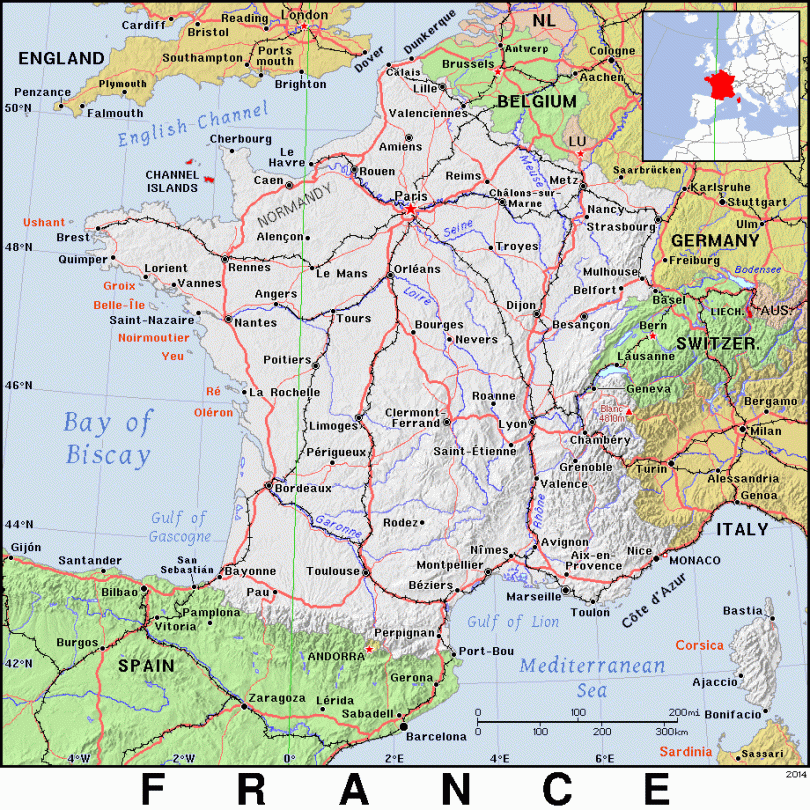
As I also pointed out in my last post, European nationality (and, by extension, the European nation-state) is built on notions of blood and soil.  In other words, being French means you are descended from a group of people broadly defined as “French” and you reside within the French “hexagon” (or at least claim that as your home).  Obviously, not every European nation-state still pursues this model–in some cases to their detriment–but some, like Italy, strenuously do.

 Now that is one sophisticated hexagon.

(Post-colonialism, being “French” includes many people outside of this geographic region, and now the French would more broadly define their nationality through shared language and culture–a model that moves closer to what I perceive to be the American model of nationalism).

In the United States–or, more specifically, in colonial British North America–Americans had a unique opportunity to define their national identity far more broadly.  Indeed, one could argue Americans did so out of necessity:  colonial British North America was a tapestry of cultures, languages, and ethnic groups.  Most hailed from the British Isles and Northern Europe, but the 18th century saw large influxes of Germanic and Scotch-Irish immigrants, not to mention the unfortunate forced immigration of the trans-Atlantic African slave trade.  Most were Protestant of various stripes–the German settlers in particular brought a rich and baffling array of spiritualism and religiosity to a young America–but Catholics and even a small number of Jews also made the trek to the colonies.

The massive Irish and German immigration brought by the Irish Potato Famine and the failed democratic revolutions of 1848, respectively, brought even more diversity to the land at that point known as the United States, and so-called “New Immigration” after the Civil War saw immigrants from Italy, Lithuania, Poland, Russia, Greece, and beyond.

By the time those “New Immigrants” began arriving in the 1870s until the tide was stemmed in the 1920s, the United States had already developed a model for nationality born of its colonial experience.  Indeed, the young United States proclaimed its nationality at the very moment it proclaimed its independence from Great Britain.

In writing the Declaration of Independence, Thomas Jefferson laid down the framework for what it means to be an American.  Jefferson, like all of the Founding Fathers, believed in the universal rights of men, rights derived not from any worldly, temporal authority, but from God Himself.  Every civics student is familiar with the ringing declaration that “We hold these truths to be self-evident, that all men are created equal, that they are endowed by their Creator with certain unalienable Rights, that among these are Life, Liberty and the pursuit of Happiness.”  Herein we see the roots of American values, birthed through the centuries by the tenacity of independent-minded Englishmen and bolstered by the more admirable claims of the Enlightenment.

However, many modern readers miss the first paragraph of the Declaration, which opens with the phrase “When in the Course of human events….”  This seemingly innocuous phrase holds within it deep wells of significance.  Jefferson here is saying that these ideals and rights are not specific to one place or one time.  The “human” here refers, rather, to all of humanity.  The phrase “in the Course of human events” refers to the timeless quality of these values–the self-evident truths of the Declaration apply yesterday, tomorrow, and forever–ad infinitum.

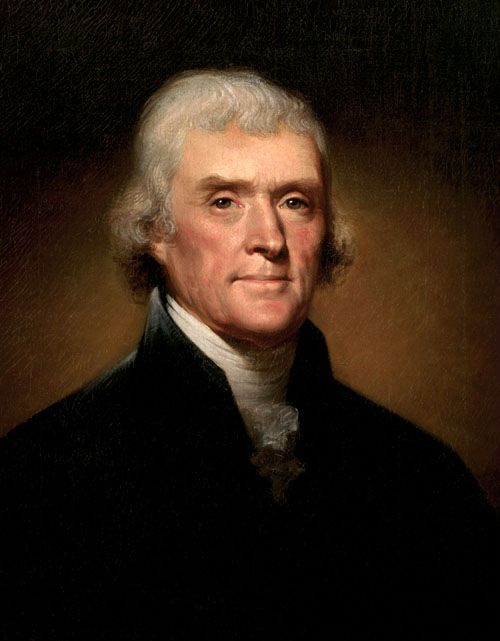
Thomas Jefferson, Babe Magnet

This simple phrase, then, goes a long way in explaining why the young United States was able to hold together in spite of its broad diversity of ethnic groups and religions, while the similarly diverse Austro-Hungarian Empire, which attempted to balance the interests of different ethnic groups by favoring some and oppressing others, ultimately collapsed.  The universal truths of the Declaration, espousing universal rights bestowed by the very Creator of the universe, give all men the opportunity to live their lives as they wish, confident in their liberty and free to pursue happiness and fulfillment as they please.

No doubt this philosophy of God-given liberty has bolstered the United States economically, allowing it become the richest, most prosperous nation on Earth–surely a carrot for future and continued immigration.  Ultimately, however, the most successful and fulfilled Americans, both native-born and immigrant, are those that come to embrace the core philosophy of the American experience.

A sad note in parting:  the increasing ignorance of these God-given rights, and the increasing balkanization of the American nationhood into favored classes and victim groups as a result of said ignorance, is undermining the universal vision of the Founders.  America today looks more and more like the Austro-Hungarian Empire of the early 20th-century:  decadent and splendid on the surface, but torn by internal turmoil and ethnic strife within.

To avoid a similar state, the United States must make a concerted effort to revive the Founders’ understanding of the American philosophy enshrined in the Declaration of Independence.