The State of the Right

A major topic of discussion among conservative and/or non-Left thinkers, bloggers, and political theorists is what exactly makes one a “conservative” (or, perhaps more accurately, what combination of values and axiomatic beliefs constitute “conservatism”).  For the philosophically-minded, it’s an intriguing and edifying activity that forces one to examine one’s convictions, and the sources thereof.

I’ve written extensively about the Left and what motivates it.  To summarize broadly:  the modern progressive Left is motivated, at bottom, by a lust for power (the more cynical of Leftists) and a zealous nihilism.  These motivations take on a Puritan cultural totalitarianism that cannot tolerate even the mildest of dissent.  Witness the many examples of how Leftists across time and nations have devoured their own.

That said, I haven’t written too much lately about what it means to be a conservative.  One reason, I’m sure, is that it’s always more difficult to engage in the oft-painful exercise of self-reflection.  Another is that the lines of conservative thought have been shifting dramatically ever since Trump’s ascendancy in 2015-2016, and the cementing of his control over the Republican Party—the ostensible vehicle for conservative ideology—since then.

As such, in the kind of serendipitous moment that is quite common in blogging, today’s post shares two pieces on the lay of the conservative landscape, and the various factions within the broader conservative movement (and, politically, the Republican Party).

One is, by the standards of the Internet, an old essay by Gavin McInnes, “An Idiot’s Guide to the Right.”  Written in 2014, one month before Republicans would win control of the US Senate, McInnes’s breakdown of the Right is still fairly prescient, although it’s always interesting reading discussions of the conservative movement pre-Trump (McInnes, like many conservatives, hoped and believed that Ted Cruz was the last, best hope of the movement; that was certainly my view well into 2016).

The other is a post from Tax Day, “What’s Right,” by an upcoming blogger, my e-friend photog of Orion’s Cold Fire.  He gives a detailed breakdown of the shifting coalition of the Right at present, and his own “red-pilling” is very similar to my own (indeed, photog and I both fall somewhat on the fringes of the “civic nationlist” camp, with toes cautiously dipped into the parts of the “Dissident Right,” a term itself coined by VDARE.com‘s John Derbyshire).

Traditionally (since the end of the Second World War, that is), the old Republican coalition was a three-legged stool, bringing together economic/fiscal conservatives, social conservatives, and national security conservatives.  In the wake of the Cold War, the first two legs ceded more ground to the national security conservatives, some whom consisted of the much maligned “neoconservatives,” themselves reformed progressives who had been “mugged by reality.”

The neocons would enjoy their ascendancy during the George W. Bush administration, and they tend to be the major proponents of the dying Never Trump movement.  Their vehement hatred of Trump (see also: Bill Kristol, Senator Mitt Romney, and George Will) has largely discredited them, and they’ve shown that their true loyalty is to frosty globalism, not the United States.  They also pine for a mythical form of “decorum” in politics that never truly existed outside of the immediate postwar decades.

photog characterizes this group as essentially less strident Leftists, a group that “doesn’t shrink or grow.”  They were the “we need decorum” crowd that went big for the Never Trumpers, but who have largely made an unsteady cease-fire with the president—for now.  Bill Kristol and Max Boot, the extreme of this group, have essentially become full-fledged Leftists (making Kristol’s latest project, The Bulwark—to protect “conservatism,” ostensibly—all the more laughable).

These are the people that don’t want to vote for Trump, but might anyway, because he’s “morally reprehensible,” which is just their way of saying they think he’s icky and boorish.  These are the upper-middle class white women of the Republican Party, the ones I constantly implore to get over their neo-Victorian sensibilities and stop destroying the Republic from their fainting couches.

The biggest group, per photog, are the Conservative Civic Nationalists.  These are the people that love God and country, and like Trump because he represents the best hope to defend those very things.  McInnes, less perceptively, just calls this groups “Republicans,” although his “Libertarians” might fall into this group, too.  To quote photog at length:

The next big class of people are the Conservative Civic Nationalists.  This is the bulk of the Non-Left.  These are the normal people who have always believed in God and Country and that America was the land of freedom, opportunity and fairness.  They believed that all Americans were lucky to be living in the greatest country on God’s green earth.  They believed that the rule of law under the Constitution and especially the Bill of Rights is what made this the closest thing to heaven on earth and anyone living here should be supremely grateful to the Founding Fathers for inventing it and his own ancestors for coming here.  This is the group that has had the biggest change occur in the last couple of years.  But to define the change let’s break this group into two sub-divisions.  Let’s call them Sleepwalkers and the Red-Pilled.  Back in the early 2000s all the Civic Nationalists (including myself) were Sleepwalkers.

The “Red-Pilled” and “Sleepwalkers” dichotomy is one of the most interesting interpretations I’ve read about the Right lately, and it’s certainly true.  Trump awoke a large group of these Civic Nationalists, people that were disgruntled with the government overreach of the Obama era, but weren’t certain about the way forward.

Like myself, photog is cautiously optimistic that these folks will continue to wake up, bringing along non-political Centrists—the squishy, non-ideological middle—to bolster Trump’s reelection in 2020.  The Left’s relentless push for socialism and transgender bathrooms have done much to red-pill these folks, who find themselves struggling to articulate values that they just implicitly know are good, but which the Left insists on destroying.

There’s still much to be said about the current state of the Right, and I will be delving into it in more depth as the weeks progress.  For now, read these two essays—particularly photog’s—and begin digesting their ideas.  American politics are undergoing a major realignment, and we need people of good faith and values to stand for our nation.  Understanding the state of play is an important part of arming ourselves for the struggle.

Symbolism and Trumpism

Blogger photog at Orion’s Cold Fire often links to noteworthy pieces on American Greatness, the premiere blog for the Trumpist Right.  American Greatness does real yeoman’s work to articulate what Trumpian conservatism is.

His American Greatness Post of the Day for this foggy Monday morning is Robin Burk’s “What Trump Understands that Kevin Williamson Doesn’t.”

Kevin Williamson, you’ll recall, is the house globalist/libertarian for National Review (despite a brief, one-article stint at The Atlantic).  In 2016, he infamously wrote that “dysfunctional, downscale communities… deserve to die.”  He argued that communities like Garbutt, New York—a gypsum boomtown in the nineteenth century that ran its course when the gypsum was gone—have outlived their economic usefulness, and its inhabitants should move elsewhere for opportunity.

There is something to this perspective, but, as Tucker Carlson eloquently noted in an exchange with Ben Shapiro, the neoliberal order and its notions of economic mobility are hugely disruptive to communities.  Families are told, essentially, to leave behind their grandparents’ graves, their Little League teams, their memories, in order to work in service to the gaping maw of some efficiency-maximizing corporate conglomerate.

What Trumpism understands is that, while economies are dynamic, they require strong communities and stable families to maintain.  So it is that Robin Burk argues that Williamson’s libertarian approach lacks any sense of a narrative or symbols.  Williamson is testy because Trump is planning a big military parade (and, presumably, because Trump has been a far more effective advocate for conservatism than Williamson’s angry brand of libertarian orthodoxy).  It seems like wasteful agitprop to him.

What Burk explains in her piece, however, is that a common people need some unifying symbols.  That’s why the NFL National Anthem controversy revealed such deep splits in our culture.  It’s why Americans don’t particularly like it when protesters burn the American Flag.  Yes, it’s constitutional, but that doesn’t mean it’s good—and it’s the literal destruction of one of the most unifying national symbols.

Burk’s focus is more on the local, though, and it’s what makes her piece so interesting.  Communities are built between friends and neighbors.  Yes, the mills shutdown, and some people have to move to look for opportunity.  The mills shutting down also mean some people lose their way, and resort to opiates to numb the pain.

But not everyone can or wants to become economic mercenaries, shifting about rootlessly in search of the highest bidder—or just a job, for that matter.  Some folks want to build a life and a community where their ancestors did.

The implication from neoliberal and libertarian types is that, at best, that desire is unrealistic; at worst, it’s bad:  your loyalty should only be to efficiency!  Efficiency is morality!  While I love efficiency as much as the next cog, efficiency-for-its-own-sake is not and should not be our god.

As Carlson puts it (to paraphrase), we shouldn’t work for capitalism; capitalism should work for us.  Burk adds that we need symbols, formed from and interpreted by our individual experiences and memories, to create a society that fosters the good life.

TBT: Cold Turkey

As the fate of Brexit still hangs in the balance, it seems apropos to look back to a post I wrote shortly after the successful Brexit vote in 2016, “Cold Turkey” (by the way, why is Turkey in NATO again?).  As I wrote then, all of these objections—what’re we going to do about the Irish border, for example—are distractions.  Yes, they might require some sorting out, but just rip off the Band-Aid.  People will find a way to make money.  Europeans will be itching to keep their business in Britain—remember, London is one of the world’s financial capitals—and will find ways to get business done.

The devil’s bargain of the European Union was simple:  give up your freedom and national sovereignty in exchange for sweet government bennies.  The British people chose the better, harder option:  they voted for freedom (and probably government bennies on their own terms, just without European largesse).  Of course, the British people never got to opt-into that bargain; it was thrust upon them after the bait-and-switch of the European Common Market—a good idea!—morphed into an unholy, supranational tyranny.

So, here is 2016’s “Cold Turkey.”  Like any addiction, the best approach is to “just say no”:

Last week, approximately 52% of Brits voted to “Leave” the European Union in a national referendum.  They did so peacefully and democratically.  Already, 23 June 2016 is being hailed as Britain’s “Independence Day.”

I’ve written several posts about Brexit recently (herehere, and here).  Last Friday’s post, which I wrote as the results were coming in Thursday evening, explored why liberty–a vote for “Leave”–was worth the price of temporary economic disruption and, too, of giving up certain “benefits” bestowed to EU citizens.

(A quick aside:  I still find it interesting that a supranational organization that originated as an economic free trade zone evolved into an entity capable of forcing twenty-some-odd nation-states to pool sovereignty; didn’t Europe fight two world wars to prevent Germany from ruling the Continent?  But I digress.)

Based on several comments on my Facebook page, and from personal conversations, it seems that some of my pro-Remain friends and colleagues missed this point, or very candidly admitted that national sovereignty and liberty are not worth the price of sweet EU bennies (one colleague–a reluctant Brit–discounted the entire “Leave” campaign as fundamentally xenophobic and racist, implying that those alleged qualities alone invalidated the entire movement).  To the latter contingent, I can only hope we can agree to disagree.  To the former, allow me to address some points.

“[D]idn’t Europe fight two world wars to prevent Germany from ruling the Continent?”

One poster discussed at length that Brits have “become VERY accustomed to the benefits,” and that, whether they are in the EU or not, they “will still be governed, regulated, and heavily taxed by their own government but no longer enjoy the goodies that come with EU membership!”

Consider, if you will, a drug addict.  Let’s say someone addicted to heroin seeks treatment and begins taking daily doses of methadone.  Would we say, “Oh, well, sure he’s off heroin, but he’s still chemically dependent on methadone, and now he’s missing out on the sweet high that only heroin can provide”?  Or would we continue to encourage this recovering addict to kick his methadone habit, too, and restore a sick, dependent body to healthy independence?

Quit me cold… and don’t let me in the European Union.

Generous government benefits–whether they come from the EU or the British government–might come with some nice “perks” (every pro-Remainer I’ve talked to seems preoccupied with the ability to travel freely through Europe, something most of us plebes haven’t had the luxury of doing without a passport; this, to me, seems to be the definition of a “First World Problem”), but those “goodies” come at a price.  The British people have freely said, “Thanks, but no thanks.”

Naturally, there will be those who will start jonesing for cheap travel opportunities to economically depressed parts of Southern Europe, where they can live out leisurely, government-funded retirements.  There will also be everyday people who still find themselves frustrated by high taxes and tight regulations, and missing out on certain opportunities afforded them by EU membership.

“The Brits have thrown off one level of bureaucracy because… they realized it was not worth the cost.”

But is the solution more regulations and higher taxes?  The Brits have thrown off one level of bureaucracy because, despite the redistribution of wealth it brought (which mostly went away from productive countries like Britain and Germany and to profligate nations like Greece), they realized it was not worth the cost.  One of two things will now happen:  either Brits will demand further deregulation and reform of their own government, which will further ease their burdens and lower costs; or they will make an oft-repeated mistake and demand more redistribution and more taxpayer-funded goodies.

Crucially, though, the choice will be theirs to make.

Leaving the European Union will be like tearing off a bandage.  It will hurt like hell initially–we’re already seeing the effect on markets, which can’t stand uncertainty–but the pain will be fleeting (as I’ve argued in my earlier posts on the topic).

Similarly, any nation facing heavy regulations and stifling taxes can pursue a similar course–if it hasn’t become too hooked already.  “Austerity” failed in Greece not because it demanded that the Greek government stop paying janitors wages comparable to skilled tradesmen; it failed because the Greek government couldn’t kick its habit (and because austerity required tax increases, not stimulating decreases).  The nation–and the Greek people–have become so dependent upon handouts, they can no longer function without huge bailouts from wealthier nations.  That dependency will only perpetuate the cycle of addiction.

The best approach is not more dependency–more bureaucracy, more social programs, more taxes–but quitting cold turkey.  Rip off the Band-Aid, then get back to being free… or end up like Greece.

Hungarian Border Wall is 100% Effective

Pundit Dick Morris has a short piece on his website, DickMorris.com, about the Hungarian border fence.  It’s a quick read, but here are the key excerpts:

Along its 109-mile border with Serbia, Hungary has built a 13-foot-high fence featuring concertina wire (barbed wire in circles). It took six months to build (July-December of 2015) and cost $106 million. It was built by contractors and 900 Hungarian soldiers.

The fence consists of three rows of razor wire with a sturdier 11.5-foot-tall barrier inside….

And the Hungarian fence works! Before the barrier was built, in September of 2015, 138,396 migrants entered Hungary over the Serbian border. Within the first two weeks of November, the average daily flow had dropped to only 15 people.

Hungary and its populist-nationalist leader, President Viktor Orban, have faced a great deal of backlash and scorn from the progressive, bureaucratic autocrats of the European Union for their border control and immigration measures.  But Hungary is intent on keeping itself culturally Hungarian—it cannot effectively absorb the millions of potential migrants that began pouring into Europe from Syria and North Africa a few years ago.

President Orban is often cast as some latter-day Hitler, but he’s merely doing his job:  he’s putting the people of Hungary and their interests first, behind the interests of foreign vagabonds.

While researching this post, I learned that the European People’s Party—an umbrella party of “center-right” parties (as many outlets described it) running in the European Parliament’s elections this May—is barring Orban’s Fidesz Party from participating.  Apparently, part of their concern is that Orban’s Fidesz Party has posted humorous ads depicting George Soros and Jean-Claude Juncker (the Leftist super-villain billionaire and the President of the European Commission, respectively), suggesting the two are in cahoots to control Europe.

Well… aren’t they?  Isn’t the “center-right” European People’s Party supposed to represent a challenge to the Eurocrats (if anyone knows, I’m only asking semi-rhetorically)?

Two takeaways:

1.) Leave Viktor Orban alone.  He’s helped protect his country at a time when other European nations turn blind-eyes to Muslim rape gangs.

2.) The original point of this post:  President Trump can follow the Hungarian model and build an effective wall on the cheap.  Granted, we have more than 109 miles, but copy-paste that approach along our long border with Mexico, and could get the job done quickly and efficiently.

Open borders and progressive politics are the real dangers to liberty and prosperity, not an unabashed nationalist in Central Europe—or one in the United States.  Build the Wall, Drain the Swamp, and Leave the European Union!

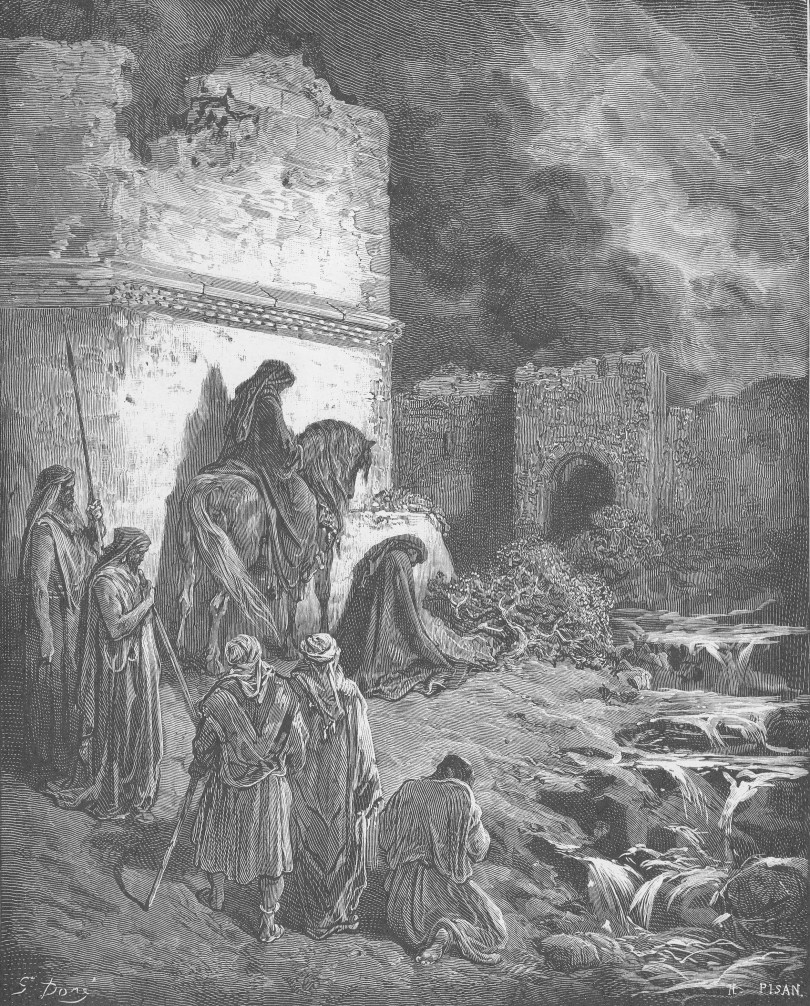
Nehemiah and National Renewal

This past Wednesday, I was asked to fill in for the pastor at the small church I attend.  Being such a small church—our average Sunday morning attendance is about forty—the pastor works another job, and he had a rare business trip.  I suppose he figured he could do worse than asking a high school history teacher to fill in for him.

Fortunately, the lesson was fairly straightforward:  he sent me a handout on Nehemiah 1:1-11, and the focus of the lesson was on the idea of spiritual renewal.

For the biblically illiterate—a shocking number of Americans today, I’m finding (I once had a class full of philosophy students who had never heard the story of the Tower of Babel, which is pretty much Sunday School 101)—the story of Nehemiah is simple:  after an extended period of exile in Babylon, the Israelites were sent back, under the auspices of the Persian Emperor Cyrus the Great, to Jerusalem.  Cyrus sponsored the rebuilding of the Temple in Jerusalem, but the city itself, as well as its walls, remained in a state of disrepair.

There were two waves of Israelite resettlement over the span of a century, but many Israelites remained in Babylon or other parts of the Persian Empire, such as the imperial capital.  Nehemiah was one of those, and would be part of a third wave of resettlement.  He served as cup-bearer to Artaxerxes, the Persian emperor at the time.  The position of cup-bearer was an important and trusted one:  he handled the emperor’s food and drink, ensuring it was not poisoned.

Beyond serving as the royal taste tester, the office carried with it important administrative duties, and gave incredible access to the emperor.  In short, it was a position of great influence, power, and prestige, which positioned Nehemiah nicely for what was to come.

Nehemiah spoke to a fellow Israelite who was visiting the imperial capital, and was distraught to hear of the poor condition of the city and its walls.  He fell to his knees, weeping and crying out to the Lord.  Nehemiah 1 details his prayer to God, calling out in adoration; confessing his and his people’s sins; thanking God for His mercy and gifts; and supplicating God for His Will to be accomplished through Nehemiah.

Specifically, Nehemiah asked God to be used to rebuild the wall around Jerusalem.  As cup-bearer, Nehemiah was able to present his petition to the emperor, who agreed to send Nehemiah to oversee the construction project.  In addition, Artaxerxes provided lumber from the royal forest, as well as funds to bankroll the endeavor.  He also sent letters with Nehemiah detailing his endorsement of the project.

Nehemiah’s work was not finished there, and it was anything but easy.  Initially, surrounding tribes criticized and mocked Nehemiah, questioning his loyalty to Artaxerxes, and saying that rebuilding the walls was a silly waste of time and effort.

However, once the wall reached half its height, his critics began plotting violence.  The plot to attack the workers reached Nehemiah, so he divided the work crews into those building the wall, and those defending their fellow workers from attack.

Having failed to stage an attack on the workers, Nehemiah’s enemies realized that the man himself was the target—cut off the head, kill the snake.  Again, God revealed this plot against Nehemiah, and he was able to avoid assassination.

Finally, the wall was rebuilt in an astonishing fifty-two days, an incredible feat of organization, ingenuity, and faithfulness.  The naysayers were humiliated, and Nehemiah instituted a period of national and spiritual renewal among the Israelites.  His reforms purified the nation spiritually and even ethnically, as old debts were forgiven and marriages to pagan women were dissolved.

It’s a powerful story—indeed, a powerful bit of history—about trusting in God in the face of extremely difficult odds.  But Nehemiah is also a story about national renewal, and the spiritual revival that came with it.

The wall around Jerusalem served a practical purpose—defending the city and its inhabitants from attack (even though the city was under the protection of the Persian Empire, the ancient Near East was, then as now, notoriously tribal, and the collapse of an empire would lead to dozens of ethnic conflicts)—but it was also a symbol of the Israelite nation.

Indeed, the author of the handout I used Wednesday evening writes that the “enemies of Israel could say, ‘What kind of God do you serve?  Look at the mess of your Holy City?’ It was a terrible witness and was cause for reproach from non-believers.”  The poor condition of the Jerusalem and its fortifications reflected the spiritual decay and corruption of the Israelites—they had intermarried with pagan women, adopting their false gods; they were living in rubble; and their reduced condition suggested that their God—the One True God—was not Who He made Himself out to Be.

It’s a bit on the nose, but I can’t help but recognize the parallels between the United States today and Jerusalem then—and between President Trump and Nehemiah (although I think Trump is closer to Cyrus the Great in terms of his spirituality and outlook).

I’m not suggesting Nehemiah was clubbing with Eastern European supermodels.  But like Trump, he faced overwhelming resistance from other nations to his wall project.  The rest of the ancient Near East feared a strong, renewed Israel.  Nehemiah’s return to Jerusalem, and the reconstruction of the wall, led to a period of national revival, as the people regained their identity, expelled the corrosive foreign influence in their midst, and renewed their commitment to God.

America is, spiritually and culturally, in similarly dire straits today.  President Trump has presented himself as a modern-day Nehemiah, come to control our borders, enforce our immigration laws, and restore America’s greatness on the world stage.  While he has made great strides in these areas, he meets resistance, duplicity, and mockery at every turn.

The story of Nehemiah tells us, however, that the struggle is worth the slings and arrows our enemies, both foreign and domestic, will lob at us.  To President Trump, I would urge the following:  stay the course, ignore the haters, take it to God, and BUILD THE WALL!

The Deep State is Real – Silent Coup Attempt and Andrew McCabe

One reason I’m not overly concerned about President Trump’s national emergency is because the normal constitutional order has not operated effectively or as designed for a very long time.  That doesn’t mean we shouldn’t respect the Constitution and the process, but there are so many extra-constitutional shenanigans going on already, it seems we’re missing the forest for the trees when we fixate on the president’s completely statutory, legal national emergency declaration.

Remember, Congress delegated the national emergency power to the executive branch in the National Emergency Act of 1976.  Whether they should have done so—or been allowed to do so—is a matter of debate, but they did, and it empowered President Trump to fulfill his Article II obligation to defend our national sovereignty.

Regardless, the media and Never Trumpers’ fixation on the national emergency distracts from the real threat to our constitutional republic:  the active attempt by the Deep State to stage a silent coup of the President.

Democrats and Deep Staters have made it clear they want to remove President Trump from office, not for any actual “high crime or misdemeanor,” but simply because they can if they either a.) get enough votes in the House and Senate or b.) stage a 25th Amendment, Cabinet-level coup.  Both of those are extremely unlikely, but they would set a dangerous precedent:  whenever there’s a president one side doesn’t like, that side can attempt to remove him from office for the flimsiest of reasons.  The breakdown of our constitutional norms would only accelerate.

Andrew McCabe’s current media tour is premised on his ostentatiously prideful boasting that he encouraged a 25th Amendment removal of President Trump, or at least wanted to explore the option.  Keep in mind, McCabe was considering this option even before President Trump had a chance to do anything that might be considered a “high crime.”

The accusations of “Russian collusion,” and the subsequent Mueller witch hunt, still have not yielded any actual evidence against Trump, and has only succeeded in rounding up some fringe characters on tedious process violations—they made mistakes in testimony as part of an investigation that itself is out-of-control and useless.

That a large portion of the federal bureaucracy and the intelligence community want to overthrow President Trump is not a sign of their desire to maintain a healthy republic, but is rather symptomatic of their disdain for the Electoral College and the American people—indeed, of the entire electoral process.

Put simply, their candidate lost, and they don’t want President Trump bringing their heinous misdeeds and conspiracies against the public to light.

Drain the Swamp!  The sooner the better.  And put McCabe behind bars for seditious activity.

Walls Work

It’s going to be a very quick post today.  While I’m enjoying an unexpectedly lengthy Winter Break—a perk of being a teacher, and why our complaints, while legitimate, should be taken with a grain of salt—I’m also quite busy outside of the mildly Dissident Right/”Alt-Lite” blogosphere.  I played a very fun solo gig last night at a coffee shop in my neck of South Carolina, and tonight I’ll be playing alto saxophone with an old-school, swingin’ big band.  I’m heading out for soundcheck and rehearsals for that soon, thus the quick post (gotta keep the streak alive!).

American Thinker posted a piece this week on the utility of border walls—how they’re popping internationally, and how they’re incredibly effective: https://www.americanthinker.com/blog/2019/02/a_fenceless_border_is_defenseless.html

Some international examples from the piece (emphasis added):

According to a February 2018 American Renaissance article, between 1945 and 1961, over 3.5 million East Germans walked across the unguarded border.  When the wall was built, it cut defections by more than 90 percent.  When Israel in January 2017 completed improvements to the fence on its border with Egypt to keep out terrorists and African immigrants, it cut illegal immigration to zero.  In 2015, The Telegraph reported on the construction of a 600-mile “great wall” border by Saudi Arabia with Iraq to stop Islamic State militants from entering the country.  The wall included five layers of fencing with watchtowers, night-vision cameras, and radar cameras.  Finally, a September 2016 article in the Washington Post reported on the new construction of a mile-long wall at Calais.

In case you missed it, the key line there is “[w]hen Israel… completed improvements to the fence on its border with Egypt… it cut illegal immigration to zero.”

Cut it to zero.  No one can plausibly argue against the effectiveness of a border wall.  Yes, ports of entry are a problem, too, but those are merely the documented cases of illegal entry.  The reason those numbers are so prominent in the debate (besides being a useful cudgel against the commonsense of a border wall) is because we have numbers—at least, more accurate numbers—for illegal entries at ports of entry as opposed to illegal entries at the porous southern border.

Again, that’s just commonsense, but it’s easy to lose in the debate.  It’s hard to fight data with data when you don’t have an accurate count—and an accurate count of illegal border crossings is, by definition, impossible!

What we do know is that illegal crossings are up—why else would there be hordes of coyote-led migrants marching en masse to the border—and a wall is a quick, cost-effective way to relieve border agents to focus on other areas.

Those hordes—as much as we can and should sympathize with their plight—represent a direct assault on our borders and national sovereignty.  If we let some come through illegally, simply because they come in large numbers, then the floodgates open.

In that context—that of a foreign invasion—the President’s decision to declare a national emergency seems to be entirely in keeping with his powers under Article II of the Constitution.

While I think he should have gotten Congress to act sooner when Republicans controlled both chambers of Congress (although, let’s be honest here:  many congressional Republicans are doing the bidding of the US Chamber of Commerce and the cheap labor lobby when it comes to border security—they want to assure a steady stream of near-slave labor for their donors), this crisis needs to be met with the full force of the Commander-in-Chief’s war-waging powers.

For the fullest explanation of that approach, read this piece from Ann Coulter.  Coulter is a controversial figure, but I think her assessment of the Constitution is accurate here.

I find “national emergencies” and broad applications of presidential powers constitutionally distasteful; however, a core responsibility of the executive is to execute the laws, including immigration laws, and to protect and guard national borders.  If Congress won’t pony up for border security, President Trump must use every power at his disposal as Commander-in-Chief to defend the nation.  That’s pretty much his entire job!

Well, it looks like this post was as long as any other.  I type pretty quickly when I’m in rant-mode, and nothing gets me there faster than illegal invasion.

Godspeed, President Trump.  Please be more attentive to this issue going forward—it’s why we elected you!

Secession Saturday

Care of photog at Orion’s Cold Fire, here’s a thought-provoking piece by Christopher Roach of American Greatness, “The Left Won’t Allow a Peaceful Separation“: https://amgreatness.com/2019/01/21/the-left-wont-allow-a-peaceful-separation/

Roach touches on some of the same points I bring up in my essay “Progressivism and Political Violence,” in which I diagnose some of the well-known pathologies of the Left, including its tendency towards totalitarianism. That impulse is why the Left is never content to adopt the Right’s “live and let live” mentality. Thus, the willingness to eat their own (as in the Northam non-troversy), to demonize young conservatives, to harass conservatives at dinner, and to denounce anyone who doesn’t believe whatever the latest frontier of social justice is this week.

The idea that America is in a “cold civil war”—one that is turning increasingly hot—isn’t nothing new (sadly). Controversial Dissident Right figure John Derbyshire calls it a conflict between “goodwhites”—the limousine liberals and soccer moms who think Trump is mean and who want to virtue-signal to minorities to appear cool and progressive—and “badwhites”—the rest of us folks in “flyover country” who largely want to be left alone to enjoy our faith, family, and liberty in peace.

That the cold, cultural civil war may turn hot is a cause of concern to many folks on the Right and Left. I shudder to contemplate it. Roach, in his piece, argues that a peaceful separation may one day be the result of our current Kulturkampf, but he is pessimistic that the Left would willingly let anyone leave, due to its totalitarian nature.

He also points out that, though we often forget it, the United States is, itself, a product of secession—from merry old England. As I often point out to my students, the question of whether or not States were bound permanently to the Constitution was an open question until 1865. The Jeffersonian “compact theory” argued, essentially, that the States had formed the Union and “opted in” to the Constitution. The big, open question prior to the American Civil War, then, was thus: having opted in to this arrangement, did States have the ability to opt out? A straightforward reading of the Declaration of Independence suggests heavily that, in certain extreme circumstances, they might be able to do so.

As I’ve long told my students, the Civil War answered that question conclusively by force of arms. Now, States sue the federal government through their respective attorney generals’ offices should there be any conflicts between them and the feds.

That said, as I’ve grown older, I’ve come to realize that no political question is ever truly “settled,” and no political arrangement—even one as enduring and amazing as our federal constitutional republic—can last forever. The idea of secession could be given a renewed lease should the federal government continue to overextend its authority, and should the culture wars deepen and darken.

To be clear, I’m not advocating for secession or anything of the sort. I’m merely exploring—in a very brief way—a complex idea that is, in the balance, not entirely without merit. Regardless of the motivations for the American Civil War, the notion of States’ rights—an entirely constitutional idea, per the Tenth Amendment—and of “compact theory” are quite sound, and could enjoy renewed credibility.

There is much to chew on and mull over here. I recommend you read Roach’s piece and make up your own mind. Feel free to leave comments below.

Happy Saturday!

–TPP

Best SOTU Ever

I was wrong, as were most conservative (and some progressive) commentators:  President Trump was right to hold out for a real State of the Union Address, rather than reviving the Jeffersonian tradition of the written address.

The president’s State of the Union speech was a tour de force:  he spoke eloquently of America’s role in advancing civil and human rights; the sanctity of human life, born and unborn; the economic development of the United States in the last two years; and the crisis at the border.

It was an address that was optimistic and accurate.  Unlike most SOTU addresses, which tend to be tedious attempts to inflate small bits of good news beyond all reasonable proportions, Trump’s 2019 address described, in detail, just how great America is, and how far we’ve come in two short years.

It’s little wonder Speaker of the House Nancy Pelosi wanted to cancel the speech:  how do Democrats respond to that?  The first part of the speech was full of positive economic news, news that can’t be ignored or denied.  The president detailed explosive wage and job growth, including the lowest unemployment rates for black, Hispanic, and Asian Americans in history.

Beyond the economic good news—and the vow that the United States will never be a socialist country—it was a fun speech (well, it was a bit long, and dragged a smidge, but not much).  Even Democrats started getting up and dancing around at one point!  Congress sang “Happy Birthday” to a Holocaust survivor.  President Trump cut some jokes, and was clearly having a blast.  As any performer knows, if you’re having fun on stage, the people in the audience will have fun, too.

If you missed the speech, go to YouTube, shut the office door, and fire that baby up while you file TPS reports.  You won’t regret it.

The Facts on the Border Crisis

As I’ve learned more about immigration—and especially since reading Pat Buchanan’s Death of the West—I’ve come to believe it is the defining crisis of this moment in American history.  The debate is not, as it has been in the past, primarily around how much immigration is desirable; rather, the question has morphed beyond reason into “does a wealthy nation have the right to define and enforce its own immigration laws?”

That used to be axiomatic to what it meant to be a nation:  by definition, a nation had the right to defend its borders, and—of course!—to have them!

Now, there’s a twisted logic that, because the United States has loads of wealth (and won tons of land from Mexico in the Treaty of Guadelupe-Hidalgo, after we soundly defeated them and captured Mexico City), we somehow have a moral obligation to surrender our sovereignty to every hard-luck case in the Western Hemisphere (and beyond).

America is a melting pot, but if you dump a bunch of salt into the soup all at once, it becomes inedible—the salt takes over.

Case in point:  the aforementioned Mexican War.  That conflict had its root in the Texas Revolution, in which the Republic of Texas gained its independence in 1836.  Texas was a province of Mexico, and the Mexican government wanted to encourage settlement, so it invited Southern yanquis to move in with their slaves.

Those American settlers had two requirements:  they had to convert to Catholicism (the official state religion of Mexico), and they had to become Mexican citizens.  A handful of token conversions later, and the Texans were in.

In 1829, Mexico abolished slavery throughout its territories.  The slaveholding Texans protested; rather than face the threat of secession of its unassimilated but wealthy minority, the Mexican government relented, granting unprecedented, asymmetrical “states’ rights” to Texas.

While Mexicans resented Texas’s special treatment, everything was fine until the military dictator General Lopez de Santa Anna rose to power.  Santa Anna vowed to end Texas’s exemption from federal law.  When he moved to enforce his decree with the Mexican Army, the Texans declared independence; after their defeat at the Alamo, American volunteers flooded in to help Texas gain its independence.

The moral of the story here is clear:  a large minority of unassimilated foreigners successfully ignored the laws of their host country, before ultimately breaking off to form a short-lived nation, before annexing into the nation of their native culture.

Mexico is playing the same playbook in reverse; indeed, some Mexican radicals call the influx of unassimilated, illegal migrants into the southwestern United States the reconquista, or “reconquest.”

Death of the West is the best feature-length discussion of that process.  For a shorter, more immediate discussion of the impact of illegal alien migration, the White House has published a page of statistics about the crisis at the border: https://www.whitehouse.gov/briefings-statements/crisis-southern-border-urgent-ignore/

Stop screwing around—and build the wall!