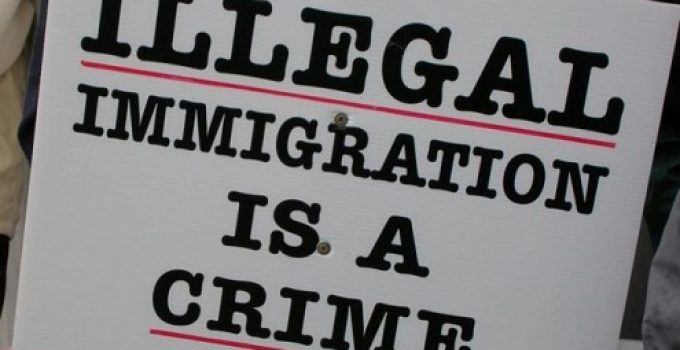
Patriots Fill Gap in Border Wall

As the federal government struggles to fulfill its basic duties, private citizens are increasingly taking matters into their own hands.  I wrote awhile ago about the GoFundMe page to fund the border wall.  That project is still underway, but seems to have stalled well short of its goal of raising $1 billion.

But there is hope.  The organization connected to that fundraising project, We Build the Wall, constructed a half-mile of wall along a notorious gap on the New Mexico border.

A half-mile is precious little along a border hundreds of miles in length, but it is something.  Further, the specific half-mile section the wall protects is a heavily-crossed gap in existing border fencing.  From The Daily Wire:

The half-mile segment of border wall, the group says, closes a gap frequently used to smuggle both people and drugs. [Former Kansas Secretary of State Kris] Kobach added that on a “typical night” around 100 migrants and $100,000 worth of illegal narcotics passed through the half-mile hole.

The Trump Administration was working on a plan to construct around 234 miles of steel fencing, effectively sealing off the southern border with a “border wall,” but attempts to secure funding for the project have stalled. Congress refused to agree to any funding for the border wall beyond the $1.6 billion promised in the 2018 budget, and President Donald Trump’s “national emergency” declaration — which would have detoured funding to the border wall from other Army Corps of Engineers projects — was halted by a judge pending ongoing litigation.

This excerpt brings up another important point:  the consistent obstruction from Democrats and activist judges of President Trump’s America First agenda.  Even with the declaration of a national emergency, the president has been blocked from making substantial progress on the border wall.

Of course, Republicans passed up a golden opportunity to act on the border wall in 2017 or 2018.  Voters need to send a strong message to candidates in both parties that getting control of the border is important.  Tax cuts and economic growth are wonderful, but for American citizens to benefit, we need strong border security, including a robust deportation system.

I’m encouraged to see private citizens banding together to solve their problems when the government won’t—few things are more American.  Nevertheless, it’s the federal government’s constitutional responsibility to protect our national sovereignty.  It shouldn’t slough off that responsibility and hope that good-willed patriots will pick up the slack.

TBT: Open Borders is the Real Moral Crisis

I’ve been writing quite a bit about immigration lately, as it’s the major issue facing the West today.  Our leaders’ inabilities to address the crisis of immigration suggests their ineffectiveness—and, perhaps, their callous indifference to the damage unrestricted and illegal immigration wreak.

President Trump rose to national prominence and won the presidency campaigning on fixing illegal immigration.  His efforts so far have been a mixed bag, as duplicitous, progressive judges overreach from their elitist perches and block Trump’s efforts at reform.

It seems a distant memory now, but all the faux-outrage from the Left just a year ago was about the “child separation” business at the border.  One still reads some echoes of those melodramatic headlines, but the underlying problem has gone unaddressed.

In fact, it’s gotten worse:  immigrants now realize that if they cross the border with a minor child, they can be swept into the interior of the country.  Once an illegal immigrant is in the nation, it’s incredibly difficult to get him out again.

It’s a sad testament that President Trump and Congress have been unable to accomplish more on this front.  As such, it’s shame that this week’s TBT still sounds all-too-familiar.

Here is “Open Borders is the Real Moral Crisis“:

I typically avoid wading into fashionable-for-the-moment moral crusades, but the hysteria over children being separated from their parents at the border is ludicrous, and demonstrates the typical “facts over feelings” emotionalism that mars our immigration debate.  That feel-goodism is why we’re even in this mess—if it can be characterized as such—in the first place.

Because I’ll be deemed a monster—“Won’t somebody please think of the children!“—for not unequivocally denouncing this Clinton-era policy, I’ll issue the usual, tedious disclaimers:  yes, it’s all very tragic; yes, it could be handled better; yes, I would have been terrified to be separated from my parents at such a young age; etc.

Now that the genuflecting to popular pieties is out of the way, let me get to my point:  this entire situation would be a non-issue if we had simply enforced our immigration lawsconsistently for the past thirty years.  President Trump isn’t the villain here (if anything, Congress is—they can take immediate action to change the policy or come up with some alternative—but I don’t even think they’re wrong this time); rather, the villains are all those who—in the vague name of “humanity” and “human rights”—ignored illegal immigration (or, worse, actively condoned it).

Sadly, it is an issue.  But what else are we to do?  Years of non-enforcement have sent the implicit but clear message to potential illegal immigrants that we don’t take our own borders (and, by extension, our national sovereignty and rule of law) seriously, and that if you’re sympathetic enough, you’ll get to skip the line.  Folks come up from Mexico and Central America fully expecting that, after some brief official unpleasantness, they can dissolve into the vastness of the United States and begin sending remittances back to their relatives—who may then pull up stakes and come.

Further, sneaking into the country illegally is a crime, and the United States has every right to enforce its laws, including those pertaining to immigration.  Mexico, similarly, has that right—and uses it unabashedly to police its own border (or to let Central American migrants waltz through on their way to the Estados Unidos).  Naturally, the punishment for breaking laws is often detainment, and the kiddies don’t join dad in his cell.

To give a common example:  what happens to the children of, say, an American heroin dealer when he’s arrested and sentenced to ten years in a drug bust?  His children—if they have no relatives willing or able to take them in—go into the foster care system.  It’s tragic, it’s terrible, but it’s part of the price of committing a felony.  No one wants it to happen, but it’s a consequence of one’s actions.  This reason is why crime is so detrimental to society at large, even beyond the immediate victims.

Unfortunately, a combination of winking at immigration enforcement (“eh, come on—you won’t get deported”), feel-good bullcrap (as my Mom would call it), and Emma Lazarus Syndrome(trademarked to The Portly Politico, 2018) have contributed to the current nightmare situation.  Now that an administration is in office that actually enforces the duly legislated law of the land—and at a point at which the problem has ballooned to epic proportions due to past lax enforcement—the problem is far thornier and more consumed with emotional and moral peril.

As any self-governing, self-sufficient adult understands, sometimes doing what is necessary is hard.  I do feel for these children who are stripped from their parents arms (although, it should be noted, usually for only a matter of hours), but who cares about my feelings?  We can have compassion for those who try to arrive here illegally, as well as their children, without attempting to take on all of their problems, and without sacrificing our national sovereignty and our laws in the process.

The United States is the most generous nation in the world—and the most prosperous—but we cannot take everyone in; to do so would not make everyone else better off, but would rather destroy what makes America the land of compassion, liberty, prosperity, and charity that it is.

***

For further reference, I recommend the following videos, the first from the brilliant Ben Shapiro, the second from Dilbert creator Scott Adams:


I’d also recommend this piece from National Review columnist Richard Lowry, which is quite good:  https://www.nationalreview.com/2018/05/illegal-immigration-enforcement-separating-kids-at-border/

And, finally, this piece from Conservative Review‘s Daniel Horowitz, which explains the true moral toll of illegal immigration—and misplaced compassion—very thoroughly:  https://www.conservativereview.com/news/the-immorality-of-the-open-borders-left/

Deportemal

I have little patience for illegal immigrants.  Their illegality encourages ethnic cloistering.  Their very presence constitutes a persistent state of lawlessness, which seems to breed further criminality.

Then there’s the matter of the vast gulf between mainstream American culture and the virtually premodern peasant cultures from which most illegal migrants come.  Child rape is serious problem among men of certain Latin American cultures, as a recent piece from The Blaze demonstrates.  A twenty-year old illegal immigrant impregnated an eleven-year old.

You read the piece and you notice something:  the police already told this young man to leave the girl alone.  Why was he not shipped back to his homeland immediately?  Why was he allowed to stick around long enough to get this girl pregnant in his car near her school?

Yes, yes—why did the school let her slip away to have sex with a man nearly a decade her elder?  There’s blame to go around.  As for the parents, the girl’s father apparently wanted to beat the crap out of the illegal alien, understandably, but the police told him to cool it so he wouldn’t get himself in trouble.

That right there illustrates why average Americans are so frustrated with illegal immigration.  Law-abiding citizens are held to a stringent, inflexible standard.  Forget to claim $20 on your income taxes?  The IRS will spend thousands of dollars to get you.  Own land with “wetlands” on it?   You can’t grow anything on it, lest a non-existent frog die.  Want to camp on the beach?  Sorry, you can’t do that.

But if you’re here illegally, you get free medical care, no taxes, and an entire political party eager to grant you the franchise.  You can even sleep with minors, because, well, that’s just your rich, vibrant culture, and we wouldn’t want to burden you with our colonialist Western standards, would we?

Here’s how we rectify this situation:  deport every illegal immigrant the minute he or she runs afoul of the law, for the slightest offense.  If Pedro throws so much as a cigarette butt onto the side of the highway, send him back.

It would be shocking to you how much illegals get away with while here.  I once heard from an attorney about a client that was here illegally.  The client had received his second speeding ticket, as well as a $1000 tickets for driving without a license.  The attorney managed to get the officer to dismiss the $1000 ticket.  Good luck doing that if you’re a citizen.

My question was, “Why didn’t they deport this guy immediately?”  Look, speeding is probably one of the more benign offenses one can commit—that’s why it’s just a misdemeanor in most States—but it can result in injury or death.  That’s tragic enough when it’s a citizen behind the wheel.  But there’s an added element of injustice when the person driving shouldn’t be here in the first place.

Finally, the whole “living in the shadows” thing is rhetoric, pure and simple.  It conjures up images of old abuelas shivering in dark trailers, afraid to go outside lest an ICE agent apprehend them.  What it really means is that they can’t get a Social Security card and get sweet government bennies—they’re in the “shadow” of official existence.  I know some libertarians who would kill to be in that situation.

Rather than huddling up in the forgotten by-ways of America, illegals flaunt their status.  I’ve been to taquerias and been told that half of those present are likely illegal.  Most of them, to be sure, are harmless, and just looking for some opportunity.  But they’ve jumped the line, doing a real disservice to immigrants that go through the lengthy, expensive process the right way.  ICE could hit a couple of these joints in an afternoon and clear them out.

The solution to illegal immigration, like most answers in life, is simple but unpleasant:  deport ’em all.  Stop fooling around with detaining them in our prisons at our expense.  Ship them back—even if it takes multiple tries—and send the message to those still in Central America that their luck won’t be any better.

America needs 100ccs of prescription-strength Deportemal, stat!

Immigration by the Numbers

Yesterday I wrote about the dangers of inviting in large numbers of immigrants from a fundamentally alien culture into Western societies.  The Somali population of Minneapolis has created a veritable “Little Mogadishu” (consider paying homage to such a blighted place) in the heart of the Twin Cities, a neighborhood riddled with crime and terrorist recruitment.

Most immigration to the United States is not nearly so pernicious—unlike Europeans, Americans generally don’t have to worry about waves of unassimilable Muslims conquering entire swaths of our major cities—but while our immigrants are more assimilable than Europe’s, the sheer number of immigrants makes that assimilation more difficult.

As I wrote yesterday, the old friction of immigration is no longer there.  Families can instantly contact one another across oceans and time zones, and travel back home—or, more likely, travel to the new home in the West—is more affordable than ever.

Couple that ease of travel with our ludicrous interpretation of the Fourteenth Amendment, which allows foreign nationals to spit out “American” citizens if they can just cross the border when the contractions begin, and you have a recipe for invasion.

The family situation goes beyond the “anchor babies” phenomenon and the child migrant crisis.  Our immigration system prioritizes family members over skilled, English-speaking immigrants.  As Scott Rasmussen notes, nearly 750,000 immigrants annually enter the United States legally simply because they’re related to someone already here.  Immigrants can send for their spouses, children, and parents under this system—who then can bring over their spouses, children, and parents, creating the “chain migration” President Trump has decried.

The president is not alone.  According to Rasmussen, 75% of voters believe our immigration system should prioritize skilled immigrants, not family members.  That cuts across partisan lines (suggesting that immigration reform is a winning issue for electoral candidates).  And that 750,000 number reflects 66% of legal permanent residents admitted to the United States.

Remember, another key source of friction in immigration is that, in the old days, it could be years before an immigrant could bring his family over.  Indeed, some immigrants might never see them again.  It’s probably humane to allow Pedro to bring his wife and eighteen kids.  But his doddering parents?  His alcoholic uncle?  His son’s wife and kids? Where do we draw the line?

A further issue is that, with the ease of wire transfers, more and more wealth produced in the United States is sent back home.  Rasmussen reports that immigrants send a whopping $148 billion home.  That’s wealth produced working in the United States.

$30.02 billion of that $148 billion goes to Mexico.  When President Trump campaigned on Mexico paying for the wall, he didn’t mean the Mexican government would cut us a check.  Instead, he argued that the United States could tax these remittance payments to fund the border wall.

It’s an idea brilliant in its simplicity, and it shifts the costs of illegal immigration to the immigrants.  Want to pick our tomatoes at slave labor wages and send the money back home?  Fine, but you’re going to pay for the means by which we’ll prevent your mountain village from crossing over, too.

Immigration policy should benefit America and its citizens first.  I often hear the specious argument that “Americans won’t do certain jobs.”  Hogwash.  Big corporate farmers and Silicon Valley billionaires just want cheap fruit-pickers, coders, and nannies.  There are millions of working poor Americans who, for a living wage, could fill those jobs.  Alternatively, mechanization and automation could complete many of those roles.

The South went through the same issue with slavery:  wealthy Southern planters wanted cheap labor to grow cotton, and Northern textile mills were happy to pay a reduced rate for slave-produced cotton.  The losers were poor working folks and farmers.

Similarly, elites profit financially (and socially—they get to feel virtuous for employing Consuela to raise their kids) while wages for working men stagnate.

President Trump and Republicans in Congress should push again for the taxing of remittances, and a major push should begin to rid ourselves of “birthright citizenship,” a ludicrous misreading of the Fourteenth Amendment (which was intended to naturalize the former slaves and their progeny, not the children of foreign visitors who happened to give birth on American soil).

More importantly and immediately, we need to build the wall and deport any and all illegal immigrants.

They Live: Analysis and Review

Last night I watched John Carpenter’s 1988 cult smash They Live, which explains (along with a couple of hours of Civilization VI) why today’s post is late.  I’ve been eager to catch this flick for awhile, and a fortuitous chain-combo of RedBox coupons and special promotions had me streaming it digitally.  What a glorious age for instant gratification.

The basic plot of the film is as follows:  out-of-work drifter Nada (played by wrestler “Rowdy” Roddy Piper; the character is named only in the film’s credits) arrives in Los Angeles looking for work.  After landing a job on a construction site (the site manager says it’s a “union job,” but Nada lands the gig after asking if the Spanish-speaking crew is in the union, too), Nada meets Frank Armitage (Carpenter veteran Keith David), a black construction worker from Detroit, trying to earn a living for his wife and children back home.  Frank takes Nada under his wing, and they head to a soup kitchen shanty town.

While at the town, Nada notices suspicious activity in a nearby church; upon further investigation, he stumbles upon a box of sunglasses that allow him to see the world for how it really is:  a black-and-white world filled with subliminal messages like “OBEY” and “MARRY AND REPRODUCE,” as well as constant messages to “BUY” and “CONSUME.”  Money reads simply “THIS IS YOUR GOD.”

More shockingly, some humans appear to be fleshless, bulging-eyed aliens, akin to zombies.  Piper figures out quickly that the horrifying creatures are not friendly, and he embarks on a shooting spree—which, of course, appears like a random shooting to everyone else.

It unfolds from there:  Nada convinces Frank—after a nearly-six-minute alleyway brawl—to try the glasses on for himself.  Seeing the world for what it is, the two join up with the small resistance, which is quickly smashed by the fleshless invaders and their human collaborators (which enjoy support from the media and law enforcement).  The film ends with the disruption of the device that keeps everyone “asleep” regarding reality, with terrifying (and humorous) consequences.

Much has been written about this film, as its not-so-subtle message of anti-commercialism is low-hanging fruit.  No less a scholar than Slovene philosopher Slavoj Žižek cites They Live as an influence on his understanding of ideology.  The film inspired street artist Shepard Fairey‘s famous “OBEY” stickers (another fascinating bit of pop culture detritus).

As such, there’s not much I can add, but I have some general reflections.  In the age of attempted Deep State coups and a political and media establishment at odds with the common man, They Live contains a certain relevance to culture in 2019 (if there really are subliminal messages in advertising, I wish there were some encouraging people to “MARRY AND REPRODUCE”; the message today is exactly the opposite).

The alien invaders manage to take control because they cut a deal with America’s elites:  give us access to your resources and cheap labor, and we’ll make you fabulously wealthy.  At a swanky dinner near the end of the film, aliens and humans toast their 39% return-on-investment.  Frank Armitage, disgusted, tells one human collaborator that he “sold out his own kind”; the collaborator says, “What’s the threat? It’s just business.”

That scene seems particularly relevant to 2016:  globalist elites were eager to serve up a deeply corrupt Hillary Clinton to continue to advance their goals of cheap labor and monochromatic global conformity.

Piper’s character, on the other hand, states his optimism early in the film:  “I believe in America.”  Even as a homeless drifter, Piper believes he can succeed if he just keeps working hard.  But he’s a man of principle—once he realizes the rigged game that’s afoot, he decides to beat them rather than join them.

Consider:  the latter option would be so much easier.  Betray your own people—humans, or, in the context of the 2016 election, Americans—for a distant, indifferent, self-aggrandizing elite, and reap the rewards.  But Piper—a loud-mouthed wrestler—fights back.  He wants a fair shake for himself and his countrymen, not a rigged system at the expense of his fellow humans.

His methods are comedic and clumsy (a hallmark of another Carpenter classic, Big Trouble in Little China), but he manages—against all odds—to make it to the top of the alien-collaborator hierarchy, ultimately bringing the whole thing down.  One can be forgiven for seeing in Nada President Trump’s historic, unlikely rise to the presidency in 2016.

That said, I shouldn’t take that metaphor too far.  Carpenter had no inkling in 1988 that Donald Trump would become president amid the crushing dominance of a politically-correct, Davos Man elite (although Trump discussed the possibility of a run at the time).  Carpenter’s message is a more heavy-handed cautionary tale about excessive consumerism and materialism.

There, however, some compelling fruits that have come from ignoring those warnings.  While globalization and capitalism have reaped huge financial rewards, they’ve come at the expense of Americans.  Frank’s line about betraying “your own kind” resonated heavily with me:  just as the human collaborators sold out their people to the aliens, our elites have sold out their countrymen and culture for cheap labor and cheap plastic crap from China.

We will always engage with art and culture in terms of our own experiences, though I would caution against excessive “current year” interpretations.  The film is a product of the 1980s.  That its message still seems so fresh is, perhaps, an indication of our culture’s stagnation since that glorious decade.

Nevertheless, They Live presents a timeless warning against sacrificing our patrimony for wealth.  Judas betrayed Christ for thirty pieces of silver; was that “just business”?

***

So, is They Live worth watching?  Absolutely.  I had a blast even before Nada discovered the glasses (which is nearly half-an-hour into the film, or so it felt—it spends a lot of time showing his struggles to find a job).  The film contains the iconic line, “I came here to chew bubblegum and kick ass—and I’ll all out of bubblegum.”

Roddy Piper acts the way wrestlers in 1980s films act, which is badly, but it’s perfect for his character, a man who is principled but driven by his id (and libido, with lethal consequences).  Keith David’s performance as Frank Armitage steals the show—he just wants to make money to support his family without any hassle, but is drawn into a fight he never wanted.

You’ll see some of the plot twists coming from a mile away, but the film is fun and thought-provoking.  I highly recommend you check it out.  Of course, I’m a big fan of John Carpenter (Big Trouble in Little China is one of my favorite movies), so your mileage may very.  For $2.99, though, it’s worth the rental.

Lazy Sunday XI: Walls

Today’s post marks twenty weeks of consecutive daily posts—140 days in a row.  I’ve written so many posts, I’m beginning to forget that I ever wrote some of them.  If you’d to support my daily scribbling, consider subscribing to my page on SubscribeStar.

Walls work.  We understand this fact on a visceral level—humans have been building walls around their cities and kingdoms since the dawn of civilization, and continue building them today.  The Israelites rebuilt the Jerusalem’s walls as a form of national and spiritual renewal.

The only legitimate question regarding a border wall along the US-Mexican border is technical in nature:  how do you build an effective barrier along thousands of miles of varied terrain?  Technical questions are difficult to solve, but that doesn’t invalidate the effectiveness of a wall once it’s completed.  Further, even tricky engineering problems are solvable.

Indeed, many of the questions that plague our nation are not difficult to answer—it’s just that the answers are unpleasant, or politically inconvenient.  When a Democrat argues that the construction of a border wall is not feasible from engineering standpoint, it’s a smokescreen.  The progressives are only concerned about expanding their voting base on the cheap, while supplying their techno-elite masters with cheap, quasi-slave labor.

With that in mind, this week’s Lazy Sunday looks back at my posts on all things wall-related.  It’s a sign of our times that anyone has had to write even this much about walls:

  • Walls Work” – the title says it all.  This piece looked at a piece from American Thinker that pointed out dramatically how effective border barriers are.  When Israel constructed a wall along its border with Egypt, “it cut illegal immigration to zero.”  I emphasize that part of the quotation in the original blog post just to make sure no one misses it.  In cast the Israeli example isn’t convincing enough, consider that the…
  • Hungarian Border Wall is 100% Effective” – yep, Hungary built a fence along its border with Serbia in the second half of 2015.  The number of immigrants entering Hungary fell from 138,396 to fifteen.  Look at those figures again, numerically and side-by-side:  138,396 -> 15.  My knowledge of scientific notation has eroded too much to write out the exact percentage of that drop, but let’s call it 100% – 15.

    Granted, Israel and Hungary both enjoy relatively short borders compared to the southern border of the United States.  But the results speak for themselves.  The billions saved in medicating, educating, housing, and detaining illegal immigrants would be worth the one-time, up-front investment.  Aren’t progressives always lecturing us about government “investments”?  Further, the upward force on wages—no longer flooded with cheap labor from abroad—would create an additional return on this crucial national security investment.

  • Buchanan on the National Emergency” – in order to fund construction of the border wall, President Trump controversially declared a national emergency in February, which then allowed him to shift around existing national security funds to build a section of the wall.  Conservatives were, understandably, dubious and concerned about this executive action, which they feared constituted executive overreach in the vein of President Obama’s “phone and a pen” rule by fiat.

    Pat Buchanan—ever the lucid, original thinker—takes Congress, not President Trump, to task.  As I point out in this piece, Buchanan argues that the president was merely using authority Congress granted him in the National Emergencies Act of 1976.

    And as I argued in the first essay on this list, President Trump has a constitutional duty to protect national security under his Article II powers.

  • Nehemiah and National Renewal” – this essay was the first of a two-part analysis of the Book of Nehemiah, and has been featured on Lazy Sunday lists before.  In this essay, I argue that, just as rebuilding Jerusalem’s walls was an act of national renewal for the Israelites, so building a border wall would be a firm sign of America’s renewed commitment to its values and sovereignty.  Of all the essays on this list, it’s the one I most recommend you read.
  • Walls Work, Part II: Sailer on Walls” – this post covered a book review by Steve Sailer, a recent feature of my “Dissident Write II” list of great writers.  Sailer reviewed Walls: A History of Civilization in Blood and Brick, by David Frye, which makes a compelling case that walls protect civilization, allow for civilization, and create stable societies.

    America enjoyed the luxury of two moats—the Atlantic and Pacific Oceans—for 150 years, before naval and aerial technology took those natural barriers away.  Now, we face a sinister, because subtle, existential threat in the form of mass illegal immigration.  A border barrier is one key step in stemming the flow—and of preserving our civilization.

    I’m hoping to pick up Frye’s book soon, and plan to write a detailed review of my own.  That review will likely be a SubscribeStar exclusive.

Enjoy your Sunday, and remember that “good fences make good neighbors.”

–TPP

Other Lazy Sunday Installments:

Walls Work, Part II: Sailer on Walls

Demographer Steve Sailer’s been nailing it lately in his book reviews.  On Wednesday, I wrote about his review of Spotted Toad’s new book on education.  Last week, Sailer reviewed another workWalls: A History of Civilization in Blood and Brick, by David Frye.  The key insight of the book:  walls make civilization possible (a corollary:  barbarians and invaders build bridges).

The book sounds fascinating, and like Spotted Toad’s work, it’s one I intend to purchase and read soon.  Sailer hits some of the highlights:  walls were, for thousands of years, the thin line between civilized societies and barbarians.  Where walls ended, barbarians ruled.

Walls provided effective protection against attacks until the Age of Gunpowder and heavy artillery ended their efficacy.  Constantinople withstood conquest for a thousand years before the Turks breached its great walls with the mighty bombard.

The current mania for “building bridges” is at odds with most of human experience.  Sailer points out all of the instances in which invaders have used bridges to attack their foes:  Persians crossing the Hellespont lashed pontoons togethera feat repeated when the Turks conquered Constantinople in 1453.

Indeed, walls don’t just keep bad guys out; they also protect the freedoms of those within.  To quote Sailer (with an embedded quotation from Frye in italics) at length:

Frye pithily sums up:

[Where] there are no border walls, there will be city walls, and where there are no city walls, there will be neighborhood walls….

Thus, Walls concludes with a quick history of the gated communities favored by Hollywood celebrities, such as the Malibu Colony, Hidden Hills, and Beverly Park.

Of course, where there are no neighborhood walls, there will tend to be walls around yards, often with broken bottles on top.

Granted, in the United States, the Jeffersonian tradition was to defend the country with a strong navy, which allowed, among many other benefits, houses to have open front lawns. But traditional American neighborliness seems racist now, so we’ve undertaken to import millions of people from more clannish and hostile cultures.

Put another way:  a strong national defense—bolstered with well-maintained, well-defended barriers—promotes freedom at home.  You don’t need a wall around your house when law enforcement protects against criminals, the military protects against foreign invaders, and sound immigration policy keeps out criminal riff-raff.

Hungary’s border wall is nearly 100% effective at keeping “refugees” out.  There is nothing un-American or unpatriotic about a wall, and open borders are a moral hazard for citizens and immigrants alike.

History—the sum total of human experience, not the “moral arc” dream-state of progressives—supports President Trump’s border wall.  The burden of proof is on the anti-border crowd.  History suggests that societies without border barriers cannot long remain free, and will soon become militaristic conquerors devoted fully to warfare.  Walls allow the people inside to be safe and free, and to specialize beyond a constant fight for survival.

Let’s hope many more Americans read Frye’s book—or, at the very least, Sailer’s excellent review of it—and come to support the border wall and a strong immigration policy.

Trump’s Economy and 2020

There’s been a spate of good economic news lately, largely thanks to President Trump’s economic policies.  US GPD grew 3.2% for the first quarter of 2019, blowing away economists’ projected 2.5% growth.  Of the 231 companies in the S&P 500 to report their Q1 earnings so far, 77.5% of them have exceeded analysts’ expectationsUS consumer spending increased 0.9% (0.7% when adjusted for inflation) during a quarter that is usually slower after the Christmastime rush.  All of that growth has occurred without a substantial increase in inflation.

That economic news is good for President Trump, but it might not be enough in and of itself.  In better times, any president with those economic numbers would breeze into a second term, but the perception among Democrats (no surprise) and some independents (more troubling) is that the economic growth we’re witnessing isn’t benefiting everyone, but instead favors the rich and powerful.

To be clear, Trump is in a strong position at the moment.  Having emerged battered but unbeaten from the Mueller investigation, he’s bested the greatest existential threat to his presidency.  Construction on the border wall has begun, and even progressive economist Thomas Friedman endorsing a “high wall” on the border.  And loony freshman Congress members like Ilhan Omar and Alexandria Ocasio-Cortez continue to commit bone-headed, unforced errors.

That said, the scuttlebutt on the Dissident Right is that economic success alone won’t secure Trump’s reelection, and that excessive focus on it might actually alienate the blue-collar workers that delivered Trump victory in 2016.  The general argument is that, unless Trump doesn’t come down hard on immigration, even economic growth won’t save him.

I don’t fully buy this argument, but there might be some truth to it.  When the economy is already good, voters begin looking at other issues more closely.  If a worker loses his job to an illegal immigrant, or if the plant moves to Mexico, it doesn’t matter how good the economy as a whole is doing.

One alarming sign of trouble:  former Vice President Joe Biden and Texan weirdo Robert Francis “Beto” O’Rourke both are competitive against Trump—in Texas!  Granted, it’s very early in this process—the 2020 election is an eternity away, politically speaking—and the media loves to trumpet Democratic victories in historically deep-red States.  But the situation in Texas, like other border and high-growth States, illustrates the importance of the immigration issue.

A quick summary:  ultra-progressive California taxes and regulates its most productive citizens out of the State, while importing cheap labor illegally (supporting it with sanctuary cities, etc.) so the uber-wealthy Silicon Valley tech titans have gardeners and nannies at slave wages.  Enough Lefties bleed out into Arizona, Texas, and other reddish States with low taxes and good law enforcement.  Those States also struggle with illegal immigration, and are demonized for trying to protect their borders.  The result:  the purpling of Texas.

To clarify:  I think President Trump is well-positioned to win in 2020, especially if the Democrats nominate a wacko or a blatant race-baiter (like Kamala Harris).  He’s got a tougher fight against a perceived moderate like Biden or Pete Buttigieg, but momentum and incumbency are on his side.

Regardless, it is vital that President Trump return to his key campaign promise from 2016:  securing the border.  Not only is that crucial for tapping into the populist discontent that catapulted him into the Oval Office, it’s the only way to preserve the United States we know and love.

The State of the Right, Part II: Dissident Right and Civic Nationalists

Last week I wrote a piece about “The State of the Right.”  It’s inspiration were two essays, one from edgelord Gavin McInnes, the other from fellow blogger photog of Orion’s Cold Fire.  photog has done real yeoman’s work on teasing out the strands of the Right today, and he’s followed up that effort with a prescient essay, “Identity Politics and Civic Nationalism – Part 1.”  It’s the first in an interesting series exploring the friction between two major factions of the Right, broadly-defined, too:  the increasingly race realist Dissident Right, and the more traditional “BoomerCon” civic nationalist Right.

The former group has been very active since the 2015-2016 Trump Ascendancy, reading various intentions and motivations into the Trump campaign’s tough stance on immigration and border control.  As photog points out, the Dissident Right is the group that had the guts to call out neocons as Leftists-in-Conservative’s-Clothing.  Essentially, Bush-era neocons were playing into the progressive’s frame:  embrace massive and/or illegal immigration, dole out protections or favors to our preferred tribal interests, and we’ll give token conservatives a few crumbs from the dinner table.

The latter group, which photog defines well in his essay “What’s Right,” is not as active online as the Dissident Right, but is far more numerous.  These are the folks who love God and country, and want to see America strong and secure.  Civic nationalists believe that race and biology are not essential barriers to achieving the American Dream; rather, anyone who works hard, assimilates, and respects the Constitution can do well.  That understanding dominated postwar America, and when Leftists have pushed identity politics too far, the “Silent Majority” has risen up to push back.

In photog’s reading, Trump’s election was not, then, the triumph of the Dissident Right race realists; instead, it was the triumph of the silent CivNats pushing back against progressive tribalism.  Just like Nixon in 1968 and 1972 and Reagan in 1980 and 1984, millions of normal, traditional Americans rose up in 2016 against looming Leftist disorder and chaos.

The argument of the Dissident Right is that all the racial division and social breakdown we’ve seen in America is proof that different races and cultures cannot long function together in a healthy body politic.

Civic Nationalist, on the other hand, argue that government policies like affirmative action and paternalistic welfare systems encourage tribalist, racialist thinking, essentially ghettoizing certain groups (often along racial lines).  America is nation of ideas, not blood.  A key example is how the “post-racialist” Obama Administration exacerbated racial tensions through its policies.

President Obama’s Justice Department, headed by racemonger Attorney General Eric Holder, significantly worsened race relations in the United States every time “police violence” claimed a black man’s life:  rather than treating such incidences on a case-by-case basis, the Obama DOJ aggressively, publicly supported the view that “systemic racism” was the cause of the attacks.  A compliant media spun narratives like “hands up, don’t shoot.”  With cops second-guessing their every interaction with a potential black suspect, many just stopped doing their jobs effectively, breeding more criminality in black neighborhoods—further “proof” that the system was “rigged” against blacks.

Most Americans reacted to these shootings with sympathy, naturally, but as the details began to trickle out, many of them were not as they appeared.  Michael Brown of Ferguson, Missouri was not the “gentle giant” the media portrayed, but a dangerous felon.  The police shooting in Charleston, however, was a legitimate example where police went too far, though it’s not, logically, proof in and of itself of “systemic racism,” or even individual racism.

Regardless, the CivNat argument is that race is incidental, not a determining factor in one’s ability to participate in the grand experiment in self-government.

So, who is correct?  Like most things, there is truth to be found among both groups.  The Civic Nationalist wing of conservatism is often slow to react and is generally complacent in its slumber, but it won’t abide consistent tomfoolery or wickedness for long.

The Dissident Right, on the other hand, is willing to come out swinging at the myriad problems facing the nation today, particularly immigration.  They argue—I think, correctly—that we can’t swamp our nation with millions of unassimilated Third Worlders from peasant cultures that have no interest in, or even thoughtfulness about, our nation or its values.  Like it or not, Anglo-Saxon jurisprudence came out of, well, Anglo-Saxons, and it took hundreds of years to develop ideas like constitutionalism, rule of law, self-governance, separation of powers, etc.

That said, I don’t think the Dissident Right is correct that only white Anglo-Saxons can enjoy the fruits of the grand British tradition (although such patrimony seems better equipped to avoid tribalism).  The history of America suggests otherwise.  Millions of Americans of every skin color and culture have managed to assimilate into American culture (if anything, black Americans are the biggest example of the failure to assimilate, but that’s for complicated historical and cultural reasons, not to mention persistent legal action to separate blacks from the rest of American society for a hundred years after emancipation).

Tribalism, however, is a very real phenomenon, and a dangerous one.  The Dissident Right gets this correct as well.  If you transported all of El Salvador to Kansas today, the people wouldn’t suddenly become restrained corn farmers participating in quilting bees and box socials; they’d be El Salvadorans, their distinct cultural and national rivalries still playing out in bloody gang violence.  Take ten El Salvadorans, however, and spread them throughout the country, and they’ll have no choice but to assimilate.

What photog and I both reject, then, is the Dissident Right’s solution to our problems, which is, simply, to embrace identity politics and tribalism for whites—use the same tactics of the Left to get carve-outs and special favors for white Americans.  That seems like a surefire way to increase, not decrease, racial tension.

To close out this lengthy, meandering post, here is photog himself, on asking “Are [the Dissident Right] right?”:

I prefer to think that they’re not.  My read on this is that the situation has been exacerbated by Republican “leaders” who actually seem to buy into the fairness of minority identity politics out of some kind of ancestral guilt or because they see electoral advantage in joining the progressives.  The proof of this can be seen in the success of a civic nationalist like Trump who isn’t guilted into kowtowing to illegal immigration out of fear of being called a racist.  Once you disarm the Progressives of that weapon you find out that the majority of Americans, even in Blue States, want immigration laws to be obeyed.

I contend if the Right forcefully advocates for full enforcement of immigration laws and the elimination of reverse discrimination policies by the government and other entities, it will go a long way toward lowering tensions between the various groups living in the United States and will allow people to start thinking of each other as neighbors and not potential enemies.

photog and I, like many Americans, are walking a fine line between the truthful claims of the Dissident Right and the Civic Nationalists.  Both camps have much to offer, and the Dissident Right has been on the front lines of the Culture Wars the past three or four years.  The two factions can work together to reinvigorate conservative thought, to shake it loose from the dogma that’s dominated it since the end of the Second World War.

That said, that dogma, too, contains useful bits.  The point, then, seems to be that we should always be pondering what is truthful, good, and useful.  The neocons tossed fuel to the fire when they endorsed increase immigration and turned a blind eye to illegal immigration.  The Dissident Right and the Civic Nationalists can both agree that rolling back illegal immigration and limiting legal immigration, at least for a time, will be beneficial for the nation as a whole.

New Criterion on Principles in Politics

Principles are, at bottom, what our politics are founded upon.  But that doesn’t mean that principles are inviolate, or that they should come at the cost of common sense or self-preservation.

That seems to be the crux of the debate occurring on the Right at the moment.  A dwindling faction of Never Trumpers argue that “decorum” and principles must be preserved at all costs, even if it means perpetual political defeat, if it means we’re on a higher road than our enemies to the Left.

The Trumpist and Dissident Rights, on the other hand, argue that we should jettison the Marques of Queensbury rules and noodle-wristed, David Frenchian hand-wringing over decorum and process to fight our opponents like backstreet scrappers.  Since the other side doesn’t follow any rules, the argument goes, the Right can at least loosen up a bit, and not stress out so much about policing its own side, when the Left steadfastly refuses to do the same.

This difference in approach suggests, of course, the different philosophies underpinning the Left and the Right.  The Left is motivated by nihilism and lust for power.  The Right is largely motivated by maintaining strong families, strong faith, and a strong nation.  In the West, the Right is, philosophically if not always theologically, Christian, so it’s natural that it treats its ideological opponents with tolerance, respect, restraint.

The progressive Left—ironically descended, in part, from the Puritan impulse to eliminate, rather than hem in, evil—prefers total destruction of its enemies, and constantly redefines what constitutes heresy to achieve ever greater degrees of “social justice” and “purity.”

The New Criterion had a piece I’ve been sitting on for awhile, waiting for a slow news week.  While it’s been eventful, nothing today really caught my eye.  I’m in the middle of my glorious, late-in-coming Spring Break this week, and there’s something about being out of the normal routine that has my mind working more sluggishly than usual.

‘Principle’ Parts” by James Bowman is about the Brexit process, and Theresa May’s disastrous performance thereof.  Rather than just ripping off the Band-Aid—what America did when we declared independence from a frosty, overbearing, overseas power—the Prime Minister has equivocated, betraying the will of the British people, trying to work out a deal rather than a—gasp!—“no deal” Brexit.

As Mark Steyn presciently points out in another piece, “Exit Brexit,” taking a “no deal” Brexit off the table undermines all of Britain’s leverage in negotiations.  Theresa May, like so many other polite “conservatives,” invested more in being the good schoolgirl going through the process than fighting for the interests of her country.  The end result:  selling out to a supranational tyranny that lacks the military ability to enforce its odious bureaucratic despotism.

Principles are important, but they mean nothing if we’re not allowed to defend them out loud in the pubic square.  The state of the battlefield at present requires tooth-and-nail battles.  The Right should spend less effort policing itself—and thereby limiting its effectiveness to a token “loyal opposition”—and should instead doggedly go after Leftists and their nihilistic, lethal ideology.