
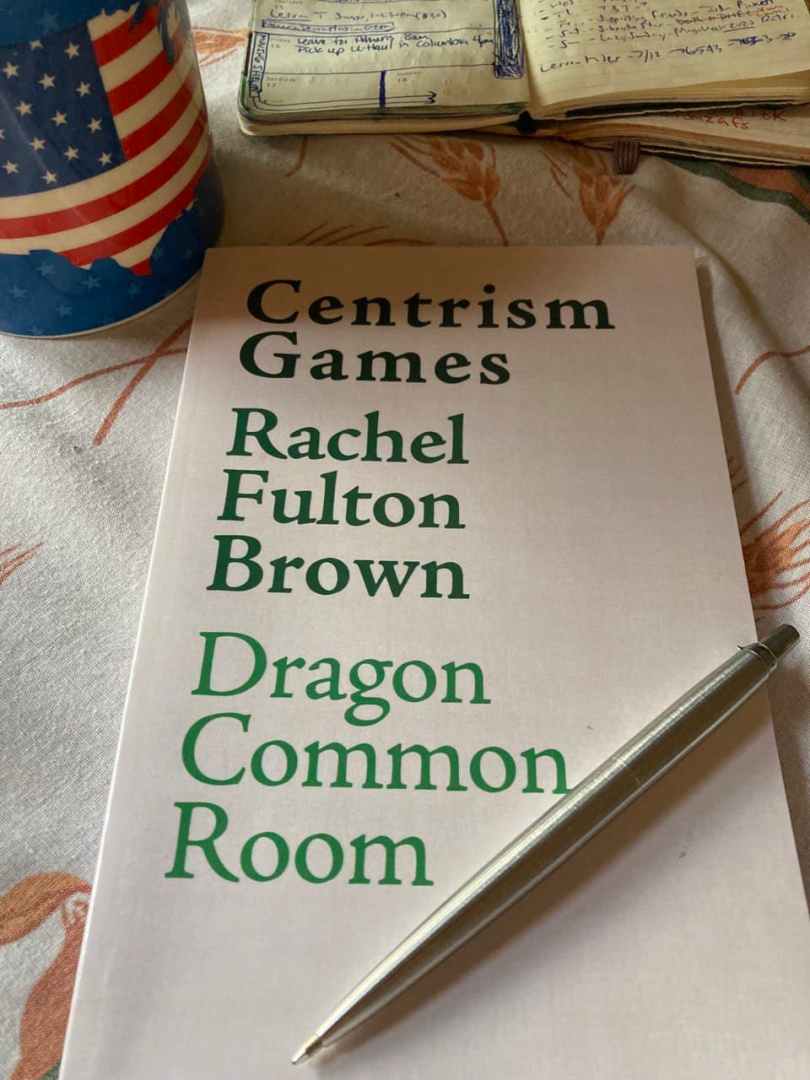
Supporting Friends Friday: Review of Rachel Fulton Brown and Dragon Common Room’s Centrism Games

After sitting with the copy on my nightstand since the book’s debut, I finally sat down and read Rachel Fulton Brown and Dragon Common Room‘s Centrism Games: A Modern Dunciad.  Having read it, my only regret is that I did not do so sooner.

A bit of background is in order:  Dr. Rachel Fulton Brown is a medievalist at the University of Chicago, and is known in our circles as a traditional Christian professor fighting against social justice indoctrination and infiltration of the humanities.

One wouldn’t think the more esoteric realm of medieval history would be a major battleground for the ultra-woke, but it makes sense:  the modern West is profoundly a product of the Middle Ages.  With that in mind, it becomes clear why the progressive revisionists wish to dominate the field:  in rewriting medieval history to fit their woke narrative, it makes the rest of their revisionist project—of casting all white, male, Christian endeavors as inherently wicked—that much easier.

Milo Yiannopoulos’s short book Medieval Rages: Why The Battle for Medieval Studies Matters to America, details that struggle in more detail.  I highly recommend picking it up, as it highlights the length to which the wokesters have gone to silence Dr. Brown.  Correspondingly, it demonstrates Dr. Brown’s incredible courage and fortitude—as well as her cleverly elfish responses to her critics.

Dr. Brown founded a Telegram chatroom, Dragon Common Room, to be a “a place for training in the arts of virtue and poetry. And mischief making for God. We fight the demons with laughter and wit.”  I participate infrequently in chat, but it has become one of my favorites on the platform.  In addition to fighting “demons with laughter and wit,” Dr. Brown and her merry band of righteous mischief-makers wrote, workshopped, edited, and compiled Centrism Games, releasing it as a handsome little volume consisting of seven poems of thirty stanzas each.

The seven poems constitute a mock-epic narrative, modeled after Alexander Pope’s satirical epic The Dunciad.  Whereas Pope’s Dunciad mocked the goddess “Dulness” and her agents, Centrism Games lampoons the goddess Fama—Fame—and her o’er eager knights

Read More »

Lazy Sunday XXXVIII: Best of the Reblogs, Part III

The Lazy Sundays roll on!  Today marks the first Sunday of Advent season, as we metaphorically prepare for the Birth of Our Lord and Savior, Jesus Christ.  But instead of doing a compilation of heartwarming holiday posts, we’re soldiering on with our “Best of the Reblogs” (see Part I and Part II).

  • Reblog: The Normalization of Ugliness Inevitably Becomes The Denigration of Beauty” – This post was a reblog from the ultra-controversial Chateau Heartiste website, which was so full of edgelord red pillery that the SJWs at WordPress finally pulled the plug.  While there was some truly despicable stuff at CH, it also hosted some hard, gut-punching Truths.  The original post argued that we’ve gone to the extreme of accepting all sorts of grotesqueries not just as people, but as the new standard of beauty—to the point that having objectively beautiful people in advertisements is seen as “hate speech.”  Of course we should love all people, but we don’t—and shouldn’t—pretend that everyone is pretty, or that every lifestyle is healthy.
  • Reblog: Conan the Southerner?” – One of the many great posts from The Abbeville Institute, this bit of literary history detailed the development of Conan the Barbarian, and the muscular barbarian’s creator’s origins and upbringing in hardscrabble Texas.  Conan is not just a wildman from the steppes; he’s a man of the Old South.
  • Galaxy Quest II: Cox Blogged” – I wrote a post, “Galaxy Quest,” about our attempts to understand the vastness of our own galaxy.  Longtime blog (and real life) friend Bette Cox linked me to some of her own work on astronomy and cosmology, and this post was an attempt to bring those writings to a (slightly) wider audience.  I’ve been reading Bette’s material for about a year, and had no idea how much she wrote about astronomy, cosmology, and space.

That’s it for this week’s Lazy Sunday.  Enjoy the start of the Christmas season.

Ho ho ho!

—TPP

Other Lazy Sunday Installments:


On Ghost Stories

Yesterday’s post about Father Robert Morey’s courageous stand for the unborn really took off.  Thank you to readers for sharing the post, and thanks to those of you who left comments.  Please continue to keep Father Bob in your prayers.  —TPP

It’s Halloween!  Well, at least it’s All Hallow’s Eve Eve, but that’s close enough for some ghoulishly delicious ghost stories.

I love a good ghost story.  The Victorians did the genre best, but many writers since have honed it further, adding their own unique twists and scares.  Even Russell Kirk, the great conservative philosopher, was a fan of ghost stories.  Indeed, his bestselling book was a ghost story.

For the Victorians, ghost stories were told at Christmastime.  This timing, while peculiar to modern readers, makes sense intuitively—Christmas is a time for remembering the past, in part (perhaps especially) our honored dead (just ask Washington Irvingif he comes by to haunt you).  The “ghosts” of departed loved ones linger closely during those long, frosty nights.  The inherent nostalgia of Christmas and the winter season—and bundling up next to a crackling fire—sets the perfect mood for ghostly tales.

Nevertheless, what other time of year can beat Halloween for a good tale of witches and werewolves; of monsters and mummies; of ghouls, goblins, and ghosts?

Read More »