The State of the Right

A major topic of discussion among conservative and/or non-Left thinkers, bloggers, and political theorists is what exactly makes one a “conservative” (or, perhaps more accurately, what combination of values and axiomatic beliefs constitute “conservatism”).  For the philosophically-minded, it’s an intriguing and edifying activity that forces one to examine one’s convictions, and the sources thereof.

I’ve written extensively about the Left and what motivates it.  To summarize broadly:  the modern progressive Left is motivated, at bottom, by a lust for power (the more cynical of Leftists) and a zealous nihilism.  These motivations take on a Puritan cultural totalitarianism that cannot tolerate even the mildest of dissent.  Witness the many examples of how Leftists across time and nations have devoured their own.

That said, I haven’t written too much lately about what it means to be a conservative.  One reason, I’m sure, is that it’s always more difficult to engage in the oft-painful exercise of self-reflection.  Another is that the lines of conservative thought have been shifting dramatically ever since Trump’s ascendancy in 2015-2016, and the cementing of his control over the Republican Party—the ostensible vehicle for conservative ideology—since then.

As such, in the kind of serendipitous moment that is quite common in blogging, today’s post shares two pieces on the lay of the conservative landscape, and the various factions within the broader conservative movement (and, politically, the Republican Party).

One is, by the standards of the Internet, an old essay by Gavin McInnes, “An Idiot’s Guide to the Right.”  Written in 2014, one month before Republicans would win control of the US Senate, McInnes’s breakdown of the Right is still fairly prescient, although it’s always interesting reading discussions of the conservative movement pre-Trump (McInnes, like many conservatives, hoped and believed that Ted Cruz was the last, best hope of the movement; that was certainly my view well into 2016).

The other is a post from Tax Day, “What’s Right,” by an upcoming blogger, my e-friend photog of Orion’s Cold Fire.  He gives a detailed breakdown of the shifting coalition of the Right at present, and his own “red-pilling” is very similar to my own (indeed, photog and I both fall somewhat on the fringes of the “civic nationlist” camp, with toes cautiously dipped into the parts of the “Dissident Right,” a term itself coined by VDARE.com‘s John Derbyshire).

Traditionally (since the end of the Second World War, that is), the old Republican coalition was a three-legged stool, bringing together economic/fiscal conservatives, social conservatives, and national security conservatives.  In the wake of the Cold War, the first two legs ceded more ground to the national security conservatives, some whom consisted of the much maligned “neoconservatives,” themselves reformed progressives who had been “mugged by reality.”

The neocons would enjoy their ascendancy during the George W. Bush administration, and they tend to be the major proponents of the dying Never Trump movement.  Their vehement hatred of Trump (see also: Bill Kristol, Senator Mitt Romney, and George Will) has largely discredited them, and they’ve shown that their true loyalty is to frosty globalism, not the United States.  They also pine for a mythical form of “decorum” in politics that never truly existed outside of the immediate postwar decades.

photog characterizes this group as essentially less strident Leftists, a group that “doesn’t shrink or grow.”  They were the “we need decorum” crowd that went big for the Never Trumpers, but who have largely made an unsteady cease-fire with the president—for now.  Bill Kristol and Max Boot, the extreme of this group, have essentially become full-fledged Leftists (making Kristol’s latest project, The Bulwark—to protect “conservatism,” ostensibly—all the more laughable).

These are the people that don’t want to vote for Trump, but might anyway, because he’s “morally reprehensible,” which is just their way of saying they think he’s icky and boorish.  These are the upper-middle class white women of the Republican Party, the ones I constantly implore to get over their neo-Victorian sensibilities and stop destroying the Republic from their fainting couches.

The biggest group, per photog, are the Conservative Civic Nationalists.  These are the people that love God and country, and like Trump because he represents the best hope to defend those very things.  McInnes, less perceptively, just calls this groups “Republicans,” although his “Libertarians” might fall into this group, too.  To quote photog at length:

The next big class of people are the Conservative Civic Nationalists.  This is the bulk of the Non-Left.  These are the normal people who have always believed in God and Country and that America was the land of freedom, opportunity and fairness.  They believed that all Americans were lucky to be living in the greatest country on God’s green earth.  They believed that the rule of law under the Constitution and especially the Bill of Rights is what made this the closest thing to heaven on earth and anyone living here should be supremely grateful to the Founding Fathers for inventing it and his own ancestors for coming here.  This is the group that has had the biggest change occur in the last couple of years.  But to define the change let’s break this group into two sub-divisions.  Let’s call them Sleepwalkers and the Red-Pilled.  Back in the early 2000s all the Civic Nationalists (including myself) were Sleepwalkers.

The “Red-Pilled” and “Sleepwalkers” dichotomy is one of the most interesting interpretations I’ve read about the Right lately, and it’s certainly true.  Trump awoke a large group of these Civic Nationalists, people that were disgruntled with the government overreach of the Obama era, but weren’t certain about the way forward.

Like myself, photog is cautiously optimistic that these folks will continue to wake up, bringing along non-political Centrists—the squishy, non-ideological middle—to bolster Trump’s reelection in 2020.  The Left’s relentless push for socialism and transgender bathrooms have done much to red-pill these folks, who find themselves struggling to articulate values that they just implicitly know are good, but which the Left insists on destroying.

There’s still much to be said about the current state of the Right, and I will be delving into it in more depth as the weeks progress.  For now, read these two essays—particularly photog’s—and begin digesting their ideas.  American politics are undergoing a major realignment, and we need people of good faith and values to stand for our nation.  Understanding the state of play is an important part of arming ourselves for the struggle.

Symbolism and Trumpism

Blogger photog at Orion’s Cold Fire often links to noteworthy pieces on American Greatness, the premiere blog for the Trumpist Right.  American Greatness does real yeoman’s work to articulate what Trumpian conservatism is.

His American Greatness Post of the Day for this foggy Monday morning is Robin Burk’s “What Trump Understands that Kevin Williamson Doesn’t.”

Kevin Williamson, you’ll recall, is the house globalist/libertarian for National Review (despite a brief, one-article stint at The Atlantic).  In 2016, he infamously wrote that “dysfunctional, downscale communities… deserve to die.”  He argued that communities like Garbutt, New York—a gypsum boomtown in the nineteenth century that ran its course when the gypsum was gone—have outlived their economic usefulness, and its inhabitants should move elsewhere for opportunity.

There is something to this perspective, but, as Tucker Carlson eloquently noted in an exchange with Ben Shapiro, the neoliberal order and its notions of economic mobility are hugely disruptive to communities.  Families are told, essentially, to leave behind their grandparents’ graves, their Little League teams, their memories, in order to work in service to the gaping maw of some efficiency-maximizing corporate conglomerate.

What Trumpism understands is that, while economies are dynamic, they require strong communities and stable families to maintain.  So it is that Robin Burk argues that Williamson’s libertarian approach lacks any sense of a narrative or symbols.  Williamson is testy because Trump is planning a big military parade (and, presumably, because Trump has been a far more effective advocate for conservatism than Williamson’s angry brand of libertarian orthodoxy).  It seems like wasteful agitprop to him.

What Burk explains in her piece, however, is that a common people need some unifying symbols.  That’s why the NFL National Anthem controversy revealed such deep splits in our culture.  It’s why Americans don’t particularly like it when protesters burn the American Flag.  Yes, it’s constitutional, but that doesn’t mean it’s good—and it’s the literal destruction of one of the most unifying national symbols.

Burk’s focus is more on the local, though, and it’s what makes her piece so interesting.  Communities are built between friends and neighbors.  Yes, the mills shutdown, and some people have to move to look for opportunity.  The mills shutting down also mean some people lose their way, and resort to opiates to numb the pain.

But not everyone can or wants to become economic mercenaries, shifting about rootlessly in search of the highest bidder—or just a job, for that matter.  Some folks want to build a life and a community where their ancestors did.

The implication from neoliberal and libertarian types is that, at best, that desire is unrealistic; at worst, it’s bad:  your loyalty should only be to efficiency!  Efficiency is morality!  While I love efficiency as much as the next cog, efficiency-for-its-own-sake is not and should not be our god.

As Carlson puts it (to paraphrase), we shouldn’t work for capitalism; capitalism should work for us.  Burk adds that we need symbols, formed from and interpreted by our individual experiences and memories, to create a society that fosters the good life.

TBT: Cold Turkey

As the fate of Brexit still hangs in the balance, it seems apropos to look back to a post I wrote shortly after the successful Brexit vote in 2016, “Cold Turkey” (by the way, why is Turkey in NATO again?).  As I wrote then, all of these objections—what’re we going to do about the Irish border, for example—are distractions.  Yes, they might require some sorting out, but just rip off the Band-Aid.  People will find a way to make money.  Europeans will be itching to keep their business in Britain—remember, London is one of the world’s financial capitals—and will find ways to get business done.

The devil’s bargain of the European Union was simple:  give up your freedom and national sovereignty in exchange for sweet government bennies.  The British people chose the better, harder option:  they voted for freedom (and probably government bennies on their own terms, just without European largesse).  Of course, the British people never got to opt-into that bargain; it was thrust upon them after the bait-and-switch of the European Common Market—a good idea!—morphed into an unholy, supranational tyranny.

So, here is 2016’s “Cold Turkey.”  Like any addiction, the best approach is to “just say no”:

Last week, approximately 52% of Brits voted to “Leave” the European Union in a national referendum.  They did so peacefully and democratically.  Already, 23 June 2016 is being hailed as Britain’s “Independence Day.”

I’ve written several posts about Brexit recently (herehere, and here).  Last Friday’s post, which I wrote as the results were coming in Thursday evening, explored why liberty–a vote for “Leave”–was worth the price of temporary economic disruption and, too, of giving up certain “benefits” bestowed to EU citizens.

(A quick aside:  I still find it interesting that a supranational organization that originated as an economic free trade zone evolved into an entity capable of forcing twenty-some-odd nation-states to pool sovereignty; didn’t Europe fight two world wars to prevent Germany from ruling the Continent?  But I digress.)

Based on several comments on my Facebook page, and from personal conversations, it seems that some of my pro-Remain friends and colleagues missed this point, or very candidly admitted that national sovereignty and liberty are not worth the price of sweet EU bennies (one colleague–a reluctant Brit–discounted the entire “Leave” campaign as fundamentally xenophobic and racist, implying that those alleged qualities alone invalidated the entire movement).  To the latter contingent, I can only hope we can agree to disagree.  To the former, allow me to address some points.

“[D]idn’t Europe fight two world wars to prevent Germany from ruling the Continent?”

One poster discussed at length that Brits have “become VERY accustomed to the benefits,” and that, whether they are in the EU or not, they “will still be governed, regulated, and heavily taxed by their own government but no longer enjoy the goodies that come with EU membership!”

Consider, if you will, a drug addict.  Let’s say someone addicted to heroin seeks treatment and begins taking daily doses of methadone.  Would we say, “Oh, well, sure he’s off heroin, but he’s still chemically dependent on methadone, and now he’s missing out on the sweet high that only heroin can provide”?  Or would we continue to encourage this recovering addict to kick his methadone habit, too, and restore a sick, dependent body to healthy independence?

Quit me cold… and don’t let me in the European Union.

Generous government benefits–whether they come from the EU or the British government–might come with some nice “perks” (every pro-Remainer I’ve talked to seems preoccupied with the ability to travel freely through Europe, something most of us plebes haven’t had the luxury of doing without a passport; this, to me, seems to be the definition of a “First World Problem”), but those “goodies” come at a price.  The British people have freely said, “Thanks, but no thanks.”

Naturally, there will be those who will start jonesing for cheap travel opportunities to economically depressed parts of Southern Europe, where they can live out leisurely, government-funded retirements.  There will also be everyday people who still find themselves frustrated by high taxes and tight regulations, and missing out on certain opportunities afforded them by EU membership.

“The Brits have thrown off one level of bureaucracy because… they realized it was not worth the cost.”

But is the solution more regulations and higher taxes?  The Brits have thrown off one level of bureaucracy because, despite the redistribution of wealth it brought (which mostly went away from productive countries like Britain and Germany and to profligate nations like Greece), they realized it was not worth the cost.  One of two things will now happen:  either Brits will demand further deregulation and reform of their own government, which will further ease their burdens and lower costs; or they will make an oft-repeated mistake and demand more redistribution and more taxpayer-funded goodies.

Crucially, though, the choice will be theirs to make.

Leaving the European Union will be like tearing off a bandage.  It will hurt like hell initially–we’re already seeing the effect on markets, which can’t stand uncertainty–but the pain will be fleeting (as I’ve argued in my earlier posts on the topic).

Similarly, any nation facing heavy regulations and stifling taxes can pursue a similar course–if it hasn’t become too hooked already.  “Austerity” failed in Greece not because it demanded that the Greek government stop paying janitors wages comparable to skilled tradesmen; it failed because the Greek government couldn’t kick its habit (and because austerity required tax increases, not stimulating decreases).  The nation–and the Greek people–have become so dependent upon handouts, they can no longer function without huge bailouts from wealthier nations.  That dependency will only perpetuate the cycle of addiction.

The best approach is not more dependency–more bureaucracy, more social programs, more taxes–but quitting cold turkey.  Rip off the Band-Aid, then get back to being free… or end up like Greece.

Hungarian Border Wall is 100% Effective

Pundit Dick Morris has a short piece on his website, DickMorris.com, about the Hungarian border fence.  It’s a quick read, but here are the key excerpts:

Along its 109-mile border with Serbia, Hungary has built a 13-foot-high fence featuring concertina wire (barbed wire in circles). It took six months to build (July-December of 2015) and cost $106 million. It was built by contractors and 900 Hungarian soldiers.

The fence consists of three rows of razor wire with a sturdier 11.5-foot-tall barrier inside….

And the Hungarian fence works! Before the barrier was built, in September of 2015, 138,396 migrants entered Hungary over the Serbian border. Within the first two weeks of November, the average daily flow had dropped to only 15 people.

Hungary and its populist-nationalist leader, President Viktor Orban, have faced a great deal of backlash and scorn from the progressive, bureaucratic autocrats of the European Union for their border control and immigration measures.  But Hungary is intent on keeping itself culturally Hungarian—it cannot effectively absorb the millions of potential migrants that began pouring into Europe from Syria and North Africa a few years ago.

President Orban is often cast as some latter-day Hitler, but he’s merely doing his job:  he’s putting the people of Hungary and their interests first, behind the interests of foreign vagabonds.

While researching this post, I learned that the European People’s Party—an umbrella party of “center-right” parties (as many outlets described it) running in the European Parliament’s elections this May—is barring Orban’s Fidesz Party from participating.  Apparently, part of their concern is that Orban’s Fidesz Party has posted humorous ads depicting George Soros and Jean-Claude Juncker (the Leftist super-villain billionaire and the President of the European Commission, respectively), suggesting the two are in cahoots to control Europe.

Well… aren’t they?  Isn’t the “center-right” European People’s Party supposed to represent a challenge to the Eurocrats (if anyone knows, I’m only asking semi-rhetorically)?

Two takeaways:

1.) Leave Viktor Orban alone.  He’s helped protect his country at a time when other European nations turn blind-eyes to Muslim rape gangs.

2.) The original point of this post:  President Trump can follow the Hungarian model and build an effective wall on the cheap.  Granted, we have more than 109 miles, but copy-paste that approach along our long border with Mexico, and could get the job done quickly and efficiently.

Open borders and progressive politics are the real dangers to liberty and prosperity, not an unabashed nationalist in Central Europe—or one in the United States.  Build the Wall, Drain the Swamp, and Leave the European Union!

Academic Leftism’s Sour Grapes

I received the following piece from a colleague at one of the schools where I teach.  The piece, entitled “The Academy is Unstable and Degrading. Historians Should Take over the Government Instead,” is indicative of how utterly clueless Leftist intellectuals are to their own dominance of not only academia, but the culture and government as well.

The author, Dr. Daniel Bessner, is an assistant professor of American foreign policy at the University of Washington, and, as he makes clear from the piece, an avowed socialist.  Indeed, the crux of the op-ed is as follows:  the academy is crumbling, as tenure-track jobs disappear (and, presumably, as Americans are wising up to its intense Leftist slant and poor track record in re: the job market), meaning Leftist “public intellectuals” need to find new worlds to conquer.  Dr. Bessner proposes the government.

In his diagnosis of the academy’s ills, he argues that the Left has focused too much on taking over the English Department (it’s at least refreshing to read a Leftist acknowledge that it was a self-conscious, deliberate march through the institutions), and not enough taking over the State Department, as it were.

He then proceeds to detail how libertarians moved from the fringes of political opinion to their relative ubiquity today, discussing the influence of Murray Rothbard and the Left’s favorite billionaire boogiemen, the Koch Brothers.

What’s rich about all this hand-wringing is the utter lack of self-awareness.  What about the legions of left-leaning banksters and billionaires pouring money into progressive organizations and schemes?  George Soros is our “boogieman” of the Left, but consider the entire entertainment, corporate (especially “Big Tech“), and academic apparatuses that are arrayed in favor of progressivism’s cause du jour.

The Left has dominated the culture from multiple perches for decades.  If the academy is falling into ruinous disrepair, it’s because Leftists have been running it since the 1960s.  They have only themselves to blame for the drying up of tenure-track gigs, rising tuition, and useless “assistant vice deans of diversity, inclusions, and LGBTQ2+MMORPG acceptance” positions.

One final note:  if President Trump were the dictator these Leftists soy boys make him out to be, they wouldn’t be identifying openly as socialists, nor would they be espousing a socialist agenda—as Dr. Bessner does in this piece—openly online.  That Dr. Bessner does so also demonstrates how successful his comrades have been at normalizing a fundamentally ruinous ideology in the United States (see also:  crazy-eyed Congressbabe Alexandria Ocasio-Cortez, poster-child for over-credentialed, arrogant college grads who base their entire lives off what they learned in an English 101 survey course from an angry, radical adjunct).

God help us all if Dr. Bessner and his ilk insinuate themselves further into the government.  Drain the Swamp, President Trump!

Banned! Techno-Elites Deplatform Alex Jones

The explosive news Monday was that tech giants Facebook, Spotify, YouTube, and Apple banned Alex Jones and Infowars from their respective platforms.  While Jones is a controversial figure who peddles in rumor, conspiracy, and innuendo, the concerted action from separately-owned and -managed Silicon Valley entities is unsettling.

Historian Victor Davis Hanson wrote a piece for National Review arguing that Silicon Valley giants should be regulated—or even busted up—to prevent monopolistic and anti-competitive practices, drawing parallels to the muckraking reformers of the early twentieth century who brought down Standard Oil.   I’m wary of such solutions-by-government, but Hanson was anticipating a problem that has become all-too familiar:  the massive social and cultural clout the unmoored tech giants wield.

Steven Crowder of online late-night show Louder with Crowder often pokes fun at—and complains loudly about—the various murky “terms and services” and “community guidelines” rules that are ever-shifting in continuously updated apps and platforms.  A slight change in a Facebook algorithm—or a Twitter employee having a bad day—can lead to massive reductions in traffic for a YouTuber or blogger.  Reduced—or eliminated—traffic means less revenue.  YouTubers like Crowder who helped build the platform now find their videos demonetized for the most mysterious of reasons.

Candace Owens was kicked from Twitter because she rewrote recent New York Times hire and anti-white racist Sarah Jeong’s tweets by replacing disparaging uses of “white” with “black” or “Jew.”  Razorfirst posted a video some months ago of him literally just talking about nonsense for five minutes… and it was immediately demonetized.

Now Alex Jones is banned across multiple platforms from multiple platforms—which is absolutely chilling.  Jones is certainly not without controversy, and I wouldn’t take his ramblings to heart without a heaping helping of salt, but just because he’s a kinda nutty conspiracy kook who enjoys ripping his shirt off doesn’t make his situation any less terrible.  If we write off Jones because he was “asking for it” by being kooky, then we’re missing the whole point of free speech.

And, yes, the usual objections are inevitable:  “but, TPP, the First Amendment speech protections only apply to the government!  Companies can set whatever guidelines they want!  You can use some other platform!  He still has his website.”  Yes, yes, yes, and yes—all true.  Nevertheless, the arbitrary power we’ve voluntarily—if unwittingly—yielded to these tech elites is staggering.  And this preponderance of power may be where Hanson has a point.

Is not the function of the government to protect the rights of its citizens from threats and violations, both foreign and domestic?  In this case, arbitrary bans—particularly these coordinated attacks on controversial figures—seem to be a powerful means of preventing an individual and/or entity from delivering his message in the public square.  Like the street corner doomsayer, Alex Jones has a right to be heard, even if he’s sometimes insane (for me, the jury is out on Jones; I enjoy the entertainment value of his commentary, and I think he’s probably right about 80% of the time, but then he veers off into crisis actors, etc.—the danger of a man who is charismatic and convincing).

Today, it’s a relatively buffoonish character like Jones.  Tomorrow—who knows?  Do we really want to find out?  “Hate speech” is a code word for silencing conservatives.  It’s better to publish one racist screed from a lonely nut (not referencing Jones here, to be clear) than to muzzle millions because their innocuous, mainstream conservative viewpoint might been interpreted as a “dog-whistle.”

Sunlight is the best disinfectant, and it’s often better to give madmen the rope with which to hang themselves.  When we try to silence them, they only gain in credibility (indeed, when I read the news, I immediately went… to Infowars!).

Numbers Don’t Lie – The Electoral College

Pollster Scott Rasmussen writes a brief, daily post for Ballotpedia called “Number of the Day.”  It’s an excellent, bite-sized chunk o’ statistical knowledge that gives an enlightening view of our nation from one of America’s great polltakers.

Monday’s “Number of the Day” was “49.5% of the U.S. Population Will Live in Eight States by 2040“—and continued with a discussion of the Electoral College.

For the unfamiliar, the Electoral College takes a lot of heat, usually from progressives (and especially so since President Trump won the 2016 election in the Electoral College, but lost the popular vote by margin of some millions).  There have been multiple attempts to abolish the Electoral College throughout American history, with the most successful effort coming after Richard Nixon’s electoral victory in 1968 (of course, that effort failed—fortunately).  Critics argue that the institution is “undemocratic,” as it seems to violate the principle of “one person, one vote.”

Fortunately, the Framers of the Constitution were wise enough to realize the pitfalls of popular democracy, which they believed devolved into mob rule and, ultimately, tyranny (see also:  the French Revolution), and also anticipated the dangers of a small group of urban voters being able to swing presidential elections at the expense of voters in rural States.

It is precisely this fear that Rasmussen’s demographic data highlights.  Rasmussen writes that nearly half of the nation’s population will live in one of eight States by 2040:  California, Texas, Florida, New York, Pennsylvania, Georgia, Illinois, and North Carolina.  That means that, in a popular system, those States could nearly swing a presidential election themselves.

Some readers might object that those voters are not uniform, and a popular vote would put a State like Wyoming more into play (as those ~600,000 voters—projected to be around 688,000 in 2040), but that assumes a level of individuality that, while attractive to the libertarian-minded, is not realistic.

Rural sections of the country have different goals, values, and concerns than urban centers.  A State with one or more major metropolitan areas would dominate national politics.

Rasmussen touches on this dynamic in Congress, too.  Currently, large States enjoy a huge advantage in the House of Representatives, the most “democratic” chamber at the federal level.  Small States, on the other hand, possess greater leverage in the Senate, where every State gets two Senators, regardless of population.  California—with its fifty-three Congressmen—can run roughshod over Wyoming in the House, but California’s Senators have the same clout as Wyoming’s two.

In essence, then, the different sections of the country have to reach some level of compromise to accomplish anything.  Rural States have to throw urban States a bone to get legislation passed in the House, and urban States have to support some rural State measures.

Indeed, this is largely how the farm bill and food stamps get passed:  rural Republicans vote for food stamps for the urban poor, and urban Democrats vote for corn subsidies for rural farmers.

That’s all Civics 101, but, as Dr. Samuel Johnson wrote, “People need to be reminded more often than they need to be instructed.”

A final thought:  what happens when rural-urban compromise breaks down?  The values of the rural portions of the country—chiefly the South and Midwest—are increasingly at odds with the values of the bicoastal elites and their scattered archipelago of continental metropolises.  In that case, shouldn’t we throw out the system, as we’ll just get gridlock?

To quote the Apostle Paul, “God forbid!”  That divide highlights the necessity of separation of powers.  I’d rather not have a demiqueer otherkin alternative poetess-programmer (that’s the most ridiculous caricature I could conjure up) and xyr pansexual two-spirited Wookie life-mate ramming ultra-leftist progressive policies up my butt like a hamster at their next vegan pottery party, just as I’m sure the Wookie life-mates wouldn’t want me dictating my rustic Biblical morality to them (but, just so we’re clear, you people have lost your way).

The only major threat, as I see it, is that Congress has so abdicated its responsibility to the executive branch and its unelected bureaucracy of careerist swamp creatures, that we could see the further rise of executive overreach.  That’s why progressives howl at the moon in protest to President Trump—they think he’s going to wield the sword of executive power against them the way President Obama did against us.

But with the Deep State so ensconced in our national life, I sometimes fear that we’re living in pre-Augustusean times.  In the meantime, let us hope President Trump can correct the course; that Congress will once again jealously guard its prerogatives; and that the Electoral College stands for centuries to come.

TBT: Capitalism Needs Social Conservatism

On Tuesday, I wrote about the “Human Toll of Globalization“—the dire consequences, both economic and moral, that befall a community when its primary economic engine is gutted through a naïve faith in unbridled free trade and globalization.  Another title for that piece might be almost a mirror of this essay’s from 2016:  “Civil Society Needs Cash.”

I don’t want to take that argument too far, though.  In the case of Danville, Virginia—and countless other American towns that have seen their prosperity flee abroad, or to bicoastal urban cloisters—a decaying economy wrought decaying morality, civil society, and civic pride.  That would suggest that prosperity, in and itself, cannot sustain true morality and virtue.

Indeed, as I argue in the essay below, “Capitalism Needs Social Conservatism,” excessive prosperity and material comfort breed a kind of moral complacency, what Kenneth Minogue likened to widespread Epicureanism (an excellent essay, and well worth reading if you don’t mind subscribing to The New Criterion, which is also worth the price).  Richard Weaver—one of my intellectual heroes—compared the material comfort of the then-mid-twentieth-century West to a drunk who, having grown addicted to alcohol, and requiring ever-greater quantities of it, no longer has the capacity to obtain the very substance he craves.

Milton Friedman famously argued that economic liberty is a necessary precursor to political liberty.  Similarly, I would argue that morality and virtue are necessary pillars to sustaining economic liberty for any length of time.  Indeed, George Washington argued that religion and public morality were “indispensable” to a self-governing republic.

In my mind, the orthodox libertarian (in the political sense, not the “free-will” libertarianism of the free-will-versus-determinism debate in modern philosophy) commits the same error as the orthodox Marxist in relying too much on economic analysis of behavior.  The idea of the “rational man” or “man as a rational animal” is a uniquely modern concept, and while Westerners have tried hard to shoe-horn themselves into that mold, the inner, teeming depths of our souls are still pre-rationalist.  We need God, and we still live according to symbols, rituals, and virtues.

As I wrote in 2016, “Without moral common ground and shared values that stress self-control, liberty rapidly turns to libertinism.  Libertinism without a great deal of wealth leads to shattered lives, which in turn wreck families and communities.”  I’ll explore these ideas further in my upcoming eBook, Values Have Consequences.

***

For the past week, I’ve written about the decline of the nuclear family, with follow-up posts about divorce and sex education, and about the negative impact of the of the welfare state on family formation.  These post have generated some wonderful discussions and input from followers, and I’ve been surprised by their popularity.

As I wrote in “Values Have Consequences,” I’m devoting Friday posts to discussions of social conservatism.  Social conservatism is increasingly the red-headed stepchild of the traditional Republican “tripod” coalition that also includes national security and economic conservatives (with the rise of Trump, populist nationalism could count as a fourth leg).  Politically, this marginalization makes some sense, as it’s not likely that fifty or sixty years of cultural attitudes and values will be changed at the ballot box.

Nevertheless, social conservatism is an important leg of the tripod.  Indeed, I would argue that the three coalitions are not at odds, but create logical synergies that allow each leg to stand.  The stool is much more stable when the three legs work together.

Economic conservatism–by which I mean the belief that freer markets, fewer and lighter regulations, and lower taxes, or what is more properly called neoliberalism (after the classical liberalism of the 18th-century thinkers like Adam Smith)–is wonderful and hugely important.  It’s led to massive gains domestically and globally, lifting untold millions off people out of poverty.  It allows people to enjoy a greater variety of goods and labor-saving devices, and provides more leisure time (and plenty of things to do during that time).

But free markets unmoored from guiding principles, strong and stable institutions, and the rule of law can morph into mindless Mammon worship.  Without a shared sense of trust and belief in human dignity, capitalism becomes cold and abstract.

Further, full-fledged economic liberalization without the limiting principles applied by constitutionalism and a morality supported by strong families and a robust civil society can lead to socially-destructive disruptions and behaviors.

As I’ve argued many times, making mistakes or bad choices is the necessary price of liberty.  But for self-government to work effectively–and to avoid social instability–a healthy dose of social conservatism is the best medicine.

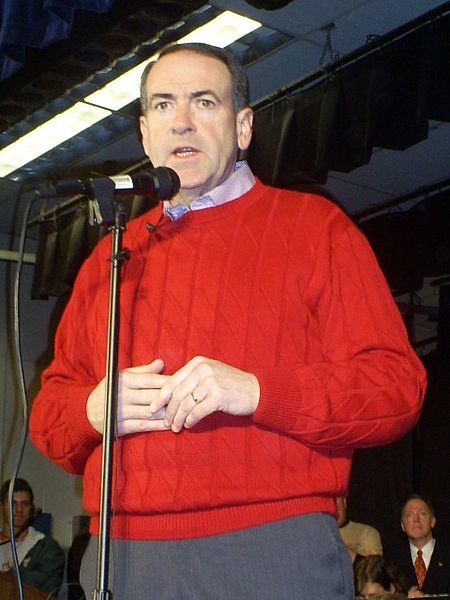
Former Arkansas Governor Mike Huckabee wears the most socially conservative outfit ever; later, he played bass on Fox News.
(Image Sourcehttps://en.wikipedia.org/wiki/File:Huckabeemike.JPG; photo by Craig Michaud)

To offer an illustration from recent history, contrast the post-Soviet experiences of Poland (and most of Eastern Europe) with that of Russia.  Despite decades under Communism–an ideology that was aggressively atheistic, stressing loyalty to the state and Communist Party over all else–Poland roared back into the West.  It adopted neoliberal (modern conservative) economic policies, and was one of the few European nations not to suffer severely during the Great Recession.

Russia similarly adopted “shock therapy” after the Soviet Union collapsed for good in 1991.  Rather than experiencing a huge economic boom, however, well-connected former Communists and others close to the old regime made off like bandits, leaving most Russians left holding the bag.

What’s the difference?  For one, the Russians lived under Communism for nearly a generation longer than the Poles, meaning there were several generations of downtrodden, state-dependent Russians by the time the USSR collapsed.  Many of these Russians were unable to adjust to a free-market system after living in a closed economy for so long.

Another key difference–and one that I think is extremely significant–is that Russians lost any scrap of civil society they might have possessed prior to the Bolshevik takeover in late 1917.  Civil society–the institutions between the basic family unit and the government, like churches, schools, clubs, civic organizations, etc.–was automatically preempted when every club, organization, or activity became part of the Soviet government.  The severely crippled (and, as I understand it, collaborationist) Russian Orthodox Church was unable or unwilling to push back against Soviet rule, providing little in the way of a spiritual alternative to the totalizing influence of Communism.

“[F]ree markets unmoored from guiding principles, strong and stable institutions, and the rule of law can morph into mindless Mammon worship.”

Poland, on the other hand, managed to maintain its deep Catholic faith.  The Catholic Church as an international organization (and with powerful, influential popes, most notably the Polish anti-Communist John Paul II) could never be wiped out completely by Soviet Communism.  Further, the Poles formed the Solidarity trades union movement, which offered an alternative to official Communist organizations.

Thus, after the dissolution of the Soviet Union, Poland emerged with a strong civil society anchored in a richly Christian worldview and ethic.  The shared sense of morality–one that stresses mutual respect, the dignity of human life, and the importance of honesty–allowed the complex deals and uptempo economic exchanges of capitalism to occur smoothly and rapidly.  From these civil and religious values came a firmer grasp of and respect for the rule of law, making predictable economic activity and long-term planning possible.

Russia, on the other hand, devolved into a fast-paced, nationwide run on the national cupboard.  Those with good connections grabbed whatever public funds and goodies they could.  Normal Russians couldn’t figure out why their government checks and free lunches stopped coming, and couldn’t understand why (or how) to pay taxes.  With the collapse of the Soviet Union, all civic organizations ceased to exist, because they were all part of the Soviet government.  Without any civil society or other enduring institutions to model good behavior and to stress and enforce moral values, Russia struggled–and continues to do so–to adapt to global capitalism and democracy.  Not surprisingly, they’ve turned to a dictatorial strongman for guidance.

***

What of the American context?  As I’ve written before, I’m skeptical of full-fledged libertarianism–what I would broadly define as the marriage of economically conservative and socially liberal views–because it fails to acknowledge the need for strong moral values to uphold its own economic assumptionsLiberty and self-government can only really work when coupled with self-imposed order and restraint.  Without moral common ground and shared values that stress self-control, liberty rapidly turns to libertinism.  Libertinism without a great deal of wealth leads to shattered lives, which in turn wreck families and communities.

Eventually, unbridled, unchecked lasciviousness–even among (formerly) responsible adults–results in social chaos, requiring a dwindling number of hardworking, honest, and thrifty individuals to pay for the ramifications of poor moral choices that have been magnified many times over.

“[L]ibertarianism… fails to acknowledge the need for strong moral values to uphold its own economic assumptions.  Liberty and self-government can only really work when coupled with self-imposed order and restraint.”

Capitalism’s blessing of unparalleled abundance is also a potential curse.  Without a strong civil society that stresses good moral values–and without proper historical perspective–it becomes easy to take that abundance for granted.

That abundance also allows, for a time, more and more individuals to pay for the price of bad decisions.  Prior to the modern era, few people were wealthy enough to risk the negative consequences of immorality.  Now, Americans and Westerners enjoy a level of material comfort and well-being that can absorb at least some of the unpleasantness of questionable choices.  Over time, however, that security breaks down.

Richard Weaver likened the situation to an alcoholic who is so addicted to his drink, he’s unable to do the work necessary to pay for his addiction.  The more he needs the alcohol, the less capable he becomes of obtaining it.  Likewise, the more individuals become addicted to luxuries, the less able they are to work hard to maintain them.

To avoid the fate of Weaver’s drunk, we must recognize the importance of social conservatism.  While we should maximize individual liberty as much as possible, and within the bounds of the Constitution, we should also stress the moral and religious underpinnings that make that liberty both possible and responsible.

TBT: Economics: A Human Science

The unofficial, unintentional theme of this week’s posts have been about economics in general (other than Tuesday’s SCOTUS piece)—the power of tax cuts, the potential upsides to tariffs, etc.  In that spirit, I thought for week’s post about diving back into a piece that reflects my gradually evolving thinking about economics.

The summer before my sophomore year of college, I read the second edition of Milton Friedman’s Capitalism and Freedom, a work that completely revolutionized how I thought about the world and economics.  Free-market principles became my lodestar, and colored my ideology for a decade.  Indeed, I still adhere to these principles when it comes to economic questions.

However, as I grew older and (hopefully) more experienced, I began to realize that neoliberal economic theory, while elegant, is not always hard-and-fast, and that there are many more wrinkles to economic issues than appear at first glance.  I don’t believe in overcomplicating things—again, cutting taxes tends to stimulate economic growth—but most issues contain a frisson of nuance that is easy to miss.

I’d long held to the idea that free trade is a largely unalloyed good, and that the short-term costs of lost jobs or reduced wages in some industries domestically would be made up for by increased efficiency of production and the rise of new, better industries.  Sure, there’d be some friction in the duration, but people will manage, and we can always throw some funds for reeducation their way.

While I think such disruption is inevitable, I don’t think we should embrace it so blindly that we forget about the people who find themselves out of work, or in a position that they can’t modify their skillsets to find a new job.  I live in the rural South, and there are hundreds of little towns that dried up once the mill the left, the railroad shut down, or the big family farms sold off.  Part of that story is the onward march of Time and economic progress—and the drama of human history.  But part of it is the story of globalist elites selling out Middle America.

This situation is not one merely of tariffs, taxes, and the like, but also of a radical ideology that would see national borders dissolved and massive immigration—even illegal immigration—encouraged.  I am libertarian on many issues, but the pitfall of modern economic libertarianism—and there are many—is that it only conceives of issues in terms of economic efficiency (and, if you get right down to it, it’s inverted Marxism, to the extent that, for Marxists, everything is about economics—or, more properly, materialism).  And, yes, generally greater efficiency means greater quality of life, but economics is not always the clean, elegant science that its proponents claim it to be.

To that end, I argue that economics, properly considered, should be considered part of the humanities, as it deals in a direct, visceral way with the people’s lives.

I don’t know the precise balancing act, or what should be achieved.  I highly recommend reading Patrick J. Buchanan’s The Death of the West for a more complete treatment of how to revive wages for workers while maintaining a high degree of quality and efficiency.  I don’t agree with all of Buchanan’s proposals, which are heavily influenced by Catholic social teachings, but there is an appeal to the idea that, if the government is going to interfere in the economy (and it is, and does), then it should be in favor of workers and families, not at their expense.

Finally, I wrote this essay in the context of the Brexit vote—which I intend to write an eBook on soon—and the arguments I was hearing about the economic catastrophe Brexit would be (that hasn’t been the case yet).  I argued, essentially, that the liberty and national sovereignty are more important than sweet European Union bennies and transfer-of-wealth payments.  The EU is a despicable organization as it currently operates, and as a lover of liberty, I’m thrilled to see nationalist-populist movements rising in major European countries.  I don’t agree with all of these groups or their policies (many of which are socialistic in nature), but the impulse towards greater national sovereignty is, in general, a healthy one in our age of excessive globalization and unelected supranational tyrants.

With that lengthy introduction, I give you 24 June 2016’s “Economics: A Human Science“:

If you’ve read my blog the past couple of weeks, you know that I am strongly in favor of Brexit, or Great Britain voting to “Leave” the European Union.  I’ve laid out my reasons here and here.  As I write this post, results are trickling in on that historic vote, and I am intermittently checking them with great interest–and not a small bit of trepidation.  Right now (about 10:30 PM EST/-5 GMT), “Leave” has a slight edge, but the outcome is too close to call.

Already, though, the British pound and the euro have taken a beating in value, as gold prices soar (this blog is conservative in viewpoint, so I probably should start urging you to buy gold, guns, and freeze-dried food reserves; sourcehttp://www.bloomberg.com/news/articles/2016-06-23/pound-surge-builds-as-polls-show-u-k-to-remain-in-eu-yen-slips).  One of the major bogeymen of the “Remain” side in the referendum was the threat of economic downturn.  As I conceded in both of my previous posts on Brexit, there will no doubt be major economic disruption should Britain vote to “Leave.”  However, a (likely temporary) drop in the value of the pound sterling is a price well paid for restored national sovereignty.

God Save the Queen… and Great Britain from the clutches of Eurozone bureaucrats

As conservatives, we’re accustomed to viewing economics–or, at least, economic growth–as a positive good.  After all, we believe in the power of free markets to satisfy human needs and desires, and to innovate new ideas and products that alleviate human suffering, drudgery, and toil.  Conservative politicians tend to focus on job growth and prudent deregulation–often coupled with tax and spending cuts–as perennial, bread-and-butter issues that directly affect voters’ pocketbooks for the better.

 “…these [fiscal] policies are not about making gobs of cash… but about what those gobs can do to improve lives.”

But economics, like much else, is not a means unto itself.  The reason conservatives like economic growth–besides, well, making money–is that it demonstrably improves people’s lives.  Deregulation, similarly, can work beneficially (if you doubt me, just ask anyone who has ever dealt with the Affordable Care Act and the Department of Health and Human Services).  In essence, these policies are not about making gobs of cash–although that is certainly nice–but about what those gobs can do to improve lives.

Thus, we have a stark contrast between the organic, healthy, occasionally unpredictable economic growth of a free market and the regimented, inequitable, limited economic growth of progressive corporatism.  Our current economic environment, I fear, is far closer to the latter than the former.  Complex, heavy regulations benefit larger firms and discourage the formation of smaller, newer firms by raising the upfront costs of entry.  Perverse incentives raise the costs of healthcare for young, fit Americans, while making it unrealistically cheaper for older, sicker, chubbier patients.  Overly-generous social safety benefits (some of which, like the food stamp program SNAP, the government actively advertises and encourages people to use) discourage able-bodied Americans from pursuing work.

I could go on (and on… and on).  In short, conservatives are used to being correct on principle and on economic outcomes.  Typically, conservative fiscal policies align with, rather than try to manipulate, economic realities, so the outcomes of those policies tend to be both principled and positive.

“As fiscal conservatives… let us never lose sight of the human side of economics.”

In the case of Brexit, however, the quest for restored sovereignty–a stand on an important first principle–will result in some negative economic outcomes.  A major argument of the “Remain” side is that staying in the European Union will preserve Britain’s economic stability and ensure it a place in a European common market.

Such an argument is seductive, but it leads to a gilded cage.  Nobel Prize-winning economist Milton Friedman famously said that economic freedom is a necessary precursor to, though not a guarantor of, political freedom.  With Brexit, the axiom is almost reversed–by reclaiming its political freedom, Britain will then be able to pursue renewed economic freedom.

As fiscal conservatives–or those that support free markets, freer trade, and light regulations–let us never lose sight of the human side of economics.  We too often treat economics as a science.  Instead, it should find a home alongside the humanities.

Our chief aim should be to unleash human potential.  So liberated, its creativity and ingenuity can lift human life to greater heights.

We already have a model:  we’ve been doing it in the United States for over 200 years.

TBT: Happy Birthday, America!

Two years ago, I dedicated my Fourth of July post to analyzing Lincoln’s Gettysburg Address.  In the spirit of MAGA Week 2018—and to preserve the TPP TBT tradition—I’m re-posting that classic post today.

A major theme of the blog posts from that summer was the idea of America as a nation, an idea I still find endlessly compelling.  The election of President Trump in November 2016 has reinvigorated public debates about the nature of American nationalism, as well as revived, at least partially, a spirit of unabashed patriotism.

As a child, I took it for granted that America was a special place.  When I learned American history as a child, I learned the heroic tales of our Founders.  While revisionist historians certainly have been correct in pointing out the faults of some of these men, I believe it is entirely appropriate to teach children—who are incapable of understanding such nuance—a positive, patriotic view of American history.  We shouldn’t lie to them, but there’s nothing wrong with educating them that, despite its flaws, America is pretty great.

Today the United States of America celebrates 240 years of liberty.  240 years ago, Americans boldly banded together to create the greatest nation ever brought forth on this earth.

They did so at the height of their mother country’s dominance.  Great Britain emerged from the French and Indian War in 1763 as the preeminent global power.  Americans had fought in the war, which was international in scope but fought primarily in British North America.  After Britain’s stunning, come-from-behind victory, Americans never felt prouder to be English.

Thirteen short years later, Americans made the unprecedented move to declare their independence.  Then, only twenty years after the Treaty of Paris of 1763 that ended the French and Indian War, another Treaty of Paris (1783) officially ended the American Revolution, extending formal diplomatic recognition to the young United States.  The rapidity of this world-historic shift reflects the deep respect for liberty and the rule of law that beat in the breasts of Americans throughout the original thirteen colonies.

America is founded on ideas, spelled out in the Declaration of Independence and given institutional form and legal protection by the Constitution.  Values–not specific ethnicity–would come to form a new, distinctly American nationalism, one that has created enduring freedom.

***

Rather than rehash these ideas, however, I’d instead like to treat you to the greatest political speech ever given in the English language.  It’s all the more remarkable because it continues to inspire even when read silently.  I’m writing, of course, about Abraham Lincoln’s Gettysburg Address.  Here is the transcript (Source:  http://www.gettysburg.com/bog/address.htm):
“Four score and seven years ago, our fathers brought forth on this continent a new nation: conceived in liberty, and dedicated to the proposition that all men are created equal.

“Now we are engaged in a great civil war. . .testing whether that nation, or any nation so conceived and so dedicated. . . can long endure. We are met on a great battlefield of that war.

“We have come to dedicate a portion of that field as a final resting place for those who here gave their lives that that nation might live. It is altogether fitting and proper that we should do this.

“But, in a larger sense, we cannot dedicate. . .we cannot consecrate. . . we cannot hallow this ground. The brave men, living and dead, who struggled here have consecrated it, far above our poor power to add or detract. The world will little note, nor long remember, what we say here, but it can never forget what they did here. It is for us the living, rather, to be dedicated here to the unfinished work which they who fought here have thus far so nobly advanced.

“It is rather for us to be here dedicated to the great task remaining before us. . .that from these honored dead we take increased devotion to that cause for which they gave the last full measure of devotion. . . that we here highly resolve that these dead shall not have died in vain. . . that this nation, under God, shall have a new birth of freedom. . . and that government of the people. . .by the people. . .for the people. . . shall not perish from the earth. “

 ***
The Gettysburg Address is elegant in its simplicity.  At less than 300 words, it was a remarkably short speech for the time (political and commemorative speeches often ran to two or three hours).  Yet its power is undiminished all these years later.  President Lincoln was only wrong about one thing:  the claim that the “world will little note, nor long remember, what we say here” has proven untrue.
I will likely write a deeper analysis of the Address in November to commemorate its delivery; in the meantime, I ask you to read and reread the speech, and to reflect on its timeless truths.
God Bless America!
–TPP
To read different versions of the Gettysburg Address–there are several versions extant–check out this excellent page from Abraham Lincoln Online:  http://www.abrahamlincolnonline.org/lincoln/speeches/gettysburg.htm.