Election Season 2020: Iowa Caucuses

After all the anticipation, it’s finally here—the proper beginning of the 2020 presidential election.  The Iowa caucuses kick off tonight, and there’s no telling how it’s all going to shake out (although it looks like Bernie is on track to have a good night).

The Iowa caucuses work differently than the primaries in other States.  Scott Rasmussen’s Number of the Day today explains the process succinctly.  Essentially, if a candidate does not receive 15% of the votes at a precinct, his or her supporters must recast their votes for one of the remaining candidates.  That means that, while a candidate always wants to be a voter’s first choice, being the second choice can still work well.  It also makes it possible to see where support will go if a candidate drops out.

Read More »

Tucker Carlson’s Platform for Victory in 2020

Tucker Carlson is the gift that keeps on giving.  In a segment from last week, the populist-friendly television host offered up a winning strategy for President Trump—and a warning.

In essence:  while economic numbers are very good, many of Trump’s base of supporters—the working and middle classes—are still struggling, or at least perceive that they are.  In a longer piece from Joel Kotkin (also on Carlson’s Daily Caller website), the author argues that the tensions between the Trumpian lower classes and the ascendant upper class is akin to the friction between the French Third Estate (the commoners) and the First and Second Estates (the aristocracy and the clergy) just prior to the French Revolution.

Read More »

TBT: Tom Steyer’s Belt

Like many bloggers, I wrote a “2019’s Top Five Posts” feature to acknowledge the most-trafficked posts of the year.  One of the surprise sleeper hits was this post, “Tom Steyer’s Belt.”

I wrote this piece on September 30, 2019, largely as a cheeky throwaway.  It didn’t seem to get much traffic initially, but that’s true of many of my posts.

Then, probably in late November, but certainly by December, I noticed something:  it was getting a handful of clicks everyday.  It was just a few at first—maybe four or five, sometimes less—but then the views grew.

Now I’m getting dozens of views everyday from this post alone—usually more than fifty!  As the Democratic primaries approach and challengers drop out, Tom Steyer and his stupid belt continue to hang in there, running ads all over the place.

Perhaps not surprisingly, other people want to know the meaning behind the belt.  According to my WordPress analytics—limited as they are—a few of the clicks to my piece come from the search terms “why does Tom Steyer wear that stupid belt” and “Tom Steyer’s stupid belt.”  Less judgmental permutations also bring up my site.

The belt has, apparently, captured the nation’s imagination (and, presumably, Steyer’s waist):  it has its own Facebook page, where “The Belt” posts hilarious comments.

Well, at least some good will come from Steyer’s campaign—a good laugh at a clueless Leftie’s expense.

Here’s 2019’s “Tom Steyer’s Belt“—now the most popular post on The Portly Politico:

When I was in college, I formed this ridiculous pseudo-band with a suitemate of mine (who has, apparently, now gone down some dark roads) called Blasphemy’s Belt, which my bio on another band’s website refers to as an “electro-pop humor duo.”  I can’t remember how we came up with the name—our music wasn’t particularly or purposefully blasphemous (or good), and while we wore belts, they weren’t outrageous (just to keep our pants up)—but it was apparently catchy enough that people picked up on it.

The Belt never performed live, other than for an annoyed roommate, and a highly grating pop-up concert (at least, that’s what hipsters would call it nowadays) on our floor’s study room, but we generated enough buzz to get people to vote for us in a “Best of Columbia” survey in The Free Times.  We didn’t win anything, but it was an object lesson in how enough hype can make people believe you have substance when you really don’t.

That’s my self-indulgent way to introduce some literal navel-gazing—at Democratic hopeful and wealthy scold Tom Steyer‘s virtue-signallingsanctimonious belt.

Tom Steyer is a former hedge fund manager and current environmentalist nutcase who, along with half of the population of the United States, is running for the Democratic presidential primary in 2020.  Unlike Blasphemy’s Belt, nobody knows who he is; I don’t even think he qualified for the debates. Unfortunately, he’s trying to rectify that by running incessant ads on Hulu.

I’ve seen enough attack ads from Democrats to tune them out—they’re just a more overt form of the dishonesty progressives usually engage in—but Steyer’s ad brings bile to my throat.  It’s not because of his ludicrous claims (that President Trump is a “fraud and a failure”), idiotic as they are.

It’s because of his stupid belt.

Tom Steyer has no chance in the Democratic primary because a.) he’s unknown; b.) he’s an old white guy and c.) he’s not the old white guy who was President Obama’s VP.  As such, he no name recognition or intersectionality points.  He’s not even a pretend Indian like Elizabeth Warren.  He wears a blue button-up shirt with rolled-up sleeves and jeans in his commercials—the default uniform of politicians trying to appeal to the working man—and is utterly forgettable.

Except for that belt!

Here is the one picture I could find of it online, and it’s just a picture of someone’s television showing the ad (care of a Kenyan newspaper):

Steyer Belt.jpg

Here is an excerpt from the article (again, it’s from a Kenyan newspaper, so the written English is prone to syntactical errors):

The Presidential hopeful revealed while responding to a curious netizen who inquired the significance of the belt since he had worn it in one of his campaign videos.

Steyer noted that he bought the belt during his visit to Kenya.

“Thanks for noticing my favorite belt! I bought it on a trip to Kenya from female artisans,” he tweeted.

Additionally, he affirmed that the belt is a reminder that the world benefits when women are educated, as the belt was made by female artisans.

“I wear it as a reminder not to be so formal, and also as a symbol that the world is a better place when we educate women and girls,” he mentioned.

This kind of pandering makes my skin crawl.  Look, I have nothing against unusual belts.  But you look at a guy like Tom Steyer wearing this ridiculous belt in a campaign ad for president, and you know he’s trying to virtue-signal.  He said as much in the excerpt above—“I like the belt, but I also want to show how progressive I am by buying colorful belts from African women.”

His very sartorial choice is a political statement.  If you’re a punk rocker, yeah, you’re showing your disdain for order with your outrageous duds.  But you’re not likely to run for President of the United States (that would be too normie and conformist—being a part of the system, rather than trying to tear it all down).

Also, how much education does it take for a Kenyan woman to make a weird belt?  She probably learned how to do it from her mother, not from a progressive public school (there, she’d just learn to resent her skillfulness making belts as a form of patriarchal, white oppression—then no belts would get made at all).

Mostly, though, Steyer’s belt highlights his own clueless elitism.  Nobody cares about your belt you picked up at some street bazaar on a luxury safari in Kenya.

Clothes say a great deal about a man (or woman).  I feel better about myself when I’m dressed well (and it’s not 8000 degrees and 400% humidity outside).  I, too, have an unusual little ornament that I sometimes wear, that often draws attention—but it’s way more endearing than some empty gesture of my multicultural bona fides.

Years ago, I had a student who was obsessed with South Korean culture and music.  She especially loved a K-pop group called Exo—basically a Korean boy band.  Before a big concert, she asked if I’d wear an Exo tie if she bought me one; naturally, I said yes.

A couple of weeks later she came to be with a little felt bag.  She explained that Exo did not have ties, but they did have tie clips.  I pulled from the bag a little piece of silver-colored metal, with a button-sized picture of Korean teen heartthrobs.

I wear it frequently, as it’s functional (it holds my ties in place) and a conversation starter.  It’s always fun to tell, as I lead with, “Oh, it’s a Korean boy band” so I get weird stares, then I tell the story above, which is an endearing example of a close and respectful student-teacher relationship.

I’m not saying I’m immune from self-righteous outbursts, but I don’t politicize a sweet, unique gift from a student (it also doesn’t look like I’m wearing the clothing of another culture in order to make myself appear more diverse and progressive).  If I wore that tie clip in a political ad (a distinct possibility), no one would be able to tell that there are ten Korean boys on it (at least, I hope not!).  Tom Steyer knows people will see his colorful, clearly-exotic belt, and he’s banking on progressive voters saying, “Wow, this old white Wall Street hedge fund manager is really down with the struggle.”

Perhaps, like the great David Carradine, Steyer’s ham-fisted belt will be his undoing.  Then again, he was never really done up in the first place.

Destroying Marriage with the Flip of a Coin

Today’s post is something straight out of Dalrock’s excellent blog:  a couple in Florida decided to take the last name of whoever won a coin toss.

Here is the image from the article:

A picture is worth a thousand soyboys.  I sent this article to my younger brother, sister-in-law, and girlfriend yesterday, and my brother commented, “The entire aesthetic of the lady officiant makes me think of one of these dystopian sci-fi settings where there’s one secular religion imposed by the State.”  Amen.

I will add:  the bride’s (Darcy’s) reaction to winning the coin toss speaks volumes.  She’s clearly gloating at winning an arbitrary coin toss that strips her husband of his last remaining shred of masculine dignity.  And the look on the groom’s (Jeff’s) face suggests he is not pleased with the outcome.

Of course, Jeff will never admit this fact.  Here is a particularly cringe-inducing excerpt:

At the altar of their Dec. 14 wedding, they flipped a brass, engraved medallion, one side with Darcy’s last name, and the other with Jeff’s surname.

“It’s fair. I am a graduate student in economics at Florida State and I think about fairness,” Jeff told the Palm Beach Post.

“Being with someone who was willing to start the marriage from a creative and teamwork and fair place felt like a really good first step toward an equal partnership,” Darcy, a nurse-midwife, added.

When the time came, it was Darcy’s name that won out. Mr. and Mrs. Ward were thrilled with the result.

“You could say I won,” Jeff said. “I was the one who received something new.”

The phrase “I am a graduate student in economics at Florida State and I think about fairness” perfectly encapsulates the clueless virtue-signalling of noodle-wristed academics.  Jeff is saying, “I’m smart, so I know better than centuries of tradition.”

His claim that he “won” because he “received something new” is protesting too much.  Jeff knows that what he and his wife have done is ludicrous—otherwise it wouldn’t make the New York Post—and emasculating, so he’s attempting to save face with a ex post facto justification.

The hyphenation of last names, or wives keeping their maiden names, may seem like a small personal choice, but it’s one of the thousand little cuts against traditional marriage.  Marriage is the coming together of two people into one, with the husband as the spiritual leader.  Taking her husband’s last name is a significant demonstration of devotion and fidelity.  It also serves the practical purpose of confirming paternity and keeping fathers responsible to their children.

It might seem like I’m making a big deal over a small decision—“it’s just a name, TPP.”  Well, what’s in a name?  Surely there is some symbolic and practical significance to taking a husband’s name.

Further, I’d be more amenable to such arguments if we hadn’t seen the systematic destruction of marriage over the last 100 years.  That destruction began with baby steps.  Anything we can do to shore up traditional marriage is a positive good.

I completely understand the special cases:  academics retaining their maiden names professionally, for example.  But a wife should not begrudge her husband for becoming one with him—that’s a recipe for a failed marriage.  Besides, no kid wants to be saddled with a hyphenated last name.

Let’s hope Jeff and Darcy make it.  My instincts tell me they won’t.  Darcy is clearly the “man” in this relationship, and Jeff is not.  Whether they realize it or not, that’s going to breed a great deal of unhappiness and strife.

I hope I’m wrong, for their sake.

The Enduring Legacy of Milton Friedman

One of the major debates on the Right over the past year or so has been the efficacy of libertarianism.  Part of that debate arises from disagreement about the role of government:  should it attempt to be neutral, as libertarians argue (which, we have seen, it is not), or should it act in the “common good” (or, as the Constitution puts it, the “common welfare”)?  In a world in which the Left wins victory after victory in the long culture wars, the assumptions of the “New Right” that arose following the Second World War are increasingly called into question.

Among those assumptions are libertarian economics.  Increasingly, conservatives are adopting a more suspicious view of concepts like supply-side economics and free-market capitalism.  That suspicion is not because capitalism is a failure, per se, but because it is almost too successful:  the wealth and prosperity it brings have also brought substantial social and cultural upheaval.  Because capitalism is an impersonal and amoral system, it doesn’t make value judgments about what is “good” or “bad” in the context of marketplace exchanges.  The Market itself is the highest “good,” so any hindrance to its efficiency is bad.

Ergo, we see arguments in favor of legalized prostitution, legalized hard drugs, legalized abortion, etc.  Again, if market efficiency is the greatest good, then why not allow these “victimless” activities?

Of course, unbridled libertarianism is doomed to fail, especially as it scales up.  Legalized hard drug use might keep junkies out of prison, but we don’t want heroine addicts buying their next hit at the grocery store.  Prostitution destroys families and the lives of the women (and men) involved, and spread disease.  Abortion is straight-up murder.

Capitalism cannot sustain itself in a vacuum.  It needs socially conservative behaviors and attitudes to sustain it.  If one wanted to live in a stateless libertarian paradise, one would need a small, tight-knit community in which everyone bought into the non-aggression principle and agreed to be honest in business dealings.  But as soon as one person decided not to abide by the unwritten social code, the entire experiment would unravel, like that scene in Demolition Man when the effeminate police force doesn’t know how to use force to subdue a violent criminal.

But for all of those critiques, capitalism remains the best system we’ve ever developed.  I agree with Tucker Carlson that the economy is a tool, not an ends to itself, but if government interferes too much with the tool, the tool is no longer effective.  If anything, the economy is a chainsaw:  too much regulation and the engine stalls and the blades become dull due to misuse and neglect; too little regulation and you lose an arm (or your life), even if you cut down a ton of trees in the process.

One of the most powerful books I ever read was Milton Friedman’s Capitalism and Freedom (1962).  It transformed the way I viewed the relationship between the government and economics.  Friedman would have a huge impact on my life and my thought.  While I don’t agree with all of his conclusions, I still largely accept his conclusions.

Friedman was a minimalist when it came to government power, but he still recognized some role for government:  maintaining the national defense, combating pollution, and fighting against infectious diseases.

Here is a 1999 interview with Milton Friedman, from the excellent Uncommon Knowledge series, hosted by Peter Robinson.  It highlights some common objections to libertarian economic ideas, as we as Friedman’s thoughtful, nuanced responses:

For what it’s worth, I’ll add that Peter Robinson is a fantastic interview.  He possesses that perfect quality in an interviewer:  he doesn’t steal the limelight.  I grew so weary of Eric Metaxas‘s interviews, not because his guests were uninteresting—he has great guests!—but because he can’t help but talk over them constantly (his penchant for campiness also goes a bit overboard, and I love that kind of cheesy stuff).  After listening to some of Peter Robinson’s interviews Sunday afternoon, I never found myself wishing he would shut up—always a good sign.

Regardless, these are some weighty issues.  I have been hard on libertarians over the past year because I think they tend to reduce complex issues to supply and demand curves, and I can’t help but notice how we keep losing ground in the culture wars by espousing endless process and slow persuasion (which seems to be stalling in its effectiveness).

On the other hand, I’m glad that conservatives don’t wield power the way progressives do; as Gavin McInnes once put it in a video (one I would never be able to locate now) after the 2016 election, Trump and conservatives have sheathed the sword of power.  Progressives, masters of psychological projection, expected Trump to come out swinging, because that’s what they would do.

I just don’t know how long we can delay them from swinging the sword again, and after Trump’s unlikely victory (and his likely reelection), I imagine progressives will no longer even engage in the pretense of even-handedness and fair play:  they will crush us relentlessly if given the chance, rather than face an uprising again.

Libertarianism doesn’t have the answer to what to do to prevent that scenario.  Unfortunately, I’m not sure any faction on the Right does—at least not in any way that is palatable.

Thanksgiving Week!

It’s Thanksgiving Week!  November is flying by; Halloween Week (and Halloween!) seem like yesterday.  Yesterday was a crisp, autumnal day, a brief respite of warmth before cold weather returned to South Carolina this morning.

As a teacher, one of my favorite “weeks” of the school year is this one.  I put “weeks” in quotation marks because, from a teaching perspective, this isn’t truly a “week,” or even a “short week” (four days, such as the Labor Day holiday early in the academic year).  Instead, it’s two days of either cramming in tests and material, or of laconically drifting into the glorious Thanksgiving Break.

Read More »

Election Results 2019

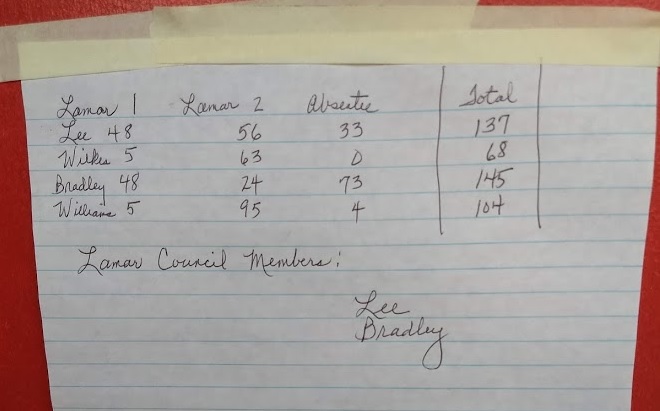
Yesterday Lamar, South Carolina held elections for Town Council.  Since our local paper doesn’t seem to be putting the results online, I thought I would post them here.

I drove by Town Hall last night to check the results, but they were still working on finalizing the results when I drove by, and I lacked the will to drag myself out of the house again.  But I swung by this morning and photographed the official receipt from the machine, as well as the handwritten results (akin to a student council election), which were posted to the front door:

My strategy of voting for the challengers in a “Jacksonian spirit of rotation in office” failed, as the two incumbents sailed to reelection.  As such, Town Council is unchanged.

Read More »

Lazy Sunday XXXIV: The Desperate Search for Meaning Series

Next to Halloween and Christmas, today is the most wonderful of the year—it’s the day that the clock falls back an hour!  Sure, that means I’ll never see the sun for the next few months, as I’ll spend the dwindling daylight hours inside a classroom, but at least I got an extra hour of sleep this morning.

This week saw a good bit of reflecting on what is important in life (like ghost stories), so I thought it would be a good opportunity to reflect on “The Desperate Search for Meaning” series of posts.  It will also help to aggregate those posts into one place.

  • The Desperate Search for Meaning” – The post that started this impromptu series (and the subject of this week’s Flashback Friday featurette), this essay was about a New Age healer, Audrey Kitching, who exploited vulnerable women into working in slave-like conditions.  Kitching bamboozled these women with her gauzy, neo-spiritualist babble; her thin sense of meaning of belonging roped them in, as they desperately attempted to fill a void in their lives—and that doesn’t even include all the women who bought Kitching’s fraudulent products.  It’s a sad story, one I think is indicative of our times.
  • The Desperate Search for Meaning, Part II” – This piece was about a crazy old lady who believes that cancer can be extruded from the body through a series of energy-channeling motions—at least on the surface.  The real focus was that, while this old loon was going through her bizarre ritual, she espoused a cult of death:  having babies is bad because of overpopulation.  It’s the religion of environmentalism, one of the several cults of modern progressivism.  It is a deadly ideology that is, essentially, anti-human.
  • The Desperate Search for Meaning, Part III: Progressive Power Crystal” – This post looked at an LA Times piece on New Age spirituality, and how it was replacing traditional Christianity as the “faith” of young Americans.  That’s all tied up with progressivism’s imperial and totalitarian ambitions—all off these anti-Christian, anti-American movements are of a piece, serving similar ends.  As I write at the end of the post:

    “Even if our elites aren’t specifically Satanists, they’re certainly not Christians.  Their religion is progressivism, an jumble of ideologies that, at bottoms, rejects Christianity and its view of human nature.  Their gods are power and envy—just like Lucifer.”

  • The Desperate Search for Meaning IV: Vanity” – This piece pulled from a sermon my pastor gave on Ecclesiastes, one of my favorite books of the Bible.  Ecclesiastes is a work of philosophy, in which King Solomon examines his life and finds that all of his pursuits are, ultimately, meaningless:  he will die, and everything he experienced and built will eventually disappear.  Therefore, his only true meaning comes through God.  It’s the earliest form of Christian existentialism ever written (with apologies to Søren Kierkegaard).  It’s also a powerful reminder that this world, in which we are so involved, is fleeting.

That’s it for this Sunday.  Going back through this posts really makes my soul ache for the people that fall for New Age nonsense and neo-paganism.  Good thing I’ve found the One True Faith—the Southern branch of the Free Will Baptist denomination. 😀

Happy Sunday!

—TPP

Other Lazy Sunday Installments:

Climate Hysteria Robs Us of Joy

Growing up, I received my fair share of public school climate indoctrination.  My generation cut its teeth on Captain Planet, the eco-propaganda cartoon that, among other things, scolded Americans for using too many resources and having too many babies.  Fast forward to today, and those arguments are mainstream.

In fact, I remember my dad telling me that Captain Planet was Ted Turner‘s ham-fisted attempt at indoctrinating kids—one of the first times I vividly remember learning that the elites were lying to us.  The finger-wagging, puritanical nagging of environmentalists further pushed me away from eco-hysteria.

Still, we were always taught that the oceans were dying, that fresh water was scarce, etc.  Well, thanks to Quora, some easy math shows us that God’s Creation is abundant enough.

Read More »

TBT: More Never Trump Treachery

With all the impeachment talk swirling, I thought it would be worth it to look back at a piece I wrote in May, focusing on squishy Michigan Congressman Justin Amash, the so-called “libertarian Republican,” as an example of the kind of bitter Never Trumpery that is champing at the bit to see President Trump impeached.

At that time, Amash argued that President Trump’s conduct was impeachable—not any actual crimes he committed, just that the way he comports himself is impeachable.  This claim coming from a guy who allegedly supports the Constitution.

Acting like a boor is not an impeachable offense.  It falls well below the bar of “high crimes and misdemeanors” set by the Constitution.  Further, President Trump’s phone calls to the Ukraine and Australia certainly fall well below that bar; I don’t even think he did anything wrong.

Read More »