It seems that a third of Republicans surveyed would be willing to make a personal contribution (or pay more in taxes; it’s a bit unclear which) to build the border wall.
Meanwhile, 97% voters opposed to President Trump also oppose funding the border wall.
I’m open to the argument that the wall might not be an effective enforcement tool—to be clear, I disagree with that argument, but I understand where its proponents are coming from—but I suspect that’s not the case for the bulk of that 97%.
A border is one of the most basic elements of what makes a state a state—or a nation a nation. It’s inherent in the definition of what it means to be a sovereign state.
Yes, I’m familiar with the usual objections: it’s expensive; modern air travel would diminish a wall’s effectiveness; technology can fill the same role. But an actual, physical wall is a powerful symbol that America takes border enforcement seriously, that as a nation we not only will build physical barriers to keep out dishonest invaders, we’ll also enforce those laws on the books.
The message to the world for the past thirty years has been “we have laws, but they’re just a suggestion; get here, and we’ll figure out how to keep you in and get you bennies.” A wall sends a different message: “if you’re going to come, you’d better do it right. Don’t think about sneaking in.”
In short, if there’s a GoFundMe or Kickstarter for the border wall, I’ll pitch in. Every patriot should—and would. Or President Trump can stick to his guns, refuse any budget deal that doesn’t fund at least part of the wall, and keep his greatest campaign promise.
Build the Wall!
UPDATE: after writing this post, but before it was published, I happened to receive an e-mail from a friend to a fundraiser to raise $1 billion toward the Border Wall. You can contribute to it here: https://ca.gofundme.com/TheTrumpWall
I typically avoid wading into fashionable-for-the-moment moral crusades, but the hysteria over children being separated from their parents at the border is ludicrous, and demonstrates the typical “facts over feelings” emotionalism that mars our immigration debate. That feel-goodism is why we’re even in this mess—if it can be characterized as such—in the first place.
Because I’ll be deemed a monster—“Won’t somebody please think of the children!“—for not unequivocally denouncing this Clinton-era policy, I’ll issue the usual, tedious disclaimers: yes, it’s all very tragic; yes, it could be handled better; yes, I would have been terrified to be separated from my parents at such a young age; etc.
Now that the genuflecting to popular pieties is out of the way, let me get to my point: this entire situation would be a non-issue if we had simply enforced our immigration laws consistently for the past thirty years. President Trump isn’t the villain here (if anything, Congress is—they can take immediate action to change the policy or come up with some alternative—but I don’t even think they’re wrong this time); rather, the villains are all those who—in the vague name of “humanity” and “human rights”—ignored illegal immigration (or, worse, actively condoned it).
Sadly, it is an issue. But what else are we to do? Years of non-enforcement have sent the implicit but clear message to potential illegal immigrants that we don’t take our own borders (and, by extension, our national sovereignty and rule of law) seriously, and that if you’re sympathetic enough, you’ll get to skip the line. Folks come up from Mexico and Central America fully expecting that, after some brief official unpleasantness, they can dissolve into the vastness of the United States and begin sending remittances back to their relatives—who may then pull up stakes and come.
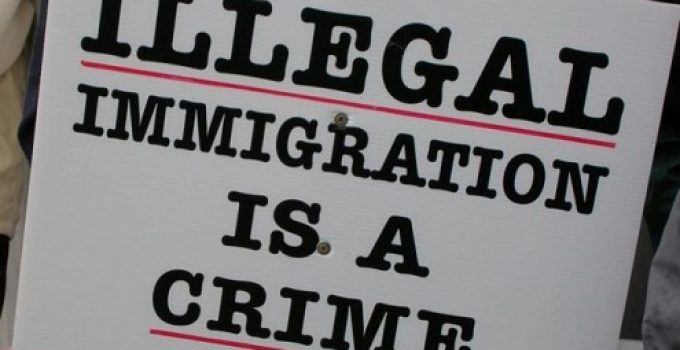
Further, sneaking into the country illegally is a crime, and the United States has every right to enforce its laws, including those pertaining to immigration. Mexico, similarly, has that right—and uses it unabashedly to police its own border (or to let Central American migrants waltz through on their way to the Estados Unidos). Naturally, the punishment for breaking laws is often detainment, and the kiddies don’t join dad in his cell.
To give a common example: what happens to the children of, say, an American heroin dealer when he’s arrested and sentenced to ten years in a drug bust? His children—if they have no relatives willing or able to take them in—go into the foster care system. It’s tragic, it’s terrible, but it’s part of the price of committing a felony. No one wants it to happen, but it’s a consequence of one’s actions. This reason is why crime is so detrimental to society at large, even beyond the immediate victims.
Unfortunately, a combination of winking at immigration enforcement (“eh, come on—you won’t get deported”), feel-good bullcrap (as my Mom would call it), and Emma Lazarus Syndrome (trademarked to The Portly Politico, 2018) have contributed to the current nightmare situation. Now that an administration is in office that actually enforces the duly legislated law of the land—and at a point at which the problem has ballooned to epic proportions due to past lax enforcement—the problem is far thornier and more consumed with emotional and moral peril.
As any self-governing, self-sufficient adult understands, sometimes doing what is necessary is hard. I do feel for these children who are stripped from their parents arms (although, it should be noted, usually for only a matter of hours), but who cares about my feelings? We can have compassion for those who try to arrive here illegally, as well as their children, without attempting to take on all of their problems, and without sacrificing our national sovereignty and our laws in the process.
The United States is the most generous nation in the world—and the most prosperous—but we cannot take everyone in; to do so would not make everyone else better off, but would rather destroy what makes America the land of compassion, liberty, prosperity, and charity that it is.
***
For further reference, I recommend the following videos, the first from the brilliant Ben Shapiro, the second from Dilbert creator Scott Adams:



 The Portly Politico