The Influence of Christianity on America’s Founding

The following remarks were delivered on 10 December 2018 to the Darlington County and the Florence County Republican Parties (South Carolina) at their joint Christmas party.  This talk was a very cursory overview of a complicated topic, but I had to address it in about eight minutes to a room full of people who just wanted to eat barbecue and have a good time, not hear a minutiae-laden history lecture.  The talk derives primarily from Dr. Mark David Hall’s Heritage Foundation lecture “Did America Have a Christian Founding?” (PDF) I highly encourage readers to investigate that source, as it addresses the issue more completely.

I’ve been asked to speak briefly tonight about the influence of Christianity on America’s Founding.  Given the Christmas season, and the continuing culture war that attempts to revise Christianity’s impact out of our history and the public sphere, this topic is particularly germane.

For tonight’s remarks, I’ve drawn heavily—and almost exclusively—from a Heritage Foundation lecture delivered in May 2011 entitled “Did America Have a Christian Founding?” (PDF)  The lecturer, Dr. Mark David Hall, focuses on a few major points to argue that, while it’s a bit complicated, the influence of Christianity on the Founding generation and the Framers of the Constitution was intense and profound.

The notion of a “wall of separation between Church and State” comes from a letter Thomas Jefferson wrote to a congregation of Baptists in Danbury, Connecticut.  It was the only time Jefferson used the phrase in writing, though Supreme Court justices beginning in the 1940s began to latch onto the idea as if it represented the entirety of late-18th-century opinion on the matter.  In fact, almost all of the Framers of the Constitution believed that government should encourage Christianity wherever possible.  They simply believed that such support for churches should occur at the local and State levels, not the federal.

This belief explains the relative silence of the Constitution on the matter of religion:  when the Framers drafted the document, they intended it to create a very limited federal government, one that would largely stay out of issues that the States were more equipped to handle.  When it came to established churches at the State level, the assumption was not that they were a de facto good; rather, the argument for or against establishment boiled down to “what is best to support Christianity generally?”  Some States, particularly in New England, had established churches—thus the chafing of the Danbury Baptists—but other States simply required individuals to pay a tax to support their individual denomination.

Now, to be clear:  I’m not advocating we return to the establishment of official denominations at the State level—the government can barely issue driver’s licenses effectively, and I sure don’t want them sniffing around the church collection plate—but the point here is that the Framers viewed State and local establishment as a profoundly in line with both the Constitution and the desire to preserve Christian principles.  Even Jefferson, the famous Deist among the Founders, hosted the Reverend John Leland, and had the reverend open a session of Congress with prayer.  Jefferson refused to declare days of thanksgiving and fasting—a custom established under Washington and continued after Jefferson left office—but he did so on purely constitutional grounds:  he didn’t think he had the authority.  Even then, he still observed days that, in all but name, had the same intent.

I’ve focused tonight largely on Christianity’s influence during and after debate and ratification of the Constitution.  I’ll close with a brief examination of the American Revolution.  As Christians will know, Romans 13 requires us to submit to higher authorities.  But theologians from John Calvin forward began arguing that, in some cases, a Christian might be allowed to resist an ungodly ruler, and some theologians began to argue affirmatively that they a Christian would be required to resist such a ruler.

The influence of Calvinism was so widespread by the beginning of the Revolution that King George III allegedly called it “a Presbyterian Rebellion.”  More notably, the Declaration of Independence clearly invokes “nature’s God.”  While some scholars have contended that such phrases as “Supreme Judge” and “Providence” are spiritual-sounding weasel-words used to refer to a theoretical or philosophical concept of “God,” Americans at the time would have understood them as references to the Christian God, the Holy Trinity.

There are, of course, endless vignettes from the Revolution that suggest God’s Hand in the proceedings—the unlikely fog that allowed Washington and his men to escape Manhattan Island, for example—but, from the historical record, it seems abundantly clear that, while the Founding generation was tolerant of other faiths, it was comprised of an overwhelmingly Christian people.  Our government was built on the assumption that thus we would remain.  As Washington noted in his Farewell Address, “religion and morality” were the “indispensable supports” of our constitutional system.

Veterans’ Day 2018, Commemoration of the Great War, and Poppies

The following remarks were delivered to the Florence County Republican Party at its 12 November 2018 monthly program, which was dedicated to honoring veterans.

Yesterday Americans, Europeans, and the world commemorated the 100th anniversary of the end of the Great War, what we call the First World War.  The Armistice that silenced the guns of one of the most brutal conflicts in human history was signed in the wee hours of 11 November 1918, but did not take effect until 11 AM—the eleventh hour of the eleventh day of the eleventh month.  That bit of numerical symmetry, while memorable, cost an additional 2738 lives, with 10,944 casualties—a pointless denouement to a destructive war.

Peace would ultimately come to Europe—after three prolongations of the Armistice—in 1920 with the ratification of the Treaty of Versailles (the United States, refusing to join the League of Nations, negotiated a separate treaty with Germany, the Treaty of Berlin, in 1921).  That treaty, which the Germans called the Diktat because of its severity, and because it pinned the war solely on the German Empire, was a reflection of the Armistice signed three years earlier.

In preparing tonight’s remarks, I came across an article that describes the first meeting between Marshall Foch, the commander-in-chief of the Allied forces, and Matthias Erzberger, a middle-aged German politician who had come to sue for peace.  The Frenchman looked stonily at the German peace delegation, and said, “Tell these gentlemen I have no proposals to make.”  Rather, Marshal Foch had a number of demands to issue, thirty-four in total, including Germany’s agreement to pay heavy reparations.

In hindsight, we know the folly of trying to squeeze blood and treasure from the turnip that was a starving, reduced Germany—and the radicalism it, in part, inspired.  But we have to understand, as best we can, the bitterness and weariness the Great War wrought.  Millions of men in Europe had lost their lives, or were maimed for life, fighting in the war.  The republican governments of France and Britain were not willing to accept peace without something to show for it; their people (and voters) would not have accepted it.  Indeed, Marshall Foch told his staff he intended “to pursue the Feldgrauen [field grays, or German soldiers] with a sword at their backs” until the moment the Armistice went into effect.  One cannot help but wonder that the fighting in this final hours was motivated, in part, by a mutual bloodlust, and an opportunity to settle scores one last time before the clock struck eleven.

From the grime and death of the Great War, however, grew new hope—a hope for peace, yes, but also a hope that humanity could avoid such a devastating conflict again.  That hope—and the enduring hope for a world built on peace and understanding—is poignantly symbolized in the flowering of the churned up “No Man’s Land,” the pock-marked area between Allied and German trenches.  Immortalized in Canadian Lieutenant-Colonel John McCrae’s “In Flanders Fields,” poppies were first flowers to bloom in that graveyard of Western civilization.  To this day, the crimson of the poppies serves as a reminder of the men who made the ultimate sacrifice for their countries, and that even in death, life endures.

I will close this somewhat grim Historical Moment with a brief reading of that poem; it can commemorate the men there far better than I:

In Flanders fields the poppies blow
Between the crosses, row on row,
That mark our place; and in the sky
The larks, still bravely singing, fly
Scarce heard amid the guns below.

We are the Dead. Short days ago
We lived, felt dawn, saw sunset glow,
Loved and were loved, and now we lie
In Flanders fields.

Take up our quarrel with the foe:
To you from failing hands we throw
The torch; be yours to hold it high.
If ye break faith with us who die
We shall not sleep, though poppies grow
In Flanders fields.


Lincoln on Education

The following is adapted from remarks to the Florence County (SC) Republican Party on the evening of 10 September 2018.  The monthly program featured members of and candidates for the local school board, so I spoke briefly about President Abraham Lincoln’s education, and his views thereof.

We’re gathered here tonight to hear from members of and candidates for School Board; in that spirit, I’d like to speak briefly about education, particularly the education of the first Republican President, Abraham Lincoln.

From what I’ve read, Lincoln’s entire formal education consisted of around a year of schooling.  He would have a week or two here and there throughout his childhood in Kentucky and Indiana, and then return to working on the family’s farm.

Despite little formal education, Lincoln taught himself throughout his life.  He loved to read, and would read deeply on a variety of subjects, obtaining books whenever and wherever he could.  One of his contemporaries commented that “I never saw Abe after he was twelve that he didn’t have a book in his hand or in his pocket. It didn’t seem natural to see a feller read like that.”  When he sat for the bar exam, he’d read law books on his own time to prepare.

Lincoln also believed in education as a source of patriotism, morality, and self-improvement—what we might call “upward mobility.”  He was not a man who wanted to stay on the farm, and his self-education was a means to escape poverty.

If you’ll indulge me, I’d like to quote Lincoln at length from his 1832 speech “To the People of Sangamo County”:

“Upon the subject of education, not presuming to dictate any plan or system respecting it, I can only say that I view it as the most important subject which we as a people can be engaged in. That every man may receive at least, a moderate education, and thereby be enabled to read the histories of his own and other countries, by which he may duly appreciate the value of our free institutions, appears to be an object of vital importance, even on this account alone, to say nothing of the advantages and satisfaction to be derived from all being able to read the scriptures and other works, both of a religious and moral nature, for themselves. For my part, I desire to see the time when education, and by its means, morality, sobriety, enterprise and industry, shall become much more general than at present, and should be gratified to have it in my power to contribute something to the advancement of any measure which might have a tendency to accelerate the happy period.”

Here we can see Lincoln’s belief that education lays the foundation for patriotism—we understand our freedoms better when we understood what they cost, and that others lack them.  We see, too, the power of education to teach us the virtuous and the good.  From that morality flows, as Lincoln said, “sobriety, enterprise, and industry,” the tripartite tools to improve our material conditions.

Patriotism, morality, and industry—these were the three benefits of education Lincoln espoused.  Coming from the man who wrote the Gettysburg Address, I think we should take Lincoln’s views on education seriously.

Historical Moment – The Formation of the Republican Party

I’ve missed two days—this past Friday and yesterday—due to back-to-school insanity, coupled with returning to my flood-prone abode (and celebrating my niece’s third birthday).  School starts back Wednesday, and some online courses I teach at a local technical college launched yesterday, so I may be adopting a new posting schedule soon—probably one or two pieces a week, or some shorter posts.  Stay tuned.

In the meantime, here is a transcript of remarks I gave to the Florence County Republican Party last night.  Our guest speaker for our monthly program was South Carolina Republican Party Chairman Drew McKissick, a man with a genius for grassroots organizing.  As such, I decided to talk about the formation of the Republican Party back in 1854.  Enjoy!  –TPP

There is some disagreement about exactly when and where the Republican Party first originated.  The national GOP website says the Party came into being in Jackson, Michigan, on 6 July 1854.  The anti-slavery convention, also called the “Under the Oaks” convention because the conventioneers met in an oak grove, nominated statewide candidates, and their Convention Platform read, “we will cooperate and be known as REPUBLICANS.”

The South Carolina GOP website, on the other hand, points to a meeting in Ripon, Wisconsin, earlier in 1854, where a group of abolitionists met to fight the expansion of slavery, although it also mentions the Jackson, Michigan convention was when the Party was “formally organized.”  Two years later, Philadelphia hosted the first Republican National Convention, which nominated John C. Fremont as the first Republican candidate for President.

Regardless of where the GOP formally began, the climate for its formation was eerily similar to our own political situation.  The “peculiar institution” of slavery bitterly divided the country.  The Kansas-Nebraska Act of 1854, the brainchild of Democratic Senator Stephen Douglas of Illinois, proposed applying “popular sovereignty” to western territories; essentially, territories would decide whether to allow slavery, or remain “free soil.”

That Act embroiled Kansas in a bloody guerrilla war between pro-slavery “Fire-Eaters” and radical abolitionists, the latter of whom sent “Beecher’s Bibles”—rifles—to free soilers attempting to keep the territory free.  In 1856, John Brown, the deranged abolitionist, and his sons massacred pro-slavery advocates with swords in the Pottawatomie Massacre, a retaliation for an earlier attack on the abolitionists.

The old Whig Party, originally organized in protest over the policies Democratic President Andrew Jackson, collapsed over the issue of slavery and “popular sovereignty.”  The conditions were ripe for a new party to emerge, one dedicated to “Free Soil, Free Labor, and Free Men” (not quite as catchy as “Make America Great Again,” but it explained the Republican Party’s platform succinctly).

Over the course of the 1850s, the young Republican Party spread rapidly throughout Northern States, bringing together abolitionists, anti-slavery Democrats, and other constituencies disillusioned with the Democratic Party’s policies on slavery and the economy.  The Republican Party from its inception opposed the expansion, if not always the outright abolition, of slavery, and hoped to keep it out of any new territories.  Southern Democrats so feared a Republican victory, they threatened to secede from the Union should a Republican President be elected.

Of course, Abraham Lincoln became the first Republican elected in a four-way race in 1860—the Democratic Party split into Northern and Southern wings, while the Constitutional Union Party gained votes in the Upper South and Appalachia—and South Carolina seceded in December 1860.

Our first President was a good one, though, and the Republican Party has endured ever since, continuing to fight for the unborn, the working man and woman, and the values that make our country great.

TBT: Kid Rock – The People’s Senator

Michigan held its primaries Tuesday, and Trump-backed candidate John James won the Republican Party’s nomination for US Senate.  In that spirit—and in the spirit of how often pundits like myself—and especially myself—get it wrong, today’s TBT TPP looks back to my piece from July 2017 about rap-rocker Kid Rock‘s short-lived—and insincere—candidacy for Senate.

When Rock announced, I believed he was completely serious—and the prospect excited me.  Like a number of other conservative commentators, I got caught up in the hype, not to mention the sheer spectacle, of a potential Kid Rock Senate run.  I went so far to order a “Kid Rock for US Senate” bumper sticker that still graces my van’s liftgate (that set me back about $12 after the outrageous shipping costs).

There’s a cautionary tale here, and it’s an important counterpoint to yesterday’s post’s plea for conservatives to support some of our less orthodox warriors, like Milo Yiannopoulos.  There is a tendency on the more populist-leaning Right to fall for the charms of the “conservative celebrity” du jour—Ben Carson back in 2014-15, Sarah Palin in 2008, Chris Christie during his first gubernatorial run, Milo, etc.  Indeed, we elected Donald Trump—more of an anti-Leftist than a Buckleyite conservative—President of the United States (woo-hoo!).

The point is, we shouldn’t always begin thrusting political ambitions upon everyone roughly to the right of the Clintons who enjoy pop culture success and some name recognition.  We are, understandably, starved for celebrities on the Right—that’s why Kanye West’s endorsement of Trump and their shared “dragon energy” excited so many of us—but for most local, State, and even federal elections, voters tend to want someone who will actually represent their interests, not just a cool, hilarious figure.

Of course, I still think Kid Rock should have run, and I feel a bit betrayed (and more than a little foolish) that he was having a laugh at us the whole time.  He certainly made his potential candidacy sound quite serious, and I still believe that, had he run, he would have had an excellent chance of unseating the Democratic incumbent, Senator Debbie Stabenow.

Political wags and armchair pundits–like yours truly–have been abuzz about the possibility of a Kid Rock Senate run in 2018.  He’d be running against Democratic incumbent Senator Debbie Stabenow–if he can win the Republican primaries–in a Trump-style insurgency campaign.

Immediate speculation focused on Kid Rock’s website, www.kidrockforsenate.com, and whether or not the Detroit rocker was serious, or just boosting publicity for his music.  Kid Rock (real name Robert Ritchie) is offering campaign apparel on the website, including bumper stickers.

I purchased a bumper sticker ($5… plus $6.99 shipping) and it billed to Warner Brothers, not a “Kid Rock for Senate” campaign committee.  Nevertheless, Kid Rock appears to be serious:  he’s made an announcement at www.kidrock.com (link).

The announcement is straight out of Trump’s playbook:  he goes after “fake news,” promises to be “a voice for tax paying, hardworking AMERICANS,” and invokes “We the People.”

Kid Rock is a populist at heart, and we’re living in a populist moment.

There’s not much to add to what’s already been said, but I’ll go out on a limb and say that Kid Rock should definitely run–and I think he can win.  As Michigan native Jordan Gehrke writes at The Federalist:

“The Michigan Senate race will be the most-watched campaign in America in 2018 if he runs. It’s got everything: celebrity, a battleground Trump won in 2016 and must win again to get re-elected, a conventional, disciplined, well-funded Democrat, a re-run of 2016, and a trailer for 2020, all rolled into one.”  (Link)

Naturally, the Establishment is poo-pooing Kid Rock’s potential run as the “dumbing down” of America.  Sure, he’s crude, he’s crass, he’s kind of trashy–but he really seems to care about the people of Michigan.  And they love him.  While it’s unlikely that any Republican will ever win Detroit in its current state, none has the opportunity to suck up votes in the city better than hometown hero Kid Rock.  With the support from rural Michigan–bona fide Trump Country–Kid Rock could best a powerful, well-funded Democratic incumbent.  A new poll from the Trafalgar Group has Kid Rock winning the Republican primary against potential opponents handily, and within the margin of error against Stabenow

Kid Rock is a populist at heart, and we’re living in a populist moment.  His care for the common man shows in his music career; for years, he’s been giving big concerts (with some big-name opening acts, like Foreigner) for just $20 a ticket.  In the face of ever-rising concert ticket prices, that concern for his fans’ wallets spoke volumes.  That’s the same kind of connection with the “little guy” that could propel him into office on a platform of government transparency and reform.

Regardless, one thing is for sure–if Kid Rock runs, 2018 will be the most exciting midterm election season in years.

Civilization is Worth It

The New Criterion, which I have touted before on this site, is an excellent, conservative publication dedicated to the arts and culture in all their forms.  I picked up a subscription (since lapsed, sadly) a couple of years ago at a deep discount, and enjoyed its strong, engaging writing immensely.  I don’t know anything about—nor have I ever seen—an opera, but the critics at New Criterion make me want to attend one.

One great resource at New Criterion is their “Media” page, which includes all of their audio articles.  These are articles read aloud by professional readers, and they make for wonderful listening while you’re going about your day, from painting walls to picking through the soggy remnants of your life.

Monday evening, New Criterion posted an audio article written by the publication’s editors.  It’s title:  “Is Civilization Overrated“?  Their conclusion, by way of reductio ad absurdum, is that, no, it isn’t, but I highly recommend you give it a listen; there’s a lot of John-Jacques Rousseau bashing, as the piece explores the destructive philosopher’s impish assertion that we were all better off foraging for berries and getting killed by saber-toothed tigers.

That question, though—is civiliation “overrated” or “worth it”—is an interesting one nonetheless.  I suspect that most everyone would say, “Well, sure,” and not give it much more thought.  But the contra argument is, at least fleetingly, interesting.  It’s also highly instructive of the thought-process of the modern Left.

I occasionally adjunct teach at a local technical college, and some years ago I had the opportunity to teach the first portion of Western Civilization survey course.  That course, naturally, started with a quick overview of prehistoric times and people in the Near East, and what pre-agricultural societies were probably like.  We then looked at the Neolithic Revolution and the rise of settled or semi-nomadic agriculture.

It was at this point that I caught a subtle but distinctive bit of the “civilization-isn’t-worth-it” mindset.  The textbook—which, sadly, I cannot quote from directly because flooding displaced me from my humble, scholarly bungalow—featured a section that went something like this:  with the advent of agriculture and settled societies came social hierarchies (true); that increase inequality (true enough, but the book makes it seem like an inherently negative development), including inequality between genders (that probably existed before agriculture); and settled agriculture began environmental degradation (again, probably true, but it also meant more human lives entering the world).

The whole passage—which I will have to quote at length when I have the book back in my possession—heavily insinuates that civilization was a raw deal; that the whole thing was a sham to bamboozle the weak into following the strong; and that men and women somehow existed in a mythical state of equality that would make the most strident radical feminist cry tears of pure Subaru Outback engine oil.

This mindset, I suspect, pervades a chunk of the modern Left, who un-ironically decry global warming (or is it cooling, or climate change?) while jetting around in gas-guzzling private jets to climate conferences.  There’s a certain naturalistic fallacy at play that is highly seductive, but ultimately facile.

I remember a conversation with my father when I was maybe seventeen, an age full of angsty brooding and doughy fatness.  I basically said, “Dad, I feel like I shouldn’t have to worry about trigonometric functions, and instead should let those motivated to solve them do it while I live in a state of naturalistic ecstasy” (okay, that wasn’t verbatim what I said, but you get the gist of it).  At seventeen, such an idea is seductive, and largely reality—someone else is bringing in the money while you play Civilization II instead of doing your math homework—but you grow out of it.

Except, apparently, for academics, the only folks educated enough to believe in fifty-three different genders and that “democratic” socialism works.  I (thankfully) grew out of my whining, which was really just an elaborate scheme to avoid doing any actual work myself—which might be the motivating factor behind Leftism after all.

Regardless, civilization seems imminently worth it.  Just ask anyone who has ever had a loved one saved through the miraculous technology of modern medicine.  Consider, too, that you’re probably reading this piece while streaming music from your phone, checking the weather, and eating a breakfast you didn’t have to kill with your bare hands after running it down for eight hours.

Are you wearing glasses right now?  At one point, you probably would have been left in the cold to die—your weakness was too costly for the rest of the tribe.  Do you have weird, probably made-up gluten allergies?  Well… maybe you would have been okay in a pre-agricultural age, but they still should have shunned you.

Ultimately, I’d much rather live in a world that produced J.S. Bach than a Stone Age pit full of atonal grunting.  It says something about the state of our civilization that the atonal grunts are back in vogue.

Hyper-dependence on technology is not without its pitfalls, and we should work to improve civilization to work more efficiently and to put humanity first (only after God), but a base reversion to an anarchic, Rousseauian “state of nature” is a fool’s dream.  It would only result in more death and heartache.

So get out there and compose some sonatas.  Civilization is worth it!

TBT: There is No General Will

Yesterday’s post about the Electoral College—and why the American constitutional system generally eschews raw majoritarianism at the national level—reminded me of an essay I wrote in 2016 about Rousseau’s idea of the “general will.”  It was probably the least popular post of the summer, but it highlights the dangers of succumbing to “mob rule,” a system of radical egalitarian democracy that inevitably results in tyranny and violence.

It was Rousseau’s notion of the general will—and the idea that “Man is born free, and everywhere he is in chains“; therefore, men must be forced to be free—that unleashed the horrors of the French Revolution and, by extension, the destructive, totalitarian regimes of the twentieth century.

The essential idea behind Rousseau’s political philosophy is that, in the absence of social constraints, man would be inherently noble—the “noble savage” idea.  As such, society exists as a way to keep the elites ensconced in power.  Whereas Lockean empiricists (that’s pretty much all Americans in the Anglo-American philosophical tradition) argue that property rights are necessary to protect the weak from the strong, and that human nature is inclined toward sinfulness (especially in the absence of law and order), Rousseauean idealists argued that property rights oppress the weak for the benefit of the strong.

Therefore, society needs to be tweaked—legally, socially, culturally, economically, etc.—until the desired outcomes are achieved.  Naturally, the “desired outcomes” shift constantly, as they would inevitably have to under a regime purportedly based on the fickle whims of the people.  Regardless, the Rousseauean view is that man, at bottom, is perfectible, and that changes to external factors will make him truly free.

Thus, we see the never-ending arguments on the Left for adopting this new policy or that new right.  Sometimes, of course, policies need changing, adopting, or repealing, but the Left doesn’t seem to have any end-goal in mind; rather, it marches on a perpetual track of “progress” that, we’re told, will one day immanentize the eschaton and bring paradise on Earth.

The conservative is naturally skeptical of these claims.  Evangelical and traditional Christians understand well man’s “sin nature,” and hard experience has taught us that, in the absence of social and legal order, life would become an orgiastic free-for-all in which the strong oppressed the weak and took what they could.  Believers also understand that paradise on this world is impossible (although that doesn’t mean we shouldn’t try to improve our world; it just means that, ultimately, we’re fallen, and only Christ can make us whole—what civilization we do enjoy, and the tolerant form Western civilization has traditionally taken, is a product of Christianity).

(For a related illustration of this phenomenon, consider how much dating and marriage have changed since the advent of the Sexual Revolution, which “freed” men and women of traditional social boundaries regarding sexuality, courtship, and marriage.  Sixty years ago, a relatively meek “beta male” could more or less be assured marriage, as promiscuity was frowned upon and women were encouraged to take one partner; now, an “alpha male”—the “strong” of the Sexual Revolution—cultivates multiple partners, while bookish “betas”—the “weak”—struggle to find mates.)

I always come back to G.K. Chesterton’s fence:  before you tear it down, you need to know why the fence is there.  It may very well serve a useful purpose that, to your eye, might not be immediately apparent (an endorsement for studying history!).  Or it could be useless and in need of discarding.  Either way, do your research first, and be wary of swift, radical changes.

With that, I give you 3 August 2016’s “There is No General Will“:

I’ve been watching the television series Wayward Pines (don’t worry; no spoilers), which raises tons of great questions about how a society–particularly a closed one under duress–should function.  What’s the proper balance between freedom and security?  How much should governing elites reveal to the folks, and what should be concealed?  Should people fulfill specific roles in a society to benefit the greater goals of that society, or should they be free to choose their professions (and, for that matter, their mates, homes, schools, etc.)?

These are interesting and complicated questions.  Indeed, the question of the proper balance between freedom and security has puzzled republics since Periclean Athens.  The question itself is misleading, I would argue—and likely will in a future post—that the two are not mutually exclusive.

“[T]here is no such thing as the general will.”

But I digress.  All of these questions seem to pose a larger one:  what is the “general will” or “greater good” of a society, and how should a society go about pursuing it?  My answer is that there is no such thing as the general will.

Now, to be clear, this statement does not mean that I think there’s no merit in a society pursuing some common goals, or that I deny that sometimes in a majoritarian system there will be policies that some people don’t like, but that are beneficial for society as a whole.  Our whole constitutional system in the United States is carefully balanced to make sure that the “will of the people” is well-represented at the local, State, and national levels, while still guaranteeing and protecting the basic rights of individuals—even when those rights aren’t particularly popular.

But here’s the rub—while our constitutional order protects against the tyranny of the majority, the broad notion—from French philosopher Jean-Jacques Rousseau—of the “general will” acknowledges no such limiting principle against the power of the majorityIt is against this sense that the “will of the people” is the be-all, end-all of social good that I stand.

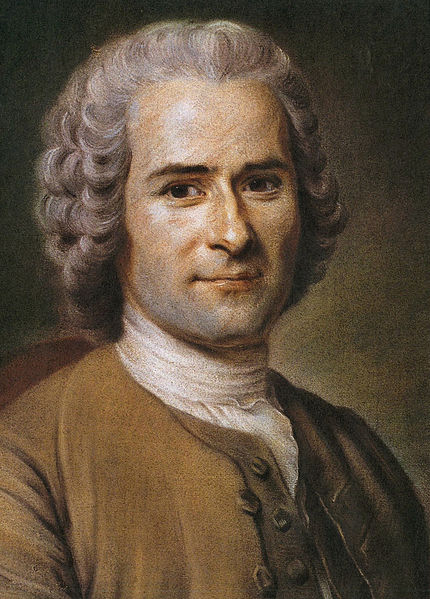
Jean-Jacques Rousseau, Philosophical Super Villain.
(Image Sourcehttps://en.wikipedia.org/wiki/File:Jean-Jacques_Rousseau_(painted_portrait).jpg, portrait by Maurice Quentin de La Tour)

The people, as a whole, are fickle.  It’s very difficult to get ten people to agree about what to eat for dinner; note how difficult it is for 330 million to agree on even the most basic of issues (in South Carolina, we still haven’t reached any kind of consensus about how to pay for and fix our roads, something virtually everyone wants done).

Even if you can get ten reasonable people to agree to, say, a long-term weekly dining schedule, at some point one or two will start to say, “Well, maybe we could have spaghetti on Wednesday nights instead of tacos.”  Imagine that conversation happening loudly and angrily across fifty States.  It’s a recipe—pardon the pun—for disaster.

Raw majoritarianism—what Rousseau appears to be calling for when he argues that society should be based on the “general will” of the people—is an unworkable scheme on anything but the smallest levels of society.  Rousseau’s chilling dictum that men are “forced to be free” reveals the inevitable consequence of unbridled democracy:  ultimately, the inexpressible “general will” becomes expressed through a demagogic tyrant, or through a legislator uninhibited by any restraints on its law-making authority beyond what the people want.

“[T]he ‘general will’ acknowledges no… limiting principle against the power of the majority.”

I’ve long viewed Rousseau as one of the great villains of modern philosophy, and I would argue that one can draw a more-or-less straight line from Rousseau and the French Revolution through fascism, communism, and totalitarianism, all the way to modern illiberal progressivism.  Rousseau—like modern progressives—believes in the mutability of human will, arguing that laws, not human nature, make people bad or good.  Get the laws right–or tweak the system enough–and you can spit out completely virtuous people.

Thus we see the conceit of the modern Left that no one commits crime out of greed or evil; instead, they’re “victims of circumstance” or subject to “systems of oppression” that cause them to do evil.  If only we created more programs or redistributed more wealth—or, if taken to the logical extreme, if only we did away with private property altogether, since the state and its laws exist to protect it—then, finally, man would be perfect.

Such notions are not only absurd; they are hugely injurious to both individual freedom and the health of society at large.  A virtuous society is one that cultivates a virtuous culture, which is only sustainable if it educates its people to live virtuously, recognizing that there will always be failures because, after all, to err is human.

(Note:  I do acknowledge that sometimes people are driven to commit typically immoral deeds out of necessity; however, I believe our society hugely exaggerates the extent to which such motives drive criminality and wickedness; just ask any wealthy person who’s ever been convicted of shoplifting or embezzlement why they stole, and you’ll quickly realize that even people with plenty of material safety are tempted to sin.)

“Raw majoritarianism… is an unworkable scheme….”

Expecting pure perfection is dangerous and unrealistic.  Mistakes are the inevitable price of freedom.  You can ignore reality for a time and get by with it, but eventually it will catch up.

Rather than idealistically seek after a non-existent “general will,” we should instead govern ourselves—and resist tyranny in the process.  To do so requires decentralization of power (and more local decision-making), a shared understanding of American values, and an education rich in morality, virtue, and philosophy.

(To read more about Rousseau’s thought–and, perhaps, to correct my errors and oversimplifications, read more at http://plato.stanford.edu/entries/rousseau/.)

Democrats Show Their True Colors

Over the weekend, Democratic congressional nominee Alexandria Ocasio-Cortez appeared on a video with Vermont Senator Bernie Sanders.  The two self-styled democratic socialists were campaigning for Brent Welder in Kansas City.  In the video, the telegenic young Marxist boasted that “We’re gonna flip this seat red in November,” accidentally confusing the Republican Red for the Democratic Blue.

A minor gaffe, to be sure, but it’s interesting to consider the political party colors, which were reversed not too long agoRed has traditionally been the color of Communist, Marxist, socialist, and other leftist movements since the nineteenth century.  According to a piece from The Smithsonian (linked above and here), the media’s first usage of different colors to demonstrate presidential election results occurred in the 1976 race, in which Democratic candidate Jimmy Carter won when Mississippi went “red.”  Apparently, media outlets used the colors interchangeably until the 2000 election; we’ve stuck to red for Republicans and blue for Democrats since then.

In retrospect, though, the red coloring fits more with the ideology, goals, and history of the Democratic Party, and particularly its progressive wing (which, I would argue, is most of the party at this point).  Lately, Democrats have been flaunting their true colors unabashedly.

Take Ms. Ocasio-Cortez, for example.  She won a much-discussed upset in the Democratic primary for a New York congressional district against a powerful incumbent, Joe Crowley.  Her politics are stridently Leftist:  she supports Medicare for all, the abolishment of Immigration and Customs Enforcement (ICE), the forgiveness of all student loan debt, and a plethora of other unrealistic, expensive causes.

She’s also a much more appealing—and, therefore, more dangerous—face for “democratic” socialism than its other ubiquitous standard-bearer, Bernie Sanders. Senator Sanders is an aging, old-school socialist of the Trotskyite variety, much like his British counterpart, Labour Party leader Jeremy Corbyn.  He’s never held a serious job outside of politics (which he entered in his forties), and he now looks like a kooky mad scientist who could disappear in a pile of dust and bones if a strong wind hit him (or if the deal he made with that necromancer is broken).

Ocasio-Cortez, on the other hand, is 28, and has the sort of Millennial profile that is common for my confused generation:  she worked as a bartender until a year ago; she’s passionate about many subjects, but not well-versed in any of them; she’s over-educated to the point of uselessness (see the previous phrase).

She’s also super telegenic and—except for some unfortunately-timed photos—a babe, and a Latina at that.

That’s a combination that Democrats can’t resist.  Like President Barack Obama—who was cool, African-American, a community organizer, and had a messiah complex—Democrats want a candidate who parrots radical ideologies while also validating them emotionally.  The hope is that an attractive young candidate will help them in future elections; thus, the constant touting of Ocasio-Cortez as the “future of the Democratic Party.”

Never mind that NY-14 congressional district that Ocasio-Cortez will soon represent (there’s not much chance of a Republican challenger succeeding in this district, which is a +29 D district) is nearly 50% Hispanic.  “Hispanic” is a tricky term, because it covers a number of different groups, but these aren’t your third- or fourth-generation Texas Hispanics (the ones who make up about half of the ICE agents Ocasio-Cortez wants out of a job); these are likely recent immigrants who, regardless of race, traditionally vote Democratic.  Some of them no-doubt originate from countries accustomed to leftist populist politicians.

Regardless, the Left is stripping down the last pretenses of being “moderate” or in favor of “common sense,” although you’ll still hear some use that phrase.  In the wake of President Trump’s election and administration, the Democratic Party has become increasingly open about its desire to soak the rich, redistribute wealth, take on a host of burdensome social and economic responsibilities, and generally move the nation further along toward socialism.

Outside of some parts of the South and the Midwest, the idea of the old-school “conservative Democrat” is long dead; it’s only now that the Democratic Party is showing its true colors.

To the Moon!

Before beginning today’s post, a quick note about last Friday night’s concert:  the whole thing came off smashingly.  My buddy John and I gave a 90-minute performance at a coffee shop in Hartsville, South Carolina, Crema Coffee Bar, where we’ve played a number of such shows in the past.

This show was, easily, the most fun I’ve had playing this particular venue, our home-away-from-home in Hartsville.  John and I took turns playing original tunes, and we both unveiled new selections, John debuting an Irish tragedy entitled “The Sailor,” and I introducing my latest irreverent comedy tune, “Private Lessons (Goth Chick).”

We also enjoyed an excellent turnout, which is not to be taken for granted.  Live music doesn’t always have the appeal it once did, and sometimes promoting a show can come across as a bit needy—“please come listen to us!”—especially as everyone you know is in a band these days.  Fortunately, our friends and fans were hugely supportive, and it seemed like a capacity crowd at the height of the show.  A YUGE “thank-you” to everyone who came out.

My next tour stop is the Juggling Gypsy in Wilmington, North Carolina, on Friday, August 3, starting around 9 PM.  You can learn more at www.tjcookmusic.com or on my Facebook page.

***

I’ve written  a bit about space exploration and the formation of Space Force on this blog, and I’ve long been an advocate semi-publicly of expansion into space.  Neil deGrasse Tyson wrote an essay in Foreign Affairs when I still subscribed to the globalist rag that had me jumping for joy.  The essay, “The Case for Space,” is one of the best apologias written for the benefits we would reap from funding additional space exploration.  Tyson is a poor political pundit, and his fanboyish acolytes are so annoying, they reflect poorly on him, but he knows what he’s talking about when it comes to space.

I’m a fiscal, as well as a social, conservative, but I’m all about spending gobs of government cash on space exploration—and colonization.  I realize I’m committing the same error everyone does—“don’t spend my tax dollars… except on all this stuff I personally like or agree with”—but I see a role for the government in space exploration that makes sense constitutionally and functionally, in a way that, say, free bus fare for war widows isn’t.

Like Newt Gingrich—the other great modern essayist on space exploration—I see expansion into space as akin to westward expansion in the nineteenth century.  There were a lot of hardy pioneers that took the risks and were “rugged individualists”—but the government granted generous loans and tracts of land to railroad companies to open up those lands.  The government—largely Republican-controlled after the American Civil War—played a role in catalyzing western expansion.

Similarly, we see a mix of entrepreneurship and government support today, although the government seems bogged down in its usual bureaucratic inefficiencies, while the hot-shot mega-billionaire flyboys are taking the major risks.  Nevertheless, Gingrich wrote over the weekend about this very topic, marking the 49th anniversary of the moon landing.

As usual, the Trump administration, as Gingrich writes, is thinking “big league” when it comes to space, and Vice President Michael Pence is heading up a revived National Space Council.  The NSC is charged with exploring placing bases on the moon to reduce the costs of launches, which would be much more fuel-efficient in the moon’s reduced gravitational field (which is one-sixth that of Earth’s).

In a larger, cultural sense—since I’m not versed enough in the technical side of this subject, I’m deflecting to where I can bloviate on slightly more solid ground—I don’t understand the disinterest in, even hostility toward, space exploration.  In general, I’m dismayed by the lack of pioneering derring-do and spirit in American culture today.  Aren’t we descended from rugged frontiersmen and women who crossed oceans, forded rivers, climbed mountains, and endured dysentery to get here?

A few years ago, I stumbled upon one of those writers I love—a slightly fringe character who writes about weird, just-outside-of-the-mainstream topics.  The author in question is James D. Heiser, a bishop in the Evangelical Lutheran Diocese of North America and a founding member of the Mars Society, a group that aims to put Americans on Mars.

I first stumbled upon Heiser after reading a review of his book “The American Empire Should Be Destroyed”:  Alexander Dugin and the Perils of the Immanentized Eschatology, which is about the titular figure, an eccentric, Rasputin-like character who advises Vladimir Putin in some capacity.  That book led me to another Heiser work, Civilization and the New Frontier:  Reflections on Virtue and the Settlement of a New World, a collection of essays—mostly his introductory remarks at various Mars Society annual conventions—about the settlement of Mars.

The basic argument is that the quest to settle new worlds will stretch Americans not just scientifically, but spiritually:  in striving for the stars, we’ll cultivate the classical virtues that make civilization possible, and, in the process, reinvigorate our earthly civilization.

I believe there’s something to this thesis.  Struggle—be it the struggle to survive on the hostile Martian plains, or to make ends meet here on Earth—breeds growth.  Adversity is the heat that tempers the iron of the soul.

Space has much to offer:  abundant natural resources, the thrill of discovery, hot alien babes (just kidding about that last one).  But it also has the potential to inspire future generations of Americans to reach for the stars—both physically, and spiritually.

TBT: Capitalism Needs Social Conservatism

On Tuesday, I wrote about the “Human Toll of Globalization“—the dire consequences, both economic and moral, that befall a community when its primary economic engine is gutted through a naïve faith in unbridled free trade and globalization.  Another title for that piece might be almost a mirror of this essay’s from 2016:  “Civil Society Needs Cash.”

I don’t want to take that argument too far, though.  In the case of Danville, Virginia—and countless other American towns that have seen their prosperity flee abroad, or to bicoastal urban cloisters—a decaying economy wrought decaying morality, civil society, and civic pride.  That would suggest that prosperity, in and itself, cannot sustain true morality and virtue.

Indeed, as I argue in the essay below, “Capitalism Needs Social Conservatism,” excessive prosperity and material comfort breed a kind of moral complacency, what Kenneth Minogue likened to widespread Epicureanism (an excellent essay, and well worth reading if you don’t mind subscribing to The New Criterion, which is also worth the price).  Richard Weaver—one of my intellectual heroes—compared the material comfort of the then-mid-twentieth-century West to a drunk who, having grown addicted to alcohol, and requiring ever-greater quantities of it, no longer has the capacity to obtain the very substance he craves.

Milton Friedman famously argued that economic liberty is a necessary precursor to political liberty.  Similarly, I would argue that morality and virtue are necessary pillars to sustaining economic liberty for any length of time.  Indeed, George Washington argued that religion and public morality were “indispensable” to a self-governing republic.

In my mind, the orthodox libertarian (in the political sense, not the “free-will” libertarianism of the free-will-versus-determinism debate in modern philosophy) commits the same error as the orthodox Marxist in relying too much on economic analysis of behavior.  The idea of the “rational man” or “man as a rational animal” is a uniquely modern concept, and while Westerners have tried hard to shoe-horn themselves into that mold, the inner, teeming depths of our souls are still pre-rationalist.  We need God, and we still live according to symbols, rituals, and virtues.

As I wrote in 2016, “Without moral common ground and shared values that stress self-control, liberty rapidly turns to libertinism.  Libertinism without a great deal of wealth leads to shattered lives, which in turn wreck families and communities.”  I’ll explore these ideas further in my upcoming eBook, Values Have Consequences.

***

For the past week, I’ve written about the decline of the nuclear family, with follow-up posts about divorce and sex education, and about the negative impact of the of the welfare state on family formation.  These post have generated some wonderful discussions and input from followers, and I’ve been surprised by their popularity.

As I wrote in “Values Have Consequences,” I’m devoting Friday posts to discussions of social conservatism.  Social conservatism is increasingly the red-headed stepchild of the traditional Republican “tripod” coalition that also includes national security and economic conservatives (with the rise of Trump, populist nationalism could count as a fourth leg).  Politically, this marginalization makes some sense, as it’s not likely that fifty or sixty years of cultural attitudes and values will be changed at the ballot box.

Nevertheless, social conservatism is an important leg of the tripod.  Indeed, I would argue that the three coalitions are not at odds, but create logical synergies that allow each leg to stand.  The stool is much more stable when the three legs work together.

Economic conservatism–by which I mean the belief that freer markets, fewer and lighter regulations, and lower taxes, or what is more properly called neoliberalism (after the classical liberalism of the 18th-century thinkers like Adam Smith)–is wonderful and hugely important.  It’s led to massive gains domestically and globally, lifting untold millions off people out of poverty.  It allows people to enjoy a greater variety of goods and labor-saving devices, and provides more leisure time (and plenty of things to do during that time).

But free markets unmoored from guiding principles, strong and stable institutions, and the rule of law can morph into mindless Mammon worship.  Without a shared sense of trust and belief in human dignity, capitalism becomes cold and abstract.

Further, full-fledged economic liberalization without the limiting principles applied by constitutionalism and a morality supported by strong families and a robust civil society can lead to socially-destructive disruptions and behaviors.

As I’ve argued many times, making mistakes or bad choices is the necessary price of liberty.  But for self-government to work effectively–and to avoid social instability–a healthy dose of social conservatism is the best medicine.

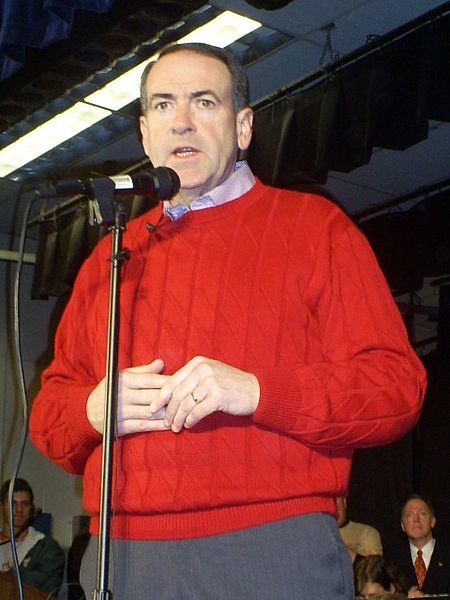
Former Arkansas Governor Mike Huckabee wears the most socially conservative outfit ever; later, he played bass on Fox News.
(Image Sourcehttps://en.wikipedia.org/wiki/File:Huckabeemike.JPG; photo by Craig Michaud)

To offer an illustration from recent history, contrast the post-Soviet experiences of Poland (and most of Eastern Europe) with that of Russia.  Despite decades under Communism–an ideology that was aggressively atheistic, stressing loyalty to the state and Communist Party over all else–Poland roared back into the West.  It adopted neoliberal (modern conservative) economic policies, and was one of the few European nations not to suffer severely during the Great Recession.

Russia similarly adopted “shock therapy” after the Soviet Union collapsed for good in 1991.  Rather than experiencing a huge economic boom, however, well-connected former Communists and others close to the old regime made off like bandits, leaving most Russians left holding the bag.

What’s the difference?  For one, the Russians lived under Communism for nearly a generation longer than the Poles, meaning there were several generations of downtrodden, state-dependent Russians by the time the USSR collapsed.  Many of these Russians were unable to adjust to a free-market system after living in a closed economy for so long.

Another key difference–and one that I think is extremely significant–is that Russians lost any scrap of civil society they might have possessed prior to the Bolshevik takeover in late 1917.  Civil society–the institutions between the basic family unit and the government, like churches, schools, clubs, civic organizations, etc.–was automatically preempted when every club, organization, or activity became part of the Soviet government.  The severely crippled (and, as I understand it, collaborationist) Russian Orthodox Church was unable or unwilling to push back against Soviet rule, providing little in the way of a spiritual alternative to the totalizing influence of Communism.

“[F]ree markets unmoored from guiding principles, strong and stable institutions, and the rule of law can morph into mindless Mammon worship.”

Poland, on the other hand, managed to maintain its deep Catholic faith.  The Catholic Church as an international organization (and with powerful, influential popes, most notably the Polish anti-Communist John Paul II) could never be wiped out completely by Soviet Communism.  Further, the Poles formed the Solidarity trades union movement, which offered an alternative to official Communist organizations.

Thus, after the dissolution of the Soviet Union, Poland emerged with a strong civil society anchored in a richly Christian worldview and ethic.  The shared sense of morality–one that stresses mutual respect, the dignity of human life, and the importance of honesty–allowed the complex deals and uptempo economic exchanges of capitalism to occur smoothly and rapidly.  From these civil and religious values came a firmer grasp of and respect for the rule of law, making predictable economic activity and long-term planning possible.

Russia, on the other hand, devolved into a fast-paced, nationwide run on the national cupboard.  Those with good connections grabbed whatever public funds and goodies they could.  Normal Russians couldn’t figure out why their government checks and free lunches stopped coming, and couldn’t understand why (or how) to pay taxes.  With the collapse of the Soviet Union, all civic organizations ceased to exist, because they were all part of the Soviet government.  Without any civil society or other enduring institutions to model good behavior and to stress and enforce moral values, Russia struggled–and continues to do so–to adapt to global capitalism and democracy.  Not surprisingly, they’ve turned to a dictatorial strongman for guidance.

***

What of the American context?  As I’ve written before, I’m skeptical of full-fledged libertarianism–what I would broadly define as the marriage of economically conservative and socially liberal views–because it fails to acknowledge the need for strong moral values to uphold its own economic assumptionsLiberty and self-government can only really work when coupled with self-imposed order and restraint.  Without moral common ground and shared values that stress self-control, liberty rapidly turns to libertinism.  Libertinism without a great deal of wealth leads to shattered lives, which in turn wreck families and communities.

Eventually, unbridled, unchecked lasciviousness–even among (formerly) responsible adults–results in social chaos, requiring a dwindling number of hardworking, honest, and thrifty individuals to pay for the ramifications of poor moral choices that have been magnified many times over.

“[L]ibertarianism… fails to acknowledge the need for strong moral values to uphold its own economic assumptions.  Liberty and self-government can only really work when coupled with self-imposed order and restraint.”

Capitalism’s blessing of unparalleled abundance is also a potential curse.  Without a strong civil society that stresses good moral values–and without proper historical perspective–it becomes easy to take that abundance for granted.

That abundance also allows, for a time, more and more individuals to pay for the price of bad decisions.  Prior to the modern era, few people were wealthy enough to risk the negative consequences of immorality.  Now, Americans and Westerners enjoy a level of material comfort and well-being that can absorb at least some of the unpleasantness of questionable choices.  Over time, however, that security breaks down.

Richard Weaver likened the situation to an alcoholic who is so addicted to his drink, he’s unable to do the work necessary to pay for his addiction.  The more he needs the alcohol, the less capable he becomes of obtaining it.  Likewise, the more individuals become addicted to luxuries, the less able they are to work hard to maintain them.

To avoid the fate of Weaver’s drunk, we must recognize the importance of social conservatism.  While we should maximize individual liberty as much as possible, and within the bounds of the Constitution, we should also stress the moral and religious underpinnings that make that liberty both possible and responsible.