TBT – #MAGAWeek2018 – John Quincy Adams

Because I was out sick from work yesterday (and will be again today), I needed a way to cover Secretary of State and President John Quincy Adams with one AP United States History class that was slightly behind the others (in part to our strange, rotating schedule).  It occurred to me that I had written nearly 2000 words on the great Secretary of State back in 2018, during the first ever #MAGAWeek.  Why not have the students read that?

So, given my decrepit—but improving!—situation, I thought I’d dedicate today’s TBT to the man who was, perhaps, the greatest Secretary of State in American history—the oft-forgotten, much-maligned John Quincy Adams:

John Quincy Adams

If yesterday’s MAGA Week profile of George Washington was straight from “American History Greatest Hits, Volume I,” today’s selection is like a bootlegged deep-cut from an obscure local musician’s live show.  John Quincy Adams—an American diplomat, Secretary of State, President, and Congressman—deserves better.

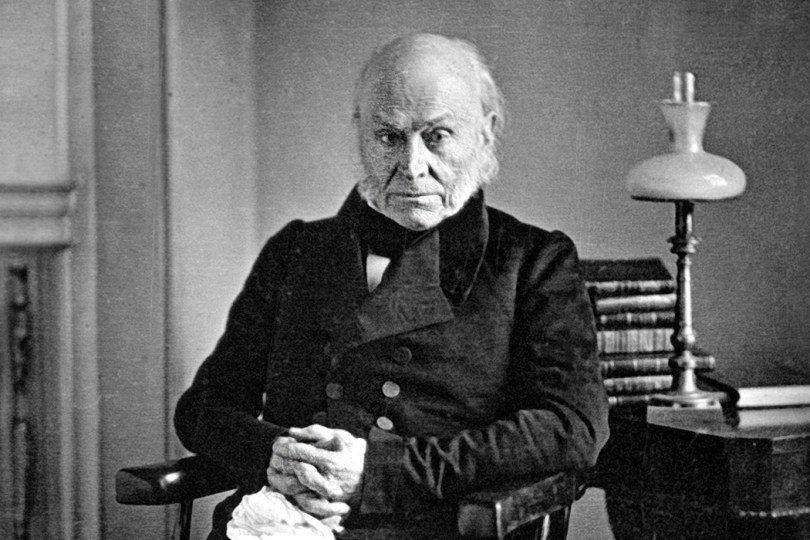
US History students of mine for years have recoiled at the dour daguerreotype portrait of our somewhat severe sixth President.  But behind that stern, austere visage churned the  mind of a brilliant, ambitious man—and probably the greatest Secretary of State in American history.  I will be focusing on Adams’s tenure in that position in today’s profile.

An “Era of Good Feeling”

Adams was one of several “all-star” statesmen of the second generation of great Americans.  After the careers of George Washington, Alexander Hamilton, Thomas Jefferson, and John Quincy’s father, John Adams, a new, youthful cadre of ambitious and talented national leaders took their place at the helm of a nation that was growing and expanding rapidly.  From the ill-fated War of 1812 through the Mexican War, leaders like John C. Calhoun, Daniel Webster, Henry Clay, and Andrew Jackson—the populist odd-man out—forged a national identity and sought to navigate the nation through its early growing pains.

John Quincy Adams was among this group.  After the War of 1812, his father’s old Federalist Party largely died out, both due to the treasonous actions of the so-called “Blue Light” Federalists (who openly sided with the British) and to demographic changes brought about by westward expansion and the Louisiana Purchase in 1803.  More Americans were small, yeoman farmers, and the Federalists’ pro-British, pro-industry, pro-commerce platform held little appeal for feisty frontiersman who were suspicious of a strong federal government and the hated Second Bank of the United States, charted in 1816.

As such, the United States entered an “Era of Good Feeling” under President James Monroe, in which one party, the Democratic-Republican Party, remained.  Monroe’s cabinet was a “who’s who” of young, dynamic men, and Adams was his Secretary of State.

Secretary of State

It was in this context that Adams made his most significant contributions to American foreign policy and nationalism.  While serving as Secretary of State, he laid out a vision for America’s future that held throughout the nineteenth century.

In essence, Adams argued that the United States should pursue a realist foreign policy that avoided wars and foreign entanglements; that the nation should not seek a European-style “balance of power” with its Latin American neighbors, but should be exercise hegemonic dominance in the Western Hemisphere; and that the United States should gain such territory as it could diplomatically.

In 1821, Adams famously issued his warning against involvement in foreign wars of liberation.  The context for this warning was the Greek War of Independence from the Ottoman Empire, an endeavor that was hugely popular in Europe, particularly in Britain.  Many Americans urged Congress to intervene in the interest of liberty, and for Americans to at least send arms to help in another fledgling nation’s war for independence.

Adams perceptively saw the dangers inherent in the United States involving itself in other nations’ wars, even on the most idealistic of grounds.  To quote Adams at length:

“Wherever the standard of freedom and Independence has been or shall be unfurled, there will her heart, her benedictions and her prayers be. But she goes not abroad, in search of monsters to destroy. She is the well-wisher to the freedom and independence of all. She is the champion and vindicator only of her own. She will commend the general cause by the countenance of her voice, and the benignant sympathy of her example. She well knows that by once enlisting under other banners than her own, were they even the banners of foreign independence, she would involve herself beyond the power of extrication, in all the wars of interest and intrigue, of individual avarice, envy, and ambition, which assume the colors and usurp the standard of freedom. The fundamental maxims of her policy would insensibly change from liberty to force…. She might become the dictatress of the world. She would be no longer the ruler of her own spirit.” (Emphasis added; Source:  https://www.mtholyoke.edu/acad/intrel/jqadams.htm)

If America were to involve itself in open-ended wars of liberation—even once!—it would set a dangerous precedent that the United States would become constantly embroiled in the squabbles of other nations.  No matter how well-meaning, such intervention would commit the nation to a disastrously unlimited policy of nation-building and war.

The Transcontinental Treaty (1819)

Prior to rumblings for intervention in Greece, Adams brokered the purchase of Spanish Florida in a rather amusing fashion.  The hero of the Battle of New Orleans, General Andrew Jackson, pursued a group of Seminole Indians into Florida, violating orders to respect the international border.  In the process, Jackson attacked a fort manned by Seminoles and escaped slaves, killed two British spies, and burned a Spanish settlement.

Instantly, an international crisis seemed imminent.  To a man, President Monroe’s cabinet demanded disciplinary action be taken against General Jackson.  It was Adams—who, ironically, would become Jackson’s bitterest political opponent in 1824 and 1828—argued against any such action, and planned to use Jackson’s boldness to America’s advantage.

With apologies to Britain and Spain, Adams pointed out that, despite the government’s best efforts, Jackson was almost impossible to control, and was apt to invade the peninsula again.  Further, Spanish rule in Florida was increasingly tenuous, due to the various Latin American wars of independence flaring up at the time.  With revolts likely—and facing the prospect of another Jackson invasion—Spain relented, selling the entire territory for a song.

The Oregon Country and the Convention of 1818

Adams was also key in securing the Oregon Country for the United States, although the process was not completed in full until James K. Polk’s presidency, some thirty years later.  The Oregon Country—consisting of the modern States of Washington and Oregon—was prime land for settlement, but the United States and Great Britain both held valid claims to the territory.

Adams realized that the United States could afford to be patient—given America’s massive population growth at the time, and its citizens’ lust for new lands, Adams reasoned that, given enough time, American settlers would quickly outnumber British settlers in the territory.

Sure enough, Adams secured another territory for the United States, albeit in far less dramatic fashion that the acquisition of Florida one year later.

The Monroe Doctrine (1823)

Perhaps Adams’s greatest contribution to the United States was his work on the Monroe Doctrine in 1823.  Once again, Adams’s diplomatic brilliance came into play.

Adams sought to keep the United States out of foreign wars, but he also wanted to keep European powers out of the Western Hemisphere.  As Spain continued to lose its grip on its American colonies, the autocratic nations of Russia, Prussia, and Austria (the Austrian Hapsburg controlled Spain at this time) sought to reestablish monarchical rule in the Western Hemisphere.

President Monroe and Secretary Adams were having none of it—nor was was Great Britain, which enjoyed a brisk trade with the newly-independent republics of Latin America.  To that end, Britain proposed issuing a joint statement to the world, with the effect of committing both nations to keeping the new nations of Latin American independent.

Monroe was excited at the idea, but in his ever-prescient manner, Adams argued for caution.  Were the United States to issue the declaration jointly with Britain, they would appear “as a cockboat in the wake of a British man-o-war.”  It would be better, Adams argued, to issue a statement unilaterally.

The United States had no way, in 1823, to enforce the terms of the resulting Monroe Doctrine, which pushed for three points:  Europe was to cease intervention in the affairs of the Western Hemisphere (non-intervention); Europe was to cease acquiring new colonies in the Western Hemisphere (non-colonization); and the United States would stay out of open-ended entanglements and alliances with Europe (isolation).

However, Adams knew that Britain would enforce the Monroe Doctrine with its mighty navy, even if the United States issued it unilaterally, because it would be in Britain’s national interest to do so.  Sure enough, Adams’s shrewd realism won the day, and, other than France’s brief occupation of Mexico during the American Civil War, European powers never again established colonies in the New World.

After Monroe’s Cabinet

For purposes of space and length, I will forego a lengthy discussion of Adams’s presidency and his tenure in Congress.  He was an ardent nationalist in the sense that he sought an ambitious project of internal improvements—roads, canals, harbors, and lighthouses—to tie the young nation together.  In his Inaugural Address, he called for investment in a national university and a series of observatories, which he called “lighthouses of the sky,” an uncharacteristically dreamy appellation that brought him ire from an already-hostile Congress.

His presidency, too, was marred by the unusual circumstances of his election; Adams is the only president to never win the popular or electoral vote, or to ascend to the position from the vice presidency.  That’s a story worth telling in brief, particularly for political nerds.

The presidential election field of 1824 was a crowded one, and the “Era of Good Feeling” and its one-party dominance were showing signs of sectional tension (indeed, the second system of two parties, the National Republicans—or “Whigs”—and Jackson’s Democratic Party, would evolve by 1828).  There were four candidates for president that year:  Andrew Jackson, John Quincy Adams, Speaker of the House Henry Clay, and Secretary of Treasury William Crawford of Georgia.

Jackson won a plurality of the electoral votes—99—but no candidate had a clear majority.  In this event, the top three candidates are thrown to the House of Representatives, where each State’s delegation votes as one.  Crawford, who finished third, was deathly ill, and was not a suitable candidate, and Henry Clay, in fourth, was not eligible constitutionally.

That left the rabble-rousing Jackson and the austere Adams.  Clay, as Speaker of the House, held immense influence in Congress, and could not stand Jackson, so he threw his support behind Adams, who won the election in Congress.

Apparently losing all the wisdom and prudence of his days at the State Department, Adams foolishly named Clay as his new Secretary of State—an office that, in those days, was perceived as a stepping stone to the presidency.  Jackson supporters immediately cried foul, arguing that it was a “corrupt bargain” in which Clay sold the presidency in exchange for the Cabinet position.

While it appears that Adams sincerely believed Clay was simply the best man for the job, the decision cast a pall over his presidency, and Jackson supporters would gleefully send their man to the Executive Mansion in 1828.

At that point, Adams expected to settle into a quiet retirement, but was elected to represent his congressional district in 1830.  During his time in Congress, he fought against slavery and the infamous “gag rule,” which prevented Congressman from receiving letters from constituents that contained anti-slavery materials.  He was also a vocal opponent of the Mexican War—as was a young Abraham Lincoln during his single term in Congress—and died, somewhat disgracefully, while rising to oppose a measure to honor the veterans of that war.

Regardless, Adams’s career shaped the future of the country, gaining it international prestige and setting it on track to emerge as a mighty nation, stretching from sea to shining sea.  Through his service and genius, Adams made America great—and, physically, in a very literal sense.

Quick References

Lazy Sunday XXXII: Festivals

This fall, I’ve been hitting up a number of small-town festivals in an attempt to get out more to see the forgotten by-ways of rural South Carolina.  I work pretty hard during the week (indeed, most of today will dedicated to finalizing first quarter report grades), so I’m making a point of enjoying my weekends more.

To that end, this week’s Lazy Sunday will look back at some recent festival-going.  I should note that the full versions of these pieces are Subscribe Star exclusives; to read them in full requires a subscription of $1 a month or more to my Subscribe Star page.

  • Aiken Amblings” – This piece detailed my trip to my hometown for Aiken’s Makin’, a sprawling, two-day crafts festival that brings vendors from all over the Southeast to ply their wares.  I have fond memories of this festival from my childhood, and it’s still a major fall event.
  • Yemassee Shrimp Festival 2019” – This post is all about a long day trip to tiny Yemassee, South Carolina, for the Yemassee Shrimp Festival.  The trip also included stops at the historic Old Sheldon Church ruins and St. James the Greater Catholic Church in Ritter, South Carolina.
  • Candy Apples” – My paean to a typically autumnal fair food, the sticky, tart candy apple.  We had some good ones last weekend.
  • Festival Circuit: Ridge Spring Harvest Festival and Clinton Scots & Brats” – Yesterday’s post detailed a two-for-one festival day—my trip to the Ridge Spring Harvest Festival and Clinton, South Carolina’s Scots & Brats celebration, the latter of which was the source of the candy apples that inspired the previous Saturday’s post.

Hopefully there will be more festivals to come.  For now, I’ve got to get back to grading.

Happy Sunday!

—TPP

Other Lazy Sunday Installments:

One-Way Cosmopolitanism

A major theme—perhaps clumsily conveyed—of yesterday’s post was that Americans should be able to keep their culture and local identity without shame.  As I noted, struggling rural communities are particularly susceptible to being swept away by large-scale immigration, legal or otherwise.  Thus, we see small South Carolina towns gradually hispanicize, turning into little replicas of various Latin American cultures, rather than the old Southern culture that predominated.

One often hears that Americans should be tolerant and open-minded to other cultures, and to extend maximum understanding and patience.  That is a generous and worthy view:  I don’t expect the Chinese foreign exchange students at our school to speak accent-less English and understand liberty their first day off the plane.  In that instance, we go out of our way to attempt to understand the cultural background from which those students came.

It’s another matter, though, when it involves the permanent or long-term relocation of foreign aliens to our land.  Remember the expression, “When in Rome, do as the Romans do?”  That rule always seems to apply to Americans—who are routinely criticized for being uncouth abroad—but never to any other ethnic group, and especially not to cultures outside of the West.

It’s an enduring frustration of mine:  one-way cosmopolitanism.

Read More »

Happy Columbus Day!

Today is Columbus Day in the United States, the day that commemorates Columbus’s voyage to the Americas in 1492.  It’s one of the most significant events in human history—as I tell my American History students, “we wouldn’t be here if Columbus hadn’t made his voyages”—yet the social justice, Cultural Marxist revisionist scolds want to do away with the holiday entirely, replacing it instead with “Indigenous People’s Day.”

The thrust of the proposed (or, as is the way with SJWs, demanded) name change is that Columbus was a genocidal, white male meanie who defrauded and murdered peace-loving Native Americans (who had the gall to mislabel Indians!), so instead we should celebrate the contributions of Stone Age cannibals.

Read More »

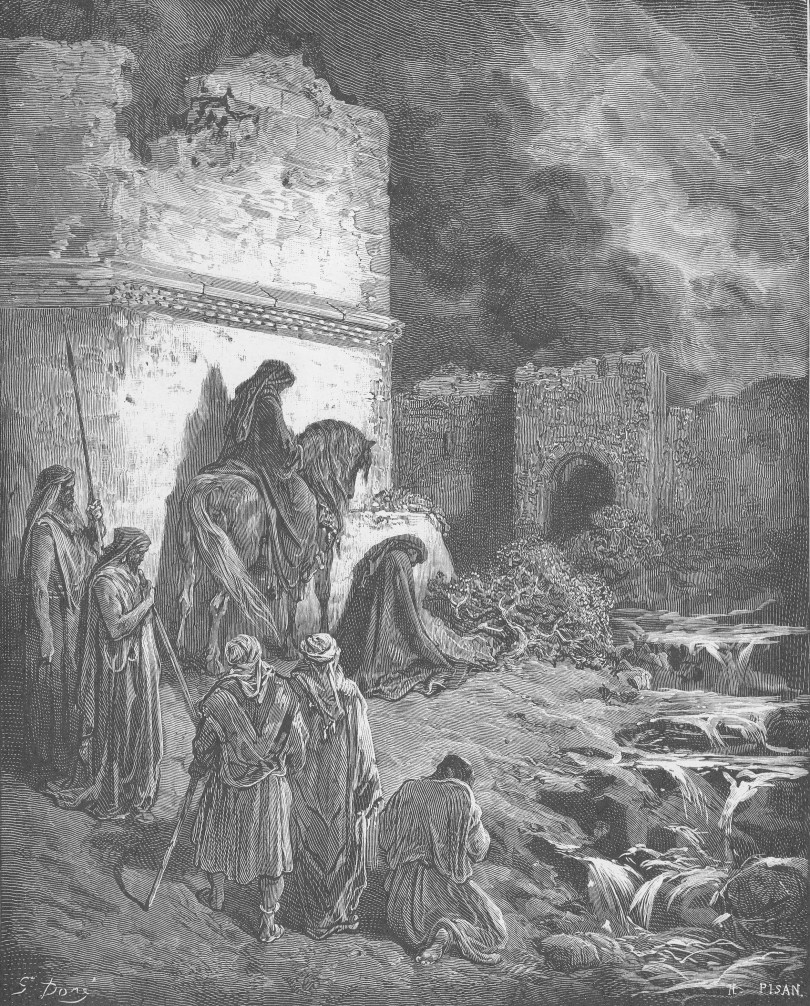
TBT: Nehemiah and National Renewal

In keeping with the unofficially churchy theme of two of this week’s posts (here and here), it seemed like a good opportunity to look back at a post from February about Nehemiah.  In “Nehemiah and National Renewal,” I explored the impact of Nehemiah’s faithful reconstruction of Jerusalem’s collapsed wall in terms of the national renewal it brought (and the spiritual renewal that came with it in a follow-up post):

This past Wednesday, I was asked to fill in for the pastor at the small church I attend.  Being such a small church—our average Sunday morning attendance is about forty—the pastor works another job, and he had a rare business trip.  I suppose he figured he could do worse than asking a high school history teacher to fill in for him.

Fortunately, the lesson was fairly straightforward:  he sent me a handout on Nehemiah 1:1-11, and the focus of the lesson was on the idea of spiritual renewal.

For the biblically illiterate—a shocking number of Americans today, I’m finding (I once had a class full of philosophy students who had never heard the story of the Tower of Babel, which is pretty much Sunday School 101)—the story of Nehemiah is simple:  after an extended period of exile in Babylon, the Israelites were sent back, under the auspices of the Persian Emperor Cyrus the Great, to Jerusalem.  Cyrus sponsored the rebuilding of the Temple in Jerusalem, but the city itself, as well as its walls, remained in a state of disrepair.

There were two waves of Israelite resettlement over the span of a century, but many Israelites remained in Babylon or other parts of the Persian Empire, such as the imperial capital.  Nehemiah was one of those, and would be part of a third wave of resettlement.  He served as cup-bearer to Artaxerxes, the Persian emperor at the time.  The position of cup-bearer was an important and trusted one:  he handled the emperor’s food and drink, ensuring it was not poisoned.

Beyond serving as the royal taste tester, the office carried with it important administrative duties, and gave incredible access to the emperor.  In short, it was a position of great influence, power, and prestige, which positioned Nehemiah nicely for what was to come.

Nehemiah spoke to a fellow Israelite who was visiting the imperial capital, and was distraught to hear of the poor condition of the city and its walls.  He fell to his knees, weeping and crying out to the Lord.  Nehemiah 1 details his prayer to God, calling out in adoration; confessing his and his people’s sins; thanking God for His mercy and gifts; and supplicating God for His Will to be accomplished through Nehemiah.

Specifically, Nehemiah asked God to be used to rebuild the wall around Jerusalem.  As cup-bearer, Nehemiah was able to present his petition to the emperor, who agreed to send Nehemiah to oversee the construction project.  In addition, Artaxerxes provided lumber from the royal forest, as well as funds to bankroll the endeavor.  He also sent letters with Nehemiah detailing his endorsement of the project.

Nehemiah’s work was not finished there, and it was anything but easy.  Initially, surrounding tribes criticized and mocked Nehemiah, questioning his loyalty to Artaxerxes, and saying that rebuilding the walls was a silly waste of time and effort.

However, once the wall reached half its height, his critics began plotting violence.  The plot to attack the workers reached Nehemiah, so he divided the work crews into those building the wall, and those defending their fellow workers from attack.

Having failed to stage an attack on the workers, Nehemiah’s enemies realized that the man himself was the target—cut off the head, kill the snake.  Again, God revealed this plot against Nehemiah, and he was able to avoid assassination.

Finally, the wall was rebuilt in an astonishing fifty-two days, an incredible feat of organization, ingenuity, and faithfulness.  The naysayers were humiliated, and Nehemiah instituted a period of national and spiritual renewal among the Israelites.  His reforms purified the nation spiritually and even ethnically, as old debts were forgiven and marriages to pagan women were dissolved.

It’s a powerful story—indeed, a powerful bit of history—about trusting in God in the face of extremely difficult odds.  But Nehemiah is also a story about national renewal, and the spiritual revival that came with it.

The wall around Jerusalem served a practical purpose—defending the city and its inhabitants from attack (even though the city was under the protection of the Persian Empire, the ancient Near East was, then as now, notoriously tribal, and the collapse of an empire would lead to dozens of ethnic conflicts)—but it was also a symbol of the Israelite nation.

Indeed, the author of the handout I used Wednesday evening writes that the “enemies of Israel could say, ‘What kind of God do you serve?  Look at the mess of your Holy City?’ It was a terrible witness and was cause for reproach from non-believers.”  The poor condition of the Jerusalem and its fortifications reflected the spiritual decay and corruption of the Israelites—they had intermarried with pagan women, adopting their false gods; they were living in rubble; and their reduced condition suggested that their God—the One True God—was not Who He made Himself out to Be.

It’s a bit on the nose, but I can’t help but recognize the parallels between the United States today and Jerusalem then—and between President Trump and Nehemiah (although I think Trump is closer to Cyrus the Great in terms of his spirituality and outlook).

I’m not suggesting Nehemiah was clubbing with Eastern European supermodels.  But like Trump, he faced overwhelming resistance from other nations to his wall project.  The rest of the ancient Near East feared a strong, renewed Israel.  Nehemiah’s return to Jerusalem, and the reconstruction of the wall, led to a period of national revival, as the people regained their identity, expelled the corrosive foreign influence in their midst, and renewed their commitment to God.

America is, spiritually and culturally, in similarly dire straits today.  President Trump has presented himself as a modern-day Nehemiah, come to control our borders, enforce our immigration laws, and restore America’s greatness on the world stage.  While he has made great strides in these areas, he meets resistance, duplicity, and mockery at every turn.

The story of Nehemiah tells us, however, that the struggle is worth the slings and arrows our enemies, both foreign and domestic, will lob at us.  To President Trump, I would urge the following:  stay the course, ignore the haters, take it to God, and BUILD THE WALL!

World Space Week Starts Today

It’s been a long but productive week for yours portly.  Readers will notice that, other than my recent features (yesterday and last Thursday’s posts), I’ve been mostly silent on the impeachment circus.  My general policy in this age of media perfidy is to withhold comment until the real facts have been reported.

The way everything is shaping up, my gut instincts—that there is nothing to claims that President Trump has committed impeachable offenses, defined constitutionally as “high crimes and misdemeanors”—seem validated.  Of course, that won’t stop the Democrats from expending months of energy, treasure, and rhetoric on banging the drum of impeachment.

In general, I’ve been trying to expand the focus of the blog, moving away from strictly writing about politics and politics-adjacent issues to more general interest topics.  My little piece on Saturn from a few weeks ago was enjoyable to write, and seemed to garner some positive feedback.

As such, I was excited to see that today marks the beginning of World Space Week.

Read More »

SubscribeStar Saturday: Yemassee Shrimp Festival 2019

Today’s post is a SubscribeStar Saturday exclusive.  To read the full post, subscribe to my SubscribeStar page for $1 a month or more.

Last weekend my girlfriend and I kicked off an ad hoc autumnal tour of various festivals around the State of South Carolina with a trip to Yemassee, South Carolina, for the annual Yemassee Shrimp Festival.  Readers will recall our visit to Aiken’s Makin’ in my hometown of Aiken, South Carolina, earlier in the month.  That visit got us thinking about other fall festivals we could attend.

I stumbled upon the Shrimp Festival while researching the Yemasee War (note the single “S” in the tribal name; I’m not sure when the town decided to add the second), a brutal Indian war in which various tribes banded together to wipe out the Carolina colony.  The conflict lasted from 1715-1717, and the tide only turned for the colonists after the Cherokee Indians joined forces with the Carolinians in order to defeat their ancient enemy, the Creeks.

In reading about that unfortunate, disruptive colonial war, I came across the Shrimp Festival.  I love small-town boosterism, and these little festivals bring a good bit of money into rural communities.

More importantly, they’re just plain fun.  Where else can you eat curly fries hand-cut from a gigantic spud and fried fresh to order, or see a chihuahua dressed as a taco, complete with sombrero?  Yes, both of those were just part of the fun at the Yemassee Shrimp Festival.

To read the rest of this post, subscribe to my SubscribeStar page for $1 a month or more.

America’s Roman Roots

The Portly Politico is striving towards self-sufficiency.  If you would like to support my work, consider subscribing to my SubscribeStar page.  Your subscription of $1/month or more gains you access to exclusive content every Saturday, including annual #MAGAWeek posts.  If you’ve received any value from my scribblings, I would very much appreciate your support.

Armchair historians and dime-a-dozen political pundits (like yours portly) love to compare the United States to the Roman Empire, usually during its decadent latter-day decline.  The comparison is an easy one to make; just like Rome in the fourth and fifth centuries, the United States possesses an underclass of wage slaves; an obsession with mystery religions and spiritualistic fads; an immigration crisis; a decadent, self-indulgent quasi-morality; declining birth rates; and a sense the precious liberty of the old Republic has been lost.

Yet for all those declinist comparisons—apt though they may be—Americans should extend their historical gaze back further, to the Roman Republic.  That is what Dr. Steele Brand, Assistant Professor of History at The King’s College, urges Americans to do in an op-ed entitled “Why knowing Roman history is key to preserving America’s future” (thanks to a dear former of colleague of mine—and a regular reader of this blog—for sharing this piece).

Read More »

Lazy Sunday XXVII: Bric-a-Brac

It’s been a pretty crazy week, and the weekend has only eased up slightly.  Last week’s Lazy Sunday was all about small town living, and about how valuable social peace is to maintaining a healthy society.

I’ve been harping on this idea a great deal lately.  Politics is an abyss, and staring into it for too long and too often starts to distort and twist one’s perspective.  In some ways, avoiding the topic twists the perspective of those who are not staring into the abyss, as I wrote about yesterday.  Nevertheless, it gets tiring—indeed, soul-sucking—to focus on politics constantly.

Additionally, I am increasingly in a state of despair about the ultimate direction of our nation and culture.  President Trump has been a welcome, God-given reprieve, but even his efforts have been repeatedly stymied, even by those within the party he remolded into his own image.  Even normal ideas are increasingly considered “radical,” and we can’t even discuss problems openly anymore in a polite setting.  I am a declinist by nature, but this is just ridiculous.

So, in the midst of this deepening despair—and this sense that, in abandoning God, He’s abandoned us to our fate—I’ve been trying to write more about lighter topics.  Perhaps it’s a bit of buoyant distraction as the ship slowly descends into the murky depths of irreversible darkness, or maybe it’s the recognition that there’s more to life than petty political squabbles (although most of those squabbles are increasingly theological battles for the soul of the West), but I’ve found that writing about Saturn is more enjoyable.

With that in mind, here’s a grab-bag of portly bric-a-brac:

  • The Bull on the Roof” – I wrote this post on my phone—never an enjoyable endeavor—while watching my little niece and nephew one evening (they lived, so I guess I wasn’t too negligent).  It’s about a delightful little piece of classical music from 1920, before modern classical music turned into atonal trash and killed the genre.  I wish music composition schools were still churning out composers who could write stuff like this piece.
  • Funcling” – I love being an uncle.  My little niece and two nephews are fun (and exhausting) to watch and to play with, and their imaginations are amazing.  This piece was about their obsession with pretending to be various Nintendo characters, mostly Kirby and sundry Pokemon.
  • Summer Reading: The Story of Yankee Whaling” – I read this little book over the summer, and loved it.  Written for children in the late 1950s, the book is an historical overview of the defunct whaling industry, an industry that built and fueled New England and America.  They don’t write history like this anymore; now, the book would be full of hand-wringing about whales being endangered species due to overhunting.  None of that in this book:  whales are powerful creatures, and men need to make a living.  Adventure ensues.
  • Saturn: The Creepiest Planet?” – Other than Earth, Saturn is the best planet (and, next to Earth, the creepiest, it seems).  I dream of being able to visit other planets.  In fact, I get perturbed when talking to scientists because they’re such buzzkills about space exploration.  “You would be crushed instantly, TPP, if you tried to fly into Saturn’s gaseous core” (even that sentence mocking them is probably riddled with errors to which they would object)—yeah, I know!  Let me suspend disbelief for a minute.  Better yet, come up with some solutions.  I’m sick of nerds telling me that putting plants and potting soil on the moon won’t terraform it.  Figure it out!  Aren’t we paying you to make science-fiction a reality?

That’s it for this week.  Don’t let politics suck your soul away.  Maybe God will hear our cries for help and do something; maybe not.  Regardless, spend time with family, read good books, and listen to good music—and try to enjoy yourself as the ship goes down.

—TPP

Other Lazy Sunday Installments:

May We Never Forget

Today’s Number of the Day from pollster Scott Rasmussen is a poignant 9/11 memorial:  204 New York City firefighters have died due to illnesses from that fateful day.  That’s in addition to the 343 NYFD firefighters who gave their lives on September 11, 2001 (the NYFD maintains a list of “line of duty deaths” dating back to 1865; deaths 809 through 1151 were the result of the 9/11 terrorist attacks).  Rasmussen also notes that 2977 people died in the attacks.

Read More »