
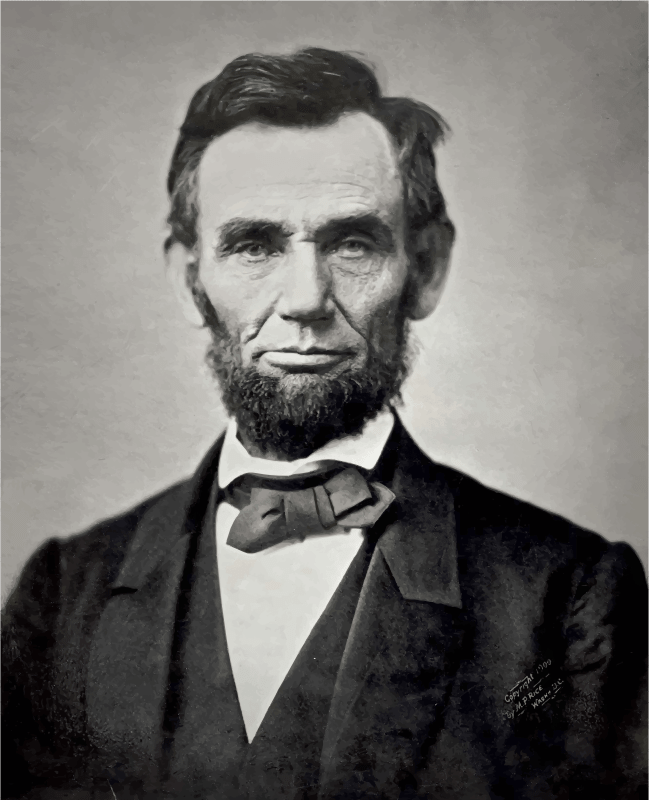
Lazy Sunday II: Lincoln Posts

I’ve been out of town all weekend—thus yesterday’s very belated post—and it’s getting to the point in the academic year where all the craziness hits at once.  That being the case, I’m posting another one of these “compilation” reference posts to give you, my insatiable readers, the illusion of new content.  It’s like when a classic television show does a clip show episode:  you relive your favorite moments from the series (or, in this case, the arbitrary theming I foist upon you).

Today’s “Lazy Sunday” readings look back at my posts that pertain to President Abraham Lincoln, the Great Emancipator (read the first “Lazy Sunday” compilation).  I noticed that I’ve been writing more about Lincoln over the past week (perhaps my quiet homage to the recently-completed Black History Month?), so I decided to compile, in one place, all of my Abraham Lincoln posts (at least, the ones I could find on this blog).

Without further ado, here are The Portly Politico‘s Lincoln Posts (in chronological order):

  • TBT: Happy Birthday, America!” – a reblog from the old TPP site, this post largely lets Lincoln speak for himself, as it features a full transcript of the Gettysburg Address.  Always good for patriotic goosebumps.
  • Historical Moment – The Formation of the Republican Party” – this short post was adapted from a brief talk I gave to the Florence County Republican Party.  The purpose of the meeting, I recall, was to focus Republicans on who we are as a Party and what we believe, so I thought it would be useful to give a brief introduction to the formation of the GOP.  As the first Republican President (although not the first Republican presidential candidate—that honor goes to John Charles Fremont of California, who ran in 1856), Lincoln obviously exercised huge influence on the young party.
  • Lincoln on Education” – another “Historical Moment” adaptation (I’m all about recycling material), I was supposed to deliver this moment before a forum of candidates for the Florence School District 1 race in autumn 2018.  I was all set to deliver it, but the FCGOP Chairman (accidentally?) skipped over me in the agenda, so I saved it until the following month’s meeting (again, why let good copy go to waste?).
  • Lincoln’s Favorability” – here’s one of TWO posts from last week about Abraham Lincoln.  I’m going to give Lincoln a rest after tonight—he worked hard enough during the Civil War—but this piece looked at an interesting Rasmussen poll, that shows Lincoln is massively beloved by the American people.
  • Reblog: Lincoln and Civil Liberties” – this post is a reblog from Practically Historical, the blog of SheafferHistorianAZ.  Sheaffer—a fellow high school history teacher—wrote a post detailing how Lincoln’s suspension of the writ of habeus corpus was, indeed, constitutional.

Happy Sunday!

–TPP

The Influence of Christianity on America’s Founding

The following remarks were delivered on 10 December 2018 to the Darlington County and the Florence County Republican Parties (South Carolina) at their joint Christmas party.  This talk was a very cursory overview of a complicated topic, but I had to address it in about eight minutes to a room full of people who just wanted to eat barbecue and have a good time, not hear a minutiae-laden history lecture.  The talk derives primarily from Dr. Mark David Hall’s Heritage Foundation lecture “Did America Have a Christian Founding?” (PDF) I highly encourage readers to investigate that source, as it addresses the issue more completely.

I’ve been asked to speak briefly tonight about the influence of Christianity on America’s Founding.  Given the Christmas season, and the continuing culture war that attempts to revise Christianity’s impact out of our history and the public sphere, this topic is particularly germane.

For tonight’s remarks, I’ve drawn heavily—and almost exclusively—from a Heritage Foundation lecture delivered in May 2011 entitled “Did America Have a Christian Founding?” (PDF)  The lecturer, Dr. Mark David Hall, focuses on a few major points to argue that, while it’s a bit complicated, the influence of Christianity on the Founding generation and the Framers of the Constitution was intense and profound.

The notion of a “wall of separation between Church and State” comes from a letter Thomas Jefferson wrote to a congregation of Baptists in Danbury, Connecticut.  It was the only time Jefferson used the phrase in writing, though Supreme Court justices beginning in the 1940s began to latch onto the idea as if it represented the entirety of late-18th-century opinion on the matter.  In fact, almost all of the Framers of the Constitution believed that government should encourage Christianity wherever possible.  They simply believed that such support for churches should occur at the local and State levels, not the federal.

This belief explains the relative silence of the Constitution on the matter of religion:  when the Framers drafted the document, they intended it to create a very limited federal government, one that would largely stay out of issues that the States were more equipped to handle.  When it came to established churches at the State level, the assumption was not that they were a de facto good; rather, the argument for or against establishment boiled down to “what is best to support Christianity generally?”  Some States, particularly in New England, had established churches—thus the chafing of the Danbury Baptists—but other States simply required individuals to pay a tax to support their individual denomination.

Now, to be clear:  I’m not advocating we return to the establishment of official denominations at the State level—the government can barely issue driver’s licenses effectively, and I sure don’t want them sniffing around the church collection plate—but the point here is that the Framers viewed State and local establishment as a profoundly in line with both the Constitution and the desire to preserve Christian principles.  Even Jefferson, the famous Deist among the Founders, hosted the Reverend John Leland, and had the reverend open a session of Congress with prayer.  Jefferson refused to declare days of thanksgiving and fasting—a custom established under Washington and continued after Jefferson left office—but he did so on purely constitutional grounds:  he didn’t think he had the authority.  Even then, he still observed days that, in all but name, had the same intent.

I’ve focused tonight largely on Christianity’s influence during and after debate and ratification of the Constitution.  I’ll close with a brief examination of the American Revolution.  As Christians will know, Romans 13 requires us to submit to higher authorities.  But theologians from John Calvin forward began arguing that, in some cases, a Christian might be allowed to resist an ungodly ruler, and some theologians began to argue affirmatively that they a Christian would be required to resist such a ruler.

The influence of Calvinism was so widespread by the beginning of the Revolution that King George III allegedly called it “a Presbyterian Rebellion.”  More notably, the Declaration of Independence clearly invokes “nature’s God.”  While some scholars have contended that such phrases as “Supreme Judge” and “Providence” are spiritual-sounding weasel-words used to refer to a theoretical or philosophical concept of “God,” Americans at the time would have understood them as references to the Christian God, the Holy Trinity.

There are, of course, endless vignettes from the Revolution that suggest God’s Hand in the proceedings—the unlikely fog that allowed Washington and his men to escape Manhattan Island, for example—but, from the historical record, it seems abundantly clear that, while the Founding generation was tolerant of other faiths, it was comprised of an overwhelmingly Christian people.  Our government was built on the assumption that thus we would remain.  As Washington noted in his Farewell Address, “religion and morality” were the “indispensable supports” of our constitutional system.

Veterans’ Day 2018, Commemoration of the Great War, and Poppies

The following remarks were delivered to the Florence County Republican Party at its 12 November 2018 monthly program, which was dedicated to honoring veterans.

Yesterday Americans, Europeans, and the world commemorated the 100th anniversary of the end of the Great War, what we call the First World War.  The Armistice that silenced the guns of one of the most brutal conflicts in human history was signed in the wee hours of 11 November 1918, but did not take effect until 11 AM—the eleventh hour of the eleventh day of the eleventh month.  That bit of numerical symmetry, while memorable, cost an additional 2738 lives, with 10,944 casualties—a pointless denouement to a destructive war.

Peace would ultimately come to Europe—after three prolongations of the Armistice—in 1920 with the ratification of the Treaty of Versailles (the United States, refusing to join the League of Nations, negotiated a separate treaty with Germany, the Treaty of Berlin, in 1921).  That treaty, which the Germans called the Diktat because of its severity, and because it pinned the war solely on the German Empire, was a reflection of the Armistice signed three years earlier.

In preparing tonight’s remarks, I came across an article that describes the first meeting between Marshall Foch, the commander-in-chief of the Allied forces, and Matthias Erzberger, a middle-aged German politician who had come to sue for peace.  The Frenchman looked stonily at the German peace delegation, and said, “Tell these gentlemen I have no proposals to make.”  Rather, Marshal Foch had a number of demands to issue, thirty-four in total, including Germany’s agreement to pay heavy reparations.

In hindsight, we know the folly of trying to squeeze blood and treasure from the turnip that was a starving, reduced Germany—and the radicalism it, in part, inspired.  But we have to understand, as best we can, the bitterness and weariness the Great War wrought.  Millions of men in Europe had lost their lives, or were maimed for life, fighting in the war.  The republican governments of France and Britain were not willing to accept peace without something to show for it; their people (and voters) would not have accepted it.  Indeed, Marshall Foch told his staff he intended “to pursue the Feldgrauen [field grays, or German soldiers] with a sword at their backs” until the moment the Armistice went into effect.  One cannot help but wonder that the fighting in this final hours was motivated, in part, by a mutual bloodlust, and an opportunity to settle scores one last time before the clock struck eleven.

From the grime and death of the Great War, however, grew new hope—a hope for peace, yes, but also a hope that humanity could avoid such a devastating conflict again.  That hope—and the enduring hope for a world built on peace and understanding—is poignantly symbolized in the flowering of the churned up “No Man’s Land,” the pock-marked area between Allied and German trenches.  Immortalized in Canadian Lieutenant-Colonel John McCrae’s “In Flanders Fields,” poppies were first flowers to bloom in that graveyard of Western civilization.  To this day, the crimson of the poppies serves as a reminder of the men who made the ultimate sacrifice for their countries, and that even in death, life endures.

I will close this somewhat grim Historical Moment with a brief reading of that poem; it can commemorate the men there far better than I:

In Flanders fields the poppies blow
Between the crosses, row on row,
That mark our place; and in the sky
The larks, still bravely singing, fly
Scarce heard amid the guns below.

We are the Dead. Short days ago
We lived, felt dawn, saw sunset glow,
Loved and were loved, and now we lie
In Flanders fields.

Take up our quarrel with the foe:
To you from failing hands we throw
The torch; be yours to hold it high.
If ye break faith with us who die
We shall not sleep, though poppies grow
In Flanders fields.