TBT: Politics, Locally-Sourced

Monday’s post, “Symbolism and Trumpism,” looked at the importance of unifying symbols, and how our interpretations of those symbols derive from our local experiences.  While Trumpism is a nationalist movement, it is one infused with localism—the more parochial form of federalism.  Local identity—and rootedness to a place—is crucial in building investment in one’s nation.

Indeed, I would argue that localism is key to building a strong nation.  People need personal and emotional investment in their communities.  That means the ability to make a living and support one’s family where one finds oneself.

Unfortunately, we tend to emphasize the importance of national politics, while knowing very little about local and State politics—the level that can really affect our lives day-to-day.  Yes, the federal government and its power are cause for concern, and we should keep a close eye on it.  But the reason it’s grown to such gargantuan proportions is because we’ve delegated greater powers and responsibilities to it, rather than doing the hard work of governing ourselves and learning about our local politics.

Yesterday was election day in Florence, South Carolina, and in other localities throughout the state.  Specifically, there were a number of primaries, both Democratic and Republican, for various local and statewide seats, including an exciting State Senate race for my district, SC-31.  That race saw a long-serving incumbent, Senator Hugh Leatherman, face challenges from local insurance agent Richard Skipper and current Florence County Treasurer Dean Fowler, Jr.  This race was of particular interest because of the huge sums of money spent on it, as well as Governor Nikki Haley’s injection into the race (she endorsed Richard Skipper).  Ultimately, Senator Leatherman retained his seat for another term (he’s currently been serving in the SC State House and/or Senate for thirty-six years) handily, with a respectable showing from Mr. Skipper.

(For detailed results of yesterday’s elections throughout the Pee Dee region, click here.)

Mmm… sweet, delicious numbers.
(Source:  http://wpde.com/news/election-results; screen-shot taken at 10:09 PM, 14 June 2016)

For all that time, money, and effort, 10,953 voters cast ballots (according to returns from WPDE.com).  In essence, those voters picked the State Senator (as there is no Democratic challenger, Leatherman will run unopposed to retain his seat in November).  I don’t know the exact number of eligible voters in SC-31–it’s a strange district that includes parts of Florence and Darlington Counties–but I would wager there are far more than 10,953.

Turnout for primaries, especially off-season and local ones, is typically very low.  Voters in these primaries tend to be more involved politically and more informed about local politics… or they happen to be friends with a candidate.

It’s often said that politics, like much else in life, is all about relationships.  This quality is what gives local elections their flavor, and what keeps candidates accountable to their constituents.  In other words, it’s usually good that we know the people we elect to serve us, or at least to have the opportunity to get to know that person.

Indeed, our entire system is designed to work from the bottom-up, not from the top-down.  As I will discuss on Friday in a longer post about the concept of popular sovereignty (written in response to comments about last week’s post “American Values, American Nationalism”), this does not mean that we don’t occasionally entrust professionals to complete the people’s work–after all, I wouldn’t want a dam constructed by an attorney with no background in hydroelectric engineering.  But it does mean that ultimate political authority derives from the consent of the governed–from “We, the people.”

In the late 18th and early 19th centuries, Americans often knew very little about the goings-on in the nation’s capital.  Washington, D.C. was largely seen as a distant, almost alien place that served an important role in foreign policy and in times of national crisis, such as war, but few people followed national politics too terribly closely.  Indeed, even presidential candidates were nominated by state legislatures or party caucuses, and were elected at conventions by national delegates (as opposed to the current system of “pledged delegates” that exists in conjunction with democratic primaries).

“[U]ltimate political authority derives from the consent of the governed–from ‘We, the people.'”

Instead, most Americans’ focus was on local and state politics, because those were the levels of government that most affected their lives.

Today, that relationship is almost completely inverted.  Due to a complex host of factors–the centralization of the federal government; the standardization of mass news media to reach a national scope; the ratification of the XVII Amendment and the subsequent breakdown of federalism–Americans now know far more about national politics than they do local or statewide politics.

The irony is, the national government is where everyday people have the least influence, and where it is the hardest to change policy.  Also, changes in national policy affect all Americans.  What might work well in, say, Pennsylvania could be a poor fit for South Carolina or Oregon.

At the local level, though, Americans can have a great deal of impact–they can more easily talk to their city councilman than their congressman (although I would like to note that SC-7 Congressman Tom Rice is one of the most accessible and approachable people I’ve ever met).

Let’s follow the trends in dining and shopping and go local.  Learning more about local politics is healthy for the body politic, and is one small but effective way we can begin to restore the proper balance and focus between the people, the States, and the federal government.
Mueller Probe Complete, Trump Vindicated

The long national nightmare is overThe long national nightmare is over—the Mueller probe/expensive government boondoggle/politically-motivated, Deep State witch hunt is finally complete, and President Trump is in the clear:  there was no collusion between the Trump campaign and the Russian government.

Now that the world finally knows what we all suspected for the past two years, the Left is in complete meltdown mode.  The mental gymnastics to which they’re resorting is humorous, but sad.  A key lesson to remember is that what the Left can’t achieve politically or socially, it will achieve through the courts (or violence).

For two years, the Left assumed that their inside man, Robert Mueller, and the rest of the Clintonian, globalist Deep State would produce (or, if need be, fabricate) the “evidence” needed to oust a duly-elected President of the United States.

Now, they’re magic wand has turned into a limp stick, incapable of conjuring up the fabled “collusion” the Left dreamed about for two long years.

President Trump emerges victorious.  It’s a huge blow to the Deep State, and almost like Part II of the 2016 election:  an outside figure, facing enormous odds and an entire media-government-business establishment arrayed against him, has won a hard-fought battle, even with the deck stacked against him.

There are still investigations in New York involving the perfidious and mendacious Michael Cohen, but those will, most likely, similarly yield nothing but bitter fruit for the Left—and more vindication for Trump.

In the meantime, it’s a great day to be on the Trumpian Right.  MAGA MAGA MAGA!

–TPP

P.S.—Here’s a great video c/o my younger brother:

Out of Control Feds

A benefit of writing this little blog is that I read (and, usually, skim) a great deal of material from all over the web, and come away knowing more than I otherwise would.  My hope is to take some of the flotsam and jetsam I come across and condense and give context to it.

Such was the situation with Jim Treacher, the pseudonym of Sean Medlock.  Treacher/Medlock is a lukewarm Never Trumper (from what I can gather) who writes for PJ Media.  Treacher wrote a piece earlier in the week about “conservative” website The Bulwark, which is unhinged neocon Bill Kristol‘s new pet project since The Weekly Standard was unceremoniously shuttered a few months ago.

That piece, “In What Sense is The Bulwark Conserving Conservatism,” is not the point of this post, but it is a disturbing read.  Treacher examines the self-righteous scribblings of Molly Jong-Fast, who covered CPAC for The Bulwark.  CPAC is the major event in conservative activism, and every year generates plenty of controversy between the warring factions of Conservatism, Inc.  Jong-Fast (hyphenated names make my skin crawl) basically spent the entire conference shuddering about how “anti-choice” the conference was, and making jokes about a group of conservatives wanting to limit the size and scope of the federal government.

What did you expect, baby?  CPAC isn’t a meeting of the D.C. Workers’ Soviet.  Yeesh.  Read the piece to get the full flavor for this foolishness.  It proves the claims from Dissident Right figures that modern “conservatism” doesn’t conserve anything, and yesterday’s Leftist utopia is today’s “conservative principle.”

Tough words to type, but in the case of Kristol and his ilk, terribly true.  Regardless, in the piece Treacher mentions in passing being struck by a State Department vehicle in 2010, which prevented his attendance at CPAC.

That took me down a frightening rabbit hole:  a State Department vehicle struck Treacher, who was in the crosswalk at the time.  The State Department agent driving the vehicle, Mike McGuinn, did not apologize to Treacher; indeed, Treacher was issued a ticket for jaywalking—while in his hospital bed!

Some key excerpts from The Daily Caller‘s piece about the incident:

An agent in the vehicle, Mike McGuinn, did not identify himself to Medlock at the scene, or apologize for running him down. Indeed, Washington, D.C., police drove to a local emergency room to serve Medlock with a jaywalking citation as he lay prostrate in a hospital bed, while a man who identified himself as “special agent” stood by watching and taking notes….

At the hospital, DC police officer John Muniz arrived to issue Medlock a $20 jaywalking ticket. Medlock was lying sedated on a gurney, so Muniz delivered the ticket to a Daily Caller colleague, who was at the hospital with Medlock. He looked embarrassed as he did so. Behind him stood a man dressed in a dark suit who identified himself as a “special agent.” He said nothing but wrote in a notebook.

Curiously, the ticket says that Medlock was struck at an intersection four blocks from where the accident actually took place. And it claims that Medlock was walking diagonally across the intersection at the time. In one of his strikingly short conversations with the Daily Caller, agent Mike McGuinn acknowledged that Medlock was not jaywalking at all, but walking “outside the crosswalk when the incident occurred.”

The question is: Did the federal agent driving the SUV, faced with potential liabilities from the accident, encourage local police to issue some sort – any sort – of citation to Medlock, to establish his culpability?

Three years later, Treacher wrote a piece for The Daily Caller detailing the State Department’s practice of hiring law enforcement personnel with checkered pasts.

Here we have a federal bureaucracy utterly indifferent to the lives of the citizens it ostensibly serves.  In Treacher’s case, I can’t tell if it’s malignant indifference, or rank incompetence.  Bureaucracies of all stripes try to avoid liability and controversy—they exist to protect and expand themselves, after all—but only the federal government could get away with running someone down in a crosswalk, ticketing that person, and never owning up to its mistake.

I wrote yesterday about the presence of Deep State, anti-Trump actors in the State Department, and of their collusion with the Obama administration’s Department of Justice.  If they have the gall to attempt the takedown of a duly-elected President, then imagine their contempt and disregard for us.

Now that the Mueller probe has ended (I think that’s the takeaway from the promise that there would be no more indictments), Deep State perfidy will only grow more sinister.  Gird your loins, President Trump.

The Deep State is Real, Part II: US Ambassadors and DOJ Conspired Against Trump

Congressman Mark Meadows (R-NC) dropped a bombshell earlier this week:  Obama-era US ambassadors conspired with the Department of Justice against President Trump.  Every site I find points back to the original Washington Examiner piece linked above, although the blog Independent Sentinel has a bit more commentary, tying it back to the fake Christopher Steele dossier.

You’ll recall the Steele dossier is a document the Clinton campaign commissioned through back-channels (a law firm), which was then used to obtain a FISA warrant to wiretap then-candidate Trump’s communications.  That mendacious original sin spawned the odious “Russian collusion” narrative that lingers around the Trump Administration like a bad fart.  Andrew McCarthy in National Review calls the dossier a “Clinton-campaign product.”

Regardless, if Meadows is correct, it serves as further proof that the Washington “Deep State”—the “Swamp”—is very, terrifyingly real.  It will stop at nothing to disrupt President Trump’s America First agenda, and subvert a free and fair election.

What’s most chilling about all this chicanery is not that it targets President Trump particularly (although that certainly creates its own problems—few good, conscientious Americans will choose to run for public office, especially as conservatives, unless they have the cash and the guts to risk everything).  Rather, it suggests that our experiment in self-government is dangerously threatened by a group of unelected elites cloistered in the Washington foreign policy and law enforcement establishment.

America stands at a crossroads.  We’ve arrogated ever-more power to an unaccountable federal bureaucracy.  Many conservatives—myself included—hoped that the extended government shutdown would aid in the draining of the Swamp.  So far, though, it seems that the president is still surrounded by enemies.

We have a choice:  we continue down the current road, ceding more power to the government, and hoping against hope for some kind of “enlightened, constitutionalist despot” to restore as much of our constitutional framework as possible.  President Trump’s difficulties weeding out seditious bureaucrats suggest that path is incredibly difficult, and it will make presidential contests—as well as Supreme Court nominations—increasingly vicious.  The progressive Left has an edge in the culture, the institutions, government, and on the streets.

The other option is weed out the federal bureaucracy, strike down the administrative state, and restore power to Congress.  Restoring power to the States would also reduce the emphasis on national politics über alles.

But conservative politicians have been peddling those nostrums for years, without much headway.  Thus, we find ourselves struggling along with a feeble Congress, a dictatorial federal court system, an arrogant administrative regime, and a presidency that is both excessively powerful and, paradoxically, unable to control its own bureaucracy.

Something has to give.  President Trump has fought back ably overall, but one man alone cannot restore our constitutional order.  Indeed, that’s the whole point of our system—to diffuse power broadly.  He’s done what he could through the constitutional powers at his disposal.

I don’t know what the future holds, but if we want to continue the grand experiment in self-government, we have to hobble the Deep State—indeed, it must be destroyed.

TBT: What is Popular Sovereignty?

Today’s looks back at an essay entitled “What is Popular Sovereignty?”  It was a follow-up, of sorts, to “American Values, American Nationalism,” one of my most-read posts (a post that I still largely agree with, though I am moving away slightly from the idea of American as absolutely a “propositional nation”—I do think it was an outgrowth of a distinctly Anglo-American culture, though it’s proven remarkably adaptive as peoples of different nationalities and cultures have settled here).  A friend posted a Facebook comment taking issue with the idea of popular sovereignty as I presented it in that essay, and this was my attempt to address his objections.

As I point out in the essay below, I do think we should have some un-elected positions within government.  If the government is building a hydroelectric dam, I don’t want to hold an election for the lead engineer.  I’m also not advocating for pure democracy, which the Framers of the Constitution rightfully saw as an odious and dangerous form of government that would, inevitably, collapse into mob rule and, ultimately, tyranny.

What I do warn against is the law-making power invested increasingly in the hands of an unaccountable federal bureaucracy, one that is technically under the control of the executive branch, but which functionally operates independently—the “Deep State,” as it were.  If the President did have control over the bureaucracy, it would be bad enough—the executive would wield legislative powers.  But an unaccountable bureaucracy that even the executive cannot rein in is even more frightening.  At least we could hope for an “enlightened despot” executive who would minimize the damage of his bureaucracy, but if the bureaucracy runs itself, regardless of who holds the presidency, liberty is deeply threatened.

So, here is 2016’s “What is Popular Sovereignty?”:

On Wednesday, 8 June 2016, I posted a piece entitled “American Values, American Nationalism.”  In that piece, I discussed the “Five Core Values of America,” a set of values inspired by a government textbook I used to use with my US Government students.  The second value, “popular sovereignty,” is deals with the idea that power in our political system ultimately derives from the people–as Abraham Lincoln said in the Gettysburg Address, our government is “by, of, and for the people.”

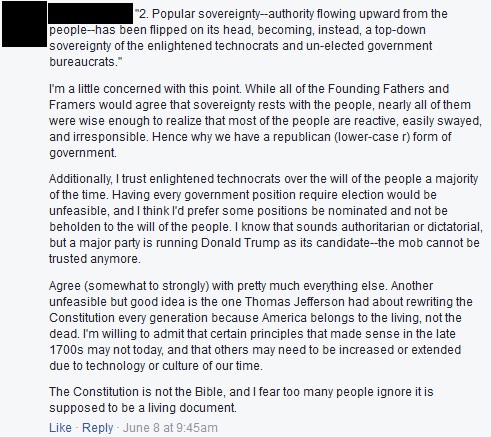
This post received quite a few comments on my Facebook page, including this one from a good friend of mine:

Now watch as I set my progressive-libertarian friend straight–respectfully.

My friend raised a very valid point:  the Framers of the Constitution were suspicious, if not outright terrified, of democracy.  Aristotle had identified democracy as one of the “bad” forms of government that came when rule by the people went bad.  The Framers had seen the consequences of a federal government that was too weak, namely the barely-contained chaos of Shays’ Rebellion in 1785.  Naturally, they wanted a government by, of, and for the people–thus the requirement that the Constitution be ratified by 3/4ths of the States in special ratifying conventions (designed to circumvent the Anti-Federalist state legislatures)–but they recognized that unbridled populism would lead to demagoguery.  It’s pedantic to say it, but Nazi Germany is the quintessential example of a desperate people granting dictatorial powers to a charismatic individual.

Pure democracy, without any checks on the majority’s power, quickly turns to one-man authoritarianism.”

The French political philosopher Montesquieu argued that the English government succeeded because it balanced monarchy, aristocracy, and democracy effectively, which further influenced the belief of the Framers that government should filter the will of the people through a complex system of checks and balances, and a rigorous, jealously-guarded separation of powers.  Thus we have such institutions as the much-maligned (but quite brilliant) Electoral College, and a Senate that is designed to act as a break on the people’s (often fickle) will.  Indeed, before it was corrupted by the XVII Amendment, the Senate was intended to represent the interests of the States themselves, rather than the will of the people, which is represented in the House of Representatives.

***

So, how did I address my friend’s concerns?  Here is my reply (with some minor edits for clarity and brevity) to my friend’s remarks, and to elaborate on the concept of “popular sovereignty”:

You are correct in noting the skepticism with which the Framers viewed unbridled democracy. There was much wisdom in their skepticism, precisely out of concern that a well-positioned demagogue could, in the right circumstances, sway the fickle populous to his whims. Pure democracy, without any checks on the majority’s power, quickly turns to one-man authoritarianism.

When I write about popular sovereignty, then, perhaps it would be more accurate to say that I mean “consent of the governed.” The people consented through our constitutional order when they elected delegates to special state ratifying conventions (circumventing the generally Anti-Federalist-controlled state legislatures). The people, then, ultimately gave consent to that government, and continue to do so through regular elections. Of course, a complex system of checks and balances tempers the will of the people (voiced primarily through the House of Representatives, which controls the power of the purse), balancing with it the will of the States, and vesting a great deal of authority to halt dubious legislation in the hands of the executive.

As for Thomas Jefferson’s love of revolutions and his proposal to rewrite the Constitution each generation, the actual Constitution provides a useful mechanism that makes such rewrites generally unnecessary, but possible: the amendment process. So far, every proposed amendment has come from the Congress, and all but two have been ratified in state legislatures (the other two were ratified, like the Constitution itself, in special state ratifying conventions). However, the Constitution provides another method–one that has yet to be used–to propose amendments: 2/3rds of the States can convene a constitutional convention to propose amendments. Texas’s current governor, Greg Abbott, is currently working on just such a convention of the States. In short, the Constitution provides us a way to change it to fit current needs without throwing out the whole document.

Of course, I would argue strenuously for an originalist reading of the Constitution and its amendments, all of which should be read in the context of those who proposed them. This still allows for changes through the amendment process, and for congressional elaboration. The Constitution is not meant to cover ever eventuality, and gives a great deal of space to Congress and (this is important and often forgotten) the States.

“It approaches something like tyranny when the President has the power to write laws (indirectly through the bureaucracy he manages) and to enforce them.” 


As for your comments about technocrats, perhaps I should clarify here, too. What I am primarily concerned about is the ability of federal agencies to write their own rules, many of which have the force of law. This practice is dangerous because most of these federal agencies operate within the executive branch and have little congressional oversight. Law-making powers are meant to rest solely within the Congress, and the job of the President is to duly enforce those acts to the best of his ability. It approaches something like tyranny when the President has the power to write laws (indirectly through the bureaucracy he manages) and to enforce them. Even scarier is the prospect that the federal bureaucracy has become so large that the President cannot exercise effective control over it, or even know what it’s doing! Many presidents–particularly our current one–have used bureaucratic rule-making to push unpopular measures without input from the people’s representatives. Congress is complicit in this, as it has delegated these powers to the executive bureaucracy, and the Supreme Court has allowed it to do so.

That being said, you are absolutely correct that there is a need for an intelligent, qualified, and motivated civil service, and, naturally, we want our dams to stay sealed tight and our roads to be paved and efficient. I would never dream of proposing we elect, say, the head of the South Carolina Department of Transportation. Here, again, the Constitution provides precedent: at the national level, the President appoints his cabinet heads, as well as federal and Supreme Court judges and justices. The Senate, however, has the responsibility of confirming these nominations, helping to prevent egregiously bad appointments.

If these proper checks and balances are maintained–if the different branches stick to their constitutional duties and limits, and if the proper relationship exists between the federal government and the several States–even a reckless executive can only do so much damage. If Congress vigorously protects its legislative prerogatives, an unqualified or authoritarian-minded president may still do some harm, but his ability to do so will be greatly diminished, and the damage can be contained.

***

This conversation went back and forth for a few more posts, which I will possibly include in future pieces.  In the interest of space–as this rumination is already quite lengthy–I will refrain from sharing them now.

However, I would ask that you permit me one parting thought:  we should be on guard against the lionization of the presidency.  The Congress–which represents the people and is, therefore the seat of popular sovereignty–may be consistently unpopular, but it is the proper branch to resist the huge expansion of the presidency.  Presidents increasingly attempt to speak for the people, but in a country that is divided between two entrenched, fundamentally incompatible political philosophies, it is nearly impossible to do so.  Indeed, attempting to do so leads to a Rousseau-style attempt to impose “the common will” on people–whether they want it or not.

Instead, let’s speak for ourselves.  We can do that through involvement in local politics, but also by communicating with our Congressmen and Senators.  Let them know that we expect Congress to reclaim its proper legislative powers from the executive bureaucracy.

TBT: Federalism Denied

It’s a late post today, faithful TPP readers, as the school year is gearing up and constraints on my time increase.  Better late than never, yes?

This week’s throwback post discusses the Seventeenth Amendment, which ended the election of US Senators via their respective State legislatures, and instead moved that choice directly to the people of the several States.

One of the Progressive Era Amendments—which gave us such chestnuts as the graduated income tax (Sixteenth Amendment), Prohibition (Eighteenth Amendment), and women’s suffrage (Nineteenth Amendment)—the Seventeenth Amendment was part of a broad cultural and political shift toward, paradoxically, greater choice and enfranchisement for the electorate on the one hand, and greater government control and oversight on the other.

Americans were optimistic in the power of the government at all levels—and, increasingly, at the federal level—to solve problems like poverty and privation, naively believing that, in a democracy, the people would make wise decisions about selecting its technocratic, managerial elite.

Not surprisingly, the managerial elites gained enormous power, and the people got the shaft.

This essay explores the consequences of the direct election of US Senators, as well as why State legislatures came to support the idea.  On the one hand, States lost their representation in Congress—the Senate was designed to represent State-level interests nationally—but State legislatures were also relieved of responsibility for what was becoming an onerous duty, susceptible to corruption, or even carelessness.

Here is “Federalism Denied”:

In last Wednesday’s post, “Politics, Locally-Sourced,” I urged readers to become more interested in and educated about their local and state governments.  A keystone of modern conservative political philosophy (and of the classical liberalism of the Framers) is decentralization, the idea that power should be spread broadly, both in terms of population and geography.  Due to the massive power the federal government accrued during and after the Second World War, decentralists also argue that power should devolve from the federal government back to the States.  The federal government, of course, plays an important role in maintaining the national defense, conducting foreign affairs, and regulating interstate commerce, among a number of other constitutionally delineated areas, but a great deal of power is reserved for the States in the X Amendment.

The X Amendment reads thus:  “The powers not delegated to the United States by the Constitution, nor prohibited by it to the States, are reserved to the States respectively, or to the people.”  Clearly, then, where the Constitution is silent, the States are reserved broad powers.  They cannot become dictatorial–their constitutions must not conflict with the national supremacy of the US Constitution–but they can have broad latitude in determining statewide regulations, taxes, and the like.

In theory, at least, this federalist structure is how our nation is supposed to operate, and it manages to do so, despite significant hobbling from the federal government.  Congress has forced upon the States a number of unfunded federal mandates.  Essentially, a large portion of State budgets are consumed with fulfilling orders from Washington, D.C., without any form of assistance.  Additionally, States are often coerced into adopting certain policies or passing certain laws, lest the federal government withdraw their funding (this tactic was used to increase the drinking age from 18 to 21–not necessarily a bad thing, but the means matter almost as much as the ends; such coercion circumvents the proper amendment process).

What brought about this change, and how can we reverse it?  How can we restore the proper balance between the States and the federal government?

There are no easy answers here, and the centralization of power in the federal government occurred for a complicated host of reasons:  the acceptance of a desperate people of a greater role for the government in the economy during the Great Depression; the (temporary) success of a massively planned economy during the Second World War; the massive expansion of the welfare state during the Great Society; the (necessary) fight at the national level to protect the civil rights of black Americans; and more.

However, I would argue that a major source of this problem was the passage of the XVII Amendment.

The XVII Amendment replaced the old system of selecting senators with their direct election.  Prior to its passage, senators were selected by their state legislatures, which were themselves chosen in local elections.

There are a number of compelling arguments for why this amendment was adopted.  For one, many states had already moved to a de facto system of direct election, in which voters essentially “elected” their senator, and the state legislatures were duly pledged to vote in accord with the people’s choice.  Also, there were several scandals in which senate candidates merely bribed state legislators for their votes.  Finally, many state legislators found that voters cared more about who the legislators would elect to the Senate, not what they thought about state problems.

You can review these arguments in a (rather condescending) piece from Slate by David Schleicher entitled “States’ Wrongs.”


“[T]he States no longer have a constitutional role in the federal government.”

However, while there certainly appeared to be need for reform in senatorial elections, many of these problems still persist.  Voters are still overly-fixated on national politics, even more so than voters in the late nineteenth and early twentieth centuries.  If anything, state elections are even more focused on national issues than they were before.  Special interest groups still manage to exert influence over the Senate, and can do so even more effectively by whipping up voters.

Most importantly, though, is that the States no longer have a constitutional role in the federal government.  The Senate used to serve as the representative of the States’ interests, while the House still operates as the representative of the people’s interests.  Now the people have direct influence over both branches of Congress, and an important, necessary brake on the fickle will of the majority is gone.

States’ rights has become an ugly phrase, associated as it is with slavery and segregation.  However, just because states’ rights has been invoked to defend the indefensible doesn’t mean that it isn’t a good idea.  The States function as an important bulwark against tyranny, and federalism affords many opportunities for policy innovation and experimentation–Louis Brandeis’s “laboratories of democracy.”  Also, the geographical, ethnic, religious, and cultural diversity of the United States practically demands states’ rights, as different States have different needs, goals, and desires.

Repeal of the XVII Amendment is extremely difficult and unlikely:  people like to vote (actually, people like to know they can vote, even if they often choose not to do so).  But Congress, specifically the Senate, can do much to keep the further expansion of federal power in check.  Senator Ben Sasse of Nebraska is spearheading this effort through his speeches, delivered from the Senate floor, about the proper role of the Senate and its obligation to be an august, contemplative chamber.

We, the people, can also take steps to become more involved in state politics.  Ultimately, the drive to restore federalism starts with us.

***

For more information about the XVII Amendment and different approaches to addressing it, here are some resources:

The Campaign to Restore Federalism (pro-repeal of the XVII Amendment):  http://www.restorefederalism.org/

“Repeal the 17th:  Problems to Address” by constitutional scholar Rob Natelson:  http://tenthamendmentcenter.com/2013/08/26/repeal-the-17th-problems-to-address/

“Repeal the 17th Amendment?” by Gene Healy of the Cato Institute (great piece that is sympathetic to the idea, but recognizes the political problems involved):  http://www.cato.org/publications/commentary/repeal-17th-amendment

“States’ Wrongs” (mentioned above) by David Schleicher of Slate (anti-repeal, with some interesting historical background and a lot of elitist sneering at movement conservatives):  http://www.slate.com/articles/news_and_politics/jurisprudence/2014/02/conservatives_17th_amendment_repeal_effort_why_their_plan_will_backfire.html

TBT: Family Matters Follow-Up Part II: The Welfare State and the Crisis of the Family

TBT for this week: https://theportlypolitico.blogspot.com/2016/08/family-matters-follow-up-part-ii.html

Last week’s featured a follow-up to one of the most read pieces on my old site, “Family Matters.”  That piece generated so many questions and comments on Facebook back in 2016 that I wrote two lengthy follow-up posts.  This post deals with the deleterious impact of the welfare state upon the family, looking first at the effect of the Great Society on the black family.  It then examines how those negative consequences spread beyond racial barriers to destroy traditional and nuclear family formation across races.

Now, over half of children born to women under 30 are born out of wedlock, regardless of race.  Economics doesn’t explain that story entirely, but misguided government policy, which placed perverse incentives on single motherhood, have driven what is ultimately a cultural and spiritual decline.

The details are in the post below, so without further ado, here is 10 August 2016’s “Family Matters Follow-Up Part II: The Welfare State and the Crisis of the Family“:

My series of posts on the decline of the traditional family unit in the United States and the West has generated a great deal of discussion (and, occasionally, some bitter recriminations).  Thus, after the overwhelming feedback and requests for clarification I received to “Family Matters,” I decided to expand upon some portions of that piece (click here to read “Follow-Up Part I” about divorce and sex education).

One of the claims of “Family Matters” concerned the “havoc” President Lyndon Johnson’s Great Society/War on Poverty wreaked on the black American families.  In the original post, I failed to link to any data or articles to substantiate this claim, but I’ve since updated the post with links to Daniel Patrick Moynihan’s famous “Moynihan Report” (actual title:  The Negro Family:  The Case for National Action) and a piece from 2015 that summarizes some of the main points of the report.

The late Daniel Patrick Moynihan–who would go on to serve as US Ambassador to India and the United Nations, then as a Democratic Senator for New York–enjoys a rare respect as a liberal among conservatives.  Though he was a leftist on many issues, he was first and foremost a scholar with a commitment to following the data wherever it took him.

The so-called “Moynihan Report”–which he wrote while working as a bureaucrat in the Department of Labor in 1965–demonstrated that many of the problems of the black community were caused only in part by discrimination, but much more so by a decline in marriage and stable family formation.  While racial discrimination was (and–I would like to think to a lesser extent–still is) a major problem in the 1960s, it alone could not explain adequately the plight of many black Americans.

Instead, what Moynihan discovered was that well-intentioned government programs inadvertently subsidized single motherhood, and were destroying the black family.  Indeed, the “national action” for which Moynihan called was that which would reinforce “the establishment of a stable Negro family structure.”  This national goal would be “difficult,” but “it almost certainly offers the only possibility of resolving in our time what is, after all, the nation’s oldest, and most instransigent, and now its most dangerous social problem.”  (Moynihan, The Negro Family)

I once heard a conservative black gentleman from Darlington, South Carolina, summarize Moynihan’s argument thus:  at a time when black men faced legitimate discrimination in the workforce, and could lose their jobs on the flimsiest of pretexts, the federal government came along offering generous support to single mothers.  By 1975–ten years after Moynihan’s prophetic report–a head of household would have to earn $88,000 (in 2015 dollars; about $22,000 in 1975) to out-earn the benefit from the federal government.  (Jack Coleman, “Juan Williams:  Daniel Patrick Moynihan ‘Had it Right’ About Breakdown of the Black Family”)  As Jason Riley, author of Please Stop Helping Us:  How Liberals Make it Harder for Blacks to Succeed wrote in a 2015 op-ed in The Wall Street Journal, “In effect, the government paid mothers to keep fathers out of the home–and paid them well.”

Not surprisingly, many women took note of this benefit.  Some of them–and, yes, I know what you’re about to read will be hard to believe, but it actually happened–calculated that they were better off divorcing their husbands or having a child out of wedlock, especially given the real, costly discrimination their husbands faced.  Government do-gooding, coupled with a legacy of racial discrimination, caused many young black children to grow up without fathers.

Initially, that might not have been a huge problem… but it metastasized.  Young boys grew up without father figures to shape them, and came to expect that leaving a woman, or having children with multiple women, was natural.  Young girls grew up thinking they had no reasonable expectation of their man sticking around.  With each generation, the problem grew worse and worse, until now roughly 72-73% of black children born in America are born to a single parent.

“[S]imply replacing one parent with a paycheck does not fulfill a child’s many needs.”

Single parenthood is sometimes the only option, but it’s a tough row to hoe.  Not only does it place financial burdens on the parent; it also removes from her or him the ability to parent a child adequately.  To quote economist Walter Williams at length:

“Whether a student is black, white, orange or polka-dot and whether he’s poor or rich, there are some minimum requirements that must be met in order for him to do well in school. Someone must make the student do his homework. Someone must see to it that he gets eight to nine hours of sleep. Someone has to fix him a wholesome breakfast and ensure that he gets to school on time and respects and obeys teachers.

“Here’s my question: Which one of those basic requirements can be accomplished through a presidential executive order, a congressional mandate or the edict of a mayor, a superintendent of schools or a teacher? If those basic requirements aren’t met, whatever else that is done in the name of education is for naught.” (emphasis added; Walter Williams, “Can Racial Discrimination Explain Much?”)

In other words, simply replacing one parent with a paycheck does not fulfill a child’s many needs.  Children born out-of-wedlock and raised by a single parent are more likely “to experience a variety of cognitive, emotional, and behavioral problems,” according to Dr. Paul Amato in “The Impact of Family Formation Change on the Cognitive, Social, and Emotional Well-Being of the Next Generation.”   That creates ripple effects for generations to come, and the cycle is difficult to break.

***

The problem was prevalent even before Moynihan wrote his report (which, not surprisingly, caused many of his fellow-liberals to accuse him of “racism” and bigotry–common tactics when faced with an unpleasant truth).  Ronald Reagan, while campaigning for Arizona Senator and Republican presidential candidate Barry Goldwater in 1964, told the story in his magisterial “A Time for Choosing” speech of a mother who divorced her husband to get a check from the government, and how she learned to do it after talking to two other women who’d also gamed the system.

We’ve now had fifty-one years of the Great Society, and while some of its programs helped alleviate malnutrition and other problems that are, thankfully, dwindling issues, its good intentions created a host of other problems.  In 1965, one could still plausibly claim that government do-gooders merely didn’t know any better.  Now, the argument seems to be, “Well, we’re trying to do the right thing, so that’s all that should matter.”  That’s prime paving stone for the road to hell.

“The decline of the family is a problem all Americans will have to address.”

Moynihan argued that black Americans in particular were experiencing the decline of family formation most heavily because of the “tangle of pathologies” stemming from centuries of slavery and a century of legal, social, and economic segregation, and that this legacy dovetailed disastrously with the perverse incentive toward divorce and single motherhood.  As he predicted, this tangle morphed into a multi-generational cycle that has ground many black Americans further into poverty.

In 2016, the negative consequences have not only magnified the problem among black Americans; it’s spread throughout American society.  There’s been a crisis among black families for fifty years; we ignored it at our peril.

The experience of black American families since the 1960s is a sad story, though there are many brave black mothers and fathers who raise their children with love and support.  They are struggling to break a dangerous cycle, one that swirls in a murky stew of cultural, social, and economic pressures against the two-parent family and traditional marriage.

Racism appears to have enhanced the deleterious effects of the welfare state in the case of black families, but now those negative consequences are increasingly color-blind.  The decline of the family is a problem all Americans will have to address.

(For additional reading, check out the works of Walter Williams, a brilliant economist and political conservative who, as it happens, is black.  Start here for an appetizer:  http://www.washingtonexaminer.com/can-racial-discrimination-explain-much/article/2556814; after that, get Race and Economics:  How Much Can Be Blamed on Discrimination?)

Buchanan on the National Emergency

One of my favorite writers, paleocon Pat Buchanan, has a piece on one of my favorite sites, Taki’s Magazine, about President Trump’s recent declaration of a national emergency.  That national emergency, you’ll recall, will allow the President to use existing funds within the federal bureaucracy to build a border wall, thereby circumventing Congress’s lackluster appropriation of funds for that purpose.

Critics argue that the president is undermining our Constitution, with its careful balance of powers between the branches, specifically its delegation of the “power of the purse” to Congress.  While I certainly share some of those concerns, Buchanan points out that Trump’s national emergency is only the latest (and one of the mildest) in a long line of the executive overreach.

More crucially, Buchanan places the blame for the extension of the executive power at Congress‘s feet.  In this regard, Buchanan is correct:  Congress, with the support of an activist federal judiciary, long ago realized that it could farm out key legislative functions to the executive branch (specifically, the federal bureaucracy), and thereby avoid catching the blame for the nation’s problems.  In the process, the executive and judicial branches have arrogated greater powers to themselves (thus, the tug-of-wars between unelected federal judges and the Trump administration on virtually every policy).

To quote Buchanan at length:

Yet while presidents have acted decisively, without congressional authorization and sometimes unconstitutionally, Congress has failed to defend, and even surrendered, its legitimate constitutional powers.

Congress’s authority “to regulate commerce with foreign nations” has been largely ceded to the executive branch, with Congress agreeing to confine itself to a “yeah” or “nay” vote on whatever trade treaty the White House negotiates and sends to the Hill.

Congress’s authority to “coin money” and “regulate the value thereof” was long ago transferred to the Federal Reserve.

Congress’s power to declare war has been ignored by presidents since Truman. Authorizations for the use of military force have replaced declarations of war, with presidents deciding how broadly they may be interpreted.

In declaring the national emergency Friday, Trump rested his case on authority given the president by Congress in the National Emergencies Act of 1976.

As I wrote over the weekend, I believe the president acted within his the scope of Article II of the Constitution in issuing the national emergency, as it pertains to powers inherent in the office of the executive:  national defense and border security.  I’m not completely comfortable with this method for funding a border wall, and I think the president and congressional Republicans blew an opportunity to build the wall during the two years of Republican control of the federal government, but action needed to be taken.

Buchanan’s piece is titled, chillingly, “Why Autocrats are Replacing Democrats.”  To answer his own question, he argues that voters internationally are weary of the plodding democratic process, and are eager for leaders who will deliver solutions to their problems.  Buchanan claims that republican forms of government have failed to fulfill their most basic functions—border and immigration control, national security, etc.—and the people demand solutions—action.

I don’t think President Trump is an autocrat or a fascist.  I also don’t entirely blame him for using powers Congress has delegated to his office.  Up to this point, President Trump has stayed very much within defined constitutional limits in the exercise of his authority.

We should, however, be ever vigilant about—and always on guard against—executive overreach.  While I think the president acted within accepted constitutional bounds here—and relied upon the poor decisions of a past Congress to shore up his case for the national emergency—I hope this method of governance does not became de rigeur habit, as it did under the Obama administration.

On the plus side, we’re getting a wall!

Secession Saturday

Care of photog at Orion’s Cold Fire, here’s a thought-provoking piece by Christopher Roach of American Greatness, “The Left Won’t Allow a Peaceful Separation“: https://amgreatness.com/2019/01/21/the-left-wont-allow-a-peaceful-separation/

Roach touches on some of the same points I bring up in my essay “Progressivism and Political Violence,” in which I diagnose some of the well-known pathologies of the Left, including its tendency towards totalitarianism. That impulse is why the Left is never content to adopt the Right’s “live and let live” mentality. Thus, the willingness to eat their own (as in the Northam non-troversy), to demonize young conservatives, to harass conservatives at dinner, and to denounce anyone who doesn’t believe whatever the latest frontier of social justice is this week.

The idea that America is in a “cold civil war”—one that is turning increasingly hot—isn’t nothing new (sadly). Controversial Dissident Right figure John Derbyshire calls it a conflict between “goodwhites”—the limousine liberals and soccer moms who think Trump is mean and who want to virtue-signal to minorities to appear cool and progressive—and “badwhites”—the rest of us folks in “flyover country” who largely want to be left alone to enjoy our faith, family, and liberty in peace.

That the cold, cultural civil war may turn hot is a cause of concern to many folks on the Right and Left. I shudder to contemplate it. Roach, in his piece, argues that a peaceful separation may one day be the result of our current Kulturkampf, but he is pessimistic that the Left would willingly let anyone leave, due to its totalitarian nature.

He also points out that, though we often forget it, the United States is, itself, a product of secession—from merry old England. As I often point out to my students, the question of whether or not States were bound permanently to the Constitution was an open question until 1865. The Jeffersonian “compact theory” argued, essentially, that the States had formed the Union and “opted in” to the Constitution. The big, open question prior to the American Civil War, then, was thus: having opted in to this arrangement, did States have the ability to opt out? A straightforward reading of the Declaration of Independence suggests heavily that, in certain extreme circumstances, they might be able to do so.

As I’ve long told my students, the Civil War answered that question conclusively by force of arms. Now, States sue the federal government through their respective attorney generals’ offices should there be any conflicts between them and the feds.

That said, as I’ve grown older, I’ve come to realize that no political question is ever truly “settled,” and no political arrangement—even one as enduring and amazing as our federal constitutional republic—can last forever. The idea of secession could be given a renewed lease should the federal government continue to overextend its authority, and should the culture wars deepen and darken.

To be clear, I’m not advocating for secession or anything of the sort. I’m merely exploring—in a very brief way—a complex idea that is, in the balance, not entirely without merit. Regardless of the motivations for the American Civil War, the notion of States’ rights—an entirely constitutional idea, per the Tenth Amendment—and of “compact theory” are quite sound, and could enjoy renewed credibility.

There is much to chew on and mull over here. I recommend you read Roach’s piece and make up your own mind. Feel free to leave comments below.

Happy Saturday!

–TPP

Saturday Reading: SOTU and the Shutdown

A quick post today, as I have a jam-packed Saturday (after a jam-packed week, with another busy week on the horizon—it’s the Year of the Panther, baby!):  the President has reached an agreement to reopen the government for three weeks, it seems in order to get paychecks out to Homeland Security and federal law enforcement more than anything else, with the promise (threat?) to leverage another government shutdown in February to obtain border wall funding.

This compromise feels like a loss; I can only hope President Trump has some clever scheme up his sleeve.  From what I’ve been hearing (most recently on today’s episode of Radio Derb), the polls have shown Americans steadily blaming Trump for the shutdown.  Of course, this prompts me to ask, “do they see the shutdown as positive or negative?”

Certainly there are good federal employees who need paychecks, especially border patrol agents and federal law enforcement, but how many of you actually felt the effects of the shutdown?  At the very least, let’s hope the President took Ben Boychuck’s advice, as well as the advice of his anonymous senior official, to layoff permanently some of the dead weight in the federal bureaucracy.

As Boychuck writes in the Sacramento Bee:

Everyone knows the president cannot fire career government employees willy-nilly. Our civil service laws are ironclad. But a fairly obscure rule would allow the administration to lay off certain workers if they’ve been furloughed for at least 30 days. It’s called a “reduction in force” and it’s perfectly legal as long as the White House adheres to certain criteria, accounting for an employee’s tenure, total federal and military service, and work performance.

According to Boychuck, some 350,000 federal employees are eligible for “reduction in force” according to this obscure rule.  I don’t think anyone is advocating laying off all of those people—surely some 5-10% of them perform useful functions and/or aren’t totally subvervise to the President’s agenda—but I imagine we could do without at least some of them.  Surely even a token culling of the herd would send a powerful warning to feds:  you work for the American people, not your second home.

A part of me worries that our peacocking POTUS might be reopening the government simply to give the State of the Union Address in the House chambers.  That would be a bad move.  The Constitution doesn’t specify the form or venue for the SOTU address.  In fact, it doesn’t even have to be a verbal “address” at all!

Thomas Jefferson—timid about public speaking, and fearful of the kingly connotations—stopped giving a verbal address upon taking office in 1801.  Instead, his annual message was sent to Congress and read aloud by the Speaker or another member, then published throughout the States in newspapers.  Everyone could easily read it, and this approach made perfect sense in a pre-mass-communications age.

The Jefferson approach endured until the presidency of Democrat and progressive Woodrow Wilson.  Remember, Wilson hated our Constitution (PDF), and believed it was an archaic document that did not work adequately in the dynamic, industrial world of the early twentieth century.  He idolized the British Parliament, and sought to make the presidency more akin to the position of Prime Minister—the first among equal voting members in the legislature.  He believed that approach, called fusion of powers, was more efficient and democratic (“democratic” in those days being the Left’s preferred way to advance progressive ideology and policy, though in practice that meant electing representatives who would farm out their law-making powers to unelected technocrats in the federal bureaucracy).

Regardless, the die was cast, and with the advent of television, the State of the Union Address has become a ponderous, grandiose political event that doesn’t really tell us anything useful about the state of the nation, but just how awesome whoever the current president is.  This time, those boastful claims would be mostly true, but was it worth reopening the government to do it on time?

Boychuck, among others on the Right, were calling for the President to end the modern, monarchical spectacle of the State of the Union, returning it to Jeffersonian simplicity.  As much as I don’t want to deny the president his moment in the sun, that approach seems prudent, and more in accord with the republican nature of our Constitution.