SubscribeStar Saturday: Washington, D.C. Trip Part VI: Arlington, Holocaust Museum, Home

Today’s post is a SubscribeStar Saturday exclusive.  To read the full post, subscribe to my SubscribeStar page for $1 a month or more.  For a full rundown of everything your subscription gets, click here.

After a hairy night of elevator-related shenanigans, everyone was pretty ready to hit the road.  That said, we still had a long hike through Arlington National Cemetery, followed by a trip to the Holocaust Museum, before heading home to South Carolina.

Sadly, it appears I lost the photographs I took at Arlington National Cemetery, as well as the powerful World War II Memorial from the previous night.  It’s a shame, because it’s a humbling and breathtaking place.  The cemetery is massive, with graves everywhere; even so, it is running out of space.

We chanced upon the changing of the guard ceremony, where the guards stand vigil over the Tomb of the Unknown Soldier.  Our tour group was a bit late hiking up the hill to the Tomb, but our students managed to position themselves in such a way as to witness the guards perform the ceremony.

Even with our typically rambunctious group and dozens of other school groups, it was very quiet.  After two long days of trying to explain to them why these places were sacred, the awe and reverence of Arlington did more to quiet their ever-running mouths more than any of my self-righteous jeremiads ever could.

Following the quiet, contemplative morning at Arlington, we had a quick lunch at a mall food court, then headed to the Holocaust Museum—a sobering final coda to our trip.

To read the rest of this post, subscribe to my SubscribeStar page for $1 a month or more.

SubscribeStar Saturday: Washington, D.C. Trip Part V: Elevator Shuffle

Today’s post is a SubscribeStar Saturday exclusive.  To read the full post, subscribe to my SubscribeStar page for $1 a month or more.  For a full rundown of everything your subscription gets, click here.

I’m finally getting back to this series about a late-March 2023 trip my school’s ninth- and tenth-graders took to Washington, D.C.  I put it on hold due to a number of factors, few of which I can recall anymore.  Travel posts with tons of pictures are always a bit time-consuming (even as I’m realizing I don’t have any pictures for this post—d’oh!), and the end of the school year likely left me with inadequate time.  Whatever the reasons—lame or otherwise—I’m continuing the saga of the field trip that nearly made me quit education for good.

Our school trip to Washington, D.C., was going pretty well up to this point.  Despite the kids being knuckleheads and talking over the tour guide, we were at least herding them efficiently from one place to another on this rather frenetic trip around our nation’s capital.

What struck me on this trip is how little common sense teenagers possess.  I should know this truth by now, having taught fourteen-to-sixteen-year olds for over a decade.  Still, some lingering bit of vestigial optimism clings stubbornly to my mind, and I always think they know better.

Nothing dissuaded me of that incorrect notion more than what happened when we got back to the hotel that second night in D.C., and a group of rowdy teens overloaded an elevator.

To read the rest of this post, subscribe to my SubscribeStar page for $1 a month or more.

MAGAWeek2023: John Taylor Gatto

This week is MAGAWeek2023, my celebration of the men, women, and ideas that MADE AMERICA GREAT!  Starting Monday, 3 July 2023, this year’s MAGAWeek2023 posts will be SubscribeStar exclusives.  If you want to read the full posts, subscribe to my SubscribeStar page for as little as $1 a month.  You’ll also get access to exclusive content every Saturday.

It’s no secret that education in the United States—at least, formalized, factory-style education—is broken, and quite badly.  No one, however, quite understands why.  State politicians, federal Department of Education bureaucrats, and local schoolboards all pass more and more regulations and requirements, few of which actually address the root causes of this brokenness.  Instead, they merely treat the symptoms, symptoms they themselves have created, and the treatments usually just breed more symptoms, to be treated once again with another dose of “education reform.”

Naturally, these “reforms” and “treatments” fall squarely on teachers to administer.  Politicians and school administrators are like aloof doctors who are so disconnected from their patient, and so motivated by their own agendas, they don’t really care about the patient’s health, so long as they can say, “we did something.”  Parents—forced into long working hours and with little free time—foist their students into a system that is supposed to work, but ultimately is just government-funded daycare.  How else is mom supposed to work sixty hours a week alongside dad?  That’s progress, after all!

So students and teachers are caught in the middle.  Teachers become nurses in this sick system.  Like real nurses, most of them think they know everything, and know better than the doctors.  Typically, teachers are correct in assuming they know more than the doctors; the problem, however, is that most of the most strident nurse-teachers go on to become the doctors, and then proceed to prescribe the same medicines, only this time they think they know better.

The other teachers labor on with some quiet grumbling, making the best of an increasingly impossible situation.  Caught between parents who are by turns indifferent and meddling and administrators and politicians who are inflexible and demanding, teachers administer whatever prescriptions they are forced to deliver, and try to do some actual teaching in the process.

The results are clear:  the worst become whiney thorns that are absorbed into the administrative ranks.  The best labor on, looking forward to summer.  The rest burnout quickly, leaving the profession early.

Students, meanwhile, are alternatively coddled and hyper-micromanaged.  They spew obscenities in the hallways and locker rooms with abandon; they vandalize bathroom stalls; they vape (the gayest form of nicotine consumption) between classes; they show up late every day.  At the same time, their every movement is tracked—by cameras, by sign-in and sign-out sheets, by teachers roaming the halls.  It’s a bizarre form of anarcho-tyranny in which all the poor behaviors are allowed to run rampant like kudzu, a weed the administration timidly trims from time to time while blaming the teachers for not realizing Johnny was at the vending machine instead of in the bathroom.

Is it any wonder we live in a world with rampant cheating and arbitrary rules, which are just arbitrarily waived the moment anyone offers up a sob story?  We’ve bred generations of students who are paradoxically rebellious and conformist—as long as Johnny takes his shot and is a good little office worker, he can indulge in whatever lame vices he wishes, so long as he shows up mostly on time the next day.  Did Johnny sleep with the secretary or steal money from the till?  Well, he must have had a good reason—he had a rough home life, you know.

None of these problems are particularly new or novel.  We’ve all come to accept them as the price for modern living:  send the kids off to indoctrination daycare, because God forbid both parents aren’t working.  After all, that’s feminism—women are liberated when they can slave for some strange man eight hours every day.  That’s way better than staying home with her kids and maintaining a good home for her husband and children… right?

Into this Orwellian nightmare stepped the great John Taylor Gatto.  Gatto taught in New York City public schools for thirty years, and was a renowned teacher, author, and public speaker.  He was one of the pioneers and major proponents of the “unschooling” movement, a variation on homeschooling that emphasizes activities chosen by the learner.  He was also a major critic of the kind of factory-style public education we have today (itself an innovation from socialist German intellectuals that, unfortunately, glommed its way onto the minds of American education “reformers” in the late nineteenth century).  Gatto argued forcefully that modern education is not only broken, but actively destroys real learning.  Instead, it merely creates conformist worker drones who are educated simpletons.

To read the rest of today’s MAGAWeek2023 post, head to my SubscribeStar page and subscribe for $1 a month or more!

Minecraft Camp 2023!

It’s summertime again for yours portly, which means MINECRAFT CAMP!  Woot!

I’m back to spend my mornings playing the digital equivalent of LEGOs on the computer with elementary school kids.  It’s glorious!

By the time you read this post, we’ll be halfway through the first of two sessions of camp.  I have had a group of ten campers this week, with three students (two former, one current) helping out as counselors.  The second week has just three campers enrolled at the time of this writing, but I imagine that will change.  I had just five students signed up for this week’s camp as of last week and it doubled by camp day, so… we’ll see!

Minecraft Camp is one of the tentpoles of my summer hustlin’.  This time of year, lessons slow down considerably due to family trips and the like, and while I still teach quite a few in the summer, it’s nothing like the volume of the school year.  So Minecraft Camp helps to keep the lights on.

Read More »

Open Mic Adventures XXXIV: “Chase’s Dilemma”

In keeping with the vacation vibes of Memorial Day Weekend, it’s going to be a pretty short edition of Open Mic Adventures this week.  The good news is that very soon I’ll be back to showcasing footage from actual open mics, and not just me noodling on the piano in my school’s tiny music room.

That said, I hastily recorded a video of a very basic piano piece I wrote for one of my students, whose name is Chase.  It was a very quick sightreading exercise for him, and an opportunity for me to write some more student-focused material.

I suppose the “Dilemma” in the title refers to the presence of an F# accidental, as well as the necessity to move the right hand from C to D position and back again.  The left hand is a simple ascending line with that playful F# tossed in the mix.

Read More »

Gig Day VII: TJC Spring Jam III

It’s time for another front porch concert!  This event—the TJC Spring Jam and Recital—will be the sixth Front Porch concert I’ve hosted (I think), and I’ve learned quite a bit from the others, including the last Spooktacular.

This year marks the third Spring Jam, which has become a popular event with my private music students.  These front porch concerts started out as a way for my buddy John and me to play gigs during The Age of The Virus, when nobody was open for live music.  I realized that if I wanted to play in front of a live audience, I’d have to circumvent the hysteria and become the venue and talent.

Gradually, the concept morphed from a self-indulgent concert into a recital for my private music students.  The Lord has really blessed me—far beyond what I deserve—with a large clientele of private music students (around twenty-two at the time of writing, working out in practice to anywhere from twenty-to-twenty-four lessons a week), so it made sense to offer a couple of recital opportunities a  year for them.

Read More »

SubscribeStar Saturday: Baccalaureate Service 2023

Today’s post is a SubscribeStar Saturday exclusive.  To read the full post, subscribe to my SubscribeStar page for $1 a month or more.  For a full rundown of everything your subscription gets, click here.

The following is the written version of the speech/sermon I’ll be giving at my school’s baccalaureate service tomorrow, Sunday, 20 May 2023.  It pulls from the Scripture readings that students will make prior to my little sermonette, which are Proverbs 3:1-6, James 1:2-5, Psalm 20:1-5, Jeremiah 29:11, and Psalm 113.  I also include Matthew 11:28-30 and Psalm 20:6 (and probably allude to several other verses that I do not reference directly).

Good evening families, faculty, staff, and graduates of the Class of 2023. You have worked hard to be sitting here today, and in six days you will get to sit again for another ceremony, during which your mother will probably cry and you will hear a dozen or so senior videos with the Trace Adkin’s song “You’re Gonna Miss This” (and probably Bill Joel’s “Vienna”).

But to get where you are today took a great deal of effort and struggle. Sometimes it was your parents doing the struggling, or your teachers, but ultimately, you had to get the work done. Your reward for your efforts is to build upon the foundation you have laid, and while I encourage you all to get some much-deserved rest, your work is only beginning.

While you have learned a plethora of facts, and learned how to perform elaborate titrations in Chemistry, and learned how to dissect a work of literature or a piece of poetry, you have also learned how to live. In learning all of these other skills and facts and figures, you have, in the process, learned what matters in life. And here is the big hint: it isn’t how to perform elaborate titrations in a chemistry lab.

Our purpose in this life is to praise and glorify God in all of our endeavors. Psalm 113 is a model for us: “From the rising of the sun to its going down; The Lord’s name is to be praised.”

“From the rising of the sun to its going down.” That’s a lot! Not exactly an easy task, is it? We are to praise and glorify God in all of our endeavors? Well, yes. Fortunately, we have God to Help us.

To read the rest of this post, subscribe to my SubscribeStar page for $1 a month or more.

SubscribeStar Saturday: Grinding Down

Today’s post is a SubscribeStar Saturday exclusive.  To read the full post, subscribe to my SubscribeStar page for $1 a month or more.  For a full rundown of everything your subscription gets, click here.

Does anyone else feel as though work has gotten more difficult lately?  It seems as though as the academic year grinds towards its inevitable end, everything is getting busier—and harder.

Perhaps it’s the knowledge that soon—always, blessedly, soon—it will be summer, bringing unlimited freedom along with the heat, humidity, and mosquitos.  Readers in normal careers—the ones that don’t get two months off every summer—probably don’t get pre-summer blues, because there’s never a break.  Paradoxically, I suspect that the knowledge that I’ll have loads of free time soon makes the current slogger seem even sloggier.

Of course, it does get busy this time of year.  If third quarter is the doldrums of the school year—the long, dark days of January and February, when everyone is in some form of waking hibernation—fourth quarter is the grand reawakening, full of concerts, plays, and multifarious other special events.  Then it’s end-of-the-year banquets, awards ceremonies, baccalaureate services, graduations, and all the rest, blurring together into one glorious slurry of festivities and obligations.

I’ve actually been asked to speak at my school’s baccalaureate service this year, which is a huge honor, but which also necessitated rescheduling a book-signing event my cousin is putting together (new date is TBD).  I’ll be posting my little sermon next Saturday, so you’ll actually have the opportunity to read it a day before I deliver it.

Regardless, I can sense burnout creeping in, as the days wear on and seem to get longer and longer (and start earlier and earlier).  There’s a reason I’m writing about the toll of overwork this week, rather than continuing with the saga of my Washington, D.C. trip (the next episode is going to be awesome, by the way).

To read the rest of this post, subscribe to my SubscribeStar page for $1 a month or more.

SubscribeStar Saturday: Washington, D.C. Trip Part IV: Driving Miss Lindsey

Today’s post is a SubscribeStar Saturday exclusive.  To read the full post, subscribe to my SubscribeStar page for $1 a month or more.  For a full rundown of everything your subscription gets, click here.

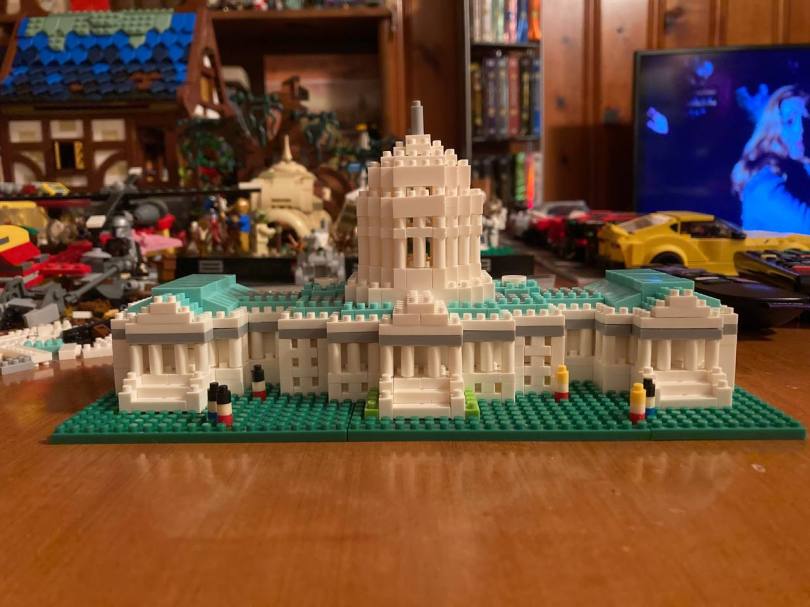
After a beautiful, contemplative morning at Mount Vernon, we scurried onto the bus to head up to Capitol Hill.  We had a scheduled meeting with Congressman Russell Fry (the man who unseated Tom Rice in the 2022 election), but due to some parental meddling, we also had a meeting with Senator Lindsey Graham, the senior senator from South Carolina.  These meetings ended up being scheduled for the same time, so I found myself on the phone with Fry’s aid to sort out the particulars.

Our tour guide Denise was on edge because of the overlapping times, and was particularly concerned about us meeting with Fry on the steps on the House of Representatives side of the Capitol Building, then quickly relocating to the Senate steps.  The distance is probably two or three football lengths—not a very far walk at all.  Apparently, though, senators don’t like crossing over to the House side, because they’re somehow demigods.

Of course, she underestimated the kind of clout (and, likely, political donations) that our parents command, and pretty soon Miss Lindsey would be sashaying our way.

To read the rest of this post, subscribe to my SubscribeStar page for $1 a month or more.

Dorothy Sayers and “The Lost Tools of Learning”

“For the sole true end of education is simply this: to teach men how to learn for themselves; and whatever instruction fails to do this is effort spent in vain.” —Dorothy Sayers

What a powerful sentiment, because it is True! I recently had occasion to read Dorothy Sayers’s speech—later adapted into an essay—entitled “The Lost Tools of Learning“; it was akin to my first reading of Richard Weaver’s Ideas Have Consequences: a lightning bolt of the True and the Good striking directly upon my mind.

In the speech, Sayers lays out the medieval method of learning, the Trivium, consisting of Grammar, Dialectic (or Logic), and Rhetoric, we she argues should be divided into age-appropriate stages (the “Poll-Parrot,” the “Pert,” and the “Poetic”).  Each stage corresponds with one aspect of the Trivium (the Poll-Parrot studies Grammar, the Pert studies Logic, and the Poetic studies Rhetoric), and while the ages aren’t precise, they basically include when children are knowledge sponges and can learn anything (the parrot, roughly elementary school and earlier); the stage when children start questioning everything and love trapping adults in logical contradictions (the pert, roughly middle school); and the age in which children are on the cusp of adulthood (around fourteen- or fifteen-years old).

This essay is an absolute must-read.  It is long, however, so I’m offering up some of my thoughts on the essay, which has already taken root in my soul, forcing me to re-examine and reconsider how I approach teaching.

Read More »