SubscribeStar Saturday: Returning to School in The Age of The Virus

Today’s post is a SubscribeStar Saturday exclusive.  To read the full post, subscribe to my SubscribeStar page for $1 a month or more.  For a full rundown of everything your subscription gets, click here.

This past Monday teachers returned to work at my small private private school.  We start classes this Thursday, 24 August 2020.  We’ll be holding classes in-person and on-campus, with a number of new safety and sanitation protocols to attempt to limit the spread of The Virus.

It is in times like these that I’m glad I have been teaching for a decade.  My heart goes out to the new and first-year teachers, who are entering the classroom for the first time in highly atypical—indeed, unprecedented—conditions.  Building and planning out courses is a heavy enough load for a first-year teacher; doing so while enforcing various mask and social-distancing policies on rowdy youngsters is a Herculean task.

Needless to say, school is going to look a bit different this year.  Most of the changes are fairly doable, but it’s going to take consistent enforcement to implement them, and it’s really going to require a culture change at our school.  Our formerly informal but professional culture among teachers, administrators, and students is likely to become far more regimented.

A note to subscribers:  I finally caught up on tardy posts.  “Universal Studios Trip No. 2” and “Family Fun Time” are complete and available for $1 and higher subs.  Thank you for your patience!

For $5 subs, earlier in the week I posted “BONUS Doodles I“—one of several random perks for $5 and up subs.

To read the rest of this post, subscribe to my SubscribeStar page for $1 a month or more.

TBT: Lazy Sunday XXIV: Education

The school year starts back in one week, and it’s a flurry of activity to prepare for students returning to school, especially in The Age of The Virus.  I’m slowly readjusting to returning to work on a daily basis, after enjoying the short-lived fantasy life of summer.

It’s going to be a difficult transition with all the new Virus-related restrictions, which I will write about more this weekend.  “Culture shock” is probably the best term for it.  Enforcing mask-wearing, constant cleaning between classes, and other new protocols are going to be an additional, wearying task atop the many others teachers and students are already required to navigate.

I’ve written quite a bit about education over the past year, especially as the last academic year was particularly trying.  The posts featured below were all written before that difficult year, which really affected some of my attitudes and personal theories about teaching.  The profession is not getting any easier, and with the latest revival of woke social justice, it’s also getting less tolerable ideologically.

This week’s TBT is, as far as I can recall, a first:  I’m throwing back to an old Lazy Sunday.  This one is pretty meaty, as it links to quite a bit of my writing about education.

With that, here is August 2019’s “Lazy Sunday XXIV: Education“:

The school year is back in full swing, and I am already beat.  It looks like it’s going to be a good year, and I have some very bright students, but my teaching load is substantially busier than last year, and my private lesson empire continues to grow.  Those are all blessings, but it means a lot more work for yours portly.

That’s all to say that I thought this Sunday’s edition of Lazy Sunday would be perfect for looking back at my education-related posts:

  • Lincoln on Education” – a little post consisting of remarks I made to the Florence County (SC) Republican Party back in September 2018 (actually, it may have been October—one of my “Historical Moments” was skipped in the program accidentally, so I reused it the following month).  I looked at the education—and the views thereon—of President Abraham Lincoln.  He was an avid learner, and saw education as the means by which he could improve himself.  Apparently, it worked!
  • Teachers Quitting in Record Numbers – Reflections on Education” – this lengthy post outlines my own observations about why teachers quit the profession—and some of its major problems.  My main idea was “flexibility”:  in pay, in lesson plans, and in certification.  Public education is a great deal for bad teachers—they coast along, cashing a paycheck no matter how well they do—but a poor one for good teachers.  Private education is great, but it can’t compete, at least in the rural South, with public education in terms of teacher pay and benefits.But the biggest concern is what I elegantly dubbed “administrative bullcrap.”  Teachers get loaded down with all of these duties that are only distantly related to their alleged jobs:  molding young minds.
  • The State of Education” – this post details the travails of a New York City French teacher, a good teacher whose experiences in multiple schools illustrate how public education is a bad gig for good teachers.  The stories are jaw-dropping, but hardly surprising now:  zero administrative support for discipline, a “talent show” that nearly devolves into a sweaty orgy, violent outbursts from animalistic students, etc.  Terrifying stuff.
  • Sailer and Spotted Toad on Education” – this post was a bit “meta”—it’s an overview of a review of a book.  That makes my post tertiary commentary at best.  The post looks at demographer Steve Sailer’s review of blogger Spotted Toad’s book 13 Ways of Going on a Field Trip: Stories about Teaching and Learning a narrative memoir detailing Toad’s decade teaching in public schools in the Bronx.  I’ve picked up the book but still haven’t read it (I’m working through Milo’s Middle Rages: Why the Battle for Medieval Studies Matters to America; review coming soon), but it looks to be an interesting read.
  • SubscribeStar Saturday:  The State of Education Update” – this post is an update of “The State of Education,” written nearly on the eve of my return to this present school year.  As SubscribeStar Saturday exclusive, you’ll have to subscribe to my SubscribeStar page for $1 a month or more to read it.  Tantalizing, no?

So, there you have it.  Now to fulfill my obligation to my wonderful SubscribeStar subscribers and get their delayed post done.

Happy School Year!

–TPP

Back to the Grind 2020

Today marks the first day that teachers at my little private school returned to work (classes don’t begin until 20 August 2020).  We’ve been going through protocol for returning to school and, boy, let me tell you:  it’s going to be a doozy.

I’m already grating at the mask wearing, which we are to keep on unless we’re able to socially distance appropriately (such as being in our classrooms alone).  I’m not arguing that they’re some kind of symbol of oppression (which, let’s face it, they kind of are); they’re just uncomfortable.  It is hot in South Carolina, and will remain that way well into October.  Masks stifle, literally and figuratively.

But I’m willing to wear one for the safety of my students and colleagues.  The real challenge will be enforcing, a la the ubiquitous “Karens” of the world, social distancing and mask rules.  That will be a Sisyphean task, especially with the younger students.

We’re also livestreaming our classes if we have a student who has elected to learn from home.  Students will be required to sign in at the scheduled class time, and marked “present,” “absent,” and “tardy” as normal.  That won’t be too difficult, but it will certainly add to the growing list of daily classroom administration tasks.  We’ll also be disinfecting desks at every classroom change, which will add another small but onerous burden to the already-hectic change-of-classtime.

Needless to say, it will be an interesting school year.  I’m praying that these new measures can be implemented relatively smoothly, but teachers and students are in for an adjustment—a borderline culture shock.

More to come.  Say a prayer for teachers, students, administrators, and support personnel.  We need your support!

—TPP


TBT: Ideas Have Consequences – Introduction

Yesterday was the last session of the Summer 2020 History of Conservative Thought course.  This summer marks the second run of the course, and it was a fantastic class.  I had three young men enrolled, all quite eager to dive into the material.

I try to avoid lengthy lectures in HoCT, giving the basic background information and scaffolding necessary to put the readings into context.  I want the works to speak for themselves, and for the students to the do the heavy lifting of sussing out meaning and the author’s ideas.  Each week students wrote a short essay or answered a few different guided questions, then we would come in and discuss the material.

With this summer’s group, that model worked very well, as two of the young men in particular loved to plunge into discussions and ask questions.  One of the students was concurrently taking a colleague’s popular Terror and Terrorism course, which leads off each summer with the French Revolution.  That always dovetails nicely with our discussion of Edmund Burke, as we read several excerpts from his Reflections on the Revolution in France.  Burke comes on the heels of our discussion of Russell Kirk’s conservative principles, and helps frame the early portion of the course in the Burkean tradition.

In July, we left the nineteenth century and began looking at the modern conservative movement, with a heavy emphasis on William F. Buckley, Jr., and the notion of fusionism.  Buckley’s National Review catches a good bit of flack on the Right these days, including from this blog, but it truly shaped conservatism in the second half of the twentieth century.  Before National Review, conservatism was a disorganized, disunited hodgepodge of various ideologies, movements, and issues—it was, as Lionel Trilling put it, a “reactionary impulse,” a grumpy attitude about the way things were, but without a cohesive understanding of how to combat the dominance of New Deal liberalism.

For all its noodle-wristed hand-wringing and desperate virtue-signalling today, National Review created the modern conservative movement by giving conservatives their voice, their publication.  It also gave conservatism a politically viable platform of issues that could win in national politics.  That focus on nationalism certainly cuts against the Kirkean/Burkean mold of organic, ordered liberty, but it was the reality of post-war American political life.

We ended with another mid-century conservative, but one fitting far more into the spiritual and moral mold of Burke and Kirk, and far less in the neoliberal and materialist mold of Buckley-style fusionism:  Richard Weaver’s seminal Ideas Have Consequences, which I consider one of the greatest books ever written.  Indeed, I’m a bit of a Weaver fanboy, as he’s been featured twice on my Summer Reading Lists, first in 2016 for Ideas Have Consequences, and again in 2020 for his collection of Southern Essays.

For the course, we just read the “Introduction” to the book, which I try to read every August before school resumes.  It reminds me why I teach, and what is at stake.  Reading Ideas Have Consequences—first published in 1948—today reads like prophecy fulfilled.  Weaver’s core focus on William of Occam as the source of modernity and its related ills might seem a bit far-fetched, but that’s merely the germ from which the analysis of modernity’s fallen view of the world grows.

The real heart of Ideas Have Consequences is the abandonment of the transcendental—of God—in favor for navel-gazing particularism, a constant focus on lower, material concerns.  Unbound from any obligation to or belief in a transcendental moral order, men are left adrift in a world full of isolation, alienation, confusion, and meaninglessness.

I’ll let the rest speak for itself.  Here is 29 July 2019’s “Ideas Have Consequences – Introduction“:

Read More »

Catching Up

I’ve returned from Universal Studios, and will be writing the SubscribeStar-exclusive post promised on Saturday sometime this evening.  It was a very fun trip, and was a wonderful opportunity to catch up with family.

Of course, as with any trip, now I’m playing catch up after enjoying nearly a week of good food, good family, and good times.  I’m teaching a new Pre-AP Music Appreciation course this academic year, and begin online training with four Zoom sessions starting tomorrow.  That means today I’ve got to work through some online modules to be prepared for the first session.

I’m also clearing out a backlog of e-mails.  It’s remarkable how quickly it all piles up after just a few days.  My junk account is bursting with solicitations, most of them truly garbage.  But I’m also catching up on some work and personal correspondence, so if you’ve written to me over the past week, don’t fret—I will respond as soon as possible.

Returning from this trip marks the beginning of the end of summer vacation.  I still have a couple of weeks of summery freedom remaining, but the tempo of work-related activities will only increase from here on out.  I will, of course, continue posting to the blog daily, but posts will likely be a bit shorter as the school year resumes.

I’ll have some updates and information soon about how school is resuming in The Age of The Virus.  That was the topic of some discussion on photog’s blog, Orion’s Cold Fire, back on his 11 July 2020 update post.  It will be quite interesting to see how different States and school districts handle the return.  My little private school is planning on resuming as normal, just with way more sanitation and some social distancing and such.  Again, more details to come.

That’s about it for today.  I’ll be getting into some meatier substance soon, but some gossamer fluff is surely allowable from time to time.

God Bless,

TPP

Lazy Sunday LXIX: Phone it in Fridays, Part III

We’ve celebrated another with the  posts (here, here, here, and here).  Now we’re on the long march toward the 2020 election, which will hopefully be a triumphant landslide for GEOTUS Donaldus Magnus.

For now, it’s time to continue our month-long review of past Phone it in Friday posts.  This week makes for an odd trio:  the first post, “Phone it in Friday VII: Universal Studios,” looks back to a family trip to the Florida theme park at the end of February, on the eve of The Age of The Virus.  Only dimly did I realize at the time that we were living in the twilight days of The Before Times.

The next two posts both deal with The Virus, which dominated blog discussion in those early, fretful days of The Age of The Virus.  If we’re basing the quality of the posts on the lightheartedness and fun of the posts, then these match up nicely with their counterparts in the new Star Wars trilogy:  one good, fun movie (because it’s basically The New Hope) followed by two dreadful SJW escapades.

You can decide (especially you purple-haired schoolmarm star fleet captains out there):

  • Phone it in Friday VII: Universal Studios” – This post is the ultimate example of a “Phone it in Friday” post, as I slammed it out on my tiny netbook computer while babies were screaming (probably) in the hotel room.  It regales readers with some highlights from my family’s trip to Universal Studios, a rare during-the-school-year vacation.  It was worth burning through my three annual personal days, that’s for sure.  My brothers and our significant others and/or children will be heading back there later in the month, in fact.
  • Phone it in Friday VIII: Coronavirus Conundrum” – I wrote this a week after the Universal Studios post, when everything was still up in the air regarding The Virus, at least here in South Carolina.  We’d had very few cases by that point in SC, but the Pacific Northwest was getting hammered.  Ten days later, we transitioned to distance learning.  At the time, we didn’t know much about The Virus, other than it was China’s fault; as I wrote at the time, “My hope is that after all is done, China will be a pariah, no longer vaunted as a power on the rise, but maligned as a malicious, mendacious regime.”  We’ll see.
  • Phone it in Friday IX: Coronavirus Conundrum, Part II: Attack of The Virus” – The title of this post actually drew from the second episode of the Star Wars prequel trilogy, Attack of the Clones.  That afternoon, we had a huge, emergency faculty meeting to figure out distance learning.  Two days later, on Sunday, 15 March 2020, Governor McMaster announced that schools were shutting down through the end of March, and they ended up staying shut for the rest of the year (with distance learning, of course).  I also filed that day to run in Lamar’s Town Council election, which was supposed to be 12 May 2020, but will now be this Tuesday, 14 July 2020.  Wish me luck!

That’s it!  I would like to note that today’s post marks eighty weeks of consecutive posts, and the sixty-ninth edition of Lazy Sunday.  Wooooot!

Happy Sunday!

—TPP

Other Lazy Sunday Installments:

TBT: History of Conservative Thought Update: Edmund Burke

The Summer 2020 session of History of Conservative Thought is really going well.  Yesterday, the three young man each gave brief presentations on three excerpts from Edmund Burke’s writing, summarizing Burke’s main points and ideas.

It was made for a lively, far-ranging discussion.  One of the students is taking another summer course, Terror and Terrorism, a popular summertime offering from one of my colleagues.  I had the pleasure to fill-in last summer for the French Revolution portion of that class while my colleague was away at an AP Summer Institute.  Apparently, that course just covered the French Revolution again, so it dovetailed nicely with our discussion of Burke’s Reflections on that bloody affair.  We had a good time contrasting Burkean “ordered liberty” and Rousseau’s “general will.”

As such, I thought this edition of TBT could look back to Summer 2019’s HoCT update, “History of Conservative Thought Update: Edmund Burke“:

A bit of a delayed post today, due to a busier-than-usual Monday, and the attendant exhaustion that came with it. The third meeting of my new History of Conservative Thought class just wrapped up, and while I should be painting right now, I wanted to give a quite update.

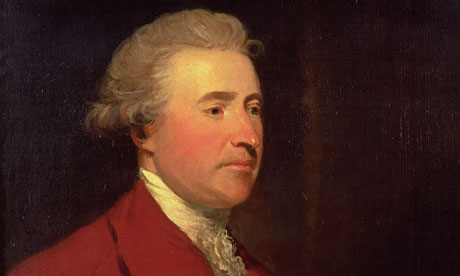
Last week, we began diving into the grandfather of modern conservatism, Edmund Burke. Burke prophetically saw the outcome of the French Revolution before it turned sour, writing his legendary Reflections on the Revolution in France in 1789 as the upheaval began. Burke argued that the French Revolution ended the greatness of European civilization, a Europe that governed, in various ways, its respective realms with a light hand, and a sense of “moral imagination.”

To quote Burke reflecting on the Queen of France:

“I thought ten thousand swords must have leaped from their scabbards to avenge even a look that threatened her with insult. But the age of chivalry is gone. That of sophisters, economists, and calculators, has succeeded; and the glory of Europe is extinguished forever. Never, never more, shall we behold that generous loyalty to rank and sex, that proud submission, that dignified obedience, that subordination of the heart, which kept alive, even in servitude itself, the spirit of an exalted freedom. The unbought grace of life, the cheap defence of nations, the nurse of manly sentiment and heroick enterprise is gone! It is gone, that sensibility of principle, that chastity of honour, which felt a stain like a wound, which inspired courage whilst it mitigated ferocity, which ennobled whatever it touched, and under which vice itself lost half its evil, by losing all its grossness.”

What a powerful excerpt! The “sophisters, economists, and calculators,” indeed, reign in the West. What Burke was driving at here was that the rationalistic, abstract bureaucrats who would abandon tradition in their quest for a perfect society would sacrifice everything that made their country great, and life worth living.

Burke was also arguing that there is more to obedience to a government or king than the mere threat of power. People are invested in their country and society—and willing to submit to authority—because of organic culture from which it grows. Uprooting the great tree of tradition in favor of abstract foundations merely destroys the tree, and plants its seedlings in shallow ruts of stone. What grows will be anemic and pitiful by comparison.

Volumes could and have been written about Burke, but I’ll leave it here for now. Next week we’re getting into the development of Northern and Southern conservatism, which should make for some pre-Independence Day fun.

History of Conservative Thought Summer 2020, Week 2

The second week of History of Conservative Thought 2020 is in the books.  We did another Google Meet session, as I’m still supposed to be quarantining, but we should be able to meet in person next week.  My fever is virtually gone, and I’m finally feeling normal again.

The bulk of today’s discussion centered on Russell Kirk’s “Ten Conservative Principles,” which expanded a bit upon the six conservative principles Kirk wrote about in the “Introduction” to The Portable Conservative Reader.  It was a great discussion, and it was interesting to read the students’ papers before class to see how their answer to the question “What is Conservatism?” changed after reading Kirk.

Read More »

TBT: What is Conservatism?

I’m still struggling with fever and migraines, although both seem to be improving and growing milder.  Fortunately, I received word today that I do not have The Virus.  So now I have to get to the bottom of whatever malady plagues me.

Yesterday I launched the Summer 2020 session of History of Conservative Thought online; you can read about our discussion here.  As such, it seemed a good time to look back 2019’s What is Conservatism?,” the first post from the Summer 2019 run.

The post here details Russell Kirk’s “Introduction” to The Portable Conservative Reader, which has also been repackaged as “Ten Conservative Principles.”  It’s an important essay that details the general principles and attitudes of the conservative as he attempts to make sense of the world.

It’s influential, too, though Kirk’s influence has suffered somewhat versus Buckley-style fusionism.  The Z Man dedicated an entire podcast to the essay a few weeks ago.

It’s well worth a read.  But for now, here’s my summary of it in “What is Conservatism?“:

Today I’m launching a summer class at my little private school here in South Carolina.  The course is called History of Conservative Thought, and it’s a course idea I’ve been kicking around for awhile.  Since the enrollment is very small, this first run is going to be more of an “independent study,” with a focus on analyzing and writing about some key essays and books in the conservative tradition.  I’ll also be posting some updates about the course to this blog, and I’ll write some explanatory posts about the material for the students and regular readers to consult.  This post will be one of those.

Course Readings:

Most of the readings will be digitized or available online at various conservative websites, but if you’re interested in following along with the course, I recommend picking up two books:

1.) Richard Weaver‘s Ideas Have Consequences ($6.29):  this will be our “capstone” reading for the summer.
2.) The Portable Conservative Reader (edited by Russell Kirk):  we’ll do some readings from this collection, including Kirk’s “Introduction” for the first week.

Course Scope:

I’ll be building out the course week-to-week, but the ultimate goal is to end with 2016 election, when we’ll talk about the break down of the postwar neoliberal consensus, the rise of populism and nationalism in the West, and the emergence of the Dissident Right.

After the introductory week, we’ll dive into Edmund Burke, then consider the antebellum debates about States’ rights.  I haven’t quite worked out the murky bit during the Gilded Age, but we’ll look at the rise of Progressivism in the early twentieth century, then through the conservative decline during the Great Depression and the Second World War.

After that, it’s on to Buckley conservatism and fusionism, as well as the challenges of the Cold War and international communism.  Paleoconservatives like Pat Buchanan and (if I’m feeling edgy) Sam Francis will get shout-outs as well.

Week 1:  What is Conservatism?

That’s the basic outline.  For the first day, we’re going to look at the question in the title:  what is conservatism?  What makes one a conservative?  Feel free to comment below on your thoughts.

After we see what students think conservatism is, we’ll begin reading through Russell Kirk’s “Introduction” in The Portable Conservative Reader.  It’s an excellent overview of the question posed.  The first section of the lengthy “Introduction” is entitled “Succinct Description,” and it starts with the question, “What is conservatism?”

Not being one to reinvent what others have done better—surely that is part of being a conservative (see Principle  below)—I wanted to unpack his six major points.  Kirk argues that though conservatism “is no ideology,” and that it varies depending on time and country, it

“may be apprehended reasonably well by attention to what leading writers and politicians, generally called conservative, have said and done…. to put the matter another way, [conservatism] amounts to the consensus of the leading conservative thinkers and actors over the past two centuries.”

Kirk condenses that grand tradition into six “first principles,” derived largely from British and American conservatives.  To wit:

1.) Belief in a Transcendent Moral Order – conservatives believe there is higher authority or metaphysical order that human societies should build upon.  As Kirk puts it, a “divine tactic, however dimly descried, is at work in human society.”  There is a need for “enduring moral authority.”  The Declaration of Independence, for example, draws on the concept of “natural law” to complain about abuses of God-given rights.  The implication is that a good and just society will respect God’s natural law.

2.) The Principle of Social Continuity – Kirk puts this best:  “Order and justice and freedom,” conservatives believe, “are the artificial products of a long and painful social experience, the results of centuries of trial and reflection and sacrifice.”

As such, the way things are is the product of long, hard-won experience, and changes to that social order should be gradual, lest those changes unleash even greater evils than the ones currently present.  Conservatives abhor sudden upheaval; to quote Kirk again:  “Revolution slices through the arteries of a culture, a cure that kills.”

3.) The Principle of Prescription, or the “wisdom of our ancestors” – building on the previous principle, “prescription” is the belief that there is established wisdom from our ancestors, and that the antiquity of an idea is a merit, not a detraction.  Old, tried-and-trued methods are, generally, preferable to newfangled conceptions of how humans should organize themselves.

As Kirk writes, “Conservatives argue that we are unlikely, we moderns, to make any brave new discoveries in morals or politics or taste.  It is perilous to weigh every passing issue on the basis of private judgment and private rationality.”  In other words, there is great wisdom in traditions, and as individuals it is difficult, in our limited, personal experience, to comprehend the whole.

It’s like G. K. Chesterton’s fence:  you don’t pull down the fence until you know why it is built.  What might seem to be an inconvenience, a structure no longer useful, may very well serve some vital purpose that you only dimly understand, if at all.

4.) The Principle of Prudence – in line with Principles and , the conservative believes that politicians or leaders should pursue any reforms only after great consideration and debate, and not out of “temporary advantage or popularity.”  Long-term consequences should be carefully considered, and rash, dramatic changes are likely to be more disruptive than the present ill facing a society.  As Kirk writes, “The march of providence is slow; it is the devil who always hurries.”

5.) The Principle of Variety – the “variety” that Kirk discusses here is not the uncritical mantra of “Diversity is Our Strength.”  Instead, it is the conservative’s love for intricate variety within his own social institutions and order.

Rather than accepting the “narrowing uniformity and deadening egalitarianism of radical systems,” conservatives recognize that some stratification in a society is inevitable.  Material and social inequality will always exist—indeed, they must exist—but in a healthy, ordered society, each of these divisions serves its purpose and has meaning.  The simple craftsman in his workshop, while materially less well-off than the local merchant, enjoys a fulfilling place in an ordered society, one that is honorable and satisfying.  Both the merchant and the craftsmen enjoy the fruits of their labor, as private property is essential to maintaining this order:  “without private property, liberty is reduced and culture is impoverished,” per Kirk.

This principle is one of the more difficult to wrap our minds around, as the “variety” here is quite different than what elites in our present age desire.  Essentially, it is a rejection of total social and material equality, and a celebration of the nuances—the nooks and crannies—of a healthy social order.  “Society,” Kirk argues, “longs for honest and able leadership; and if natural and institutional differences among people are destroyed, presently some tyrant or host of squalid oligarchs will create new forms of inequality.”

Put another way:  make everyone equal, and you’ll soon end up with another, likely worse, form of inequality.

6.) The Principle of the Imperfectibility of Human Nature – unlike progressives, who believe that “human nature” is mutable—if we just get the formula right, everyone will be perfect!—conservatives (wisely) reject this notion.  Hard experience demonstrates that human nature “suffers irremediably from certain faults…. Man being imperfect, no perfect social order ever can be created.”  An Utopian society, assuming such a thing were possible, would quickly devolve into rebellion, or “expire of boredom,” because human nature is inherently restless and rebellious.

Instead, conservatives believe that the best one can hope for is “a tolerably ordered, just and free society, in which some evils, maladjustments, and suffering continue to lurk.”  Prudent trimming of the organic oak tree of society can make gradual improvements, but the tree will never achieve Platonic perfection (to quote Guns ‘n’ Roses:  “Nothing lasts forever, even cold November rain”).

Conclusion

Kirk stresses in the rest of the introduction that not all conservatives accept or conform to all of the six principles again; indeed, most conservatives aren’t even aware of these principles, or may only dimly perceive them.

That’s instructive:  a large part of what makes one conservative is lived experience.  “Conservatism” also varies depending on time and place:  the social order that, say, Hungary seeks to preserve is, of necessity, different than that of the United States.

Conservatism, too, is often a reaction to encroaching radicalism.  Thus, Kirk writes of the “shop-and-till” conservatism of Britain and France in the nineteenth century:  small farmers and shopkeepers who feared the loss of their property to abstract rationalist philosophers and coffeeshop radicals, dreaming up airy political systems in their heads, and utterly detached from reality.

If that sounds like the “Silent Majority” of President Richard Nixon’s 1968 and 1972 elections—or of President Trump’s 2016 victory—it’s no coincidence.  The great mass of the voting public is, debatably, quietly, unconsciously conservative, at least when it comes to their own family, land, and local institutions.  Those slumbering hordes only awaken, though, when they perceive their little platoon is under siege from greater forces.  When they speak, they roar.

But that’s a topic for another time.  What do you think conservatism is? Leave your comments below.

–TPP

First Day of History of Conservative Thought 2020

Today marked the first day of the Summer 2020 session of my History of Conservative Thought course.  Because I’m sick and awaiting COVID-19 test results, we held the inaugural session on Google Meet, discussing the big picture question “What is Conservatism?

The session went quite well (and I was pleased to see that even with a fever I could last around 75 minutes).  The students hit upon these concepts as being key to conservatism:

  • Fiscal responsibility
  • Constitutionalism (in the American context)
  • Limited/small government and States’ Rights
  • Traditionalism in a cultural and religious sense
  • Opposition to Progressivism itself (certainly a feature of Buckleyite fusionism
  • Peace through Strength
  • Strict immigration enforcement

To that list I added the classically liberal concept of natural rights and the Burkean idea of “ordered liberty.”  We also talked about how the earliest conservatives of the Enlightenment Period were largely monarchists, and explicitly rejected the concept of natural rights (at least, rejected the concept as Americans understand it; that is, that all men are created equal and God gives them their rights).

They’re reading Russell Kirk’s “Ten Conservative Principles” for next week, and we’ll check Kirk’s principles against their list.

Read More »