Global Poverty in Decline

Regular readers know that I frequently cite pollster Scott Rasmussen’s #Number of the Day series from Ballotpedia.  I do so because a.) his numbers often reveal some interesting truths about our world and b.) blogging is, at bottom, the art of making secondary or tertiary commentary on what other, smarter, harder-working people have thought, written, and done.

Yesterday’s #Number of the Day dealt with global poverty; specifically, Americans’ ignorance to the fact that global poverty has declined substantially over the last twenty years.  Indeed, global poverty has been reduced by half in that time.

I’ll confess I was ignorant of the extent of this decline, too, although it makes sense that poverty has decreased, especially when you consider the rise of post-Soviet market economies in Eastern Europe and China’s meteoric rise since the 1980s.

I suspect that the perennial culprit of the Mainstream Media is to blame, in part, for this ignorance, coupled as it is with progressive politicians.  The rise of “democratic socialist” candidates—as well as the lingering effects of the Great Recession—would have Americans believe that the global economy is in terrible shape, and that “underprivileged” parts of the world labor in ever-worsening poverty (so, let’s just move them all here—that’ll solve poverty!).

It’s refreshing to see that capitalism is working its economic magic, and people all over the globe are lifting themselves out of poverty.  If representative republicanism and strong civil societies can take root and flourish in more places, the ingredients will be in place for continued economic and cultural growth.

Democrats Favor Socialism

Republicans and conservatives have long understood that many Democrats [not-so?] secretly harbor a love for socialism, and that socialistic policies are their end-goal.  As I wrote in “Democrats Show Their True Colors,” “democratic” socialism has been growing in popularity in the Democratic Party, and the party has tapped into its progressive roots and lurched violently to the Left.

Scott Rasmussen’s #Number of the Day today backs this trend up with hard numbers.  He writes that 57% of Democrats have a positive view of socialism, while only 47% have a positive view of capitalism.  That 47% figure is down from 56% just two years ago.

71% of Republicans, on the other hand, view capitalism positively, while 16% of RINOs view socialism favorably.  I don’t understand how any Republican can view socialism favorably; I suspect they view “socialism” as “limited government-run enterprises,” like the Tennessee Valley Authority or the Department of Motor Vehicles.  I can’t imagine many of them support true, complete government ownership of property and the means of production.

These trends toward socialism on the Left make Republican victory—as unlikely as it might be—in the 2018 midterm elections all-the-more crucial.

Progressivism and Political Violence II: Candace Owens Attack and the Deficiency of Decorum

A small part of me really believed that the insanity of post-election 2016 and pre-and-post-Inaugural 2017, while still simmering at a low boil, had largely shifted back to the fringes, with the real threats to liberty returning to online flame wars and techno-corporate elites deplatforming anyone to the right of Joseph Stalin.  Sure, Antifa—the ironically-named organization of hooded, masked Millennial fascists—is still around, and entitled behemoths still kneel during the National Anthem, but the street-level thuggery seemed to have quieted down.

As with many things in life, I was, unfortunately, wrong.  Candace Owens—the intelligent black conservative who inspired Kanye West’s Twitter lovefest for President Trump earlier this summer—was attacked in Philadelphia by a group of noodle-wristed soy boys and their pansexual, transgender lesbian besties while trying to enjoy a breakfast with Charlie Kirk. the founder of Turning Point USA.

I should have listened to my own analysis—and remembered very recent incidences, like White House Press Secretary Sarah Huckabee Sanders’s expulsion from a restaurant because her mere presence made gay employees uncomfortable (I know they’re drama queens, but, c’mon—can we stop indulging gay men like they’re fragile children?)—rather than engage in unfounded optimism.

The attack on Owens—who was forced to leave the restaurant because of the disturbance, and who endured cries of “F*ck White Supremacy” (remember, she’s black)—is merely the latest in a long stream of Leftists attacks on the Right.  Some, like yesterday’s deplatforming of Alex Jones and InfoWars—are non-violent, but hurt economically and socially by reducing or eliminating traffic to websites.

What the Left cannot achieve through social or economic coercion—through its dominance of institutions like academia, media, the arts, corporations, etc.—it will gladly do through physical violence (thus the “by any means necessary” mantra so beloved of Communist revolutionaries).  I suspect that a number of seemingly respectable cultural and academic figures on the Left, while publicly tut-tutting their street fighters, secretly thrill at the violent upheaval their radicals-in-arms create.

Indeed, this is no mere speculation.  Remember the television executive who scoffed, after the Las Vegas Mandalay Bay shooting, that most of the victims were probably Republican Trump supporters, anyway?

Aging counterculture revolutionaries—now firmly entrenched in their tenured ivory towers and emeritus seats, forever addicted to the false god of youth—live dreamily, vicariously through the antics of young street “toughs” who emulate the very professoriate that idealizes their destruction.

Now more than ever, the Right must come together.  Remember the meteoric rise and swift fall of Milo Yiannopoulos?  For years, conservatives dreamed of a funny, popular figure who would help break us out of National Review and Weekly Standard stuffiness and show that we don’t hate gay people or minorities (we just hate annoying people in general).  When he finally came, Conservatism Inc. rejected him out-of-hand because he made mean jokes on stage (the same objection, I’m sure you’ve realized, they’ve made about Trump).  Milo can be a little much sometimes, but I don’t think I’ve ever heard him state a fact that was incorrect.  Hyperbolic in delivery, yes; factually inaccurate, no.

My point is this:  we’ve got to give the decorum thing a rest.  I’m not saying we should go out and diss every non-conservative we ever meet, or to engage in street fights with Antifa (except in self-defense)—we should try to be cordial and peaceful whenever possible—but if the other side is going to punch you while you’re trying to have a rational discussion, then, well, your fists have gotsta do the talking for you.

Again, I am not condoning or attempting to incite anyone to violence.  I’m just saying that we need to back off figures like Trump, Milo, Candace Owens, Gavin McInness, etc., who are making the tough, real sacrifices in this culture war, and who are exposing themselves to real physical danger.  So what if they get a little rhetorically saucy or say something mean but funny?  Decorum has its place, but it seems to be a luxury we can ill-afford at present.

HSAs are A-Okay

My Congressman, Tom Rice, sends out little e-mail updates on a regular basis.  In his latest newsletter, the South Carolina US-7 representative included a link to a video (below) of his statements before Congress about expanding Health Savings Accounts, or HSAs.

https://www.youtube.com/watch?v=0KPoNk9eRUc

The gist of the proposal is to expand health-savings accounts to allow account holders to contribute more to them.  The current legal annual contribution (in FY2018) for a single individual is $3450, up from $3400 last year and $3350 the year before.  That comes out to $287.50 a month, which can be contributed pre-tax directly from an account holder’s paycheck.

The way the law is currently written, HSAs are excellent both to cover medical expenses before reaching your deductible (and, naturally, most HSA-compliant plans are high deductible ones) and to save and invest for retirement.  You can accrue a qualified medical expense today—say, a visit to the emergency room—and you can submit that receipt in a decade (or longer—there’s no apparent time-limit) to take out that amount.

To give a hypothetical:  let’s say you have a medical bill for $3000.  Yes, your annual contribution to your HSA could cover that.  But, let’s say you’ve built up a good emergency fund, and elect to pay the bill out-of-pocket through that fund.  In, say, five years, you need to tap your HSA funds for some reason.  If you’ve kept the receipt (and credit card statements help, too), you can file that with your HSA and withdraw the $3000.

Why go through the trouble?  Because many HSA administrators—including my own, HealthSavings Administrators—allow you to invest in mutual funds with your HSA contributions.  If you’re making an 8% annual return on those contributions, that $3000 today will be worth around $4100 in five years (investment math folks, please check my numbers; regardless, you get the point—money grows).

Alternatively, if you don’t tap that money for decades—and keep contributing—you’ll have a very nice retirement account growing tax-free for all those years.

My current health insurance carries a $6550 deductible—which I didn’t even come close to hitting in 2017 when I broke my left wrist, although it was still expensive—but I’ve accrued enough of an emergency fund that I could meet that expense should the need arise (I pray it doesn’t).  If my emergency fund were sunk into something else—say, a new car, or a less flood-prone house—then I could tap into my HSA contributions from the past few years.

And here is the other benefit of HSAs, the one that I’m sure Congressman Rice as in mind:  they help you reach your deductible, and bring some market forces to bear on healthcare costs.

I suspect that one of the culprits of high healthcare costs is the lack of transparency—no one knows how much anything costs, and everything is fungible.  When I broke my wrist, I received a hefty ER bill (about $3000) about four months after the fall (I don’t understand the delay on that; it seems like they could just tally it all up and print it out at the time of the accident).  I called the hospital, and they told they were “running a special”—if I paid in full that day, they’d knock HALF of the cost off the bill.  Because I’m an extreme budgeter and have an emergency fund, I could do it, and leaped at the “special.”

Most people don’t have enough money saved up to even meet a $500 emergency, but an HSA makes it more doable.  Even without an emergency fund, if an account holder were making monthly contributions, he’d be able to take advantage of such price reductions.

HSAs aren’t a magic bullet to bringing down healthcare costs, but they would go a long way to addressing the problem.  If we lived in a pre-Obamacare age, you’d be able to get a high-deductible, HSA-compliant plan for probably $50-100 a month, depending on age and health.  Even if you didn’t want to manage the money in various investments, the incentives to save—namely, the pre-tax benefit—are enough that many Americans would likely take contribute to their HSA.

When Secretary of Housing and Urban Development Ben Carson was running for president in 2015-2016, he proposed transferable, minimally-funded ($5000 at birth, I believe) HSAs be issued for all Americans.  The ability to transfer funds between family members and to grow that wealth over time would be huge.

Similarly, President George W. Bush proposed giving Americans the option to contribute their Social Security contributions into personally-managed investment accounts.  That would reduce the astronomical costs of that federal boondoggle and give Americans much greater returns on their investments.  Naturally, Democrats rejected that plan out of hand, and accused Bush of hating old people.  Yeesh.

The takeaway is this:  whether it’s in healthcare or retirement savings, the American people know best.  Yes, we’d need some additional financial education—which we desperately need anyway—but, c’mon, are you going to continue running the same inefficient, wasteful systems just because a small percentage of people won’t adequately manage their money?

Liberty works in nearly every arena, and it would work in healthcare and health insurance, too.  HSAs are the wave of the future, and I’m glad to see Tom Rice is championing them.

Trump’s Economic Growth Isn’t Due to Farm Exports

President Trump has enjoyed massive economic growth since his election, much less his actual inauguration.  The latest economic growth numbers for Q2 put the annualized rate of growth at a whopping 4.1%.

Naturally, the progressive Leftists are grasping about for any explanation they can to account for this growth, or to downplay it.  One of the more novel proposals is that the only reason growth is so high is because farmers are rushing out their exports to other nations ahead of planned tariffs—and the retaliatory measures they will garner.

While I’m willing to concede these premature exports may account for some of the growth rate in Q2, I doubt very seriously that there are enough additional soybean exports to China in a three-month period to bump the entire economic growth rate by more than a fraction of a percent.

Consider all the factors at play here:  the 2017 tax cut, specifically to the corporate tax rate, created a yuge incentive to companies to repatriate dollars held overseas, and made American companies internationally competitive again (prior to the cuts, our corporate tax rate of 35% was one of the highest in the developed world).  The easing of pressure on corporate rates and individual income tax rates have boosted business and consumer confidence, and wages have increased as unemployment continues to fall.

Even before the passage of the tax cut, deregulation within the executive branch began stimulating the economy.  In his famous Gettysburg campaign speech, in which then-candidate Trump put forth his reform agenda for the United States, he promised an executive order requiring the removal of two regulations for every one new regulation written.  In classic Trumpian fashion, the President delivered—and then some:  in 2017, the Trump administration cut a whopping twenty-two regulations for every one regulation passed.

The one-two punch of deregulation and tax cuts has juiced the engine of the economy with rocket fuel, but the media loves to run with the narrative that it’s all smoke-and-mirrors, and we’re only enjoying this growth because a bunch of farmers rushed out exports early.

They push that story for two reasons:

1.) They can’t give Trump credit for anything positive

2.) It draws attention to the downsides of tariffs, and the cloying sentimentality of the farmer struggling under Trump

I have a great deal of respect for farming and the rural life, but these aren’t Nebraska homesteaders or Jeffersonian yeoman farmers we’re talking about.  Not that that matters—big corporate farms shouldn’t be punished for being big; I’m merely cautioning readers to take such rhetoric with a massive dose of soy (actually, pick something else; we don’t need anymore soy boys).  The mainstream media is going to spin this story in the most maudlin fashion possible.

Tariffs historically have hurt farmers, who often pay the price of tariffs both ways:  they pay more imported goods, and they struggle to access foreign markets competitively when they export their products.  And, as I wrote recently, I don’t think tariffs are without their costs.

That said, there’s no way Q2 GDP growth can be driven solely, or even mostly, by farm exports.  Further, it seems that such robust growth makes tariffs more affordable, in the sense that the United States can spare a few decimals of growth in exchange for greater protections of worker.

Finally, tariffs-as-bargaining-chip seems to be working.  China’s economy is in free-fall, and the Chinese have to eat.  Even with tariffs on US soybeans and other farm products, China needs what we’re growing more than we need what they’re churning out.

In short, stay the course, President Trump.  Rebalance our trade agreements, make the income tax cuts permanent, and keep regulations light.

Democrats Show Their True Colors

Over the weekend, Democratic congressional nominee Alexandria Ocasio-Cortez appeared on a video with Vermont Senator Bernie Sanders.  The two self-styled democratic socialists were campaigning for Brent Welder in Kansas City.  In the video, the telegenic young Marxist boasted that “We’re gonna flip this seat red in November,” accidentally confusing the Republican Red for the Democratic Blue.

A minor gaffe, to be sure, but it’s interesting to consider the political party colors, which were reversed not too long agoRed has traditionally been the color of Communist, Marxist, socialist, and other leftist movements since the nineteenth century.  According to a piece from The Smithsonian (linked above and here), the media’s first usage of different colors to demonstrate presidential election results occurred in the 1976 race, in which Democratic candidate Jimmy Carter won when Mississippi went “red.”  Apparently, media outlets used the colors interchangeably until the 2000 election; we’ve stuck to red for Republicans and blue for Democrats since then.

In retrospect, though, the red coloring fits more with the ideology, goals, and history of the Democratic Party, and particularly its progressive wing (which, I would argue, is most of the party at this point).  Lately, Democrats have been flaunting their true colors unabashedly.

Take Ms. Ocasio-Cortez, for example.  She won a much-discussed upset in the Democratic primary for a New York congressional district against a powerful incumbent, Joe Crowley.  Her politics are stridently Leftist:  she supports Medicare for all, the abolishment of Immigration and Customs Enforcement (ICE), the forgiveness of all student loan debt, and a plethora of other unrealistic, expensive causes.

She’s also a much more appealing—and, therefore, more dangerous—face for “democratic” socialism than its other ubiquitous standard-bearer, Bernie Sanders. Senator Sanders is an aging, old-school socialist of the Trotskyite variety, much like his British counterpart, Labour Party leader Jeremy Corbyn.  He’s never held a serious job outside of politics (which he entered in his forties), and he now looks like a kooky mad scientist who could disappear in a pile of dust and bones if a strong wind hit him (or if the deal he made with that necromancer is broken).

Ocasio-Cortez, on the other hand, is 28, and has the sort of Millennial profile that is common for my confused generation:  she worked as a bartender until a year ago; she’s passionate about many subjects, but not well-versed in any of them; she’s over-educated to the point of uselessness (see the previous phrase).

She’s also super telegenic and—except for some unfortunately-timed photos—a babe, and a Latina at that.

That’s a combination that Democrats can’t resist.  Like President Barack Obama—who was cool, African-American, a community organizer, and had a messiah complex—Democrats want a candidate who parrots radical ideologies while also validating them emotionally.  The hope is that an attractive young candidate will help them in future elections; thus, the constant touting of Ocasio-Cortez as the “future of the Democratic Party.”

Never mind that NY-14 congressional district that Ocasio-Cortez will soon represent (there’s not much chance of a Republican challenger succeeding in this district, which is a +29 D district) is nearly 50% Hispanic.  “Hispanic” is a tricky term, because it covers a number of different groups, but these aren’t your third- or fourth-generation Texas Hispanics (the ones who make up about half of the ICE agents Ocasio-Cortez wants out of a job); these are likely recent immigrants who, regardless of race, traditionally vote Democratic.  Some of them no-doubt originate from countries accustomed to leftist populist politicians.

Regardless, the Left is stripping down the last pretenses of being “moderate” or in favor of “common sense,” although you’ll still hear some use that phrase.  In the wake of President Trump’s election and administration, the Democratic Party has become increasingly open about its desire to soak the rich, redistribute wealth, take on a host of burdensome social and economic responsibilities, and generally move the nation further along toward socialism.

Outside of some parts of the South and the Midwest, the idea of the old-school “conservative Democrat” is long dead; it’s only now that the Democratic Party is showing its true colors.

TBT: Capitalism Needs Social Conservatism

On Tuesday, I wrote about the “Human Toll of Globalization“—the dire consequences, both economic and moral, that befall a community when its primary economic engine is gutted through a naïve faith in unbridled free trade and globalization.  Another title for that piece might be almost a mirror of this essay’s from 2016:  “Civil Society Needs Cash.”

I don’t want to take that argument too far, though.  In the case of Danville, Virginia—and countless other American towns that have seen their prosperity flee abroad, or to bicoastal urban cloisters—a decaying economy wrought decaying morality, civil society, and civic pride.  That would suggest that prosperity, in and itself, cannot sustain true morality and virtue.

Indeed, as I argue in the essay below, “Capitalism Needs Social Conservatism,” excessive prosperity and material comfort breed a kind of moral complacency, what Kenneth Minogue likened to widespread Epicureanism (an excellent essay, and well worth reading if you don’t mind subscribing to The New Criterion, which is also worth the price).  Richard Weaver—one of my intellectual heroes—compared the material comfort of the then-mid-twentieth-century West to a drunk who, having grown addicted to alcohol, and requiring ever-greater quantities of it, no longer has the capacity to obtain the very substance he craves.

Milton Friedman famously argued that economic liberty is a necessary precursor to political liberty.  Similarly, I would argue that morality and virtue are necessary pillars to sustaining economic liberty for any length of time.  Indeed, George Washington argued that religion and public morality were “indispensable” to a self-governing republic.

In my mind, the orthodox libertarian (in the political sense, not the “free-will” libertarianism of the free-will-versus-determinism debate in modern philosophy) commits the same error as the orthodox Marxist in relying too much on economic analysis of behavior.  The idea of the “rational man” or “man as a rational animal” is a uniquely modern concept, and while Westerners have tried hard to shoe-horn themselves into that mold, the inner, teeming depths of our souls are still pre-rationalist.  We need God, and we still live according to symbols, rituals, and virtues.

As I wrote in 2016, “Without moral common ground and shared values that stress self-control, liberty rapidly turns to libertinism.  Libertinism without a great deal of wealth leads to shattered lives, which in turn wreck families and communities.”  I’ll explore these ideas further in my upcoming eBook, Values Have Consequences.

***

For the past week, I’ve written about the decline of the nuclear family, with follow-up posts about divorce and sex education, and about the negative impact of the of the welfare state on family formation.  These post have generated some wonderful discussions and input from followers, and I’ve been surprised by their popularity.

As I wrote in “Values Have Consequences,” I’m devoting Friday posts to discussions of social conservatism.  Social conservatism is increasingly the red-headed stepchild of the traditional Republican “tripod” coalition that also includes national security and economic conservatives (with the rise of Trump, populist nationalism could count as a fourth leg).  Politically, this marginalization makes some sense, as it’s not likely that fifty or sixty years of cultural attitudes and values will be changed at the ballot box.

Nevertheless, social conservatism is an important leg of the tripod.  Indeed, I would argue that the three coalitions are not at odds, but create logical synergies that allow each leg to stand.  The stool is much more stable when the three legs work together.

Economic conservatism–by which I mean the belief that freer markets, fewer and lighter regulations, and lower taxes, or what is more properly called neoliberalism (after the classical liberalism of the 18th-century thinkers like Adam Smith)–is wonderful and hugely important.  It’s led to massive gains domestically and globally, lifting untold millions off people out of poverty.  It allows people to enjoy a greater variety of goods and labor-saving devices, and provides more leisure time (and plenty of things to do during that time).

But free markets unmoored from guiding principles, strong and stable institutions, and the rule of law can morph into mindless Mammon worship.  Without a shared sense of trust and belief in human dignity, capitalism becomes cold and abstract.

Further, full-fledged economic liberalization without the limiting principles applied by constitutionalism and a morality supported by strong families and a robust civil society can lead to socially-destructive disruptions and behaviors.

As I’ve argued many times, making mistakes or bad choices is the necessary price of liberty.  But for self-government to work effectively–and to avoid social instability–a healthy dose of social conservatism is the best medicine.

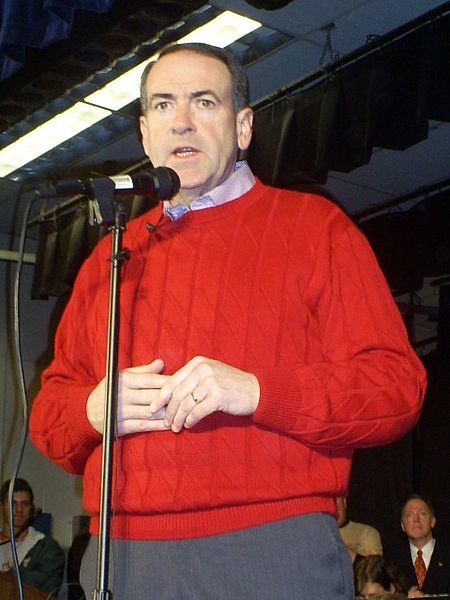
Former Arkansas Governor Mike Huckabee wears the most socially conservative outfit ever; later, he played bass on Fox News.
(Image Sourcehttps://en.wikipedia.org/wiki/File:Huckabeemike.JPG; photo by Craig Michaud)

To offer an illustration from recent history, contrast the post-Soviet experiences of Poland (and most of Eastern Europe) with that of Russia.  Despite decades under Communism–an ideology that was aggressively atheistic, stressing loyalty to the state and Communist Party over all else–Poland roared back into the West.  It adopted neoliberal (modern conservative) economic policies, and was one of the few European nations not to suffer severely during the Great Recession.

Russia similarly adopted “shock therapy” after the Soviet Union collapsed for good in 1991.  Rather than experiencing a huge economic boom, however, well-connected former Communists and others close to the old regime made off like bandits, leaving most Russians left holding the bag.

What’s the difference?  For one, the Russians lived under Communism for nearly a generation longer than the Poles, meaning there were several generations of downtrodden, state-dependent Russians by the time the USSR collapsed.  Many of these Russians were unable to adjust to a free-market system after living in a closed economy for so long.

Another key difference–and one that I think is extremely significant–is that Russians lost any scrap of civil society they might have possessed prior to the Bolshevik takeover in late 1917.  Civil society–the institutions between the basic family unit and the government, like churches, schools, clubs, civic organizations, etc.–was automatically preempted when every club, organization, or activity became part of the Soviet government.  The severely crippled (and, as I understand it, collaborationist) Russian Orthodox Church was unable or unwilling to push back against Soviet rule, providing little in the way of a spiritual alternative to the totalizing influence of Communism.

“[F]ree markets unmoored from guiding principles, strong and stable institutions, and the rule of law can morph into mindless Mammon worship.”

Poland, on the other hand, managed to maintain its deep Catholic faith.  The Catholic Church as an international organization (and with powerful, influential popes, most notably the Polish anti-Communist John Paul II) could never be wiped out completely by Soviet Communism.  Further, the Poles formed the Solidarity trades union movement, which offered an alternative to official Communist organizations.

Thus, after the dissolution of the Soviet Union, Poland emerged with a strong civil society anchored in a richly Christian worldview and ethic.  The shared sense of morality–one that stresses mutual respect, the dignity of human life, and the importance of honesty–allowed the complex deals and uptempo economic exchanges of capitalism to occur smoothly and rapidly.  From these civil and religious values came a firmer grasp of and respect for the rule of law, making predictable economic activity and long-term planning possible.

Russia, on the other hand, devolved into a fast-paced, nationwide run on the national cupboard.  Those with good connections grabbed whatever public funds and goodies they could.  Normal Russians couldn’t figure out why their government checks and free lunches stopped coming, and couldn’t understand why (or how) to pay taxes.  With the collapse of the Soviet Union, all civic organizations ceased to exist, because they were all part of the Soviet government.  Without any civil society or other enduring institutions to model good behavior and to stress and enforce moral values, Russia struggled–and continues to do so–to adapt to global capitalism and democracy.  Not surprisingly, they’ve turned to a dictatorial strongman for guidance.

***

What of the American context?  As I’ve written before, I’m skeptical of full-fledged libertarianism–what I would broadly define as the marriage of economically conservative and socially liberal views–because it fails to acknowledge the need for strong moral values to uphold its own economic assumptionsLiberty and self-government can only really work when coupled with self-imposed order and restraint.  Without moral common ground and shared values that stress self-control, liberty rapidly turns to libertinism.  Libertinism without a great deal of wealth leads to shattered lives, which in turn wreck families and communities.

Eventually, unbridled, unchecked lasciviousness–even among (formerly) responsible adults–results in social chaos, requiring a dwindling number of hardworking, honest, and thrifty individuals to pay for the ramifications of poor moral choices that have been magnified many times over.

“[L]ibertarianism… fails to acknowledge the need for strong moral values to uphold its own economic assumptions.  Liberty and self-government can only really work when coupled with self-imposed order and restraint.”

Capitalism’s blessing of unparalleled abundance is also a potential curse.  Without a strong civil society that stresses good moral values–and without proper historical perspective–it becomes easy to take that abundance for granted.

That abundance also allows, for a time, more and more individuals to pay for the price of bad decisions.  Prior to the modern era, few people were wealthy enough to risk the negative consequences of immorality.  Now, Americans and Westerners enjoy a level of material comfort and well-being that can absorb at least some of the unpleasantness of questionable choices.  Over time, however, that security breaks down.

Richard Weaver likened the situation to an alcoholic who is so addicted to his drink, he’s unable to do the work necessary to pay for his addiction.  The more he needs the alcohol, the less capable he becomes of obtaining it.  Likewise, the more individuals become addicted to luxuries, the less able they are to work hard to maintain them.

To avoid the fate of Weaver’s drunk, we must recognize the importance of social conservatism.  While we should maximize individual liberty as much as possible, and within the bounds of the Constitution, we should also stress the moral and religious underpinnings that make that liberty both possible and responsible.

An Open Letter to Papa John’s Pizza

Disclaimer—sigh:  I do not endorse racist ideologies or unnecessarily racist language, but I support free speech.  People shouldn’t go around using racial slurs, and may face professional and social consequences for doing so, even though it’s protected speech.  That said, I also believe nuance and context matter greatly.  It’s for the non-nuanced- or contextually-minded reader that I include this brief disclaimer, which I hate is even something I have to consider doing in an allegedly free country.

Pizza is a big part of modern American history, one of those beautiful examples of “cultural appropriation” that took the thin-crusted Neapolitan peasant street-food, improved upon it greatly, and made it a staple for all classes and races in the United States.

While everyone and their brother has their own opinions about the best slice and where to get it, my favorite of the “chain delivery pizza joints” (not to be confused with generally-superior ma-and-pop local pizza joints—or the Aiken-Augusta-area chain Pizza Joint) is, hand’s down, Papa John’s.

Sunday afternoon, I received “An open Letter from Papa John’s CEO, Steve Ritchie” in my e-mail.  Apparently, Papa John’s founder John Schnatter said The Forbidden Word, and has been forced out of his company.

You can read the full-text of Ritchie’s letter here.  A key line (emphasis added):

Racism and insensitive language – no matter the context – will not be tolerated at any level of our company. Period.

I began looking around to see what exactly Schnatter said.  What I found is that, yes, he used The Forbidden Word—in reference to Kentucky Fried Chicken’s beloved Colonel Sanders, on a conference call with a company training him on how to handle public relations better.

In essence, Schnatter was asked in a role-playing exercise how he would handle a situation similar to his remarks about the NFL National Anthem protests.  Schnatter had spoken out publicly about the protests, arguing—correctly—that they were hurting Papa John’s sales (Papa John’s has long been the official pizza of the NFL, so poor NFL ratings meant poor pizza sales; I’ve often enjoyed the ridiculously good deals they put out during football season).  As such, he’d already put a target on his back for progressive Social Justice Warriors.

As for the use of The Forbidden Word, Schnatter responded that Colonel Sanders used it, and then related a story about racial violence he witnessed or heard about as a boy in Indiana.  He wasn’t endorsing such violence, but intended it to show that he detested it.

Apparently, some employees of the public relations firm, Laundry Service, were offended, and—wow, wouldn’t you know it!—his use of The Forbidden Word was leaked.

Now he’s no longer working for the company he founded, and 120,000 employees (not to mention Papa John’s stockholders) are going to suffer.

I’m not holding Schnatter blameless here—he should know in the twenty-first century that a.) the Leftist mob doesn’t care about nuance, they just want another scalp and b.) you’re not allowed as a white man to say a word that thickly marinates every modern rap song—but a lot of employees, many of them black, might face layoffs because a handful of people got upset and leaked the contents of a confidential, training-based conference call.

It just goes to show that no one is safe, in any forum, at any time, ever.

In response to all this non-troversy, I took a moment to write a reply to Mr. Ritchie.  Here is the text in full:

Dear Mr. Ritchie,

Thank you for your e-mail.  I was unaware of the Papa John’s non-troversy until I received this e-mail.

From what I can tell from the news reports, John Schnatter may have been a tad careless with a culturally-taboo word, but he meant no ill-intent.

I suspect, rather, that he’s been crucified—the latest victim of such—on the cross of political correctness gone mad.  Given his past statements about NFL protestors hurting NFL ratings—and, by extension, your company’s pizza sales—he put a target on his back too tempting for the Social Justice Warriors to ignore, as he dared to make a truthful observation about one of their sacred cows.

Those statements, too, may have been unwise in a business context (even leaving out the possible racial component–and I don’t think arguing that players should abide by League rules is an inherently racist idea—it’s probably not a good idea to criticize publicly a major business partner), but they don’t warrant the kind of scorched-earth response that Mr. Schnatter has endured.

I am sorry to hear that his remarks have hurt actual people—the employees and franchisees of Papa John’s.  Surely you can agree that that’s the only tangible damage that has occurred here.  Otherwise, no person, of any race, was actually harmed by Mr. Schnatter’s use of the “N” word in an in-house conference call that, as I understand it, was a training session for avoiding future public-relations imbroglios (oops!).  In that context especially, shouldn’t the one receiving the training have additional leeway to learn without fear of some SJW ruining his life?

I hope that your employees will continue to make excellent pizza, as they have done for years, and will not be overly burdened by the kabuki theatre of your diversity initiatives.  I understand that, as a major company, you have to do your token genuflecting to the gods of multiculturalism and political-correctness, even though I’d personally rather see your Board grow some cajones and say, “Sorry for the misunderstanding and if anyone was offended, but the remarks have been taken out of context.  We serve pizza for all people, and while we don’t condone racism, we do support free speech, and believe that everyone should lighten up a bit—preferably over a slice of Papa John’s pizza.”

Sincerely,

Tyler James Cook

The cost of doing business seems to be never uttering anything remotely controversial, ever.  Schnatter was doomed the moment he pointed out—again, correctly—that the NFL was losing viewership because of the politicized National Anthem protests.  Yes, he shouldn’t have said The Forbidden Word—even in the context of quoting someone else, it’s not allowed according to current social mores—but it was just a matter of time before the Twitter mobs, Social Justice Warriors, white knights, or overly-sensitive consultants (Laundry Service is designed to train people not to make public faux pas; surely they’ve had clueless clients before that needed teaching) brought him down.

Why can’t we just enjoy pizza without it becoming an exercise in political posturing?

The Human Toll of Globalization

Last week’s posts shared a similar theme:  the costs of unbridled free trade; the benefits of cutting corporate and income taxes to unleash economic growth; and the human side to economics that academics tend to miss.

The first and third topics referenced above came into sharp relief as I read an excellent piece by Chadwick Moore, “Left for Dead in Danville: How Globalism is Killing Working Class America.”  It’s a long-form piece of journalism for Breitbart, but it is well worth the read.  I encourage all of my readers to set aside twenty minutes to read it and its terrifying account of globalization gone wrong.

My post today simply seeks to offer up a summary of Moore’s findings, presenting them in an easily-digestible form for those who don’t have the time or inclination to read his full-length piece.

The conceit of the piece is simple:  Moore visited Danville, Virginia, a former textile mill town located on the Dan River, and very close to North Carolina.  The town was once—and “once” doesn’t mean “a hundred years ago,” but about twenty years ago—a thriving town that supported a solid middle-class through its robust textile industry.  Civic pride was abundant, and the Dan River Mill supported a number of youth and community activities and functions that are familiar to anyone who has grown up in a small town.

Then came NAFTA in 1994, followed by China’s entrance into the World Trade Organization in 2000.  After years of struggling to compete with foreign competition, Dan River Mills shut down in 2006 (it had been open since 1882).

As the town’s economy declined and unemployment skyrocketed, social problems grew.  Drug use increased dramatically, as did crime, and formerly-safe, middle-class neighborhoods devolved into dangerous slums.  More than a quarter of the town’s population is on food stamps.

Race relations also grew worse.  The town had enjoyed peaceful, working relationships between black and white citizens, who worked together happily in the mills and other businesses.  Now, the KKK plans rallies, preying off the desperation of the unemployed (the town is roughly half white, half black).

Moore gives a good bit of space to quoting Michael Stumo, the CEO of the Coalition for a Prosperous America.  Stumo elegantly explains the problem in Danville—as with many other small towns in Middle America—tracing it to China and the World Trade Organization.  Some choice bits to chew on:

“‘When China joined the WTO in 2000 with 1.3 billion people underemployed, it began pulling them out of the rice paddies, the farms, and rural areas, and putting them to work. The Chinese under-consume. They produce more than they consume, [in] a country that’s four and a half times as big as ours and relying on the American consumer to fund their path to wealth and doing so with a state-directed economy, which is different than communist, it’s a strategic mix of state capitalism with a little bit of private sector in it. We always thought communism would fail, but China found central planning 2.0 and is pretty good at it,’ he says….

‘We have free trade within the 50 states,’ Stumo says. ‘By impoverishing our middle class with this offshoring driven by free trade policy, you’re killing the U.S. consumer market, which drives growth, because they have no money. Five or ten percent cheaper prices is overwhelmed in this stage by lack of production and stagnant wages,’ he says. ‘The U.S. middle class cannot afford to fund the rise of other countries anymore.

‘Industry doesn’t stand still; industry is always incubating—you give up the jobs, the wealth creation, the supply chain clusters in communities, and that affects the service sector around them,’ Stumo says. ‘You pull those plants out, and a lot of people are out of work, and then the whole general wage level drops because burger-flipping isn’t an upward pressure on wages, but production is.'”

A degree of globalization, in an age of mass transit and mass communications, inevitable.  And open trade with lower tariffs generally is beneficial.  But naïvely-open trade with dishonest trading partners with slave-level wages primarily benefits the dishonest party.  Yes, there are some winners in the United States—I certainly enjoy a higher quality of life because of cheap electronics from abroad, for example—but as I wrote last week, isn’t it worth paying a little more for your television or washing machine, if it means an American keeps his job.

My thinking on this is simple:  the actual, physical and mental of work, in and of itself, important.  Yes, we could pay everyone a guaranteed basic income, or help people through more assistance programs (ignore the astronomical costs of those programs for the moment), but even if they worked beautifully in the material sense, they will, in the long-run, lead to a deterioration of real skills and, more important, a spiritual vitality.

I strongly believe that the three keys to happiness are faith, family, and work, in that order.  Work is ennobling, even if it is unpleasant at times.  As such, if the government is going to do something, would it not be wiser to offer assistance that requires work?

Tariffs accomplish this goal to some extent, and are entirely constitutional (indeed, one of the authors of the Federalist Papers, Alexander Hamilton, argued for them as Secretary of Treasury).  They also produce revenue for the federal government, and could be used to offset further reductions in corporate and income tax rates.

Ultimately, the social and civic costs of unbridled, unfocused free trade seem too steep.  Read Moore’s observations about the flood of drugs and despair into this once-civic-minded, prosperous town, and understand that the 10% discount you enjoy on your consumer goods is seldom worth the human toll.

To clarify once again, I’m not arguing we return to the massively high tariffs of the late-nineteenth and early twentieth centuries.  That would be economically disastrous in other ways, and would further enhance our federal government’s penchant for corporatist back-scratching and favoritism.  But some judicious, targeted tariffs, especially against nations like China, are wise.  Why should we be subsidizing China’s growth at the expense of our own?

One final thought:  as I wrote Friday, a married man used to be able to raise his kids on a gas station pump-boy’s salary.  Sure, life was lean, and there weren’t a ton of crazy gadgets to play with or luxuries to enjoy, but the kids grew up well enough and the wife could stay home to raise them.  Are we really that much better off now, when both husband and wife slave for 40+ hours a week (and usually longer), outsource their parenting responsibilities to daycare and public schools, and can’t get out from under student loan, home, car, and consumer debt?

There are a host of factors driving the modern scenario of today versus the “blue-collar father” of yesteryear, but surely one economic solution is to stop burrowing out our families and towns in favor of frosty, urban cosmopolitanism and aloof globalism.  I care about the people of China, and I’m glad to see they’re no longer trapped in rice paddies and collectivized farms, but—like our great President Trump—I care about my country and fellow countrymen first.  So should the United States government—it’s job is, literally, to put Americans first.

Soccer Sucks

Over the weekend, France and Croatia squared off in the championship match of the 2018 World Cup.  The French team—which only has six players (of twenty-three) you and I would think of when we imagine a Frenchman—defeated the plucky Eastern European squad 4-2, an astoundingly high score for a soccer match.

Other than watching my students play occasionally, I can’t stand soccer.  The game has numerous flaws:  it’s overly-long, without any true breaks (an obstacle, as my brother pointed out, to monetization—you only have one half-time in which to show commercials); the scores are too low; and the action is rare.

The typical soccer game certainly requires a great deal of endurance:  I’m told that an average soccer player runs several miles during the course of a match.  But it’s all kabuki theatre, at least to my (admittedly) untrained eye.  All that running around seems to accomplish precious little, as players scamper about for agonizingly long stretches of time without really accomplishing anything.

In that meaningless but constant motion, I see a metaphor for the political systems found in nations that are perennially good at soccer.  Take this year’s champions:  France is not about actually being productive—scoring points—but about treading water.  Lycee-educated bureaucrats kick back to comfortable, easy jobs with short hours; workers of every stripe enjoy excessive labor protections; nothing is open on the weekends.

No wonder France’s unemployment rate in 2017 was 9.4% (down from a modest 10% from the previous year), while its youth unemployment rate is a whopping 19.3% (and didn’t get below 20% until April of this year).  French youngsters can’t get employment because the statist economic system limits growth, discourages innovation, and incentivizes bad or lazy employees.  Employees cannot be fired “at-will”—that is, without cause—and the process to remove underperforming employees takes month.  If you’re a French employee who knows he’s going to be fired, you might as well kick back for a few months and enjoy getting paid for doing nothing.  What’re they going to do, fire you?

While we should certainly treat workers with respect—and some labor protections are no-doubt positive—we have to remember there’s an employer who has put up a great deal of capital to try to make a profitable enterprise work.  No employer, no employees.  Sometimes a worker, while well-intentioned, just doesn’t work out, and the employer needs the flexibility to replace underperforming employees at will.

But I digress.  This essay is ostensibly about soccer.  Some additional thoughts:

Soccer is inherently un-American.  Yes, it’s hugely popular with younger children, which has led pundits to predict its ascendancy for decades.  But let’s consider why it’s popular.  John Derbyshire in his latest episode of Radio Derb argues that soccer caught on among upper-middle-class American children because their overprotective and status-conscious mothers saw it as “European,” and, therefore, more sophisticated and cultured (ignoring, as Derbyshire points out, all the hooliganism that goes with soccer).

A more compelling theory is Chuck Klosterman’s, from his 2004 book Sex, Drugs, and Cocoa Puffs, a collection of essays that I enjoyed immensely in my graduate school and early teaching days.  Klosterman argues that children like soccer because they’re bad at sports:

Soccer unconsciously rewards the outcast, which is why so many adults are fooled into thinking their kids love it. The truth is that most children don’t love soccer; they simply hate the alternatives more. For 60 percent of the adolescents in any fourth-grade classroom, sports are a humiliation waiting to happen. These are the kids who play baseball and strike out four times a game. These are the kids afraid to get fouled in basketball, because it only means they’re now required to shoot two free throws, which equates to two air balls. Basketball games actually stop to annihilate them.

That is why soccer seems like such a respite from all that mortification; it’s the one aerobic activity where nothingness is expected. Even at the highest levels, every soccer match seems to end 1-0 or 2-1. A normal eleven-year-old can play an entire season without placing toe to sphere and nobody would even notice, assuming he or she does a proper job of running about and avoiding major collisions.

When I read this passage originally—probably around 2007 or 2008—I experienced that state that constant readers know well:  the state of having read one’s innermost thoughts and experiences in a book.  As a perpetually plump (and extremely unathletic) child, I looked forward to soccer in Middle School PE class (and my high school NJROTC class) because I knew I’d be able to stand around doing nothing most of the time, and the good athletes would cover for me.

Again, we come to a metaphor for working life in socialistic bureaucracies (and, sadly, many corporate gigs):  if you just keep your head down long enough, someone minimally competent and motivated will get something done; just try to avoid messing up spectacularly and you’ll be okay.

When I’d heard that the United States failed to make it into the World Cup, I was relieved.  It’s not that I don’t want the United States to do well—if we’re going to do something like participate in professional soccer, we might as well do it as well as we can—but I was loathe to witness the spontaneous generation of soccer “fans” awakening from their four-years’ slumber to proselytize about how it’s such a good game.

Methinks they do protest too much.  Soccer sucks; long live [American] football!