Symbolism and Trumpism

Blogger photog at Orion’s Cold Fire often links to noteworthy pieces on American Greatness, the premiere blog for the Trumpist Right.  American Greatness does real yeoman’s work to articulate what Trumpian conservatism is.

His American Greatness Post of the Day for this foggy Monday morning is Robin Burk’s “What Trump Understands that Kevin Williamson Doesn’t.”

Kevin Williamson, you’ll recall, is the house globalist/libertarian for National Review (despite a brief, one-article stint at The Atlantic).  In 2016, he infamously wrote that “dysfunctional, downscale communities… deserve to die.”  He argued that communities like Garbutt, New York—a gypsum boomtown in the nineteenth century that ran its course when the gypsum was gone—have outlived their economic usefulness, and its inhabitants should move elsewhere for opportunity.

There is something to this perspective, but, as Tucker Carlson eloquently noted in an exchange with Ben Shapiro, the neoliberal order and its notions of economic mobility are hugely disruptive to communities.  Families are told, essentially, to leave behind their grandparents’ graves, their Little League teams, their memories, in order to work in service to the gaping maw of some efficiency-maximizing corporate conglomerate.

What Trumpism understands is that, while economies are dynamic, they require strong communities and stable families to maintain.  So it is that Robin Burk argues that Williamson’s libertarian approach lacks any sense of a narrative or symbols.  Williamson is testy because Trump is planning a big military parade (and, presumably, because Trump has been a far more effective advocate for conservatism than Williamson’s angry brand of libertarian orthodoxy).  It seems like wasteful agitprop to him.

What Burk explains in her piece, however, is that a common people need some unifying symbols.  That’s why the NFL National Anthem controversy revealed such deep splits in our culture.  It’s why Americans don’t particularly like it when protesters burn the American Flag.  Yes, it’s constitutional, but that doesn’t mean it’s good—and it’s the literal destruction of one of the most unifying national symbols.

Burk’s focus is more on the local, though, and it’s what makes her piece so interesting.  Communities are built between friends and neighbors.  Yes, the mills shutdown, and some people have to move to look for opportunity.  The mills shutting down also mean some people lose their way, and resort to opiates to numb the pain.

But not everyone can or wants to become economic mercenaries, shifting about rootlessly in search of the highest bidder—or just a job, for that matter.  Some folks want to build a life and a community where their ancestors did.

The implication from neoliberal and libertarian types is that, at best, that desire is unrealistic; at worst, it’s bad:  your loyalty should only be to efficiency!  Efficiency is morality!  While I love efficiency as much as the next cog, efficiency-for-its-own-sake is not and should not be our god.

As Carlson puts it (to paraphrase), we shouldn’t work for capitalism; capitalism should work for us.  Burk adds that we need symbols, formed from and interpreted by our individual experiences and memories, to create a society that fosters the good life.

Americans Support America First Agenda

A quick Saturday night post:  a Harvard/Harris Poll (PDF), according to Breitbart, suggests there is substantial support for an “America First” agenda.  Such an agenda places the government’s priority as protecting American citizens first and foremost, and includes enforcing immigration laws, pushing for fairer trade via tariffs, and ending open-ended foreign wars.

I’ve written about the rise in economic nationalism before, including a detailed case study from BreitbartTucker Carlson’s 3 January 2019 monologue is probably the best defense of an “American First” agenda I’ve ever heard.

Economic nationalism dovetails with immigration in that enforcing immigration laws—and deporting illegal immigrants—would drive up wages for workers domestically.  I would also argue that a moratorium on most legal immigration for at least a decade would probably be prudent, to facilitate assimilation.

And, as painful as they would be, mass deportations of any illegal alien, regardless of criminal record, would do much to remove the un-assimilated, and to dissuade further incidences of border hopping.

It seems a good portion of Americans agree with at least some of these assessments.  Here is a quotation from the Breitbart piece on the poll:

Across racial lines, the vast majority of white Americans, 79 percent, and black Americans, 75 percent, said they would support a candidate who said they wanted an immigration system that benefited American citizens, rather than foreign nationals.

Similarly, more than 6-in-10 voters said they would be more likely to support a candidate in an election that spoke of the national “emergency with the savage MS-13 gang” that has been largely due to the country’s mass illegal and legal immigration system that has been supported by Republicans, Democrats, the open borders lobby, Wall Street executives, and corporate interests.

It’s encouraging to see solid support for an America First agenda, even if that doesn’t always translate to love for President Trump himself.  It does suggest, however, that if he sticks to his original campaign promises—as he has largely done—he is poised to do well in 2020.

More Good News: Tom Rice on the State of the Economy

My Congressman, Tom Rice of SC US House District 7, laid out the incredible impact President Trump and the Republican tax cuts have had on the American economy.  It’s worth taking five minutes to watch his testimony to the Ways and Means Committee of Congress, in which he discusses how dramatically the economy has improved in two years—after ten years of moribund “recovery”:

Congressman Rice gives a shout-out to Florence-Darlington Technical College and its diesel mechanics program, as well as Horry-Georgetown Technical College.  Our education system is a complete mess, but if we can get over our fixation on sending everyone to college, we’re poised to train skilled workers for high-tech manufacturing jobs, which are exploding in demand for qualified employees.

Most notably, he points out that Marion County—the poorest county in South Carolina—has seen its unemployment rate fall from ~9% to a little over 4% in two years.  Marion County is ~56% black, so that directly benefits the quality of life of black Americans in the county.

It’s little wonder that a recent Rasmussen poll put President Trump at a 52% approval rating.  President Trump’s reforms—passing tax cuts, fighting for better trade deals, and slashing regulations—have energized the American economy dramatically.

Tucker Carlson’s Diagnosis

A recent monologue from Tucker Carlson’s Fox News program is blowing up the right-wing blogosphere, and understandably so.  Carlson has been a vocal critic of the neoliberal deification of economic efficiency at all costs.  I used to be a member of this cult, until the candidacy of Donald Trump (and lived experience) knocked the idealistic scales from my eyes.

Normally, it bugs me when people send me video clips to watch.  If they’re cutesy videos of the variety that drive clicks—think cats playing piano, or Goth versions of Christmas songs—I usually ignore them, no matter how hyped they are.  That’s not some virtue on my part; I just don’t want to take the time to watch them, especially on a cell phone (a pet peeve:  someone making me watch a video on their cell phone; I will refuse).

That said, I’m indulging in some hypocrisy:  you must watch this video as soon as you’re able.

For those of you that don’t want to take the time, here are some highlights:

  • Elites care only about maximizing economic efficiency, regardless of the human costs to individuals, families, and communities
  • That lust for efficiency drives income inequality, particularly benefiting the technology sector/Silicon Valley
  • “We are ruled by mercenaries, who feel no long-term obligation to the people they rule”—a key idea; I’ve read a similar analysis from controversial blogger Z-Man, in which he argues that leaders in a democracy are, inherently, renters rather than owners, and therefore are heavily tempted towards asset-stripping while in office, rather than building and maintaining a nation:  http://thezman.com/wordpress/?p=15929
  • Because of the hollowing out of American manufacturing and declining wages (again, due in part to the quest for efficiency), men struggle to find employment or to improve their wages
    • Because of that, rural parts of the country are dominated increasingly by healthcare and education, female-dominated fields
    • While better wages for women is fine, Carlson claims that—whether or not they should—women are less likely to marry men who earn less than them, therefore

These are just some of the most interesting insights, but Carlson sums up in fifteen minutes what would take a legion of hack bloggers like me hours or weeks to explain.

Again, I urge you to watch this videohttps://video.foxnews.com/v/5985464569001/?playlist_id=5198073478001#sp=show-clips

Trump’s Economic Growth Isn’t Due to Farm Exports

President Trump has enjoyed massive economic growth since his election, much less his actual inauguration.  The latest economic growth numbers for Q2 put the annualized rate of growth at a whopping 4.1%.

Naturally, the progressive Leftists are grasping about for any explanation they can to account for this growth, or to downplay it.  One of the more novel proposals is that the only reason growth is so high is because farmers are rushing out their exports to other nations ahead of planned tariffs—and the retaliatory measures they will garner.

While I’m willing to concede these premature exports may account for some of the growth rate in Q2, I doubt very seriously that there are enough additional soybean exports to China in a three-month period to bump the entire economic growth rate by more than a fraction of a percent.

Consider all the factors at play here:  the 2017 tax cut, specifically to the corporate tax rate, created a yuge incentive to companies to repatriate dollars held overseas, and made American companies internationally competitive again (prior to the cuts, our corporate tax rate of 35% was one of the highest in the developed world).  The easing of pressure on corporate rates and individual income tax rates have boosted business and consumer confidence, and wages have increased as unemployment continues to fall.

Even before the passage of the tax cut, deregulation within the executive branch began stimulating the economy.  In his famous Gettysburg campaign speech, in which then-candidate Trump put forth his reform agenda for the United States, he promised an executive order requiring the removal of two regulations for every one new regulation written.  In classic Trumpian fashion, the President delivered—and then some:  in 2017, the Trump administration cut a whopping twenty-two regulations for every one regulation passed.

The one-two punch of deregulation and tax cuts has juiced the engine of the economy with rocket fuel, but the media loves to run with the narrative that it’s all smoke-and-mirrors, and we’re only enjoying this growth because a bunch of farmers rushed out exports early.

They push that story for two reasons:

1.) They can’t give Trump credit for anything positive

2.) It draws attention to the downsides of tariffs, and the cloying sentimentality of the farmer struggling under Trump

I have a great deal of respect for farming and the rural life, but these aren’t Nebraska homesteaders or Jeffersonian yeoman farmers we’re talking about.  Not that that matters—big corporate farms shouldn’t be punished for being big; I’m merely cautioning readers to take such rhetoric with a massive dose of soy (actually, pick something else; we don’t need anymore soy boys).  The mainstream media is going to spin this story in the most maudlin fashion possible.

Tariffs historically have hurt farmers, who often pay the price of tariffs both ways:  they pay more imported goods, and they struggle to access foreign markets competitively when they export their products.  And, as I wrote recently, I don’t think tariffs are without their costs.

That said, there’s no way Q2 GDP growth can be driven solely, or even mostly, by farm exports.  Further, it seems that such robust growth makes tariffs more affordable, in the sense that the United States can spare a few decimals of growth in exchange for greater protections of worker.

Finally, tariffs-as-bargaining-chip seems to be working.  China’s economy is in free-fall, and the Chinese have to eat.  Even with tariffs on US soybeans and other farm products, China needs what we’re growing more than we need what they’re churning out.

In short, stay the course, President Trump.  Rebalance our trade agreements, make the income tax cuts permanent, and keep regulations light.

TBT: Capitalism Needs Social Conservatism

On Tuesday, I wrote about the “Human Toll of Globalization“—the dire consequences, both economic and moral, that befall a community when its primary economic engine is gutted through a naïve faith in unbridled free trade and globalization.  Another title for that piece might be almost a mirror of this essay’s from 2016:  “Civil Society Needs Cash.”

I don’t want to take that argument too far, though.  In the case of Danville, Virginia—and countless other American towns that have seen their prosperity flee abroad, or to bicoastal urban cloisters—a decaying economy wrought decaying morality, civil society, and civic pride.  That would suggest that prosperity, in and itself, cannot sustain true morality and virtue.

Indeed, as I argue in the essay below, “Capitalism Needs Social Conservatism,” excessive prosperity and material comfort breed a kind of moral complacency, what Kenneth Minogue likened to widespread Epicureanism (an excellent essay, and well worth reading if you don’t mind subscribing to The New Criterion, which is also worth the price).  Richard Weaver—one of my intellectual heroes—compared the material comfort of the then-mid-twentieth-century West to a drunk who, having grown addicted to alcohol, and requiring ever-greater quantities of it, no longer has the capacity to obtain the very substance he craves.

Milton Friedman famously argued that economic liberty is a necessary precursor to political liberty.  Similarly, I would argue that morality and virtue are necessary pillars to sustaining economic liberty for any length of time.  Indeed, George Washington argued that religion and public morality were “indispensable” to a self-governing republic.

In my mind, the orthodox libertarian (in the political sense, not the “free-will” libertarianism of the free-will-versus-determinism debate in modern philosophy) commits the same error as the orthodox Marxist in relying too much on economic analysis of behavior.  The idea of the “rational man” or “man as a rational animal” is a uniquely modern concept, and while Westerners have tried hard to shoe-horn themselves into that mold, the inner, teeming depths of our souls are still pre-rationalist.  We need God, and we still live according to symbols, rituals, and virtues.

As I wrote in 2016, “Without moral common ground and shared values that stress self-control, liberty rapidly turns to libertinism.  Libertinism without a great deal of wealth leads to shattered lives, which in turn wreck families and communities.”  I’ll explore these ideas further in my upcoming eBook, Values Have Consequences.

***

For the past week, I’ve written about the decline of the nuclear family, with follow-up posts about divorce and sex education, and about the negative impact of the of the welfare state on family formation.  These post have generated some wonderful discussions and input from followers, and I’ve been surprised by their popularity.

As I wrote in “Values Have Consequences,” I’m devoting Friday posts to discussions of social conservatism.  Social conservatism is increasingly the red-headed stepchild of the traditional Republican “tripod” coalition that also includes national security and economic conservatives (with the rise of Trump, populist nationalism could count as a fourth leg).  Politically, this marginalization makes some sense, as it’s not likely that fifty or sixty years of cultural attitudes and values will be changed at the ballot box.

Nevertheless, social conservatism is an important leg of the tripod.  Indeed, I would argue that the three coalitions are not at odds, but create logical synergies that allow each leg to stand.  The stool is much more stable when the three legs work together.

Economic conservatism–by which I mean the belief that freer markets, fewer and lighter regulations, and lower taxes, or what is more properly called neoliberalism (after the classical liberalism of the 18th-century thinkers like Adam Smith)–is wonderful and hugely important.  It’s led to massive gains domestically and globally, lifting untold millions off people out of poverty.  It allows people to enjoy a greater variety of goods and labor-saving devices, and provides more leisure time (and plenty of things to do during that time).

But free markets unmoored from guiding principles, strong and stable institutions, and the rule of law can morph into mindless Mammon worship.  Without a shared sense of trust and belief in human dignity, capitalism becomes cold and abstract.

Further, full-fledged economic liberalization without the limiting principles applied by constitutionalism and a morality supported by strong families and a robust civil society can lead to socially-destructive disruptions and behaviors.

As I’ve argued many times, making mistakes or bad choices is the necessary price of liberty.  But for self-government to work effectively–and to avoid social instability–a healthy dose of social conservatism is the best medicine.

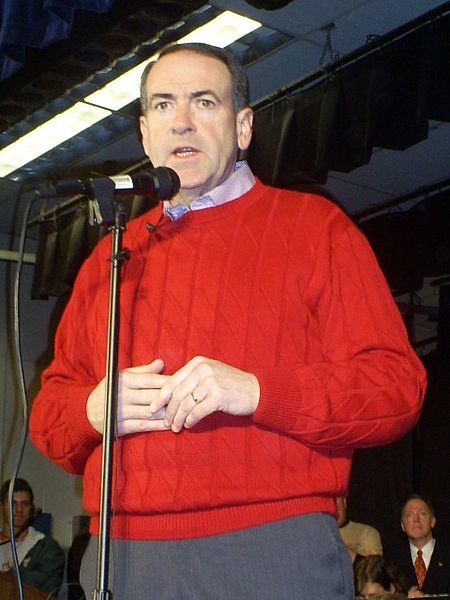
Former Arkansas Governor Mike Huckabee wears the most socially conservative outfit ever; later, he played bass on Fox News.
(Image Sourcehttps://en.wikipedia.org/wiki/File:Huckabeemike.JPG; photo by Craig Michaud)

To offer an illustration from recent history, contrast the post-Soviet experiences of Poland (and most of Eastern Europe) with that of Russia.  Despite decades under Communism–an ideology that was aggressively atheistic, stressing loyalty to the state and Communist Party over all else–Poland roared back into the West.  It adopted neoliberal (modern conservative) economic policies, and was one of the few European nations not to suffer severely during the Great Recession.

Russia similarly adopted “shock therapy” after the Soviet Union collapsed for good in 1991.  Rather than experiencing a huge economic boom, however, well-connected former Communists and others close to the old regime made off like bandits, leaving most Russians left holding the bag.

What’s the difference?  For one, the Russians lived under Communism for nearly a generation longer than the Poles, meaning there were several generations of downtrodden, state-dependent Russians by the time the USSR collapsed.  Many of these Russians were unable to adjust to a free-market system after living in a closed economy for so long.

Another key difference–and one that I think is extremely significant–is that Russians lost any scrap of civil society they might have possessed prior to the Bolshevik takeover in late 1917.  Civil society–the institutions between the basic family unit and the government, like churches, schools, clubs, civic organizations, etc.–was automatically preempted when every club, organization, or activity became part of the Soviet government.  The severely crippled (and, as I understand it, collaborationist) Russian Orthodox Church was unable or unwilling to push back against Soviet rule, providing little in the way of a spiritual alternative to the totalizing influence of Communism.

“[F]ree markets unmoored from guiding principles, strong and stable institutions, and the rule of law can morph into mindless Mammon worship.”

Poland, on the other hand, managed to maintain its deep Catholic faith.  The Catholic Church as an international organization (and with powerful, influential popes, most notably the Polish anti-Communist John Paul II) could never be wiped out completely by Soviet Communism.  Further, the Poles formed the Solidarity trades union movement, which offered an alternative to official Communist organizations.

Thus, after the dissolution of the Soviet Union, Poland emerged with a strong civil society anchored in a richly Christian worldview and ethic.  The shared sense of morality–one that stresses mutual respect, the dignity of human life, and the importance of honesty–allowed the complex deals and uptempo economic exchanges of capitalism to occur smoothly and rapidly.  From these civil and religious values came a firmer grasp of and respect for the rule of law, making predictable economic activity and long-term planning possible.

Russia, on the other hand, devolved into a fast-paced, nationwide run on the national cupboard.  Those with good connections grabbed whatever public funds and goodies they could.  Normal Russians couldn’t figure out why their government checks and free lunches stopped coming, and couldn’t understand why (or how) to pay taxes.  With the collapse of the Soviet Union, all civic organizations ceased to exist, because they were all part of the Soviet government.  Without any civil society or other enduring institutions to model good behavior and to stress and enforce moral values, Russia struggled–and continues to do so–to adapt to global capitalism and democracy.  Not surprisingly, they’ve turned to a dictatorial strongman for guidance.

***

What of the American context?  As I’ve written before, I’m skeptical of full-fledged libertarianism–what I would broadly define as the marriage of economically conservative and socially liberal views–because it fails to acknowledge the need for strong moral values to uphold its own economic assumptionsLiberty and self-government can only really work when coupled with self-imposed order and restraint.  Without moral common ground and shared values that stress self-control, liberty rapidly turns to libertinism.  Libertinism without a great deal of wealth leads to shattered lives, which in turn wreck families and communities.

Eventually, unbridled, unchecked lasciviousness–even among (formerly) responsible adults–results in social chaos, requiring a dwindling number of hardworking, honest, and thrifty individuals to pay for the ramifications of poor moral choices that have been magnified many times over.

“[L]ibertarianism… fails to acknowledge the need for strong moral values to uphold its own economic assumptions.  Liberty and self-government can only really work when coupled with self-imposed order and restraint.”

Capitalism’s blessing of unparalleled abundance is also a potential curse.  Without a strong civil society that stresses good moral values–and without proper historical perspective–it becomes easy to take that abundance for granted.

That abundance also allows, for a time, more and more individuals to pay for the price of bad decisions.  Prior to the modern era, few people were wealthy enough to risk the negative consequences of immorality.  Now, Americans and Westerners enjoy a level of material comfort and well-being that can absorb at least some of the unpleasantness of questionable choices.  Over time, however, that security breaks down.

Richard Weaver likened the situation to an alcoholic who is so addicted to his drink, he’s unable to do the work necessary to pay for his addiction.  The more he needs the alcohol, the less capable he becomes of obtaining it.  Likewise, the more individuals become addicted to luxuries, the less able they are to work hard to maintain them.

To avoid the fate of Weaver’s drunk, we must recognize the importance of social conservatism.  While we should maximize individual liberty as much as possible, and within the bounds of the Constitution, we should also stress the moral and religious underpinnings that make that liberty both possible and responsible.

The Human Toll of Globalization

Last week’s posts shared a similar theme:  the costs of unbridled free trade; the benefits of cutting corporate and income taxes to unleash economic growth; and the human side to economics that academics tend to miss.

The first and third topics referenced above came into sharp relief as I read an excellent piece by Chadwick Moore, “Left for Dead in Danville: How Globalism is Killing Working Class America.”  It’s a long-form piece of journalism for Breitbart, but it is well worth the read.  I encourage all of my readers to set aside twenty minutes to read it and its terrifying account of globalization gone wrong.

My post today simply seeks to offer up a summary of Moore’s findings, presenting them in an easily-digestible form for those who don’t have the time or inclination to read his full-length piece.

The conceit of the piece is simple:  Moore visited Danville, Virginia, a former textile mill town located on the Dan River, and very close to North Carolina.  The town was once—and “once” doesn’t mean “a hundred years ago,” but about twenty years ago—a thriving town that supported a solid middle-class through its robust textile industry.  Civic pride was abundant, and the Dan River Mill supported a number of youth and community activities and functions that are familiar to anyone who has grown up in a small town.

Then came NAFTA in 1994, followed by China’s entrance into the World Trade Organization in 2000.  After years of struggling to compete with foreign competition, Dan River Mills shut down in 2006 (it had been open since 1882).

As the town’s economy declined and unemployment skyrocketed, social problems grew.  Drug use increased dramatically, as did crime, and formerly-safe, middle-class neighborhoods devolved into dangerous slums.  More than a quarter of the town’s population is on food stamps.

Race relations also grew worse.  The town had enjoyed peaceful, working relationships between black and white citizens, who worked together happily in the mills and other businesses.  Now, the KKK plans rallies, preying off the desperation of the unemployed (the town is roughly half white, half black).

Moore gives a good bit of space to quoting Michael Stumo, the CEO of the Coalition for a Prosperous America.  Stumo elegantly explains the problem in Danville—as with many other small towns in Middle America—tracing it to China and the World Trade Organization.  Some choice bits to chew on:

“‘When China joined the WTO in 2000 with 1.3 billion people underemployed, it began pulling them out of the rice paddies, the farms, and rural areas, and putting them to work. The Chinese under-consume. They produce more than they consume, [in] a country that’s four and a half times as big as ours and relying on the American consumer to fund their path to wealth and doing so with a state-directed economy, which is different than communist, it’s a strategic mix of state capitalism with a little bit of private sector in it. We always thought communism would fail, but China found central planning 2.0 and is pretty good at it,’ he says….

‘We have free trade within the 50 states,’ Stumo says. ‘By impoverishing our middle class with this offshoring driven by free trade policy, you’re killing the U.S. consumer market, which drives growth, because they have no money. Five or ten percent cheaper prices is overwhelmed in this stage by lack of production and stagnant wages,’ he says. ‘The U.S. middle class cannot afford to fund the rise of other countries anymore.

‘Industry doesn’t stand still; industry is always incubating—you give up the jobs, the wealth creation, the supply chain clusters in communities, and that affects the service sector around them,’ Stumo says. ‘You pull those plants out, and a lot of people are out of work, and then the whole general wage level drops because burger-flipping isn’t an upward pressure on wages, but production is.'”

A degree of globalization, in an age of mass transit and mass communications, inevitable.  And open trade with lower tariffs generally is beneficial.  But naïvely-open trade with dishonest trading partners with slave-level wages primarily benefits the dishonest party.  Yes, there are some winners in the United States—I certainly enjoy a higher quality of life because of cheap electronics from abroad, for example—but as I wrote last week, isn’t it worth paying a little more for your television or washing machine, if it means an American keeps his job.

My thinking on this is simple:  the actual, physical and mental of work, in and of itself, important.  Yes, we could pay everyone a guaranteed basic income, or help people through more assistance programs (ignore the astronomical costs of those programs for the moment), but even if they worked beautifully in the material sense, they will, in the long-run, lead to a deterioration of real skills and, more important, a spiritual vitality.

I strongly believe that the three keys to happiness are faith, family, and work, in that order.  Work is ennobling, even if it is unpleasant at times.  As such, if the government is going to do something, would it not be wiser to offer assistance that requires work?

Tariffs accomplish this goal to some extent, and are entirely constitutional (indeed, one of the authors of the Federalist Papers, Alexander Hamilton, argued for them as Secretary of Treasury).  They also produce revenue for the federal government, and could be used to offset further reductions in corporate and income tax rates.

Ultimately, the social and civic costs of unbridled, unfocused free trade seem too steep.  Read Moore’s observations about the flood of drugs and despair into this once-civic-minded, prosperous town, and understand that the 10% discount you enjoy on your consumer goods is seldom worth the human toll.

To clarify once again, I’m not arguing we return to the massively high tariffs of the late-nineteenth and early twentieth centuries.  That would be economically disastrous in other ways, and would further enhance our federal government’s penchant for corporatist back-scratching and favoritism.  But some judicious, targeted tariffs, especially against nations like China, are wise.  Why should we be subsidizing China’s growth at the expense of our own?

One final thought:  as I wrote Friday, a married man used to be able to raise his kids on a gas station pump-boy’s salary.  Sure, life was lean, and there weren’t a ton of crazy gadgets to play with or luxuries to enjoy, but the kids grew up well enough and the wife could stay home to raise them.  Are we really that much better off now, when both husband and wife slave for 40+ hours a week (and usually longer), outsource their parenting responsibilities to daycare and public schools, and can’t get out from under student loan, home, car, and consumer debt?

There are a host of factors driving the modern scenario of today versus the “blue-collar father” of yesteryear, but surely one economic solution is to stop burrowing out our families and towns in favor of frosty, urban cosmopolitanism and aloof globalism.  I care about the people of China, and I’m glad to see they’re no longer trapped in rice paddies and collectivized farms, but—like our great President Trump—I care about my country and fellow countrymen first.  So should the United States government—it’s job is, literally, to put Americans first.

TBT: Economics: A Human Science

The unofficial, unintentional theme of this week’s posts have been about economics in general (other than Tuesday’s SCOTUS piece)—the power of tax cuts, the potential upsides to tariffs, etc.  In that spirit, I thought for week’s post about diving back into a piece that reflects my gradually evolving thinking about economics.

The summer before my sophomore year of college, I read the second edition of Milton Friedman’s Capitalism and Freedom, a work that completely revolutionized how I thought about the world and economics.  Free-market principles became my lodestar, and colored my ideology for a decade.  Indeed, I still adhere to these principles when it comes to economic questions.

However, as I grew older and (hopefully) more experienced, I began to realize that neoliberal economic theory, while elegant, is not always hard-and-fast, and that there are many more wrinkles to economic issues than appear at first glance.  I don’t believe in overcomplicating things—again, cutting taxes tends to stimulate economic growth—but most issues contain a frisson of nuance that is easy to miss.

I’d long held to the idea that free trade is a largely unalloyed good, and that the short-term costs of lost jobs or reduced wages in some industries domestically would be made up for by increased efficiency of production and the rise of new, better industries.  Sure, there’d be some friction in the duration, but people will manage, and we can always throw some funds for reeducation their way.

While I think such disruption is inevitable, I don’t think we should embrace it so blindly that we forget about the people who find themselves out of work, or in a position that they can’t modify their skillsets to find a new job.  I live in the rural South, and there are hundreds of little towns that dried up once the mill the left, the railroad shut down, or the big family farms sold off.  Part of that story is the onward march of Time and economic progress—and the drama of human history.  But part of it is the story of globalist elites selling out Middle America.

This situation is not one merely of tariffs, taxes, and the like, but also of a radical ideology that would see national borders dissolved and massive immigration—even illegal immigration—encouraged.  I am libertarian on many issues, but the pitfall of modern economic libertarianism—and there are many—is that it only conceives of issues in terms of economic efficiency (and, if you get right down to it, it’s inverted Marxism, to the extent that, for Marxists, everything is about economics—or, more properly, materialism).  And, yes, generally greater efficiency means greater quality of life, but economics is not always the clean, elegant science that its proponents claim it to be.

To that end, I argue that economics, properly considered, should be considered part of the humanities, as it deals in a direct, visceral way with the people’s lives.

I don’t know the precise balancing act, or what should be achieved.  I highly recommend reading Patrick J. Buchanan’s The Death of the West for a more complete treatment of how to revive wages for workers while maintaining a high degree of quality and efficiency.  I don’t agree with all of Buchanan’s proposals, which are heavily influenced by Catholic social teachings, but there is an appeal to the idea that, if the government is going to interfere in the economy (and it is, and does), then it should be in favor of workers and families, not at their expense.

Finally, I wrote this essay in the context of the Brexit vote—which I intend to write an eBook on soon—and the arguments I was hearing about the economic catastrophe Brexit would be (that hasn’t been the case yet).  I argued, essentially, that the liberty and national sovereignty are more important than sweet European Union bennies and transfer-of-wealth payments.  The EU is a despicable organization as it currently operates, and as a lover of liberty, I’m thrilled to see nationalist-populist movements rising in major European countries.  I don’t agree with all of these groups or their policies (many of which are socialistic in nature), but the impulse towards greater national sovereignty is, in general, a healthy one in our age of excessive globalization and unelected supranational tyrants.

With that lengthy introduction, I give you 24 June 2016’s “Economics: A Human Science“:

If you’ve read my blog the past couple of weeks, you know that I am strongly in favor of Brexit, or Great Britain voting to “Leave” the European Union.  I’ve laid out my reasons here and here.  As I write this post, results are trickling in on that historic vote, and I am intermittently checking them with great interest–and not a small bit of trepidation.  Right now (about 10:30 PM EST/-5 GMT), “Leave” has a slight edge, but the outcome is too close to call.

Already, though, the British pound and the euro have taken a beating in value, as gold prices soar (this blog is conservative in viewpoint, so I probably should start urging you to buy gold, guns, and freeze-dried food reserves; sourcehttp://www.bloomberg.com/news/articles/2016-06-23/pound-surge-builds-as-polls-show-u-k-to-remain-in-eu-yen-slips).  One of the major bogeymen of the “Remain” side in the referendum was the threat of economic downturn.  As I conceded in both of my previous posts on Brexit, there will no doubt be major economic disruption should Britain vote to “Leave.”  However, a (likely temporary) drop in the value of the pound sterling is a price well paid for restored national sovereignty.

God Save the Queen… and Great Britain from the clutches of Eurozone bureaucrats

As conservatives, we’re accustomed to viewing economics–or, at least, economic growth–as a positive good.  After all, we believe in the power of free markets to satisfy human needs and desires, and to innovate new ideas and products that alleviate human suffering, drudgery, and toil.  Conservative politicians tend to focus on job growth and prudent deregulation–often coupled with tax and spending cuts–as perennial, bread-and-butter issues that directly affect voters’ pocketbooks for the better.

 “…these [fiscal] policies are not about making gobs of cash… but about what those gobs can do to improve lives.”

But economics, like much else, is not a means unto itself.  The reason conservatives like economic growth–besides, well, making money–is that it demonstrably improves people’s lives.  Deregulation, similarly, can work beneficially (if you doubt me, just ask anyone who has ever dealt with the Affordable Care Act and the Department of Health and Human Services).  In essence, these policies are not about making gobs of cash–although that is certainly nice–but about what those gobs can do to improve lives.

Thus, we have a stark contrast between the organic, healthy, occasionally unpredictable economic growth of a free market and the regimented, inequitable, limited economic growth of progressive corporatism.  Our current economic environment, I fear, is far closer to the latter than the former.  Complex, heavy regulations benefit larger firms and discourage the formation of smaller, newer firms by raising the upfront costs of entry.  Perverse incentives raise the costs of healthcare for young, fit Americans, while making it unrealistically cheaper for older, sicker, chubbier patients.  Overly-generous social safety benefits (some of which, like the food stamp program SNAP, the government actively advertises and encourages people to use) discourage able-bodied Americans from pursuing work.

I could go on (and on… and on).  In short, conservatives are used to being correct on principle and on economic outcomes.  Typically, conservative fiscal policies align with, rather than try to manipulate, economic realities, so the outcomes of those policies tend to be both principled and positive.

“As fiscal conservatives… let us never lose sight of the human side of economics.”

In the case of Brexit, however, the quest for restored sovereignty–a stand on an important first principle–will result in some negative economic outcomes.  A major argument of the “Remain” side is that staying in the European Union will preserve Britain’s economic stability and ensure it a place in a European common market.

Such an argument is seductive, but it leads to a gilded cage.  Nobel Prize-winning economist Milton Friedman famously said that economic freedom is a necessary precursor to, though not a guarantor of, political freedom.  With Brexit, the axiom is almost reversed–by reclaiming its political freedom, Britain will then be able to pursue renewed economic freedom.

As fiscal conservatives–or those that support free markets, freer trade, and light regulations–let us never lose sight of the human side of economics.  We too often treat economics as a science.  Instead, it should find a home alongside the humanities.

Our chief aim should be to unleash human potential.  So liberated, its creativity and ingenuity can lift human life to greater heights.

We already have a model:  we’ve been doing it in the United States for over 200 years.

Q&A Wednesday – Tax Cuts, Trade Wars, Etc.

Two of my most loyal readers, Megan and Frederick (I highly recommend the latter’s corporate history blog, CorporateHistory.International), both chimed in via Facebook about Monday’s post on tax cuts.  Frederick pointed out a potential downside to corporate tax cuts—what’s to stop large multinationals from investing that money in physical plants and employees overseas, notably in China?  Megan asked me to elaborate further on tariffs in relation to that very question.

Being a conservative, I like to conserve things—traditions, morals, civil society, working institutions, etc.—but most especially effort.  I’m a strong believer in the dictum, “Work smarter, not harder” (although you need a healthy dose of the latter, too).  As such, I’m adapting my Facebook response to them here.

I think the question of tariffs and trade wars is hugely interesting, and needn’t be bogged down in tedious charts and numbers.  What I do believe is that President Trump has ripped the façade from the bipartisan push for globalism, and particularly demonstrated the real, human cost of unbridled free trade.

I used to be 99% a free trader, with 1% reserved for mild tariffs on national security-related goods, like steel.

Now I’m probably more 85% free trade, 15% tariffs. A tariff is a tax, yes, and it’s borne not just by foreign nations exporting goods to the US, but also by American consumers, who have to pay more for goods that are protected (and, thus, more expensive and potentially of a lesser quality than they would be in a competitive, free market).  That disclaimer aside, it seems like paying a few more bucks for your washing machine is a good way to keep Americans employed and earning a decent wage.

If you take that reasoning too far you fall into the dilemma of minimum wage increases, which increase unemployment (especially for unskilled, young, and minority workers) and raise costs, so that any increased wages enjoyed by the beneficiaries are eaten away by the increased costs of consumer goods—all served up with a side of higher unemployment.

That said, judicious tariffs—I’m not arguing for the high, blanket tariffs of the late nineteenth century, which wouldn’t work well in our modern, interconnected economy—especially related to key industries like steel, could keep a lot of Americans working, and would allow blue-collar workers to earn a wage that wouldn’t require years of expensive schooling.

Also, I think targeted tariffs against unequal trading partners—I’m thinking primarily of China—would level the playing field, and prevent some of the outsourcing and capital flight that might occur with a corporate tax cut (or, more likely, increase). It’s unreasonable to expect American workers—with all their labor protections, etc.—to compete with near-slave wage Chinese workers. China’s currency manipulation to make its exports artificially cheaper, as well its rampant intellectual property theft, needs to be combated, and if it means getting our cheap plastic Happy Meal toys from Vietnam (or the USA!) instead of China, so be it.

The current “trade war” with China sees Americans in a much better position than the Chinese. China needs those exports, but the USA can stand to experience some minor drag to its GDP growth given the massive growth we’re seeing with the tax cuts (not just the corporate tax cut, but also the 20% deduction for small business pass-through earnings, which is YUGE for small business growth—a key driver of employment in our country). I see it as a trade-off—pay a little more for some consumer goods, but create imbalance in the Chinese economy and force them to play ball on par with the Western world and Japan.

My only real concern with this approach is there is no limiting principle (although that’s true for any type of tax, and we have to have some of them), which makes me wary as a limited-government Jeffersonian, but the Hamiltonian commercialist in me sees this moment in history as one in which we can uniquely leverage our economic clout to improve our own economy and our position internationally, and we can afford to go through a trade war longer than China (or Mexico, or Europe).

Everyone loses if a trade war lasts too long, but I think the Chinese will blink first. American workers will be the ones to benefit.

One additional thought, which will require more elegant development in a future post:  even with the inefficiencies and deadweight loss that would occur from overly-high tariffs, wouldn’t protecting domestic jobs be a more effective and fulfilling way to provide a living for blue-collar workers than the current welfare system?  Instead of a massive, government-run bureaucracy administering a complex and redundant system of bennies, society could bear the cost through paying a bit more for consumer goods.  Such a system would create more semi-skilled positions in some industries, and I’d rather we subsidize people through work than to subsidize them not to work.  Again, that’s a very rough sketch, but some food for thought.

Regardless, tariffs are not an unalloyed evil, nor is free trade an unalloyed good.  There’s room for both.  Economics suggests that the balance should favor the latter more heavily than the former, but we can temper the massive social disruption that unbridled globalization unleashes.