Bernie’s (Cell) Bloc Voting

Blogger jonolan at Reflections from a Murky Pond has a post about Bernie Sanders’s recent suggestion that convicted, incarcerated prisoners should be able to vote. The piece, “Bernie’s Folsom Pledge,” points out not just the absurdity of such a position, but the devastating political outcomes it would have.

We all understand the former implicitly: incarcerated felons are paying their debt to society, so their usual rights—freedom of movement (now “arrested”), the ability to vote, etc.—are forfeit. There is a fruitful discussion to be had about when, and under what circumstances, former convicts might be restored their right to vote, but the notion that inmates should be able to cast ballots undermines the very concept of punitive imprisonment.

The latter point—what would the political impact be if we allowed prisoners to vote—is not considered as frequently. In part, that’s because the idea was, until relatively recently, completely ridiculous. But we live in an age in which what was once decent, traditional, and commonsensical (and, therefore, never seriously questioned or in need of articulate defense) is challenged constantly, if not already destroyed utterly, so we have to engage in mental exercises that were once entirely abstract and academic.

jonolan does a great service here in a very succinct post way. Here he details the terrifying impact a prison population could have on local elections:

Focus on the State, County, and Local elections.

Imagine, if you will, the great harm that incarcerated felons could do in those elections, especially ones for: Police Chiefs, Sheriffs, District Attorneys, Prosecutors, and/or Judges. Remember, these are elections with a much smaller electorate and, hence, the population of a prison there could and likely would greatly impact the outcome(s).

Convicted felons voting for their jailers and captors: only slightly removed from the old cliche of the insane running the asylum. Turnout in these county elections (as sheriffs are usually elected at the county level) is so low that sometimes even a dozen (or fewer) votes can swing the outcome.

According to World Prison Brief, the prison population in the United States is around 2,121,600. I couldn’t find the average population of a typical American prison—perhaps a more patient and enterprising reader can—but imagine in a rural, low-population county what impact the prison population could have. Granted, prisoners might not even be registered to vote in the county in which they find themselves incarcerated (opening up another question: where, how, and in what precinct would prisoners be registered to vote?), but if they were, they could easily elect ne’er-do-wells to key law enforcement positions.

jonolan also points out the constitutional error implicit in extending voting rights to criminals:

Voting, be it for offices within each state or for elected federal offices is a matter that is wholly within the purview of each state. The federal government can only step in to prevent certain broad abuses, e.g., denying the “right” to vote based on race (15th Amendment), sex (19th Amendment), or advanced age (26th Amendment). As such, it is grossly inappropriate for any Presidential candidate to weigh in on this matter and to use it as a plank in his campaign’s platform.

As such, Bernie’s pro-prisoner proposal would require a constitutional amendment. That would mean proposal by 2/3rds of both chambers of Congress, then ratification by 3/4ths of the States. Of course, that’s Bernie’s shield: he knows it’s insane (and, as jonolan argues, it’s probably an attempt to shore up his iffy support among black voters), but he can call for it, virtually risk-free, while gaining some brownie points with progressives.

The whole proposal is yet another tiresome example of the destructive ideology of progressivism. In its endless thirst for new “rights” to grant and extend—always at the behest of government, of course—the Left forever pushes beyond any semblance of an orderly, sane society. It would be humorous if they weren’t so effective.

Beto Antoinette

Today’s post is some low-hanging fruit (or free-range chicken?), but it’s too good to pass up:  arm-flailing weirdo and rat-faced rich kid Robert Francis “Beto” O’Rourke, the Democrats’ favorite Hispanic Irishman, when asked about combating poor nutrition in poor rural communities, called for the establishment of trendy farm-to-table restaurants in those communities.

Commentators have been quick to pounce on O’Rourke’s out-of-touch policy prescription, comparing it immediately to Marie Antoinette’s infamous solution for French peasants who couldn’t afford bread:  “let them eat cake.”

The only difference is that the poor, much-maligned Queen of France never said it.  O’Rourke—after a fashion—did.  If there was any doubt that O’Rourke is an out-of-touch pseudo-hippie, this proposal destroys it.  Remember, this presidential candidate literally ate dirt after losing to Senator Ted Cruz.

As I was reading up on this amusing example of elitist cluelessness, I stumbled an interesting, instructive sideshow:  some policing on the Left.  The Washington Examiner piece linked above includes the following tweet from Washington Post reporter Annie Linskey, who live-tweeted O’Rourke’s Nevada town hall:

That’s a perfectly innocuous example of reporting.  O’Rourke said it, Linskey reported it.  Now, notice this tweet from the editor of Wonkette (her Twitter handle is “commiegirl1,” for crying out loud), a far-Left “news” site that seems to favor snark over substance (if you want your stomach to turn, just read through their headlines—these people have lost their way):

Schoenkopf is referencing a tweet from David Weigel (who wrote a great book about prog rock), another Post reporter, who writes vaguely about O’Rourke’s remarks about “food deserts.”  She then follows up with a nasty tweet, writing that “I would literally fire you if you pulled that sh[*]t at Wonkette, about ANYONE.”

So, Linskey accurately—and in more detail than her colleague—tweeted a simple fact, and this Leftist wacko ostentatiously, hysterically said she would fire this poor woman—if only she had the power to do so.

Two takeaways:

1.) That mentality—“I would destroy you given the power”—is indicative of the Left.  It must crush any opposition, perceived or real, which leads to my second observation:

2.) Even the slightest implication of opposition to a Leftist sacred cow (which, it seems, O’Rourke is at the moment) is punished, swiftly and ferociously.  The very fact that Linskey had the gall to report on O’Rourke’s gaffe was enough to condemn her.

I don’t know Linskey’s politics, but if she writes for the Post, she’s probably left-of-center.  Even if that’s true, the progressives won’t hesitate to devour their own.

O’Rourke’s star seems to be falling as Democrats turn to a more flamboyant nobody, but progressives still like him because he could possibly win them Texas.  Hopefully, voters of a populist stripe will realize this man cares nothing for them or their struggles.

Bland and Gay

The Democratic field for 2020 is a circus of tribal interests. Each candidate represents some special interest group in the rainbow coalition of the Democratic Party: Kamala Harris is the Queen of Black Voters; Cory Booker is the closeted, melodramatic homosexual; Elizabeth Warren is the shrill, angry white lady; Joe Biden is the Old Obama Perv; Tulsi Gabbard is the ethnically-ambiguous babe (and the least bad of all of them).

But the candidate that has everyone all a-titter is South Bend, Indiana Mayor Pete Buttigieg, the platitudinous gay man. Everyone seems to love this guy, notably upper-middle class white people and the tech industry. Breitbart‘s Allum Bokhari has a piece attempting to explain Buttigieg’s appeal to Big Tech and the closeted Leftists of the Never Trump movement.

Bokhari’s takeaway is this: Mayor Buttigieg is the kind of bland, copy-cat politician that the Establishments of both parties preferred prior to the 2016 election. He hearkens back to a time when the Establishment dominated politics with impunity.

There’s something to this analysis, I think. I’m continually frustrated with alleged conservatives who say they like President Trump’s policies, but cannot support him “on principle” because he’s “morally reprehensible.”

I recall a conversation with a friend and his wife—both devout Catholics—who dislike President Trump, largely (I perceived) for rhetorical reasons. The husband is given to virtue-signalling to the pieties of the day, but the wife is a bit more based. I pleaded with her to get over her distaste for Trump’s “meanness” and to cast her vote for him in 2020, as he’s the only candidate who is going to fight against abortion and for religious liberty. She told me she did not oppose the president for being a “meanie,” but because she finds him “morally reprehensible.”

I thought about that comment, and realized it’s nonsense. Saying the president is “morally reprehensible”—and, therefore, you’re not going to vote for him—is the same thing as saying you won’t support him because he’s a meanie; it just sounds better to frame it in moral tones.

Yes, yes, President Trump has done some immoral stuff, things many of us would shudder to contemplate. But who among us isn’t a sinner? What I care about are results. Cyrus the Great wasn’t a God-fearing man, but he restored the Jewish people to their homeland and paid to rebuild the Temple.

It’s a shame we have to keep reminding other Christians that a.) God uses all people to achieve His ends and b.) God forgives—and, as Christians, we believe in forgiveness!

But I digress. I intuit that what these cosmopolitan, upper-middle class whites want is, simply, a blandly non-offensive guy to say nice things and to appear “presidential.” In the current mix, the only figure that really fits that “Platonic ideal” of a president is Pete Buttigieg.

Add in a splash of mildly exotic gayness, and he pushes all the right buttons for these folks: they get to virtue-signal their support for a now-acceptable “alternative lifestyle,” while bowing to a vapid, clean-cut nice guy.

Pathetic. In a better age, we’d reject Mayor Pete for his Wildean antics. Instead, we’re elevating a Midwestern mayor with a slim record to presidential heights because it makes country club types feel good about themselves. “He’s nice—oooh, and gay! I like that combination.” Please.

Given the hysterical, limp-wristed lengths to which loafer-lighteners have gone to force their lifestyle on the general public, it seems like we’d want to keep them away from the highest office in the land. Pete Buttigieg’s twisting of God’s Word to endorse his flamboyant lifestyle is far more dangerous than Trump saying his favorite verse is “Two Corinthians.”

Get a grip, folks. MAGA MAGA MAGA!

The State of the Right, Part II: Dissident Right and Civic Nationalists

Last week I wrote a piece about “The State of the Right.”  It’s inspiration were two essays, one from edgelord Gavin McInnes, the other from fellow blogger photog of Orion’s Cold Fire.  photog has done real yeoman’s work on teasing out the strands of the Right today, and he’s followed up that effort with a prescient essay, “Identity Politics and Civic Nationalism – Part 1.”  It’s the first in an interesting series exploring the friction between two major factions of the Right, broadly-defined, too:  the increasingly race realist Dissident Right, and the more traditional “BoomerCon” civic nationalist Right.

The former group has been very active since the 2015-2016 Trump Ascendancy, reading various intentions and motivations into the Trump campaign’s tough stance on immigration and border control.  As photog points out, the Dissident Right is the group that had the guts to call out neocons as Leftists-in-Conservative’s-Clothing.  Essentially, Bush-era neocons were playing into the progressive’s frame:  embrace massive and/or illegal immigration, dole out protections or favors to our preferred tribal interests, and we’ll give token conservatives a few crumbs from the dinner table.

The latter group, which photog defines well in his essay “What’s Right,” is not as active online as the Dissident Right, but is far more numerous.  These are the folks who love God and country, and want to see America strong and secure.  Civic nationalists believe that race and biology are not essential barriers to achieving the American Dream; rather, anyone who works hard, assimilates, and respects the Constitution can do well.  That understanding dominated postwar America, and when Leftists have pushed identity politics too far, the “Silent Majority” has risen up to push back.

In photog’s reading, Trump’s election was not, then, the triumph of the Dissident Right race realists; instead, it was the triumph of the silent CivNats pushing back against progressive tribalism.  Just like Nixon in 1968 and 1972 and Reagan in 1980 and 1984, millions of normal, traditional Americans rose up in 2016 against looming Leftist disorder and chaos.

The argument of the Dissident Right is that all the racial division and social breakdown we’ve seen in America is proof that different races and cultures cannot long function together in a healthy body politic.

Civic Nationalist, on the other hand, argue that government policies like affirmative action and paternalistic welfare systems encourage tribalist, racialist thinking, essentially ghettoizing certain groups (often along racial lines).  America is nation of ideas, not blood.  A key example is how the “post-racialist” Obama Administration exacerbated racial tensions through its policies.

President Obama’s Justice Department, headed by racemonger Attorney General Eric Holder, significantly worsened race relations in the United States every time “police violence” claimed a black man’s life:  rather than treating such incidences on a case-by-case basis, the Obama DOJ aggressively, publicly supported the view that “systemic racism” was the cause of the attacks.  A compliant media spun narratives like “hands up, don’t shoot.”  With cops second-guessing their every interaction with a potential black suspect, many just stopped doing their jobs effectively, breeding more criminality in black neighborhoods—further “proof” that the system was “rigged” against blacks.

Most Americans reacted to these shootings with sympathy, naturally, but as the details began to trickle out, many of them were not as they appeared.  Michael Brown of Ferguson, Missouri was not the “gentle giant” the media portrayed, but a dangerous felon.  The police shooting in Charleston, however, was a legitimate example where police went too far, though it’s not, logically, proof in and of itself of “systemic racism,” or even individual racism.

Regardless, the CivNat argument is that race is incidental, not a determining factor in one’s ability to participate in the grand experiment in self-government.

So, who is correct?  Like most things, there is truth to be found among both groups.  The Civic Nationalist wing of conservatism is often slow to react and is generally complacent in its slumber, but it won’t abide consistent tomfoolery or wickedness for long.

The Dissident Right, on the other hand, is willing to come out swinging at the myriad problems facing the nation today, particularly immigration.  They argue—I think, correctly—that we can’t swamp our nation with millions of unassimilated Third Worlders from peasant cultures that have no interest in, or even thoughtfulness about, our nation or its values.  Like it or not, Anglo-Saxon jurisprudence came out of, well, Anglo-Saxons, and it took hundreds of years to develop ideas like constitutionalism, rule of law, self-governance, separation of powers, etc.

That said, I don’t think the Dissident Right is correct that only white Anglo-Saxons can enjoy the fruits of the grand British tradition (although such patrimony seems better equipped to avoid tribalism).  The history of America suggests otherwise.  Millions of Americans of every skin color and culture have managed to assimilate into American culture (if anything, black Americans are the biggest example of the failure to assimilate, but that’s for complicated historical and cultural reasons, not to mention persistent legal action to separate blacks from the rest of American society for a hundred years after emancipation).

Tribalism, however, is a very real phenomenon, and a dangerous one.  The Dissident Right gets this correct as well.  If you transported all of El Salvador to Kansas today, the people wouldn’t suddenly become restrained corn farmers participating in quilting bees and box socials; they’d be El Salvadorans, their distinct cultural and national rivalries still playing out in bloody gang violence.  Take ten El Salvadorans, however, and spread them throughout the country, and they’ll have no choice but to assimilate.

What photog and I both reject, then, is the Dissident Right’s solution to our problems, which is, simply, to embrace identity politics and tribalism for whites—use the same tactics of the Left to get carve-outs and special favors for white Americans.  That seems like a surefire way to increase, not decrease, racial tension.

To close out this lengthy, meandering post, here is photog himself, on asking “Are [the Dissident Right] right?”:

I prefer to think that they’re not.  My read on this is that the situation has been exacerbated by Republican “leaders” who actually seem to buy into the fairness of minority identity politics out of some kind of ancestral guilt or because they see electoral advantage in joining the progressives.  The proof of this can be seen in the success of a civic nationalist like Trump who isn’t guilted into kowtowing to illegal immigration out of fear of being called a racist.  Once you disarm the Progressives of that weapon you find out that the majority of Americans, even in Blue States, want immigration laws to be obeyed.

I contend if the Right forcefully advocates for full enforcement of immigration laws and the elimination of reverse discrimination policies by the government and other entities, it will go a long way toward lowering tensions between the various groups living in the United States and will allow people to start thinking of each other as neighbors and not potential enemies.

photog and I, like many Americans, are walking a fine line between the truthful claims of the Dissident Right and the Civic Nationalists.  Both camps have much to offer, and the Dissident Right has been on the front lines of the Culture Wars the past three or four years.  The two factions can work together to reinvigorate conservative thought, to shake it loose from the dogma that’s dominated it since the end of the Second World War.

That said, that dogma, too, contains useful bits.  The point, then, seems to be that we should always be pondering what is truthful, good, and useful.  The neocons tossed fuel to the fire when they endorsed increase immigration and turned a blind eye to illegal immigration.  The Dissident Right and the Civic Nationalists can both agree that rolling back illegal immigration and limiting legal immigration, at least for a time, will be beneficial for the nation as a whole.

TBT: Six Long Years

I’m still indulging in the unrealistic decadence of Spring Break’s unlimited freedom.  After a long Wednesday painting, I decided to go with an unorthodox pick for this week’s TBT.  Indeed, I’ve mined out the best of the old TPP blog; pretty soon I’ll be reposting pieces from this iteration of it, what I call “TPP 3.0.”  The benefit of daily posts is that I have a good bit of windbaggery to pull from.

Today’s TBT hearkens back to the dawn of the TPP 2.0 era, when I relaunched the blog after a six- (in reality, a seven-) year hiatus.  I was down on Fripp Island, a place that always seems to get the literary juices flowing.  There’s something about sitting at a dark, wooden desk in a study at the beach that channels some Pat Conroy-esque inspirado.

Anyway, it was there that I decided to do thrice-weekly posts for the duration of the summer.  The posts then were much longer than the average posts now.  These days, I average around 600 words on a post.  In those days, I was churning out 1200-1500 words three times a week.  There’s a reason I started the TBT weekly feature:  I wrote some quality content back in those days.

The post you’re about to read, “Six Long Years,” was a quick set of reflections on the very eventful years that passed from 2010-2016.  The world changed rapidly during the Obama Administration; we often forget how quickly and how much.  I can still remember, vividly, when many States—including deep blue ones!—voted against legalizing same-sex marriage.  Now, even suggesting what was the norm less than ten years ago would be grounds for deplatforming, doxxing, and SJW Twitter (and real) mobs otherwise destroying your life.

Now, even 2016 seems like an eternity ago.  Trump’s election that November was a “through-the-looking-glass” moment.  Who knows what the next six years might hold?

There’s no way to know.  Regardless, here is 2016’s “Six Long Years“:

A lot can happen in six years.

When I last posted on this blog, I announce that Nikki Haley had been elected Governor of South Carolina.

That was November of 2010.  Think about what was going on at that time:

– Democrats still controlled the Senate, but had just lost the House to the rising T.E.A. Party insurgency.

– The Affordable Care Act had been passed, but would not go into effect until 2013 (2014, as it turned out, due to the executive fiat of the Department of Health and Human Services).

– The Great Recession was, from a technically economic standpoint, over, but the much-vaunted Obama recovery was still frustratingly anemic at best, and virtually invisible to many Americans.

– President Barack Obama hadn’t completely divided the country along race, class, and gender lines, and his disastrous foreign policy hadn’t completely crippled American power and prestige abroad.

What a difference six years make.  Here are some highlights:

– Nikki Haley not only began her first gubernatorial term in 2011; she handily won reelection in 2014 in a landslide victory against her 2010 opponent, Vincent Sheheen.  The relatively unknown upstart from Bamberg made good on her promise to grow the State economically.  She guided the state through the horrible Charleston Nine massacre in 2015; adroitly handled the resultant push to remove the Confederate Flag from the Statehouse grounds; and entered VP buzz for the carnival-like 2015-2016 presidential election season.

– The Democrats lost control of the Senate after an unexpected Republican surge in the 2014 midterm elections, which cemented the gains of 2010 and showed Americans’ growing dissatisfaction with the Affordable Care Act in particular and the Obama administration’s equivocating in general.  This victory came despite an unpopular government shut-down (led by the brilliant Senator Ted Cruz of Texas) in 2013 and former Massachusetts Governor Mitt Romney’s drubbing in the 2012 presidential election.

– Racial wounds that had mostly scabbed over were ripped open once again–this time with the president dumping plenty of salt on them.  Alleged police misconduct in Ferguson, Missouri and beyond brought out protestors in droves… despite the fact that many of these unfortunate events were not racially motivated (although some, such as the death of Eric Garner in New York City, highlighted the perils of excessive force and regulations).  Baltimore caught fire, Ferguson was ablaze, and the big losers were small black business owners who saw their stores looted amid cries for racial and social justice.

– The American college campus, always a training school for Leftist ideologues, became a breeding ground for illiberal Progressives, those who loudly (and sometimes violently) suppressed freedom of speech if such speech was deemed unacceptable or “hateful” (the latter often taking a rather protean definition).  Dovetailing with the rise in identity politics (see the previous bullet point), campus multiculturalism took on a dangerously Balkanized flavor, one that denounced the First Amendment and, in the process, heterosexual white men in favor of a vague commitment to skin-deep “diversity” (unless you’re transgender, in which case you can be whatever you feel like at any given moment).

– Out of all this craziness came the largest, most talented field of Republican presidential hopefuls in the nation’s history.  With seventeen (!) candidates, Republicans were treated to a wealth of talent—but also a great deal of muckraking, mudslinging, and intense political maneuvering.  From this crowded field emerged an unlikely victor:  business mogul Donald J. Trump.  In one of the biggest twists in American political history, a non-ideological, brash, gutsy-but-not-very-detail-oriented, and always-controversial reality television star won the nomination of an increasingly conservative Republican Party.  Put another way, a thrice-married, formerly-pro-Clinton, formerly-pro-choice New Yorker beat out a born-again, pro-life Texan.

Needless to say, it’s been pretty crazy.

With everything that’s happened, I realized that it’s time to get back into this world of political commentary.  The unique character of the 2016 presidential election alone has me salivating (be on the lookout for my brief overview of the 2015-2016 presidential nomination process).  There are so many questions:  what will become of the Republican Party?  Can Trump win the election (for what it’s worth, I think he can)?  Will Hillary manage to hold off socialist Bernie Sanders?  How will Trump and Clinton go after each other?  Should conservatives support Trump, or back a third-party candidate (for reasons I’ll explain in a future post, I’ll say “yes, with some caveats” to the first part and “no” to the second)?  What would a viable third-party candidacy look like—if such a thing is possible?

There’s a lot to talk about.

So, strap in and brace yourself—it’s going to be one heck of a ride.

All the best,

The Portly Politico

Sri Lankan Church Bombings

It was a lovely Easter Weekend here in South Carolina, which is, after all, God’s Country.  It was a weekend full of church, colorful clothes, a trip to the movies, and TONS of eating.  If you’ve never celebrated a major holiday (that is, an Easter- or Christmas-level event) in the South, you’re missing out on good eatin’.

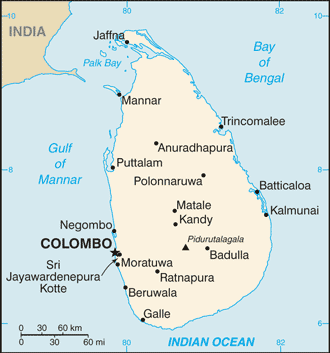
Unfortunately, less than a week after the Notre Dame fire, anti-Christian terrorists persecuted fellow brothers and sisters in Christ in three cities in Sri Lanka, the island nation to the south of India.  The death toll is somewhere between 138 and 207, with approximately 450 others injured.

Islamist extremists committed these attacks on hotels and Christian churches, an act all-the-more wicked for its symbolic timing.  As Christians flocked to worship the Resurrection of Christ Jesus, Muslim terrorists callously and opportunistically slaughtered them.

Sadly, these attacks are nothing new.  In the wake of the Notre Dame fire—which was probably an accident, but could have been the result of foul-play—some news outlets quietly began to point to the persistent attacks on French churches that have been going on since February.  Europe is particularly awash in shiftless, military-aged, unassimilated Muslim men, men easily radicalized into supporting and conducting these kinds of attacks.  A shocking percentage of “moderate” Muslims support or condone terrorist attacks as sometimes justified.

I’m not as familiar with the issues Asian Christians face with Islam, but there have been attacks in the Philippines, as well as attacks on Christians of all stripes in North Africa and the Middle East.

Christianity faces twin threats today:  the progressive Left and Islamism.  The former is a more subtle, but increasingly bold, threat, that seeks to destroy Western Civilization from within.  The latter is an external threat that is very upfront about its hatred for non-Muslims, but that also leverages the tolerance of Western societies to its advantage.  The Left and Islam are allies of convenience, despite their many incompatibilities.

My prayers go out to all Christians facing persecution, from the small-scale persecution of mockery to the very real persecutions of death and intimidation.  Christ promised us that, as Christians, the world would reject us, and persecution would be inevitable.  In the United States, especially in the religious South, we’ve been spoiled, and have grown complacent, to threats to our faith.  We should never forget the real men and women who gave their lives—and continue to risk them—to keep the faith.

Here’s hoping for some better news as the week progresses.  Deus Vult!

Slammed Holy Saturday: Captain Marvel

It’s been a busy Easter Weekend, so I’m late posting what is going to be a very short post tonight.  I’ve been uncling busily with my little niece, playing “my little device,” as she calls my Nintendo 3DS XL.  Before that, we had some early Easter celebrating, as well as taking in Captain Marvel, the latest installment in the expansive Marvel Cinematic Universe.  Earlier in the morning, we watched a helicopter drop plastic eggs onto a football field, which was pretty cool.

As far as Captain Marvel goes, it was a good flick, despite star Brie Larson’s desire that men not go see it.  The title character is definitely a one-dimensional Mary Sue in the vein of Rey from the new Star Wars trilogy, just with a surlier attitude.  She goes from being pretty powerful to limitlessly powerful within a very short period of time, and is suddenly repelling high-tech space missiles and flying through entire spaceships.

Other than that—and a slightly dragging third act—it was enjoyable, and sets up the final MCU film, Avengers: Endgame, with some interesting questions.  The “grrrrrl power” stuff was a bit on-the-nose, but you know it’s going to be going into it.  Getting some of the backstory on Nick Fury is fun, and it really fleshes out his character in the “early days” of the current MCU.  That and the mid-90s nostalgia—the movie takes place in 1995—are the best parts.

So, the SJW politics weren’t quite as a ridiculous as I’d been led to believe; it certainly wasn’t as overwrought and insufferable as Star Wars: The Last Jedi (especially Rose—shudder).  It’s a fun movie, although I’m concerned that they’ve introduced this god-like, intergalactic, personality-less heroine at the last minute to be Endgame‘s third-wave feminist deus ex machina.

Of course, these are the insignificant complaints of doughy nerdiness.  What Marvel does with its stable of characters doesn’t matter too much, although it is annoying to see characters become stand-ins for the writers’ politics.  As readers know, I prefer to keep politics out of art except in the most subtle, clever of ways.  The best of these superhero movies keep the politics to a minimum, and instead focus on unifying virtues like justice, honor, and courage.

There was plenty of that in Captain Marvel amid the “you go girlism” and pseudo-sci-fi wackiness.  It’s worth seeing if you’re invested in the characters; let’s just hope Marvel isn’t selling out to trendy political fashions in the denouement of its storied, lengthy franchise’s main story arc.

Buttigieg and Buchanan: Redefining Morality

It’s Good Friday here in Christendom, and while it feels like Christianity took one on the chin earlier this week, we know there’s victory in Jesus.

Indeed, Christianity has been compromised quite a bit lately, with the rise of “feel-good” non-denominational churches and the decline of High Protestant denominations, both succumbing, in different ways, to social justice pabulum. Blogger Dalrock writes extensively about how “conservative” churches are snookered into radical acceptance of homosexuality (and extremist feminism) as somehow Christ-like. That goes beyond “love the sinner, not the sin,” which is correct; Dalrock writes about “same sex-attracted” preachers in prominent non-denominational churches arguing that their gayness makes them “holy.”

Political pundit, noted paleoconservative, and devout Catholic Pat Buchanan has a piece on Taki’s Magazine this week about Mayor Pete Buttigieg, the out-and-proud Democratic presidential hopeful who is making waves because he’s a.) deceptively normal but b.) also gay, which isn’t as glamorous for the Left as being transgender, but it’s still their alternative lifestyle of choice. Buchanan examines “Mayor Pete’s” assertion that God made him gay, so he’s supposed to live that lifestyle (despite some very specific New Testament injunctions against homosexuality; unless Mayor Pete is the Second Coming of Christ, he’s adding to God’s Word).

Ultimately, gayness isn’t the issue (it’s just one of many bludgeons the Left wields in a relentless culture war). The issue is a persistent redefining of morality, not to mention the moral arrogance of Leftists who believe they, not God, can redefine thousands of years of moral absolutes.

Permit me to quote Buchanan at length:

Consider what has changed already.

In the 19th century, blasphemy was a crime.

In the Roaring ’20s the “vices” of booze and gambling were outlawed. Now they are major sources of state revenue.

Divorce was a rarity. Now half of all marriages are dissolved.

After the sexual revolution of the ’60s, births out of wedlock rocketed to where 40 percent of all children are born without a father in the home, as are half of Hispanics and 70 percent of all black children.

Pornography, which used to bring a prison term, today dominates cable TV. Marijuana, once a social scourge, is the hot new product. And Sen. Kamala Harris wants prostitution legalized.

In the lifetime of many Americans, homosexuality and abortion were still scandalous crimes. They are now cherished constitutional rights.

Yet, Mayor Pete’s assertion — that God made him gay, and God intended that he live his life this way, and that this life is moral and good — is another milestone on the road to a new America.

For what Buttigieg is saying is that either God changes his moral law to conform to the changing behavior of mankind or that, for 2,000 years, Christian preaching and practice toward homosexuals has been bigoted, injurious and morally indefensible.

The decline of the family and Christianity, I believe, are twin evils that brought us to this point. The two go hand in hand: without strong families, moral instruction falls to the wayside (or is delegated to progressive educators and the system that supports them). Without Christianity, the foundation that makes strong family formation possible is missing (at least, family formation loses its metaphysical component).

To be clear, we should not persecute homosexuals, and should treat them with dignity and respect. That said, we should not indulge their petulant outbursts, much less their insistence that their lifestyle is not just normal, but somehow godly. Statistically and morally, neither of those claims are valid or borne out by history or Scripture.

We should love one another, acknowledging we are all sinners in need of Christ. That does not mean we have to condone or enable sin, in whatever form. Homosexuality is particularly difficult to address, but we could start by not openly celebrating it all the time, nor should we encourage people struggling with those proclivities to define their entire being around their sexual preferences. What a terrible foundation upon which to build your identity!

Enjoy this Good Friday, and pray for direction on how we can renew our nation and our relationship with God.

Lazy Sunday VII: The Deep State

It’s been a good weekend, and today’s post marks another milestone in this blog’s brief history:  fifteen weeks of consecutive daily posts.  After a change of pace last Sunday, I’m back to Lazy Sunday. This week’s edition looks back at posts about the administrative Deep State that exists in the federal government.  Indeed, it’s an unholy alliance of D.C. insiders, corporate elites, academic Leftists, and social justice warriors, all arrayed against President Trump and his agenda.

The Deep State is, as I’ve written, very real.  We can no longer trust judges to dispassionately rule on or uphold the Constitution; bureaucrats to execute faithfully the president’s orders; or government officials to act in the best interest of the American people.  Further, we cannot trust our elites to even abide by the outcome of a fair, free election.  The long, expensive Mueller probe represented a vague, politically-motivated witch hunt, all designed to de-legitimize President Trump.  That our unelected intelligence agencies played an active role in such treasonous activity further highlights the dire situation in which the Republic finds itself.

Indeed, we’ve entered into a period of praetorian rule in the United States.  No longer is the Constitution respected.  If the people make the “wrong” choice for president, then the full apparatus of the Swamp will swing into action to “correct” the wrongthink of the plebes.  Most Americans do not appreciate how far we’ve passed through the looking glass.  I would urge President Trump to restructure radically our intelligence agencies, making them accountable to elected officials and, therefore, the American people.

These posts detail the perfidy and duplicity of the Deep State.  They only scratch the surface.

1.) “Fictitious Frogs and Bureaucratic Despotism” – this piece examines, in brief, the excesses and abuses of federal agencies that have been delegated lawmaking powers.  Weak-willed Congress’s have readily given up their precious legislative powers, and out-of-control justices have approved this unconstitutional, cowardly activity.  The results have been both absurd and catastrophic, particularly with everyone’s favorite government-agency-to-hate, the Environmental Protection Agency.

2.) “The Deep State is Real – Silent Coup Attempt and Andrew McCabe” – disgraced Deputy Attorney General was going around bragging about his attempt to lead a 25th Amendment removal of President Trump from office, premised on the ridiculous notion—unfortunately axiomatic among Leftists—that the president is insane.  Despite no evidence to suggest as much, McCabe, like other Deep States progressives, merely wanted to remove the president from office.  Of course, to progressives, anyone who disagrees with them is either mentally ill or evil.

3.) “The Deep State is Real, Part II: US Ambassadors and DOJ Conspired Against Trump” – this post kicked off a few days of Deep State reflections.  It’s a “must-read,” as I explain how the notorious Steele dossier, a fake document used to obtain a FISA warrant to wiretap the Trump campaign phones, was commissioned by the Clinton campaign.  With all the claims of “Russian collusion” levied at President Trump, it’s an absurd example of projection:  Clinton was the one “colluding” with a foreign agent (Christopher Steele, the author of the dossier, is a former British spy) to influence the outcome of an American election—and using the backchannels of state power to eavesdrop on an innocent man’s presidential campaign.  That’s far more sinister than anything the Nixon campaign did in 1972 (at least the Committee to Re-Elect the President kept the Watergate burglary domestic).  Secretary of State Hillary Clinton should be in federal prison.

4.) “Mueller Probe Complete, Trump Vindicated” – remarkably, even Robert Mueller couldn’t straight-up lie about President Trump.  I’ll end this Lazy Sunday on a positive note:  President Trump was cleared of any “collusion” with Russia (keep in mind, “collusion” isn’t even a legal term, and is vague to the point of meaninglessness, which is the point:  anyone can read into the phrase “Russian collusion” whatever dark fantasies they want).  Now that the probe is done, President Trump should act with all haste to DRAIN THE SWAMP!

Happy Sunday.  Rest up—we’ve got to take back America!

Other Lazy Sunday Posts:

Right-Wing Rockers

Charles Norman at Taki’s Magazine has a piece entitled “A Secret History of Right-Wing Rock Stars“; it’s definitely worth a read over your Friday morning breakfast.  As a musician, I often experience the common assumption that I’m automatically a Leftist.  I remember a former Fine Arts colleague expressing shock when she learned I was a conservative Republican; a music teacher in a comedic power pop band couldn’t possibly be conservative!

Another anecdote:  there’s a group of poets and far-Left activists in Columbia who host a weekly poetry open micweekly poetry open mic, for which I’ve played as the featured musician a number of times (they have a featured musician play a short set, then a featured poet, then open it up to all comers).  They’re a mix of aging Boomer hippies—the ones that never quite cleaned up and became striving yuppies in the Eighties—and radical chic SJW college kids.  Twice now, I’ve opened for a transgender “woman” who “transitioned” from being a man; pretty much all of her “poetry” consists of angry screeds against the doctor who shouldn’t have “looked between my legs, but within my heart” when he was born.

The last time I played for them was around June 2017.  I was in the midst of a songwriting dry spell, and told the host as much.  He said (to paraphrase), “how could you not be artistically motivated in this political climate, with this president?”  He was clearly energized in opposition to President Trump, and assumed I would be as well.

The point of that story is that, despite my very public expression of my political and social views in this medium and others, these folks just assumed I was one of them because I’m a flamboyant performer with funny songs.  Of course, as I wrote last Friday, I try to keep my politics out of my music to the extent possible.  Mission accomplished, I suppose.

(Incidentally, the entire time I played that gig, I was worried about the very tasteful “Trump” sticker on the back of my van.  At best, I wanted to avoid “getting into it” verbally with a strident social justice warrior; at worst, I didn’t want to come back to a slashed tire.  Was that paranoia on my part?  I know a Leftie at a GOP meeting wouldn’t have need of the same fear—but would he experience it, nonetheless, groundlessly?  These questions are the price of a progressive Left that advances its ends by any means necessary.)

But I digress.  Many musicians I know are left-of-center, even here in the rural South, and artistic types often buck up against whatever the prevailing cultural norms are.  Of course, in our age of culturally dominant progressivismnot expressing cloyingly simplistic statements like “love is love” or “hate has no home here” is itself an act of rebellion.  As Gavin McInnes says, being conservative is punk rock.

As such, Norman’s piece was eye-opening and interesting.  It really is a “secret history” of not-so-secret, but oft-forgotten, conservatism among post-war rockers.  Norman focuses on Brit rocker Morrissey of The Smiths, who I’ve always perceived of as some kind of icon for jaded Gen X-ers and “Born this Way” homosexuals.  But ol’ Morrissey has made waves lately with some controversial comments about foreigners and Muslims.

What was more shocking was David Bowie’s flirtation with fascism.  Bowie has always had a knack for reinvention, and his career was built on actual and perceived ambiguity, both in terms of musicality and sexuality.  Ziggy-era Bowie was renowned for his androgyny; a musician buddy of mine calls him “Britain’s favorite closeted heterosexual.”

Norman points out that writers, eager to shoe-horn Bowie into their own political cosmos, try to explain away Bowie’s political views as “strange”—that is, the innocent follies of a wacky artiste, not to be taken seriously.  That’s the approach taken in a lengthy Politico piece on Bowie’s politics.

So, were Bowie’s unorthodox political views the follies of artistic youth?  He backpedaled hard later in life—prudent, if you’re linked to fascism, and not unlike Democrats renouncing their former Klan membership—and probably did denounce those ideas.

Does it matter?  David Bowie wasn’t trying to get anyone killed.  He made a lot of great music that brings everyone together (that comedic power pop band I mentioned earlier, The Lovecrafts, was united musically by one shared influence:  the Thin White Duke).

Music is for everyone.  There is an odd comfort in knowing that some of the greatest rockers of the twentieth century supported immigration restrictionist MP Enoch Powell.  Otherwise, just enjoy their musical output.