Somali Shenanigans

Mass immigration and open borders are huge problems, but their costs are sometimes difficult to see.  Generally, Americans take a rosy view of immigration, as it conjures up images of plucky Irishmen crammed onto ships, chuffing past Ellis Island.  We’re the melting pot—people of different creeds and races come here, each contributing some distinct spices to the stew, but ultimately subsuming into the larger cultural heritage and mores of the host country.  Learn English, learn the Constitution, follow the rules, and you’re golden.

Of course, that all assumes the assimilability of the immigrants.  Back in those rose-tinted Ellis Island days, waves of Irish, Italian, and Eastern European immigrants (not to mention Chinese and Japanese migrants to California) caused great consternation, as each ethnic tribe and nationality stuck to its own.  With the National Origins Act of 1924, that great wave of migration trimmed to a trickle, with quotas favoring immigration from Western Europe.  Combined with the national struggles of the Great Depression and the Second World War, those migrants had time to get “baked in” to the national pie, and emerged full Americans.

Consider, too, that these immigrants came to the United States at a time when there was significant friction by doing so.  Many of them would never return to their home countries, or would do so only many decades later.  Lacking the access to mass, global communications networks, many of them never saw or heard from their relatives and families again.

Today, immigrants are able to communicate seamlessly with their relatives back home—a wonderful marvel of our modern-age.  They can also hop a jet plane and be back in hours (or get here quickly).  That same friction is no longer present to the same extent as it was 100 years ago.

Couple that with massive legal and illegal immigration, and the push to assimilate begins to vanish rapidly.  That push becomes more of a gentle nudge, if that.  Why learn English and the local customs when you can be surrounded by your hombres from back home?

Let’s go a step further:  what if your host culture no longer promotes or defends the rightness of its own beliefs and values?  Instead, it promotes multiculturalism and diversity as self-evident goods.  The official and cultural messages are no longer “assimilate” and “respect our laws, values, and God,” but instead become, “do your own thing” and “we’re nothing special—we don’t even really believe this stuff.”  Suddenly, there’s no compelling reason to assimilate into a culture that lacks confidence in itself.

Take all of that and add in a culture that does have some conviction in the rightness—and righteousness—of itself, and you’ve got the makings of a cloistered, insular community of unassimilable immigrants in your midsts.

Such is the situation in Minnesota with the Somali “refugees” living there.  They are, almost universally, devout Muslims.  They are also what the cool kids call “visible minorities”—they’re black—which serves as a further impediment to assimilation.  Islam in its most fundamental form is, essentially, at odds with Western civilization.  The very existence of Sharia law conflicts directly with the Constitution.  It’s all a recipe for disaster.

Indeed, the situation in “Little Mogadishu“—the Somalian neighborhood in the Minneapolis-St. Paul area—is a miniature form of the Islamic migrant crisis Europe has endured for years now.  Like the banlieues of France and Belgium, Somalian Muslims have created their own ethnic enclave in the heart of a State once dominated by Swedes and Germans.

Little Mogadishu is, sadly, following the pattern of other Muslim-dominated areas in the West.  It’s crime rate is through the roof, growing 56% in 2018.  Most of that increase is due to gang violence between competing Somali street gangs.

Minnesota—in a suicidal display of “Upper Midwestern Nice”—has encouraged the accumulation of Somalis into its State, creating a powerful ethnic voting bloc that holds increasing sway over the Democratic-Farm-Labor Party (the technical appellation for the Democratic Party in Minnesota).  Freshman Congresswoman Ilhan Omar, who can barely speak English without an anti-Semitic accent, is a troubling figure to have walking the highest corridors of power.  She’s a political figure ripped straight out of sub-Saharan

That’s had lethal consequences, too, such as Somali police officer Mohammed Noor’s fatal shooting of Australian Justine Damond.  That killing drew attention to what was likely an unfortunate diversity-hire.  The Minneapolis Police Department is, apparently, attempting to hire more Somali officers to improve community outreach in Little Mogadishu, but why did the city allow such an alien enclave to develop in the first place?

That incident at least received coverage from the mainstream media.  What didn’t was this piece from InfoWars, which details (with police documents) the antics of a group of eight or ten Somali teens.  It seems these precocious, vibrant youngsters were spreading diversity with hammers and pipes in an attempt to rob elderly white people.

Some of these attacks are, no doubt, the result of typical inner-city gang violence.  But the insidious influence of radical Islamism is alive in well in the environs of this Minneapolis banlieue.  Fox News calls it “the terrorist recruitment capital of the US.”  Ami Horowitz, in a jaw-dropping YouTube video, demonstrates that Somali Americans believe Sharia law is preferable to (and, by implication, should replace) America’s constitutional law.

So, how does the United States avoid replicating the errors of Europe and Minnesota?  Tighter immigration restrictions would be a key first step.

Another would be more drastic, and unlikely politically.  Indeed, were it to succeed, the precedent it established could be destructive in the long-run to religious liberty.  I’ll elaborate:

Article VI of the Constitution states that “no religious Test shall ever be required as a Qualification to any Office or public Trust.”  That is a beautiful statement in favor of religious liberty.

That said, Islam may very well be the grand exception.  It is a faith that is fundamentally incompatible with the faith, culture, and laws of the West.  It has no desire to reform (indeed, it may lack the ability to do so), and it contains within it no separation of church and state.  The faith of Islam is the law code.

As such, one could argue it may be necessary to amend the Constitution to ban Muslims from serving in higher office.  That is a bold step, and one that I shrink away from even as I ponder it.  But can there be any guarantee of loyalty from followers of a religion that is so hostile to American and Western values?

Of course, the flaw in this approach is that individual Muslims are, like lapsed Catholics and Protestants, sometimes easygoing about their faith.  At the same time, even lax Muslims have a tendency to radicalize quickly.  Just look at the Boston Marathon bomber, who went from being a pot-smoking loser to killing innocent people in the blink of an eye.

Regardless, the West has to wake itself up to the real, existential threat Islam represents.  We’ve spent nearly 1400 years fighting against its aggressive expansion—the Battle of Tours, the defense at the gates of Vienna, the Reconquista—only now to invite the invaders in with open arms?

A few hundred Muslim immigrants a year is no big shakes.  But if we adopt Europe’s “come one, come all” approach, we’ll lose everything that makes our country great, and free.


Reblog: Practically Historical on the Electoral College

A quick (and late) post today, as the Internet is still out at home (although this time it’s not entirely due to Frontier’s incompetence).  SheafferHistorianAZ of Practically Historical posted another classic piece yesterday defending the Electoral College.  Rather than rely solely on abstract arguments, he went to the primary sources:  in this case, the words of James Madison, the Father of the Constitution, and Alexander Hamilton, the first Secretary of Treasury.

Here is an excerpt from SheafferHistorianAZ himself, taken from before and after quotations from Madison (writing in Federal No. 39) and Hamilton (Federalist No. 68; emphasis is Sheaffer’s):

Plurality is part of the Federal electoral process, but integrated to meet the needs of federalism.  States matter in our compound republic.  Madison wanted them involved in the process of choosing the executive.

Think of the electoral vote this way…  In the 1960 World Series, the New York Yankees outscored the Pittsburgh Pirates 55-27  and out-hit the hapless Pirates 91-60.  Using the rationale of plurality as demanded by the national popular vote crowd, the Yankees were clearly world champs that year.  But runs are integrated into games, and in 1960, the Pirates won 4 games, the Yankees 3.  Runs and hits are part of a process, but the process integrates all parts of the sport into choosing a winner[.]

That sports metaphor is one that I think will resonate with many voters, and it’s one that is intuitive.  It’s probably the best I’ve heard.  It’s a tough pitch to say, “the States have rights in our system, and without the Electoral College, LA and NYC would decide every election.”

Anti-Collegiates (the best term I can come up with on the fly for the anti-Electoral College crowd) always argue that States like Wyoming would get more attention from presidential candidates, which is numerically ludicrous—what’s 600,000 Wyomans against millions of New Yorkers?—and disingenuous.  No one arguing against the Electoral College cares about the people in Wyoming; they just want progressive elites and their urban mobs to always carry presidential elections for progressive Democrats.

But the sports metaphors takes something abstract but important—States’ rights and accounting for regional differences—and puts in terms that are more concrete but trivial.  Everyone knows it doesn’t matter if you win every game by an extra point—what matters is that you win every game (college football fans may disagree slightly, but a W is a W).

One final note before wrapping up:  I’ve recently heard proposals to reform the Electoral College to conform with congressional districts, so that it’s more reflective of the popular will, while still retaining the essential “flavor” of the Electoral College.  It’s intriguing, but I also think it’s a trap:  it’s a compromise position for a side that has no leverage.  Engaging in that debate tacitly concedes that there’s something wrong with the Electoral College, when there really isn’t.

Don’t fix what isn’t broken.  Yes, we occasionally get distorted outcomes.  But those “distortions” act as an important break on mob rule and the tyranny it inevitably breeds.

Reblog: Lincoln and Civil Liberties

One of the joys of blogging is the opportunity to read the work of other writers in the “blogosphere.”  Recently, I’ve been reading SheafferHistorianAZ‘s work at his blog, Practically Historical.  Sheaffer writes brief, pithy posts about various historical figures and problems, and seems to have a particular interest in both Abraham Lincoln and Dwight Eisenhower, two of my favorite presidents.

Yesterday, he posted a piece entitled “Lincoln and Civil Liberties” that touches on an interesting constitutional question:  did the Great Emancipator violate the Constitution when he suspended the writ of habeus corpus and arrested Americans without due process or the chance to see a judge?

Sheaffer argues that Lincoln was completely justified, as those arrested were actively seditious and traitorous.  He cites the case of John Merryman, the Marylander arrested for his attempt to spur Maryland to secede from the Union.  From Sheaffer (all links are his):

John Merryman was not an innocent victim… of government tyranny as portrayed by Chief Justice Roger Taney.  Merryman led a detachment of Maryland militiamen in armed resistance to troops in Federal service.  Taney was a partisan Democrat staunchly opposed to Lincoln and supportive of secessionist doctrine.  Ex parte Merryman is not legal precedent at all and cannot be cited as such- it is a political document designed to hinder Lincoln’s attempts to protect Washington and preserve the Union.  It was issued by Taney alone- scholars often make the mistake of assuming that the Supreme Court concurred with the ruling.

As Sheaffer points out, there is a trend in Lincoln scholarship that recasts the president as an out-of-control tyrant.  The most prominent figure in this revisionist school is probably Thomas DeLorenzo, and the idea has circulated broadly, even if it hasn’t penetrated the American psyche (remember, Lincoln enjoys a 90% favorability rating among Americans today).

No doubt the American Civil War expanded federal powers, and indelibly changed the relationship between the States and the federal government, in some ways to the detriment of constitutionalism.

Consider that, prior to the Civil War, many States assumed they could “opt out” of the Constitution, having previously “opted in” to it.  Lincoln argued that the Union predated the Constitution, and therefore could not be left; Daniel Webster earlier argued that the Union and the Constitution were “one and inseparable.”

Regardless, the American Civil War resolved by force of arms what could not be resolved in Congress or debating societies (of course, no political question is ever settled permanently).  After that, the States would never have quite the same leverage over the federal government (probably for the better, but perhaps for the worse in some ways), and would lose even more with the ratification of the Seventeenth Amendment.

These are interesting questions to consider.  Sheaffer’s contribution to this discussion is sober and direct.


TBT: Federalism Denied

It’s a late post today, faithful TPP readers, as the school year is gearing up and constraints on my time increase.  Better late than never, yes?

This week’s throwback post discusses the Seventeenth Amendment, which ended the election of US Senators via their respective State legislatures, and instead moved that choice directly to the people of the several States.

One of the Progressive Era Amendments—which gave us such chestnuts as the graduated income tax (Sixteenth Amendment), Prohibition (Eighteenth Amendment), and women’s suffrage (Nineteenth Amendment)—the Seventeenth Amendment was part of a broad cultural and political shift toward, paradoxically, greater choice and enfranchisement for the electorate on the one hand, and greater government control and oversight on the other.

Americans were optimistic in the power of the government at all levels—and, increasingly, at the federal level—to solve problems like poverty and privation, naively believing that, in a democracy, the people would make wise decisions about selecting its technocratic, managerial elite.

Not surprisingly, the managerial elites gained enormous power, and the people got the shaft.

This essay explores the consequences of the direct election of US Senators, as well as why State legislatures came to support the idea.  On the one hand, States lost their representation in Congress—the Senate was designed to represent State-level interests nationally—but State legislatures were also relieved of responsibility for what was becoming an onerous duty, susceptible to corruption, or even carelessness.

Here is “Federalism Denied”:

In last Wednesday’s post, “Politics, Locally-Sourced,” I urged readers to become more interested in and educated about their local and state governments.  A keystone of modern conservative political philosophy (and of the classical liberalism of the Framers) is decentralization, the idea that power should be spread broadly, both in terms of population and geography.  Due to the massive power the federal government accrued during and after the Second World War, decentralists also argue that power should devolve from the federal government back to the States.  The federal government, of course, plays an important role in maintaining the national defense, conducting foreign affairs, and regulating interstate commerce, among a number of other constitutionally delineated areas, but a great deal of power is reserved for the States in the X Amendment.

The X Amendment reads thus:  “The powers not delegated to the United States by the Constitution, nor prohibited by it to the States, are reserved to the States respectively, or to the people.”  Clearly, then, where the Constitution is silent, the States are reserved broad powers.  They cannot become dictatorial–their constitutions must not conflict with the national supremacy of the US Constitution–but they can have broad latitude in determining statewide regulations, taxes, and the like.

In theory, at least, this federalist structure is how our nation is supposed to operate, and it manages to do so, despite significant hobbling from the federal government.  Congress has forced upon the States a number of unfunded federal mandates.  Essentially, a large portion of State budgets are consumed with fulfilling orders from Washington, D.C., without any form of assistance.  Additionally, States are often coerced into adopting certain policies or passing certain laws, lest the federal government withdraw their funding (this tactic was used to increase the drinking age from 18 to 21–not necessarily a bad thing, but the means matter almost as much as the ends; such coercion circumvents the proper amendment process).

What brought about this change, and how can we reverse it?  How can we restore the proper balance between the States and the federal government?

There are no easy answers here, and the centralization of power in the federal government occurred for a complicated host of reasons:  the acceptance of a desperate people of a greater role for the government in the economy during the Great Depression; the (temporary) success of a massively planned economy during the Second World War; the massive expansion of the welfare state during the Great Society; the (necessary) fight at the national level to protect the civil rights of black Americans; and more.

However, I would argue that a major source of this problem was the passage of the XVII Amendment.

The XVII Amendment replaced the old system of selecting senators with their direct election.  Prior to its passage, senators were selected by their state legislatures, which were themselves chosen in local elections.

There are a number of compelling arguments for why this amendment was adopted.  For one, many states had already moved to a de facto system of direct election, in which voters essentially “elected” their senator, and the state legislatures were duly pledged to vote in accord with the people’s choice.  Also, there were several scandals in which senate candidates merely bribed state legislators for their votes.  Finally, many state legislators found that voters cared more about who the legislators would elect to the Senate, not what they thought about state problems.

You can review these arguments in a (rather condescending) piece from Slate by David Schleicher entitled “States’ Wrongs.”


“[T]he States no longer have a constitutional role in the federal government.”

However, while there certainly appeared to be need for reform in senatorial elections, many of these problems still persist.  Voters are still overly-fixated on national politics, even more so than voters in the late nineteenth and early twentieth centuries.  If anything, state elections are even more focused on national issues than they were before.  Special interest groups still manage to exert influence over the Senate, and can do so even more effectively by whipping up voters.

Most importantly, though, is that the States no longer have a constitutional role in the federal government.  The Senate used to serve as the representative of the States’ interests, while the House still operates as the representative of the people’s interests.  Now the people have direct influence over both branches of Congress, and an important, necessary brake on the fickle will of the majority is gone.

States’ rights has become an ugly phrase, associated as it is with slavery and segregation.  However, just because states’ rights has been invoked to defend the indefensible doesn’t mean that it isn’t a good idea.  The States function as an important bulwark against tyranny, and federalism affords many opportunities for policy innovation and experimentation–Louis Brandeis’s “laboratories of democracy.”  Also, the geographical, ethnic, religious, and cultural diversity of the United States practically demands states’ rights, as different States have different needs, goals, and desires.

Repeal of the XVII Amendment is extremely difficult and unlikely:  people like to vote (actually, people like to know they can vote, even if they often choose not to do so).  But Congress, specifically the Senate, can do much to keep the further expansion of federal power in check.  Senator Ben Sasse of Nebraska is spearheading this effort through his speeches, delivered from the Senate floor, about the proper role of the Senate and its obligation to be an august, contemplative chamber.

We, the people, can also take steps to become more involved in state politics.  Ultimately, the drive to restore federalism starts with us.

***

For more information about the XVII Amendment and different approaches to addressing it, here are some resources:

The Campaign to Restore Federalism (pro-repeal of the XVII Amendment):  http://www.restorefederalism.org/

“Repeal the 17th:  Problems to Address” by constitutional scholar Rob Natelson:  http://tenthamendmentcenter.com/2013/08/26/repeal-the-17th-problems-to-address/

“Repeal the 17th Amendment?” by Gene Healy of the Cato Institute (great piece that is sympathetic to the idea, but recognizes the political problems involved):  http://www.cato.org/publications/commentary/repeal-17th-amendment

“States’ Wrongs” (mentioned above) by David Schleicher of Slate (anti-repeal, with some interesting historical background and a lot of elitist sneering at movement conservatives):  http://www.slate.com/articles/news_and_politics/jurisprudence/2014/02/conservatives_17th_amendment_repeal_effort_why_their_plan_will_backfire.html

Flight 93 Election Follow-Up

In September 2016, just two months prior to Donald Trump’s unlikely-but-historic election to the presidency, Michael Anton, writing under the pseudonym “Publius Decius Mus,” penned a groundbreaking essay, one that sounded like a thunderclap through the Right, and which doubtlessly swayed a number of independents.  The now-famous essay was “The Flight 93 Election,” and it spelled out the high stakes of the then-pending election.  If you haven’t read it, do so now.

(If my proposed History of Conservative Thought summer course makes, it will be one of the readings for the final week of class, which will cover the 2016 election and the various branches of conservative and Dissident Right thought surrounding the election.)

Anton has a new piece now, “What We Still Have to Lose” (thanks to photog at Orion’s Cold Fire for linking to this piece on his excellent blog), which serves as a follow-up of sorts to his original essay.  The piece serves as reminder of what is still at stake for the United States, and to promote, somewhat mildly, Anton’s new book, After the Flight 93 Election:  The Vote that Saved America and What We Still Have to Lose.

According to Anton, critics of the original essay argued that he had no positive view for America, and merely argued that electing Trump was a desperation play—gamble on the dark horse, because the known evil of Hillary Clinton is too great—to prevent further disaster.  Anton concedes that even he underestimated candidate Trump, and that President Trump has exceeded his expectations.

As such, Anton sets out in this essay (an excerpt from the book) that he does, indeed, possess a positive vision for how America and conservatism can advance.  This essay doesn’t get much into that vision, but it does highlight that there is still much to lose.

To prove that point—and to defend against claims of “apocalypticism” in his analysis of the 2016 election—Anton points to the infamous Kavanaugh confirmation hearings:

What the Kavanaugh affair has made clearer to me than ever is that the Left will not stop until all opposition is totally destroyed. The harm they do to people, institutions, mores, and traditions is, in their view, not regrettable though unavoidable collateral damage; it is rather an essential element of the project. It’s a bit rich to be accused by nihilists of lacking a positive vision. But such is life in 2018. To stand up for truth, morality, the good, the West, America, constitutionalism, and decency is to summon the furies.

America cannot long go on like this. Something’s gotta give, and something will. What that “something” will be depends in no small part on the actions of men and women of good character, good judgment, and goodwill. Among the most heartening things I’ve seen in my lifetime was the way the president, the Republican establishment, and most of the conservative movement stood together in the face of what a few took to calling “the Flight 93 Confirmation.” In that instance, justice was done. Many more tests are coming. Victory will require not just spirit and spine but the right arguments that explicate the right principles.

I agree that “something’s gotta give.”  I generally despise using the verb “to feel” in writing—it’s weak and transient—but I certainly feel as though we’re on the verge of some cataclysmic paradigm shift.  The political and cultural atmosphere certainly seem different since the 2016 election, and the Left is showing its true colors—its penchant for violence, its destruction of the reputation of an innocent man, its dominance of Silicon Valley to deplatform rivals—as the levers of power slip away.

I’ll have to pick up Anton’s book to read more of his vision for America.  If it’s as bold as his “The Flight 93 Election” essay, it could wake up many more Americans to the continued perils we face from a bitter, Cultural Marxist Left.


Reblog: New White Shoe Review for You

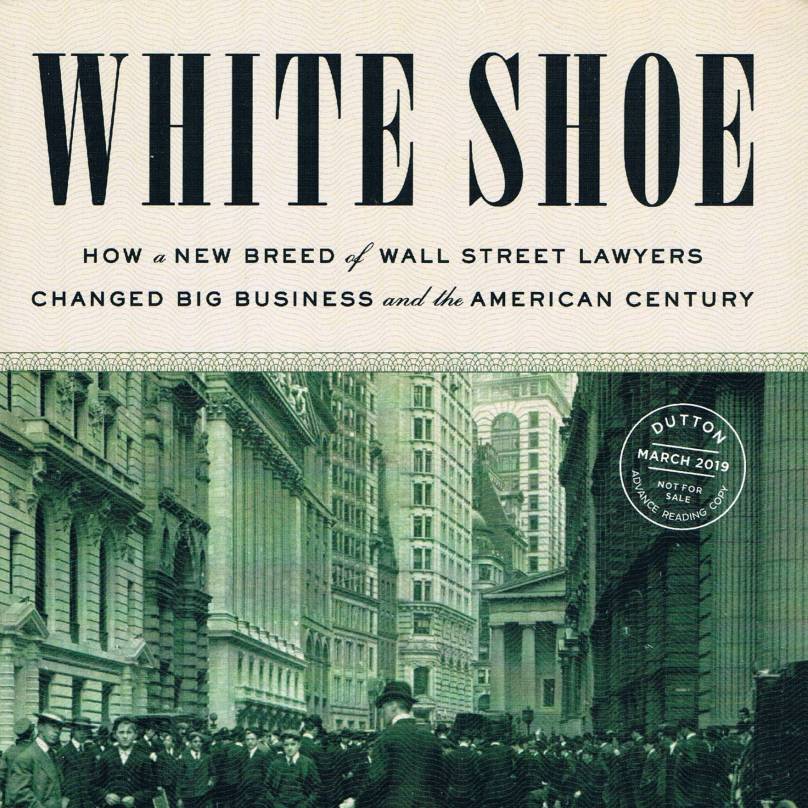
My good friend and fellow blogger Frederick Ingram of Corporate History International has written an intriguing review of what appears to be a quite intriguing book: historian John Oller’s White Shoe: How a New Bread of Wall Street Lawyers Changed Big Business and the American Century. Based on Ingram’s review alone, the book is a fascinating dive into the heady politics of early twentieth-century America, the transition from the relative laissez-faire capitalism of the so-called “Gilded Age” into the economic, political, and social reforms of the Progressive Era.

The Progressive Movement fundamentally transformed the United States, in many ways (constitutionally) for the worse. But it was an attempt to rectify some of the excesses of the Gilded Age, and to ensure that workers were not merely cogs in faceless corporate machines. In reading Ingram’s review, I heard echoes of Tucker Carlson’s recent on-air musings, particularly the idea that efficiency is not a god to be worshipped blindly, and that capitalism is great, but it should work for us, not the other way around.

The more things change, the more they stay the same: Carlson’s diagnosis of America’s current ills echoes attorney (and future Supreme Court justice) Louis Brandeis’s “curse of bigness,” the argument against efficiency-for-its-own-sake. I was struck, while reading Ingram’s review, how much our own age mirrors the period that, in many ways, begat our current crises: the Progressive Era of 100 years ago.

According to Ingram, a consensus of sorts was reached among these big Wall Street Lawyers (WSLs), which ultimately prevented radicalism and presented “capitalism with a human face”:

“The end of ‘The Last Great Epoch’ coincided with the end of World War I, flanked by the funerals of the earlier generation of great industrialists and white shoe pioneers. ‘Each year has the significance of a hundred,’ said William Nelson Cromwell in 1918, and this applied not just to armistice negotiations but vast swaths of human society. Business, law, and government in the US would be professionalized and regulated, but still relatively free by world standards. The reforms advocated by enlightened and informed WSLs formed a barrier against imported radicalism. Even rightwing attorneys backed movements such as social security, child labor prohibitions, and even minimum wage.”


Ingram, as I mentioned, is a good friend, and we’ve had some lively discussions over the years about the “big questions” of life. His thoughtfulness and reflexivity are in full display in his review here, as he links insights from this work to concurrent readings of Jordan Peterson and Christopher Andrews. He also brings in his own experiences working in “BigLaw,” as he calls it, the grueling world of billable hours and 80+-hour workweeks.

To (indulgently) block-quote Ingram once more:

“Having worked as a BigLaw accounting clerk myself, I have an issue with the Cravath System and the slavish devotion to billable hours. Is your spouse really going to leave you if you don’t make $250,000 this year? Will your children no longer look up to you? Is that worth being a cortisol-addled prick 80 hours a week, every weekday of your miserable life? Wouldn’t it be wiser to make, I don’t know, $100k or even $50k and have your peace of mind back?”


As much as I admire the energy and drive of the restless striver—and as much as I over-work myself—Ingram makes a compelling point. Money doesn’t buy happiness (although it certainly buys a great deal of freedom), and the pursuit of it can lead other, more enduring obligations—family, friends, faith—to wither.

An excellent review, from a good friend. Check it out at https://corporatehistory.international/2019/01/27/new-white-shoe-review-for-you, then pick up a copy of Oller’s book.

fridrix's avatarCorporate History International

White Shoe: How a New Breed of Wall Street Lawyers Changed Big Business and the American Century by John Oller (Dutton: 2019). Review by Frederick C. Ingram, CorporateHistory.International, January 27, 2019.

White Shoe promises to deliver an engaging and revealing tale regarding the handful of New York City attorneys who effectively created big business as we’ve known it, the “new high priests for a new century.” As an accomplished historian (The Swamp Fox: How Francis Marion Saved the American Revolution, Da Capo: 2016) and former Wall Street attorney himself (Willkie Farr & Gallagher), John Oller is well placed to fulfill this tall order.

20190127 white shoe cover squareIn a previous economy, I researched hundreds of corporations for the International Directory of Company Histories, so the prospect of peeking a little beyond the opaque public relations and investor relations curtain intrigued me. I’m also reminded of strolling along Fifth Avenue, whose equally opaque walls…

View original post 1,441 more words

TBT: Rustics Have Opinions, Too

I first launched The Portly Politico on Blogger back in 2009.  It was a different world back then, and I was a different conservative.  I was probably still deep in my Randian-libertarian economic conservative phase:  I sincerely believed neoliberal economics and mostly unbridled capitalism could solve almost all of the world’s problems, which meant I was fundamentally progressive in my outlook, “progressive” in the sense of taking a Whiggish view of human history—yes, some things are bad now, but they’ll inexorably get better as we expand free trade and free movement of peoples across borders.  Heck, I even thought that, as a Christian nation, America should take in illegal immigrants!

Such are the follies of youth.  Intervening years of lived experience—not to mention the increasingly overt radicalism of the Left—have convinced me that, as wonderful as free markets are, we’ve tended to sacrifice real lives and communities in exchange for cheap plastic junk.  I’ve also considerably altered my views on immigration; at this point, I think America needs 150 milligrams of Deportemal (and a healthy dose of limiting legal immigration, too).

One thing that hasn’t changed:  I still identify with the struggles and values of rural America.  In this 2009 post, I pointed out the growing contempt for rural Americans that the Democratic Party now openly embraces.  I think I was overly-generous to the author of the piece discussed herein, however; upon re-reading Kevin Baker’s essay “Barack Hoover Obama,” I’m chilled by how openly he argues for the usurpation of usual constitutional order and division of powers in order to push for “change.”  I apparently missed it completely ten years ago, much to my current chagrin.

Back then, I remember conservatives having some mild optimism that President Obama would govern as a pragmatic moderate—left-of-center, to be sure, but reasonable.  Then he forced through the Affordable Care Act on a purely partisan basis, alienating Republicans and contributing to the deep ideological divide in America today.  His administration doubled down on identity politics, reopening mostly-healed racial wounds.  Much of the cultural chaos we suffer today is the result of the twin evils of Senator Teddy Kennedy’s 1965 immigration bill and President Obama’s politics of racial grievance.

So, that’s my apology for my naivety as a young, portly man.  That said, here is 2009’s “Rustics Have Opinions, Too“:

I’ve noticed something about the American Left, specifically those members who claim to be “cultured”: they share a distrust and even hatred for rural Americans. They constantly mock the values, feelings, and politics of this oft-derided constituency, framing them as stereotypical “rednecks” or “good ol’ boys” who spend most of their time polishing their guns drunk while watching NASCAR.

Let’s face it: stereotypes exist for a reason. Think of any offensive stereotype and there’s a kernel of truth to it. But that doesn’t mean we should go around judging people based on those stereotypes. Liberals are making that point all the time, and in this case they’re actually right. As usual, though, they fall back into their old, hypocritical ways when it comes to rural Americans. It’s “hate speech” if someone insinuates that an Asian is good at math, but it’s perfectly acceptable to laugh at someone who’s only skin pigmentation is on the back of his neck.

I’m not saying that having a sense of humor is wrong. Maybe white guys really aren’t as cool as black dudes when they drive. Dave Chappelle had tons of great material and Boondocks deals with race relations in the United States today better than any other show out there. I want to make it clear that I have nothing against humor. By laughing at stereotypes, we rob them of their power, rather than adding to it.

The same holds true for “rednecks” or “white trash” or whatever label one uses. If it weren’t, Jeff Foxworthy would be out of a job. The problem arises, however, when we start to marginalize those Americans because of the stereotypes that exist. Such marginalization of African Americans, for example, would be roundly denounced by the left, and rightfully so. Unfortunately, liberals often celebrate when such marginalization is applied to the rural white American.

In an otherwise excellent article in Harper’s Magazine entitled “Barak Hoover Obama: The Best and the Brightest Blow it Again,” Kevin Baker indulges in this marginalization to a sickening extent [Note–at the time of this writing, the full text of the article is only available to Harper’s subscribers]. The bulk of the article draws historical parallels between Presidents Herbert Hoover and Barack Obama. Baker’s research is impeccable and his understanding of an oft-maligned (and extremely intelligent) former president is refreshing. He implicitly challenges the more common “Obama-is-to-Roosevelt-as-Bush-is-to-Hoover” analogy and draws some pessimistic conclusions about Obama’s approach to passing many of his long-promised, radically liberal reforms.

A large part of Baker’s argument is that President Obama is proceeding with excessive caution and is relying too heavily on Congress to enact the changes he seeks for the nation (naturally, many conservatives would argue that the opposite is true, but suffice it to say that Baker is approaching Obama’s proposed reforms from the point of view of a liberal supporter–he actually thinks that cap-and-trade is a good thing). Baker maintains that congressional Democrats from states with small populations like Montana are stepping up after years of quiet service to challenge many of Obama’s efforts.

The language Baker uses to describe these representatives and senators is thick with disrespect. He talks about their states as filled with tumbleweeds and ignorance. He implicitly challenges the notion that these congressmen–and by extension their constituents–have no place in contemporary American politics and that they should be brushed aside and ignored, all because they’re impeding Ossiah’s democratic-socialist vision. This viewpoint is shared implicitly and explicitly by most liberals and leftists. The thinking is that because these states have small populations–and don’t have a good place to get sushi or gourmet coffee–they don’t deserve to have a place in the American political system (not to mention the fact that Baker is encouraging Obama to squelch dissent and open discussion, supposed bedrocks of modern liberalism).

What’s most disturbing about this reasoning is that it is anathema to the very structural philosophy of the United States Constitution. The Constitution clearly sets out to create a structure that gives states with large populations more power in the House of Representatives, while allowing states with small populations to maintain an equal footing in the Senate. The same theory exists behind the Electoral College. If our system was not balanced in this way, New York and California would always pick the next president and would exert a dangerous amount of control over national politics (with only conservative Texas able to balance things out a bit). Regional interests do not necessarily coincide with national interests, and what’s good for New York may not be good, and may even be bad, for Iowa.

Yet liberals consistently ignore this inconvenient truth and view it as a stumbling block to their pet projects, whatever they might be. At the risk of sounding like a blowhard conservative talk show host, leftists in America today have no respect for the Constitution except when it is politically advantageous or convenient. Now, I am willing to admit that there are plenty of conservatives who probably treat the Constitution in the same way, but they are much, much harder to find. This disrespect cannot endure for long, regardless of the side.

Therefore, I applaud what these rural Democrats are doing. Maybe they are dusty old relics of the party, but that’s for the Democrats to sort out themselves, and that should not invalidate what these men have to say. Maybe most of them are blowhards and are simply seizing their moment to be in the spotlight or to play to their base, but some of them have useful objections and suggestions. I don’t want to give liberals any additional aid, but it seems to me that they could use all the help they can get in the more rural parts of the country. Taking the interests of rural Democrats more seriously would be a great start.

Kevin Baker and his ilk live in a world of trendy green advertising and mocha lattes. They have no respect for hard working rural Americans–oh, heck, we’ll call them “rednecks”–who help make this country into the wonderful tapestry of ideas and cultures it is today.

Besides, who wants to watch Jeff Gordon race in a Prius?

The Left’s Cluelessness on Gun Control

As a rule, I don’t write about guns, gun control, or shootings, mainly because I have nothing to add, and because there doesn’t seem to be much to discuss:  either you support gun rights, or you don’t (in other words, you either read the Constitution literally, or you simply want to reinterpret it to fit your ideology more conveniently).

My basic take on the issue is as follows:  the personal right to bear arms is constitutionally safeguarded in the Second Amendment.  That right is necessary for two reasons:  to protect personal property, yourself, and your family; and to protect against an overly oppressive government.  To be clear, I’m not advocating any kind of violent overthrow of or resistance to the government; rather, I’m arguing that the Second Amendment is our last resort against a government that becomes so hostile to our rights, we have no other recourse but to fight it (see also:  the American Revolution).  I do not think we have reached that point, as we still have ample constitutional means to correct and reform the government.

As for shootings, I believe it’s a spiritual and mental issue, not a gun issue.  Godlessness seems to be the real root issue of many of our social maladies, coupled with a nihilism whose logical conclusion is “if everything is meaningless, then I can do whatever I want,” and “if everything is meaningless, then life is worthless.”  Connect the dots, and it’s no surprise we have nihilistic suicides and mass murders.  Add in the grotesque, macabre fame such acts bring in an age of social media, and the sick motivations for violence are further heightened.

Regardless, I couldn’t help notice this piece from Pacific Standard, a far Left rag known (to the extent it is) for its radicalism and overly-earnest headlines.  I get PS‘s daily e-mail of stories, and occasionally read its pieces to see what the other side is thinking (occasionally, they’re actually interesting).

I’ve been sitting on this one for awhile, but here is the context for the piece:  it was written shortly after the shooting last November in California.  Heads collectively exploded when word got out that progressive utopia California, with its robust gun control laws, was the site of a tragic mass shooting.  Without cheapening the deaths of those unfortunate, innocent souls, the question that came to my mind was, “If gun control is so effective, then how could this happen in California?”

Of course, it’s a straw man question:  gun control isn’t effective.  Indeed, arming responsible, law-abiding people is far preferable to disarming them (and, in effect, arming the bad guys, who will break the new gun control laws).  What struck me, then, was the head-exploding of the true believers on the Left.  The subtitle of this piece says it all:  “A quick look at the regulations and numbers doesn’t necessarily suggest the state’s laws are useless.”

In short, pro-gun control Leftists scrambled to explain away this shooting.  For the Left, shootings are never about man’s fallen nature and capacity for sin (unless that man is a white police officer and the person shot is some kind of favored minority), but instead a technocratic problem to be solved with increasing government control—enforced, ironically, with guns.


Numbers Don’t Lie – The Electoral College

Pollster Scott Rasmussen writes a brief, daily post for Ballotpedia called “Number of the Day.”  It’s an excellent, bite-sized chunk o’ statistical knowledge that gives an enlightening view of our nation from one of America’s great polltakers.

Monday’s “Number of the Day” was “49.5% of the U.S. Population Will Live in Eight States by 2040“—and continued with a discussion of the Electoral College.

For the unfamiliar, the Electoral College takes a lot of heat, usually from progressives (and especially so since President Trump won the 2016 election in the Electoral College, but lost the popular vote by margin of some millions).  There have been multiple attempts to abolish the Electoral College throughout American history, with the most successful effort coming after Richard Nixon’s electoral victory in 1968 (of course, that effort failed—fortunately).  Critics argue that the institution is “undemocratic,” as it seems to violate the principle of “one person, one vote.”

Fortunately, the Framers of the Constitution were wise enough to realize the pitfalls of popular democracy, which they believed devolved into mob rule and, ultimately, tyranny (see also:  the French Revolution), and also anticipated the dangers of a small group of urban voters being able to swing presidential elections at the expense of voters in rural States.

It is precisely this fear that Rasmussen’s demographic data highlights.  Rasmussen writes that nearly half of the nation’s population will live in one of eight States by 2040:  California, Texas, Florida, New York, Pennsylvania, Georgia, Illinois, and North Carolina.  That means that, in a popular system, those States could nearly swing a presidential election themselves.

Some readers might object that those voters are not uniform, and a popular vote would put a State like Wyoming more into play (as those ~600,000 voters—projected to be around 688,000 in 2040), but that assumes a level of individuality that, while attractive to the libertarian-minded, is not realistic.

Rural sections of the country have different goals, values, and concerns than urban centers.  A State with one or more major metropolitan areas would dominate national politics.

Rasmussen touches on this dynamic in Congress, too.  Currently, large States enjoy a huge advantage in the House of Representatives, the most “democratic” chamber at the federal level.  Small States, on the other hand, possess greater leverage in the Senate, where every State gets two Senators, regardless of population.  California—with its fifty-three Congressmen—can run roughshod over Wyoming in the House, but California’s Senators have the same clout as Wyoming’s two.

In essence, then, the different sections of the country have to reach some level of compromise to accomplish anything.  Rural States have to throw urban States a bone to get legislation passed in the House, and urban States have to support some rural State measures.

Indeed, this is largely how the farm bill and food stamps get passed:  rural Republicans vote for food stamps for the urban poor, and urban Democrats vote for corn subsidies for rural farmers.

That’s all Civics 101, but, as Dr. Samuel Johnson wrote, “People need to be reminded more often than they need to be instructed.”

A final thought:  what happens when rural-urban compromise breaks down?  The values of the rural portions of the country—chiefly the South and Midwest—are increasingly at odds with the values of the bicoastal elites and their scattered archipelago of continental metropolises.  In that case, shouldn’t we throw out the system, as we’ll just get gridlock?

To quote the Apostle Paul, “God forbid!”  That divide highlights the necessity of separation of powers.  I’d rather not have a demiqueer otherkin alternative poetess-programmer (that’s the most ridiculous caricature I could conjure up) and xyr pansexual two-spirited Wookie life-mate ramming ultra-leftist progressive policies up my butt like a hamster at their next vegan pottery party, just as I’m sure the Wookie life-mates wouldn’t want me dictating my rustic Biblical morality to them (but, just so we’re clear, you people have lost your way).

The only major threat, as I see it, is that Congress has so abdicated its responsibility to the executive branch and its unelected bureaucracy of careerist swamp creatures, that we could see the further rise of executive overreach.  That’s why progressives howl at the moon in protest to President Trump—they think he’s going to wield the sword of executive power against them the way President Obama did against us.

But with the Deep State so ensconced in our national life, I sometimes fear that we’re living in pre-Augustusean times.  In the meantime, let us hope President Trump can correct the course; that Congress will once again jealously guard its prerogatives; and that the Electoral College stands for centuries to come.

The Evolution of Judicial Supremacy – Judicial Review

Last night, President Trump nominated Judge Brett Kavanuagh to serve on the Supreme Court to fill the vacancy left by the retirement of Justice Anthony Kennedy.  As such, I thought it would be germane to explore briefly the role of the Supreme Court.

Popular understanding of the Court today is that it is the ultimate arbiter and interpreter of the Constitution, but that’s not properly the case.  The Court has certainly assumed that position, and it’s why the Supreme Court wields such outsized influence on our political life, to the point that social justice snowflakes are now worried about Justice Ruth Bader Ginsburg’s diet and exercise regimen.

Properly understood, each branch—the President, the Congress, and the Court—play their roles in interpreting the constitutionality of laws.  Indeed, President Andrew Jackson—a controversial populist figure in his own right—argued in his vigorous veto of the Bank Bill, which would renew the charter of the Second Bank of the United States, that the President had a duty to veto laws that he believed to be unconstitutional.

Unfortunately, we’ve forgotten this tripartite role in defending the Constitution from scurrilous and unconstitutional acts due to a number of historical developments, which I will quickly outline here, with my primary focus being a case from the early nineteenth century.

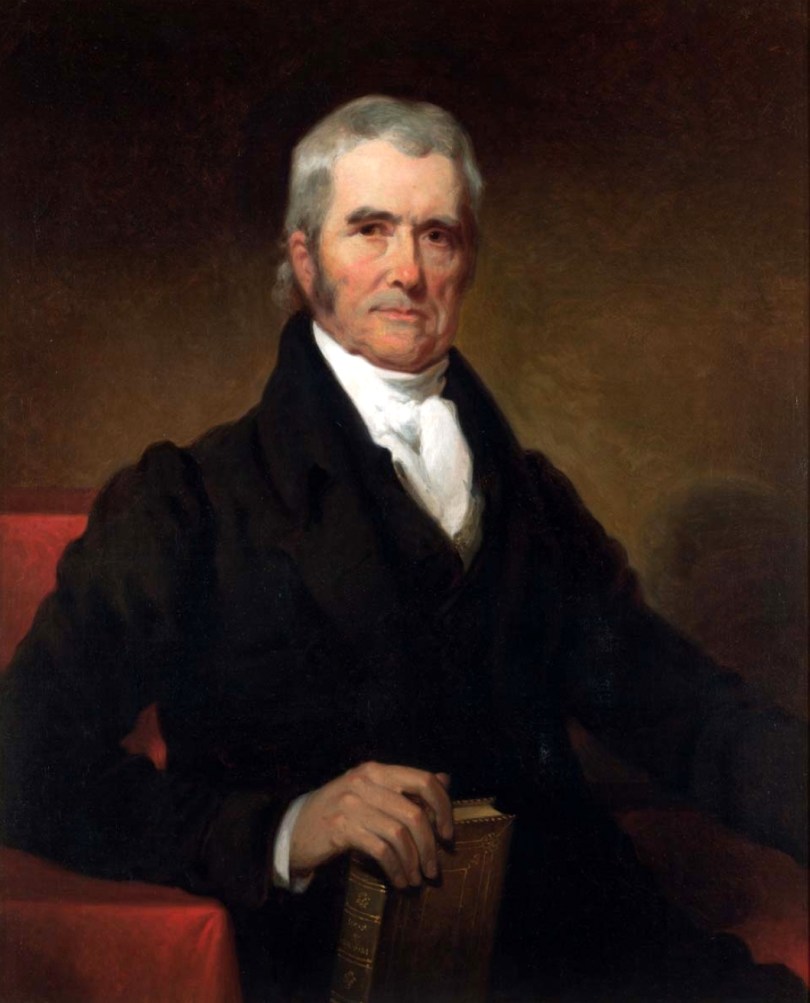
The notion that the Supreme Court is to be the interpreter of the Constitution dates back to 1803, in the famous Marbury v. Madison case.  That case was a classic showdown between Thomas Jefferson and James Madison on one hand—representing the new Democratic-Republican Party in control of the executive branch—and Chief Justice John Marshall, a Federalist appointee, on the other.

The case centered on an undelivered “midnight appointment” of William Marbury to serve as Justice of the Peace for Washington, D.C.  The prior president, John Adams, had issued a handful of last-minute appointments before leaving office, and left them on the desk of the incoming Secretary of State, James Madison, to deliver.  Naturally, Jefferson and Madison refused to do so, not wanting to pack the judicial branch with any more Federalists, and Marbury sued for his appointment.

If Marshall ruled that Madison must deliver the appointment, there was a very real risk that the Jefferson administration would refuse.  Remember, the Supreme Court has no power to execute its rulings, as the President is the chief executive and holds that authority.  On the other hand, ruling in Madison’s favor would make the Court toothless in the face of the Jefferson administration, which was already attempting to “unpack” the federal courts through acts of Congress and the impeachment (and near removal) of Justice Samuel Chase.

In a brilliant ruling with far-reaching consequences, Marshall ruled that the portion of the Judiciary Act of 1789 that legislated that such disputes be heard by the Supreme Court were unconstitutional, so the Supreme Court could not render a judgment.  At the same time, Marshall argued strongly for “judicial review,” the pointing out that the Court had a unique responsibility to strike down laws or parts of laws that were unconstitutional.

That’s all relatively non-controversial as far as it goes, but since then, the power of the federal judiciary has grown to outsize influence.  Activist judges in the twentieth century, starting with President Franklin Roosevelt’s appointees and continuing through the disastrous Warren and Burger Courts, have stretched judicial review to absurd limits, creating “penumbras of emanations” of rights, legislating from the bench, and even creating rights that are nowhere to be found in the Constitution.

Alexander Hamilton argued in Federalist No. 78 that the Court would be the weakest and most passive of the branches, but it has now become so powerful that a “swing” justice like former Justice Kennedy can become a virtual tyrant.  As such, the confirmation of any new justice has devolved into a titanic struggle of lurid accusations and litmus tests.

The shabby treatment of the late Judge Robert Bork in his own failed 1987 nomination is a mere foretaste of what awaits Judge Kavanaugh.  Hopefully Kavanaugh is well-steeped in constitutional law and history—and will steadfastly resist the siren song of personal power at the expense of the national interest.