Northam Non-troversy and Abortion

I’m going to be honest here:  I do not care about Virginia Governor Ralph Northam’s old yearbook photograph, in which he’s either in blackface or wearing a Klan hood.  I don’t support or endorse doing either of those outfits, but how does a photograph of a goofy costume from over thirty years ago affect the man’s ability to do his job now?  It’s not as though he has a track record of racist remarks that might bias his enforcement of Virginia’s laws against black, Jewish, or Catholic Virginians.

The problem with progressivism is that it eats its own with gusto, as the socially-acceptable behavior of yesteryear becomes the always-forbidden “hate” of today.  It was certainly in poor taste to wear blackface in the 1980s, but, give me a break.  When does the statute of limitations on poor decisions expire?  Are we allowed to never commit a mistake if we want to serve in public office?

What demonstrates how truly evil the Left is is that they don’t care about Northam’s endorsement, just a little over a week ago, of infanticide.  When asked in a radio interview what should be down with a child born alive that the mother initially wanted aborted, Northam replied that the mother and at least two physicians should consult about the baby’s fate while the baby was “kept comfortable.”

Where are the anguished cries about that?  Northam wearing a Klan hood to a beer bash in the 80s didn’t cost any black people their jobs or their lives.  Abortion kills them by the tens of thousands every year.

Pat Buchanan—ever-brilliant, ever-prescient and -insightful—has a piece exploring the implications of the Northam non-troversy that I highly recommend you read.  A representative excerpt:

We are at the beginning of a Kulturkampf to purge America of all monuments and tributes to the white males who created, built and ruled the country, and once believed that they, their nation, their faith, and their civilization were superior to all others. And, without apology, they so acted in the world.

Those two guys drinking beer in blackface and Klan robes and a hood thought they were being funny, but to the unamused members of a radicalized Democratic Party, there is nothing funny about them.

And, after Northam, these intolerant people will demand that the Democratic Party nominate a candidate who will echo their convictions about America’s past.

America will pay for its generations of infanticide if we don’t end it, and soon.  God is just, and delivers His judgment with swiftness and ferocity after long forbearance.  One reason the Philistines were destroyed was because of their worship of Baal, which required sacrificing babies.  Similarly, the Carthaginians were crushed, in part, because of their child sacrifices.

We’re sacrificing babies to the altar of progressive politics and the ethos of “if it feels good, do it—and don’t worry about the consequences.”  I can at least appreciate the hedonist who accepts the bad with the good of his lifestyle—say, the smoker who acknowledges it’s bad for him, but he enjoys doing it anyway.  But what kind of monster snuffs out a human life for convenience?

Northam needn’t resign over a picture.  But he and other Democrats should fall on their knees in repentance over their endorsement of the mass murder of innocents.

TBT: The Alabama Special Election, Principles, and Persecution

Back in 2017, I was enthusiastic about the candidacy of Judge Roy Moore as he ran for US Senate in a special election in Alabama.  Moore is a darling of social conservatives because of his willingness to challenge flawed higher court rulings on the establishment of religion.  He famously refused to remove a monument of the Ten Commandments from the Alabama State Supreme Court in defiance of a federal court ruling, and was elected back to the bench after being removed for his defiance.

I relished the idea of this bumptious, no-nonsense Christian in the US Senate, and after he won the Republican nomination in a heated campaign against Establishment GOP favorite Luther Strange, I figured he would coast to an easy win.

Then, of course, the Left brought out the knives, and heretofore unspoken allegations of sexual misconduct from the murky past surfaced.  Remember, Moore ran in multiple races, often as a controversial and high-profile figure, without any of these allegations ever surfacing.  What made this race different?

In this piece from December 2017, I argue that Moore was railroaded, and that while some of the stories of his age-disparate relationships with teenage girls were likely true, they all seemed relatively benign given the times (the swingin’ 1970s).  My basic takeaway was, and is, this:  the worst of the allegations against Moore also was the most incongruous from others; Moore was super respectful to the other girls who mention dating him; and several of the girls were eager to date a successful, older attorney.  Essentially, it’s highly unlikely he did anything illegal or wrong; he was just a dude who liked dating girls in their late teens.  That’s a big unusual, but he wasn’t breaking any laws at the time.

With the modern Left, though, yesterday’s unorthodox peccadilloes become today’s wicked heresies (and vice-versa).  That Moore is a fundamentalist, evangelical Christian made him an even more appealing target for character assassination.  The noodle-wristed hand-wringers of Conservatism, Inc., were all too willing to fall over themselves proving to the Left that they, too, were good guys with their denunciations of Moore.

Here, then, is 2017’s “The Alabama Special Election, Principles, and Persecution“:

The campaign of Alabama Senate candidate Judge Roy Moore is reeling after allegations that, in the 1970s and 1980s, Moore dated several teenage girls.  The Washington Post article that broke the news focuses on Leigh Corfman, who alleges that Moore approached her at the courthouse in Etowah County, Alabama, when she was only fourteen-years old.  After obtaining her phone number, Corfman claims Moore met with her and forced her to touch him over the underwear.

Several other women also told the Washington Post that they dated Moore while he was in his early 30s and they in their late teens.  These other women were between sixteen and eighteen (sixteen is the legal age of consent in Alabama), and report that their dates with the young deputy district attorney were respectful, involving no physical contact beyond hugging and kissing.  One of the women even said her mother was thrilled that her daughter was dating a successful attorney.

Judge Moore denied all of the allegations, but each day seems to bring some fresh revelation or twist.  He has since said that he may have dated some teenagers of legal age when he was younger.  The truth is difficult to discern, but here is what we do know:

  • Four women–all above the legal age of consent–reported that Moore was respectful (one noted that after her mother forbid her from dating an older man, their relationship ended, apparently without any further fanfare).
  • Leigh Corfman, who was fourteen at the time of the alleged groping, was the only woman accusing Moore of any explicitly illegal and illicit sexual activity.
  • Tina Johnson emerged a few days into the controversy, alleging that Moore grabbed her butt in 1991. (Link)
  • Judge Moore has been married to his wife, Kayla Moore, who is younger than him by fourteen years, for decades.  She has defended her husband fiercely in the face of these accusations.
  • Moore has run multiple local and statewide campaigns–many of them controversial–and no allegations have emerged during any of these (highly contentious) campaigns.
  • Moore is a boogeyman for the political Left, and something of a Jacksonian folk hero for the Right.  He famously refused to remove a monument of the Ten Commandments from the grounds of the Alabama Judicial Building after a federal court ruled it constituted an establishment of religion (Alan Keyes eloquently denounced that federal court order in a classic essay–and, for my students, perennial Government class assignment–entitled “On the Establishment of Religion:  What the Constitution Really Says“), leading to his removal from the Alabama Supreme Court in 2003.

    He was reelected to the Alabama Supreme Court ten years later, only to be removed again in 2016 for refusing to comply with the Supreme Court’s dubious decision in Obergefell v. Hodges, the landmark case that read into the Constitution a heretofore unwritten and unrecognized right for same-sex couples to marry.

  • Moore was favored by the Bannonite-wing of the Republican Party (if such a thing exists) in the intense Republican primary run-off battle against Senator Luther Strange, who had been appointed to fill the vacant seat after Jeff Sessions was tapped to serve as Attorney General in the Trump administration.  The Republican Establishment–notably Senate Majority Leader Mitch McConnell, but also President Trump–supported Strange, while Moore was cast as the “Trumpian” candidate.
Those last two points raise my eyebrows.  Here’s a man who is no stranger to (political) controversy, the consummate culture warrior in an age when every political battle seems to connect to cultural and social values.  Moore’s firm religious convictions make him evil in the eyes of progressive Democrats, and embarrassing to well-heeled, Establishment, country-club Republicans.

It’s no secret that the Washington Post endorsed Moore’s opponent, Democrat Doug Jones.  Then the Post sought out women who claim to have had encounters with Moore.  For a heavily left-leaning publication hoping to humiliate the sitting president and the Republican Party in a deep red state, the temptation to go after a popular but controversial populist figure would have to have been palpable.

The disdain of the Establishment Republicans for Moore (and, by extension, President Trump) could explain the fervor with which they have gone after Moore, calling for him to resign within mere hours of the Post‘s story breaking.  It’s as though McConnell was just waiting for something like this to cross his desk, so he and other RINOs could rush out to denounce Moore and try to twenty-three-skidoo in their preferred candidate.

It seems that Republican leadership has succumbed to the same mania for virtue-signalling that dominates the Left.  I can barely read National Review–formerly one of my favorite publications–because of its consistently noodle-wristed editorializing whenever any populist-oriented Republican speaks out of turn.  Just read David French’s off-putting essay on “creepy Christianity” here.  With friends like these, who needs enemies?

The worst of the accusations–the groping of the fourteen-year old and the incident in 1991–don’t seem to fit the pattern of the stories the other women told the Post.  I’m fully willing to concede that, based on what we’re learning now, a young Roy Moore dated some girls in their late teens.  He married a woman fourteen years his junior.  Clearly, he had a taste for younger women, but he hasn’t committed adultery, as one of his most vocal critics, Senator John McCain, did, and his relationships, by all accounts, were above-board.  He’s remained faithful–as far as we know–to his wife.

“For a heavily left-leaning publication hoping to humiliate the sitting president and the Republican Party in a deep red state, the temptation to go after a popular but controversial populist figure would have to have been palpable.”

It may seem unorthodox now–and I am certainly not advocating that thirty-two-year old men start dating sixteen-year olds!–but such age-disparate relationships were more common and socially acceptable forty years ago.  For a fuller examination of this point, I refer you to Frank J. Tipler’s piece at American Thinker; read it here.

Regardless, the Left has no logical grounds for objection.  How can a philosophical and political movement that endorses every sexual arrangement imaginable stand against legal, age-disparate, consenting relationships and maintain even a modicum of internal consistency?  Again, this is no endorsement of such relationships, but if you’re the party of transgender, bisexual, polyamorous, gay, lesbian, queer, inter-species rights, how can you draw the line here?  You’ve already run miles past it.

Ultimately, squeamish National Review-and-Establishment types are claiming the moral high ground, arguing that a US Senate seat isn’t worth sacrificing principles.  At this point, though, their haste to condemn Moore smacks of moral cowardice and political opportunism.  Are they not going to at least entertain the idea that the man is innocent, or was just a bit unorthodox in his dating habits forty years ago?  Rather than try to scuttle a still-popular candidate before he barely has a chance to defend himself, could not McConnell and other Senate Republicans attempt to reach out to the Moore campaign?  Even if he’s not your style of Republican, you could learn to work with him, rather than prome to expel him from the Senate if he wins!

This video from Stefan Molyneux (below; WARNING–NSFW) gets down to brass tacks:  preserving the Republican’s razor-thin majority in the Senate is worth showing some political backbone, rather than allowing a partial-birth abortion-supporting Democrat to snag the seat.

This election suggests that Establishment Republicans, for all their talk of decorum and principles, are sometimes little better or different than their Democratic opponents.  They don’t want a scrappy culture warrior  And despite some dire poll numbers, the accusations may not stick:  according to RCP polling, Moore was up 3 points over Jones (as of 14 November), though he has fallen to a far more dicey 0.8% lead (as of 16 November, the date this post was written).  That’s within the margin of error, though certainly not the double-digit lead Republicans want in Alabama.  More on those poll numbers, and my analysis of them, to come.

If we learn that Moore did indeed assault Leigh Cofrman, than I’ll retract my defense of him immediately.  But for now, we have no consistent pattern of bad behavior, and what appears to be some very powerful opponents arrayed against a man who has suffered professionally for his beliefs.  From where I’m sitting, Judge Moore’s treatment looks more like persecution than justice.

Reblog: New White Shoe Review for You

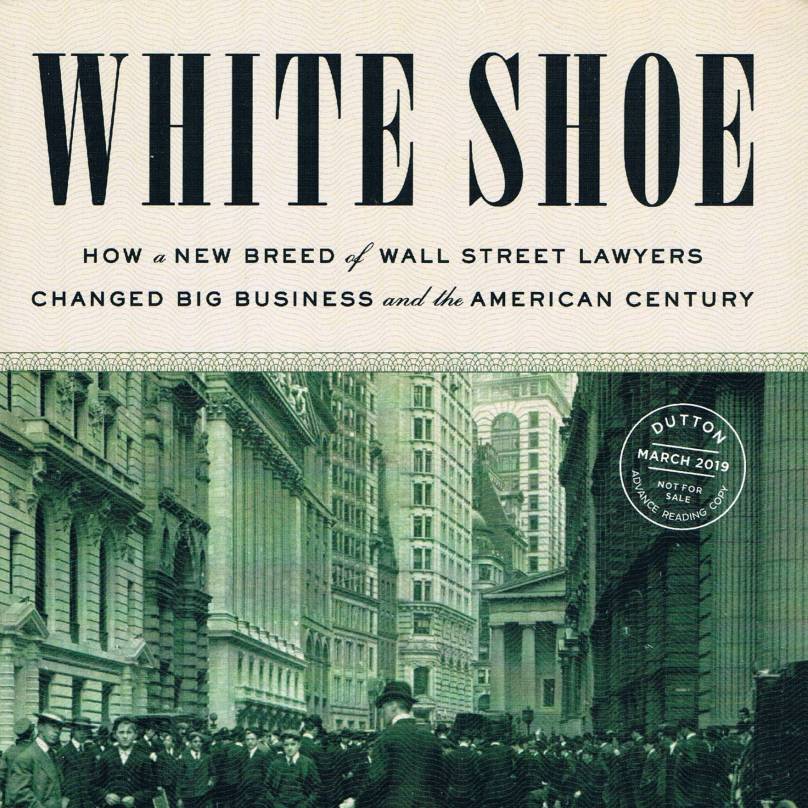
My good friend and fellow blogger Frederick Ingram of Corporate History International has written an intriguing review of what appears to be a quite intriguing book: historian John Oller’s White Shoe: How a New Bread of Wall Street Lawyers Changed Big Business and the American Century. Based on Ingram’s review alone, the book is a fascinating dive into the heady politics of early twentieth-century America, the transition from the relative laissez-faire capitalism of the so-called “Gilded Age” into the economic, political, and social reforms of the Progressive Era.

The Progressive Movement fundamentally transformed the United States, in many ways (constitutionally) for the worse. But it was an attempt to rectify some of the excesses of the Gilded Age, and to ensure that workers were not merely cogs in faceless corporate machines. In reading Ingram’s review, I heard echoes of Tucker Carlson’s recent on-air musings, particularly the idea that efficiency is not a god to be worshipped blindly, and that capitalism is great, but it should work for us, not the other way around.

The more things change, the more they stay the same: Carlson’s diagnosis of America’s current ills echoes attorney (and future Supreme Court justice) Louis Brandeis’s “curse of bigness,” the argument against efficiency-for-its-own-sake. I was struck, while reading Ingram’s review, how much our own age mirrors the period that, in many ways, begat our current crises: the Progressive Era of 100 years ago.

According to Ingram, a consensus of sorts was reached among these big Wall Street Lawyers (WSLs), which ultimately prevented radicalism and presented “capitalism with a human face”:

“The end of ‘The Last Great Epoch’ coincided with the end of World War I, flanked by the funerals of the earlier generation of great industrialists and white shoe pioneers. ‘Each year has the significance of a hundred,’ said William Nelson Cromwell in 1918, and this applied not just to armistice negotiations but vast swaths of human society. Business, law, and government in the US would be professionalized and regulated, but still relatively free by world standards. The reforms advocated by enlightened and informed WSLs formed a barrier against imported radicalism. Even rightwing attorneys backed movements such as social security, child labor prohibitions, and even minimum wage.”


Ingram, as I mentioned, is a good friend, and we’ve had some lively discussions over the years about the “big questions” of life. His thoughtfulness and reflexivity are in full display in his review here, as he links insights from this work to concurrent readings of Jordan Peterson and Christopher Andrews. He also brings in his own experiences working in “BigLaw,” as he calls it, the grueling world of billable hours and 80+-hour workweeks.

To (indulgently) block-quote Ingram once more:

“Having worked as a BigLaw accounting clerk myself, I have an issue with the Cravath System and the slavish devotion to billable hours. Is your spouse really going to leave you if you don’t make $250,000 this year? Will your children no longer look up to you? Is that worth being a cortisol-addled prick 80 hours a week, every weekday of your miserable life? Wouldn’t it be wiser to make, I don’t know, $100k or even $50k and have your peace of mind back?”


As much as I admire the energy and drive of the restless striver—and as much as I over-work myself—Ingram makes a compelling point. Money doesn’t buy happiness (although it certainly buys a great deal of freedom), and the pursuit of it can lead other, more enduring obligations—family, friends, faith—to wither.

An excellent review, from a good friend. Check it out at https://corporatehistory.international/2019/01/27/new-white-shoe-review-for-you, then pick up a copy of Oller’s book.

fridrix's avatarCorporate History International

White Shoe: How a New Breed of Wall Street Lawyers Changed Big Business and the American Century by John Oller (Dutton: 2019). Review by Frederick C. Ingram, CorporateHistory.International, January 27, 2019.

White Shoe promises to deliver an engaging and revealing tale regarding the handful of New York City attorneys who effectively created big business as we’ve known it, the “new high priests for a new century.” As an accomplished historian (The Swamp Fox: How Francis Marion Saved the American Revolution, Da Capo: 2016) and former Wall Street attorney himself (Willkie Farr & Gallagher), John Oller is well placed to fulfill this tall order.

20190127 white shoe cover squareIn a previous economy, I researched hundreds of corporations for the International Directory of Company Histories, so the prospect of peeking a little beyond the opaque public relations and investor relations curtain intrigued me. I’m also reminded of strolling along Fifth Avenue, whose equally opaque walls…

View original post 1,441 more words

The Left’s Cluelessness on Gun Control

As a rule, I don’t write about guns, gun control, or shootings, mainly because I have nothing to add, and because there doesn’t seem to be much to discuss:  either you support gun rights, or you don’t (in other words, you either read the Constitution literally, or you simply want to reinterpret it to fit your ideology more conveniently).

My basic take on the issue is as follows:  the personal right to bear arms is constitutionally safeguarded in the Second Amendment.  That right is necessary for two reasons:  to protect personal property, yourself, and your family; and to protect against an overly oppressive government.  To be clear, I’m not advocating any kind of violent overthrow of or resistance to the government; rather, I’m arguing that the Second Amendment is our last resort against a government that becomes so hostile to our rights, we have no other recourse but to fight it (see also:  the American Revolution).  I do not think we have reached that point, as we still have ample constitutional means to correct and reform the government.

As for shootings, I believe it’s a spiritual and mental issue, not a gun issue.  Godlessness seems to be the real root issue of many of our social maladies, coupled with a nihilism whose logical conclusion is “if everything is meaningless, then I can do whatever I want,” and “if everything is meaningless, then life is worthless.”  Connect the dots, and it’s no surprise we have nihilistic suicides and mass murders.  Add in the grotesque, macabre fame such acts bring in an age of social media, and the sick motivations for violence are further heightened.

Regardless, I couldn’t help notice this piece from Pacific Standard, a far Left rag known (to the extent it is) for its radicalism and overly-earnest headlines.  I get PS‘s daily e-mail of stories, and occasionally read its pieces to see what the other side is thinking (occasionally, they’re actually interesting).

I’ve been sitting on this one for awhile, but here is the context for the piece:  it was written shortly after the shooting last November in California.  Heads collectively exploded when word got out that progressive utopia California, with its robust gun control laws, was the site of a tragic mass shooting.  Without cheapening the deaths of those unfortunate, innocent souls, the question that came to my mind was, “If gun control is so effective, then how could this happen in California?”

Of course, it’s a straw man question:  gun control isn’t effective.  Indeed, arming responsible, law-abiding people is far preferable to disarming them (and, in effect, arming the bad guys, who will break the new gun control laws).  What struck me, then, was the head-exploding of the true believers on the Left.  The subtitle of this piece says it all:  “A quick look at the regulations and numbers doesn’t necessarily suggest the state’s laws are useless.”

In short, pro-gun control Leftists scrambled to explain away this shooting.  For the Left, shootings are never about man’s fallen nature and capacity for sin (unless that man is a white police officer and the person shot is some kind of favored minority), but instead a technocratic problem to be solved with increasing government control—enforced, ironically, with guns.


The Impermanence of Pop Culture

File this under “obvious but profound”:  culture critic Kyle Smith at National Review writes about the impermanence of pop culture icons in his piece “The Great Forgetting.”  His thesis is simple:  the household names of today will almost universally be forgotten within two generations, lacking the immediate import and significance they currently hold.

An interesting point that Smith makes is that some of the biggest films, books, and music of a given age are often quickly forgotten, and we never know which particular work of art or artist will become the “shorthand” for the entire time period.  He poses the question:  which rock band will be the one that serves as the “definitive” stand-in?  My money would be on Led Zeppelin, but even giants of past genres are swiftly lost to time, with only a shrinking handful of fastidious acolytes discussing their works.

I’ve witnessed this phenomenon first-hand with my students.  Teaching keeps you young in some ways, but it has a knack for reminding you of the inexorable march of time.  Pop culture references that would resonate with students a decade ago are now almost completely foreign to them, outside of a few well-trod, well-remembered classics.

When I first began teaching, I could make South Park references (surprisingly germane when you’re teaching US Government classes) and probably half of students understood and appreciated them.  Now, I’m lucky if one or two students in a class of fifteen or twenty have ever seen an episode of the show, much less the specific episode I’m referencing.

What I’ve found cuts against this “Great Forgetting” is music.  Current acts follow the broad trend:  they’re all the rage for a year or two, then are forgotten.  But “classic” acts—by which I mean music from the 60s-80s (and, increasingly, the 90s) are remembered (at least, their songs are) better and more enduringly than acts from other ages.  Almost every middle school boy I’ve ever taught has, among the list of forgettable rap and country acts of their time, loved AC/DC (perhaps regrettable in and of itself).

I suspect that has more to do with trends in the music industry than with any particular purchase bands like AC/DC have on popular culture.  The economics of big label touring have changed to benefit legacy acts (see also:  The Rolling Stones), and the AOR or classic rock radio format hasn’t changed much since I first started listening to Eagle 102.3 FM as a junior in high school nearly 20 years ago (example:  classic rock stations still play too much Lynyrd Skynyrd).  Grandparents are taking their grandchildren to see KISS.

Besides notable exceptions in music, this trend seems even more intense in the other fine arts.  Don’t get me started on the visual arts, which produce politically-correct garbage more than actual artists these days (lest you think I’m a rube, I more-or-less taught myself art history by visiting the Columbia Museum of Art’s excellent permanent exhibit on Sundays, when it’s free, and Roger Kimball’s Rape of the Masters: How Political Correctness Sabotages Art eruditely backs up this position).  Film stars fade from memory with shocking rapidity—remember when Ben Stiller was in every movie?—and I doubt anyone outside of the ballet world can name many current dancers, much less ones from fifty year ago.

Further, we live in an age in which all of the information we could ever want about any artists is immediately available at our fingertips.  Of course, we have to know what to look for in order to find it—the paradox and conundrum of life in the Internet Age.

Most of what Smith writes about probably deserves to be forgotten, not because it’s bad, but because it’s not particularly great or memorable inherently.  But there is much excellent art that fades away, like tears in rain.  As I’ve grown older and have listened to more classical music, I’ve come to realize there’s much more than “The Big Three” of Bach, Mozart, and Beethoven.

One final reflection:  Smith’s piece touches on a desire of many, if not all, humans:  the desire to be remembered, to be immortalized.  This idea has preoccupied me as I’ve grown older, and begun to think about what kind of mark I might leave on the world (hopefully, I still have ample to leave such a mark, but there’s no guarantee of tomorrow).  We can approach that question with a sense of hopelessness—no matter we do, eventually it will be forgotten—or with carefree aplomb—do what you have to do for those around you, and don’t worry about the fleeting evanescence of fame.

The latter is the only reasonable response.  Fame is fleeting.  Do what you can to help your fellow man for the sake of building Christ’s Kingdom—the only thing that is truly eternal—and not to build up your own.  Enduring greatness in man’s eyes is the private reserve of a small few.  Eternal fulfillment in Christ is for everyone.

How the Reformation Shaped the World

There’s a video up on Prager University called “How the Reformation Shaped the World” (PDF transcript for those who prefer to read).  Stephen Cornils of the Wartburg Theological Seminary gives an adequate, broad overview of the impact of the Protestant Reformation (albeit with some noise about Martin Luther’s anti-Semitism, which, while accurate, smacks of throwing a sop to politically-correct hand-wringers).  You can view the video in full below.

I’ve written about the influence of Christianity (and it was, notably, Protestant Christianity) on the founding of America, and I’ve discussed how shared Protestantism helped create an American identity.  Indeed, I would argue that, without Protestantism, there would be no America, as such.

I would also argue—perhaps more controversially—that America’s commitment to Protestantism as opposed to Catholicism allowed the nation to avoid the anticlerical upheavals seen in France and other predominantly and officially Catholic countries.  While there were official, established churches at the State level into the 19th-century—which I wrote about in “The Influence of Christianity on America’s Founding“—the lack of federal establishment, and the general movement towards greater religious liberty, ensured a proliferation of Protestant denominations in the early Republic.

Catholicism inherently insists upon a top-down hierarchy of control.  Luther’s view of man’s relation to God is horizontal, as Bishop James D. Heiser argues in his extended sermon The One True God, the Two Kingdoms, and the Three Estates (one of my Christmas gifts, incidentally, and a good, quick read for just $5).  That is, every man is accountable to God directly, and is responsible for accepting Christ and maintaining his relationship with God.  That horizontal, rather than vertical, relationship infuses Western Civilization with a sense of individualism, the effects of which have been far-reaching and both positive and negative.

Regardless, the impact of the Protestant Reformation is staggering to consider.  The Catholic Church in the 16th century was an increasingly sclerotic and corrupt institution, one that had fallen from its great height as the pacifying influence upon a barbaric, post-Roman Europe (of course, the Counter Reformation reinvigorated and, in part, helped purify the Church).  With the advent of the printing press and translations into national languages, conditions were ripe for an explosion of religious reform in the West.  The ripple effects of the Reformation still pulse through Western life and culture.

That said, I’m not anti-Catholic, nor is that the intent of this post.  In today’s political and theological climate, committed followers of Christ must band together, be they Catholic or Protestant.  I don’t “buy” Catholic theology in toto, but I respect the Catholic Church’s longstanding traditions and consistent institutional logic.  Thomas Aquinas’s cosmological argument in the Summa Theologica is pretty much what I learned growing up as an Evangelical Protestant.  And I’m broadly sympathetic to the traditional Catholic argument that the Reformation busted up the orderly cosmos of medieval European society (see Richard Weaver‘s various essays for further elucidation of this idea).  A side effect of the Reformation naturally includes many of the cons of modernity.

Ultimately, too, Christians face the double-threat of modern progressive ideology and radical Islamism.  I’ve written about the former in detail, but not so much the latter.  For the moment, suffice it to say that the two are temporary, uneasy, but powerful allies against a traditionalist, conservative, Christian worldview, and both are deeply antithetical to Western values and culture.

These are some broad and slapdash thoughts, ones which I will gradually develop in future posts as necessary.  Any useful resources or insights are welcome—please share in the comments.

Happy New Year!

“Silent Night” turns 200

One of my favorite Christmas carols, “Silent Night,” turns 200 this Christmas season.

The carol was originally written as a poem in the aftermath of the Napoleonic Wars by a village priest, Joseph Mohr, in the village of Oberndorf, Austria, in 1816. Two years later, Mohr approached the town’s choirmaster and organist, Franz Xaver Gruber, to set the poem to music. Gruber agreed, and the carol enjoyed its first performance to a small congregation, which universally enjoyed its simple sweetness.

Since then, the humble hymn has spread far and wide, and is probably the most recognizable Christmas carol globally today. It’s been covered (likely) thousands of times; it’s certainly become a staple of my various Christmas performances.

This simple, sweet, powerful carol beautifully tells the story of Christ’s birth, as well as the import of that transformative moment in history, that point at which God became Flesh, and sent His Son to live among us.

As much as I enjoy classic hard rock and heavy metal, nothing can beat the tenderness of “Silent Night”—except the operatic majesty of “O, Holy Night,” objectively the best Christmas song ever written.

Merry Christmas, and thank God for sending us His Son, Jesus Christ.

Reblog: Who doesn’t like Christmas? — Esther’s Petition

A poignant piece from Esther’s Petition, an excellent blog about faith.  It’s been a tough Christmas season for some friends of mine, with death and heartbreak hovering around and darkening the usual brightness of this season.  Ms. Cox writes beautifully—wrenchingly—about how the holidays can be difficult, and how we should strive to be understanding of that […]

The Influence of Christianity on America’s Founding

The following remarks were delivered on 10 December 2018 to the Darlington County and the Florence County Republican Parties (South Carolina) at their joint Christmas party.  This talk was a very cursory overview of a complicated topic, but I had to address it in about eight minutes to a room full of people who just wanted to eat barbecue and have a good time, not hear a minutiae-laden history lecture.  The talk derives primarily from Dr. Mark David Hall’s Heritage Foundation lecture “Did America Have a Christian Founding?” (PDF) I highly encourage readers to investigate that source, as it addresses the issue more completely.

I’ve been asked to speak briefly tonight about the influence of Christianity on America’s Founding.  Given the Christmas season, and the continuing culture war that attempts to revise Christianity’s impact out of our history and the public sphere, this topic is particularly germane.

For tonight’s remarks, I’ve drawn heavily—and almost exclusively—from a Heritage Foundation lecture delivered in May 2011 entitled “Did America Have a Christian Founding?” (PDF)  The lecturer, Dr. Mark David Hall, focuses on a few major points to argue that, while it’s a bit complicated, the influence of Christianity on the Founding generation and the Framers of the Constitution was intense and profound.

The notion of a “wall of separation between Church and State” comes from a letter Thomas Jefferson wrote to a congregation of Baptists in Danbury, Connecticut.  It was the only time Jefferson used the phrase in writing, though Supreme Court justices beginning in the 1940s began to latch onto the idea as if it represented the entirety of late-18th-century opinion on the matter.  In fact, almost all of the Framers of the Constitution believed that government should encourage Christianity wherever possible.  They simply believed that such support for churches should occur at the local and State levels, not the federal.

This belief explains the relative silence of the Constitution on the matter of religion:  when the Framers drafted the document, they intended it to create a very limited federal government, one that would largely stay out of issues that the States were more equipped to handle.  When it came to established churches at the State level, the assumption was not that they were a de facto good; rather, the argument for or against establishment boiled down to “what is best to support Christianity generally?”  Some States, particularly in New England, had established churches—thus the chafing of the Danbury Baptists—but other States simply required individuals to pay a tax to support their individual denomination.

Now, to be clear:  I’m not advocating we return to the establishment of official denominations at the State level—the government can barely issue driver’s licenses effectively, and I sure don’t want them sniffing around the church collection plate—but the point here is that the Framers viewed State and local establishment as a profoundly in line with both the Constitution and the desire to preserve Christian principles.  Even Jefferson, the famous Deist among the Founders, hosted the Reverend John Leland, and had the reverend open a session of Congress with prayer.  Jefferson refused to declare days of thanksgiving and fasting—a custom established under Washington and continued after Jefferson left office—but he did so on purely constitutional grounds:  he didn’t think he had the authority.  Even then, he still observed days that, in all but name, had the same intent.

I’ve focused tonight largely on Christianity’s influence during and after debate and ratification of the Constitution.  I’ll close with a brief examination of the American Revolution.  As Christians will know, Romans 13 requires us to submit to higher authorities.  But theologians from John Calvin forward began arguing that, in some cases, a Christian might be allowed to resist an ungodly ruler, and some theologians began to argue affirmatively that they a Christian would be required to resist such a ruler.

The influence of Calvinism was so widespread by the beginning of the Revolution that King George III allegedly called it “a Presbyterian Rebellion.”  More notably, the Declaration of Independence clearly invokes “nature’s God.”  While some scholars have contended that such phrases as “Supreme Judge” and “Providence” are spiritual-sounding weasel-words used to refer to a theoretical or philosophical concept of “God,” Americans at the time would have understood them as references to the Christian God, the Holy Trinity.

There are, of course, endless vignettes from the Revolution that suggest God’s Hand in the proceedings—the unlikely fog that allowed Washington and his men to escape Manhattan Island, for example—but, from the historical record, it seems abundantly clear that, while the Founding generation was tolerant of other faiths, it was comprised of an overwhelmingly Christian people.  Our government was built on the assumption that thus we would remain.  As Washington noted in his Farewell Address, “religion and morality” were the “indispensable supports” of our constitutional system.

#TBT: It’s a Thanksgiving Miracle

It’s Thanksgiving Day 2018, and I have much to thank God for this year:  a new home, a good job, eight (and counting) private music students, President Trump, and a mostly-functioning left wrist.  I’ve also lost about fifty-one (51) pounds since early June.  Sure, the midterms were a bit of a stalemate, but the GOP kept the Senate.

In that spirit, below is 2017’s “It’s a Thanksgiving Miracle,” a post about surviving a pretty nasty (and stupid) fall from an extension ladder onto a concrete pad.  I wrote that post just a few days after the fall, and expressed my thanks to God for sparing me worse injuries.  The wrist is mostly healed now (I can play bass, guitar, and piano again, though the wrist gets agitated after playing bass or guitar after about thirty minutes), although it will probably never be back to 100%.  There’s still a gnarly scar on my left leg, though the leg itself is fine (the scar, unfortunately, doesn’t look cool or dangerous; it’s just kind of a scary gash).

We have much to be thankful for this year.  Enjoy some time today with your families (or the good folks at Waffle House or Golden Corral).

God bless.

–TPP

This past Saturday, I fell from a ladder while hanging Christmas lights…. I shattered my left wrist—it’s called a distal radius fracture—and gashed my left leg. My head was also hurt, but there was no damage to my brain.

The fall was about 10-12 feet onto concrete. It could have been much, much worse; I am very thankful it wasn’t.

The doctor at the ER and the nurse practitioner both told me I would almost certainly need surgery due to the nature of my fracture. I saw the orthopedist Tuesday, and he was able to set the fracture to an “acceptable” state.

America’s Favorite Food


Setting the fracture without surgery was a major answer to prayer. I go back on 5 December for a follow-up; if the setting takes, I’ll get a flexi-cast. If not, I’ll have to have surgery.

That’s all to say that my posting will be [limited] for a time, as typing is rather tedious (I’m “typing” this post on my cell phone–the predictive text actually makes it faster). I’ll continue to do my best to deliver quality content and thoughtful analysis, just in shorter and less frequent chunks.

I am very thankful to our Creator, the Lord Jesus Christ, for extending His Hand of protection and healing; He has already worked miracles during my recovery through the prayers of many friends and family (not to mention the capable hands of my excellent orthopedic surgeon). I’m grateful to be alive!

God Bless, and Happy Thanksgiving!

–TPP