What is Conservatism?

Today I’m launching a summer class at my little private school here in South Carolina.  The course is called History of Conservative Thought, and it’s a course idea I’ve been kicking around for awhile.  Since the enrollment is very small, this first run is going to be more of an “independent study,” with a focus on analyzing and writing about some key essays and books in the conservative tradition.  I’ll also be posting some updates about the course to this blog, and I’ll write some explanatory posts about the material for the students and regular readers to consult.  This post will be one of those.

Course Readings:

Most of the readings will be digitized or available online at various conservative websites, but if you’re interested in following along with the course, I recommend picking up two books:

1.) Richard Weaver‘s Ideas Have Consequences ($6.29):  this will be our “capstone” reading for the summer.
2.) The Portable Conservative Reader (edited by Russell Kirk):  we’ll do some readings from this collection, including Kirk’s “Introduction” for the first week.

Course Scope:

I’ll be building out the course week-to-week, but the ultimate goal is to end with 2016 election, when we’ll talk about the break down of the postwar neoliberal consensus, the rise of populism and nationalism in the West, and the emergence of the Dissident Right.

After the introductory week, we’ll dive into Edmund Burke, then consider the antebellum debates about States’ rights.  I haven’t quite worked out the murky bit during the Gilded Age, but we’ll look at the rise of Progressivism in the early twentieth century, then through the conservative decline during the Great Depression and the Second World War.

After that, it’s on to Buckley conservatism and fusionism, as well as the challenges of the Cold War and international communism.  Paleoconservatives like Pat Buchanan and (if I’m feeling edgy) Sam Francis will get shout-outs as well.

Week 1:  What is Conservatism?

That’s the basic outline.  For the first day, we’re going to look at the question in the title:  what is conservatism?  What makes one a conservative?  Feel free to comment below on your thoughts.

After we see what students think conservatism is, we’ll begin reading through Russell Kirk’s “Introduction” in The Portable Conservative Reader.  It’s an excellent overview of the question posed.  The first section of the lengthy “Introduction” is entitled “Succinct Description,” and it starts with the question, “What is conservatism?”

Not being one to reinvent what others have done better—surely that is part of being a conservative (see Principle below)—I wanted to unpack his six major points.  Kirk argues that though conservatism “is no ideology,” and that it varies depending on time and country, it

“may be apprehended reasonably well by attention to what leading writers and politicians, generally called conservative, have said and done…. to put the matter another way, [conservatism] amounts to the consensus of the leading conservative thinkers and actors over the past two centuries.”

Kirk condenses that grand tradition into six “first principles,” derived largely from British and American conservatives.  To wit:

1.) Belief in a Transcendent Moral Order – conservatives believe there is higher authority or metaphysical order that human societies should build upon.  As Kirk puts it, a “divine tactic, however dimly descried, is at work in human society.”  There is a need for “enduring moral authority.”  The Declaration of Independence, for example, draws on the concept of “natural law” to complain about abuses of God-given rights.  The implication is that a good and just society will respect God’s natural law.

2.) The Principle of Social Continuity – Kirk puts this best:  “Order and justice and freedom,” conservatives believe, “are the artificial products of a long and painful social experience, the results of centuries of trial and reflection and sacrifice.”

As such, the way things are is the product of long, hard-won experience, and changes to that social order should be gradual, lest those changes unleash even greater evils than the ones currently present.  Conservatives abhor sudden upheaval; to quote Kirk again:  “Revolution slices through the arteries of a culture, a cure that kills.”

3.) The Principle of Prescription, or the “wisdom of our ancestors” – building on the previous principle, “prescription” is the belief that there is established wisdom from our ancestors, and that the antiquity of an idea is a merit, not a detraction.  Old, tried-and-trued methods are, generally, preferable to newfangled conceptions of how humans should organize themselves.

As Kirk writes, “Conservatives argue that we are unlikely, we moderns, to make any brave new discoveries in morals or politics or taste.  It is perilous to weigh every passing issue on the basis of private judgment and private rationality.”  In other words, there is great wisdom in traditions, and as individuals it is difficult, in our limited, personal experience, to comprehend the whole.

It’s like G. K. Chesterton’s fence:  you don’t pull down the fence until you know why it is built.  What might seem to be an inconvenience, a structure no longer useful, may very well serve some vital purpose that you only dimly understand, if at all.

4.) The Principle of Prudence – in line with Principles and , the conservative believes that politicians or leaders should pursue any reforms only after great consideration and debate, and not out of “temporary advantage or popularity.”  Long-term consequences should be carefully considered, and rash, dramatic changes are likely to be more disruptive than the present ill facing a society.  As Kirk writes, “The march of providence is slow; it is the devil who always hurries.”

5.) The Principle of Variety – the “variety” that Kirk discusses here is not the uncritical mantra of “Diversity is Our Strength.”  Instead, it is the conservative’s love for intricate variety within his own social institutions and order.

Rather than accepting the “narrowing uniformity and deadening egalitarianism of radical systems,” conservatives recognize that some stratification in a society is inevitable.  Material and social inequality will always exist—indeed, they must exist—but in a healthy, ordered society, each of these divisions serves its purpose and has meaning.  The simple craftsman in his workshop, while materially less well-off than the local merchant, enjoys a fulfilling place in an ordered society, one that is honorable and satisfying.  Both the merchant and the craftsmen enjoy the fruits of their labor, as private property is essential to maintaining this order:  “without private property, liberty is reduced and culture is impoverished,” per Kirk.

This principle is one of the more difficult to wrap our minds around, as the “variety” here is quite different than what elites in our present age desire.  Essentially, it is a rejection of total social and material equality, and a celebration of the nuances—the nooks and crannies—of a healthy social order.  “Society,” Kirk argues, “longs for honest and able leadership; and if natural and institutional differences among people are destroyed, presently some tyrant or host of squalid oligarchs will create new forms of inequality.”

Put another way:  make everyone equal, and you’ll soon end up with another, likely worse, form of inequality.

6.) The Principle of the Imperfectibility of Human Nature – unlike progressives, who believe that “human nature” is mutable—if we just get the formula right, everyone will be perfect!—conservatives (wisely) reject this notion.  Hard experience demonstrates that human nature “suffers irremediably from certain faults…. Man being imperfect, no perfect social order ever can be created.”  An Utopian society, assuming such a thing were possible, would quickly devolve into rebellion, or “expire of boredom,” because human nature is inherently restless and rebellious.

Instead, conservatives believe that the best one can hope for is “a tolerably ordered, just and free society, in which some evils, maladjustments, and suffering continue to lurk.”  Prudent trimming of the organic oak tree of society can make gradual improvements, but the tree will never achieve Platonic perfection (to quote Guns ‘n’ Roses:  “Nothing lasts forever, even cold November rain”).

Conclusion

Kirk stresses in the rest of the introduction that not all conservatives accept or conform to all of the six principles again; indeed, most conservatives aren’t even aware of these principles, or may only dimly perceive them.

That’s instructive:  a large part of what makes one conservative is lived experience.  “Conservatism” also varies depending on time and place:  the social order that, say, Hungary seeks to preserve is, of necessity, different than that of the United States.

Conservatism, too, is often a reaction to encroaching radicalism.  Thus, Kirk writes of the “shop-and-till” conservatism of Britain and France in the nineteenth century:  small farmers and shopkeepers who feared the loss of their property to abstract rationalist philosophers and coffeeshop radicals, dreaming up airy political systems in their heads, and utterly detached from reality.

If that sounds like the “Silent Majority” of President Richard Nixon’s 1968 and 1972 elections—or of President Trump’s 2016 victory—it’s no coincidence.  The great mass of the voting public is, debatably, quietly, unconsciously conservative, at least when it comes to their own family, land, and local institutions.  Those slumbering hordes only awaken, though, when they perceive their little platoon is under siege from greater forces.  When they speak, they roar.

But that’s a topic for another time.  What do you think conservatism is? Leave your comments below.

–TPP

The God Pill

There’s some interesting developments in the “manosphere,” a sometimes seedy, always lively corner of the Internet.  The manosphere grew out of the pickup artist (PUA) phenomenon of the early 2000s, then morphed into a catch-all philosphical, cultural, and lifestyle movement that encapsulated all manner of ideas about relations between the genders.  While not necessarily “conservative,” the manosphere broadly occupied a space on the fringe of the Right, overlapping with Dissident or Alt-Right thinkers.

It also promoted strongly the idea of the “red pill” and “red pill awareness”:  its leading lights and most avid followers purported to see things as they really are, not the fantasy realm of blue pill NPCs.  That came with a number of time-tested insights about the nature of male-female relationships, along with some unfortunate detours down the dark by-ways of discourse:  anti-Semitism, racism, libertine sexual mores, and the like.

Ultimately, though, it was a beautifully messy example of what free speech should be:  free-flowing, raucous, even unsettling discussions about every conceivable topic.  We like to imagine the public square as some kind of sanitized, lofty forum of David French-ian gentlemen debating arid abstractions.  In the world of the Internet, it’s more of a mud-flecked, bloody arena.

The 2015-2016 election cycle probably witnessed the greatest growth in this movement.  Donald Trump—a man known for his success in business and with beauties—captured the imagination of the manosphere the same way he won over the Silent Majority:  he was tough, brash, and unpredictable.  More importantly, he challenged a stagnant, ossified establishment and status quo.

The manosphere glommed onto Trump like herbal supplements on an Alex Jones live-stream.  Until the implosion of the Alt-Right at Charlottesville, the ‘sphere was going strong.

There are many strains of thought within the broad Red-Pill/manosphere movement, and I can’t do justice to them in a short blog post.  What I found interesting while reading some of these authors—the “Big Three” are Rollo Tomassi, Roissy, and Roosh V—was their gradual transition from PUAs to snake-oil sophists to political theorists.  One might scoff at the idea of a dude teaching guys how to pick up chicks formulating political and cultural ideas, but, hey, they did it.

What’s even more fascinating was watching the probing into the foundations of political systems.  On the old Return of Kings website, controversial founder Roosh V wrote a series of articles examining the different world religions, weighing their perceived pros and cons.  He also seemed to grow increasingly disgusting with a life of meaningless sex (I’ll provide some actual links when I write a longer treatment of this transition).

Now, Roosh has done a dramatic turnaround, after he has undergone—he claims—a profound religious conversion.  Consistent with that conversion, he’s banned posts on his popular forum about “pre-marital sexual activity,” to great scorn from his readers.  He’s also removed eleven of his Bang guides from his website (books for hooking up with women at home and abroad).

Some of his readers are accusing him of engaging in censorshipa la big tech companies shutting down InfoWars.  This comparison is absurd.  Roosh is a single entity, maintaining a server with his own funds and for his own purposes.  He’s not crushing political discourse or criticism of a regime.

Other comments accuse Roosh of “selling out”—as if telling people not to talk about sex is somehow going to sell more books.  Maybe the eleven books he’s removed from his website weren’t selling well anymore, but it does seem like a sincere example of “putting your money where your mouth is.”  Sure, maybe he’ll parlay his newfound faith into giving talks to churches, but that’s a pretty big transition to swing.  He’s not tapped into that market at all.

I could be naive, but this doesn’t seem like a case of “conversion-for-cash.”  There was a distinct undertone of disgust with his former lifestyle in Roosh’s recent writing, and a subtle repudiation of the West’s culture of sexual license.

Even before his conversion, I noted the Augustinian quality of the path Roosh trod.  He gave himself fully to the pursuit of earthly pleasures, only to find that pursuit was fruitless:  no amount of casual encounters could give him meaning.  Indeed, a theme that was beginning to emerge on sites like Return of Kings was a call to return to traditional gender and sexual roles, including a renewed embrace of Christianity in the West.

“Game” practitioners like Roosh were researchers in the dark field of dating and relationships in the twenty-first-century West.  They developed some useful techniques and stratagems for navigating those murky, painful waters, but their experiences also led them to Truth.  Roosh might have been a dime-store Sophist, but he’s come to realize that only Christ can fill the void.

I do hope his conversion is sincere.  If it is, his moves to remove potentially damaging books from his website is commendable, and a show of good faith.

It’s no wonder, though, that heads are exploding.  Christians are guaranteed persecution.  As Roosh puts it:

If you’re not a believer, it is unlikely you will understand the nature of these decisions and similar ones that will come in the future.

Amen, brother.  God bless.

Lazy Sunday XI: Walls

Today’s post marks twenty weeks of consecutive daily posts—140 days in a row.  I’ve written so many posts, I’m beginning to forget that I ever wrote some of them.  If you’d to support my daily scribbling, consider subscribing to my page on SubscribeStar.

Walls work.  We understand this fact on a visceral level—humans have been building walls around their cities and kingdoms since the dawn of civilization, and continue building them today.  The Israelites rebuilt the Jerusalem’s walls as a form of national and spiritual renewal.

The only legitimate question regarding a border wall along the US-Mexican border is technical in nature:  how do you build an effective barrier along thousands of miles of varied terrain?  Technical questions are difficult to solve, but that doesn’t invalidate the effectiveness of a wall once it’s completed.  Further, even tricky engineering problems are solvable.

Indeed, many of the questions that plague our nation are not difficult to answer—it’s just that the answers are unpleasant, or politically inconvenient.  When a Democrat argues that the construction of a border wall is not feasible from engineering standpoint, it’s a smokescreen.  The progressives are only concerned about expanding their voting base on the cheap, while supplying their techno-elite masters with cheap, quasi-slave labor.

With that in mind, this week’s Lazy Sunday looks back at my posts on all things wall-related.  It’s a sign of our times that anyone has had to write even this much about walls:

  • Walls Work” – the title says it all.  This piece looked at a piece from American Thinker that pointed out dramatically how effective border barriers are.  When Israel constructed a wall along its border with Egypt, “it cut illegal immigration to zero.”  I emphasize that part of the quotation in the original blog post just to make sure no one misses it.  In cast the Israeli example isn’t convincing enough, consider that the…
  • Hungarian Border Wall is 100% Effective” – yep, Hungary built a fence along its border with Serbia in the second half of 2015.  The number of immigrants entering Hungary fell from 138,396 to fifteen.  Look at those figures again, numerically and side-by-side:  138,396 -> 15.  My knowledge of scientific notation has eroded too much to write out the exact percentage of that drop, but let’s call it 100% – 15.

    Granted, Israel and Hungary both enjoy relatively short borders compared to the southern border of the United States.  But the results speak for themselves.  The billions saved in medicating, educating, housing, and detaining illegal immigrants would be worth the one-time, up-front investment.  Aren’t progressives always lecturing us about government “investments”?  Further, the upward force on wages—no longer flooded with cheap labor from abroad—would create an additional return on this crucial national security investment.

  • Buchanan on the National Emergency” – in order to fund construction of the border wall, President Trump controversially declared a national emergency in February, which then allowed him to shift around existing national security funds to build a section of the wall.  Conservatives were, understandably, dubious and concerned about this executive action, which they feared constituted executive overreach in the vein of President Obama’s “phone and a pen” rule by fiat.

    Pat Buchanan—ever the lucid, original thinker—takes Congress, not President Trump, to task.  As I point out in this piece, Buchanan argues that the president was merely using authority Congress granted him in the National Emergencies Act of 1976.

    And as I argued in the first essay on this list, President Trump has a constitutional duty to protect national security under his Article II powers.

  • Nehemiah and National Renewal” – this essay was the first of a two-part analysis of the Book of Nehemiah, and has been featured on Lazy Sunday lists before.  In this essay, I argue that, just as rebuilding Jerusalem’s walls was an act of national renewal for the Israelites, so building a border wall would be a firm sign of America’s renewed commitment to its values and sovereignty.  Of all the essays on this list, it’s the one I most recommend you read.
  • Walls Work, Part II: Sailer on Walls” – this post covered a book review by Steve Sailer, a recent feature of my “Dissident Write II” list of great writers.  Sailer reviewed Walls: A History of Civilization in Blood and Brick, by David Frye, which makes a compelling case that walls protect civilization, allow for civilization, and create stable societies.

    America enjoyed the luxury of two moats—the Atlantic and Pacific Oceans—for 150 years, before naval and aerial technology took those natural barriers away.  Now, we face a sinister, because subtle, existential threat in the form of mass illegal immigration.  A border barrier is one key step in stemming the flow—and of preserving our civilization.

    I’m hoping to pick up Frye’s book soon, and plan to write a detailed review of my own.  That review will likely be a SubscribeStar exclusive.

Enjoy your Sunday, and remember that “good fences make good neighbors.”

–TPP

Other Lazy Sunday Installments:

The Decline of Religion in America

A frequent topic of this blog is religion, specifically Christianity, and its influence on American society and Western Civilization.  Many of the problems we face as a nation are the result not only of bad government policy or dangerous ideologies, but are metaphysical and spiritual in nature.  As Paul writes in Ephesians 6:12, “For we wrestle not against flesh and blood, but against principalities, against powers, against the rulers of the darkness of this world, against spiritual wickedness in high places.” (KJV)

As such, two pieces caught my eye this week, both dealing with the decline of religion in the West generally and the United States specifically.  One is from Dissident Right blogger Z Man, “Religion Versus Capitalism“; the other is a syndicated column by Daniel Davis, “America is Still Highly Religious, So Why Do We Keep Liberalizing?”  Both offer different answers to the question posed by the latter question.

For Davis, the problem is that, while Americans are more religious than our European counterparts, and that we say we want a greater role for religion in society, our theology is bad—infected (my term) by the social justice and Cultural Marxist platitudes of our age.

Americans embrace “feel-good Christianity,” what I call the “Buddy Christ” version of our faith:  Jesus was just a cool hippie who wanted everybody to love each other, man.  In this distorted version of the Gospel, sin isn’t a grave threat, but simply “missing the mark”—you’ll do better next time, kiddo.  Keep practicing sinning and eventually you’ll hit that mark!

(I’ve actually heard this argument from some Evangelical preachers, mostly of the hip, non-denominational type.  They get so caught up in the root of the word “sin” as “missing the mark” in the context of target practice, they inadvertently give blanket license to sin, as grace is abundant, so God will forgive you—an early heresy that the Apostle Paul addressed directly.  “Missing the mark” trivializes the gravity of sin, making it sound like “oops! My bad!”  If the “mark” is righteousness, then missing the mark is pretty serious.)

Davis points out the pitfalls of this “feel-good Christianity,” and our propensity to make God fit our worldview, instead of us trying to accept and embrace His:

What we have in America is a radical separation of God from “reality”—the real world that we claim to live in. It’s not that we reject “God” per se, but we reject a God who comes with a certified worldview package—a God who orders the universe, sets moral norms, defines our being, and binds our consciences to a moral code in this world—today.

We’ve kept God, but jettisoned the traditional package.

The problem is, this is almost the same as rejecting God completely. If believing in God has no impact on the way we view realities in this world—whether they be gender, marriage, or who counts as a person worthy of dignity and respect—then what God are we even worshipping?

Could it be that the atheists are right when they accuse us of worshipping a God of our own making?

Davis also links to a website, The State of Theology, which highlights the disconnect between professions of faith and what Christians—including Evangelicals!—actually believe.  Part of the problem is “feel-good” theology, but a big part is simple biblical ignorance.  Americans pay lip service, according to The State of Theology, to core precepts of Christianity, but don’t seem to understand them at a deeper level or apply them to their daily lives.

Z Man—who I believe is Catholic and Catholic-educated, though he stated in one podcast that he hasn’t been to church in years—approaches the problem from a different angle.  He argues, essentially, that the proliferation of capitalist materialism is at odds, fundamentally, with Christianity and other religions, and the West has embraced materialism as its true faith.

He also links the decline of religion to a decline in fertility rates, and notes that as nations have become more integrated in the global economy, they’ve become less religious and less fertile.  There are myriad possible explanations for declining birthrates in developed societies, but Z Man’s theory is intriguing.  As material wealth increases and the profit motive becomes the “highest good,” religiosity declines.  With the decline of traditional religious values comes less of an emphasis on family formation.

For Z Man, the problem is that we worship materialism—he argues that libertarianism is the irrational, passionate “religion” of capitalistic materialism—in place of God.  To quote his piece at length:

In a system where the highest good is a profit, then all other considerations must be secondary. Lying, for example, is no longer strictly prohibited. The seller will no longer feel obligated to disclose everything to the buyer. The seller will exaggerate his claims about his product or service. Buyers, of course, will seek to lock in sellers into one way contracts based on information unknown the other seller. The marketplace, at its most basic level, is a game of liar’s poker, where all sides hope to fool the other.

Religion, in contrast, also assumes certain things about people, but seeks to mitigate and ameliorate them. Generally speaking, religion assumes the imperfection of man and sees that imperfection as the root cause of human suffering. While those imperfections cannot be eliminated, the negative effects can be reduced through moral codes, contemplation and the full understanding of one’s nature. Religions, outside of some extreme cults, are not about altering the nature of man, but rather the acceptance of it.

I would argue that capitalism does not necessarily lead to liars—how do you build business if you gain a reputation for dishonesty?—but capitalism definitely needs the traditionalism of orthodox religion to work for long.  In the absence of the moral framework that socially and religiously conservative values supply, capitalism can easily become an orgiastic free-for-all of mendacious exchanges and swindling.

Indeed, China’s autocratic capitalism is a prime example of a state using the mechanism of capitalism in a moral vacuum to aggrandize its own power.  Wags and particularists will argue that China’s system is not true capitalism, but rather a corporatist perversion, which is certainly accurate—but the United States has its share of cronyistic arrangements.  To be clear, there is a world of difference separating China’s increasingly totalitarian brand of corporatism and America’s more mundane system of well-heeled lobbyists, but the Chinese example clearly demonstrates what happens when you value pure materialism at the expense of everything else.

While I don’t completely accept Z Man’s analysis, I do think he makes a solid point.  Christians should never subvert true faith in Christ to the false god of capitalist materialism.  Indeed, such faith is merely the more benign face of a two-sided Marxist coin.

Both unbridled libertarianism and full-throated Communism are premised on a materialist worldview that discounts the metaphysical.  The former allows religion to exist as a largely private, subjective concern, so long as it doesn’t get too insistent about its truth claims.  The latter seeks to destroy any loyalty to anything other than the state—or the “Party,” or “Dear Leader,” etc.  The former is certainly preferable to the latter, but both ultimately will leave followers unfulfilled.

The Church—Orthodox, Catholic, High Protestant, Evangelical Protestant, etc.—needs to commit itself fully to foundational biblical Truth.  We should be reading and debating Augustus and Aquinas, not to mention the Gospels and Paul’s Epistles.  Preachers need to move beyond the mega-church formula of glossy advertising campaigns, Sunday morning rock concerts, and blandly inoffensive, pop-culture-laden sermons.

Instead, unabashedly proclaim the Gospel.  Denounce abortion from the pulpit.  Call out homosexuality.  Call out radical Islamism and progressivism as the existential threats they are to Western Civilization.  Deus Vult!

Bland and Gay

The Democratic field for 2020 is a circus of tribal interests. Each candidate represents some special interest group in the rainbow coalition of the Democratic Party: Kamala Harris is the Queen of Black Voters; Cory Booker is the closeted, melodramatic homosexual; Elizabeth Warren is the shrill, angry white lady; Joe Biden is the Old Obama Perv; Tulsi Gabbard is the ethnically-ambiguous babe (and the least bad of all of them).

But the candidate that has everyone all a-titter is South Bend, Indiana Mayor Pete Buttigieg, the platitudinous gay man. Everyone seems to love this guy, notably upper-middle class white people and the tech industry. Breitbart‘s Allum Bokhari has a piece attempting to explain Buttigieg’s appeal to Big Tech and the closeted Leftists of the Never Trump movement.

Bokhari’s takeaway is this: Mayor Buttigieg is the kind of bland, copy-cat politician that the Establishments of both parties preferred prior to the 2016 election. He hearkens back to a time when the Establishment dominated politics with impunity.

There’s something to this analysis, I think. I’m continually frustrated with alleged conservatives who say they like President Trump’s policies, but cannot support him “on principle” because he’s “morally reprehensible.”

I recall a conversation with a friend and his wife—both devout Catholics—who dislike President Trump, largely (I perceived) for rhetorical reasons. The husband is given to virtue-signalling to the pieties of the day, but the wife is a bit more based. I pleaded with her to get over her distaste for Trump’s “meanness” and to cast her vote for him in 2020, as he’s the only candidate who is going to fight against abortion and for religious liberty. She told me she did not oppose the president for being a “meanie,” but because she finds him “morally reprehensible.”

I thought about that comment, and realized it’s nonsense. Saying the president is “morally reprehensible”—and, therefore, you’re not going to vote for him—is the same thing as saying you won’t support him because he’s a meanie; it just sounds better to frame it in moral tones.

Yes, yes, President Trump has done some immoral stuff, things many of us would shudder to contemplate. But who among us isn’t a sinner? What I care about are results. Cyrus the Great wasn’t a God-fearing man, but he restored the Jewish people to their homeland and paid to rebuild the Temple.

It’s a shame we have to keep reminding other Christians that a.) God uses all people to achieve His ends and b.) God forgives—and, as Christians, we believe in forgiveness!

But I digress. I intuit that what these cosmopolitan, upper-middle class whites want is, simply, a blandly non-offensive guy to say nice things and to appear “presidential.” In the current mix, the only figure that really fits that “Platonic ideal” of a president is Pete Buttigieg.

Add in a splash of mildly exotic gayness, and he pushes all the right buttons for these folks: they get to virtue-signal their support for a now-acceptable “alternative lifestyle,” while bowing to a vapid, clean-cut nice guy.

Pathetic. In a better age, we’d reject Mayor Pete for his Wildean antics. Instead, we’re elevating a Midwestern mayor with a slim record to presidential heights because it makes country club types feel good about themselves. “He’s nice—oooh, and gay! I like that combination.” Please.

Given the hysterical, limp-wristed lengths to which loafer-lighteners have gone to force their lifestyle on the general public, it seems like we’d want to keep them away from the highest office in the land. Pete Buttigieg’s twisting of God’s Word to endorse his flamboyant lifestyle is far more dangerous than Trump saying his favorite verse is “Two Corinthians.”

Get a grip, folks. MAGA MAGA MAGA!

New Criterion on Principles in Politics

Principles are, at bottom, what our politics are founded upon.  But that doesn’t mean that principles are inviolate, or that they should come at the cost of common sense or self-preservation.

That seems to be the crux of the debate occurring on the Right at the moment.  A dwindling faction of Never Trumpers argue that “decorum” and principles must be preserved at all costs, even if it means perpetual political defeat, if it means we’re on a higher road than our enemies to the Left.

The Trumpist and Dissident Rights, on the other hand, argue that we should jettison the Marques of Queensbury rules and noodle-wristed, David Frenchian hand-wringing over decorum and process to fight our opponents like backstreet scrappers.  Since the other side doesn’t follow any rules, the argument goes, the Right can at least loosen up a bit, and not stress out so much about policing its own side, when the Left steadfastly refuses to do the same.

This difference in approach suggests, of course, the different philosophies underpinning the Left and the Right.  The Left is motivated by nihilism and lust for power.  The Right is largely motivated by maintaining strong families, strong faith, and a strong nation.  In the West, the Right is, philosophically if not always theologically, Christian, so it’s natural that it treats its ideological opponents with tolerance, respect, restraint.

The progressive Left—ironically descended, in part, from the Puritan impulse to eliminate, rather than hem in, evil—prefers total destruction of its enemies, and constantly redefines what constitutes heresy to achieve ever greater degrees of “social justice” and “purity.”

The New Criterion had a piece I’ve been sitting on for awhile, waiting for a slow news week.  While it’s been eventful, nothing today really caught my eye.  I’m in the middle of my glorious, late-in-coming Spring Break this week, and there’s something about being out of the normal routine that has my mind working more sluggishly than usual.

‘Principle’ Parts” by James Bowman is about the Brexit process, and Theresa May’s disastrous performance thereof.  Rather than just ripping off the Band-Aid—what America did when we declared independence from a frosty, overbearing, overseas power—the Prime Minister has equivocated, betraying the will of the British people, trying to work out a deal rather than a—gasp!—“no deal” Brexit.

As Mark Steyn presciently points out in another piece, “Exit Brexit,” taking a “no deal” Brexit off the table undermines all of Britain’s leverage in negotiations.  Theresa May, like so many other polite “conservatives,” invested more in being the good schoolgirl going through the process than fighting for the interests of her country.  The end result:  selling out to a supranational tyranny that lacks the military ability to enforce its odious bureaucratic despotism.

Principles are important, but they mean nothing if we’re not allowed to defend them out loud in the pubic square.  The state of the battlefield at present requires tooth-and-nail battles.  The Right should spend less effort policing itself—and thereby limiting its effectiveness to a token “loyal opposition”—and should instead doggedly go after Leftists and their nihilistic, lethal ideology.

Sri Lankan Church Bombings

It was a lovely Easter Weekend here in South Carolina, which is, after all, God’s Country.  It was a weekend full of church, colorful clothes, a trip to the movies, and TONS of eating.  If you’ve never celebrated a major holiday (that is, an Easter- or Christmas-level event) in the South, you’re missing out on good eatin’.

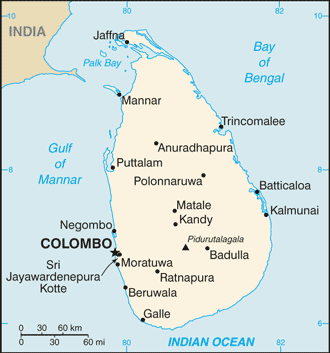
Unfortunately, less than a week after the Notre Dame fire, anti-Christian terrorists persecuted fellow brothers and sisters in Christ in three cities in Sri Lanka, the island nation to the south of India.  The death toll is somewhere between 138 and 207, with approximately 450 others injured.

Islamist extremists committed these attacks on hotels and Christian churches, an act all-the-more wicked for its symbolic timing.  As Christians flocked to worship the Resurrection of Christ Jesus, Muslim terrorists callously and opportunistically slaughtered them.

Sadly, these attacks are nothing new.  In the wake of the Notre Dame fire—which was probably an accident, but could have been the result of foul-play—some news outlets quietly began to point to the persistent attacks on French churches that have been going on since February.  Europe is particularly awash in shiftless, military-aged, unassimilated Muslim men, men easily radicalized into supporting and conducting these kinds of attacks.  A shocking percentage of “moderate” Muslims support or condone terrorist attacks as sometimes justified.

I’m not as familiar with the issues Asian Christians face with Islam, but there have been attacks in the Philippines, as well as attacks on Christians of all stripes in North Africa and the Middle East.

Christianity faces twin threats today:  the progressive Left and Islamism.  The former is a more subtle, but increasingly bold, threat, that seeks to destroy Western Civilization from within.  The latter is an external threat that is very upfront about its hatred for non-Muslims, but that also leverages the tolerance of Western societies to its advantage.  The Left and Islam are allies of convenience, despite their many incompatibilities.

My prayers go out to all Christians facing persecution, from the small-scale persecution of mockery to the very real persecutions of death and intimidation.  Christ promised us that, as Christians, the world would reject us, and persecution would be inevitable.  In the United States, especially in the religious South, we’ve been spoiled, and have grown complacent, to threats to our faith.  We should never forget the real men and women who gave their lives—and continue to risk them—to keep the faith.

Here’s hoping for some better news as the week progresses.  Deus Vult!

He is Risen!

Happy Easter to everyone!  Today’s post is another short one for this important holiday weekend (it also marks sixteen weeks of daily posts—shew!).

Jesus Christ died for our sins around 2000 years ago, and was resurrected three days later.  Today, Christians all over the world celebrate His death and resurrection, and eagerly await His eventual return.

According to Scott Rasmussen, 74% of Americans will celebrate Easter today, but only 40% of Americans will attend church (but, hey, that’s better than nothing).  He also writes that 67% of Americans believe Jesus Christ arose from the dead—one of the more heartening statistics I’ve read in awhile, considering Pat Buchanan’s recent piece about our declining public morality.

This Easter, I’m praying for national and spiritual renewal for America and the West.  Part of that is the need for revival across our nation.

Enjoy a day of fellowship and family.  And if you have time, check out my old “Lazy Sunday” compilation of pieces about Christianity.

Happy Easter!

–TPP

Reblog: The joke’s on him (Dalrock Post)

A quick post, re: this morning’s post on moral decline:  Dalrock posted this piece about a sleazy divorce attorney in Dallas pitching divorce as a way to clear up closet space.

Here’s the Tweet with the billboard:

This mentality is why we’re in moral free-fall.

Buttigieg and Buchanan: Redefining Morality

It’s Good Friday here in Christendom, and while it feels like Christianity took one on the chin earlier this week, we know there’s victory in Jesus.

Indeed, Christianity has been compromised quite a bit lately, with the rise of “feel-good” non-denominational churches and the decline of High Protestant denominations, both succumbing, in different ways, to social justice pabulum. Blogger Dalrock writes extensively about how “conservative” churches are snookered into radical acceptance of homosexuality (and extremist feminism) as somehow Christ-like. That goes beyond “love the sinner, not the sin,” which is correct; Dalrock writes about “same sex-attracted” preachers in prominent non-denominational churches arguing that their gayness makes them “holy.”

Political pundit, noted paleoconservative, and devout Catholic Pat Buchanan has a piece on Taki’s Magazine this week about Mayor Pete Buttigieg, the out-and-proud Democratic presidential hopeful who is making waves because he’s a.) deceptively normal but b.) also gay, which isn’t as glamorous for the Left as being transgender, but it’s still their alternative lifestyle of choice. Buchanan examines “Mayor Pete’s” assertion that God made him gay, so he’s supposed to live that lifestyle (despite some very specific New Testament injunctions against homosexuality; unless Mayor Pete is the Second Coming of Christ, he’s adding to God’s Word).

Ultimately, gayness isn’t the issue (it’s just one of many bludgeons the Left wields in a relentless culture war). The issue is a persistent redefining of morality, not to mention the moral arrogance of Leftists who believe they, not God, can redefine thousands of years of moral absolutes.

Permit me to quote Buchanan at length:

Consider what has changed already.

In the 19th century, blasphemy was a crime.

In the Roaring ’20s the “vices” of booze and gambling were outlawed. Now they are major sources of state revenue.

Divorce was a rarity. Now half of all marriages are dissolved.

After the sexual revolution of the ’60s, births out of wedlock rocketed to where 40 percent of all children are born without a father in the home, as are half of Hispanics and 70 percent of all black children.

Pornography, which used to bring a prison term, today dominates cable TV. Marijuana, once a social scourge, is the hot new product. And Sen. Kamala Harris wants prostitution legalized.

In the lifetime of many Americans, homosexuality and abortion were still scandalous crimes. They are now cherished constitutional rights.

Yet, Mayor Pete’s assertion — that God made him gay, and God intended that he live his life this way, and that this life is moral and good — is another milestone on the road to a new America.

For what Buttigieg is saying is that either God changes his moral law to conform to the changing behavior of mankind or that, for 2,000 years, Christian preaching and practice toward homosexuals has been bigoted, injurious and morally indefensible.

The decline of the family and Christianity, I believe, are twin evils that brought us to this point. The two go hand in hand: without strong families, moral instruction falls to the wayside (or is delegated to progressive educators and the system that supports them). Without Christianity, the foundation that makes strong family formation possible is missing (at least, family formation loses its metaphysical component).

To be clear, we should not persecute homosexuals, and should treat them with dignity and respect. That said, we should not indulge their petulant outbursts, much less their insistence that their lifestyle is not just normal, but somehow godly. Statistically and morally, neither of those claims are valid or borne out by history or Scripture.

We should love one another, acknowledging we are all sinners in need of Christ. That does not mean we have to condone or enable sin, in whatever form. Homosexuality is particularly difficult to address, but we could start by not openly celebrating it all the time, nor should we encourage people struggling with those proclivities to define their entire being around their sexual preferences. What a terrible foundation upon which to build your identity!

Enjoy this Good Friday, and pray for direction on how we can renew our nation and our relationship with God.