
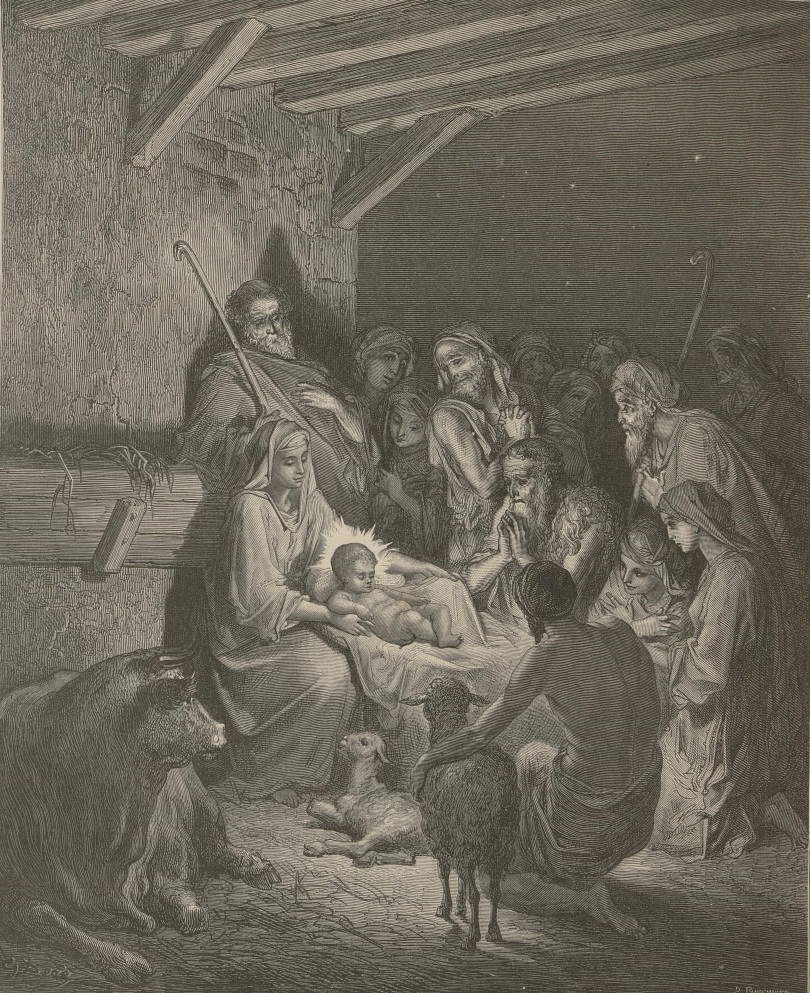
Away in a Manger

The political scene still strikes me as incredibly boring—a sad testament to how jaded our politics have become, that we don’t get more riled up about impeachment proceedings.  It’s also a testament to the perfidy and disingenuous of congressional Democrats:  everyone knows the articles of impeachment are a politically-motivated farce and, to use GEOTUS’s preferred name, a “witch hunt.”

It’s sad that President Trump will be impeached, and I’m nervous that squishy neocons and RINOs in the Senate will betray him.  That would be the ultimate kick in the teeth—the elites backhanding their own citizens for daring to challenge their aloof rule.  I shudder to contemplate the fall out should conviction and removal in the Senate occur.

Until then, it’s all a distracting media circus, with the Democrats and press engaged in a frenzied dance around the cannibal’s pot.  Even then, it manages to be incredibly dull.  At least actual cannibals have some conviction.

All that said, let’s look at more Christmas carols!  Next up:  “Away in a Manger.”
Read More »

Lazy Sunday XL: Christmas Carols

No, it’s not an “extra large” edition of Lazy Sunday, dear reader:  it’s the fortieth edition of this hallowed tradition.  That’s forty Sundays of thematic reflections, gazing back at the output of fifty weeks of consecutive daily posts.  Yep—today marks the 350th consecutive day of posts here at The Portly Politico.  We’re just fifteen days away from reaching the one-year mark.

Just as yesterday’s SubscribeStar Saturday post on “O Holy Night” (subscribe today for just $1 a month to read it and dozens of other pieces) should have come as no surprise to readers, this Lazy Sunday continues with that theme.  Indeed, we’re looking back at the posts this week (and from last December) about Christmas music:

  • ‘Silent Night’ turns 200” (and “TBT: ‘Silent Night’ turns 200“) – I wrote this post on Christmas 2018.  At the time, the world was celebrating the 200th anniversary of a sweet, simple Christmas carol, and one of my all-time favorites.
  • The Joy of Christmas Carols” – This piece is a reflection on the sheer joy of playing and singing Christmas carols.  Like traditional hymns, carols possess wonderful staying power, and they stick with you powerfully.  I’ve often caught myself singing “Joy to the World” (more below) in the middle of July.  They also beautifully and simply tell the story of Christ.
  • Joy to the World” – “Joy to the World” is somewhere in my Top 5 Favorite Christmas Carols (if such a list actually existed).  The Number One slot goes to our next entry, but “Joy” is up there, for sure.  In this post I analyze the simple but effective use of a descending D major scale to kick off the melody of a song that leaps and bounds across those eight notes, much like the soaring tones of the angels that appeared over Bethlehem that night some 2000 years ago.
  • SubscribeStar Saturday: O Holy Night” – I believe that, objectively, “O Holy Night” is the greatest Christmas song ever.  I used to say the “objectively” part as a joke—how can an opinion be objective reality?—but now I’ve come to believe it.  It’s powerful.  It’s operatic.  And for $1 a month, you can find out why.

That’s it!  We’re closing in on Christmas, rapidly.  Enjoy your Sunday, and Merry Christmas!

—TPP

Other Lazy Sunday Installments:

The Joy of Christmas Carols

Christmas puts me in a musical mood. For one, I’m somewhat contractually-obligated to put on a Christmas concert, which will consume most of my free time this week, so I’d better embrace the Christmas spirit—or else. But it’s not hard to get excited about the iconic music of the season.

(Also, Milo Yiannopoulos—the actual Milo—shared my post about his views on Romantic music, which helped make it the most trafficked post of the year so far. That was incredibly gracious of him to do, and it’s further boosted my excitement for playing and writing about music.)

As I wrote in an earlier blog post on hymnals, I’ve gradually taken over piano playing at my little Free Will Baptist church. We sing many of the traditional hymns that were written and popularized in the nineteenth and twentieth centuries, as well as some earlier selections. Shape-note hymns are often hard to play, with big intervalic leaps in the melodies and surprisingly complex harmonies.

Take that melodic variety and harmonic complexity and multiply it by a factor of ten, and you’ve got Christmas carols.

Read More »