The Joy of Autumn

It was a hot and muggy Halloween here in South Carolina (with tornado warnings mid-trick-or-treating!), but my complaints about the season’s distinct lack of autumnality must have worked:  we’ve had a crisp, cold week.  Indeed, in true South Carolina fashion, we’ve largely skipped autumn and have headed directly to winter (of course, don’t be surprised if it’s 80 degrees on Thanksgiving Day).

I’m getting excited for Thanksgiving.  It’s been busy at work lately, and the natives are restless.  Teachers know when students need a break—there’s a weirdness to the atmosphere, and you can almost feel the kids clawing at the walls.  As a Leftie British colleague of mine once quipped, “You Americans think it’s a good idea to have eighteen weeks of school without a break.”  Usually I’m not one for foreign interlopers critiquing our awesome country, but even a progressive Briton is right now and then.

Mainly, though, I’m excited for some downtime with the family, with lots of filling food and cold, crisp days.  Sweater weather, as the vapid co-eds call it, has arrived, and I welcome it happily.  Like the vapid co-eds, I like all the pumpkin spice stuff, too.

Read More »

TBT: Nehemiah and National Renewal

In keeping with the unofficially churchy theme of two of this week’s posts (here and here), it seemed like a good opportunity to look back at a post from February about Nehemiah.  In “Nehemiah and National Renewal,” I explored the impact of Nehemiah’s faithful reconstruction of Jerusalem’s collapsed wall in terms of the national renewal it brought (and the spiritual renewal that came with it in a follow-up post):

This past Wednesday, I was asked to fill in for the pastor at the small church I attend.  Being such a small church—our average Sunday morning attendance is about forty—the pastor works another job, and he had a rare business trip.  I suppose he figured he could do worse than asking a high school history teacher to fill in for him.

Fortunately, the lesson was fairly straightforward:  he sent me a handout on Nehemiah 1:1-11, and the focus of the lesson was on the idea of spiritual renewal.

For the biblically illiterate—a shocking number of Americans today, I’m finding (I once had a class full of philosophy students who had never heard the story of the Tower of Babel, which is pretty much Sunday School 101)—the story of Nehemiah is simple:  after an extended period of exile in Babylon, the Israelites were sent back, under the auspices of the Persian Emperor Cyrus the Great, to Jerusalem.  Cyrus sponsored the rebuilding of the Temple in Jerusalem, but the city itself, as well as its walls, remained in a state of disrepair.

There were two waves of Israelite resettlement over the span of a century, but many Israelites remained in Babylon or other parts of the Persian Empire, such as the imperial capital.  Nehemiah was one of those, and would be part of a third wave of resettlement.  He served as cup-bearer to Artaxerxes, the Persian emperor at the time.  The position of cup-bearer was an important and trusted one:  he handled the emperor’s food and drink, ensuring it was not poisoned.

Beyond serving as the royal taste tester, the office carried with it important administrative duties, and gave incredible access to the emperor.  In short, it was a position of great influence, power, and prestige, which positioned Nehemiah nicely for what was to come.

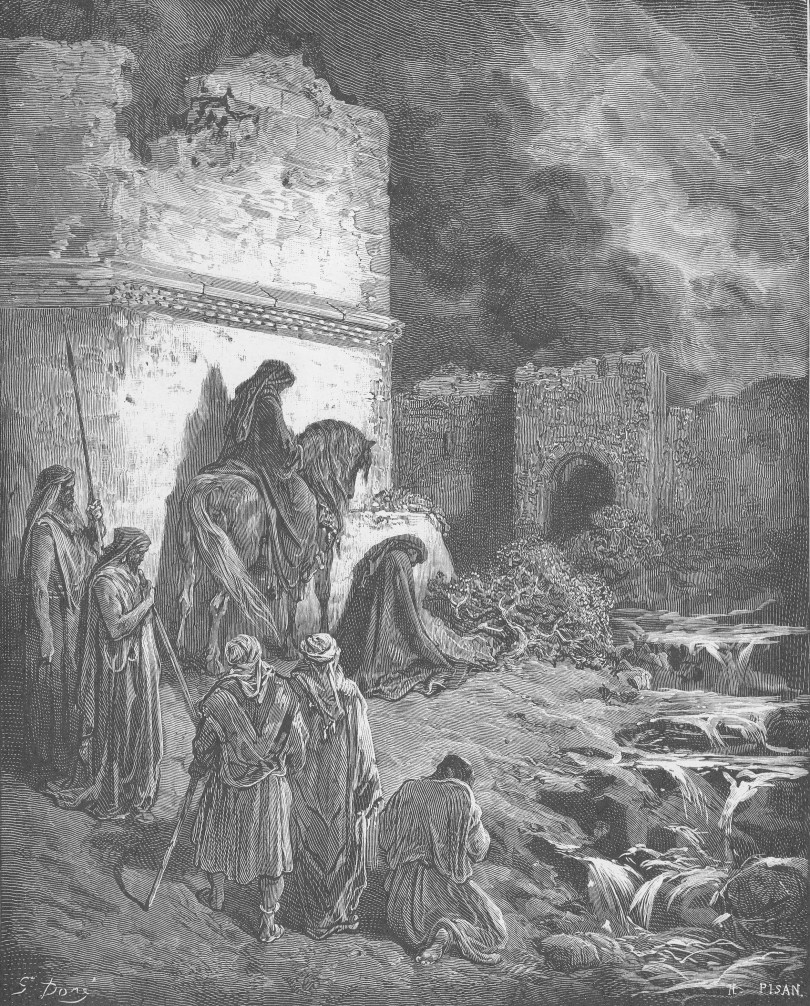
Nehemiah spoke to a fellow Israelite who was visiting the imperial capital, and was distraught to hear of the poor condition of the city and its walls.  He fell to his knees, weeping and crying out to the Lord.  Nehemiah 1 details his prayer to God, calling out in adoration; confessing his and his people’s sins; thanking God for His mercy and gifts; and supplicating God for His Will to be accomplished through Nehemiah.

Specifically, Nehemiah asked God to be used to rebuild the wall around Jerusalem.  As cup-bearer, Nehemiah was able to present his petition to the emperor, who agreed to send Nehemiah to oversee the construction project.  In addition, Artaxerxes provided lumber from the royal forest, as well as funds to bankroll the endeavor.  He also sent letters with Nehemiah detailing his endorsement of the project.

Nehemiah’s work was not finished there, and it was anything but easy.  Initially, surrounding tribes criticized and mocked Nehemiah, questioning his loyalty to Artaxerxes, and saying that rebuilding the walls was a silly waste of time and effort.

However, once the wall reached half its height, his critics began plotting violence.  The plot to attack the workers reached Nehemiah, so he divided the work crews into those building the wall, and those defending their fellow workers from attack.

Having failed to stage an attack on the workers, Nehemiah’s enemies realized that the man himself was the target—cut off the head, kill the snake.  Again, God revealed this plot against Nehemiah, and he was able to avoid assassination.

Finally, the wall was rebuilt in an astonishing fifty-two days, an incredible feat of organization, ingenuity, and faithfulness.  The naysayers were humiliated, and Nehemiah instituted a period of national and spiritual renewal among the Israelites.  His reforms purified the nation spiritually and even ethnically, as old debts were forgiven and marriages to pagan women were dissolved.

It’s a powerful story—indeed, a powerful bit of history—about trusting in God in the face of extremely difficult odds.  But Nehemiah is also a story about national renewal, and the spiritual revival that came with it.

The wall around Jerusalem served a practical purpose—defending the city and its inhabitants from attack (even though the city was under the protection of the Persian Empire, the ancient Near East was, then as now, notoriously tribal, and the collapse of an empire would lead to dozens of ethnic conflicts)—but it was also a symbol of the Israelite nation.

Indeed, the author of the handout I used Wednesday evening writes that the “enemies of Israel could say, ‘What kind of God do you serve?  Look at the mess of your Holy City?’ It was a terrible witness and was cause for reproach from non-believers.”  The poor condition of the Jerusalem and its fortifications reflected the spiritual decay and corruption of the Israelites—they had intermarried with pagan women, adopting their false gods; they were living in rubble; and their reduced condition suggested that their God—the One True God—was not Who He made Himself out to Be.

It’s a bit on the nose, but I can’t help but recognize the parallels between the United States today and Jerusalem then—and between President Trump and Nehemiah (although I think Trump is closer to Cyrus the Great in terms of his spirituality and outlook).

I’m not suggesting Nehemiah was clubbing with Eastern European supermodels.  But like Trump, he faced overwhelming resistance from other nations to his wall project.  The rest of the ancient Near East feared a strong, renewed Israel.  Nehemiah’s return to Jerusalem, and the reconstruction of the wall, led to a period of national revival, as the people regained their identity, expelled the corrosive foreign influence in their midst, and renewed their commitment to God.

America is, spiritually and culturally, in similarly dire straits today.  President Trump has presented himself as a modern-day Nehemiah, come to control our borders, enforce our immigration laws, and restore America’s greatness on the world stage.  While he has made great strides in these areas, he meets resistance, duplicity, and mockery at every turn.

The story of Nehemiah tells us, however, that the struggle is worth the slings and arrows our enemies, both foreign and domestic, will lob at us.  To President Trump, I would urge the following:  stay the course, ignore the haters, take it to God, and BUILD THE WALL!

101 Postmatians – 101st Consecutive Daily Post!

Perhaps it’s a bit odd to celebrate grinding diligence, but I’m proud of myself.  Yesterday’s post on model bills (a bit of a snoozer of a topic, I’ll admit) marked the 100th consecutive daily post on this blog.

I realized in late December 2018/early January 2019 that WordPress tracks streaks once you hit three consecutive days of posting, so I decided to see how long I could keep the momentum going.  Initially, I was just going to try to get through January.  It’s a slow month in the academic year, a rare moment when I have a sliver of extra time to devote to extracurricular hobbies, like music.

Of course, the more I wrote, the easier it became to churn out posts on any number of topics.  Pretty soon, I’d gotten to fifty posts.  Despite Internet outages (within weeks of each other, both times because a Frontier technician incorrectly disconnected my line), I was able to get some posts up (even if they weren’t of the best quality).

So, to celebrate, I thought I’d take today “off” with a classic retrospective (which I already do once or twice a week with “TBT Thursdays” and “Lazy Sundays“)—a written “clip show,” if you will, of The Streak ’19’s Top Five Posts (so far).

The following are the five posts with the most views as of the time of this writing, presented in descending order (most views to fewest):

1.) “Hump Day Hoax” – it seems these local stories do well (my piece on the fight at the Lamar Egg Scramble has turned up in quite a few searches; I’m still trying to find more details about it).  This piece was about the Mayor of Lamar’s claim that her car was vandalized in a racially-motivated attack, and she expressed relief that the vandal didn’t try to kill her and her husband.  When the Darlington County Sheriff’s deputy came out to investigate, he discovered the mysterious yellow substance was pollen!  That didn’t prevent it from making national news, getting a mention in Newsweek.

At first, I thought our mayor was just trying to get some cheap PR and sympathy for herself, but after discussing it with some other folks, the consensus seems to be that she suffered from stupidity, filtered through a conspiratorial, black victim mentality.  Rather than see the sticky substance for what it was—the ubiquitous pollen that covers our fair Dixie—the mayor’s first thought was a racist attack.

That’s a sad way to live.  As I wrote in this piece, the mayor is a sweet lady, and I think she really wants to do her best to help our little town.  That said, this kind of ignorant hysteria doesn’t help anyone or anything, much less race relations.

2.) “Secession Saturday” – boy, this post generated some views.  The focus of this post was a piece from American Greatness, “The Left Won’t Allow a Peaceful Separation,” by Christopher Roach.  It explores whether or not some kind of peaceful parting of ways between America’s two cultures—traditionalists and progressives—is desirable, and revisits questions the American Civil War resolved—at least for a time—with force of arms (“do States have the right to secede?,” for example).

A panicked former student texted me in anguish, worrying about a Civil War II, after seeing this post on Facebook.  I tried to allay her fears.  But the real point of my commentary was on the idea that the Left is fundamentally totalitarian, and will broach no disagreements.  That’s a key insight Roach and others make, and it’s why I reference back to his piece so frequently.

Of course, it also helped that I linked to this guy in the comments of a more successful blog.

3.-4.) “Nehemiah and National Renewal” & “Nehemiah Follow-Up” – these two posts came amid a week in which I found myself immersed in the Book of Nehemiah (one of my favorites in the Old Testament, as he builds a wall to renew his nation).  The initial post sparked some great feedback from Ms. Bette Cox, a fellow blogger (who, incidentally, preceded me in my soon-to-be-vacated position as the Florence County [SC] GOP Secretary).  She astutely pointed out that my first post missed a key point:  in Nehemiah 1, the prophet falls to his knees and asks for God’s Will.

5.) “Tucker Carlson’s Diagnosis” – one of the posts from the early days of The Streak ’19, it was also a rare video post from me.  I’ll occasionally embed YouTube videos in my posts, but I tend to avoid writing posts that say, “hey, watch this lengthy video.”

Nothing bugs me more than when I’m out somewhere, having a conversation, and someone thrusts a phone in my face with a YouTube video.  I’ve actually told my friends that if they do this, I will refuse to watch it.  It’s not that I don’t want to share the joke with you; it’s that you’re making me watch a video on a cellphone!  C’mon.  I can barely hear the dialogue (or song, or whatever) on your tinny, bass-less phone speaker.  Furthermore, can’t we have a conversation without resorting to SNL clips?

But I digress.  I made an exception for Tucker Carlson’s powerful monologue about our frigid, uncaring elites.  I’ve definitely jumped on the Carlson populist-nationalist train, and I think he makes a compelling case for preserving—or, at least not actively destroying—small towns and the families they nurture.

So, there you have it—a lengthier-than-planned reheating of my posts during The Streak ’19.

Thanks for all of your love and support.  Here’s to another 100 posts!

–TPP

Nehemiah and National Renewal

This past Wednesday, I was asked to fill in for the pastor at the small church I attend.  Being such a small church—our average Sunday morning attendance is about forty—the pastor works another job, and he had a rare business trip.  I suppose he figured he could do worse than asking a high school history teacher to fill in for him.

Fortunately, the lesson was fairly straightforward:  he sent me a handout on Nehemiah 1:1-11, and the focus of the lesson was on the idea of spiritual renewal.

For the biblically illiterate—a shocking number of Americans today, I’m finding (I once had a class full of philosophy students who had never heard the story of the Tower of Babel, which is pretty much Sunday School 101)—the story of Nehemiah is simple:  after an extended period of exile in Babylon, the Israelites were sent back, under the auspices of the Persian Emperor Cyrus the Great, to Jerusalem.  Cyrus sponsored the rebuilding of the Temple in Jerusalem, but the city itself, as well as its walls, remained in a state of disrepair.

There were two waves of Israelite resettlement over the span of a century, but many Israelites remained in Babylon or other parts of the Persian Empire, such as the imperial capital.  Nehemiah was one of those, and would be part of a third wave of resettlement.  He served as cup-bearer to Artaxerxes, the Persian emperor at the time.  The position of cup-bearer was an important and trusted one:  he handled the emperor’s food and drink, ensuring it was not poisoned.

Beyond serving as the royal taste tester, the office carried with it important administrative duties, and gave incredible access to the emperor.  In short, it was a position of great influence, power, and prestige, which positioned Nehemiah nicely for what was to come.

Nehemiah spoke to a fellow Israelite who was visiting the imperial capital, and was distraught to hear of the poor condition of the city and its walls.  He fell to his knees, weeping and crying out to the Lord.  Nehemiah 1 details his prayer to God, calling out in adoration; confessing his and his people’s sins; thanking God for His mercy and gifts; and supplicating God for His Will to be accomplished through Nehemiah.

Specifically, Nehemiah asked God to be used to rebuild the wall around Jerusalem.  As cup-bearer, Nehemiah was able to present his petition to the emperor, who agreed to send Nehemiah to oversee the construction project.  In addition, Artaxerxes provided lumber from the royal forest, as well as funds to bankroll the endeavor.  He also sent letters with Nehemiah detailing his endorsement of the project.

Nehemiah’s work was not finished there, and it was anything but easy.  Initially, surrounding tribes criticized and mocked Nehemiah, questioning his loyalty to Artaxerxes, and saying that rebuilding the walls was a silly waste of time and effort.

However, once the wall reached half its height, his critics began plotting violence.  The plot to attack the workers reached Nehemiah, so he divided the work crews into those building the wall, and those defending their fellow workers from attack.

Having failed to stage an attack on the workers, Nehemiah’s enemies realized that the man himself was the target—cut off the head, kill the snake.  Again, God revealed this plot against Nehemiah, and he was able to avoid assassination.

Finally, the wall was rebuilt in an astonishing fifty-two days, an incredible feat of organization, ingenuity, and faithfulness.  The naysayers were humiliated, and Nehemiah instituted a period of national and spiritual renewal among the Israelites.  His reforms purified the nation spiritually and even ethnically, as old debts were forgiven and marriages to pagan women were dissolved.

It’s a powerful story—indeed, a powerful bit of history—about trusting in God in the face of extremely difficult odds.  But Nehemiah is also a story about national renewal, and the spiritual revival that came with it.

The wall around Jerusalem served a practical purpose—defending the city and its inhabitants from attack (even though the city was under the protection of the Persian Empire, the ancient Near East was, then as now, notoriously tribal, and the collapse of an empire would lead to dozens of ethnic conflicts)—but it was also a symbol of the Israelite nation.

Indeed, the author of the handout I used Wednesday evening writes that the “enemies of Israel could say, ‘What kind of God do you serve?  Look at the mess of your Holy City?’ It was a terrible witness and was cause for reproach from non-believers.”  The poor condition of the Jerusalem and its fortifications reflected the spiritual decay and corruption of the Israelites—they had intermarried with pagan women, adopting their false gods; they were living in rubble; and their reduced condition suggested that their God—the One True God—was not Who He made Himself out to Be.

It’s a bit on the nose, but I can’t help but recognize the parallels between the United States today and Jerusalem then—and between President Trump and Nehemiah (although I think Trump is closer to Cyrus the Great in terms of his spirituality and outlook).

I’m not suggesting Nehemiah was clubbing with Eastern European supermodels.  But like Trump, he faced overwhelming resistance from other nations to his wall project.  The rest of the ancient Near East feared a strong, renewed Israel.  Nehemiah’s return to Jerusalem, and the reconstruction of the wall, led to a period of national revival, as the people regained their identity, expelled the corrosive foreign influence in their midst, and renewed their commitment to God.

America is, spiritually and culturally, in similarly dire straits today.  President Trump has presented himself as a modern-day Nehemiah, come to control our borders, enforce our immigration laws, and restore America’s greatness on the world stage.  While he has made great strides in these areas, he meets resistance, duplicity, and mockery at every turn.

The story of Nehemiah tells us, however, that the struggle is worth the slings and arrows our enemies, both foreign and domestic, will lob at us.  To President Trump, I would urge the following:  stay the course, ignore the haters, take it to God, and BUILD THE WALL!