Richard Weaver in the Age of The Virus

In the Age of The Virus, we’re beginning to reevaluate the way we live.  I’ve written quite a bit about distance learning, and photog has a piece up on his blog predicting a larger shift to remote work.  That transition would threaten micromanaging middle managers everywhere, though, and one doesn’t become a micromanaging middle manager without a knack of occupational self-preservation.

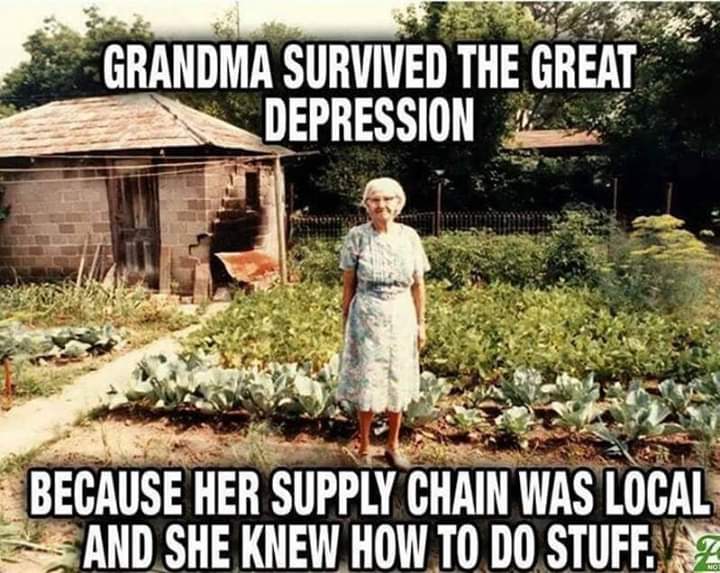
I’ve also been interested in the potential cultural impact.  Already there seems to be a minor revival in interest in gardening.  Part of that is prudent:  we need to have some food to fall back on should the supply chains face further disruption.

But I also suspect some of it is spiritual.  Modern man has become divorced from his roots in the soil—in Creation.  Modernity has liberated us from the constant fear of want, but that liberation came with a price:  we traded the liberty of the soil for the chains of comfort.  Growing a little vegetable garden, however meager, is a way to reconnect with the land, and with the beauty of God’s Creation.

Read More »

Lazy Sunday LIV: Coronavirus

It was inevitable—a Lazy Sunday dedicated to the coronavirus.  This may end up being a “Part I,” depending on what happens over the next few weeks, but I’m planning on shifting away from corona talk for awhile.  There are bigger and better things in life than a Chinese biological weapon and/or Chinese culinary disaster-turned-virus.

I’ve been trying to make the most of a generally bad situation.  It’s springtime in South Carolina, so for about two weeks, we’ll enjoy pleasantly mild weather before the oppressive heat of summer hits.  Z Man has an excellent, optimistic post up today about “Springtime In The Pandemic“; it’s a must-read, and follows some of my own ideas about the possible cultural consequences of everyone being at home and resuming more traditional roles.

So this Lazy Sunday, it’s time to look back at my various posts on the dreaded virus:

  • Phone it in Friday VIII: Coronavirus Conundrum” & “Phone it in Friday IX: Coronavirus Conundrum, Part II: Attack of the Virus” – What a difference a week makes!  Between these two posts, I went from writing off the coronavirus as a bad strain of flu to being much more concerned.  Even since the second installment here, though, I’ve come to reassess the situation again. How much of this shutdown is necessary to stem the spread of the virus, and how much of it is the result of panicked media reporting?  I think it’s possible it’s a threat and the threat is overblown.  We’ll see next week, when this fifteen-day experiment in social isolation has run its course—or gets renewed.
  • SubscribeStar Saturday: Coronavirus Prepping” – When I wrote this post on 7 March 2020, I still thought the coronavirus’s threat was remote, but I was concerned about the disruption to supply chains.  I detailed my steps for preparing for the possibility of quarantines and/or shortages.  Fortunately, it seems that now grocers are catching up, and unless you’re looking for toilet paper, you can largely find what you need.
  • High-Tech Agrarianism” – This essay explored an idea I’ve been kicking around for awhile, but that takes on new urgency in the Age of Corona:  what if we combined small-scale agriculture with high technology?  Using our lawns to grow grass seems like a waste of the land and of the effort to maintain it.  What if we applied the effort of mowing and weeding to growing easy-to-maintain crops?  In our normal lives, people don’t have the time, but as we’re shifting more to telecommuting and distance learning, it seems like we’d all be able to spend a bit more time in the garden.
  • The Revival of Traditionalism?” – In line with the previous post, this piece explored the social and cultural impact of the coronavirus on gender roles.  It was vindicating to see one of the greats write on a similar topic this morning.  The upshot to this whole forced shutdown is that we’re really reevaluating what truly matters in life, as I opined about at length above.

Well, that does it for now.  Stay safe, wash your hands, and God Bless!

—TPP

Other Lazy Sunday Installments:

High-Tech Agrarianism

The coronavirus situation—which I am convinced is both quite serious, but also inspiring some huge overreactions—has created a world that feels almost entirely different than it did even a few days ago.  This time last week, I was convinced that the whole thing was way overblown, and that life would largely continue apace, minus some school closures here and there.

By Friday evening I was growing more concerned, as everything began to get closed or cancelled.  I proctored the SAT Saturday morning and even went out of town that evening.  At that point, I thought the risk of my school closing was greater than it had been even two or three days before, but I still figured it was a relatively remote possibility.

Then Governor McMaster announced the closure of all South Carolina public schools (I teach at a private school, but we always follow gubernatorial closures)—and a bunch of other stuff shut down.  I picked up dinner at a Hardee’s in Florence, South Carolina Monday evening after a guitar lesson, and it was surreal—everything was gone from the front, and the cashier had to give me a lid and straw according to their new cleanliness guidelines.

(Let’s take a moment to thank all those service industry folks and long-distance truckers who are continuing to work and risking exposure; they are unsung heroes.  Also, spare a thought to people in those industries that are out-of-work at the moment.  They need our love and charity now more than ever.)

That’s all to say that, in a remarkably short period of time, the United States has undergone a major paradigm shift.  The world of Saturday, 14 March 2020 at 2 PM—when I emerged from the cocoon of extended time SAT testing—was a different than the world of Wednesday, 18 March 2020 at 9 PM (when I’m writing this very belated blog post).

One trend—that I think will be positive if it endures—is the implicit rejection of globalism.  People are suddenly awakening, dramatically, to the manifold downsides of open borders and excessive global economic integration.  Suddenly, localism is back in vogue.

Read More »