
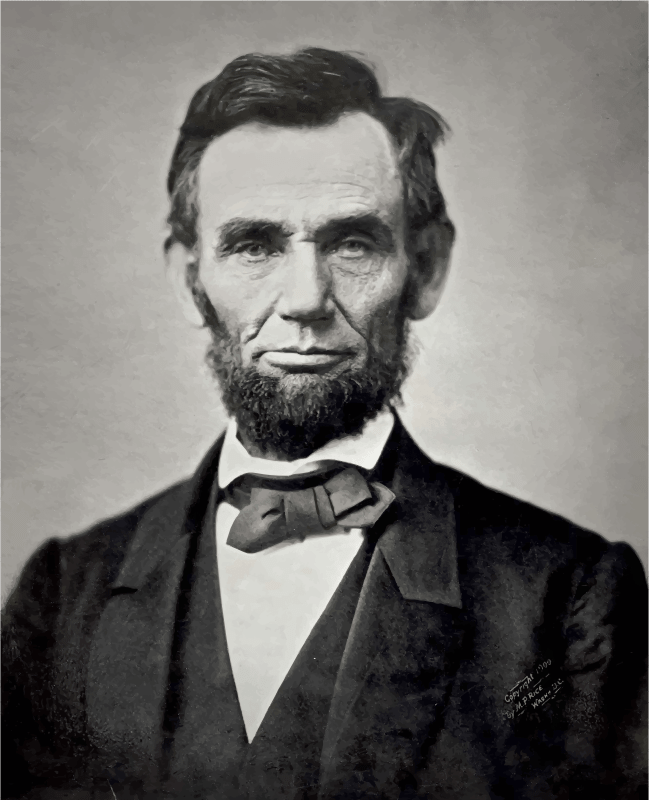
Lincoln’s Favorability

One of Scott Rasmussen’s recent Number of the Day entries for Ballotpedia deals with the Abraham Lincoln’s current high favorability ratings:  90% of Americans have a favorable view of the Great Emancipator.  88% have a favorable view of our first president, George Washington.

That was certainly not the case when Lincoln was president.  He was an unlikely figure when he first took office, and many in his own party—the young Republican Party—doubted his ability to see the United States through the American Civil War.

It’s easy to forget—or even to imagine—that Lincoln believed he would not win re-election in 1864.  Thus, he picked Andrew Johnson, a pro-Union, pro-slavery Democrat from Tennessee, as his running mate.  (Of course, Lincoln never dreamed his symbolic gesture of political goodwill and unity would lead to an unqualified boor becoming president.)  Regardless, the fall of Atlanta and subsequent Union victories boosted Lincoln at the polls, securing his reelection (he was touched to find that soldiers overwhelming supported their Commander-in-Chief).

Blogger SheafferHistorianAZ at Practically Historical posted a piece recently entitled, “Finest Two Minutes,” about Lincoln’s delivery of the Gettysburg Address.  That speech is, indeed, one of the most moving and powerful political speeches in the English language, and it’s less than 300 words.

What caught my eye was this quotation:

The Chicago Times recorded, “The cheek of every American must tingle with shame as he reads the silly, flat and dishwatery utterances of the man who has to be pointed out to intelligent foreigners as the President of the United States.”

It’s instructive to remember that, while history views Lincoln fondly (SheafferHistorianAZ rates him as a “Great”-level president), he was not universally beloved at his time, and only won in 1860 because the race was split four ways:  there were two Democratic candidates (Northern and Southern), the Republican (Lincoln), and John Bell of the Constitutional Union Party.  Lincoln did not even appear on the ballot in many Southern States.  Lincoln had to earn his greatness, and much of it came with posterity.

Similarly, President Reagan was not universally beloved in his own party when he was elected in 1980.  The parallels to our current president, Donald Trump, and his own struggles with his adopted party are striking.

The lesson seems to be to aim for greatness, regardless of contemporary naysayers.  Few Americans remember George McClellan, but everyone remembers the Great Emancipator.

Lincoln on Education

The following is adapted from remarks to the Florence County (SC) Republican Party on the evening of 10 September 2018.  The monthly program featured members of and candidates for the local school board, so I spoke briefly about President Abraham Lincoln’s education, and his views thereof.

We’re gathered here tonight to hear from members of and candidates for School Board; in that spirit, I’d like to speak briefly about education, particularly the education of the first Republican President, Abraham Lincoln.

From what I’ve read, Lincoln’s entire formal education consisted of around a year of schooling.  He would have a week or two here and there throughout his childhood in Kentucky and Indiana, and then return to working on the family’s farm.

Despite little formal education, Lincoln taught himself throughout his life.  He loved to read, and would read deeply on a variety of subjects, obtaining books whenever and wherever he could.  One of his contemporaries commented that “I never saw Abe after he was twelve that he didn’t have a book in his hand or in his pocket. It didn’t seem natural to see a feller read like that.”  When he sat for the bar exam, he’d read law books on his own time to prepare.

Lincoln also believed in education as a source of patriotism, morality, and self-improvement—what we might call “upward mobility.”  He was not a man who wanted to stay on the farm, and his self-education was a means to escape poverty.

If you’ll indulge me, I’d like to quote Lincoln at length from his 1832 speech “To the People of Sangamo County”:

“Upon the subject of education, not presuming to dictate any plan or system respecting it, I can only say that I view it as the most important subject which we as a people can be engaged in. That every man may receive at least, a moderate education, and thereby be enabled to read the histories of his own and other countries, by which he may duly appreciate the value of our free institutions, appears to be an object of vital importance, even on this account alone, to say nothing of the advantages and satisfaction to be derived from all being able to read the scriptures and other works, both of a religious and moral nature, for themselves. For my part, I desire to see the time when education, and by its means, morality, sobriety, enterprise and industry, shall become much more general than at present, and should be gratified to have it in my power to contribute something to the advancement of any measure which might have a tendency to accelerate the happy period.”

Here we can see Lincoln’s belief that education lays the foundation for patriotism—we understand our freedoms better when we understood what they cost, and that others lack them.  We see, too, the power of education to teach us the virtuous and the good.  From that morality flows, as Lincoln said, “sobriety, enterprise, and industry,” the tripartite tools to improve our material conditions.

Patriotism, morality, and industry—these were the three benefits of education Lincoln espoused.  Coming from the man who wrote the Gettysburg Address, I think we should take Lincoln’s views on education seriously.

Historical Moment – The Formation of the Republican Party

I’ve missed two days—this past Friday and yesterday—due to back-to-school insanity, coupled with returning to my flood-prone abode (and celebrating my niece’s third birthday).  School starts back Wednesday, and some online courses I teach at a local technical college launched yesterday, so I may be adopting a new posting schedule soon—probably one or two pieces a week, or some shorter posts.  Stay tuned.

In the meantime, here is a transcript of remarks I gave to the Florence County Republican Party last night.  Our guest speaker for our monthly program was South Carolina Republican Party Chairman Drew McKissick, a man with a genius for grassroots organizing.  As such, I decided to talk about the formation of the Republican Party back in 1854.  Enjoy!  –TPP

There is some disagreement about exactly when and where the Republican Party first originated.  The national GOP website says the Party came into being in Jackson, Michigan, on 6 July 1854.  The anti-slavery convention, also called the “Under the Oaks” convention because the conventioneers met in an oak grove, nominated statewide candidates, and their Convention Platform read, “we will cooperate and be known as REPUBLICANS.”

The South Carolina GOP website, on the other hand, points to a meeting in Ripon, Wisconsin, earlier in 1854, where a group of abolitionists met to fight the expansion of slavery, although it also mentions the Jackson, Michigan convention was when the Party was “formally organized.”  Two years later, Philadelphia hosted the first Republican National Convention, which nominated John C. Fremont as the first Republican candidate for President.

Regardless of where the GOP formally began, the climate for its formation was eerily similar to our own political situation.  The “peculiar institution” of slavery bitterly divided the country.  The Kansas-Nebraska Act of 1854, the brainchild of Democratic Senator Stephen Douglas of Illinois, proposed applying “popular sovereignty” to western territories; essentially, territories would decide whether to allow slavery, or remain “free soil.”

That Act embroiled Kansas in a bloody guerrilla war between pro-slavery “Fire-Eaters” and radical abolitionists, the latter of whom sent “Beecher’s Bibles”—rifles—to free soilers attempting to keep the territory free.  In 1856, John Brown, the deranged abolitionist, and his sons massacred pro-slavery advocates with swords in the Pottawatomie Massacre, a retaliation for an earlier attack on the abolitionists.

The old Whig Party, originally organized in protest over the policies Democratic President Andrew Jackson, collapsed over the issue of slavery and “popular sovereignty.”  The conditions were ripe for a new party to emerge, one dedicated to “Free Soil, Free Labor, and Free Men” (not quite as catchy as “Make America Great Again,” but it explained the Republican Party’s platform succinctly).

Over the course of the 1850s, the young Republican Party spread rapidly throughout Northern States, bringing together abolitionists, anti-slavery Democrats, and other constituencies disillusioned with the Democratic Party’s policies on slavery and the economy.  The Republican Party from its inception opposed the expansion, if not always the outright abolition, of slavery, and hoped to keep it out of any new territories.  Southern Democrats so feared a Republican victory, they threatened to secede from the Union should a Republican President be elected.

Of course, Abraham Lincoln became the first Republican elected in a four-way race in 1860—the Democratic Party split into Northern and Southern wings, while the Constitutional Union Party gained votes in the Upper South and Appalachia—and South Carolina seceded in December 1860.

Our first President was a good one, though, and the Republican Party has endured ever since, continuing to fight for the unborn, the working man and woman, and the values that make our country great.

TBT: Happy Birthday, America!

Two years ago, I dedicated my Fourth of July post to analyzing Lincoln’s Gettysburg Address.  In the spirit of MAGA Week 2018—and to preserve the TPP TBT tradition—I’m re-posting that classic post today.

A major theme of the blog posts from that summer was the idea of America as a nation, an idea I still find endlessly compelling.  The election of President Trump in November 2016 has reinvigorated public debates about the nature of American nationalism, as well as revived, at least partially, a spirit of unabashed patriotism.

As a child, I took it for granted that America was a special place.  When I learned American history as a child, I learned the heroic tales of our Founders.  While revisionist historians certainly have been correct in pointing out the faults of some of these men, I believe it is entirely appropriate to teach children—who are incapable of understanding such nuance—a positive, patriotic view of American history.  We shouldn’t lie to them, but there’s nothing wrong with educating them that, despite its flaws, America is pretty great.

Today the United States of America celebrates 240 years of liberty.  240 years ago, Americans boldly banded together to create the greatest nation ever brought forth on this earth.

They did so at the height of their mother country’s dominance.  Great Britain emerged from the French and Indian War in 1763 as the preeminent global power.  Americans had fought in the war, which was international in scope but fought primarily in British North America.  After Britain’s stunning, come-from-behind victory, Americans never felt prouder to be English.

Thirteen short years later, Americans made the unprecedented move to declare their independence.  Then, only twenty years after the Treaty of Paris of 1763 that ended the French and Indian War, another Treaty of Paris (1783) officially ended the American Revolution, extending formal diplomatic recognition to the young United States.  The rapidity of this world-historic shift reflects the deep respect for liberty and the rule of law that beat in the breasts of Americans throughout the original thirteen colonies.

America is founded on ideas, spelled out in the Declaration of Independence and given institutional form and legal protection by the Constitution.  Values–not specific ethnicity–would come to form a new, distinctly American nationalism, one that has created enduring freedom.

***

Rather than rehash these ideas, however, I’d instead like to treat you to the greatest political speech ever given in the English language.  It’s all the more remarkable because it continues to inspire even when read silently.  I’m writing, of course, about Abraham Lincoln’s Gettysburg Address.  Here is the transcript (Source:  http://www.gettysburg.com/bog/address.htm):
“Four score and seven years ago, our fathers brought forth on this continent a new nation: conceived in liberty, and dedicated to the proposition that all men are created equal.

“Now we are engaged in a great civil war. . .testing whether that nation, or any nation so conceived and so dedicated. . . can long endure. We are met on a great battlefield of that war.

“We have come to dedicate a portion of that field as a final resting place for those who here gave their lives that that nation might live. It is altogether fitting and proper that we should do this.

“But, in a larger sense, we cannot dedicate. . .we cannot consecrate. . . we cannot hallow this ground. The brave men, living and dead, who struggled here have consecrated it, far above our poor power to add or detract. The world will little note, nor long remember, what we say here, but it can never forget what they did here. It is for us the living, rather, to be dedicated here to the unfinished work which they who fought here have thus far so nobly advanced.

“It is rather for us to be here dedicated to the great task remaining before us. . .that from these honored dead we take increased devotion to that cause for which they gave the last full measure of devotion. . . that we here highly resolve that these dead shall not have died in vain. . . that this nation, under God, shall have a new birth of freedom. . . and that government of the people. . .by the people. . .for the people. . . shall not perish from the earth. “

 ***
The Gettysburg Address is elegant in its simplicity.  At less than 300 words, it was a remarkably short speech for the time (political and commemorative speeches often ran to two or three hours).  Yet its power is undiminished all these years later.  President Lincoln was only wrong about one thing:  the claim that the “world will little note, nor long remember, what we say here” has proven untrue.
I will likely write a deeper analysis of the Address in November to commemorate its delivery; in the meantime, I ask you to read and reread the speech, and to reflect on its timeless truths.
God Bless America!
–TPP
To read different versions of the Gettysburg Address–there are several versions extant–check out this excellent page from Abraham Lincoln Online:  http://www.abrahamlincolnonline.org/lincoln/speeches/gettysburg.htm.