The Revival of Traditionalism?

Milo Yiannopoulos posted a screen shot yesterday of an essay from The Atlantic reading “How the Coronavirus Will Send Us Back to the 1950s” (the piece, by Helen Lewis, is now called “The Coronavirus Is a Disaster for Feminism“—a silver lining to this pandemic, I suppose).  His caption reads, “HOLY SH[*]T YES PLEASE[.]”

The Lewis piece is the usual feminist hand-wringing about the disparate impact of the coronavirus on women.  Feminists always find a way to make global catastrophes about them, and not about everyone who is truly suffering.  The attitude seems to be, “yes, yes, people will die, but why do I have to make any sacrifices or trade-offs for the people I ostensibly love?”

Read More »

High-Tech Agrarianism

The coronavirus situation—which I am convinced is both quite serious, but also inspiring some huge overreactions—has created a world that feels almost entirely different than it did even a few days ago.  This time last week, I was convinced that the whole thing was way overblown, and that life would largely continue apace, minus some school closures here and there.

By Friday evening I was growing more concerned, as everything began to get closed or cancelled.  I proctored the SAT Saturday morning and even went out of town that evening.  At that point, I thought the risk of my school closing was greater than it had been even two or three days before, but I still figured it was a relatively remote possibility.

Then Governor McMaster announced the closure of all South Carolina public schools (I teach at a private school, but we always follow gubernatorial closures)—and a bunch of other stuff shut down.  I picked up dinner at a Hardee’s in Florence, South Carolina Monday evening after a guitar lesson, and it was surreal—everything was gone from the front, and the cashier had to give me a lid and straw according to their new cleanliness guidelines.

(Let’s take a moment to thank all those service industry folks and long-distance truckers who are continuing to work and risking exposure; they are unsung heroes.  Also, spare a thought to people in those industries that are out-of-work at the moment.  They need our love and charity now more than ever.)

That’s all to say that, in a remarkably short period of time, the United States has undergone a major paradigm shift.  The world of Saturday, 14 March 2020 at 2 PM—when I emerged from the cocoon of extended time SAT testing—was a different than the world of Wednesday, 18 March 2020 at 9 PM (when I’m writing this very belated blog post).

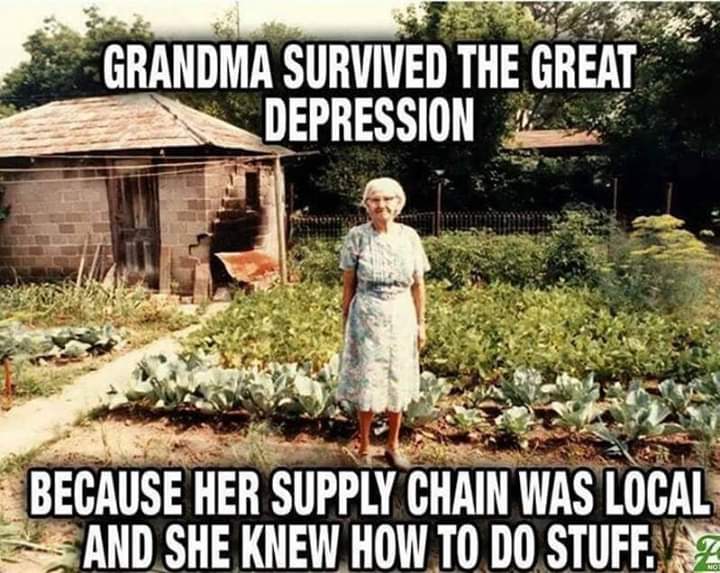
One trend—that I think will be positive if it endures—is the implicit rejection of globalism.  People are suddenly awakening, dramatically, to the manifold downsides of open borders and excessive global economic integration.  Suddenly, localism is back in vogue.

Read More »

TBT: The Human Toll of Globalization

One of the more interesting developments in conservatism since Trump’s rise in 2015-2016 has been a reevaluation of our basic economic policy.  Much of the ideas debated originated, in our modern political era, with Pat Buchanan.  For decades, the assumption among conservatism was that economic efficiency was the highest good, as it lowered costs and eliminated or reduced government overreach.

That was a reasonable set of assumptions when our nation shared a common culture, and when the United States dominated global markets hegemonically.  But the goal of reducing the size of government morphed pathologically into the mad worship of Efficiency above all else.  We sold out social capital—stable families, cohesive communities, robust civil society—for quick cash.

That’s the gist of Z-Man’s post today, “Middle-Man Conservatism.”  Tucker Carlson has similarly touched upon the woeful consequences of worshiping Efficiency-for-its-own-sake.  Sure, Americans possess a pioneering spirit—we’ll move to the oil fields in North Dakota if we have to do so—but we’re still motivated by the same things other humans are:  family, community, belonging.  Gutting our communities to save fifty bucks on a washing machine is a ludicrous trade-off.

Read More »

Vacation Reading: Quintus Curtius’s “Digest”

I’m hitting the road with my family for a fun-filled trip to Florida.  As such, posts will be a bit shorter through the weekend.

That said, it’s also the perfect time to catch up on some reading.  Classicist and antiquarian Quintus Curtius just released a massive collection of his blog essaysDigest, which I am excited to, um, digest.

Readers may recall a post I wrote last summer about an essay from Curtius about the ocean.  That essay is indicative of Curtius’s depth of thought and erudition; his mind is keenly analytical, and he writes with the perspective of someone who has lived and learned much.

Read More »

The God Pill, Part III

I’ve written a couple of pieces (here and here) about the so-called “God Pill,” and specifically Roosh V‘s remarkable conversion to (Orthodox, it seems?) Christianity.  Roosh’s conversion, it seems, is quite sincere, and he’s put his money where his belief is by unpublishing many of his books dealing with “game,” the art of seduction.

Roosh wrote an essay about a month ago, “How I Turned To God,” in which he explains the events and influences that led to his conversion.  Roosh was the archetype of the atheist materialist:  an evolution-espousing microbiologist, who then began a successful—if only in the material sense—career as a professional Don Juan.

He literally had sex and wrote about it for a living.  As he writes, “How could a man who was so far from God come to have complete trust in Him practically overnight?”

Read More »

Belated SubscribeStar Saturday: Oases of Tradition

Today’s post is a SubscribeStar Saturday exclusive.  To read the full post, subscribe to my SubscribeStar page for $1 a month or more.  For a full rundown of everything your subscription gets, click here.

This weekend was full of family time for yours portly (thus the delayed post).  Celebrating my youngest nephew’s first birthday with generations of family members and like-minded friends reminded me not only of the importance of family, but also of how refreshing it is to be among people who share your basic beliefs.

I’ve written about this phenomenon a number of times in my vast archives of blog posts, but it’s a topic that could use a longer treatment.  A major struggle facing conservatives and traditionalists today is a sense of social and cultural isolation that can be downright suffocating at times.  But we should avoid the black-pilled mentality of nihilistic despair, not only because it’s what our enemies want, but because it’s simply not true.

To read the rest of this post, subscribe to my SubscribeStar page for $1 a month or more.

Long Live Rush Limbaugh

For conservatives, one of the most powerful moments of last week’s State of the Union Address was when President Trump awarded talk-radio legend Rush Limbaugh with the Presidential Medal of Freedom, the highest civilian honor a president can bestow.  This morning, NEO at his blog Nebraska Energy Observer has a piece up, “The Era of Limbaugh,” which is a must-read summary of Rush’s legacy.

It’s hard to understate El Rushbo’s influence.  For many of us, he was our first exposure to conservative talk-radio (I even named the microphone we used for announcing football games “The Golden Mic”).  He is a tent pole in the 12-3 PM time slot—unwavering, unshaking.  I remember back in 2012 when a local Florence, South Carolina radio station dropped Rush—and he was unavailable in the Pee Dee for a few days (until another station picked him up a few days later).  It was pandemonium!  Well, at the very least, listeners were quite irate.

Read More »

Lazy Sunday XLVIII: Culture

A paradox of blogging is that the more I write, the more difficult (at least some weeks) it is to think up a good theme for Lazy Sunday.  Part of the problem is that the earliest editions often featured very broad categories; thus, the proliferation of “Part II” posts throughout.

Of course, that’s probably a problem for me, the writer.  You’re just looking to scan through a list of hyperlinks while enjoying your pre-church coffee (or—given my tardiness posting of late—your post-church nap).  Such is the nature of the relationship between creator and consumer—thirty minutes put into crafting a blog post equates to about thirty seconds of skimming.  But it’s worth it to have your eyeballs (eww…) for those thirty seconds!

On that note, I’m dedicating this week’s Lazy Sunday to matters of culture.  In compiling this short list of recent pieces, I came to realize that I way overuse the “culture” tag on my blog posts.  In my defense, I do so because I see most issues as cultural (or, even more deeply, theological and philosophical), rather than merely political or economical, in nature.  The major political battles we’re fighting in the West today are, at heart, about culture.

Read More »

Lazy Sunday XLVI: Man Time

It’s been a big week for events in the manosphere.  Popular (and controversial) game pioneer Roosh V essentially ratified a decision from last year, and unpublished the remainder of his smuttier oeuvre.  At nearly the same time, the venerable Christian writer Dalrock announced the retirement of his blog, but after an outpouring of support (and shock), he has decided to leave the blog up, though he’s disabling comments.

As often happens on the blog, the unplanned, unofficial theme of the week became, naturally, the manosphere, and some discussion of its current state.  As such, this edition of Lazy Sunday looks back at some posts pertaining to that complicated, oft-misunderstand corner of the Internet:

  • The God Pill” (and “TBT: The God Pill“) – This post was my attempt to provide a (very brief) history of the manosphere in the context of one of its Big Three, Roosh V (the others in the triumvirate are Rollo Tomassi and the now-deplatformed Chateau Heartiste/Roissy).  Roosh in particular underwent a lengthy transformation:  he embraced a life of casual sex and, not surprisingly, found it unfulfilling and empty.  He then descended into a period of despair (the “Black Pill”), but God reached down and scooped him up—thus, the “God Pill.”  It’s been remarkable to see Roosh confirm his newfound faith with the voluntary unpublishing of much of his work—a move that has not been without controversy.
  • The God Pill, Part II” – This post picks up the thread from Roosh’s conversion.  He kept several of his “game” books in print, but the conviction of the Holy Spirit finally led him to unpublish the remainder, including his bestseller, Game.  It seems Roosh is really attempting to live his faith fully, but he will need our spiritual support to stay the course.  He’s apparently even asking readers to give him advice on how to support himself going forward.
  • Reacting to Hysterical Reactions: Peloton Ad” – This piece was one of those throwaways I wrote hastily to meet my self-imposed daily deadline, but the media coverage of this Peloton ad really ticked me off.  I have no desire to spend $2000+ on an exercise bike with a video of a lesbian shouting at me.  But everyone—including our friends on the Right—were alleging this ad was proof of toxic masculinity and all the rest, simply because the wife is grateful for the gift (watch the ad in the original post).  Kudos to Dalrock, too, for drawing this one to my attention.
  • Royal Cuckery” – Poor Prince Harry.  It’s amazing how an attractive woman can make a man throw it all away.  It’s also amazing how the quality of “attractive”—which necessarily has a “best by” date affixed to it—can cause an otherwise upstanding man to ignore all the other warning signs:  a broken home, a prior divorce, a woke outlook on life.  A big thanks to Free Matt Podcasts for sharing this post in his weekly roundup, too.
  • Get Woke, Get Dumped” – This post was the contrasting companion piece to the Prince Harry one.  British actor Laurence Fox has taken the other route, and dumped his SJW girlfriend summarily.  He’s also sworn off women under 35—a dicier proposition, but understandable.  Younger girls have been so infected with and indoctrinated by wokery, it’s like talking to aliens.  There are obvious exceptions, of course, but those are called “unicorns.”

Well, that wraps up another beefy Sunday.  If those didn’t put some hair on your chest, there’s probably too much soy in your diet.

Happy Sunday!

—TPP

Other Lazy Sunday Installments:

The Creation of Culture

Today’s post is a SubscribeStar Saturday exclusive.  To read the full post, subscribe to my SubscribeStar page for $1 a month or more.  For a full rundown of everything your subscription gets, click here.

The impeachment trial rolls on, and continues to be so boring, even the senators involved were falling asleep.  I have a classic Boomer colleague with whom I share a classroom, and he has been following the impeachment with rapt attention, periodically bursting into fulminations that “both sides have already made up their minds!  They’re not even listening to each other.”

He’s a sweet man, so I bite my tongue.  The reason no one is listening is because the whole thing is patently a sham.  The process isn’t being taken seriously because it’s been cheapened:  it’s merely a lurid attempt—the latest in a long series—to undo the results of the 2016 election.

That deep division is so predictable at this point that it’s not even interesting anymore, even if it remains important.  But rather than dwell on the fundamental division between two diametrically opposed philosophies (and, in many ways, theologies), I want to devote today’s SubscribeStar Saturday post to something more positive.

I’ve been pondering lately the ways in which culture gets created.  So much of our current political battles are really, at heart, spiritual.  They are also cultural.  In essence, some people are allowed to have culture; others—straight white Christian men, for example—are not.  Never mind that straight (and a few gay) white Christian men gave us the greatest works of classical music, notions of liberty and self-government, and all sorts of other wonderful cultural products.

That’s not to say that other people can’t create culture.  Not at all.  Simply saying that Aristotle was a great thinker doesn’t diminish, say, the accomplishments of George Washington Carver.  But if we’re allowed to celebrate Carver as a black scientist, why can’t we celebrate, say, Mozart as an example of the greatness of Western Civilization?  Indeed, the greatness of Western Civilization is that its principles may have started in Europe, but are, in fact, universal:  George Washington Carver was able to conduct his peanut experiments awash in the intellectual ferment of Western culture.

But I digress.  A good friend of mine has written an excellent collection of poetry, A Year of Thursday Nights.  The poet, Jeremy Miles, collected the poems as he wrote and performed them at a local coffee shop’s open mic night nearly every Thursday night for a year.  The work is a powerful example of how culture—and a culture—gets created.

To read the rest of this post, subscribe to my SubscribeStar page for $1 a month or more.