Hungarian Border Wall is 100% Effective

Pundit Dick Morris has a short piece on his website, DickMorris.com, about the Hungarian border fence.  It’s a quick read, but here are the key excerpts:

Along its 109-mile border with Serbia, Hungary has built a 13-foot-high fence featuring concertina wire (barbed wire in circles). It took six months to build (July-December of 2015) and cost $106 million. It was built by contractors and 900 Hungarian soldiers.

The fence consists of three rows of razor wire with a sturdier 11.5-foot-tall barrier inside….

And the Hungarian fence works! Before the barrier was built, in September of 2015, 138,396 migrants entered Hungary over the Serbian border. Within the first two weeks of November, the average daily flow had dropped to only 15 people.

Hungary and its populist-nationalist leader, President Viktor Orban, have faced a great deal of backlash and scorn from the progressive, bureaucratic autocrats of the European Union for their border control and immigration measures.  But Hungary is intent on keeping itself culturally Hungarian—it cannot effectively absorb the millions of potential migrants that began pouring into Europe from Syria and North Africa a few years ago.

President Orban is often cast as some latter-day Hitler, but he’s merely doing his job:  he’s putting the people of Hungary and their interests first, behind the interests of foreign vagabonds.

While researching this post, I learned that the European People’s Party—an umbrella party of “center-right” parties (as many outlets described it) running in the European Parliament’s elections this May—is barring Orban’s Fidesz Party from participating.  Apparently, part of their concern is that Orban’s Fidesz Party has posted humorous ads depicting George Soros and Jean-Claude Juncker (the Leftist super-villain billionaire and the President of the European Commission, respectively), suggesting the two are in cahoots to control Europe.

Well… aren’t they?  Isn’t the “center-right” European People’s Party supposed to represent a challenge to the Eurocrats (if anyone knows, I’m only asking semi-rhetorically)?

Two takeaways:

1.) Leave Viktor Orban alone.  He’s helped protect his country at a time when other European nations turn blind-eyes to Muslim rape gangs.

2.) The original point of this post:  President Trump can follow the Hungarian model and build an effective wall on the cheap.  Granted, we have more than 109 miles, but copy-paste that approach along our long border with Mexico, and could get the job done quickly and efficiently.

Open borders and progressive politics are the real dangers to liberty and prosperity, not an unabashed nationalist in Central Europe—or one in the United States.  Build the Wall, Drain the Swamp, and Leave the European Union!

TPP Weekend Update

Readers will know that this week has been pretty insane for TPP, so the quality and length of blog posts have suffered accordingly.  My Internet connection woes, coupled with an unusually hectic work schedule, limited my ability to get posts out by 6:30 AM EST—and I had to write several entries on my phone on public WiFi.

Indeed, I’m writing today’s post amid the hectic South Carolina Junior Classical League Spring Forum, which my little school is hosting this weekend.  I just wrapped up moderating Certamen (proposed team name:  “Certamen Noodles”), which is basically quiz bowl or academic team for Latin nerds (take your average nerd and dollop even more nerdiness on top; one kid in one of the Certamen matches literally “meeped” at random, to give you a mental picture).

There’s been a lot going on this week that I’ve been unable to comment upon, like the college athletic scholarships corruption scandal and the mosque shootings in New Zealand.

The best statement I’ve seen on the latter is from an Australian Senator from Queensland, Fraser Anning, who condemned the violence, but also pointed out that Islam endorses such violence against non-Muslims on a regular basis.  Best line:  “The entire religion of Islam is simply the violent ideology of a sixth century despot masquerading as a religious leader….”  Dang.  Well said, sir.

Fortunately, the Internet is working again at home, after the valiant efforts of a gracious Frontier technician, Harold.  I’m still quite frustrated with Frontier; they told me they had no technicians in the field, but Harold told me he’d been sitting in the local office all day waiting to get dispatched.  This after I’d spent an hour on the phone with a Frontier supervisor demanding answers as to why the company couldn’t keep a four-hour appointment window scheduled a week out.

It turns out that someone in the local office unplugged a jump cable, which caused me to lose Internet.  I literally could have walked 1000 feet around the corner and talked to someone.  Now I’m armed with the general location of the local office (which is just where Frontier technicians maintain the local access point for the town, apparently, and not a true “office”) and Harold’s number, so I can (hopefully) fast-track repairs in the future.

My takeaway:  Frontier still sucks, but their technicians are great.  The whole company is just riddled with incompetence at the customer service level, and they make a lot of unforced errors (like accidentally unplugging my Internet for a week), and they operate in the Stone Ages of cable/Internet provides (a two-year contract, really?).

Enough whining.  Tomorrow we’ll be back with another installment of “Lazy Sunday” (I, II, and III), and then (hopefully) back to more substantive material.

God bless, and Happy Saturday!

–TPP

Americans Support America First Agenda

A quick Saturday night post:  a Harvard/Harris Poll (PDF), according to Breitbart, suggests there is substantial support for an “America First” agenda.  Such an agenda places the government’s priority as protecting American citizens first and foremost, and includes enforcing immigration laws, pushing for fairer trade via tariffs, and ending open-ended foreign wars.

I’ve written about the rise in economic nationalism before, including a detailed case study from BreitbartTucker Carlson’s 3 January 2019 monologue is probably the best defense of an “American First” agenda I’ve ever heard.

Economic nationalism dovetails with immigration in that enforcing immigration laws—and deporting illegal immigrants—would drive up wages for workers domestically.  I would also argue that a moratorium on most legal immigration for at least a decade would probably be prudent, to facilitate assimilation.

And, as painful as they would be, mass deportations of any illegal alien, regardless of criminal record, would do much to remove the un-assimilated, and to dissuade further incidences of border hopping.

It seems a good portion of Americans agree with at least some of these assessments.  Here is a quotation from the Breitbart piece on the poll:

Across racial lines, the vast majority of white Americans, 79 percent, and black Americans, 75 percent, said they would support a candidate who said they wanted an immigration system that benefited American citizens, rather than foreign nationals.

Similarly, more than 6-in-10 voters said they would be more likely to support a candidate in an election that spoke of the national “emergency with the savage MS-13 gang” that has been largely due to the country’s mass illegal and legal immigration system that has been supported by Republicans, Democrats, the open borders lobby, Wall Street executives, and corporate interests.

It’s encouraging to see solid support for an America First agenda, even if that doesn’t always translate to love for President Trump himself.  It does suggest, however, that if he sticks to his original campaign promises—as he has largely done—he is poised to do well in 2020.

Buchanan on the National Emergency

One of my favorite writers, paleocon Pat Buchanan, has a piece on one of my favorite sites, Taki’s Magazine, about President Trump’s recent declaration of a national emergency.  That national emergency, you’ll recall, will allow the President to use existing funds within the federal bureaucracy to build a border wall, thereby circumventing Congress’s lackluster appropriation of funds for that purpose.

Critics argue that the president is undermining our Constitution, with its careful balance of powers between the branches, specifically its delegation of the “power of the purse” to Congress.  While I certainly share some of those concerns, Buchanan points out that Trump’s national emergency is only the latest (and one of the mildest) in a long line of the executive overreach.

More crucially, Buchanan places the blame for the extension of the executive power at Congress‘s feet.  In this regard, Buchanan is correct:  Congress, with the support of an activist federal judiciary, long ago realized that it could farm out key legislative functions to the executive branch (specifically, the federal bureaucracy), and thereby avoid catching the blame for the nation’s problems.  In the process, the executive and judicial branches have arrogated greater powers to themselves (thus, the tug-of-wars between unelected federal judges and the Trump administration on virtually every policy).

To quote Buchanan at length:

Yet while presidents have acted decisively, without congressional authorization and sometimes unconstitutionally, Congress has failed to defend, and even surrendered, its legitimate constitutional powers.

Congress’s authority “to regulate commerce with foreign nations” has been largely ceded to the executive branch, with Congress agreeing to confine itself to a “yeah” or “nay” vote on whatever trade treaty the White House negotiates and sends to the Hill.

Congress’s authority to “coin money” and “regulate the value thereof” was long ago transferred to the Federal Reserve.

Congress’s power to declare war has been ignored by presidents since Truman. Authorizations for the use of military force have replaced declarations of war, with presidents deciding how broadly they may be interpreted.

In declaring the national emergency Friday, Trump rested his case on authority given the president by Congress in the National Emergencies Act of 1976.

As I wrote over the weekend, I believe the president acted within his the scope of Article II of the Constitution in issuing the national emergency, as it pertains to powers inherent in the office of the executive:  national defense and border security.  I’m not completely comfortable with this method for funding a border wall, and I think the president and congressional Republicans blew an opportunity to build the wall during the two years of Republican control of the federal government, but action needed to be taken.

Buchanan’s piece is titled, chillingly, “Why Autocrats are Replacing Democrats.”  To answer his own question, he argues that voters internationally are weary of the plodding democratic process, and are eager for leaders who will deliver solutions to their problems.  Buchanan claims that republican forms of government have failed to fulfill their most basic functions—border and immigration control, national security, etc.—and the people demand solutions—action.

I don’t think President Trump is an autocrat or a fascist.  I also don’t entirely blame him for using powers Congress has delegated to his office.  Up to this point, President Trump has stayed very much within defined constitutional limits in the exercise of his authority.

We should, however, be ever vigilant about—and always on guard against—executive overreach.  While I think the president acted within accepted constitutional bounds here—and relied upon the poor decisions of a past Congress to shore up his case for the national emergency—I hope this method of governance does not became de rigeur habit, as it did under the Obama administration.

On the plus side, we’re getting a wall!

Walls Work

It’s going to be a very quick post today.  While I’m enjoying an unexpectedly lengthy Winter Break—a perk of being a teacher, and why our complaints, while legitimate, should be taken with a grain of salt—I’m also quite busy outside of the mildly Dissident Right/”Alt-Lite” blogosphere.  I played a very fun solo gig last night at a coffee shop in my neck of South Carolina, and tonight I’ll be playing alto saxophone with an old-school, swingin’ big band.  I’m heading out for soundcheck and rehearsals for that soon, thus the quick post (gotta keep the streak alive!).

American Thinker posted a piece this week on the utility of border walls—how they’re popping internationally, and how they’re incredibly effective: https://www.americanthinker.com/blog/2019/02/a_fenceless_border_is_defenseless.html

Some international examples from the piece (emphasis added):

According to a February 2018 American Renaissance article, between 1945 and 1961, over 3.5 million East Germans walked across the unguarded border.  When the wall was built, it cut defections by more than 90 percent.  When Israel in January 2017 completed improvements to the fence on its border with Egypt to keep out terrorists and African immigrants, it cut illegal immigration to zero.  In 2015, The Telegraph reported on the construction of a 600-mile “great wall” border by Saudi Arabia with Iraq to stop Islamic State militants from entering the country.  The wall included five layers of fencing with watchtowers, night-vision cameras, and radar cameras.  Finally, a September 2016 article in the Washington Post reported on the new construction of a mile-long wall at Calais.

In case you missed it, the key line there is “[w]hen Israel… completed improvements to the fence on its border with Egypt… it cut illegal immigration to zero.”

Cut it to zero.  No one can plausibly argue against the effectiveness of a border wall.  Yes, ports of entry are a problem, too, but those are merely the documented cases of illegal entry.  The reason those numbers are so prominent in the debate (besides being a useful cudgel against the commonsense of a border wall) is because we have numbers—at least, more accurate numbers—for illegal entries at ports of entry as opposed to illegal entries at the porous southern border.

Again, that’s just commonsense, but it’s easy to lose in the debate.  It’s hard to fight data with data when you don’t have an accurate count—and an accurate count of illegal border crossings is, by definition, impossible!

What we do know is that illegal crossings are up—why else would there be hordes of coyote-led migrants marching en masse to the border—and a wall is a quick, cost-effective way to relieve border agents to focus on other areas.

Those hordes—as much as we can and should sympathize with their plight—represent a direct assault on our borders and national sovereignty.  If we let some come through illegally, simply because they come in large numbers, then the floodgates open.

In that context—that of a foreign invasion—the President’s decision to declare a national emergency seems to be entirely in keeping with his powers under Article II of the Constitution.

While I think he should have gotten Congress to act sooner when Republicans controlled both chambers of Congress (although, let’s be honest here:  many congressional Republicans are doing the bidding of the US Chamber of Commerce and the cheap labor lobby when it comes to border security—they want to assure a steady stream of near-slave labor for their donors), this crisis needs to be met with the full force of the Commander-in-Chief’s war-waging powers.

For the fullest explanation of that approach, read this piece from Ann Coulter.  Coulter is a controversial figure, but I think her assessment of the Constitution is accurate here.

I find “national emergencies” and broad applications of presidential powers constitutionally distasteful; however, a core responsibility of the executive is to execute the laws, including immigration laws, and to protect and guard national borders.  If Congress won’t pony up for border security, President Trump must use every power at his disposal as Commander-in-Chief to defend the nation.  That’s pretty much his entire job!

Well, it looks like this post was as long as any other.  I type pretty quickly when I’m in rant-mode, and nothing gets me there faster than illegal invasion.

Godspeed, President Trump.  Please be more attentive to this issue going forward—it’s why we elected you!

The Facts on the Border Crisis

As I’ve learned more about immigration—and especially since reading Pat Buchanan’s Death of the West—I’ve come to believe it is the defining crisis of this moment in American history.  The debate is not, as it has been in the past, primarily around how much immigration is desirable; rather, the question has morphed beyond reason into “does a wealthy nation have the right to define and enforce its own immigration laws?”

That used to be axiomatic to what it meant to be a nation:  by definition, a nation had the right to defend its borders, and—of course!—to have them!

Now, there’s a twisted logic that, because the United States has loads of wealth (and won tons of land from Mexico in the Treaty of Guadelupe-Hidalgo, after we soundly defeated them and captured Mexico City), we somehow have a moral obligation to surrender our sovereignty to every hard-luck case in the Western Hemisphere (and beyond).

America is a melting pot, but if you dump a bunch of salt into the soup all at once, it becomes inedible—the salt takes over.

Case in point:  the aforementioned Mexican War.  That conflict had its root in the Texas Revolution, in which the Republic of Texas gained its independence in 1836.  Texas was a province of Mexico, and the Mexican government wanted to encourage settlement, so it invited Southern yanquis to move in with their slaves.

Those American settlers had two requirements:  they had to convert to Catholicism (the official state religion of Mexico), and they had to become Mexican citizens.  A handful of token conversions later, and the Texans were in.

In 1829, Mexico abolished slavery throughout its territories.  The slaveholding Texans protested; rather than face the threat of secession of its unassimilated but wealthy minority, the Mexican government relented, granting unprecedented, asymmetrical “states’ rights” to Texas.

While Mexicans resented Texas’s special treatment, everything was fine until the military dictator General Lopez de Santa Anna rose to power.  Santa Anna vowed to end Texas’s exemption from federal law.  When he moved to enforce his decree with the Mexican Army, the Texans declared independence; after their defeat at the Alamo, American volunteers flooded in to help Texas gain its independence.

The moral of the story here is clear:  a large minority of unassimilated foreigners successfully ignored the laws of their host country, before ultimately breaking off to form a short-lived nation, before annexing into the nation of their native culture.

Mexico is playing the same playbook in reverse; indeed, some Mexican radicals call the influx of unassimilated, illegal migrants into the southwestern United States the reconquista, or “reconquest.”

Death of the West is the best feature-length discussion of that process.  For a shorter, more immediate discussion of the impact of illegal alien migration, the White House has published a page of statistics about the crisis at the border: https://www.whitehouse.gov/briefings-statements/crisis-southern-border-urgent-ignore/

Stop screwing around—and build the wall!

Friday Musings: Populism is East versus West

I share my classroom with a veteran history teacher, who teaches my school’s eighth grade South Carolina History course.  The students are currently covering the events leading up to the American Revolution, particularly the unpopular Proclamation Line of 1763.  His discussion of the topic led me to a minor epiphany.

First, some historical context:  after the British defeated the French and their allies in the French and Indian War (the Seven Years’ War in Europe), millions of acres of land west of the Appalachian Mountains were open to American settlement.  The Americans were bursting with pride in delivering a hard-fought victory against Britain’s major European foe, and were eager to enjoy the spoils of war:  the newly opened lands.

Unfortunately, Parliament stalled land-hungry settlers with a well-intentioned but misguided policy:  the Proclamation Line of 1763.  According to an act of Parliament, there was to be no settlement west of the Appalachian Mountains.  The land was to be left to the Indians living there.

The policy was not without merit:  the British spent a great deal of blood and treasure fighting Indians during the French and Indian War, and while the conflict was global in nature, most of the fighting occurred in British North America and present-day Canada.  A major source of bad blood was the tendency of Americans to move onto Indian-owned lands; similarly, rapacious Indians would raid vulnerable settlers in the western parts of colonies (such raids fomented an early populist uprising of farmers in western Virginia, Bacon’s Rebellion, in 1676).  The British sought to avoid another costly war with the natives by preventing their future antagonism:  keep Americans off that land.

Americans, understandably, were livid.  For one, they saw it as Britain rewarding the very foes they’d just vanquished (keep in mind, too, the ferocity of native warriors—there’s a reason we name our military hardware and athletic teams “The Braves” and the like).  They also believed this land was their destiny and their birthright—having defeated a tenacious foe, they were ready to head west.

What got me thinking was a comment my colleague made; to paraphrase:  “If Parliament had just sat down with the colonists and discussed it with them, they could have avoided a lot of disaster.”  That comment made me realize:  so much populism is a conflict between an indifferent Eastern (now bicoastal) elite, and an energetic, cantankerous Western settler-class.

That is, by no means, a novel insight (see also:  Bacon’s Rebellion).  The insight, however, is the repeated unwillingness of elite interests to try to understand or cope with the sources of the common man’s difficulties.  Some differences are, indeed, intractable, but it seems that, in many cases, elites could hear out and account for the problems of the common folk.

Indeed, in many cases, both are right.  Consider the historic struggles between Thomas Jefferson and Alexander Hamilton.  Thank goodness George Washington heeded Hamilton’s advice for how to structure the finances of the young nation.  Hamilton’s fiscal policies set the United States on firm footing, building investor confidence and shoring up the American government’s credit.

On the other hand, Jefferson was right that Congress had no explicit authority to establish a national bank, and that we shouldn’t become too dependent on urban industrialization and finance, lest we lose our sense of republican virtue.

There are, increasingly, fundamental disconnects between America’s urban elites and rural commoners.  Witness New York State’s catastrophic, plainly satanic abortion law, which (from all the discussion around it), seems to allow for abortion while a woman is still in labor.  There’s no compromising with an idea that is, unarguably, evil.

That said, elites should take seriously the common American’s keen sense for fair play.  Illegal (and mass legal) immigration is deleterious not only because it is illegal, but because it hurts native-born Americans, driving down their wages (for the benefit of the elites) and transforming their neighborhoods and towns.  Americans will welcome a reasonable number of legal immigrants with open arms, but they expect immigrants to come legally, to assimilate, and to become loyal American citizens (including breaking ties with their old countries).

The elites are people, too, and often act in what they believe is for the greater good, or for long-term national preservation (at least, this statement seemed accurate in America’s past; our postmodern elites seem largely committed to undermining core American principles).  That said, they’ve adopted the Left’s prevailing ethos of de facto nihilism and materialist self-indulgence, along with the Left’s disdain for the common man.

In short, the elites have lost any sense of noblesse oblige, of obligation to maintaining a good, happy, healthy society.  They are as far removed from their fellow countrymen as East is from West.

Put Your Money Where Your Poll Is

According to a 2018 Gallup poll, 16% of Americans said they want to leave the United States permanently.  Not surprisingly, you can guess who most of these borderless, loyalty-deficient Americans are.

National Review reports that “Those who said they wanted to leave the U.S. tended to be members of groups that lean Democratic, such as women, youth, and low-income people.”  Indeed, 20% of women told Gallup they want to live permanently in another country, compared to just 13% of men; 30% of Americans aged 15 to 29 want to move.

So, young radical feminists, why don’t you put your money where your poll is?  I’d wager less than 1% of those who indicated they want to leave will actually do so.

The most generous argument, of course, is that relocating to another country is expensive and a lengthy process (the result of properly enforcing a nation’s immigration laws).  Also, American citizenship is, despite cheapening from birth-right citizenship and massive immigration, a golden ticket, one that people are willing to move across oceans and deserts to gain.

The real reason is that no person with a shred of common sense would ever give up the sweet bennies and lavish standard of living the United States provides, or at least not for merely political reasons.  Remember all those progressive celebrities who vowed hollowly to leave the country should Trump win?  Why is Lena Dunham still here?

What this polling boils down to, then, is a reverse of the “Trump Effect” from 2016 presidential polls.  A major, compelling theory for why those polls were so wrong is that Trump voters were afraid or embarrassed to tell a pollster they intended to vote for Donald Trump.

In the case of this Gallup poll, the opposite is occurring:  progressives are eager to virtual-signal their disdain for their country and president; thus, the inflated numbers.

Let’s put this out there for consideration:  the government could purchase cheap plane tickets for anyone who wants to relocate.  I’m sure Justin Trudeau will take in these “refugees.”  This policy, while initially expensive, would drain off some of America’s Leftists (they’d find plenty of jobs in Canada’s multicultural, social justice bureaucracy), and would be almost as beneficial as erecting the border wall.  Leftists would love getting free, permanent travel to another land, with the added benefit of feeling cool and sophisticated.


Patriots Would Pitch In for the Wall

An interesting piece from Breitbart about President Trump’s proposed wall: https://www.breitbart.com/politics/2018/12/19/poll-one-third-of-republicans-would-pitch-in-to-build-wall/

It seems that a third of Republicans surveyed would be willing to make a personal contribution (or pay more in taxes; it’s a bit unclear which) to build the border wall.

Meanwhile, 97% voters opposed to President Trump also oppose funding the border wall.

I’m open to the argument that the wall might not be an effective enforcement tool—to be clear, I disagree with that argument, but I understand where its proponents are coming from—but I suspect that’s not the case for the bulk of that 97%.

A border is one of the most basic elements of what makes a state a state—or a nation a nation. It’s inherent in the definition of what it means to be a sovereign state.

As such, securing the border seems like a logical, natural thing for a nation to pursue. In my mind, that includes the construction of a border wall.

Yes, I’m familiar with the usual objections: it’s expensive; modern air travel would diminish a wall’s effectiveness; technology can fill the same role. But an actual, physical wall is a powerful symbol that America takes border enforcement seriously, that as a nation we not only will build physical barriers to keep out dishonest invaders, we’ll also enforce those laws on the books.

The message to the world for the past thirty years has been “we have laws, but they’re just a suggestion; get here, and we’ll figure out how to keep you in and get you bennies.” A wall sends a different message: “if you’re going to come, you’d better do it right. Don’t think about sneaking in.”

In short, if there’s a GoFundMe or Kickstarter for the border wall, I’ll pitch in. Every patriot should—and would. Or President Trump can stick to his guns, refuse any budget deal that doesn’t fund at least part of the wall, and keep his greatest campaign promise.

Build the Wall!

UPDATE: after writing this post, but before it was published, I happened to receive an e-mail from a friend to a fundraiser to raise $1 billion toward the Border Wall. You can contribute to it here: https://ca.gofundme.com/TheTrumpWall

The Evolution of Judicial Supremacy – Judicial Review

Last night, President Trump nominated Judge Brett Kavanuagh to serve on the Supreme Court to fill the vacancy left by the retirement of Justice Anthony Kennedy.  As such, I thought it would be germane to explore briefly the role of the Supreme Court.

Popular understanding of the Court today is that it is the ultimate arbiter and interpreter of the Constitution, but that’s not properly the case.  The Court has certainly assumed that position, and it’s why the Supreme Court wields such outsized influence on our political life, to the point that social justice snowflakes are now worried about Justice Ruth Bader Ginsburg’s diet and exercise regimen.

Properly understood, each branch—the President, the Congress, and the Court—play their roles in interpreting the constitutionality of laws.  Indeed, President Andrew Jackson—a controversial populist figure in his own right—argued in his vigorous veto of the Bank Bill, which would renew the charter of the Second Bank of the United States, that the President had a duty to veto laws that he believed to be unconstitutional.

Unfortunately, we’ve forgotten this tripartite role in defending the Constitution from scurrilous and unconstitutional acts due to a number of historical developments, which I will quickly outline here, with my primary focus being a case from the early nineteenth century.

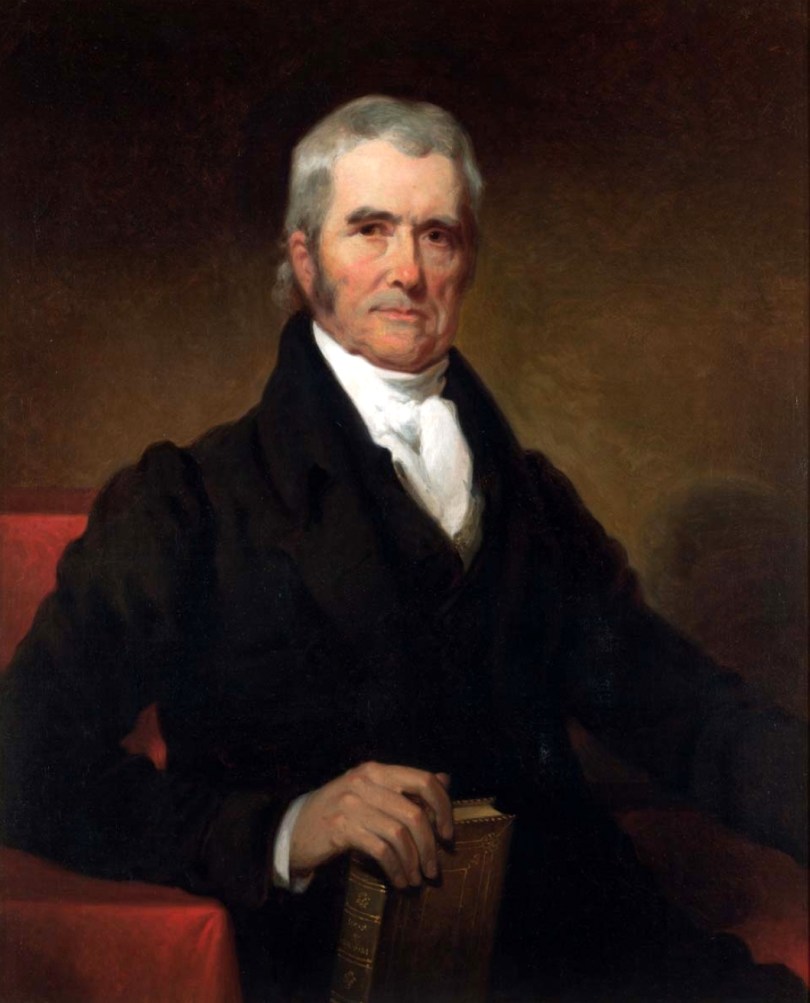
The notion that the Supreme Court is to be the interpreter of the Constitution dates back to 1803, in the famous Marbury v. Madison case.  That case was a classic showdown between Thomas Jefferson and James Madison on one hand—representing the new Democratic-Republican Party in control of the executive branch—and Chief Justice John Marshall, a Federalist appointee, on the other.

The case centered on an undelivered “midnight appointment” of William Marbury to serve as Justice of the Peace for Washington, D.C.  The prior president, John Adams, had issued a handful of last-minute appointments before leaving office, and left them on the desk of the incoming Secretary of State, James Madison, to deliver.  Naturally, Jefferson and Madison refused to do so, not wanting to pack the judicial branch with any more Federalists, and Marbury sued for his appointment.

If Marshall ruled that Madison must deliver the appointment, there was a very real risk that the Jefferson administration would refuse.  Remember, the Supreme Court has no power to execute its rulings, as the President is the chief executive and holds that authority.  On the other hand, ruling in Madison’s favor would make the Court toothless in the face of the Jefferson administration, which was already attempting to “unpack” the federal courts through acts of Congress and the impeachment (and near removal) of Justice Samuel Chase.

In a brilliant ruling with far-reaching consequences, Marshall ruled that the portion of the Judiciary Act of 1789 that legislated that such disputes be heard by the Supreme Court were unconstitutional, so the Supreme Court could not render a judgment.  At the same time, Marshall argued strongly for “judicial review,” the pointing out that the Court had a unique responsibility to strike down laws or parts of laws that were unconstitutional.

That’s all relatively non-controversial as far as it goes, but since then, the power of the federal judiciary has grown to outsize influence.  Activist judges in the twentieth century, starting with President Franklin Roosevelt’s appointees and continuing through the disastrous Warren and Burger Courts, have stretched judicial review to absurd limits, creating “penumbras of emanations” of rights, legislating from the bench, and even creating rights that are nowhere to be found in the Constitution.

Alexander Hamilton argued in Federalist No. 78 that the Court would be the weakest and most passive of the branches, but it has now become so powerful that a “swing” justice like former Justice Kennedy can become a virtual tyrant.  As such, the confirmation of any new justice has devolved into a titanic struggle of lurid accusations and litmus tests.

The shabby treatment of the late Judge Robert Bork in his own failed 1987 nomination is a mere foretaste of what awaits Judge Kavanaugh.  Hopefully Kavanaugh is well-steeped in constitutional law and history—and will steadfastly resist the siren song of personal power at the expense of the national interest.