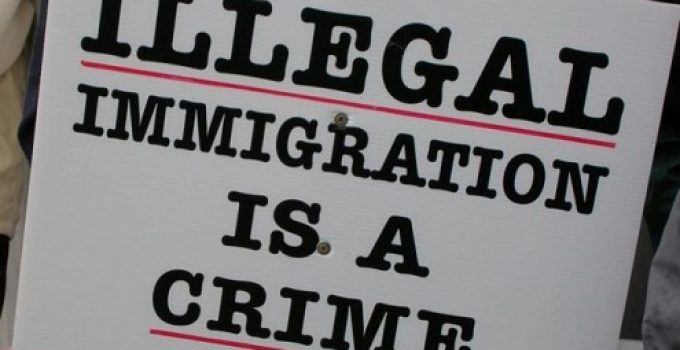
Deportemal II: Trump Vows Mass Deportations

On Monday, President Trump announced the deportation of millions of illegal aliens beginning “next week,” vowing that ICE agents would remove such aliens “as fast as they come in.”

Here are the two pertinent tweets from the president:

Critics and supporters alike are asking for details on how Immigration and Customs Enforcement will process the millions here illegally.  As I write this post, I’ve just listened to part of Ben Shapiro’s podcast on the announcement; he argues that a surgical, case-by-case approach is preferable, as some illegal aliens possess skills we would want in the United States.

While I appreciate Shapiro’s measured response, I can’t agree.  As I wrote in “Deportemal,” the time for half-measures has passed.  A lengthy review process of the millions of illegal aliens—which could be anywhere from 11 to 33 million (PDF; that document shows an illegal population of 12 million as of 2015), and maybe higher (that no one can know for sure is a major part of the problem)—would bog down for years, if not decades.  Another visa process ladled on top of inherent law-breaking will merely exacerbate the problem.

Consider:  our current catch-and-release system—migrants show up to one court date, get a temporary visa and orders to report back to court, then disappear into the countryside, never darkening an immigration court again—already gives migrants an easy in.  Essentially, touching American soil is like tagging home base:  once you’re here, you’re in.

Now, imagine adding an individual review process to that.  First, you’d have to assume good-faith on the part of illegals in the country.  They have virtually no incentive to come to another hearing.  Yes, they have the opportunity to be absolved of their illegal status (I’m assuming that’s what Shapiro is proposing), but if they think they don’t, they’ll avoid the process.

Second, a whole cottage-industry of gaming the individual amnesty system will emerge.  Lawyers skilled in the ins-and-outs of this fresh bureaucratic hell will profit at the expense of their countrymen and poor illegals.  Appeals—and you know with the federal government there would be a lengthy appeals process—would linger on for months, even years, further adding to the administrative load of ICE and our courts.

If we were dealing with a few thousand people, we could demonstrate some mercy and approach this issue with a lighter touch.  Unfortunately, we’ve failed to enforce our border laws for so long that we’ve allowed this crisis to metastasize, to the detriment of American citizens and potential immigrants alike.

Republicans squandered a golden opportunity to make some real strides on immigration reform during the 2017-2019 congressional session.  President Trump has moved mountains since then via constitutional executive orders and international diplomacy, particularly his threat of slapping hefty, incremental tariffs on Mexico.  Increased enforcement of Mexico‘s southern border has, according to Shapiro, already eased the number of arrests on the American border.

In the wake of President Trump’s massive 2020 reelection campaign launch last night in Orlando, Florida, it is imperative for immigration patriots to run (and win!) in 2020, and for Americans to support Trump’s reelection.  It’s our best hope to resolve this crisis, to the benefit of Americans and the world.

For more of my writing on immigration, check out “Lazy Sunday XIII: Immigration.”

Consider supporting the blog at my SubscribeStar page.  $1/mo. gets you exclusive access to new posts every Saturday.

Lazy Sunday XIII: Immigration

I’ve really been beating the drum about immigration lately, so today’s Lazy Sunday should come as no surprise.  Illegal immigration is a major crisis facing the United States and Europe, and it’s one we ignore at our peril.

Indeed, even legal immigration presents a problem if left unregulated.  Massive amounts of immigration leads easily to ethnic cloistering; if left unchecked, entire neighborhoods or cities can become unrecognizable.

An essential component of conservative nationalism is that a nation is made up of a people.  In the old European conception, that manifests itself as the nation-state:  a group of people sharing a common lineage or shared blood.  Sometimes that identity is self-consciously constructed, but it still stems from the notion that a certain people and a certain land make up the nation.

The American conception of nationalism is only slightly different:  the American people don’t have to share the same patrimony, but they do have to share similar values.  Those values are Anglo-Saxon in origin, but they can (and must) be adopted by anyone.

As such, ethnic cloistering subverts the assimilation process, placing fundamentally alien populations in the midst of natives.  That’s a recipe for conflict, as it undermines social and national cohesion.

“Nationalism” doesn’t have to be a dirty word.  There’s nothing inherently wrong with a group of people wanting to have their own nation.  No America should feel like a thoughtcriminal because he wants to protect his country from unregulated foreign invasion.

Some food for thought for your Sunday morning.

  • Open Borders is the Real Moral Crisis” – One of my first posts on immigration (and last week’s TBT feature), the context for this piece was the child separation policy and the faux outrage about it (notice how you never hear about this anymore?).  When I wrote this piece, this issue was red-hot, and I anticipated all sorts of social justice whinging.  Now that the political usefulness of child props is waning, it’s interesting to read it with fresh eyes.  My basic argument is unchanged, though:  we wouldn’t be dealing with child separation and the like if it we simply enforced the law.
  • The Facts on the Border Crisis” – This piece looked at the history of Texas Republic and the oft-forgotten Mexican War.  Texas was a major province of Mexico.  After gaining independence from Spain, the young Mexican government invited white American yanquis to settle the territory if they converted to Catholicism.  When the Mexican government attempted to abolish slavery, the American settlers—many of whom came from the Deep South with their slaves in tow—balked, demanding to keep their slaves.  When General Santa Anna attempted to enforce the Mexican constitution, the Texans rebelled.

    The point:  large, marginally-assimilated foreigners dominant in one geographic area is a recipe for disaster.  Now, Mexico is doing to the Southwest what Americans did to Texas in the nineteenth century—they even call it the Reconquista.

  • Somali Shenanigans” – Case in point:  the resettlement of Somali refugees and immigrants into Minneapolis has completely transformed the demographic makeup of a large neighborhood in the city.  That’s also changed the politics of the State’s Democrat-Farm-Labor Party, which now caters to this largely unassimilable contingent.  Indeed, they’ve now elected Ilhan Omar to Congress, a woman who allegedly married her brotherallegedly married her brother to commit immigration fraud.
  • Immigration by the Numbers” – This post details the costs, social and economic, of immigration, focusing primarily on the huge amount of American dollars sent to foreign nations as “remittances.”  Remittances are funds earned in the United States and wired back to family members in an immigrant’s home country.  It’s a massive business, accounting for $148 billion in total, with $30.02 billion going to Mexico (China also gets a pretty penny).  That’s American wealth draining off to support other countries.
  • Deportemal” – Rounding out this week’s Lazy Sunday is a little post about the lawlessness that stems from illegal immigration.  The attitude of illegals is excessively cavalier:  in addition to existing in a state of persistent illegality, they leverage their “shadow” status to avoid real penalties for petty crimes.  The frustration for legal citizens is palpable:  we’re held to a rigid legal standard, while authorities turn a blind or helpless eye to illegal activity from illegal aliens who feel entitled to breaking the law because their home countries suck.

Illegal immigration is a frustrating assault on the lives of American citizens and the rule of law.  Rather than indulge such wide-scale lawlessness, we should robustly and aggressively prosecute and deport illegals upon apprehension for any offense, from the smallest jaywalking misdemeanor to child rape and murder.  If you’re caught and you’re illegal, you’re going back!

Other Lazy Sunday Installments:

Patriots Fill Gap in Border Wall

As the federal government struggles to fulfill its basic duties, private citizens are increasingly taking matters into their own hands.  I wrote awhile ago about the GoFundMe page to fund the border wall.  That project is still underway, but seems to have stalled well short of its goal of raising $1 billion.

But there is hope.  The organization connected to that fundraising project, We Build the Wall, constructed a half-mile of wall along a notorious gap on the New Mexico border.

A half-mile is precious little along a border hundreds of miles in length, but it is something.  Further, the specific half-mile section the wall protects is a heavily-crossed gap in existing border fencing.  From The Daily Wire:

The half-mile segment of border wall, the group says, closes a gap frequently used to smuggle both people and drugs. [Former Kansas Secretary of State Kris] Kobach added that on a “typical night” around 100 migrants and $100,000 worth of illegal narcotics passed through the half-mile hole.

The Trump Administration was working on a plan to construct around 234 miles of steel fencing, effectively sealing off the southern border with a “border wall,” but attempts to secure funding for the project have stalled. Congress refused to agree to any funding for the border wall beyond the $1.6 billion promised in the 2018 budget, and President Donald Trump’s “national emergency” declaration — which would have detoured funding to the border wall from other Army Corps of Engineers projects — was halted by a judge pending ongoing litigation.

This excerpt brings up another important point:  the consistent obstruction from Democrats and activist judges of President Trump’s America First agenda.  Even with the declaration of a national emergency, the president has been blocked from making substantial progress on the border wall.

Of course, Republicans passed up a golden opportunity to act on the border wall in 2017 or 2018.  Voters need to send a strong message to candidates in both parties that getting control of the border is important.  Tax cuts and economic growth are wonderful, but for American citizens to benefit, we need strong border security, including a robust deportation system.

I’m encouraged to see private citizens banding together to solve their problems when the government won’t—few things are more American.  Nevertheless, it’s the federal government’s constitutional responsibility to protect our national sovereignty.  It shouldn’t slough off that responsibility and hope that good-willed patriots will pick up the slack.

TBT: Open Borders is the Real Moral Crisis

I’ve been writing quite a bit about immigration lately, as it’s the major issue facing the West today.  Our leaders’ inabilities to address the crisis of immigration suggests their ineffectiveness—and, perhaps, their callous indifference to the damage unrestricted and illegal immigration wreak.

President Trump rose to national prominence and won the presidency campaigning on fixing illegal immigration.  His efforts so far have been a mixed bag, as duplicitous, progressive judges overreach from their elitist perches and block Trump’s efforts at reform.

It seems a distant memory now, but all the faux-outrage from the Left just a year ago was about the “child separation” business at the border.  One still reads some echoes of those melodramatic headlines, but the underlying problem has gone unaddressed.

In fact, it’s gotten worse:  immigrants now realize that if they cross the border with a minor child, they can be swept into the interior of the country.  Once an illegal immigrant is in the nation, it’s incredibly difficult to get him out again.

It’s a sad testament that President Trump and Congress have been unable to accomplish more on this front.  As such, it’s shame that this week’s TBT still sounds all-too-familiar.

Here is “Open Borders is the Real Moral Crisis“:

I typically avoid wading into fashionable-for-the-moment moral crusades, but the hysteria over children being separated from their parents at the border is ludicrous, and demonstrates the typical “facts over feelings” emotionalism that mars our immigration debate.  That feel-goodism is why we’re even in this mess—if it can be characterized as such—in the first place.

Because I’ll be deemed a monster—“Won’t somebody please think of the children!“—for not unequivocally denouncing this Clinton-era policy, I’ll issue the usual, tedious disclaimers:  yes, it’s all very tragic; yes, it could be handled better; yes, I would have been terrified to be separated from my parents at such a young age; etc.

Now that the genuflecting to popular pieties is out of the way, let me get to my point:  this entire situation would be a non-issue if we had simply enforced our immigration lawsconsistently for the past thirty years.  President Trump isn’t the villain here (if anything, Congress is—they can take immediate action to change the policy or come up with some alternative—but I don’t even think they’re wrong this time); rather, the villains are all those who—in the vague name of “humanity” and “human rights”—ignored illegal immigration (or, worse, actively condoned it).

Sadly, it is an issue.  But what else are we to do?  Years of non-enforcement have sent the implicit but clear message to potential illegal immigrants that we don’t take our own borders (and, by extension, our national sovereignty and rule of law) seriously, and that if you’re sympathetic enough, you’ll get to skip the line.  Folks come up from Mexico and Central America fully expecting that, after some brief official unpleasantness, they can dissolve into the vastness of the United States and begin sending remittances back to their relatives—who may then pull up stakes and come.

Further, sneaking into the country illegally is a crime, and the United States has every right to enforce its laws, including those pertaining to immigration.  Mexico, similarly, has that right—and uses it unabashedly to police its own border (or to let Central American migrants waltz through on their way to the Estados Unidos).  Naturally, the punishment for breaking laws is often detainment, and the kiddies don’t join dad in his cell.

To give a common example:  what happens to the children of, say, an American heroin dealer when he’s arrested and sentenced to ten years in a drug bust?  His children—if they have no relatives willing or able to take them in—go into the foster care system.  It’s tragic, it’s terrible, but it’s part of the price of committing a felony.  No one wants it to happen, but it’s a consequence of one’s actions.  This reason is why crime is so detrimental to society at large, even beyond the immediate victims.

Unfortunately, a combination of winking at immigration enforcement (“eh, come on—you won’t get deported”), feel-good bullcrap (as my Mom would call it), and Emma Lazarus Syndrome(trademarked to The Portly Politico, 2018) have contributed to the current nightmare situation.  Now that an administration is in office that actually enforces the duly legislated law of the land—and at a point at which the problem has ballooned to epic proportions due to past lax enforcement—the problem is far thornier and more consumed with emotional and moral peril.

As any self-governing, self-sufficient adult understands, sometimes doing what is necessary is hard.  I do feel for these children who are stripped from their parents arms (although, it should be noted, usually for only a matter of hours), but who cares about my feelings?  We can have compassion for those who try to arrive here illegally, as well as their children, without attempting to take on all of their problems, and without sacrificing our national sovereignty and our laws in the process.

The United States is the most generous nation in the world—and the most prosperous—but we cannot take everyone in; to do so would not make everyone else better off, but would rather destroy what makes America the land of compassion, liberty, prosperity, and charity that it is.

***

For further reference, I recommend the following videos, the first from the brilliant Ben Shapiro, the second from Dilbert creator Scott Adams:


I’d also recommend this piece from National Review columnist Richard Lowry, which is quite good:  https://www.nationalreview.com/2018/05/illegal-immigration-enforcement-separating-kids-at-border/

And, finally, this piece from Conservative Review‘s Daniel Horowitz, which explains the true moral toll of illegal immigration—and misplaced compassion—very thoroughly:  https://www.conservativereview.com/news/the-immorality-of-the-open-borders-left/

Deportemal

I have little patience for illegal immigrants.  Their illegality encourages ethnic cloistering.  Their very presence constitutes a persistent state of lawlessness, which seems to breed further criminality.

Then there’s the matter of the vast gulf between mainstream American culture and the virtually premodern peasant cultures from which most illegal migrants come.  Child rape is serious problem among men of certain Latin American cultures, as a recent piece from The Blaze demonstrates.  A twenty-year old illegal immigrant impregnated an eleven-year old.

You read the piece and you notice something:  the police already told this young man to leave the girl alone.  Why was he not shipped back to his homeland immediately?  Why was he allowed to stick around long enough to get this girl pregnant in his car near her school?

Yes, yes—why did the school let her slip away to have sex with a man nearly a decade her elder?  There’s blame to go around.  As for the parents, the girl’s father apparently wanted to beat the crap out of the illegal alien, understandably, but the police told him to cool it so he wouldn’t get himself in trouble.

That right there illustrates why average Americans are so frustrated with illegal immigration.  Law-abiding citizens are held to a stringent, inflexible standard.  Forget to claim $20 on your income taxes?  The IRS will spend thousands of dollars to get you.  Own land with “wetlands” on it?   You can’t grow anything on it, lest a non-existent frog die.  Want to camp on the beach?  Sorry, you can’t do that.

But if you’re here illegally, you get free medical care, no taxes, and an entire political party eager to grant you the franchise.  You can even sleep with minors, because, well, that’s just your rich, vibrant culture, and we wouldn’t want to burden you with our colonialist Western standards, would we?

Here’s how we rectify this situation:  deport every illegal immigrant the minute he or she runs afoul of the law, for the slightest offense.  If Pedro throws so much as a cigarette butt onto the side of the highway, send him back.

It would be shocking to you how much illegals get away with while here.  I once heard from an attorney about a client that was here illegally.  The client had received his second speeding ticket, as well as a $1000 tickets for driving without a license.  The attorney managed to get the officer to dismiss the $1000 ticket.  Good luck doing that if you’re a citizen.

My question was, “Why didn’t they deport this guy immediately?”  Look, speeding is probably one of the more benign offenses one can commit—that’s why it’s just a misdemeanor in most States—but it can result in injury or death.  That’s tragic enough when it’s a citizen behind the wheel.  But there’s an added element of injustice when the person driving shouldn’t be here in the first place.

Finally, the whole “living in the shadows” thing is rhetoric, pure and simple.  It conjures up images of old abuelas shivering in dark trailers, afraid to go outside lest an ICE agent apprehend them.  What it really means is that they can’t get a Social Security card and get sweet government bennies—they’re in the “shadow” of official existence.  I know some libertarians who would kill to be in that situation.

Rather than huddling up in the forgotten by-ways of America, illegals flaunt their status.  I’ve been to taquerias and been told that half of those present are likely illegal.  Most of them, to be sure, are harmless, and just looking for some opportunity.  But they’ve jumped the line, doing a real disservice to immigrants that go through the lengthy, expensive process the right way.  ICE could hit a couple of these joints in an afternoon and clear them out.

The solution to illegal immigration, like most answers in life, is simple but unpleasant:  deport ’em all.  Stop fooling around with detaining them in our prisons at our expense.  Ship them back—even if it takes multiple tries—and send the message to those still in Central America that their luck won’t be any better.

America needs 100ccs of prescription-strength Deportemal, stat!

Immigration by the Numbers

Yesterday I wrote about the dangers of inviting in large numbers of immigrants from a fundamentally alien culture into Western societies.  The Somali population of Minneapolis has created a veritable “Little Mogadishu” (consider paying homage to such a blighted place) in the heart of the Twin Cities, a neighborhood riddled with crime and terrorist recruitment.

Most immigration to the United States is not nearly so pernicious—unlike Europeans, Americans generally don’t have to worry about waves of unassimilable Muslims conquering entire swaths of our major cities—but while our immigrants are more assimilable than Europe’s, the sheer number of immigrants makes that assimilation more difficult.

As I wrote yesterday, the old friction of immigration is no longer there.  Families can instantly contact one another across oceans and time zones, and travel back home—or, more likely, travel to the new home in the West—is more affordable than ever.

Couple that ease of travel with our ludicrous interpretation of the Fourteenth Amendment, which allows foreign nationals to spit out “American” citizens if they can just cross the border when the contractions begin, and you have a recipe for invasion.

The family situation goes beyond the “anchor babies” phenomenon and the child migrant crisis.  Our immigration system prioritizes family members over skilled, English-speaking immigrants.  As Scott Rasmussen notes, nearly 750,000 immigrants annually enter the United States legally simply because they’re related to someone already here.  Immigrants can send for their spouses, children, and parents under this system—who then can bring over their spouses, children, and parents, creating the “chain migration” President Trump has decried.

The president is not alone.  According to Rasmussen, 75% of voters believe our immigration system should prioritize skilled immigrants, not family members.  That cuts across partisan lines (suggesting that immigration reform is a winning issue for electoral candidates).  And that 750,000 number reflects 66% of legal permanent residents admitted to the United States.

Remember, another key source of friction in immigration is that, in the old days, it could be years before an immigrant could bring his family over.  Indeed, some immigrants might never see them again.  It’s probably humane to allow Pedro to bring his wife and eighteen kids.  But his doddering parents?  His alcoholic uncle?  His son’s wife and kids? Where do we draw the line?

A further issue is that, with the ease of wire transfers, more and more wealth produced in the United States is sent back home.  Rasmussen reports that immigrants send a whopping $148 billion home.  That’s wealth produced working in the United States.

$30.02 billion of that $148 billion goes to Mexico.  When President Trump campaigned on Mexico paying for the wall, he didn’t mean the Mexican government would cut us a check.  Instead, he argued that the United States could tax these remittance payments to fund the border wall.

It’s an idea brilliant in its simplicity, and it shifts the costs of illegal immigration to the immigrants.  Want to pick our tomatoes at slave labor wages and send the money back home?  Fine, but you’re going to pay for the means by which we’ll prevent your mountain village from crossing over, too.

Immigration policy should benefit America and its citizens first.  I often hear the specious argument that “Americans won’t do certain jobs.”  Hogwash.  Big corporate farmers and Silicon Valley billionaires just want cheap fruit-pickers, coders, and nannies.  There are millions of working poor Americans who, for a living wage, could fill those jobs.  Alternatively, mechanization and automation could complete many of those roles.

The South went through the same issue with slavery:  wealthy Southern planters wanted cheap labor to grow cotton, and Northern textile mills were happy to pay a reduced rate for slave-produced cotton.  The losers were poor working folks and farmers.

Similarly, elites profit financially (and socially—they get to feel virtuous for employing Consuela to raise their kids) while wages for working men stagnate.

President Trump and Republicans in Congress should push again for the taxing of remittances, and a major push should begin to rid ourselves of “birthright citizenship,” a ludicrous misreading of the Fourteenth Amendment (which was intended to naturalize the former slaves and their progeny, not the children of foreign visitors who happened to give birth on American soil).

More importantly and immediately, we need to build the wall and deport any and all illegal immigrants.

Somali Shenanigans

Mass immigration and open borders are huge problems, but their costs are sometimes difficult to see.  Generally, Americans take a rosy view of immigration, as it conjures up images of plucky Irishmen crammed onto ships, chuffing past Ellis Island.  We’re the melting pot—people of different creeds and races come here, each contributing some distinct spices to the stew, but ultimately subsuming into the larger cultural heritage and mores of the host country.  Learn English, learn the Constitution, follow the rules, and you’re golden.

Of course, that all assumes the assimilability of the immigrants.  Back in those rose-tinted Ellis Island days, waves of Irish, Italian, and Eastern European immigrants (not to mention Chinese and Japanese migrants to California) caused great consternation, as each ethnic tribe and nationality stuck to its own.  With the National Origins Act of 1924, that great wave of migration trimmed to a trickle, with quotas favoring immigration from Western Europe.  Combined with the national struggles of the Great Depression and the Second World War, those migrants had time to get “baked in” to the national pie, and emerged full Americans.

Consider, too, that these immigrants came to the United States at a time when there was significant friction by doing so.  Many of them would never return to their home countries, or would do so only many decades later.  Lacking the access to mass, global communications networks, many of them never saw or heard from their relatives and families again.

Today, immigrants are able to communicate seamlessly with their relatives back home—a wonderful marvel of our modern-age.  They can also hop a jet plane and be back in hours (or get here quickly).  That same friction is no longer present to the same extent as it was 100 years ago.

Couple that with massive legal and illegal immigration, and the push to assimilate begins to vanish rapidly.  That push becomes more of a gentle nudge, if that.  Why learn English and the local customs when you can be surrounded by your hombres from back home?

Let’s go a step further:  what if your host culture no longer promotes or defends the rightness of its own beliefs and values?  Instead, it promotes multiculturalism and diversity as self-evident goods.  The official and cultural messages are no longer “assimilate” and “respect our laws, values, and God,” but instead become, “do your own thing” and “we’re nothing special—we don’t even really believe this stuff.”  Suddenly, there’s no compelling reason to assimilate into a culture that lacks confidence in itself.

Take all of that and add in a culture that does have some conviction in the rightness—and righteousness—of itself, and you’ve got the makings of a cloistered, insular community of unassimilable immigrants in your midsts.

Such is the situation in Minnesota with the Somali “refugees” living there.  They are, almost universally, devout Muslims.  They are also what the cool kids call “visible minorities”—they’re black—which serves as a further impediment to assimilation.  Islam in its most fundamental form is, essentially, at odds with Western civilization.  The very existence of Sharia law conflicts directly with the Constitution.  It’s all a recipe for disaster.

Indeed, the situation in “Little Mogadishu“—the Somalian neighborhood in the Minneapolis-St. Paul area—is a miniature form of the Islamic migrant crisis Europe has endured for years now.  Like the banlieues of France and Belgium, Somalian Muslims have created their own ethnic enclave in the heart of a State once dominated by Swedes and Germans.

Little Mogadishu is, sadly, following the pattern of other Muslim-dominated areas in the West.  It’s crime rate is through the roof, growing 56% in 2018.  Most of that increase is due to gang violence between competing Somali street gangs.

Minnesota—in a suicidal display of “Upper Midwestern Nice”—has encouraged the accumulation of Somalis into its State, creating a powerful ethnic voting bloc that holds increasing sway over the Democratic-Farm-Labor Party (the technical appellation for the Democratic Party in Minnesota).  Freshman Congresswoman Ilhan Omar, who can barely speak English without an anti-Semitic accent, is a troubling figure to have walking the highest corridors of power.  She’s a political figure ripped straight out of sub-Saharan

That’s had lethal consequences, too, such as Somali police officer Mohammed Noor’s fatal shooting of Australian Justine Damond.  That killing drew attention to what was likely an unfortunate diversity-hire.  The Minneapolis Police Department is, apparently, attempting to hire more Somali officers to improve community outreach in Little Mogadishu, but why did the city allow such an alien enclave to develop in the first place?

That incident at least received coverage from the mainstream media.  What didn’t was this piece from InfoWars, which details (with police documents) the antics of a group of eight or ten Somali teens.  It seems these precocious, vibrant youngsters were spreading diversity with hammers and pipes in an attempt to rob elderly white people.

Some of these attacks are, no doubt, the result of typical inner-city gang violence.  But the insidious influence of radical Islamism is alive in well in the environs of this Minneapolis banlieue.  Fox News calls it “the terrorist recruitment capital of the US.”  Ami Horowitz, in a jaw-dropping YouTube video, demonstrates that Somali Americans believe Sharia law is preferable to (and, by implication, should replace) America’s constitutional law.

So, how does the United States avoid replicating the errors of Europe and Minnesota?  Tighter immigration restrictions would be a key first step.

Another would be more drastic, and unlikely politically.  Indeed, were it to succeed, the precedent it established could be destructive in the long-run to religious liberty.  I’ll elaborate:

Article VI of the Constitution states that “no religious Test shall ever be required as a Qualification to any Office or public Trust.”  That is a beautiful statement in favor of religious liberty.

That said, Islam may very well be the grand exception.  It is a faith that is fundamentally incompatible with the faith, culture, and laws of the West.  It has no desire to reform (indeed, it may lack the ability to do so), and it contains within it no separation of church and state.  The faith of Islam is the law code.

As such, one could argue it may be necessary to amend the Constitution to ban Muslims from serving in higher office.  That is a bold step, and one that I shrink away from even as I ponder it.  But can there be any guarantee of loyalty from followers of a religion that is so hostile to American and Western values?

Of course, the flaw in this approach is that individual Muslims are, like lapsed Catholics and Protestants, sometimes easygoing about their faith.  At the same time, even lax Muslims have a tendency to radicalize quickly.  Just look at the Boston Marathon bomber, who went from being a pot-smoking loser to killing innocent people in the blink of an eye.

Regardless, the West has to wake itself up to the real, existential threat Islam represents.  We’ve spent nearly 1400 years fighting against its aggressive expansion—the Battle of Tours, the defense at the gates of Vienna, the Reconquista—only now to invite the invaders in with open arms?

A few hundred Muslim immigrants a year is no big shakes.  But if we adopt Europe’s “come one, come all” approach, we’ll lose everything that makes our country great, and free.

Lazy Sunday XI: Walls

Today’s post marks twenty weeks of consecutive daily posts—140 days in a row.  I’ve written so many posts, I’m beginning to forget that I ever wrote some of them.  If you’d to support my daily scribbling, consider subscribing to my page on SubscribeStar.

Walls work.  We understand this fact on a visceral level—humans have been building walls around their cities and kingdoms since the dawn of civilization, and continue building them today.  The Israelites rebuilt the Jerusalem’s walls as a form of national and spiritual renewal.

The only legitimate question regarding a border wall along the US-Mexican border is technical in nature:  how do you build an effective barrier along thousands of miles of varied terrain?  Technical questions are difficult to solve, but that doesn’t invalidate the effectiveness of a wall once it’s completed.  Further, even tricky engineering problems are solvable.

Indeed, many of the questions that plague our nation are not difficult to answer—it’s just that the answers are unpleasant, or politically inconvenient.  When a Democrat argues that the construction of a border wall is not feasible from engineering standpoint, it’s a smokescreen.  The progressives are only concerned about expanding their voting base on the cheap, while supplying their techno-elite masters with cheap, quasi-slave labor.

With that in mind, this week’s Lazy Sunday looks back at my posts on all things wall-related.  It’s a sign of our times that anyone has had to write even this much about walls:

  • Walls Work” – the title says it all.  This piece looked at a piece from American Thinker that pointed out dramatically how effective border barriers are.  When Israel constructed a wall along its border with Egypt, “it cut illegal immigration to zero.”  I emphasize that part of the quotation in the original blog post just to make sure no one misses it.  In cast the Israeli example isn’t convincing enough, consider that the…
  • Hungarian Border Wall is 100% Effective” – yep, Hungary built a fence along its border with Serbia in the second half of 2015.  The number of immigrants entering Hungary fell from 138,396 to fifteen.  Look at those figures again, numerically and side-by-side:  138,396 -> 15.  My knowledge of scientific notation has eroded too much to write out the exact percentage of that drop, but let’s call it 100% – 15.

    Granted, Israel and Hungary both enjoy relatively short borders compared to the southern border of the United States.  But the results speak for themselves.  The billions saved in medicating, educating, housing, and detaining illegal immigrants would be worth the one-time, up-front investment.  Aren’t progressives always lecturing us about government “investments”?  Further, the upward force on wages—no longer flooded with cheap labor from abroad—would create an additional return on this crucial national security investment.

  • Buchanan on the National Emergency” – in order to fund construction of the border wall, President Trump controversially declared a national emergency in February, which then allowed him to shift around existing national security funds to build a section of the wall.  Conservatives were, understandably, dubious and concerned about this executive action, which they feared constituted executive overreach in the vein of President Obama’s “phone and a pen” rule by fiat.

    Pat Buchanan—ever the lucid, original thinker—takes Congress, not President Trump, to task.  As I point out in this piece, Buchanan argues that the president was merely using authority Congress granted him in the National Emergencies Act of 1976.

    And as I argued in the first essay on this list, President Trump has a constitutional duty to protect national security under his Article II powers.

  • Nehemiah and National Renewal” – this essay was the first of a two-part analysis of the Book of Nehemiah, and has been featured on Lazy Sunday lists before.  In this essay, I argue that, just as rebuilding Jerusalem’s walls was an act of national renewal for the Israelites, so building a border wall would be a firm sign of America’s renewed commitment to its values and sovereignty.  Of all the essays on this list, it’s the one I most recommend you read.
  • Walls Work, Part II: Sailer on Walls” – this post covered a book review by Steve Sailer, a recent feature of my “Dissident Write II” list of great writers.  Sailer reviewed Walls: A History of Civilization in Blood and Brick, by David Frye, which makes a compelling case that walls protect civilization, allow for civilization, and create stable societies.

    America enjoyed the luxury of two moats—the Atlantic and Pacific Oceans—for 150 years, before naval and aerial technology took those natural barriers away.  Now, we face a sinister, because subtle, existential threat in the form of mass illegal immigration.  A border barrier is one key step in stemming the flow—and of preserving our civilization.

    I’m hoping to pick up Frye’s book soon, and plan to write a detailed review of my own.  That review will likely be a SubscribeStar exclusive.

Enjoy your Sunday, and remember that “good fences make good neighbors.”

–TPP

Other Lazy Sunday Installments:

Walls Work, Part II: Sailer on Walls

Demographer Steve Sailer’s been nailing it lately in his book reviews.  On Wednesday, I wrote about his review of Spotted Toad’s new book on education.  Last week, Sailer reviewed another workWalls: A History of Civilization in Blood and Brick, by David Frye.  The key insight of the book:  walls make civilization possible (a corollary:  barbarians and invaders build bridges).

The book sounds fascinating, and like Spotted Toad’s work, it’s one I intend to purchase and read soon.  Sailer hits some of the highlights:  walls were, for thousands of years, the thin line between civilized societies and barbarians.  Where walls ended, barbarians ruled.

Walls provided effective protection against attacks until the Age of Gunpowder and heavy artillery ended their efficacy.  Constantinople withstood conquest for a thousand years before the Turks breached its great walls with the mighty bombard.

The current mania for “building bridges” is at odds with most of human experience.  Sailer points out all of the instances in which invaders have used bridges to attack their foes:  Persians crossing the Hellespont lashed pontoons togethera feat repeated when the Turks conquered Constantinople in 1453.

Indeed, walls don’t just keep bad guys out; they also protect the freedoms of those within.  To quote Sailer (with an embedded quotation from Frye in italics) at length:

Frye pithily sums up:

[Where] there are no border walls, there will be city walls, and where there are no city walls, there will be neighborhood walls….

Thus, Walls concludes with a quick history of the gated communities favored by Hollywood celebrities, such as the Malibu Colony, Hidden Hills, and Beverly Park.

Of course, where there are no neighborhood walls, there will tend to be walls around yards, often with broken bottles on top.

Granted, in the United States, the Jeffersonian tradition was to defend the country with a strong navy, which allowed, among many other benefits, houses to have open front lawns. But traditional American neighborliness seems racist now, so we’ve undertaken to import millions of people from more clannish and hostile cultures.

Put another way:  a strong national defense—bolstered with well-maintained, well-defended barriers—promotes freedom at home.  You don’t need a wall around your house when law enforcement protects against criminals, the military protects against foreign invaders, and sound immigration policy keeps out criminal riff-raff.

Hungary’s border wall is nearly 100% effective at keeping “refugees” out.  There is nothing un-American or unpatriotic about a wall, and open borders are a moral hazard for citizens and immigrants alike.

History—the sum total of human experience, not the “moral arc” dream-state of progressives—supports President Trump’s border wall.  The burden of proof is on the anti-border crowd.  History suggests that societies without border barriers cannot long remain free, and will soon become militaristic conquerors devoted fully to warfare.  Walls allow the people inside to be safe and free, and to specialize beyond a constant fight for survival.

Let’s hope many more Americans read Frye’s book—or, at the very least, Sailer’s excellent review of it—and come to support the border wall and a strong immigration policy.

The State of the Right, Part II: Dissident Right and Civic Nationalists

Last week I wrote a piece about “The State of the Right.”  It’s inspiration were two essays, one from edgelord Gavin McInnes, the other from fellow blogger photog of Orion’s Cold Fire.  photog has done real yeoman’s work on teasing out the strands of the Right today, and he’s followed up that effort with a prescient essay, “Identity Politics and Civic Nationalism – Part 1.”  It’s the first in an interesting series exploring the friction between two major factions of the Right, broadly-defined, too:  the increasingly race realist Dissident Right, and the more traditional “BoomerCon” civic nationalist Right.

The former group has been very active since the 2015-2016 Trump Ascendancy, reading various intentions and motivations into the Trump campaign’s tough stance on immigration and border control.  As photog points out, the Dissident Right is the group that had the guts to call out neocons as Leftists-in-Conservative’s-Clothing.  Essentially, Bush-era neocons were playing into the progressive’s frame:  embrace massive and/or illegal immigration, dole out protections or favors to our preferred tribal interests, and we’ll give token conservatives a few crumbs from the dinner table.

The latter group, which photog defines well in his essay “What’s Right,” is not as active online as the Dissident Right, but is far more numerous.  These are the folks who love God and country, and want to see America strong and secure.  Civic nationalists believe that race and biology are not essential barriers to achieving the American Dream; rather, anyone who works hard, assimilates, and respects the Constitution can do well.  That understanding dominated postwar America, and when Leftists have pushed identity politics too far, the “Silent Majority” has risen up to push back.

In photog’s reading, Trump’s election was not, then, the triumph of the Dissident Right race realists; instead, it was the triumph of the silent CivNats pushing back against progressive tribalism.  Just like Nixon in 1968 and 1972 and Reagan in 1980 and 1984, millions of normal, traditional Americans rose up in 2016 against looming Leftist disorder and chaos.

The argument of the Dissident Right is that all the racial division and social breakdown we’ve seen in America is proof that different races and cultures cannot long function together in a healthy body politic.

Civic Nationalist, on the other hand, argue that government policies like affirmative action and paternalistic welfare systems encourage tribalist, racialist thinking, essentially ghettoizing certain groups (often along racial lines).  America is nation of ideas, not blood.  A key example is how the “post-racialist” Obama Administration exacerbated racial tensions through its policies.

President Obama’s Justice Department, headed by racemonger Attorney General Eric Holder, significantly worsened race relations in the United States every time “police violence” claimed a black man’s life:  rather than treating such incidences on a case-by-case basis, the Obama DOJ aggressively, publicly supported the view that “systemic racism” was the cause of the attacks.  A compliant media spun narratives like “hands up, don’t shoot.”  With cops second-guessing their every interaction with a potential black suspect, many just stopped doing their jobs effectively, breeding more criminality in black neighborhoods—further “proof” that the system was “rigged” against blacks.

Most Americans reacted to these shootings with sympathy, naturally, but as the details began to trickle out, many of them were not as they appeared.  Michael Brown of Ferguson, Missouri was not the “gentle giant” the media portrayed, but a dangerous felon.  The police shooting in Charleston, however, was a legitimate example where police went too far, though it’s not, logically, proof in and of itself of “systemic racism,” or even individual racism.

Regardless, the CivNat argument is that race is incidental, not a determining factor in one’s ability to participate in the grand experiment in self-government.

So, who is correct?  Like most things, there is truth to be found among both groups.  The Civic Nationalist wing of conservatism is often slow to react and is generally complacent in its slumber, but it won’t abide consistent tomfoolery or wickedness for long.

The Dissident Right, on the other hand, is willing to come out swinging at the myriad problems facing the nation today, particularly immigration.  They argue—I think, correctly—that we can’t swamp our nation with millions of unassimilated Third Worlders from peasant cultures that have no interest in, or even thoughtfulness about, our nation or its values.  Like it or not, Anglo-Saxon jurisprudence came out of, well, Anglo-Saxons, and it took hundreds of years to develop ideas like constitutionalism, rule of law, self-governance, separation of powers, etc.

That said, I don’t think the Dissident Right is correct that only white Anglo-Saxons can enjoy the fruits of the grand British tradition (although such patrimony seems better equipped to avoid tribalism).  The history of America suggests otherwise.  Millions of Americans of every skin color and culture have managed to assimilate into American culture (if anything, black Americans are the biggest example of the failure to assimilate, but that’s for complicated historical and cultural reasons, not to mention persistent legal action to separate blacks from the rest of American society for a hundred years after emancipation).

Tribalism, however, is a very real phenomenon, and a dangerous one.  The Dissident Right gets this correct as well.  If you transported all of El Salvador to Kansas today, the people wouldn’t suddenly become restrained corn farmers participating in quilting bees and box socials; they’d be El Salvadorans, their distinct cultural and national rivalries still playing out in bloody gang violence.  Take ten El Salvadorans, however, and spread them throughout the country, and they’ll have no choice but to assimilate.

What photog and I both reject, then, is the Dissident Right’s solution to our problems, which is, simply, to embrace identity politics and tribalism for whites—use the same tactics of the Left to get carve-outs and special favors for white Americans.  That seems like a surefire way to increase, not decrease, racial tension.

To close out this lengthy, meandering post, here is photog himself, on asking “Are [the Dissident Right] right?”:

I prefer to think that they’re not.  My read on this is that the situation has been exacerbated by Republican “leaders” who actually seem to buy into the fairness of minority identity politics out of some kind of ancestral guilt or because they see electoral advantage in joining the progressives.  The proof of this can be seen in the success of a civic nationalist like Trump who isn’t guilted into kowtowing to illegal immigration out of fear of being called a racist.  Once you disarm the Progressives of that weapon you find out that the majority of Americans, even in Blue States, want immigration laws to be obeyed.

I contend if the Right forcefully advocates for full enforcement of immigration laws and the elimination of reverse discrimination policies by the government and other entities, it will go a long way toward lowering tensions between the various groups living in the United States and will allow people to start thinking of each other as neighbors and not potential enemies.

photog and I, like many Americans, are walking a fine line between the truthful claims of the Dissident Right and the Civic Nationalists.  Both camps have much to offer, and the Dissident Right has been on the front lines of the Culture Wars the past three or four years.  The two factions can work together to reinvigorate conservative thought, to shake it loose from the dogma that’s dominated it since the end of the Second World War.

That said, that dogma, too, contains useful bits.  The point, then, seems to be that we should always be pondering what is truthful, good, and useful.  The neocons tossed fuel to the fire when they endorsed increase immigration and turned a blind eye to illegal immigration.  The Dissident Right and the Civic Nationalists can both agree that rolling back illegal immigration and limiting legal immigration, at least for a time, will be beneficial for the nation as a whole.