TBT: What is Popular Sovereignty?

Today’s looks back at an essay entitled “What is Popular Sovereignty?”  It was a follow-up, of sorts, to “American Values, American Nationalism,” one of my most-read posts (a post that I still largely agree with, though I am moving away slightly from the idea of American as absolutely a “propositional nation”—I do think it was an outgrowth of a distinctly Anglo-American culture, though it’s proven remarkably adaptive as peoples of different nationalities and cultures have settled here).  A friend posted a Facebook comment taking issue with the idea of popular sovereignty as I presented it in that essay, and this was my attempt to address his objections.

As I point out in the essay below, I do think we should have some un-elected positions within government.  If the government is building a hydroelectric dam, I don’t want to hold an election for the lead engineer.  I’m also not advocating for pure democracy, which the Framers of the Constitution rightfully saw as an odious and dangerous form of government that would, inevitably, collapse into mob rule and, ultimately, tyranny.

What I do warn against is the law-making power invested increasingly in the hands of an unaccountable federal bureaucracy, one that is technically under the control of the executive branch, but which functionally operates independently—the “Deep State,” as it were.  If the President did have control over the bureaucracy, it would be bad enough—the executive would wield legislative powers.  But an unaccountable bureaucracy that even the executive cannot rein in is even more frightening.  At least we could hope for an “enlightened despot” executive who would minimize the damage of his bureaucracy, but if the bureaucracy runs itself, regardless of who holds the presidency, liberty is deeply threatened.

So, here is 2016’s “What is Popular Sovereignty?”:

On Wednesday, 8 June 2016, I posted a piece entitled “American Values, American Nationalism.”  In that piece, I discussed the “Five Core Values of America,” a set of values inspired by a government textbook I used to use with my US Government students.  The second value, “popular sovereignty,” is deals with the idea that power in our political system ultimately derives from the people–as Abraham Lincoln said in the Gettysburg Address, our government is “by, of, and for the people.”

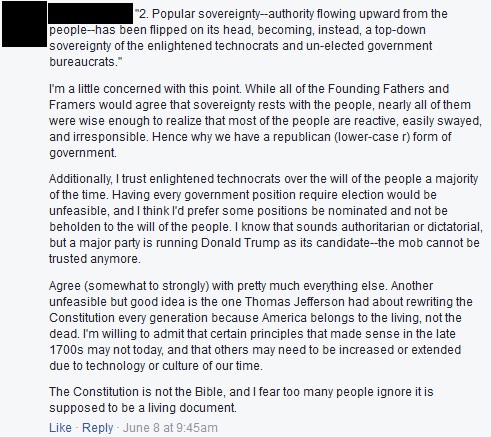
This post received quite a few comments on my Facebook page, including this one from a good friend of mine:
Now watch as I set my progressive-libertarian friend straight–respectfully.

My friend raised a very valid point:  the Framers of the Constitution were suspicious, if not outright terrified, of democracy.  Aristotle had identified democracy as one of the “bad” forms of government that came when rule by the people went bad.  The Framers had seen the consequences of a federal government that was too weak, namely the barely-contained chaos of Shays’ Rebellion in 1785.  Naturally, they wanted a government by, of, and for the people–thus the requirement that the Constitution be ratified by 3/4ths of the States in special ratifying conventions (designed to circumvent the Anti-Federalist state legislatures)–but they recognized that unbridled populism would lead to demagoguery.  It’s pedantic to say it, but Nazi Germany is the quintessential example of a desperate people granting dictatorial powers to a charismatic individual.

Pure democracy, without any checks on the majority’s power, quickly turns to one-man authoritarianism.”

The French political philosopher Montesquieu argued that the English government succeeded because it balanced monarchy, aristocracy, and democracy effectively, which further influenced the belief of the Framers that government should filter the will of the people through a complex system of checks and balances, and a rigorous, jealously-guarded separation of powers.  Thus we have such institutions as the much-maligned (but quite brilliant) Electoral College, and a Senate that is designed to act as a break on the people’s (often fickle) will.  Indeed, before it was corrupted by the XVII Amendment, the Senate was intended to represent the interests of the States themselves, rather than the will of the people, which is represented in the House of Representatives.

***

So, how did I address my friend’s concerns?  Here is my reply (with some minor edits for clarity and brevity) to my friend’s remarks, and to elaborate on the concept of “popular sovereignty”:

You are correct in noting the skepticism with which the Framers viewed unbridled democracy. There was much wisdom in their skepticism, precisely out of concern that a well-positioned demagogue could, in the right circumstances, sway the fickle populous to his whims. Pure democracy, without any checks on the majority’s power, quickly turns to one-man authoritarianism.

When I write about popular sovereignty, then, perhaps it would be more accurate to say that I mean “consent of the governed.” The people consented through our constitutional order when they elected delegates to special state ratifying conventions (circumventing the generally Anti-Federalist-controlled state legislatures). The people, then, ultimately gave consent to that government, and continue to do so through regular elections. Of course, a complex system of checks and balances tempers the will of the people (voiced primarily through the House of Representatives, which controls the power of the purse), balancing with it the will of the States, and vesting a great deal of authority to halt dubious legislation in the hands of the executive.

As for Thomas Jefferson’s love of revolutions and his proposal to rewrite the Constitution each generation, the actual Constitution provides a useful mechanism that makes such rewrites generally unnecessary, but possible: the amendment process. So far, every proposed amendment has come from the Congress, and all but two have been ratified in state legislatures (the other two were ratified, like the Constitution itself, in special state ratifying conventions). However, the Constitution provides another method–one that has yet to be used–to propose amendments: 2/3rds of the States can convene a constitutional convention to propose amendments. Texas’s current governor, Greg Abbott, is currently working on just such a convention of the States. In short, the Constitution provides us a way to change it to fit current needs without throwing out the whole document.

Of course, I would argue strenuously for an originalist reading of the Constitution and its amendments, all of which should be read in the context of those who proposed them. This still allows for changes through the amendment process, and for congressional elaboration. The Constitution is not meant to cover ever eventuality, and gives a great deal of space to Congress and (this is important and often forgotten) the States.

“It approaches something like tyranny when the President has the power to write laws (indirectly through the bureaucracy he manages) and to enforce them.” 


As for your comments about technocrats, perhaps I should clarify here, too. What I am primarily concerned about is the ability of federal agencies to write their own rules, many of which have the force of law. This practice is dangerous because most of these federal agencies operate within the executive branch and have little congressional oversight. Law-making powers are meant to rest solely within the Congress, and the job of the President is to duly enforce those acts to the best of his ability. It approaches something like tyranny when the President has the power to write laws (indirectly through the bureaucracy he manages) and to enforce them. Even scarier is the prospect that the federal bureaucracy has become so large that the President cannot exercise effective control over it, or even know what it’s doing! Many presidents–particularly our current one–have used bureaucratic rule-making to push unpopular measures without input from the people’s representatives. Congress is complicit in this, as it has delegated these powers to the executive bureaucracy, and the Supreme Court has allowed it to do so.

That being said, you are absolutely correct that there is a need for an intelligent, qualified, and motivated civil service, and, naturally, we want our dams to stay sealed tight and our roads to be paved and efficient. I would never dream of proposing we elect, say, the head of the South Carolina Department of Transportation. Here, again, the Constitution provides precedent: at the national level, the President appoints his cabinet heads, as well as federal and Supreme Court judges and justices. The Senate, however, has the responsibility of confirming these nominations, helping to prevent egregiously bad appointments.

If these proper checks and balances are maintained–if the different branches stick to their constitutional duties and limits, and if the proper relationship exists between the federal government and the several States–even a reckless executive can only do so much damage. If Congress vigorously protects its legislative prerogatives, an unqualified or authoritarian-minded president may still do some harm, but his ability to do so will be greatly diminished, and the damage can be contained.

***

This conversation went back and forth for a few more posts, which I will possibly include in future pieces.  In the interest of space–as this rumination is already quite lengthy–I will refrain from sharing them now.

However, I would ask that you permit me one parting thought:  we should be on guard against the lionization of the presidency.  The Congress–which represents the people and is, therefore the seat of popular sovereignty–may be consistently unpopular, but it is the proper branch to resist the huge expansion of the presidency.  Presidents increasingly attempt to speak for the people, but in a country that is divided between two entrenched, fundamentally incompatible political philosophies, it is nearly impossible to do so.  Indeed, attempting to do so leads to a Rousseau-style attempt to impose “the common will” on people–whether they want it or not.

Instead, let’s speak for ourselves.  We can do that through involvement in local politics, but also by communicating with our Congressmen and Senators.  Let them know that we expect Congress to reclaim its proper legislative powers from the executive bureaucracy.

Sailer on Progressive Split

Demographer and statistician Steve Sailer has a piece up at Taki’s Magazine entitled “Bernie vs. Ta-Nehisi,” detailing the major split within modern progressivism between old-school Marxists and social justice warriors.  Naturally, there’s a great deal of overlap between those groups, but Sailer looks at the major wedge between them:  their views on race.

First, let’s define our terms here:  the “old-school Marxists” like Bernie think race is a tool of the upper classes to divide the social classes.  Part of this approach, as Sailer points out, is electoral pragmatism:  align the have-nots against the haves, regardless of race, to maximize voters.  There are more non-rich people than there are rich, so promising Medicare for all and to “soak the rich” Huey Long-style can bribe voters of all stripes.

The other side—what I’ve referred to broadly referred to as the “social justice warriors”—are the ones obsessed with race, and who see racial injustice everywhere.  For Sailer, the symbolic leader of this group is racialist mediocrity Ta-Nehisi Coates, the former blogger made good because white liberals feel good about themselves when reading his rambling essays.

(I imagine it’s a sensation of righteous self-flagellation that isn’t too dangerous or life-altering for the reader:  they get the sadistic satisfaction of acknowledging their own implicit bias, racism, and privilege, while feeling like they’re making a difference because they breathlessly show their support for an erudite-sounding black guy.  But I digress.)

The former group wants to buy off all voters with as many publicly-funded goodies as possible; the latter wants to buy off minority voters with reparations and other publicly-funded goodies, all while chastising white voters (and gleefully awaiting the approaching day that whites are a minority, too).

Sailer, who refers to Coates as “TNC,” sums this division up succinctly:

The war between Bernie and TNC pits the old Marx-influenced left, with its hardheaded obsession with class, power, and money, against the new Coatesian left, which cares more about whether Marvel’s next movie features a black, female, or nonbinary superhero.

The rest of Sailer’s essay focuses on the obsession with racial identity and representation that dominates “Coatesian left.”  It’s not enough that everyone, black or white, share in Sanders’s redistributionist schemes; rather, blacks specifically must benefit at the expense of whites as a form of payback for slavery, alleged “redlining” in during the Depression, and “institutional racism.”

Further, the Coatesian/social justice Left demands “representation,” because a black superhero will magically improve the lot of black Americans.  Another Sailer quotation:

Coates’ notion that mass entertainment culture has been devoted to stereotyping black people as undeserving is, of course, absurd. But it helps explain some of his popularity in an era in which it is considered sophisticated to argue that Will Smith shouldn’t be cast as Serena and Venus Williams’ tennis dad because he’s not as dark-skinned as Idris Elba (while others argue that Smith, unlike Elba, deserves the role because he is an ADOS: American Descendant of Slaves).

Can you imagine what Socialist Senator Sanders thinks of these energies devoted to which millionaire should get richer?

Unlike Bernie, Coates is concerned with the old-fashioned comic-book virtues that appeal to 9-year-old boys: honor, status, representation, heredity, antiquity, and vengeance.

Revenge is a dish best served cold.  Maybe that’s why so many prominent Democratic presidential hopefuls are reheating such a tired idea.

Neither Sanders-style Marxism or Coatesian racial grievance will repair the United States’s fractured culture, but it will be interesting to see which side wins the Left.  Demographics suggest the latter will prevail over time.

Regardless, at bottom, both of these movements are redistributionist, and seek to plunder accumulated wealth and productivity to unprecedented degrees.  One might be traditional Marxism and the other Cultural Marxism—but they’re both Marxism.

Conservative Divestment

Conservative readers are likely familiar with the odious BDS Movement—the movement to “Boycott, Divest, and Sanction” Israel because of its alleged “crimes” against legions of peace-loving Palestinian Arabs (oy vey).  Participants in this movement are encouraged to pull their money out of Israeli companies (or companies that do business with Israel), and to refuse to buy Israeli products, thereby pressuring Israel to be even more tolerant (it’s quite ludicrous—I’d wager an Arab Muslim in the Middle East would enjoy greater liberty to exercise his religion in Israel than anywhere else in the region).

Charlie Kirk of Turning Point USA has a video for Prager University called “DivestU” in which he argues for another kind of divestment:  denying American colleges and universities donations.

It’s a fairly commonsensical idea:  conservatives are well aware of the corrupting influence of Cultural Marxism on university faculty, and the persistent indoctrination of vulnerable young people at a particularly impressionable moment in their lives.  We’ve all known the friend or relative who came back after a semester of college convinced “xyr” knows everything about the world, possessing a sneering, elitist attitude against everything good and decent (“hugs are an oppressive form of non-consensual affection!  Smash the Patriarchy!”).  Why keep feeding the beast?

It makes sense that we pay tuition—for better or worse (and mostly for the worst), we need that catskin to land a job—but Kirk points out that Americans are voluntarily donating money to colleges, institutions already bloated with federal loan dollars.

Kirk cites that American colleges and universities received $44 billion in donations in 2017.  Scott Rasmussen’s Number of the Day for 15 February 2019 notes that in 2018, colleges and universities received $46.73 billion, a whopping $1.4 billion of which went to Harvard University.  Harvard already has an endowment of over $37 billion (the benefit of being an institution for nearly 400 years:  compounding interest has lots of time to work its magic).

Indeed, Rasmussen writes that “while there are more than 4,000 colleges in the United States, 28% of that money went to just 20 schools. Those 20 universities serve 1.6% of the total student population.”  Those schools are not conservative bastions like Hillsdale College, but often the epicenter of Ivy League elitism and disdain for traditional values.

As Kirk points out in his video, even if you donate money to a specific school within a college—say, the medical school—money is fungible.  You might think you’re helping train future doctors, but you could easily be funding gender reassignment surgery (read: butchery and mutilation), or an Assistant Vice Dean of Diversity, Inclusion, and Homeopathic Cultural Healing.  Bah!

Education is a mess in the United States.  Pouring more money into institutions that are anathema to our values and hostile to our way of life is insane and masochistic.

As such, I’d encourage you to avoid donating to colleges and universities.  Put that money to use in better ways, like retirement savings.

Lazy Sunday IV: Christianity

Ah, yes, the sweet smell of at-home, high-speed Internet access in the morning.  It’s good to be back online.

For this week’s edition of “Lazy Sunday,” I thought I’d look back at some posts I’ve written about or related to the Christian faith.  For those of you that “choose to worship God in my own way” by staying home and watching televangelists in your underwear, these throwbacks are, perhaps, a timely addition to your Sunday morning.

Without further ado, here are some of my Christianity-related posts from the past few months:

    • The Influence of Christianity on America’s Founding” – I featured this piece in “Lazy Sunday III – Historical Moments,” so you can read a more thorough synopsis of it there.  After giving this talk, I walked outside to find it snowing.  Snow in December in South Carolina:  a miracle!
    • ‘Silent Night’ turns 200” – a short Christmas post, on the occasion of the 200th anniversary of “Silent Night.”  Next to “O, Holy Night”—objectively the best Christmas song ever written—“Silent Night” is one of my favorites.  The story behind it is almost as beautiful as the song itself.
    • How the Reformation Shaped the World” – the title for this post comes from a Prager University video of the same name.  The post explores—in a very broad way—the ripple effects of Martin Luther’s courageous act of faith.  The piece is a short introduction to a very complex idea; feel free to leave your thoughts below or on the original post.
    • Nehemiah and National Renewal“; “Nehemiah Follow-Up” – these companion posts deal with the Book of Nehemiah, and how the rebuilding of the wall around Jerusalem was a symbolic and practical recommitment to God and restoration of Israelite national identity.  The parallels to President Trump are a bit on the nose, but obvious.
    • The Desperate Search for Meaning” – this piece came about as many of my posts do:  I read something that floated through my transom, and thought I’d write about it.  Essentially, an online, New Age fraud was selling cheap spirituality, and was herself a troubled, possessive individual.  The real crux was how she pulled susceptible, gullible women into her orbit, women desperately searching for some meaning in their lives.  There are all manner of online charlatans who try to fill men and women’s “God-hole.”

So, enjoy your churchy Lazy Sunday with these timeless classics.

Other Lazy Sunday posts:

1.) Lazy Sunday – APR Pieces

2.) Lazy Sunday II: Lincoln Posts

3.) Lazy Sunday III: Historical Moments

You Can’t Cuck the Tuck

Tucker Carlson is amazing.  He says the true things on national, primetime television that the folks on the Dissident Right can only whisper on blogs.

As I alluded to Monday, Carlson made some cheeky remarks over a decade ago on a call-in shock jock radio show, Bubba the Love Sponge Show.  The Left-wing website Media Matters compiled his most controversial statements into an audio compilation, in which Carlson made rhetorically-bombastic-but-mostly-accurate observations about all kinds of hot-button social and gender topics.

Rather than issue a grovelling apology, Carlson challenged anyone who took issue with his comments to come onto his show and debate him—what we used to do in the United States when we disagreed with someone.

Last night, Carlson opened his hit show on Fox News with a blistering monologue, calling out Media Matters and its tawdry relationship with other mainstream media outlets and the Democratic Party.  Carlson called CNN anchor Brian Stelter the “house eunuch at CNN.”

It just goes to show that you can’t cuck the Tuck.  Hopefully Fox News backs up their host.  It’s also interesting seeing how based Tucker Carlson was as far back as 2006, which suggests he’s sincere in his populist peccadilloes.

Lazy Sunday III: Historical Moments

My Internet is out at the house, and the technician won’t be out until Friday, so posting this week may be a bit dicey and inconsistent.  As a result, I’m phoning it once again this Sunday—the perfect way to start (or end, depending on your perspective) the week.

Brace yourself for “Lazy Sunday III:  Historical Moments” (read “Lazy Sunday” and “Lazy Sunday II“).  These posts are derived from a series of short talks I gave to the Florence County (SC) GOP in 2018.  They are presented in chronological order.

1.) “The Formation of the Republican Party” – this post was featured in “Lazy Sunday II:  Lincoln Posts,” as is the second piece in this list (sorry for the redundant recycling).  It’s a quick overview of the origins of the Republican Party in the 1850s.

2.) “Lincoln and Education” – another post from “Lazy Sunday II,” this Historical Moment explores Lincoln’s education, as well as his views on the subject.

3.) “Veterans’ Day 2018, Commemoration of the Great War, and Poppies” – like President George W. Bush, I am not one of the great orators of our time, but when I delivered this Historical Moment, it was probably the most powerful oratorical presentations I’ve ever given.  That is not due in any way to my own speaking abilities (although I do possess a rich, chocolate-y baritone when speaking), but to the emotional power of John McCrae’s “In Flanders Field.”  It was an arresting moment when I delivered the lines of that simple, sweet poem.

4.) “The Influence of Christianity on America’s Founding” – this talk was a longer-form version the usual Historical Moments, which are usually about five minutes long.  I was asked to give a slightly longer speech about the influence of Christianity on the founding of our nation at a joint FCGOP-Darling County GOP Christmas dinner.  It’s a complex topic, but, yes, Christianity was and is key to the American experiment in self-government.

So there you have it—more TPP greatest hits.  Enjoy, and have a restful Sunday!


Totalitarian Leftism Strikes Back

Readers versed in the recent skirmishes of the Culture Wars may have heard about the Sad Puppies / Rabid Puppies campaign to win back the Hugo Awards—science-fiction’s biggest literary awards—from entrenched social justice Leftists.  photog at Orion’s Cold Fire has a brief piece up, linking to a piece on The Federalist about the recent controversy.

The quick takeaway is as follows:  having destroyed the Hugo Awards rather than let independent, apolitical authors get a fair shake, SJWs are now targeting a group called 20Booksto50K, an online community dedicated to getting independent authors published.  It’s an organization that is entirely harmless, from what I can tell on the surface, but it’s a threat to the SJW-dominated publishing industry.

The Left is all about dominating the institutions.  If they can’t control an institution, they’ll destroy it.  Independent organizations are a huge threat to the Left’s Cultural Marxism, as the existence of alternatives inevitably loosens the Left’s grip on power.  People aren’t allowed to have alternatives; they must accept and embrace Leftist ideology and goals, whatever they happen to be at the moment.

Not surprisingly, sci-fi writers don’t like that they can only win major awards if their stories don’t involve convoluted, high-tech battles over gender nonconformity or intergalactic diversity training.

The major figure in this field, from the little I know about it, is dissident writer Vox Day, who has created his own publishing house and distribution platform.  Vox Day anticipated deplatforming from Amazon, and was prescient in creating his own means to distribute his work to fans.

The Internet was a bastion of freedom for conservatives and dissidents of all stripes.  Now the tech giants are clamping down on the Right, and even the heretofore apolitical.  Remember:  merely being apolitical is, to the totalitarian Left, the same as being against the Left.

Like the Borg of Star Trek, all will be assimilated into the Left’s Marxist ideology.

TBT: Transformers 2: Conservatives in Disguise?

For this week’s #TBT feature, I’m digging back, for the second time, to a very old post from 2009.  It’s about—of all things—the second movie in the modern Transformers franchise.  Yeesh.

Anyway, the point of the essay—and its cringe-inducing navel-gazing—is that a government bean-counter does everything he can to wield his meager bureaucratic power like a little dictator, in the process undermining the unsteady alliance between the good Autobots and the US military.

It reminds me of Ghostbusters, when the functionary from the Environmental Protection Agency comes and shuts down the containment unit—the one holding all the captured ghosts—because it’s using too much energy and might represent an environmental threat.

Think about that for a minute, and reflect on how awesome the 1980s were—the Zeitgeist was such that the minor villain was guy who worked for the EPA.  Even left-leaning Hollywood razzed busy-body government employees during the Reagan era.

Regardless, enjoy this blast from the past, an example of a trend in Conservatism, Inc. of reading into films a conservatism message (except I was probably right on this one):

Earlier today I saw Michael Bay‘s highly-anticipated (and critically-panned) Transformers 2: Revenge of the Fallen. Prior to seeing the movie, I had no intention of writing a blog about it. Although films are occasional inspirations for my essays (see my article about the lack of strong African-American fathers, which I wrote after seeing Boyz n the Hood), I never imagined that Transformers 2 would be the subject of one of my blog entries because I don’t write straight-up reviews. Honestly, I figured it would be exactly what it is: a steady stream of explosions, robots, and mass destruction.

What I didn’t count on was that it would only be what I expected 99% of the time. That other 1% is the focus of this essay. Like the first Transformers film, Transformers 2 spent a great deal of time covering the U.S. military and its interactions with and against the various transforming automatons. Generally speaking, the soldiers are characterized as normal and basically decent–they want to do what is best for their country and they want to protect the weak and innocent, but they will follow the civilian authority of the Constitution.
In Transformers 2, however, I noticed a more overt, though still very, very subtle, endorsement of conservative politics–or, at the very least, a critique of modern liberalism. I don’t want to read too much into this (well, actually, I do), but there are several moments during the movie when the misinformed meddler, the entity trying to put the kibosh on the Autobot-military alliance, is a mealy-mouthed government bean-counter who sees the Autobots as an alien menace that constitutes a risk to national security. Now, sure, action movies are overflowing with literal-minded government stooges and opportunistic politicians who are always putting up a wall of red tape that is harder to break than the concrete bunker our hero just crashed through on his motorcycle. The key difference in Transformers 2, however, is that the government stooge in question is acting under direct orders from the president, who is explicitly identified as… Barack Obama (one news report states that “President Obama has been relocated” to a bunker somewhere in the Midwest).
Not evidence enough? At one point, this pencil-pusher makes a point straight out of the Obama foreign policy playbook: let’s try to negotiate with the bad guys. Maybe we can talk out our differences and everyone can live in peace. When the bureaucratic boob said that, I almost fell out of my seat. I don’t know if Michael Bay or the writers of Transformers 2 were intentionally making this point, but for this chubby conservative the implications were loud and clear: Obama and other liberals who demand negotiations before resorting to force against overtly hostile, dangerous opponents are fatally off base and out-of-touch. The president’s puppet makes the point that the United States should not be involved in the civil war of an alien race in the first place, but that doesn’t change the fact that it is anyway. The United States, the filmmakers seem to be suggesting, has a responsibility to aid the Autobots against the new Decepticon menace, whether it likes that obligation or not, and the proposed policies of Obama and other liberals in foreign relations are potentially devastating.
Besides a subtle endorsement of a neoconservative foreign policy–or at least a more realistic approach to foreign threats–Transformers 2 is, as I have mentioned, heavily pro-military. The film depicts soldiers as law- and order-abiding citizens who, even if they don’t like it, abide by civilian authority. This is a refreshing change from the usual Hollywood fare, which casts soldiers in the light of threats to democracy and as right-wing gun nuts who want nothing more than to seize control of the government themselves. While we should have a healthy wariness of the military as a potentially repressive arm of the federal government–a wariness that dates back to colonial America and that is most evident in the writings of Thomas JeffersonTransformers 2 makes it clear that the U.S. military is a military of dedicated civilian volunteers who value and fight for freedom. They are not professionals who ride roughshod over the freedoms of others, be they Americans or foreigners. In fact, the U.S. military works closely with several Middle Eastern governments in the film, including the Egyptian and Jordanian militaries. In one scene, when a Jordanian helicopter is grounded by a Decepticon, American soldiers aid the fallen foreigners. This is not the unilateral, oppressive, quagmired military we hear so much about in the media; this is a dynamic, humane force made up of regular, freedom-loving Americans.
This brings me to one final point, a point I’ve been mulling over for awhile. We are constantly told that wars are started by the elite and fought by the poor; that wars are little more than opportunistic struggles or, even worse, the effect of some perceived slight or random occurrence; that war is rarely right or even necessary. In different times and in different places, many of these assumptions were true. Wars in the past were started by absolute monarchs or power-hungry tyrants, while they were fought by loyal vassals or downtrodden peasants.
In the United States, however, this is not the case. We live in a society where the people, at least in theory and, cynics aside, very much in practice, have a say in the functioning of government. Whatever slogan-spouting liberals will tell you, their bumper-sticker philosophy is severely flawed and misinformed. If the United States goes to war against a hostile power or terrorist group, it is because the people have given their approval. Foreign policy is, admittedly, concentrated in the executive branch of the government, which means that the president and the Secretary of State have a great deal of influence in deciding its direction. Any president hoping to keep his office, however, is going to be careful in how he deals with foreign policy.
Therefore, the traditional criticisms levelled against war are at best incomplete and at worst obsolete, at least when applied to the United States. There is still a great deal of debate about whether or not the United States should be the world’s police officer; regardless, wars are not foisted on unwitting dupes by a greedy elite in America.
This claim is a bold one, but I stand by it. The wars in Iraq and Afghanistan would not have been fought and would not have endured so long without significant support from the American people. Now that support is beginning to wane, serious questions are being asked about America’s future role in those countries, but we are seeing a huge amount of popular outpouring for the people of Iran, who are currently struggling against their sham of a government. President Obama’s “let’s-talk-it-out” approach to foreign policy is not enough when facing a regime of authoritarian thugs.

Academic Leftism’s Sour Grapes

I received the following piece from a colleague at one of the schools where I teach.  The piece, entitled “The Academy is Unstable and Degrading. Historians Should Take over the Government Instead,” is indicative of how utterly clueless Leftist intellectuals are to their own dominance of not only academia, but the culture and government as well.

The author, Dr. Daniel Bessner, is an assistant professor of American foreign policy at the University of Washington, and, as he makes clear from the piece, an avowed socialist.  Indeed, the crux of the op-ed is as follows:  the academy is crumbling, as tenure-track jobs disappear (and, presumably, as Americans are wising up to its intense Leftist slant and poor track record in re: the job market), meaning Leftist “public intellectuals” need to find new worlds to conquer.  Dr. Bessner proposes the government.

In his diagnosis of the academy’s ills, he argues that the Left has focused too much on taking over the English Department (it’s at least refreshing to read a Leftist acknowledge that it was a self-conscious, deliberate march through the institutions), and not enough taking over the State Department, as it were.

He then proceeds to detail how libertarians moved from the fringes of political opinion to their relative ubiquity today, discussing the influence of Murray Rothbard and the Left’s favorite billionaire boogiemen, the Koch Brothers.

What’s rich about all this hand-wringing is the utter lack of self-awareness.  What about the legions of left-leaning banksters and billionaires pouring money into progressive organizations and schemes?  George Soros is our “boogieman” of the Left, but consider the entire entertainment, corporate (especially “Big Tech“), and academic apparatuses that are arrayed in favor of progressivism’s cause du jour.

The Left has dominated the culture from multiple perches for decades.  If the academy is falling into ruinous disrepair, it’s because Leftists have been running it since the 1960s.  They have only themselves to blame for the drying up of tenure-track gigs, rising tuition, and useless “assistant vice deans of diversity, inclusions, and LGBTQ2+MMORPG acceptance” positions.

One final note:  if President Trump were the dictator these Leftists soy boys make him out to be, they wouldn’t be identifying openly as socialists, nor would they be espousing a socialist agenda—as Dr. Bessner does in this piece—openly online.  That Dr. Bessner does so also demonstrates how successful his comrades have been at normalizing a fundamentally ruinous ideology in the United States (see also:  crazy-eyed Congressbabe Alexandria Ocasio-Cortez, poster-child for over-credentialed, arrogant college grads who base their entire lives off what they learned in an English 101 survey course from an angry, radical adjunct).

God help us all if Dr. Bessner and his ilk insinuate themselves further into the government.  Drain the Swamp, President Trump!

Sanctimonious Leftism

We’re all familiar with the lunacy of the Progressive Left, and its tendency toward insane and downright evil positions.  Issues like abortion (now, apparently, including babies that survive attempted murder against them) highlight the fundamentally different philosophical foundations of Progressivism and traditionalism.

That said, one of the more annoying aspects of modern Leftism is its sanctimonious virtue-signalling, which is part of the appeal of Progressivism:  you get “virtue” on the cheap, without any real sacrifice.

Case in point:  a letter to The Virginia Pilot about the Ralph Northam non-troversy.  Readers will know that I don’t much care about what costume Governor Northam wore three decades ago, but I do care that he advocates for infanticide both in and out of the womb.

But the letter in question is a prime of example of Leftist sanctimony in action, full of broad, vapory statements about how Northam can work towards reconciliation.  The letter is from Rich Harwood, who runs a policy think-tank of some kind called The Harwood Institute.

I only know about the Harwood Institute because, somehow, one of my e-mail addresses for one of the schools where I teach has ended up on their mailing list.  For about a year I thought it was the “Hardwood Institute,” and they were trying to sell me lumber.

Regardless, Rich Harwood, the namesake founder of this fairly bland, center-Left organization wrote a letter entitled “A suggested path toward reconciliation,” and blasted an abbreviated version out to the Harwood Institute’s e-mail list.

The entire letter is an exercise if blathering sanctimony.  He recommends five steps for Governor Northam, and how he can become, chillingly, an “instrument for society.”  One of those steps is—no joke—to “[m]ake room for deep sorrow.”

I think I just threw up in my mouth a little bit.

Here is an extended excerpt to give you the full flavor of Harwood’s virtue-signalling:

[Governor Northam] faces a fundamental choice: Is his reconciliation tour about his own political survival, or can he become an instrument of society? 

Choosing the latter requires him to exercise a ruthless humility, where he recognizes his own role is limited. Racial reconciliation cannot be led by a single leader, nor orchestrated by an elected official. It will come through a whole host of big and small actions, emerging over time, that include overlapping conversations, popular culture and music, the writing of new books and the illumination of painful history. 

So the governor must ask: What is my contribution in this moment? What can I do? What does it mean for me to be an instrument of society? ….

There may be those who say that Northam has made it past the worst of this crisis and that he should just hunker down and ride out the last of it. Perhaps that’s possible. But, for him, is that good enough? Can he live with that? Will that help him fulfill his personal calling, and more importantly gain a sense of redemption from Virginians? 

I urge Northam to choose the path of becoming an instrument of society.

Amid all of this feel-good crap is this phrase “instrument of society.”  That’s a terrifying concept, and one that is indicative of the totalitarian Left.  No one can just be—every individual must subsume himself into the mass.

Northam may have been an idiot thirty years ago; now, he’s a useful tool for the Left, except that the Left cannot forgive what may have been acceptable under yesterday’s morality.  For the Left, there IS no yesterday.  Everything that is bad now has always been bad, which is why their positions shift so constantly (remember when Barack Obama and Hillary Clinton were opposed to gay marriage and supported border control?).

Harwood, too, is a useless tool for the Left, and he probably doesn’t even realize it.  He’s no-doubt marinated his entire life in a cloistered, East Coast liberalism that arrogantly believes it holds all the answers—if only we can get those rubes in flyover country to come to heel.

Racial issues in America are overblown and tiresome.  Civil rights have been secured for virtually every race and deviant lifestyle choice conceivable.  Instead of focusing on these silly side issues, let’s try to stop the mass slaughter of innocents.  That’s an area where we can—and should—make “room for deep sorrow.”